Introduction
Dementia is a progressive disorder leaving individuals less able to care for themselves, more prone to emotional and behavioral problems and more likely to have poor physical health (MacKnight and Rockwood, Reference MacKnight and Rockwood2001; Burns et al., Reference Burns, O'Brien and Ames2005; Alzheimer's Society, 2014). With population aging dementia represents a major public health and care challenge (Ferri et al., Reference Ferri, Prince, Brayne, Brodaty, Fratiglioni and Ganguli2005, Alzheimer's Society, 2014). About 60% of people with dementia in the United Kingdom live in private households (Knapp et al., Reference Knapp2007). The National Dementia Strategy in England identified helping people to live well with dementia as a priority and acknowledged that non-medical aspects of care influence the experience of patients and carers and the economics of care. For them to live well at home evidence is required about the most appropriate and effective forms of support for them and their carer (Department of Health, 2009). Though little is known about the provision, delivery or effectiveness of home support services, it is likely that there is variation across the country because NHS services are designed to promote uniformity while diversity is characteristic of local authorities (Wistow, Reference Wistow2012). There has been limited research into the effectiveness of psychosocial and technology-based interventions and different models of home support for people with late stage dementia (Dawson et al., Reference Dawson, Bowes, Kelly, Velzke and Ward2015; Low and Fletcher, Reference Low and Fletcher2015; Clarkson et al., submitted). This study seeks to fill this gap.
Investigating home support for people with dementia
Research in home support for people with dementia raises a number of complex issues. These include the interweaving of formal and informal care, identifying the views of people with dementia themselves, the use of mixed methods, both qualitative and quantitative, and measurement of outcomes and costs. These are considered briefly below.
People with dementia often rely on a combination of formal support by health and social care services and informal support from family and friends. More precise descriptions of the components employed (“who did what, where and how”) are needed to evaluate their effectiveness not just in terms of cost but measures of quality of life (Clarkson et al., submitted). As carers provide an essential link between services and the person being cared for, it is important to achieve the right balance between both formal and informal care (Noelker and Bass, Reference Noelker and Bass1989; Zarit et al., Reference Zarit, Gaugler and Jarrott1999; Carpentier and Grenier, Reference Carpentier and Grenier2012). Networks of support are important in identifying risk of entry into long-term care (Bowling, Reference Bowling1994). Five network types of informal support from family, friends, neighbors, and the community have been identified (Wenger, Reference Wenger1991; Wenger and Tucker, Reference Wenger and Tucker2002). To be effective in reducing carer burden, support must be appropriate, of sufficient intensity, and target the behaviors and aspects carers find most challenging (Zarit et al., Reference Zarit, Gaugler and Jarrott1999; Venables et al., Reference Venables, Reilly, Challis, Hughes and Abendstern2006; Challis et al., Reference Challis, Sutcliffe, Hughes, von Abendorff, Brown and Chesterman2016).
Eliciting the views of older people in later stage dementia in this process constitutes a challenge. For some their level of impairment means that they lack the capacity to participate in interviews. However, research has demonstrated that many can answer questions about their quality of life, even in the presence of significant cognitive deficits (Mozley et al., Reference Mozley1999; Hoe et al., Reference Hoe, Katona, Roch and Livingston2005; Moyle, Reference Moyle2010). Where this is not possible, complementary proxy measures to capture the quality of life of people with dementia have shown acceptable psychometric properties (Smith et al., Reference Smith2005; Mulhern et al., Reference Mulhern2013). It is important to include these to capture the circumstances of participants, who would otherwise have been unable to respond, while acknowledging their limitations (Magaziner, Reference Magaziner1997; Selai and Trimble, Reference Selai and Trimble1999; Bryan et al., Reference Bryan, Hardyman, Bentham, Buckley and Laight2005).
The complexity of dementia research requires a mixed methods approach, synthesizing both quantitative and qualitative data (Pritchard and Dewing, Reference Pritchard and Dewing2001; Johnson et al., Reference Johnson, Onwuegbuzie and Turner2007; Moyle, Reference Moyle2010; Robinson et al., Reference Robinson2011). By combining the two in a single interview, an embedded ethnographic approach provides a “sociological lens” to explore the pattern of communications between the person with dementia and their carer while completing standard measures (Poland and Birt, Reference Poland and Birt2016 p.771). Elsewhere this has been described as “ethnography-understood-as-fieldwork” (Brewer, Reference Brewer2000 p.17) based on the premise that embedded research is founded on the principles of immersion fieldwork (Lewis and Russell, Reference Lewis and Russell2011). In this study this is undertaken within a more structured data collection.
Objective measurement of outcomes for people with late stage dementia living at home and their carers is complex. However, people with dementia prefer care at home (Challis et al., Reference Challis, Sutcliffe, Hughes, von Abendorff, Brown and Chesterman2016). Outcomes for carers seek to measure burden and stress but may not detect change (Zarit et al., Reference Zarit, Stephens, Townsend and Greene1998; Zarit and Leitsch, Reference Zarit and Leitsch2001). Measures of cost and cost-effectiveness require data about receipt of health and social care services (Challis et al., Reference Challis, Sutcliffe, Hughes, von Abendorff, Brown and Chesterman2016). It is also important to collect data relating to the adequacy of services and areas of unmet need (Challis and Davies, Reference Challis and Davies1986).
Aims of study
This study forms part of a wider research program: “Effective Home Support in Dementia Care: Components, Impacts and Costs of Tertiary Prevention.” It comprises nine distinct but interrelated projects funded through a National Institute for Health Research (NIHR) Program Grant for Applied Research (DTC-RP-PG-0311-12003). The aim of this specific project is to explore the presence and effect of different approaches to home support for people in later stage dementia within selected geographically distinct areas in England. Detailed research questions are as follows:
-
1. What approaches do home care agencies and other professional staff use to support people in later stage dementia and their carers at home?
-
2. What are the effects of these different approaches on outcomes for people with later stage dementia and their carers?
-
3. What is the cost-effectiveness of these different approaches to providing home support?
By home support we mean formal support from services, which complements informal support provided by family and friends (described as carers). Categorized according to its expressed purpose, it includes: supportive emotional and practical help; education, including skills training in managing behavior; and more structured therapeutic interventions, such as counseling.
Methods
This is a prospective observational study using mixed methods (Berger et al., Reference Berger, Dreyer, Anderson, Towse, Sedrakyan and Normand2012) to study outcomes for older people with dementia and their carers after receiving different components of home support. It measures the relative effectiveness of different approaches to providing support at home. Interviews will collect both quantitative and qualitative data, with the latter exploring the perceptions of older people and carers. Participants (people with dementia and their carers) will be interviewed at home on two occasions, six months apart. The same follow-up period has detected change in similar studies (Challis et al., Reference Challis2004; Clarkson et al., Reference Clarkson, Brand, Hughes and Challis2011). Data will be collected primarily from the carer but also from the person with dementia, wherever possible. The first interview will occur at a common baseline, when participants have received an assessment or formal review of their care needs. The second interview will occur when they have had services for six months following this assessment in their current living environment. The same interview schedule will be administered at each time point to facilitate comparison. Domicile of the person with dementia 12 months after the baseline interview will be collected to estimate avoidance of and time to admission to hospital or care home.
Sample
To cover the different types of support available across the country, a two stage process will be used to recruit participants, defined as people with dementia and their carers. First, sites (geographical areas) will be selected from two national surveys undertaken within the program (PSSRU, 2015). Sites will be stratified into three groups (low 1–8, medium 9–10 and high 11 or more) using sixteen indicators reflecting differences in the range of services available to older people with dementia living at home. Second, at least ten participants will be recruited from each of the following services within each geographical area: home care provider; respite services (day or overnight); community mental health teams; and local carer support services. To this end, each service will be asked to identify from their records a cohort of eligible people in receipt of home support.
A completed sample size of 310 will provide 80% power to detect a small effect size (Cohen's d = 0.3) at a significance level of 5%. This calculation is based on the regression model which will be use to explore relationships between covariates and outcomes. To take account of attrition between the two surveys, the target sample size at baseline interview is 400.
Inclusion criteria
The target population is people in the later stages of dementia, receiving home support. The inclusion criteria are as follows:
-
1. Aged 60 years and over.
-
2. Have an informal carer (who they may or may not live with).
-
3. Have received an assessment or review of their care needs within the last three months by a professional acting as a care manager.
-
4. Considered by professionals to be in the later stages of dementia.
-
5. Receiving support at home, including supported accommodation (where home care may be part of an integrated care package).
-
6. Resident within one of the ten sampled geographical areas.
Referrers within health and social care agencies will be advised to use an initial screening question to identify people who are “very confused” based on earlier research to guide the identification of people with later stage dementia (Levin et al., Reference Levin, Sinclair and Gorbach1989).
Study measures
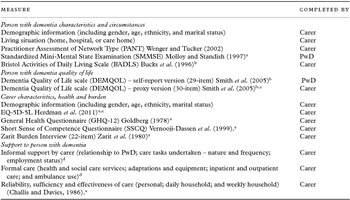
Table 1 summarizes study measures and provides details of whether they will be completed by the person with dementia or the carer (with the latter sometimes completing a proxy measure on behalf of the former). Data will be collected at two time points, baseline (week 0) and follow-up (week 26), thus measuring change over time. Most are standardized instruments, with demonstrated validity and reliability for people with dementia in the community. Measures fall into three broad groups, those relating to the person with dementia's characteristics and circumstances; carer characteristics, health and burden; and support to the person with dementia. Data about the support received by people with dementia and their carers will be used in three ways: to identify components of home support; to explore the relationship with outcomes (Challis et al., Reference Challis, Sutcliffe, Hughes, von Abendorff, Brown and Chesterman2016); and to analyze the cost-effectiveness of different approaches to home support (Drummond et al., Reference Drummond, Sculpher, Torrance, O'Brien and Stoddart2005).
Study measures

PwD=person with dementia.
a Secondary outcome.
b Primary outcome.
c For cost-effectiveness analysis.
d Adapted from Beecham and Knapp (Reference Beecham, Knapp, Thornicroft, Brewin and Wing1992).
Qualitative component
Ethnographic data will be collected unobtrusively within a more structured research process at follow-up interviews with a sub-sample of participants (people with dementia and carers) (Lewis and Russell, Reference Lewis and Russell2011). This sub-sample will be selected by the Practitioner Assessment of Network Type (PANT) (Wenger, Reference Wenger1991) completed at first interview. For these participants, the structured interviews will be audio-recorded to capture values and experiences around the quantitative component of the study and provide richer contextual and conversational data. A qualitative approach is viewed as a particularly useful means of gaining the perspective of those, who are severely cognitively impaired (Cahill and Diaz-Ponce, Reference Cahill and Diaz-Ponce2011). The sample size for analysis will be determined according to both pragmatic criteria (resources available, time for analysis) and by data saturation (O'Reilly and Parker, Reference O'Reilly and Parker2013) and is estimated at 30 interviews.
Data security
Paper questionnaires will be completed by interviewers, stored securely and entered into MACRO4, a secure data capture facility (InferMed Limited, 2015). Participant identification numbers will link data from each interview and ensure that the participant remains anonymous in the dataset. Participants’ contact details, needed to invite them to take part in interviews, will be kept separately on a password-protected computer. All personally identifiable information from transcripts of qualitative interviews will be removed. Data will be stored securely for ten years following the completion of the study.
Ethical considerations
Ethical approval has been granted by the National Research Ethics Service (NRES) (15/NW/0822). The interview schedule was designed to minimize participant burden. Participants will be assured that their participation, non-participation, or ending their participation mid-interview will not influence their care arrangements.
Informed consent will be sought from participants before starting the research. Staff working within agencies will introduce the study to participants, provide them with an information sheet, and gain their consent to be contacted by a member of the research team. Before conducting the interview, the researcher will explain the study to participants and obtain their formal consent. Researchers will decide upon the capacity of people with dementia to consent in accordance with the Mental Capacity Act 2005 (House of Commons, 2005). It will be assumed that people with dementia can consent to participate unless there is evidence to the contrary. This decision will be made in conjunction with the carer who will be asked for their opinion on whether or not the person with dementia would want to be involved. If they decide the person with dementia would have no objection to taking part the carer will provide written consent on their behalf.
Governance arrangements
An Observational Study Group to oversee and resolve operational issues; a Programme Steering Committee to oversee the entire programme; a Methodology Group responsible for the strategic development and review of methodology and oversight of data collection and analysis for this observational study; and a Public, Patient, and Carer Reference Group for the entire program, notably to review the interview schedules for this study, have been established.
Data analysis
Data from all participants will be pooled for the purpose of analysis.
Exploratory analysis: descriptive statistics (means, standard deviations for continuous variables and frequencies, and percentages for categorical variables) will be calculated for demographic, service receipt and outcome variables to check them before statistical modeling, also bivariate associations amongst variables. The distributions of the outcome measures will be reviewed for normality, and floor and ceiling effects.
Identification of approaches to home care support: To address research question 1, service receipt information will be analyzed to describe naturally occurring packages of care received by people with dementia and their carers. Data reduction techniques, factor analysis and cluster analysis (Kline, Reference Kline1994; Rogerson, Reference Rogerson and Rogerson2001), will be used.
Outcome analyses: To address research question 2, multiple regression will be used to test the relationship between outcome measures and covariates. Within these models the relative effectiveness of each approach to home support will be estimated. To minimize the risk of confounding, that is the systematic error that occurs when there is a failure to account for variables associated with both receipt of a particular care package and the outcomes under study (Trojano et al., Reference Trojano, Pellegrini, Paolicelli, Fuiani and Di Renzo2009), propensity scores will be used. These reduce the effects of baseline characteristics on receipt of different care packages to one composite measure and facilitate adjustment for this in multivariate models (Austin, Reference Austin2011).
Cost-effectiveness analysis: To address research question 3, a cost-effectiveness analysis of different approaches to home support will be undertaken. National unit costs for specific items of service will be used to estimate the costs of services used. For the primary analysis QALYs will be estimated from the EQ-5D-5L using the recently published value set (Devlin et al., Reference Devlin, Shah, Feng, Mulhern and van Hout2016). QALYs gained between baseline and follow-up interview (26 weeks) will be estimated as the number of weeks multiplied by the utility of observed survival. Covariates which may affect the costs or outcomes will be derived from relevant published economic evaluations and discussion with the program research team (Davies et al., Reference Davies2008). Costs and QALYs will be bootstrapped to generate pairs of net costs and QALYs. These will then be used to estimate the probability that a model of care may be cost-effective. Cost-effectiveness planes and cost effectiveness acceptability curves (CEACs) will be plotted. Net benefit statistics will be estimated – these approaches require that net QALYs are revalued using a monetary value that reflects decision makers willingness to pay to gain (WTPT) 1 QALY. In line with current estimates of the WTPT implicit in The National Institute for Health and Care Excellence decisions we will use the range of £0– £20k (Raftery, Reference Raftery2014; Claxton et al., Reference Claxton2015). CEACs summarize uncertainty associated with ICERs (Fenwick et al., Reference Fenwick, Claxton and Sculpher2001) in the form of the probability that the approach in question is cost-effective without hypothesis testing or risk of Type II errors, that is failing to detect a real effect.
Sensitivity analysis: This will explore structural uncertainty related to study design decisions. These include re-estimating the results using: high and low sets of unit costs; the crosswalk value set to estimate utility from the EQ-5D-5L (van Hout et al., Reference van Hout2012); the DEM-QoL as the measure of health benefit; using the primary and secondary clinical measures (e.g. Bristol Activities of Daily Living Scale, a primary outcome measure); different approaches to missing data (e.g. complete cases only; impute missing observations only); and predictions of costs and QALYs over longer time horizons (e.g. five and ten years).
Qualitative analysis: To provide additional data in respect of research questions 1 and 2, thematic and narrative analysis of interview transcripts will be undertaken to elicit the values, experiences, and routines of participants in relation to the topics of data being collected for the main study. At least two researchers will analyze each transcript. All issues will be initially identified, then, through an iterative process and developing conceptual abstraction, the major themes and processes will be identified. To establish when the ethnographic interviews should cease, analysis will be on a rolling basis (Guest et al., Reference Guest, Bruce and Johnson2006).
Discussion
The changing global demographics of dementia have led to worldwide predictions of unaffordable treatment and care costs over the coming decades (Rossor and Knapp, Reference Rossor, Knapp and model2015). In England, the cost of care is growing (Department of Health, 2012) and there is a need for research to span the artificial divide in health and social care (Alzheimer's Society, 2014). This study seeks to provide evidence to inform this debate by collecting data on the well-being of service users and carers and the use and cost of health and social care.
Previous studies have investigated home support for people with dementia and their carers by single services in single areas (e.g. Rothera et al., Reference Rothera2008) or investigated the effectiveness of a single form of treatment (e.g. Orgeta et al., Reference Orgeta2015). In contrast the current study collects data from multiple sites about home support for people with dementia and aims to investigate the effectiveness of the mix of several services. It builds on previous work undertaken by the research team into intensive case management for older people with dementia at risk of admission to residential or nursing care and a pilot project, which investigated existing models of generic and specialist home care for people with dementia in England (Challis et al., Reference Challis, Chesterman, Luckett, Stewart and Chessum2002; Reference Challis2010; Reference Challis, Sutcliffe, Hughes, von Abendorff, Brown and Chesterman2016).
This study is novel in three aspects:
-
1. First, people with dementia and their carers will be recruited from geographical areas known to exhibit differences in the range of available services. Areas will be identified through national surveys of health and social care, another study within the program. This will permit comparisons between areas with different ranges of services and individual experiences.
-
2. Second, building on a systematic literature review within the program (Clarkson et al., Reference Clarkson2016), patterns of service receipt will be examined to seek to identify service clusters (types of service mix) and their associated outcomes for carers and people with dementia and their cost-effectiveness.
-
3. Third, a sub-set of structured interviews will be audio-recorded to explore the values and experiences of participants alongside the structured data collection (Lewis and Russell, Reference Lewis and Russell2011). This will also compare the influence of different support networks on community care (Wenger and Tucker, Reference Wenger and Tucker2002).
Feasibility
Four methodological choices were made in the design of this study, the first two of which may be perceived as limitations.
-
1. First, a prospective observational approach was chosen. As care is purchased and provided by local government, the National Health Service, voluntary organizations, private providers, and people themselves and varies both within and between areas, this is in effect a natural experiment. It is hoped it will yield empirical evidence on promising forms of care to inform an appropriate intervention for evaluation in a future trial.
-
2. Second, to study participants receiving a range of services a two stage process was adopted: the services available across geographical areas were categorized using data from national surveys of health and social care provision conducted within the program and a stratified sample was drawn; and within these areas participants were selected from a variety of services – community mental health teams, home care agencies, respite care, and services for carers. To facilitate the identification of eligible participants, referrers within health and social care agencies will be advised to use an initial screening question to guide the identification of people with later stage dementia (Levin et al., Reference Levin, Sinclair and Gorbach1989; Moriarty and Webb, 2000).
-
3. Third, to yield a powerful completed dataset of at least 300 participants, three strategies were adopted. To allow for attrition, 400 participants will be recruited at baseline. Interview schedules were designed in conjunction with a panel of lay advisers to ensure they use validated measures whenever possible and to minimize participant burden and dropout. It has been arranged to interview participants interviewed at baseline who move location prior to follow-up whenever possible.
-
4. Fourth, MACRO4, an electronic data management system (InferMed Limited, 2015), will be used to monitor participants’ progress through the study and maintain a full audit trail, notably of all data amendments with reason and time. This study will be managed in collaboration with the Swansea Trials Unit.
Thus the study aims to provide commissioners and service providers with valuable information about the components of appropriate and effective home support for people with dementia and their carers across the health and social care sectors.
Conflict of interest
None.
Description of authors’ roles
H. Chester led the drafting, review and revision of the protocol, and drafted the manuscript. P. Clarkson conceived the study, and drafted and reviewed the protocol. J. Hughes conceived the study and participated in the review and revision of the protocol and drafted the manuscript. C. Sutcliffe, the study manager, participated in the review and revision of the protocol. L. Davies conceived the study, especially the economic component and participated in the drafting and revision of the protocol. C. Roberts and I. Russell conceived the study, especially the sample design and statistical analysis and participated in the drafting and revision of the protocol. F. Poland conceived the study, especially the qualitative component. J. Beresford, D. Jolley, and J. Peconi participated in the review and revision of the protocol. D. Challis conceived the study and participated in the review and revision of the protocol. All authors critically reviewed this paper and approved the final manuscript.
Acknowledgments
We thank the health service and local provider organizations, who have agreed to take part in the research by acting as sites for recruitment of participants. In particular, we thank the staff of Greater Manchester National Institute for Health Research (NIHR) Clinical Research Network. Other members of the Program Management Group are: Carol Ainsworth and Reagan Blyth (Pennine Care NHS Foundation Trust); Narinder Kapur (University College London); Martin Orrell (Nottingham University); Brenda Roe (Edge Hill University); and Jean Tottie (Uniting Carers).
This project was funded by the National Institute for Health Research (NIHR) under its Program Grants for Applied Research (Grant reference number: DTC-RP-PG-0311-12003). The views expressed are those of the authors and not necessarily those of the NIHR or the Department of Health.