Background
In Part one of this paper we discussed the elements of scholarship and how these might pertain to the current profession of radiation therapy. We established that prerequisites such as specialty clinical practice, involvement in research and increased educational preparation could increase professional involvement in scholarly activity. We recognized that there are a number of additional factors that can influence individual participation such as organizational commitment and financial support.
Methods suggested in the nursing literature that foster an academic environment include ensuring people have the needed skills to engage in projects, dedicated funding and personnel to support and mentor staff, encouraging people to collaborate (e.g., writing groups) and showcasing work within the department.Reference Jones and Van Ort1 Unsurprisingly Raff and Arnold commented, ‘the most frequently stated need was for uninterrupted, undisturbed or protected time to pursue scholarly projects’ (ref. Reference Raff and Arnold2, p. 159). Time and support were also highlighted by Crookes and Bradshaw,Reference Crookes and Bradshaw3 especially support for full time doctoral study, full time research scholarships or short, focused sabbaticals for study or research (2 weeks to a month). Other methods included formally identifying evidence of scholarship from staff, developing benchmarks such as grant capture, experimenting with alternative staffing models to free up time and the development of specific areas of expertise (ibid).
Opportunities for the analysis of daily practice such as collegial discussions, mentoring and teaching have also been identified as fostering clinical scholarship.Reference Diers4 Strategies such as an androgogic approach and experiential learning can create more empowered learners that may ‘question the status quo, share thoughts and engage in scholarly discourse’ (ref. Reference Elberson and Williams5, p. 37). Radiation therapists’ continuing education should build on the development of critical thinking and problem solving abilities begun in the undergraduate environment. As well as providing practical resources for scholarship, staff development should incorporate the cultivation of ‘cognitive growth and perceived self-competency’ (ref. Reference Meisenhelder6, p. 87).
The Experience of Princess Margaret Hospital
The previously discussed issues of encouraging and developing scholarship within radiation therapy are wide-ranging, significant, and not easily answered. One large urban radiation medicine program has recently faced the challenge of promoting an academic culture for radiation therapists and is developing an initial model to promote and nurture scholarly practice. Princess Margaret Hospital (PMH) is located in downtown Toronto, Ontario and is Canada’s largest comprehensive cancer treatment centre. PMH’s Radiation Medicine Program (RMP) has a staff of ∼350 (∼150 radiation therapists) and treats ∼6,500 patients a year using 16 linear accelerators. The department is associated with the University of Toronto’s Department of Radiation Oncology (UTDRO). There had been a conscious strategy to promote an inter-professional working model with equal opportunities (including access to academic activities) for all three of the primary professions (radiation therapists, radiation oncologists and medical physicists). As part of this strategy the operational program was reorganized into ‘Super Teams’—four anatomically defined site teams consisting of an equal distribution of members of each of the three main professional groups. The expectation was that the team members would integrate and work together in smaller groups to optimize the service provided to patients in their particular team. This was seen as advantageous in a centre with such a large number of professionals and the members were expected to innovate, problem solve, and implement evidence-based service improvements as a result of their collaborative work. In addition, the evolution of clinical practice, specifically the implementation of Intensity Modulated Radiation Therapy and 3-D planning, had a significant impact on departmental professional roles. Radiation therapists became more autonomous in planning and delivering treatment due to the large increase in contouring, planning complexity and subsequent number of verification images on the treatment unit.Reference Kane7 The team-based approach was to provide the workable platform for the implementation of new roles requiring increased depth of specialized knowledge for the development of individual expertise. As the department reorganized into ‘Super Teams’, a new model for radiation therapists was formulated called ‘Advanced Integrated Practice’ (AIP):
‘The Advanced Integrated Practice model will provide enhanced opportunities for academic growth of the Program and for professional career development within the involved professions. It will blend exemplary clinical practice with academic activities while enhancing quality, efficiency and innovation in RMP. At the same time it will provide opportunity for specialization and academic career development especially for radiation therapists.’ (ref. 8, p.4)
The AIP model was founded on the premise that the therapists’ primary clinical roles need to be focused and integrated with other areas of expertise, initially conceptualized as research, education, leadership and informatics. This would create new career paths, promote therapy contribution to advances in the field, empower the team through de-centralised leadership and develop a leading academic practice. Secondary goals were to attract and engage a highly skilled workforce. This was accomplished by the creation of a number of focused blended roles where radiation therapists worked in specialty areas such as research along with their clinical practice.
Evaluation
After the AIP model had been in place for 2 years, an evaluation was undertaken to obtain a formal measure of how the model had evolved, how the radiation therapists and other stakeholders were responding to the new model, whether the initial outcomes were realized and to create plans for further development of the design.
Methodology
The evaluation utilized a mixture of traditional qualitative research methodologies such as focus groups, quantitative surveys and a variety of other available measurable outcomes. Three focus groups in total were conducted (one with AIP research therapists and two with therapists in non-AIP roles). Team members were asked to indicate the perceived gains from the system and what barriers they had perceived. In addition, an open discussion meeting was held with supervisors and educators to look at past performance and to brainstorm possible strategic directions for the model.
For the new roles of integrated research/clinical practice, measurements of job performance satisfaction were collected using direct inquiry with individuals performing in the roles. Other outcomes measured included the number and scope of integrated jobs implemented, research involvement, academic appointments and academic output.
Results of the Evaluation
The original goals for the model were wide ranging. In evaluating the model it was noted that many of the original goals were hard to correlate directly with the AIP changes that had been made because staffing levels, treatment techniques and equipment had also been in a period of rapid change. For example, one anticipated consequence of the AIP model was a potential improvement in patient outcomes. While several of the research roles were related to implementing new technology (such as image-guided radiation therapy) which may eventually lead to an improvement in patient care, it was hard to directly relate the specific role to an improvement in outcomes given the confounding factors present.
Focus group results: perceptions of the model
After some discussion, the focus group participants appeared familiar with individual roles and, to some degree, their scopes, but not with the overall strategic AIP initiative. This suggests a lack of consistent and thorough ongoing communication about AIP. Of all the implemented roles, the research therapists saw their roles as an opportunity for advancement of the profession and personal growth. Disadvantages include a heavy workload for those filling the roles, as they tend to require extra time and personal commitment. Research therapists also felt that there was not enough support and guidance for those in the roles (especially initially) including a definition of roles and responsibilities, feedback/mentoring and help with research issues such as methodology and statistics.
Number and scope of advanced integrated roles implemented
Through a review of existing roles and job descriptions, it was established that over 40 specific AIP roles have been implemented to date, including:
Clinical practice and research
Eleven research positions have been created for radiation therapists that combine 50% investigative research with 50% clinical practice. A Research Leader is responsible for support and mentorship for these roles. In addition, the Research Leader conducts her own clinical research, is viewed as an expert in her field and has been awarded the first RMP radiation therapist peer-reviewed grant as a primary investigator. Under the direction of the Research Leader there has been considerable work done to encourage research involvement by all staff including an active journal club, research committee, research workshops and online professional development related to the conduct and dissemination of research at all levels.
Clinical practice and teaching
Currently there are two teaching-leadership roles (integrating Department of Radiation Oncology, University of Toronto educational roles with PMH clinical practice) as well as two clinical practice/undergraduate teaching roles (one didactic, one clinical teaching). Both roles have clinical components that vary from 20 to 50%. The Clinical Education Manager role was created (in part) to improve the profile of radiation therapy education within the department and the skills of the clinical teachers who provide education to students, peers and other health care professionals. Other support for education includes clinical teaching workshops and online professional development, annual education awards and support for educational research.
Volume of academic activity
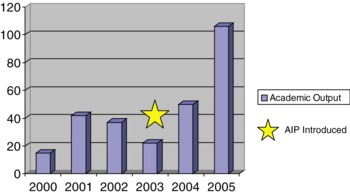
Academic activity was quantified by tracking the scholarly output of radiation therapists in the form of abstracts, presentations and papers (see Figure 1). For the purposes of this evaluation, there was no distinction made between work where the therapist was first or second author. In addition, the issue of quality of output was not directly addressed, although this is an important issue. However, the majority of academic output was oral or poster presentations at major conferences and events where there is already a peer-review process in place for abstract submission. This is also the case for most of the article publications.
Radiation therapist academic output within RMP AIP introduced. Academic output = radiation therapist first or second authored abstracts, posters, podium presentations and published papers.

Therapist academic output has improved from 2000, showing a steady increase until 2003 and a more dramatic rise after that. This is certainly due to some degree to the implementation of specific roles with dedicated research time and an expectation for the therapist to contribute to research and its dissemination. Although the research positions are in their early stages and the therapists have until fairly recently been acting to a large degree as research assistants in the acquisition and collating of data, the roles have been instrumental in changing the current professional culture and expectations of therapists in regard to their contribution to investigative and translational research.
Number of academic appointments at the affiliated university department
In academic, university-affiliated, teaching hospitals it is often a condition of employment that incumbents take up or are eligible for academic appointments. This allows the professional to contribute to their university-based academic community and assumes complementary academic activities that will exist in conjunction with the individual’s clinical practice. Duties that may be required as part of an academic appointment include: teaching, mentoring, project supervision, contribution to the administration of the department through committee involvement and contribution to the scholarly output (research or creative professional activity) of the department. These appointments are awarded to clinicians based on merit and are most frequently ‘status-only’ (non-salaried). In the RMP, academic appointments were traditionally held by physicians and some physicists only.
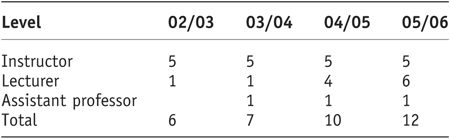
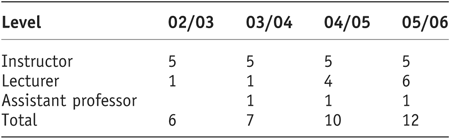
In addition to the combined academic activities of all RMP radiation therapists, the number of RMP radiation therapists holding academic appointments in the Department of Radiation Oncology at the University of Toronto was also felt to be a positive indicator that the model was a success. Therapists can apply for an academic appointment when they meet minimum requirements for academic work and must maintain a level of academic productivity to retain the appointment. Currently, there are 12 radiation therapists with confirmed appointments (see Table 1). Of these 12 therapists, 5 are at the Instructor level, 6 at Lecturer level and one radiation therapist holds an Assistant Professorship. There are 4 individuals actively seeking academic appointments. To put this into perspective, 100% of radiation oncologists (36/36), 66% of medical physicists (19/29) and 8% of radiation therapists (12/150) have an academic appointment. It is worth noting, however, that an academic appointment is a requirement of employment for radiation oncologists and not currently for the other professional groups.
Radiation therapist academic appointments within RMP
Discussion: Achieving a Departmental Academic Practice
There have been several very positive outcomes from the AIP model. Opportunities for diverse roles that incorporate an element of clinical practice (integrated roles) have increased since the model’s inception, giving radiation therapists choices in how to advance their career and opportunities to participate in areas not previously available to them. In addition academic output and research work have also risen. The research roles, for example, have been very successful in developing therapist-researchers who are engaged in both scholarly work and technical innovation. This is to be expected as dedicated time has been given to pursue research in these roles and if scholarship is considered a valued activity by the department, ‘sufficient time must be allocated and organizational support and funding must be available’ (ref. Reference Jones and Van Ort1, p. 143). In addition, mentorship for the research roles is readily available from the physicians and other team members working with the therapists on their research projects.
However, there are many opportunities for improvement. Within the department, general understanding of the model and its goals is sporadic and will need to be enhanced if the outcomes are to be fully realized. Moreover, the results show that while the implementation of the new model has met with many successes, mostly in the clinical domain, the pursuit of equality in the scholarship arena continues to present challenges. Only the research and teaching roles have been associated so far with academic output and attaining university appointments. This finding is expected, as research and teaching are primary areas of scholarly activity. Grant capture remains problematic for therapists, as research activities may not meet the criteria of many common oncology granting agencies.
There is considerable evidence that the original concept has evolved since its inception. There was an overt aim to attempt to ‘level the playing field’ between the professions within RMP. In reality, one of the primary inequities lies with the amount of academic activity in the radiation therapists group. This is obviously significant in a university-affiliated department. Freeing up time for non-clinical work and providing mentorship has worked to some degree with the research therapists. However, while scholarly production seems to be on the rise, this will have to be monitored more closely in the future to clearly determine its relationship to the AIP model.
Further work already underway includes development of the Academic Leadership Committee whose mandate is to support and inform radiation therapists about academic career opportunities at UTDRO, as well as mentor those with current appointments. In addition, there is ongoing radiation therapist–led research into academic barriers and solutions within the profession. There is also an active recruitment initiative that includes the development of a visiting scholar and invited speaker program. Presentation of research at conferences is supported with paid time-off as well as support for registration and other costs. In addition, there is financial support (and study time) available for baccalaureate and graduate degrees. For the last major international conference, a peer review process was implemented to review abstracts before submission and give feedback to improve posters and presentations. This was highly successful based on quality of the final submissions and feedback from participants, although time consuming for the limited numbers of individuals contributing their expertise.
Plans for the future include the addition of more defined metrics, perhaps dividing academic output into areas such as primary authorship, grants and published papers. Measuring the increase in more advanced scholarly activity such as publications and grant capture would demonstrate an increasingly mature academic culture. One of the supported long-term goals for RMP could include an increase in the percentage of the radiation therapy department attaining an academic appointment at UTDRO, as well as a steady progression of those with appointments through the academic ranks. This could be supported with a recruitment strategy targeting individuals with an academic interest.
Implications for Practice
Lessons learned (and implications for other organizations wishing to encourage scholarly activity) include:
The importance of ‘top down support’ must not be underestimated. The radiation therapists at PMH are fortunate to work in an environment that is explicitly inter-professional and consciously fashioned to eliminate the traditional medical hierarchical model. As a result, radiation therapists are seen as equal partners in the team and expected to contribute both clinically and academically to the work of the RMP.
It is essential that there is an overt valuing of academic activity that is articulated in the department’s strategic plan and reinforced in all general communication. This includes data gathering (publications, grants capture etc.) for annual reports, research awards evenings, e-mail congratulations when a radiation therapist publishes an article and evidence of academic activity displayed throughout the department both as individual posters and annual displays of departmental productivity.
Unsurprisingly, integrated roles with explicit expectations for research seem to have the most profound effect on the professional culture within the department. Not only do they provide protected time, mentorship and space for research activities they are now also seen as normal radiation therapist ‘work’ and have been embraced widely by the other members of the team. In addition, the roles provide the needed degree of clinical expertise. Neophyte researchers can be encouraged and supported, and later may proceed to produce their own study proposals, conduct their own research and present their own findings.
It is difficult to isolate academic activity from the underlying clinical practice that supports and feeds it. A level of experience and expertise needs to be developed concurrently with other professional skills such as the willingness and ability to pursue answers to clinical problems through research utilization.
Ongoing discussion and debate about what the department and the profession needs regarding scholarly activity should be fostered. RMP has created supervisory roles for radiation therapists for development of the research ethos and professional development related to research and mentorship, among other things. These roles include a Research Leader and a liaison position between the department and the University of Toronto.
Dedicated funding is important for conference attendance, courses related to scholarship and higher degrees (e.g., the UTDRO has just announced an annual $5,000 bursary for postgraduate study).
Involvement with a wider academic community is beneficial. A link with the University of Toronto and gradual integration by the radiation therapists into the university environment has had the effect of introducing the profession to a wider (and more rigorous) community of academic activity as well as the conventions of academic practice previously either unknown or unavailable.
Initial departmental initiatives can foster a wider involvement at many levels. Once the model was launched the effect seemed to be almost self-sustaining. There is now scholarly activity happening ‘spontaneously’ in many quarters such is the fertile atmosphere within the department.
Conclusions
For therapists, the term ‘scholarship’ may encompass teaching, research and dissemination, integration and application of new knowledge in the spirit of Boyer’s model.Reference Boyer9 For a primarily service-driven profession the relevance of scholarship lies in the improvement in patient care that can result. The department is currently investigating the possibility of adapting the Boyer model to widen the definition of scholarship and include clinicians more overtly. In addition, the Boyer model incorporates the definition of the ‘scholarship of teaching’. Teaching is a valued and important element of practice within RMP, but originally not well incorporated into the AIP concept. This needs to be addressed in the next iteration to ensure the profile of teaching is raised to be equivalent to that of research and its dissemination.
In conclusion, although RMP has made significant progress, more work must be done to promote a departmental culture that encourages and supports academic activities and connects research and scholarship with academic appointments. Academic work is often regarded as an optional extra (when recognized as a professional activity at all). Hence there is an ongoing need for individual and organizational support to nurture and develop radiation therapists in this area. Scholarly enquiry should be an integral part of radiation therapy practice at all levels in RMP and, eventually, should be a natural part of clinical practice (as it is with physician and physicist colleagues).
There seems to be a strong correlation between the barriers and facilitators for clinical nursing scholarship and those pertaining to radiation therapists discovered by this evaluation. Radiation therapists can perhaps borrow the questions posed by Riley et al., and pose them for their unique practice model:
‘What does it mean to be a nursing scholar in a practice discipline? How well do current models of scholarship support nursing scholarship?’ (ref. Reference Riley, Beal, Levi and McCausland10, p. 383).
As a profession, radiation therapy has not fully defined the meaning of scholarship and there is little literature on how to encourage academic practice. However, we are taking the first steps and it will no doubt be an interesting and stimulating journey.