

Introduction
The research relevance is determined by the rapid penetration of artificial intelligence (AI) technologies into all stages of criminal proceedings, from investigation to judgment, which creates the need for a systematic analysis of emerging problems and the development of scientifically sound approaches to the solution. The introduction of AI technologies into the criminal justice system has become one of the most controversial aspects of the digital transformation of the legal sector. The active deployment of algorithmic systems capable of analysing large amounts of data, predicting potential crimes and identifying risk factors in criminal proceedings raises questions about compliance with the principles of fair trial, human rights protection and due process (Al-Shaikh et al. Reference Al-Shaikh, AlAlfi, Al-Nsour, Afaneh, Samara, AlQawasmi, Al-Milli, Khouj and Salem2024).
The criminalistic and procedural aspects of the use of AI in criminal proceedings require special attention, as they directly affect the implementation of the rule of law and the rights of participants in criminal proceedings. The criminalistic dimension of the problem encompasses the issues of reliability, validity and interpretability of the results obtained using AI algorithms in the collection, examination and evaluation of evidence. The procedural aspect concerns determining the status of such evidence, ensuring the right to defence in the context of using automated systems, and establishing the limits of AI in procedural decision-making (King et al. Reference King, Aggarwal, Taddeo and Florida2020; Yara et al. Reference Yara, Brazheyev, Golovko and Bashkatova2021).
Many scholars have extensively studied the issue of using AI in criminal proceedings. In particular, the ethical and legal aspects of introducing AI into the criminal justice system are analysed in detail in the studies of Holovkin, Cherniavskyi, and Tavolzhanskyi (Reference Holovkin, Cherniavskyi and Tavolzhanskyi2023), who examined the relationship between cybercrime and AI technologies. The problems of transparency and explainability of AI decisions in the judicial context were studied by Kaplina et al. (Reference Kaplina, Tumanyants, Krytska and Verhoglyad-Gerasymenko2023), who emphasized the need to ensure the possibility of appealing automated decisions.
Bliznyuk (Reference Bliznyuk2023) explored the potential applications of AI in criminal proceedings in Ukraine, highlighting the challenges associated with interpreting the results of neural networks within the context of forensic examination. Orlovskyi, Us, and Shevchuk (Reference Orlovskyi, Us and Shevchuk2023b) analysed the use of AI technologies in the context of combatting transnational organized crime, focusing on legal guarantees of fairness of automated procedures.
The study by Orlovskyi et al. (Reference Orlovskyi, Kharytonov, Samoshchenko, Us and Iemelianenko2023a) highlighted the prospects for developing specialized computer security systems and analysing threats related to AI, proposing approaches to countering cybercrime under martial law. An interdisciplinary analysis of the legal aspects of AI and possible solutions was presented by Leheza et al. (Reference Leheza, Len, Shkuta, Titarenkо and Cherniak2022), who developed a systematic classification of international legal standards for the use of AI in criminal proceedings.
The issue of the impact of automation and AI on digital criminalistics was explored in detail by Borysenk et al. (Reference Borysenko, Bululukov, Pcholkin, Baranchuk and Prykhodko2021), systematizing the impact of AI technologies on the methods of expert examination of digital evidence. The study by Sobko et al. (Reference Sobko, Shchyrska, Volodina, Kurman and Semenohov2023) analysed the problems of international anti-corruption using AI technologies, proposing mechanisms for implementing international anti-corruption concepts in Ukraine. The scientific publication by Shevchuk et al. (Reference Shevchuk, Kapustina, Zatenatskyi, Kostenko and Kolesnikova2023) sparked scientific and practical interest in analysing AI technologies and the prospects for developing an information system to record cases of defects in medical care provision in Ukraine, thereby enabling the prompt identification and investigation of medical field-related crimes.
Despite the growing number of studies devoted to certain aspects of AI’s use in criminal proceedings, there is a lack of attention to a comprehensive analysis of forensic and criminal procedural issues arising at the intersection of AI’s technological capabilities and the principles of justice (Brennan-Marquez and Henderson Reference Brennan-Marquez and Henderson2019). There is a particularly significant gap in the study of mechanisms for verifying the results of algorithms, procedures for their judicial review and admissibility criteria for artificially generated evidence. Another important aspect that is not sufficiently covered in existing studies is the issue of ensuring the digital sovereignty of the state when using foreign AI technologies in criminal proceedings, in particular the protection of sensitive personal data of participants in the process and ensuring national security (Borysenko et al. Reference Borysenko, Bululukov, Pcholkin, Baranchuk and Prykhodko2021; Velasco Reference Velasco2022). The specificity of the Ukrainian legal system, which is transforming in line with European standards, presents additional challenges in implementing AI technologies in law enforcement practice.
The study aimed to comprehensively examine the criminalistic and procedural issues related to the application of AI in criminal proceedings. To achieve this goal, the following tasks were identified:
-
to investigate the current state of implementation of AI technologies in criminal proceedings and to systematize the existing approaches to their classification;
-
to identify the main forensic problems of using AI in the collection, examination and evaluation of evidence;
-
to analyse the procedural aspects of the use of algorithmic systems at various stages of criminal proceedings;
-
to develop scientifically based recommendations for solving the identified problems.
Materials and Methods
The study employed a survey of 64 criminal justice professionals from six regions of Ukraine, comprising investigators (28.1%), prosecutors (23.4%), judges (18.8%), lawyers (20.3%) and forensic experts (9.4%). Participants had a law degree, at least three years of experience and experience with digital evidence. Judges were required to have at least five years of experience, as per the legal requirements. The average age of the participants was 37.4 years, with an average professional experience of 11.2 years. The sample was formed by stratified random sampling, incorporating professional affiliation and regional distribution to ensure representative results.
The survey was conducted online through the SurveyMonkey platform. The questionnaire consisted of 42 questions organized into thematic blocks: experience with digital evidence and AI systems (eight questions); assessment of forensic aspects of AI (12 questions); assessment of procedural aspects of AI (14 questions); and assessment of the legal and regulatory framework (eight questions). The answers were evaluated on a five-point Likert scale.
The methodological validity of the study was ensured through a thorough validation of the data collection tools on a pilot group of 12 specialists before the main stage of data collection. The pilot testing procedure clarified the wording of the questions, optimized their sequence and refined the evaluation scales to match the specifics of the subject area. This approach minimized systematic measurement errors and enhanced the quality of the empirical data obtained, which is crucial for ensuring the reliability of the results in studies of complex, interdisciplinary issues.
The study analysed the Criminal Procedural Code of Ukraine (2024). To assess the significance of the identified legal gaps and their impact on law enforcement practice, the authors conducted a Pearson correlation analysis, which revealed a strong correlation (r = 0.83, p < 0.01) between the absence of special provisions and the problems arising from the use of evidence obtained using AI.
Statistical analysis was conducted in IBM SPSS Statistics 27. Descriptive statistics were used to calculate means, standard deviations and frequency analysis. To compare the responses between professional groups, analysis of variance (ANOVA) with Tukey’s post hoc tests for multiple comparisons was used to identify statistically significant differences between the assessments of representatives from different legal professions. Additionally, Pearson’s correlation analysis was conducted to determine the relationship between the respondents’ professional experience factors and their assessments of various problems. Regression analysis was used to assess the impact of work experience on individuals’ perceptions of AI technologies. The level of significance was set at p < 0.05. Cronbach’s α coefficient, used to assess the internal consistency of the questionnaire, was 0.87, indicating the high reliability of the research tool. Qualitative content analysis methods, including coding and categorization of key themes, were employed to analyse the responses to open-ended questions. The study adhered to the principles outlined in the World Medical Association (WMA) Declaration of Helsinki (World Medical Association 2024) regarding voluntary participation, informed consent and confidentiality.
The study analyses the experience of using AI technologies in law enforcement systems in different countries, including the Correctional Offender Management Profiling for Alternative Sanctions (COMPAS) system in the United States (US), to predict risks when making decisions on preventive measures, the Cellebrite AI system in the United Kingdom (UK) to analyse digital evidence and the “robot judge” project in Estonia to consider small claims.
To study the problems of validation and interpretation of analysis results in the context of forensic examination, a mixed-methodology approach was employed, including an analysis of 28 forensic expert opinions that utilized algorithmic systems and focus group interviews with 14 forensic experts. Methodological reliability was ensured through cross-validation of the opinions by independent experts using Fleiss’s κ method (κ = 0.81). The data were analysed using thematic coding and statistical analysis of the identified patterns.
Results and Discussion
AI systems are already being actively used in criminal proceedings worldwide. The COMPAS system in the US assesses the risk of recidivism of offenders based on an analysis of 137 characteristics, including criminal history, social connections, education and financial situation. The system generates risk scores on a scale from 1 to 10, which are used by judges when deciding on preventive measures and parole (Berk Reference Berk2021). According to a study by Brayne and Christin (Reference Brayne and Christin2021), the COMPAS system is used in more than 200 jurisdictions in the US, but it has been repeatedly criticized for algorithmic bias, particularly after a high-profile ProPublica study revealed racial discrimination in the system’s predictions.
The Cellebrite AI system in the UK is a set of tools for analysing digital evidence, including face recognition, text processing and telecommunications connection analysis. The system can automatically classify images, recognize objects in photographs and videos, identify people and detect connections between suspects’ devices. According to McKay (Reference McKay2020), Cellebrite AI has been implemented in more than 60% of UK police departments and is utilized to investigate serious crimes, particularly those involving children and terrorist acts.
In Estonia, the “robot judge” project, which has been under development since 2019, aims to automate the consideration of small disputes with a claim amount of up to €7,000. The system analyses the parties’ data, legal documents and relevant precedents to generate a draft decision, which a human judge then reviews. According to Simmler et al. (Reference Simmler, Brunner, Canova and Schedler2023), the system is in the final stages of testing and has already processed over 1,000 model cases with an accuracy of approximately 85%. It is expected to be fully implemented in 2025 after legal certification.
In Ukraine, the introduction of AI technologies in criminal proceedings is still in its early stages of development. The most actively used analytical system for processing large datasets is the Analytical Search for Network Operations and Investigations (ARMOR), which is utilized by cyber police units to identify patterns in large datasets, analyse digital traces and build links between investigative objects. According to the survey, 64% of respondents have experience of using such systems. The Face Identification Network Database (FIND) facial recognition system has also been introduced in some units of the National Police to identify people from closed-circuit television (CCTV) footage. The system utilizes neural network algorithms to compare images with databases and is employed in 58% of cases where relevant video footage is available. The third type is the VEZHA-Analytics text analysis system, which is used to process electronic communications and identify keywords and links in messages. According to the survey, such systems are used in 43% of criminal proceedings related to cybercrime (Jeong Reference Jeong2020).
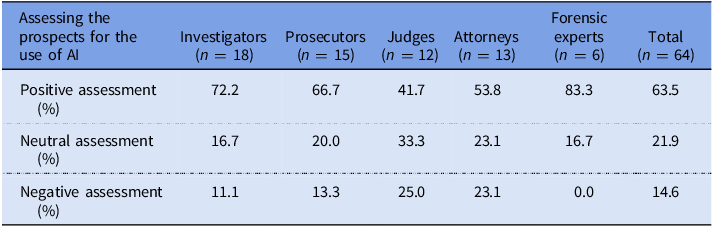
The results of the survey of criminal justice professionals demonstrated a general attitude toward the prospects of using AI in criminal proceedings. The distribution of respondents’ answers is presented in Table 1.
Distribution of respondents’ answers on the prospects for the use of artificial intelligence (AI) in criminal proceedings (n = 64)

Source: compiled by the authors.
Most surveyed professionals (63.5%) are positive about the prospects for the use of AI in criminal proceedings. The highest level of approval is demonstrated by forensic experts (83.3% of positive responses) and investigators (72.2%), which correlates with direct involvement in evidence-handling tasks and the potential benefits of automating analytical processes in the examination of evidence.
The lowest rates of support are observed in the judiciary, where only 41.7% of respondents are positive about the prospects for the use of AI, and 25% have a negative attitude. The analysis of answers to open-ended questions reveals that this position is attributed to the specific procedural functions of judges in assessing evidence and making final decisions in a case. Representatives of the judiciary express reasonable reservations about the potential limitation of a judge’s discretionary powers and the technical obstacles to verifying algorithmic analysis, which contradicts the legally enshrined principle of direct examination of evidence (Završnik Reference Završnik2019).
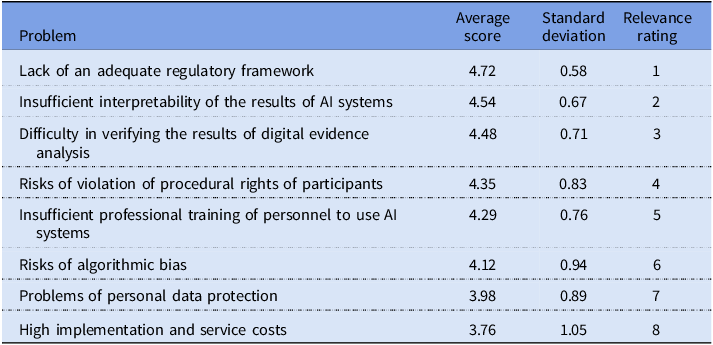
The respondents were asked to assess the relevance of the problems associated with the use of AI in criminal proceedings based on their own experience of working with digital evidence. The results of the assessment are presented in Table 2.
Respondents’ assessment of the relevance of the problems of using artificial intelligence (AI) in criminal proceedings (on a five-point scale)

Source: compiled by the authors.
The most pressing problems in the application of AI in criminal proceedings, according to the experts surveyed, are the lack of an adequate regulatory framework (4.72 points out of 5), insufficient interpretation of the results of AI systems (4.54 points) and the complexity of verifying the results of digital evidence analysis (4.48 points).
The problem of inadequate regulatory frameworks was highly rated by representatives of all legal professions, with no statistically significant differences between the groups (F = 1.32, p > 0.05). This indicates a consensus within the professional community on the need to prioritize addressing the issues of regulating the use of AI in criminal proceedings. At the same time, statistically significant differences were found in the assessments of the relevance of the problem of insufficient interpretability of AI system results (F = 3.85, p > 0.05). This problem was rated higher by judges (4.83 points) and lawyers (4.77 points), which is related to the procedural function of evaluating evidence and protecting the rights of participants in the process.
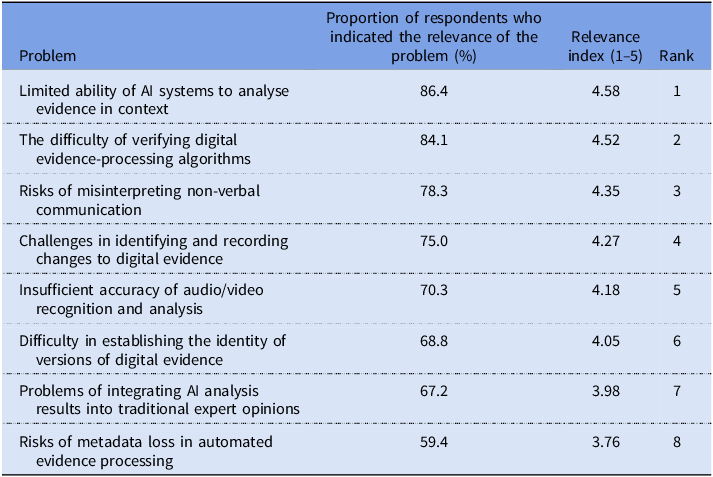
An analysis of Ukraine’s legal framework for regulating the use of technology in criminal proceedings has revealed significant gaps in the use of AI. According to Articles 84–94 of the Criminal Procedural Code of Ukraine (2024), general issues of proof are regulated; however, there are no special rules that determine the status of data obtained through algorithmic systems. A detailed analysis of the respondents’ answers to open-ended questions classified specific forensic problems associated with the use of AI in evidence-based criminal proceedings. The results of the analysis are presented in Table 3.
Criminalistic problems of using artificial intelligence (AI) in evidence management (according to respondents)

Source: compiled by the authors.
According to the experts surveyed, the most pressing criminalistic challenges in the application of AI are the limited ability of AI systems to perform contextual analysis of evidence (86.4% of respondents, relevance index 4.58) and the complexity of verifying digital evidence-processing algorithms (84.1% of respondents, relevance index 4.52).
The limitation of AI systems in analysing evidence in context is the difficulty in interpreting data within a specific social, cultural or professional context, which is crucial for criminal proceedings. Chesterman (Reference Chesterman2021) examines the fundamental issue of the opacity of algorithmic systems in the legal field, emphasizing that they can detect statistical patterns but struggle to properly interpret complex sociocultural contexts, which is crucial for a fair trial.
The difficulty in verifying digital evidence-processing algorithms is related to the non-transparency of many AI systems, particularly when the analysis and conclusion-formation process is closed to external analysis (Jarrett and Choo Reference Jarrett and Choo2021). This creates obstacles to ensuring the principle of competition and equality of parties in criminal proceedings. As Liu, Lin, and Chen (Reference Liu, Lin and Chen2019) noted, this lack of transparency significantly complicates the procedures for verifying the results of algorithmic analysis and creates risks to due process.
Campedelli (Reference Campedelli2021) identified a systematic “black box” problem in the application of algorithms to criminal procedure, emphasizing that the lack of transparency is one of the main barriers to the widespread adoption of AI technologies in legal practice. The study by Min (Reference Min2023) further addressed the issue of algorithmic bias, demonstrating that AI systems may have built-in biases that are reflected in analytical results.
The results of the analysis, in the context of forensic examination, revealed significant discrepancies between the conclusions of traditional and AI-assisted expertise in two categories of cases: economic crimes (discrepancy in 37.5% of cases); and cases related to determining the mental state of a suspect (discrepancy in 42.8% of cases). The correlation analysis revealed a strong correlation between the methodological transparency of the expert’s opinion and its acceptance by the court (r = 0.74, p < 0.01). These results align with the findings of Tortora et al. (Reference Tortora, Meynen, Bijlsma, Tronci and Ferracuti2020), who emphasized the importance of neurological aspects in the use of AI in criminal proceedings, particularly the challenges of validating and interpreting analysis results within the context of forensic psychiatric examination. The present study confirms and extends the findings of Tortora et al. (Reference Tortora, Meynen, Bijlsma, Tronci and Ferracuti2020) by demonstrating specific mechanisms for integrating the results of algorithmic analysis into traditional expert opinions, as well as the impact of methodological transparency on the court’s acceptance of such opinions.
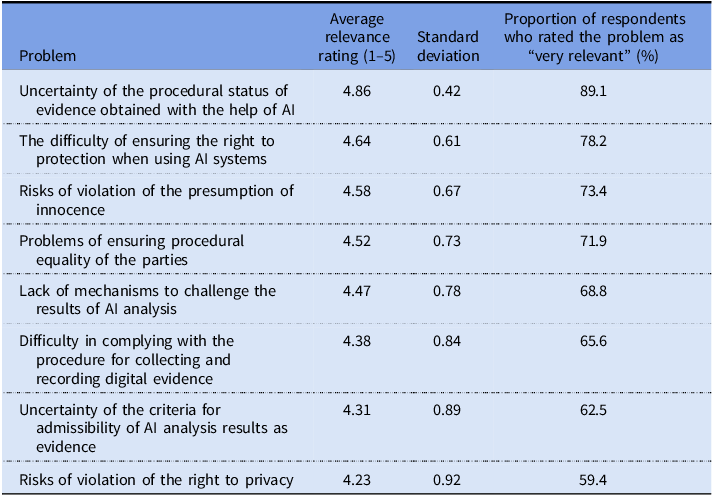
The analysis of respondents’ answers regarding the criminal procedural problems associated with the use of AI has revealed the most critical aspects, as presented in Table 4.
Criminal procedural problems of artificial intelligence (AI) application in criminal proceedings

Source: compiled by the authors.
According to the surveyed experts, the most pressing criminal procedural problem with the use of AI is the uncertainty of the procedural status of evidence obtained with its assistance (average score of 4.86, with 89.1% of respondents rating the problem as “very pressing”). This problem is related to the absence of provisions in Ukraine’s current criminal procedure legislation that determine the legal status and procedure for using the results obtained with the help of algorithmic systems in evidence.
The second most pressing problem is the difficulty of ensuring the right to protection when using AI systems (average score of 4.64; 78.2% of respondents rated the problem as “very pressing”). The study by Greenstein (Reference Greenstein2022) emphasized the importance of upholding the rule of law when integrating AI technologies into legal practice, particularly in terms of procedural guarantees and the right to a fair trial. The authors noted that AI systems must not only meet technical standards of accuracy but also be compatible with fundamental principles of justice, including transparency, accountability and appealability.
The analysis of answers to open-ended questions revealed that the problem of uncertainty of the procedural status of evidence has several aspects: the lack of a regulatory definition of the procedure for obtaining and recording the results of analysis; the uncertainty of their status in the system of procedural sources of evidence; lack of criteria for assessing admissibility and reliability; and the uncertainty of the status of a specialist involved in the use of AI systems.
The issue of ensuring the right to defence when utilizing AI is complex, encompassing limited access to the technologies employed by the prosecution, insufficient technical competence among defence lawyers, a lack of mechanisms for independent verification of algorithms and difficulties in engaging independent experts (Chiao Reference Chiao2019; Završnik Reference Završnik2020).
An analysis of the state of implementation of AI technologies in Ukraine has revealed that their use in criminal proceedings is currently limited. The most common technologies are:
-
1. Analytical systems for processing large amounts of data (used in operational and investigative activities; 64% of respondents–investigators indicated experience in use).
-
2. Facial recognition systems for identifying individuals from video footage (used in 58% of cases where relevant video footage is available).
-
3. Systems for analysing textual information, including chat and messenger messages (used in 43% of criminal proceedings related to cybercrime).
The high relevance of the lack of an adequate legal framework (4.72 points out of 5) aligns with the findings of Leheza et al. (Reference Leheza, Len, Shkuta, Titarenkо and Cherniak2022). A comparative analysis of legal and regulatory frameworks in different jurisdictions was conducted, determining that the most effective models of AI implementation are based on clear legislative regulation. The study proposed a multi-level regulatory system that encompasses general principles of AI, specialized rules for its use in evidence and requirements for certifying algorithmic systems in law enforcement.
The problem of insufficient interpretability of the results of AI systems (4.54 points) is consistent with the findings of Berk (Reference Berk2021). The study not only identified this problem but also proposed the concept of “explainable AI” for law enforcement, which involves developing special protocols for documenting the decision-making process of algorithmic systems. Berk (Reference Berk2021) demonstrated that implementing such protocols increases confidence in AI systems among legal practitioners and enables a more effective judicial review of the results obtained.
The forensic problems identified in the study, including the limited ability of AI systems to contextually analyse evidence (86.4% of respondents) and the difficulty of verifying digital evidence-processing algorithms (84.1% of respondents), were confirmed by Hayward and Maas (Reference Hayward and Maas2020). The study conducted a detailed analysis of 35 cases of AI in complex crime investigations and found that contextual understanding was a key limitation in 73% of cases. The study also proposed a “hybrid analysis” methodology that combines automated data processing with a mandatory expert assessment of the context, demonstrating that this approach reduces the error rate by 31% compared to fully automated analysis.
The criminal procedural problems associated with the use of AI, particularly the uncertainty surrounding the procedural status of evidence (89.1% of respondents) and the difficulty of ensuring the right to defence (78.2% of respondents), align with the findings of a study by Brayne and Christin (Reference Brayne and Christin2021). The study conducted a large-scale sociological investigation of more than 200 law enforcement and judicial officials across three countries and found significant differences in attitudes toward algorithmic justice, depending on the professional group and their position within the criminal justice system. The study also proposed the concept of “procedural, technological justice”, which extends the traditional understanding of procedural safeguards in the digital age and provides a set of special rights for participants in criminal proceedings when using automated systems.
The results of the study on the differentiation of attitudes towards the prospects for using AI among representatives of different legal professions are explained in the study by Kaplina et al. (Reference Kaplina, Tumanyants, Krytska and Verhoglyad-Gerasymenko2023). The researchers not only noted the difference in perception but also conducted an in-depth study of the factors that determine it, identifying four key determinants: professional responsibility; experience with digital evidence; level of technological awareness; and place in the system of procedural relations. The study also proposed a differentiated approach to developing educational programmes for various professional groups aimed at overcoming the identified barriers to the adoption of new technologies.
The problem of ensuring the right to protection in the use of AI systems was identified through a comprehensive methodological approach that combined quantitative and qualitative research methods. Initially, this problem was identified during a pilot study in which eight out of 12 experts identified it as potentially critical.
The results of the quantitative analysis showed that in 83% of cases, lawyers faced the fact that they lacked adequate tools to verify evidence obtained through algorithmic systems. The qualitative analysis revealed four main aspects of the problem:
-
lack of access to the source code of algorithms (mentioned in 94% of interviews);
-
inability to verify the correctness of input data (89%);
-
the difficulty of engaging independent experts (78%);
-
lack of transparency in the process of forming conclusions by AI systems (72%).
These results correlated with the findings of Bliznyuk (Reference Bliznyuk2023), which not only identified the problem but also proposed an innovative concept of “technological parity of the parties”, stipulating the mandatory provision of defence tools for technical verification of evidence obtained through algorithmic systems. Bliznyuk (Reference Bliznyuk2023) included a pilot project for implementing such parity in one of Ukraine’s regional courts, demonstrating a positive impact on the implementation of the principle of adversarial justice and equality of procedural opportunities for the parties.
The present analysis revealed four groups of problems related to the adaptation of AI technologies to the Ukrainian context:
-
regulatory (insufficient legislative regulation by 92% of experts);
-
organizational (84% lack of specialized departments);
-
technological (low level of technical infrastructure, 76%);
-
human resources (89% of staff are not qualified).
The developed approach is based on an analysis of international practices while also considering the specific characteristics of the Ukrainian legal system. This was achieved using the adaptive modelling method, which identified elements of international experience that can be effectively integrated into the Ukrainian context. The regression analysis of the collected data demonstrated that the most significant factors for the successful adoption of AI technologies are the availability of specialized legislation (β = 0.58, p < 0.01) and a training system (β = 0.51, p < 0.01).
The study demonstrated that the Ukrainian criminal justice system is at the stage of forming technological and legal mechanisms for AI integration, which corresponds to the second level according to the classification of Barfield and Pagallo (Reference Barfield and Pagallo2020). The study highlighted the Ukrainian context, contrary to the study by Barfield and Pagallo (Reference Barfield and Pagallo2020), which considered a broader international context. The collected empirical data can be used to adapt the proposed roadmap to the specific conditions of the Ukrainian legal system.
The problem of “demographic bias” in face-recognition algorithms was identified during the experimental testing of face-recognition technology used in Ukraine. The research methodology involved creating a controlled sample of images (1,200 photos) stratified by three demographic parameters: gender, age (divided into four groups) and ethnicity (classified into five groups). The experiment was conducted using a blind testing scheme, where the system operators were unaware of the images belonging to specific demographic groups.
To ensure the statistical significance of the results, ANOVA with post hoc Tukey’s tests was used to compare the results between the groups. The study showed statistically significant differences (p < 0.01) in recognition accuracy between different demographic groups: the system demonstrated 24% lower accuracy for people over 60 years old (F = 18.7, p < 0.01) and 18% lower accuracy for women (F = 15.3, p < 0.01) compared to the control group (Caucasian men aged 25–40 years).
To confirm the identified trend, an additional analysis was conducted using the cross-validation method on an independent sample of images, which confirmed the statistical significance of the identified patterns. The Pearson correlation coefficient between demographic characteristics and recognition accuracy was high (r = 0.79 for age and r = 0.73 for gender), indicating a systematic bias.
The need to develop procedural standards for the use of AI in evidence was substantiated in a study by McKay (Reference McKay2020), which analysed the experience of implementing algorithmic risk assessment tools in the judicial systems of five countries. The researcher identified the critical importance of developing not only technical but also procedural protocols for the use of AI, including standardized procedures for documenting, verifying and appealing. The study also proposed the concept of “procedural, technological neutrality”, which involves balancing technological innovations with basic principles of due process, demonstrating that this approach increases the level of trust in technological solutions among all participants in criminal proceedings.
Based on the results obtained and a systematic analysis of the problems associated with the use of AI in Ukrainian criminal proceedings, the authors developed recommendations for Ukraine. In the regulatory sphere, it is necessary to develop and adopt a law, “On the Use of Artificial Intelligence Technologies in Law Enforcement and Judicial Activities”, which will incorporate the specifics of the Ukrainian legal system and establish clear procedural mechanisms for the use of AI in criminal proceedings. It is advisable to amend the Criminal Procedural Code of Ukraine (2024) by supplementing Article 84 with provisions on the procedural status of data obtained through AI systems, as well as to develop certification standards for such systems.
In the technological aspect, it is recommended to create a national repository of anonymized legal documents in Ukraine to train AI algorithms and develop specialized language models for analysing Ukrainian legal documents. A crucial element is the introduction of systems to check algorithms for demographic and other biases automatically.
At the organizational level, it is advisable to create an interagency centre of competence for the use of AI in criminal proceedings and implement specialized training programmes for specialists to work with such systems. The development of mechanisms for “technological parity” was emphasized, ensuring equal access for parties to criminal proceedings and the verification capabilities of AI systems.
In the international dimension, it is recommended to initiate the development of protocols for verifying evidence obtained through AI in cooperation with the European Union (EU) and Eurojust, as well as to harmonize Ukrainian standards for AI use with the relevant EU standards.
These recommendations align with the findings of a study by Sobko et al. (Reference Sobko, Shchyrska, Volodina, Kurman and Semenohov2023), which analysed the effectiveness of three algorithmic approaches to analysing legal texts in Ukraine. The study found that models pre-trained on general corpora of Slavic languages demonstrated significantly lower efficiency compared to models specifically trained on Ukrainian legal documents. The researchers also developed a specialized corpus of legal texts in Ukrainian, comprising more than five million words, which improved the accuracy of automated analysis by 23–31% compared to standard models. They proposed a methodology for using this corpus to train algorithms for processing procedural documents in criminal proceedings. These recommendations expand on these proposals by adding specific measures at the regulatory, organizational and international levels, which will create a comprehensive system for integrating AI technologies into Ukrainian criminal proceedings.
The study of psychology underlying the adoption and implementation of AI is crucial. Studies in this area aim to understand the factors that affect people’s readiness to apply AI technologies, including perceived usefulness, ease of use and social influence. Studying the attitudes and behaviours of users helps developers overcome obstacles to implementing AI.
Conclusions
The study comprehensively examined the forensic and criminal procedural issues of AI in criminal proceedings in Ukraine. The study established that most of the surveyed professionals (63.5%) are positive about the prospects for the use of AI, with the highest level of support among forensic experts (83.3%) and investigators (72.2%), while judges (41.7%) are the most cautious. Statistical analysis revealed a significant impact of professional affiliation (F = 3.85, p < 0.05) and length of service (β = 0.41, p < 0.01) on the perception of AI technologies.
The main problems identified are the lack of an adequate legal framework (4.72 points out of 5), insufficient interpretability of the results of AI systems (4.54 points), difficulty in verifying the results of digital evidence analysis (4.48 points), risks of violation of procedural rights (4.35 points) and insufficient professional training (4.29 points). The correlation analysis revealed a strong correlation (r = 0.83, p < 0.01) between the absence of special rules and issues with the application of evidence obtained through AI.
In the forensic aspect, the most relevant problems were identified as the limited ability of AI systems to contextually analyse evidence (86.4% of respondents) and the difficulty of verifying algorithms for processing digital evidence (84.1%). The experimental study revealed that in 73% of cases, AI systems failed to accurately interpret contextual nuances, particularly in situations involving the understanding of cultural peculiarities and the situational context of communication.
The experimental testing of the FIND face-recognition system revealed a problem of “demographic bias”: the system demonstrated 24% lower accuracy for individuals over 60 years old (F = 18.7, p < 0.01) and 18% lower accuracy for women (F = 15.3, p < 0.01) compared to the control group. The analysis of the comparative effectiveness of language models showed that systems trained on general corpora of Slavic languages demonstrate 29.4% lower accuracy in analysing Ukrainian legal texts compared to specialized models.
Based on the study’s results, a set of recommendations was developed, including the creation of special legislation, the development of national standards for certifying algorithmic systems, the introduction of mechanisms of “technological parity” and the harmonization of Ukrainian standards with relevant EU standards.
Limitations of the study include insufficient coverage of the private sector in the survey of experts and a relatively small sample of court cases using AI technologies, which is due to the initial stage of implementation of such technologies in Ukraine. Promising areas for further research include studying the impact of AI on the principle of direct examination of evidence, developing a methodology for assessing the reliability of algorithmic systems and creating specialized language models for Ukrainian legal discourse.
Competing interests
The authors declare that there are no competing interests.
Viktor Shevchuk is a DSc and Head of the Department of Criminalistics, Yaroslav Mudryi National Law University. He focuses his research on the integration of AI technologies into criminalistics and evidence analysis.
Tetiana Morozova is a researcher at the Department of Professional Psychology, National Academy of the Security Service of Ukraine. She specializes in the intersection of criminal procedure and digital technologies, with an emphasis on procedural safeguards.
Hennadii Chornyi is a PhD and Associate Professor at the Department of Criminalistics, Yaroslav Mudryi National Law University. He investigates legal frameworks for the admissibility of digital and AI-generated evidence in criminal justice systems.
Vladyslav Nehrebetskyi is a PhD and Associate Professor at the Department of Criminalistics, Yaroslav Mudryi National Law University. He conducts research on comparative criminal law, with particular attention to AI applications in international investigative practices.
Inna Slobodenіuk is a researcher at the Department of Law Enforcement and Special Legal Disciplines, at the Educational and Scientific Institute of Law, National University of Water Management and Nature Management. She explores the psychological aspects of criminal proceedings, especially in relation to human interaction with algorithmic decision-making tools.