Qualitative frameworks frame decision problems through “a structured, consistent approach to decision making by facilitating the selection, organization, summarization, and interpretation of data and preferences relevant to the decision” and aid decision documentation and communication (Reference Hughes, Waddingham and Mt-Isa1). The use of qualitative frameworks has been well documented in the context of regulatory decision making through numerous systematic literature reviews (Reference Phillips, Fasolo and Zafiropoulos2–Reference Pignatti, Ashby and Brass7).
Regulatory agencies or health authorities, such as the European Medicines Agency (EMA) and US Food and Drug Administration (FDA), as well as academics (e.g., Centre for Innovation in Regulatory Science [CIRS]), are using qualitative benefit−risk frameworks (EMA PrOACT-URL, US FDA Benefit−Risk Framework and The Universal Methodology for Benefit−Risk Assessment [UMBRA] Framework) to aid benefit−risk decision-making and information dissemination (8–Reference Walker, McAuslane, Liberti, Leong and Salek10).
Health Canada (Health Products and Food Branch), is the Canadian Health Authority responsible for national public health. Before new prescription drug products (or major variations to a product) are authorized for sale in Canada, a manufacturer must present significant scientific evidence of the product's efficacy, safety, and quality to Health Canada. Health Canada assesses this information and makes a benefit−risk decision as to whether the product should be granted market authorization. Health Canada has worked closely with other regulatory agencies (The Consortium on Benefit−Risk Assessment [COBRA]) and with CIRS to evaluate UMBRA (Reference Walker, McAuslane, Liberti, Leong and Salek10). The UMBRA framework (Figure 1) is comprised of an eight-step decision-making process. It was developed by conducting a comparative review of key qualitative benefit−risk frameworks with the goal of harmonizing the common process elements into a universal, overarching qualitative decision-making framework (Reference Walker, McAuslane, Liberti, Leong and Salek10). The UMBRA framework was meant to be a single internationally acceptable platform for the benefit−risk assessment of medicines. Health Canada has evaluated UMBRA for use in benefit−risk decision making and has found it to be fit for the purpose (11).
Components of an eight-stage decision framework (UMBRA) (Reference Walker, McAuslane, Liberti, Leong and Salek10)

Similar to Regulatory agencies, Health Technology Assessment (HTA) agencies use judgment to assess the relevance of the data to make a decision or recommendation. A recommendation depends on the “perspective that is adopted for the decision and the processes used to reach that decision” (Reference Hughes, Waddingham and Mt-Isa1). HTA agencies are beginning to make recommendations which relate to Health Technology Reassessment (HTR). HTR is a “structured, evidence-based assessment of the clinical, social, ethical, and economic effects of a technology currently used in the healthcare system, to inform optimal use of that technology in comparison to its alternatives” (Reference MacKean, Noseworthy and Elshaug12). HTR may be used with prescription medicines that were not initially subjected to rigorous HTA or after initial prescription medication coverage approval as a matter of course, due to new clinical/safety/cost data or comparator changes. Overarching HTR frameworks involve a series of process steps. First, low-value or sub-optimal technologies are identified within the healthcare system. Prioritization is also required if a number of technologies are identified. Assessment follows and can include data collection, interpretation, organization, and summary to determine the clinical, economic, social, and ethical effects of a technology's use. The assessment stage frequently adopts HTA methodology to develop a recommendation for a technology and its comparators. However, HTR is more complex given the inherent lack of comparison data between alternatives, the number of alternatives that are included and the need to demonstrate the lack of benefit or harm should a recommendation further restrict technology use. Reassessment requires an even greater systematic assessment of social value, patient preferences, ethics, and stakeholder requirements. Finally, to ensure HTR recommendation outcomes are realized, a recommendation/decision dissemination phase is required, ideally using knowledge translation, to shift recommendations into practice (Reference Maloney, Schwartz, O'Reilly and Levine13–Reference Soril, MacKean, Noseworthy, Leggett and Clement15).
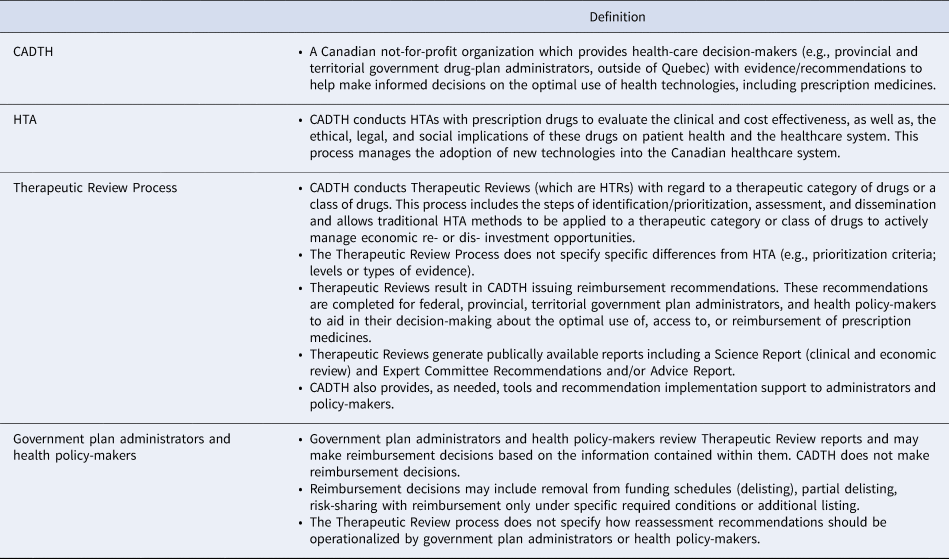
One HTA agency, Canadian Agency for Drugs and Technologies in Health (CADTH), is conducting HTR, including the above outlined process steps, through the Therapeutic Review framework for non-oncology prescription medicines to further enable provincial/territorial reallocation of investment to maximize the value for money. Further information on CADTH and the Therapeutic Review Process may be found in Table 1 (16).
CADTH Therapeutic Review Process (16)

Regulatory agencies and HTA agencies interested in decision-making assessment can have both commonalities and differences in review elements. The health problem, current use of a technology, technical characteristics, safety and clinical effectiveness elements may be common. However, differing perspectives, values, and priorities can exist (Reference Mt-Isa, Hallgreen and Wang5). For instance, Regulators are concerned with safety and efficacy in a general population while HTA agencies are focused on safety and efficacy in a specific population versus comparators with the added criteria of cost effectiveness (17). The common foundational need of Regulatory and HTA agencies, that is to assess a wide variety of evidence and make subjective decisions pertinent to many stakeholders, suggests an opportunity to assess and modify, as required, a qualitative benefit−risk framework for the use by HTA agencies and their expert committees in the HTR assessment phase. Qualitative benefit−risk frameworks can: enhance the clarity of the decision-making process by helping to set internal standards and consistency for decision making; encourage appropriate documentation; ensure each benefit and risk is articulated including their relative importance; and provide a standardized way to communicate benefits and risks to various stakeholders (Reference Pignatti, Ashby and Brass7). Qualitative frameworks accommodate the inclusion of benefit−risk quantitative assessment tools and outcomes and provide structured support through a process to frame decision problems to ensure a better definition and transparency of that decision context (Reference Hughes, Waddingham and Mt-Isa1). These frameworks include steps to ensure identified benefits and risks, applicable data, and other decision considerations are well documented in tabular or graphical displays and presented transparently.
Common foundational needs between Regulators and HTA agencies coupled with the differences in regulatory and HTR assessment raises a question of interest, that is, can a qualitative benefit−risk framework be used or modified to further enable prescription medicine HTR? As such, the purpose of this study was to understand Canadian HTA agency assessors' past experience with a qualitative decision framework (UMBRA) and to collect their insights on the use and or modification to such a framework for HTR. The UMBRA framework was chosen given its overarching and universal construction and Health Canada's acceptance. For the purposes of relevance, assessors were asked to compare the UMBRA framework to an existing Canadian framework for HTR (CADTH's Therapeutic Review).
Methods
Qualitative description was chosen as the research method for this study for two reasons. First, this research method facilitates the translation of results directly to pressing healthcare situations and provides clear information about ways for improvement (Reference Sullivan-Bolyai18) and second, the purpose of this study is directly aligned with the aim of qualitative description which is rich, straight description of an experience or an event from the participant's point of view (Reference Neergaard, Olesen, Andersen and Sondergaard19).
Setting, Participants, Sampling
Fundamental qualitative description principles guided all sampling, data collection and analysis decisions (Reference Sandelowski20–Reference Miles and Huberman22). A purposeful sample of HTA agency assessors were asked to participate in one telephone interview between 30 and 60 minutes in length as well as to respond to a member checking email. Criterion-based sampling was used to ensure participants could provide data which were information-rich and highlighted their experience (Reference Sandelowski20). Study inclusion criteria were: (1) Ability to speak English, (2) current HTA agency employment or participation on an HTA agency expert committee, (3) experience in the use of decision processes for HTA and/or HTR for prescription medicines or participation in any research regarding qualitative decision-making frameworks.
Eight participants were interviewed. This sample size was considered to be operational as we identified relatively few participants who could meet the inclusion criteria. Maximum variation sampling included searching for variation in participants experience with a qualitative decision framework and insights into the use or modification of the UMBRA framework. Participants continued to be added to the study until theoretical saturation was achieved. Theoretical saturation was achieved as themes were consistent between participants, the relationship in the data between existing themes was clear and no new potential participant names were suggested by interviewees (Reference Creswell21).
Snowball strategies were used to identify the purposeful sample. First, key informants identified some potential participants who could provide rich, straight description of their experience with HTA/HTR qualitative decision frameworks. Second, participants were asked to identify other assessors/expert committee members who met the inclusion criteria. In either case, potential participants were contacted by a person in authority at the agency who agreed to assessors being approached. Research sampling was fairly homogeneous given the similarity of participant member's socio-economic group status and professional and educational background. In addition, participants all experienced the phenomenon under study. Hamilton Integrated Research Ethics Board approval was received prior to the commencement of any study activities.
Data Collection and Analysis
An individual, semi-structured telephone interview with open-ended questions was conducted with each participant. Semi-structured interviews allowed the researcher and participant to engage in a dialog where initial questions could be modified in light of the participant's response and the researcher could probe for further understanding (Reference Smith23). The qualitative study was described to each participant via a telephone call and inclusion criteria confirmed. If participants agreed to proceed with the study an introductory email was sent which included the Qualitative Participant Information Sheet and Consent Form. Each participant's consent was obtained (via email) prior to conducting the participant interviews. All identifying information was removed from the data by use of an ID code to ensure participant and organizational anonymity and confidentiality. An initial interview guide was developed. This interview guide and pursuing methods were verified by a colleague with expert knowledge in this area and pilot tested with different colleagues with expertise in framework development to ensure questions were refined and research procedures operational (Reference Creswell21).
Data analysis used the framework of content analysis as proposed by Miles and Huberman (Reference Miles and Huberman22). Interviews, with the permission of participants, were captured verbatim through tape recording, transcribed, reread, and any field notes reviewed after each transcription while listening to the tapes to ensure reflection of the rich description, accuracy of the data, and a flavor of the responses.
One primary analyst coded all transcripts while a secondary analyst ensured peer review through coding a random sample (25 percent) of all transcripts. This process served as quality control analysis to ensure codes reflected what was in the data and not the primary investigators biases. Transcripts were coded and codes grouped into themes using NVivo (version 11) qualitative data analysis software. The review of coding and themes was an iterative process using constant comparison analysis (Reference Glaser24;Reference Fram25), given that each participant's experience might result in a modification to previous codes or themes. Themes were discussed with the secondary reviewer to ensure they flowed from the findings and alternative interpretations were not the most plausible. The primary investigators own biases were assessed and how these were influencing the interviews and data analysis process through ongoing reflection.
Each participant received an email for validation or member checking. Member checking involved asking each participant to confirm the coding developed from their interview and to review themes. Participants were asked for permission to use any direct quotations in this publication. Further details on the data strategy may be found in Supplementary Table 1.
Data representation is a straight descriptive summary of the themes found through analysis of the interview data. Themes are presented in a language similar to the participant's own language (Reference Sandelowski20).
Trustworthiness
Trustworthiness is explained by the term rigor, which is defined as the “goodness” of qualitative research (Reference Emden and Sandelowski26). To assess and establish rigor within this qualitative descriptive study, the framework of Whittemore et al. (Reference Whittemore, Chase and Mandle27) was used in combination with enhancement techniques proposed by Milne & Oberle (Reference Milne and Oberle28). This framework identifies credibility, authenticity, criticality, and integrity as primary validity criteria and enhancement techniques, related to these criteria, describe study methodology to ensure validity criteria are met. See Supplementary Table 2 for the expressions of rigor and enhancement techniques used in this research.
Results
Participants
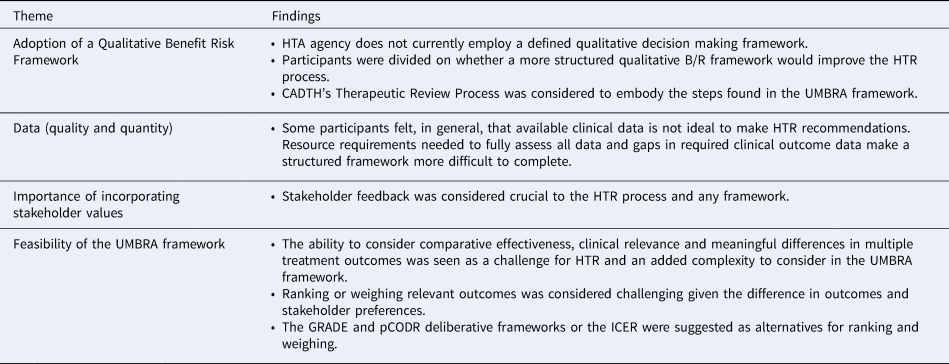
Qualitative interviews were conducted with eight participants meeting the inclusion criteria. One additional interview was scheduled but this participant was excluded as they did not have experience with HTA and/or HTR for prescription medicines and had not participated in qualitative decision-making framework research. Participants ranged from individual contributors to director level positions and held clinical, economic, stakeholder outreach, and policy positions. Among participants there was a varying degree of knowledge of qualitative benefit-risk frameworks and this research was not top-of-mind. Two participants of the eight indicated that they had participated directly in research regarding qualitative benefit-risk frameworks (one within an agency and another in a previous role) while a third indicated some involvement in such research. None of the participants were currently involved in research in qualitative benefit-risk frameworks. Participant interviews resulted in four common themes emerging (Table 2).
Summary of Themes and Findings

Adoption of a Qualitative Benefit Risk Framework
All participants agreed that their organization does not currently employ “a defined qualitative decision-making framework” (Interviewee 4). Participants were familiar with a few general Canadian frameworks and a process for HTR. These included, the Common Recommendation Framework which supports CADTH's drug expert committees in making recommendations to the participating jurisdictions to guide reimbursement decisions (29). This framework includes CADTH's recommendation categories (reimburse, reimburse with clinical criteria and/or conditions, and do not reimburse) and highlights some of the factors that CADTH's drug expert committees, in formulating a reimbursement recommendation, will consider to provide guidance to the participating jurisdictions (29). CADTH's Therapeutic Review Framework and Process was discussed. This framework is used for non-oncology prescription medicines by CADTH's and their expert committee to make HTR recommendations (16) (Table 1). Finally, the pan-Canadian Oncology Drug Review (pCODR) Expert Review Committee Deliberative Framework was described as outlining considerations for the oncology expert review committee to formulate a funding recommendation (30).
In general, participants felt that CADTH's Therapeutic Review Process was considered to embody the steps found in the UMBRA framework.
One participant re-emphasized this point by stating:
You know each of these eight elements, I would say, are already part of the [CADTH Therapeutic Review] process, they are just not laid out in this sort of discrete parcel of steps (Interviewee 2).
Participants were divided as to whether UMBRA's structured set of decision steps would provide additional value in light of current agency processes. About half of the participants felt that the UMBRA framework could provide a more structured approach to HTR assessment. One participant felt, it would be:
Nice to have this kind of framework in place, from a conceptual perspective, to say that this is the approach we take and we consistently apply, so that it is clearer (Interviewee 2). This participant continued:
It's actually a long standing question for us…we have a more defined recommendation framework but the deliberative sort of framework and other pieces of the framework that we use for coming up with our reviews have always been a bit more nebulous and not well defined. There's been many people… that said well we already do it, so what is the point of actually documenting it… others have said it needs to be clear to our stakeholders,… that we take a consistent approach to every review. I see the benefit of having something laid out because I like the idea … that we apply consistency across each of the reviews. I think the one caveat to that would be that sometimes…, especially from the expert committee, … they feel handcuffed by a framework (Interviewee 2).
Another participant reiterated the need for HTR reviewers and experts to have a more systematic approach to evaluating drug therapies and provided additional comment on the steps in the UMBRA framework (see Figure 1 for UMBRA steps) where it was felt more clarity would be welcomed:
I think we need a more systematic approach in our process for evaluating therapies and part of that is being explicit on the guiding principles that we have… I think really being clear on Steps 1 through 4 can help us (Interviewee 3).
Data (Either Too Much or Not Enough)
Data requirements were a consideration when it came to an HTA agency adopting a qualitative benefit-risk framework. Participants highlighted the number of treatments and associated studies with potentially relevant HTR outcomes but which may not be comparable given different clinical study designs. Specifically the additional resource requirements to enact a structured benefit-risk framework for HTR assessment versus a Regulatory review were a concern for two participants. The lack of data, as it relates to comparable evidence, was also highlighted. One participant states:
There are a lot of outcomes that you would love to have but you know based on experience, based on inputs from clinical experts, they are simply not studied in clinical trials (Interviewee 4).
In these cases, if feasible and justified methodologically, assessors may generate their own comparative evidence of a technology undergoing HTR and alternative treatments through indirect comparison. Even so, data gaps can exist and some participants felt this concern was alleviated, through transparent disclosure, when called out in an HTR recommendation.
Importance of Incorporating Stakeholder Feedback
Stakeholder feedback (in addition to the contribution from agency and expert committee members) was considered crucial to the HTR process. Participants defined stakeholders broadly, but mainly identifying clinicians, patients/patient groups, and drug-plan personnel as stakeholders and less frequently mentioning industry and the general public as stakeholders. One participant particularly emphasized the need for additional stakeholder input from the patient:
I think you would need more stakeholders to really work in the values, within our process you have the evidence from clinical trials but the values come from the lived experience from the patients (Interviewee 6).
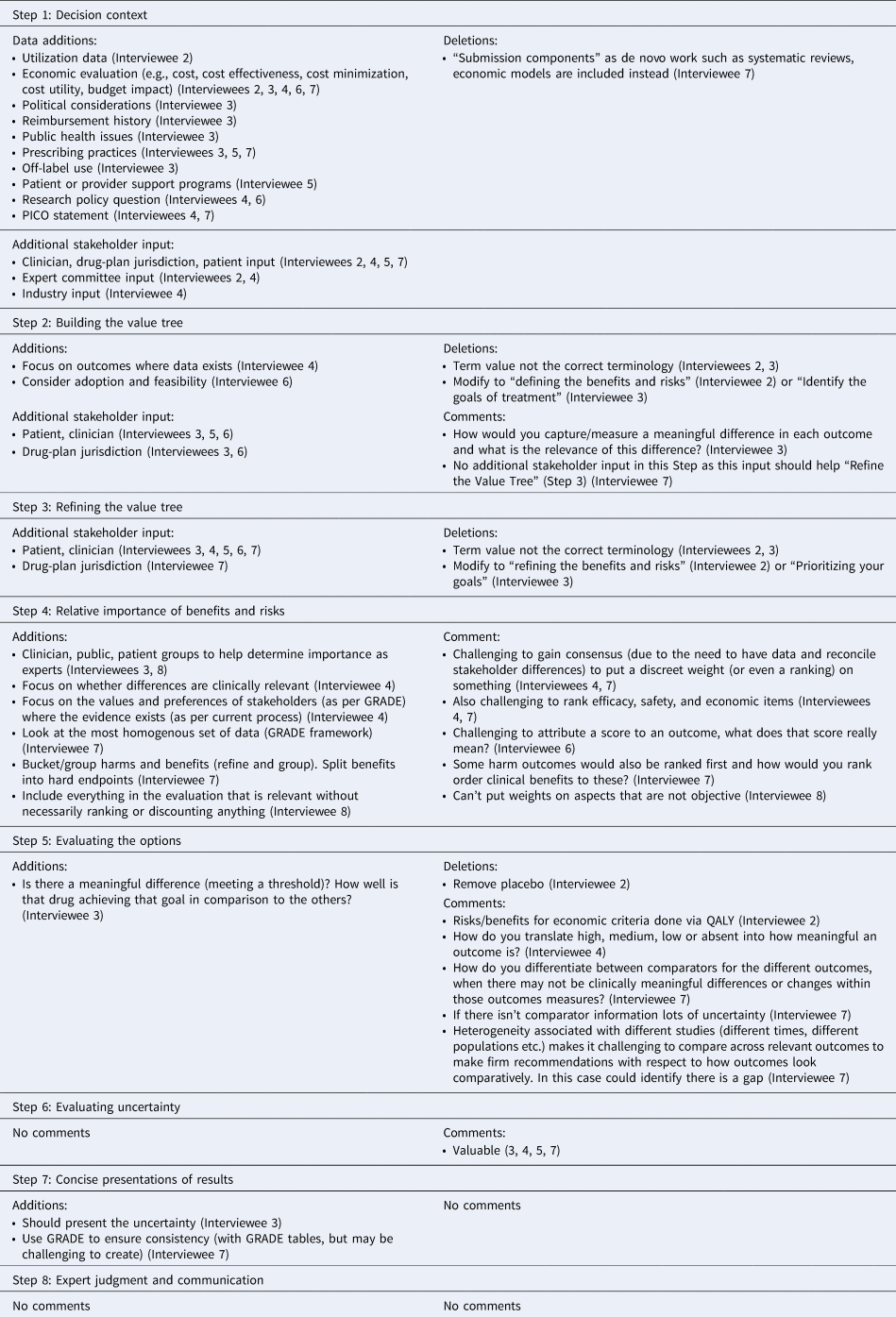
For the most part, it was felt that stakeholder input should be sought and/or considered in Steps 1–4 (Table 3). One participant provided a different perspective indicating that additional stakeholder feedback could refine the list of benefits and risks in Step 3. This participant felt that stakeholder feedback may not be required in Step 2—Building the Value Tree where reviewers/assessors select relevant risks and benefits for consideration but instead stakeholder feedback should be integrated into Step 3—Refining the Value Tree.
Suggestions for HTR UMBRA Revisions

Feasibility of the UMBRA Framework
Participants reviewed each step of the UMBRA framework providing their insights into if and how these steps could be modified for applicability to HTR. Table 3 describes participant's feedback, specifically, UMBRA framework additions, deletions, and general comments.
The main criticism of the UMBRA framework by some participants related to Steps 2–6 and their applicability to HTR. First, the approach to defining/prioritizing risks and benefits was considered to be different for HTR. One participant stated:
The process makes a lot of sense… but, I really feel it is important to talk about the change in benefit that is important and not just the outcome. It's talking about identifying the relevant outcomes and what would be a meaningful impact to people (Interviewee 3).
This participant went on to say:
You have to think about how these outcomes are able to be measured and collected and whether you are able to actually capture a meaningful difference. You kind of need to know which ones matter but also, what is a meaningful difference in each of these outcomes? (Interviewee 3).
The ability to consider comparative effectiveness, clinical relevance, and meaningful differences in multiple treatment outcomes was seen as a challenge for HTR. Given this complexity, some participants felt it would be challenging to methodically complete some steps in the UMBRA framework.
Step 4 of the UMBRA framework involves (as applicable) the reviewer applying “expert judgment to rank or weigh the relative importance of the benefits and risks/harms, according to the perspective of the decision makers or other stakeholders” (Reference Walker, McAuslane, Liberti, Leong and Salek10). However, half of the participants felt that the number of different outcomes (e.g., efficacy, safety, societal, and economic) considered in an HTR and differing stakeholder values could pose a challenge in gaining consensus. One participant stated:
You are going to have to reconcile differences of opinion on how the clinical expert feels about a particular endpoint versus how a patient group feels versus a manufacturer, there's always going to be some differences there so I think it can be really challenging to put a discreet weight on something (Interviewee 4).
Two participants believed this step to sound like Multi Criteria Decision Analysis (MCDA) which one believed had not “caught on the way people thought it would” (Interviewee 8) or didn't “think there is clear consensus in the HTA world on this idea of ranking or weighing endpoints” (Interviewee 4).
Instead a few participants mentioned the Grading of Recommendations Assessment, Development and Evaluation (GRADE) framework as a way to rank or weigh endpoints (31):
I think it is done, in an informal manner, but more so in that GRADE style of individual values and preferences as to how particular experts feel about particular outcomes (Interviewee 4).
This participant also believed that these types of statements were important to ensure transparency around a committee's thinking and how they interpreted all the different endpoints. A few participants believed the existing frameworks, such as pCODR's deliberative framework (30), could be an alternative to ranking and weighing and one felt the incremental cost-effectiveness ratio (ICER) already accomplished this goal. Another reference was made to the potential value of using GRADE tables (31) for presentation of summary data to ensure consistency and user comprehension.
Discussion
In today's environment, policy-makers face considerable challenges. They are asked to meet a population's demands and expectations; however, they must do so with limited healthcare budgets. Scarce resources must be allocated strategically to maximize population health outcomes. Reassessing the value of potentially wasteful health technologies would allow the partial or full cessation of funding allocation to these technologies with the possibility to reallocate funds to technologies with greater benefits (e.g., clinical effectiveness, quality of care, and cost effectiveness) (Reference Soril, MacKean, Noseworthy, Leggett and Clement15).
HTR is a tool to realize this goal as the assessment phase allows traditional HTA methods (usually reserved for managing the adoption of new technologies into a healthcare system) to be applied to a therapeutic category or class of drugs to actively manage economic re- or dis-investment opportunities. This allows a greater economic equilibrium as funds can be reallocated throughout a health system budget, optimizing value for money. Overarching challenges do exist in conducting and implementing HTR for medicinal products. These include: the lack of relevant evidence and comparative data; lack of transparent HTR mechanisms, heterogeneity in patient outcomes; lack of collaboration; political and social barriers; and stakeholder loss aversion, entitlement, inertia, and entrenchment (Reference Maloney, Schwartz, O'Reilly and Levine13;Reference Elshaug, Watt, Moss and Hiller32–Reference Esmail, Hanson, Holroyd-Leduc, Niven and Clement34).
The UMBRA framework, a qualitative benefit-risk framework, was developed to improve the transparency, consistency, and rigor of health authority's decision-making processes and to facilitate the presentation and dissemination of relevant decisions/recommendations and accompanying rationale in a systematic and standardized way (Reference Walker, McAuslane, Liberti, Leong and Salek10). This framework includes steps to: gather relevant data, determine and refine the benefit and risk outcomes of interest, rank these benefits and risks, compare to comparators/alternatives, evaluate the uncertainty regarding the type and magnitude of the benefits and risks, provide a conclusion and recommendation (including expert judgment), and present results/conclusions (Reference Walker, McAuslane, Liberti, Leong and Salek10). Given the purpose of qualitative benefit-risk frameworks and the structure of the UMBRA framework, it was postulated that the implementation of this framework within the HTR assessment process could alleviate some of the above described challenges.
Canadian HTA agency assessors provided their insights as to whether the UMBRA framework could be used or modified for HTR to meet decision-making and communication needs. Four common themes were identified. In general, participants felt that CADTH's Therapeutic Review Process embodied the steps of the UMBRA framework. However, the Therapeutic Review Process was preferred for both the variety and timing of stakeholder feedback, and for the absence of ranking or weighing. Participants recognized that the Therapeutic Review Process does not currently include a transparent, deliberative qualitative framework (e.g., the UMBRA framework) to aid CADTH and CADTH's expert committee in decision-making and recommendation dissemination. The authors and several participants believe that integrating a qualitative framework into the Therapeutic Review Process could aid deliberations to produce a recommendation, ensure specific criteria are considered, provide consistency in considerations and frame recommendations through a concise summary of the evidence considered and judgments made. This could further progress the implementation of a recommendation at the jurisdictional level and provide additional context for stakeholders affected by a decision. To develop a deliberative qualitative framework, both a process and a set of guiding recommendation criteria are required.
Limitations
The aim of qualitative description is a rich, straight description of an experience or an event (Reference Neergaard, Olesen, Andersen and Sondergaard19). However, “descriptions depend on the perceptions, inclinations, sensitivities and sensibilities of the describer” (Reference Giorgi35). This introduces the possibility that researcher bias could present in reporting the results of the study. To minimize such limitations, this qualitative descriptive study design included various expressions of rigor and enhancement techniques (Supplementary Table 2).
This research focused on Canadian HTA agency assessors past experiences and insights to inform any modifications to the UMBRA qualitative framework. Experiences and insights from other key stakeholders such as other drug formulary managers (budget holders), patients (users), and prescribers (healthcare providers) were not sought in this research and therefore did not inform the study results. Future research, should a deliberative qualitative decision framework be drafted or modified, ought to include stakeholder framework feedback to ensure usability and functionality. In addition, if piloted, the impact of a deliberative qualitative benefit-risk framework could be assessed in terms of the efficiency and transparency of the process and the applicability of any recommendation criteria used.
It is unknown whether the experiences and themes revealed by this study, conducted with eight participants, can be extrapolated to other Health Technology Agencies across geographical areas and social contexts. This is a methodological and qualitative question that needs to be addressed through further research, potentially by developing a qualitative recommendation framework for one HTA agency and assessing the need for modification with other agencies.
Conclusions
This research highlighted that a deliberative qualitative recommendation framework for use by both HTA agency assessors and expert committees could be a beneficial addition to an HTR process. Such a framework could enhance the consistency (through development of a standard set of criteria for consideration) and transparency (with the use of a publicly available dashboard) of the decision-making process. Research participants did not consider all steps of the UMBRA framework to be transferable to the assessment phase of HTR though they did acknowledge some strengths. Participants emphasized the complexity of HTR, given the lack of comparative data yet need to consider comparative effectiveness, clinical relevance and meaningful differences. They also emphasized the importance of stakeholder input throughout the HTR process (particularly that of the patient, their caregivers, and the clinician). Simplicity, resource efficiency, and stakeholder input are points for consideration in the development of a qualitative recommendation framework for HTR. HTA agency assessor experiences and insights and resultant key themes can be used in future research to aid in the development of a qualitative recommendation framework for HTR.
Supplementary material
The supplementary material for this article can be found at https://doi.org/10.1017/S026646231900062X
Conflict of interest
This work has been completed in partial fulfillment of the requirements for Mary Alison Maloney's PhD degree in Health Research Methodology at McMaster University. In addition, Mary Alison Maloney works full-time as the Vice-President Regulatory Affairs Radiology for Bayer US LLC. This work was carried out independently of any affiliation or information exchange with Bayer. Dr. Lisa Schwartz's Arnold L. Johnson Chair in Health Care Ethics is funded through a private endowment; Dr. Schwartz was a member of an Expert Review Panel for CADTH until April 2017. Dr. Mitchel Levine and Dr. Daria O'Reilly have no potential conflicts of interest. This research received no specific grant from any funding agency, commercial, or not-for-profit sectors.
Ethical standards
The authors assert that all procedures contributing to this work comply with the ethical standards of the relevant national and institutional committees on human experimentation and with the Helsinki Declaration of 1975, as revised in 2008.