Early in the twentieth century, before Canada’s federal and provincial governments had begun to provide even a capilliform safety net for their citizens, a welfare state was under construction in Canadian cities. This urban welfare state was stingy but expansive, covering policies as diverse as hospital care, children’s services, elderly homes, poverty assistance, immigrant services, public health, and early experiments with social assistance. The relationships among the many agencies that administered these services were complex but, by the 1920s, extensively coordinated. In Toronto, for example, the tasks of public and private fund-raising had been given to a municipal commission and a fund-raising federation; casework and client assignment had been centralized in an association of social workers; even the service delivery tasks of the agencies themselves had been subtly reshaped by years of pressure from local and provincial coordinating bodies. If the welfare state is in fact a complex ecology of public and private actors and agencies—as a number of Canadian and American scholars have recently suggested—then the Canadian welfare state was born in the late nineteenth and early twentieth centuries, and it was born in cities like Toronto.
My purpose in this article is to explain the early processes of coordination and centralization—understood as the consolidation of funding, administration, and/or service provision in a smaller number of agencies and on larger geographic scales—through which this mixed welfare state was created, using the city of Toronto as a case study. Drawing on coalitional approaches to institutional and policy change, I will argue that social policy centralization in Toronto occurred as a result of the interaction between three coalitions in the city’s social policy field and the larger-scale demographic and economic forces that strengthened and weakened these coalitions over time. The result of this jostling among local coalitions, and the innovations that they introduced along the way, was a transformation of governing authority in Toronto’s social policy sector and a first glimpse of what has come to be called the “delegated” welfare state.
Canadian and American Social Policy: Recent Revisionism and the Toronto Case
The traditional story of the Canadian welfare state is one of abrupt and transformative change. Prior to World War II, the story goes, social policy was dominated by a “residual” understanding of social need; the purpose of the public relief agency was to step in only when all other avenues of support were exhausted. This residual view persisted until the shock of the Great Depression made Canadians aware of the arbitrariness of poverty and the systemic causes of need, opening the door for the modern, comprehensive welfare state that emerged during and after World War II.Footnote 1 While many scholars have added to this narrative by noting the initiatives that emerged at the provincial level in the interwar period—such as workmen’s compensation and mother’s allowances—these provincial-level changes are typically interpreted as preliminary to the much more transformative welfare state that emerged in the postwar era.Footnote 2
This traditional story, in Canada as elsewhere, has recently come under serious questioning as a new generation of historians and social scientists have sought to explore the continuities between the prewar and postwar eras. Amid social welfare cutbacks and a resurgence of antistate and provoluntarism rhetoric in the 1990s, scholars began to investigate the deep linkages between “private” charities and “public” social policy. Mariana Valverde, who led the revisionist charge, proposed the concept of the “mixed social economy” to describe the historical relationship between charity and social policy in Canada; her work sought to “rewrite the terms of the debate by deconstructing the binary opposition between public and private, state and civil society through both empirical evidence drawn from the field of social service provision and theoretical argument.”Footnote 3
In the years that followed Valverde’s work on the mixed social economy, a number of scholars have filled out the argument with additional empirical research. Shirley Tillotson has explored the development of Community Chests and modern charitable giving, arguing that charitable giving and welfare state development, far from being in tension with one another, are in fact deeply interrelated.Footnote 4 Xiaobei Chen has examined the “mixed social economy” of the Canadian child saving movement.Footnote 5 Gale Wills has explored the uneasy alliance between social workers and business elites.Footnote 6 And Paula Maurutto has studied the historical development of Catholic charities in Toronto.Footnote 7 Maurutto’s twofold argument in her carefully researched book reflects the basic thesis of the entire generation of revisionist scholars: first, since the state has always been involved in social welfare, the birth of the “modern” welfare state in Canada was more a change in degree than a change in kind; and second, the mixed social economy of the prewar era, characterized by deep relationships between private charities and state actors, did not disappear in the transition to the modern welfare state, but instead persisted in many areas of Canadian social policy. To understand welfare state history, these authors suggest, we need to understand both sides of this revised historical narrative: the ever-deepening involvement of the state in social welfare in the prewar period, and the persistence of the “private” charitable sector in the postwar era as well.
While it is possible to trace the “mixed social economy” back into the most distant reaches of Canadian history, most revisionist scholars share the view that the most important moment for the creation of the new mixed policy arrangements were the decades surrounding the turn of the twentieth century; in Ontario, this period runs from 1874, with the passage of the provincial Charity Aid Act, through to the Great Depression.Footnote 8 It was during this period that the state first became systematically involved in social policy, moving from a role primarily as an occasional (and inconsistent) donor to active coordination of social policy. What is also obvious in the revisionist scholarship—though this is rarely noted explicitly—is that this earliest mixed welfare state was decidedly urban in character. In areas of social policy ranging from child welfare to public health and hospitals to elderly care, it was in Canada’s rapidly industrializing cities that the country’s welfare state was born. Indeed, even the social policies that first officially emerged at the provincial level during this period—such as mothers’ allowances—were in fact initially urban in origin.Footnote 9 Thus, to understand this critical moment in welfare state history—the moment when Canadian social policy first took on an indisputably “mixed” character—we need to understand the cities, such as Toronto, in which it emerged.
The revisionist scholars have focused their attention primarily on establishing the mixed character of the Canadian charitable sector. Having done so, we now need to know more about the politics of social policy development within this early urban welfare state. Paula Maurutto has provided the first steps along this path, describing some of the political alliances and controversies that shaped the charitable sector at the turn of the century.Footnote 10 But we still lack clear answers to key questions in the historical narrative in Toronto. Why, after years of trying, did centralization actually begin in earnest in Toronto in the early twentieth century? Why did that centralization process emerge not only from state actors but also from the nongovernmental sector itself? These questions are central to the development of the urban welfare state, and they have not yet been tackled directly. I will provide a coalitional perspective from which to begin to answer them in my discussion below.
Interestingly, the Canadian revisionist literature on the relationship between the charitable sector and the welfare state has developed alongside a similar literature on the historical development of the American welfare state. Against an earlier generation of scholars who focused their attention on the supposed absence of a strong welfare state in the United States, a number of social policy scholars have argued that the American welfare state is not so much weak as it is different from other models, characterized by policy instruments that are less visible, such as tax rebates, public-private partnerships, and regulated private pensions. In Europe, many local and charitable agencies were displaced by the state in the transition to the modern welfare state, but in the American case, the state became increasingly active in social policy without necessarily replacing the earlier agencies. Thus American social policy, much like the Canadian example above, has a deeply “mixed” character, in which social policy is coordinated, regulated, or funded by the state while administration and service provision is often delegated to nongovernmental actors.Footnote 11
This emphasis on the “hidden,” “delegated,” “submerged” welfare state in the American social policy literature suggests that the emergence of coordinated but mixed forms of social provision in Canadian cities may also have implications for our broader understanding of welfare state development. In this article, I focus on describing and explaining the processes by which urban social provision became increasingly linked to and coordinated by the state around the turn of the century. This process of centralization was not unique to the Canadian city. While my focus in this article is on a single city—Toronto—the forms of coordination and centralization that emerged in Toronto at the turn of the century were similar to, and occasionally inspired by, similar processes in other Canadian and American cities, including Vancouver, Montreal, Cleveland, and Chicago.Footnote 12 The Toronto case can therefore serve as a useful first step in understanding the broader comparative history of how the delegated welfare state was first constructed in the North American urban context.
Thus, in the argument that follows, my goal is not to dispute the importance of the transformation that the Canadian and American welfare states experienced in the middle of the twentieth century, nor will I explain the persistence—which was marked in both countries—of the delegated welfare state throughout that later transformation. Instead, my goal is to understand the emergence of the delegated welfare state at the urban scale prior to this transformation. The birth of the delegated welfare state at the urban scale represented a critical first step from private to public (or, more precisely, from “mostly private” to “mixed”) in welfare state history, and the persistence of key features of that welfare state, in areas as diverse as family and child services, health care and hospitals, public health, and even social assistance, makes it especially important for social policy scholars to understand the origins of the mixed welfare state at the urban scale.
Policy Coalitions, Political Resources, and the Urban Welfare State
As I have suggested above, the recent literature on the “mixed social economy” in Canada and the United States reveals the importance of early centralization processes in cities like Toronto. Drawing on recent coalitional theories of institutional and policy change—in which changes are understood in terms of the coalitions of ideas, actors, and institutions that exist in a policy field and the resources that strengthen or weaken those coalitionsFootnote 13—I will argue below that the social policy field in Toronto during this period contained three overlapping coalitions, which I will call the “municipal traditionalists,” the “municipal progressives,” and the “social work professionals.” Each of these coalitions was composed of particular individuals, political organizations, and policy ideas, and each brought different resources to bear—time, organizational capacity, reputation, knowledge of other cities, access to councillors or possession of council seats—in ongoing arguments about the scope and shape of the local welfare state.Footnote 14 Over time, I will argue, larger-scale processes of urban growth and municipal finances, together with the salience of new ideas related to urban reform, served to strengthen some coalitions and weaken others while also reshaping the patterns of alliance and competition among them. While this argument is by no means decisive—additional comparative studies will clarify the relative importance of the larger-scale changes that reshaped the local policy field—it does appear to explain patterns of centralization in Toronto at the turn of the century. I therefore begin with a brief outline of each of the three coalitions.
First, the municipal traditionalist coalition. At the core of this tradition was a commitment to a hands-off relationship between municipal government and local charity. Among the most important members of this coalition were Christian leaders, both Protestant and Catholic, who believed that charitable service was the proper domain of the city’s religious communities. United with these religious leaders were many municipal politicians, who were committed to the classical liberal view that charitable giving was best left to nongovernmental agencies. Traditionalists were not opposed to financial support for local charities from municipal or provincial governments, provided that few strings were attached, but they were often skeptical about the potential for genuinely helpful social support from secular public institutions. Secular and public charity, they argued, would have a cold and “unchristian” character, fostering depression and dependency rather than improvement and uplift.Footnote 15
The municipal progressive coalition was composed of business leaders, academics, and public intellectuals who were enthusiastic about an emerging vision of modern, efficient, scientific municipal administration. As in the United States, these “urban reformers” have received considerable attention from historians and social scientists in Canada; some argue that they were genuine idealists, others that they were self-interested speculators, and others that their interests were diverse and often highly pragmatic.Footnote 16 For the purposes of welfare state history, however, what is most important about the municipal progressives were their policy arguments: a commitment to research and statistical analysis of municipal administration; extensive sharing of “best practices” across municipalities; and a vision of municipal administration as a nonideological matter of scientific analysis and businesslike decision making.Footnote 17 In the social policy field, this meant that direct municipal involvement in social services should be limited and that municipal grants to charitable agencies should be conditional on efficient management and minimal overlap among agencies. Civic organizations like the Bureau of Municipal Research, along with organizations of business leaders such as the Toronto Board of Trade, were at the heart of this new municipal progressive coalition.
For those in the social work professional coalition, the municipal traditionalists were admirable in their devotion to charity but lamentably naive. A scattered collection of well-meaning churches, they argued, was insufficient to solve the immense challenges of urban social life. Instead, the social work professionals argued that what was needed was science: careful attention to the kinds of individuals who sought relief, extensive recordkeeping to ensure that genuinely needy individuals were supported while fraudulent double-dipping was minimized, and ongoing casework to assign individuals to the most appropriate sources of social provision. Members of this coalition were enthusiastic about—and increasingly trained in—the emerging profession of social work, and some were employed full-time by new organizations such as the Neighborhood Workers’ Association, the Catholic Charities, and the Federation for Community Service.Footnote 18 While the social work professionals shared a great deal in common with municipal progressives—and some individuals crossed comfortably between the two coalitions—social work professionals put more emphasis on the need for increased public funding of social welfare and increased state involvement in actual welfare provision, and as we will see below, social work professionals were determined to give authority over social policy issues to social workers rather than efficiency-minded businessmen.Footnote 19
Through the late nineteenth and early twentieth centuries, these three coalitions jostled for jurisdiction in Toronto’s social policy domain. Each coalition was aligned with the others on particular dimensions of debate. On matters of scientific efficiency, statistics, and coordination, social work professionals and municipal progressives aligned with one another against the traditionalists.Footnote 20 On the importance of private charity and lean municipal government, traditionalists and progressives found themselves on common ground. Even the social work professionals and the traditionalists agreed on the importance of urban social services and the need for municipal and provincial funding for the social services sector. As we will see, two larger forces—increases in municipal spending and the increasing role of social work in Toronto—led to the decline of the municipal traditionalist coalition and increased state involvement in the urban welfare state.
The Urban Welfare State: An Overview
Before I describe the processes of centralization in Toronto’s social policy arena between 1870 and 1930, I will begin with a brief overview of the urban welfare state itself. At the turn of the twentieth century, Toronto’s urban welfare state was organized into two basic categories: indoor and outdoor relief. Outdoor relief agencies provided services and supplies to needy residents who remained in their own homes: coal and wood for winter furnaces, blankets and clothing, basic foodstuffs, and in rare cases, small cash donations. Several large agencies provided outdoor relief during this period—the most important was the House of Industry, a quasi-public poorhouse that provided relief to hundreds of individuals each year—along with an enormous array of smaller agencies, many of them affiliated with neighborhood churches.Footnote 21
The other side of social welfare provision in Toronto were “indoor” relief efforts in institutions such as hospitals, orphanages, and elderly homes. We can divide these agencies into four broad categories: health care, maternalist provision, elderly care, and other services. In health care, some twenty-three distinct institutions were active by the turn of the twentieth century, and by the early 1920s the number had grown to nearly fifty. These institutions included general hospitals, hospice care, pharmaceutical dispensaries, and specialist hospitals. While few of these institutions were entirely free—those who could afford to pay were expected to do so—most were subsidized by municipal and provincial governments. By the early 1930s, Toronto’s provincially subsidized hospitals had a capacity of more than 3,500 beds and treated nearly 70,000 patients each year.Footnote 22
A second important area of indoor relief was “maternalist” policy: services related to children and to women in their capacity as mothers.Footnote 23 This domain experienced considerable upheaval in the early twentieth century as a new movement of child welfare activists argued for foster care rather than institutionalization of orphaned children.Footnote 24 Despite the passion of the new movement, foster-care services did not replace orphanages in Toronto, but were instead layered atop the existing array of child welfare institutions.Footnote 25 By the 1930s, maternalist institutions in Toronto included long-term children’s homes, foster services, day-care services for children of working mothers, and “rescue homes” for single mothers and sex workers.
The third domain of indoor relief was elderly care. While old-age poverty would remain a matter of deep concern in Toronto and other Canadian cities until—and indeed after—old-age pensions were created in the late 1920s, the city had nevertheless created at least thirteen publicly subsidized old-age homes by the early 1930s. Many of these homes were affiliated with local Catholic, Jewish, and Protestant churches and societies, but most welcomed residents of any denomination or faith.Footnote 26
In addition to health care, maternalist services, and elderly care, a variety of other institutions were also active in Toronto in the early twentieth century. These included addiction treatment facilities, immigrant settlement services, neighborhood settlement homes, employment resource centres, prison relief societies, and many others. Then as now, these agencies emerged and evolved to match the latest ideas about social welfare, effective treatment, and the causes of poverty.Footnote 27
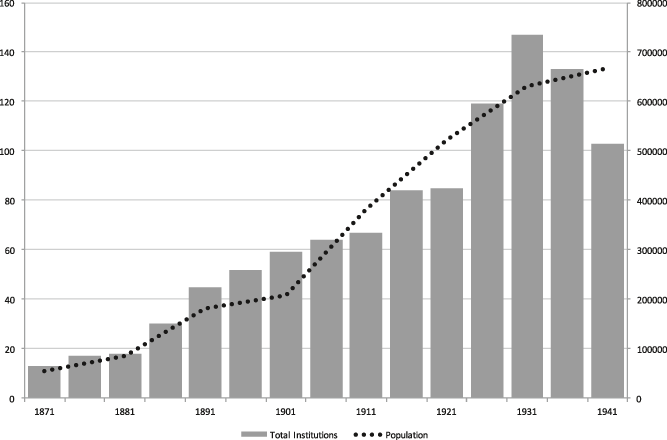
Thus, by the 1930s, Toronto’s urban welfare state included a complex ecology of institutions: religious and secular, public and private, indoor and outdoor, large and small. The size of the social sector had expanded rapidly over time. Figure 1 provides an overview of the social service agencies listed in the Toronto Municipal Directory at five-year intervals between 1871 and 1941, capturing the rapid growth in the overall institutional population—a growth rate of nearly 20 percent per decade, paralleling the rapid growth of the city’s population during the same period.Footnote 28
Social Welfare Institutions in Toronto 1871-1941

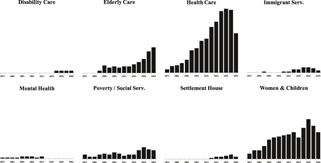
Figure 2, which disaggregates the overall totals into smaller categories, suggests that the explosion of social agencies was partly due to new categories of care, such as disability care, settlement houses, and immigrant services. But the bulk of the growth came from just three categories: health, women and children, and the elderly. In 1931, for example, the Toronto Municipal Directory listed 88 more social service agencies than had existed at the turn of the twentieth century. About 10 percent of this growth was due to new categories of service, such as disability care, but the remainder came from growth in categories that had already existed in 1901. In fact, nearly half of the growth was from increases in health agencies alone.
Growth of Charitable institutions by Category

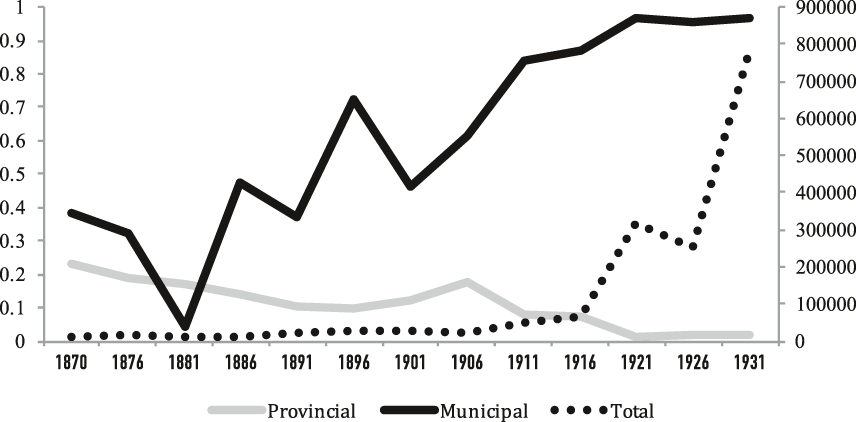
Who paid for these new agencies? Figure 3 provides a longitudinal perspective on Toronto’s largest outdoor relief agency—the House of Industry—drawn from its annual financial reports.Footnote 29 The solid black and gray lines in the figure mark the proportion of each institution’s budget from provincial and municipal sources; the dotted black line, on the secondary axis, records the institution’s total annual operating expenditures. By the late 1880s, nearly half of the House of Industry’s budget was provided by Toronto’s municipal government, and this number had increased to about 75 percent by 1910. By the time of the Great Depression, the House of Industry had become almost entirely dependent on municipal funds.
Toronto House of Industry: Provincial and Municipal Contributions (Proportions) and Total Operating Budget

To summarize: by the early twentieth century, social policy in Toronto had grown into a complex tangle of institutions. This was an era of “functional, overlapping, competing jurisdictions”—agencies were voluntarily created to undertake narrow social policy functions; the services provided by one agency almost always overlapped with those of other agencies; and per-patient government grants, not to mention the usual challenges of fund-raising and donor fatigue, meant that agencies often competed with one another for money and clients. It was within this disaggregated context, as we will now see, that processes of social policy centralization and coordination emerged.
Social Policy Centralization in Toronto
Coordination of urban social provision in Ontario cities began in the 1870s at the provincial rather than the urban scale. Canada’s new constitution in 1867 had assigned hospitals and charitable institutions to provincial jurisdiction. To oversee the institutions that received provincial funding, the Ontario government appointed John Langmuir, a business owner and former mayor of Picton, Ontario, to serve as its inspector of prisons, asylums, and charities.Footnote 30
For the first few years of his tenure, Langmuir’s inspection efforts were devoted almost exclusively to prisons and asylums; only in his third annual report did hospitals and charitable institutions even appear in his financial tables. In 1872, however, the government asked Langmuir to make an investigation of the province’s charitable institutions, with a special focus on sorting out just where the province’s money was going.Footnote 31
Langmuir’s report, submitted to the government on July 18, 1872, serves as a remarkable articulation of standard nineteenth-century liberal views about local welfare. Langmuir began by dividing charities into three categories—hospitals, poorhouses, and orphanages—each of which, he argued, merited provincial funding for a different reason. Hospitals, the first and most expensive category, deserve support because they prevent short-term illnesses from developing into chronic disabilities, thus aiding in the speedy recovery of those who might otherwise be “permanently withdrawn from the working and wealth producing population of the Province.”Footnote 32 Poorhouses, by contrast, are properly the responsibility of municipal governments, and provincial aid ought to be limited to covering the costs of nonlocals such as immigrants and the “wandering poor.” As for orphanages, they too are best left to local philanthropy; Langmuir, struggling to discern a compelling rationale for provincial support, argued weakly that ill-treated orphans today would become a tax upon the province’s health care and criminal justice systems tomorrow. In any case, Langmuir concluded, the cost involved in supporting the orphanages was low. “It is therefore very clear,” he wrote, “that even in the interests of public economy, to say nothing of humanity, it is expedient to assist [the orphanages] with Provincial funds.”Footnote 33
Having provided a rationale for provincial support, Langmuir then outlined how such support should be structured. For poorhouses and orphanages, the goal should be a fair distribution of funds: institutions with similar numbers of residents ought to receive similar funding levels. The funding scheme should also rely on matching equations, forcing local institutions to seek support from nonprovincial sources as well. For local hospitals, Langmuir proposed a more ambitious plan. Each county or district across the province would be assigned to a hospital, with the site and construction of new hospitals subject to government approval. Every hospital would be governed by a board that included three provincial appointees, one of whom would serve as chair. All hospital bylaws would be subject to government approval. If a hospital met these conditions, it would receive a provincial matching grant.Footnote 34 Had these proposals been implemented, the result would have been a decisive shift toward a public and centralized health-care system, perhaps the first of its kind in the developed world.
In the end, none of Langmuir’s suggestions were accepted by the government. In his next annual report, Langmuir reminded his readers of the gross inadequacy of the present system and proposed a more modest package of reforms. Without denying the appeal of a provincially coordinated hospital system, Langmuir admitted that “it is perhaps inadvisable to make sweeping changes in the medical and domestic administration of all the Hospitals in order to remedy defects that exist in one or two.” Instead, the government would do well to focus first on the question of funding, providing money to each kind of charitable institution on the basis of the number of patients under its care.Footnote 35 The province’s social apparatus, such as it was, would remain overwhelmingly urban in character and scale.
Ontario’s Liberal government, under the leadership of Premier Oliver Mowat, accepted Langmuir’s more modest proposals, and in 1874 the government passed the Act to Regulate Public Aid to Charitable Institutions.Footnote 36 The statute gave the government new authority in the area of governance—founding bylaws for hospitals and poorhouses were now to be subject to government approval—but the primary focus of the statute was funding. Hospitals would receive thirty cents per patient per day, poorhouses seven cents, and orphanages one cent, provided that the institution raised sufficient funds from nongovernmental sources as well. The aim was to provide a fair distribution of provincial funds while encouraging local institutions to keep their eyes fixed on securing funding from local donors and municipal governments as well.Footnote 37
What were the effects of this first instance of centralization in Ontario? According to some, the Charity Aid Act led to a flowering of local charitable institutions; Andrew Jones and Leonard Rutman, for instance, note that the number of government-supported hospitals, poorhouses, and orphanages exploded during the two decades that followed the statute.Footnote 38 While this explosion of institutions was certainly real, the role of the new funding scheme in stimulating the growth is unclear; as I noted above, all charitable institutions were growing during this period, regardless of their provincial funding. Moreover, much of the institutional growth to which Jones and Rutman refer was more a matter of reporting than creation, as existing institutions were simply added to the list of those receiving government support.
A more significant effect of the Charity Aid Act, in my view, lies in the statute’s formal division of local charitable institutions into three distinct kinds, each of which would receive very different levels of funding. This had two effects. First, because hospital funding was much more generous than the others, some institutions drifted in the direction of hospital care; the Toronto Infants’ Home, for instance, came to think of itself increasingly as an infirmary, and received additional provincial grants based on its new hospital-like status.Footnote 39 Second, Langmuir’s enthusiasm for the funding scheme meant that local institutions faced new pressure to specialize in a particular type of charitable work. This was especially true of hospitals; since the motivation for generous hospital funding was to return Ontarians quickly to the workforce, Langmuir advised hospitals to leave “the work of caring for the aged and infirm, as well as those afflicted with incurable disease, to Houses of Refuge.” When some hospitals refused to move their long-term patients, Langmuir persuaded the provincial government to give him the authority to limit hospital funding to patients who had been in residence for less than nine months; for long-term patients, hospitals would receive funding identical to the poorhouses. While my evidence is only partial, and is based primarily on Langmuir’s own reports, it does appear that the new statute served to stimulate government-funded hospitals to specialize in short-term treatment, leaving long-term care to other institutions.Footnote 40
By the mid-1870s, then, the first stages of a “mixed” or “delegated” welfare state—social provision funded and loosely regulated, but not provided, by the state—had emerged in the Province of Ontario. That this first instance of coordination emerged at the provincial scale should not mislead us about the character of the existing welfare state, which remained decidedly urban. While provincial funding to local welfare and health agencies increased during this period, Langmuir’s perspective was traditionalist in nature: provincial funding would supplement local revenues and, outside hospital funding, was justifiable largely as a means to pay for the nonlocals who would inevitably drift through the province’s urban centers.
While John Langmuir was working diligently to rationalize provincial expenditures, a handful of civic leaders in Toronto had begun to advocate for similar reorganization at the local level as well. Inspired by the international “Charity Organization” movement—a movement to centralize urban charity that had begun in London, England, and had spread to the United States in the late 1870s—a group of men and women associated with Toronto’s most prominent outdoor relief organizations met in February 1880 to discuss the prospects for a reorganized system of charitable relief in Toronto.Footnote 41
The motives of the men and women who gathered in 1880 were varied, but all of them shared at least one goal in common: to prevent fraud. The context, in Toronto as in other cities, was one of rapid urbanization and industrialization. In parallel with this population growth, as we have seen above, was an equally rapid growth in the charitable agencies in the city. The chaos of new social agencies seemed to make it possible for a wily individual to go back to the charitable buffet more than once—securing relief from one agency, such as the House of Industry, and then again from another, like the Ladies’ Relief Society—without anyone’s knowledge. Only by means of some form of coordination could this double-dipping be stopped.Footnote 42
In retrospect, this worry about imposture and fraud is not easy to understand. The tiny amount of aid provided to needy residents by institutions like the House of Industry meant that even someone who systematically extracted donations from all of the city’s outdoor relief agencies would hardly be making off like a prince. “Surely no one who ever visited any of our Houses of Providence or charitable institutions,” wrote a rare skeptical voice in 1886, “will say that the mass of suffering and afflicted creatures are congregated there in order to get a Government grant.”Footnote 43 To understand this worry, we must recognize that the real concern was not with the fraud itself, but with the deeper consequences of readily available relief: welfare dependency, or in the nineteenth-century version of the term, pauperism. For nineteenth-century traditionalist policymakers, steeped in voluntarist liberalism, growth in urban charitable agencies could only mean that their neighbours were becoming increasingly dependent on outside support. The purpose of charity, as Langmuir had argued a few years earlier, was to provide for those who had done nothing to put themselves in unfortunate circumstances: the widows, the orphans, the elderly, the seasonally unemployed. To do more than provide the barest charity, however, was to invite these unfortunates to think of themselves as worthy only of charity, keeping them from returning to hardy independence. The argument, suitably translated into contemporary rhetoric—avoiding welfare dependency, “a hand up and not a handout,” and so on—is as familiar today as it was to the men and women who assembled in Toronto in 1880 to try to reorganize the city’s outdoor relief sector.Footnote 44
What sort of reorganization did these men and women have in mind? At first, the ideas were ambitious. Toronto’s mayor, who spoke first at the meeting, proposed a wholly new agency, a “night refuge . . . where applicants for money, food, or shelter could be sent, while something like workhouses would be set up in order to provide employment for those who were able to work.”Footnote 45 The mayor assured his audience that his proposal did not imply the elimination of existing agencies, but the next speaker, Reverend D. J. Macdonell, quickly moved that “it is desirable to have one general organization for the relief of the poor of Toronto, which will secure through investigation into the cases of all applicants for relief, and thus on the one hand reach the really deserving, and on the other hand save the citizens from much imposition.”Footnote 46
Macdonell’s resolution was premature. For some, the proposed plan was too strong, serving only to weaken the valuable outdoor relief agencies that were already at work in Toronto. For others, the plan was too weak, creating yet another organization while doing little to tame the chaos of existing agencies. In the end, all that could be agreed at the first meeting was to form a committee to investigate the matter and report back in a month’s time.Footnote 47
The committee’s report proposed a structure for Toronto’s charities similar to the original Charity Organization Society in London: centralized administration of cases, district offices across the city to administer relief, and full coordination among frontline workers. This, too, never materialized—the idea was resisted with particular vigor by the House of Industry, whose leaders believed themselves to be well suited to do the necessary coordinating—and by the winter of 1880, the only innovation was a committee, the Toronto Combined Charities Committee, with plans to meet regularly to share and discuss possible fraudulent cases.Footnote 48
Thus, despite the grand ambitions, the role of the Combined Charities Committee, which reconstituted itself each winter from 1880 to 1884, was modest. Some insisted that the meetings had prevented dozens of cases of double-dipping; others thought that the committee had been little more than a conversation club.Footnote 49 For several winters, the committee sought to organize a workinghouse of its own, paying unemployed tramps for a day of stonebreaking or woodcutting. But the committee was never able to make this “labour test” a requirement for broader charitable support, so most of the city’s tramps, who were no fools, preferred the unconditional relief at the House of Industry to the backbreaking stonework of the Combined Charities’ refuge.Footnote 50
By the middle of the 1880s, Toronto’s Combined Charities Committee had completed the first full cycle in a rhythm that would persist for nearly three decades: an initial burst of enthusiasm and ambitious plans for centralization; resistance from existing agencies to any radical forms of restructuring; a few years of relatively modest and informal coordination; and then a year or two of quiet as the combined charities organization settled back into hibernation. These cycles of activity and dormancy produced a handful of modest gains through the years—including the appointment of a municipal relief officer, with some power to oversee the city’s charitable relief efforts—but they did little to change the structure of Toronto’s social welfare ecology.Footnote 51 The list of charitable agencies continued to grow, and with it grew the standard complaints about fraudulence, imposture, and pauperism.
Why did the Associated Charities repeatedly fail to grow into a coordinating body of any real strength? The answer to this question, I believe, helps to illustrate the utility of the coalitional approach. The principal cause of the Associated Charities’ failure was recalcitrance on the part of the House of Industry, borne both from interpersonal animosities and from wider disagreement between the traditionalist voices on the House of Industry Board and the fledgling progressives affiliated with the Associated Charities.Footnote 52 The Associated Charities was unable to overcome the resistance of the House of Industry largely due to the absence of the two processes that would soon emerge in Toronto: sufficiently high levels of municipal spending and the presence in the debate of social work professionals. The municipal traditionalists who dominated the field were not keen to see the municipal government take over the full cost of outdoor relief from the House of Industry, and given the House of Industry’s threats to simply close its doors if centralized management were forced upon it, a full takeover probably would have been necessary in order to bring about the Associated Charities’ desired coordination.Footnote 53 The result was a stalemate: similar arguments, year after year, for more than two decades, resulting in very little substantive institutional change.Footnote 54
As the nineteenth century gave way to the twentieth, however, a new argument, based in a growing coalition of municipal progressives, began to emerge in Toronto, one that would eventually lead to more thoroughgoing forms of centralization. The argument began with the premise that the city had a surplus of social agencies, often providing services that were barely distinguishable from one another. This premise in itself was not new; it was the foundation for the earlier arguments about pauperism and fraudulence as well. But the next premise was new: without denying the challenge of pauperism, the more important problem caused by this abundance of social agencies was waste. How could it possibly be efficient, the critics wondered, to have a dozen children’s homes, or seventeen institutions to care for the elderly? “How much better it would be,” argued one critic, “if all the city refuges for old people were centralized in one community and moved to the country, and the old people permitted to spend the evening hours of their lives in wholesome surroundings.”Footnote 55
This new argument marked the arrival, in the social welfare domain, of a new consolidationist ethos grounded in principles of efficiency, order, and scientific management. The argument was familiar, and enthusiastically articulated by municipal progressives, across the urban policy arena: Toronto’s many school boards had already been amalgamated into a single centralized board in 1903, and similar consolidation efforts were underway in public health as well. The goal was efficient, businesslike operation, grounded in modern scientific management practice. “The time has come,” the argument went, “when our giving must be systematized and our charities placed on a scientific basis.”Footnote 56
Practically speaking, the most important immediate outcome of this new argument was that “indoor relief” agencies were no longer spared from criticism. When the primary concern had been fraudulence, indoor relief agencies had mostly been ignored; a single person, no matter how clever, could hardly be committed to two institutions at the same time. But now that the leading argument had shifted to overlapping services, indoor relief agencies were no less a problem than those supplying outdoor relief. Thus, when Toronto’s municipal council appointed a Charities Commission in 1911 to investigate the city’s social policy sector—led, in appropriately municipal progressive fashion, by successful local businessmen—the commission sought to survey the entire field, from indoor day cares to agencies of outdoor relief.Footnote 57
The Charities Commission was nearly overwhelmed by the number and diversity of charitable institutions in the city. “In the city of Toronto,” the commission reported, “there are at least 244 churches and missions of all denominations, doing more or less charitable work; there are 17 institutions for the care of the aged and infirm, 9 miscellaneous institutions, and 21 organizations—a total of 63 institutions and organizations engaged in charitable work to a greater or lesser degree.”Footnote 58 Many of these institutions were overstuffed and underfunded, and the commission recommended that public and charitable funding increase each year to match Toronto’s population growth and associated charitable needs.
The commission’s main focus, however, was not on funding for individual institutions but rather on the structure of the overall social policy sector. “We find that there is overlapping in the work of several of the institutions,” it reported. “There does not seem to be any good reason for so many institutions doing similar work, and we would recommend very strongly that there should be a concentration of these. By concentration management expenses would be reduced, greater efficiency assured, together with absolute uniformity in the conduct of institutions.”Footnote 59 To achieve these goals, the commission recommended that a permanent municipal body be formed, whose role would be to research and report on the social policy sector, to decide if a new agency “will have a field of operation not already fully occupied,” and to grant cards of endorsement to well-managed agencies in an attempt to channel private philanthropy toward deserving institutions.Footnote 60
For those who were actually involved in Toronto’s charitable sector, the Charity Commission’s proposals—particularly its insistence that the new municipal commission be headed by those with no direct connection to the charitable sector—seemed shortsighted. “To call in a Commission totally ignorant of the operation of the city’s charitable work,” wrote one critic, “would be to court failure from the outset.”Footnote 61 Despite these worries, Toronto’s municipal government forged ahead with plans for the new agency. As of 1912, any social agencies that had applied to the municipal government for financial support would now make their appeal to the commission, subject to the commission’s reporting requirements. Agencies that refused to cooperate with the commission—as well as any agencies that, in the commission’s opinion, overlapped too much with others—stood to have their funding revoked by the municipality on the commission’s advice. And as the 1911 report had recommended, the commission would be led by nonspecialists: five business leaders with little previous involvement in Toronto’s charitable sector.Footnote 62
For the first few years of the life of Toronto’s Social Service Commission, the commission’s impact was more in the realm of rhetoric than restructuring. Gradually, however, the commission’s advisory authority developed into a de facto veto over public funding for any agencies it deemed inefficient or unnecessary. By 1917, several agencies had begun to complain loudly about the commission’s authority over the city’s social agencies, and four years later these complaints had grown into a general indictment.Footnote 63 Following extended debate, the commission was finally abolished, its powers transferred to a new Department of Public Welfare, within the city’s larger Department of Public Health.Footnote 64
While the businessmen who headed the Social Service Commission were busily recommending (and denying) municipal funding to the city’s social agencies, many in Toronto’s charitable sector had taken it upon themselves to introduce new coordination policies of their own. These new efforts had begun in 1912, when a group of social workers associated with local churches and social agencies began to meet at a local settlement house, calling themselves the “West District Social Conference.” Within a year, similar groups had formed in other parts of the city, and before long it seemed that further coordination was in order: on January 22, 1914, representatives of the city’s four social conferences met at Toronto City Hall to make plans for a single united conference that would coordinate social work across the city as a whole. The new united conferences began to call themselves the Neighborhood Workers’ Association, an association that would come to serve as one of the most prominent voices of the social work professional coalition that had emerged in Toronto in the early years of the twentieth century.Footnote 65
While the Neighborhood Workers’ Association—along with its Catholic equivalent, the Catholic Charities—had begun to coordinate and centralize the city’s case files and client work, others in the social policy sector were proposing to centralize fund-raising as well. The idea had initially been proposed by Dr. Horace Brittain, director of Toronto’s Bureau of Municipal Research, in a series of pamphlets that culminated in a 1917 report entitled “Toronto Gives.”Footnote 66 Having collected detailed donation records for a sample of fourteen local charities, the Bureau of Municipal Research argued that donations to most of the leading social agencies in the city were provided by a relatively small core of donors. This meant that decentralized fund-raising was costly for charities and irritating for the city’s leading donors. Far better, the bureau argued, to create a federation of social agencies, which local charities would be free to join or exit, which would undertake a single fund-raising campaign and then distribute funds to local charities.
The Neighborhood Workers’ Association—in an instance of an early alliance between the municipal progressives at the Bureau of Municipal Research and the social work professionals—was keen to implement the proposals in the “Toronto Gives” report, and when Horace Brittain persuaded his colleagues at the Toronto Rotary Club to donate $5,000 to the effort, the money was promptly handed over to the NWA to appoint a new full-time secretary whose task would be to organize a new fund-raising federation of local charities.Footnote 67 The new federation—called the Federation for Community Service—was officially formed in 1918 and launched its first fund-raising appeal in 1919. By 1920, forty-nine of Toronto’s social agencies had joined the federation, representing many of the most important agencies in the city’s social welfare sector.Footnote 68 While the federation’s name would change, its membership would fluctuate, and its specific responsibilities would evolve, the organization continues to serve as the predominant charitable fund-raising federation in the city of Toronto up to the present.Footnote 69
These complex debates about the Social Service Commission provide a useful second example of these coalitional dynamics at work. While the commission was created primarily as a result of enthusiasm from municipal progressives, the idea was also endorsed, at least in principle, by some social work professionals.Footnote 70 In time, however, support for the commission plummeted. Traditionalists, who were always uneasy about the commission, were angry when the commission decided to simply cease funding for social agencies that it saw as overlapping with others.Footnote 71 Social work professionals, annoyed by the dominance of business elites rather than social work experts on the commission, argued that its role ought to be handed over to those who better understood the policy field.Footnote 72 Even the progressives at the Bureau of Municipal Research were eventually skeptical about the commission, believing that private agencies like the Neighborhood Workers’ Association were better equipped to coordinate local social services.Footnote 73 One local social worker described the commission as a “chloroform chamber” in which proposals for public funding are “put painlessly to death regardless of the merits of the case.”Footnote 74 Neither the progressives nor the social work professionals rejected the basic idea of the Social Services Commission, but both came to agree that the commission’s present structure was unacceptable. The rise and fall of the Social Services Commission thus provides an example of the interaction among each of the three major coalitions after the social work coalition had become prominent in the field.
Taken as a whole, then, the story of Toronto’s social welfare sector from the 1870s to the early 1920s is one of explosive growth and significant transformation. In 1880, a group of men and women had gathered to suggest ideas for coordination of the city’s social services, ranging from coordinated fund-raising to a centralized repository for case files. At the time, most of these ideas had been dismissed as needlessly disruptive. By the beginning of the 1920s, however, nearly all of the ideas that had been floated in the 1880s had become reality. A powerful municipal agency now oversaw the local charitable sector, discouraged overlapping charitable work, and made recommendations to council on the proper distribution of the city’s social welfare budget. A centralized casework agency, the Neighborhood Workers’ Association, collected case files, directed people to appropriate agencies, and helped individuals make the transition from indoor to outdoor relief. A fund-raising organization, the Federation for Community Service, ran an annual charitable campaign, and distributed the private donations to the dozens of social agencies that had chosen to join the federation. More than a decade before the shock of the Great Depression, before the transformations of World War II and the province-building enthusiasm of the postwar era, Toronto’s urban welfare state had already begun to restructure itself in ways that would remain broadly familiar for decades to come.
One final development in Toronto’s social policy sector in the 1920s—the expulsion of Catholic charities from the Federation for Community Service in 1927—provides a final illustration of the promise, as well as the limits, of the coalitional perspective that I have developed in the narrative above. Throughout the 1920s, a growing chorus of disgruntled Protestants had claimed that the federation’s disappointing revenues were due to the presence of Catholic charities in the federation—anti-Catholic donors, they argued, simply would not give money to the federation if they thought that their donation would be handed over to the enemy.Footnote 75 Thus, in 1927, the Federation for Community Service asked the Catholic charities to leave the federation, and the Catholic social agencies quickly formed a federation of their own.Footnote 76 Both the municipal progressives and the social work professionals viewed this shift as something of a travesty—it created rather than eliminated overlap and inefficiency in the system—but it would be nearly twenty years before all of the city’s charitable federations would again unite in a single fund-raising drive.Footnote 77
While this final example illustrates the enduring power of the traditionalist coalition—one in which religious communities, not governments, are and ought to be at the center of social welfare work—it also suggests the broader context of the coalitional argument that I have been making. Debates in Toronto’s social policy field took place inside broader cultural cleavages, the most important of which was the Catholic-Protestant divide.Footnote 78 This meant that the traditionalist-professional cleavage was partly replicated, in fractal fashion, within both the Protestant and Catholic communities, and there were times, as in the case of the collapse of the Federation for Community Service in 1927, when this broader Protestant-Catholic cleavage overwhelmed internal debates among progressives, traditionalists, and professionals inside the social policy field.
Policy Coalitions and Social Policy Centralization in Toronto
Why was Toronto’s social policy sector transformed so dramatically in the early twentieth century? I have argued that we can find an answer to this question in the interaction between three political coalitions within the social policy field in Toronto, each of which was composed of particular individuals, civic organizations, and policy ideas. I have called these the municipal traditionalist, municipal progressive, and social work professional coalitions. In the late nineteenth century, Toronto’s social policy field was dominated by municipal traditionalists; municipal progressives, who had emerged only recently, were largely focused on other issues, and social work professionals had not yet emerged as a distinctive coalition. In the early twentieth century, municipal progressives emerged as a dominant force, shaping the emergence and early operation of the city’s Social Service Commission. It was not until the municipal progressives came together with social work professionals in the early teens, however, that the city began the process of more sustained centralization that I described above.
Two important developments made this alignment possible. First, substantial increases in municipal support for social service agencies in Toronto, which I have outlined above, strengthened the progressives’ argument for new municipal institutions to oversee and coordinate municipal spending. This led directly to the creation of the Social Services Commission in 1912. Second, the increased prominence of social work as a recognized profession in the City of Toronto meant that the city’s charitable institutions were increasingly populated by men and women who had been trained in, or who were at least enthusiastic about, modern social work theories—and this was as true of the city’s Catholic social agencies as of any others.Footnote 79 While the traditionalist coalition did not disappear in Toronto by the 1920s, the combination of large increases in municipal spending on social welfare and the rising prominence of social work professionals even within religious social agencies meant that the power of the traditionalist coalition had declined dramatically.
In the end, then, my argument is intended both to sketch out the dynamics of social policy centralization in Toronto and to point toward the kind of approach that is likely to be most useful in explaining the broader development of Canadian urban social policy. To understand this development, we must account for the internal structure of the field—as I have attempted to do in my description of traditionalists, progressives, and professionals—and the ways that long-term changes, such as levels of municipal spending, changed the relative power of each coalition within the field over time. Inspired by ideas from other policy sectors and other cities, each of these coalitions created and redefined policy tasks within the social policy field—including tasks related to financial and administrative coordination of the social policy sector—and sought to claim jurisdiction over those tasks. But we must also recognize that these social policy debates were hardly immune from broader social cleavages, such as the long-standing divide in Toronto between Protestant and Catholic religious communities. The rise and fall of these cleavages also served to strengthen some coalitions within the social policy sector—most notably the traditionalists—against what had become an occasionally uneasy but durable alliance between social work professionals and municipal progressives within Toronto’s social policy field.
Conclusion
My purpose in this article has been to understand the emergence of the “delegated” welfare state in Toronto at the turn of the twentieth century. Understanding the development of this urban welfare state, I have suggested, is a necessary component in any longer-term explanation of early social policy development in Canada. I have argued that key changes to the city’s social policy ecology during this period resulted from the interaction between three policy coalitions, which I have called the municipal traditionalists, the municipal progressives, and the social work professionals. Two important changes in the early twentieth century—the increased municipal expenditure in social welfare and the increased prominence of social work professionals—weakened the traditionalists, allowing for rapid coordination and centralization activities early in the twentieth century. These two underlying dynamics—the politics of municipal spending on social welfare, and the evolution of social work ideas about the role of the state in social policy provision—would continue to play an important role in the development of Canada’s urban welfare state as the incremental changes of the 1920s gave way to the more dramatic reconfiguration of social welfare policy during the Great Depression and World War II. Traces of this urban welfare state—from local hospital governance to urban child services to municipal public health services—persist in Canada and the United States up to the present day.
Toronto’s story is important but hardly unique. Other Canadian cities—Halifax, Montreal, Winnipeg, Calgary, Vancouver, and others—introduced similar innovations in the late nineteenth and early twentieth centuries.Footnote 80 Much the same was true of American cities; in some cases, like Chicago and Cleveland, American reformers were in regular contact with social workers and municipal leaders in Toronto.Footnote 81 We are now in a good position to extend the comparative social policy research that has been done at the state and provincial levels, by scholars such as Gerard Boychuk, down to the urban scale.Footnote 82 These early urban experiences have much to teach us about the historical development of North American social policy.