


The National Center for Advancing Translational Sciences (NCATS) K12/KL2 provides an intensive mentored 2–3-year experience for early-career faculty in clinical and translational science (CTS). A fundamental tenet is that provision of protected, mentored time for faculty early in their careers is pivotal to enhancing individual career trajectories and increasing retention in the CTS workforce [Reference Burnham and Fleming1]. In turn, the expectation is that scholars will contribute to provision of mentoring for the next generation of CTS-scientists. Clinical and Translational Science Award (CTSA) programs have pioneered work on the science and practice of effective CTS mentorship [Reference Ianni, Samuels, Champagne, Nehl and DiazGranados2,Reference Pfund, Sorkness and Asai3], including some data that speak to intended benefits for K12/KL2 scholars [Reference Wilson Chavez and Srikant4–Reference Sweeney, Schwartz and Toto8].
Building on this body of work, we present a multimethod evaluation of a K12/KL2 in the Western United States. We assessed alumni’s career progression since K12/KL2 participation, alignment with the Translational Science Benefits Model (TSBM; [Reference Luke, Sarli and Suiter9] perceived benefits of one’s research in bridging the science-to-practice gap through discoveries with clinical, community, economic, and/or public health impacts), and scholar/mentor perceptions of the K12/KL2 experience.
Materials and methods
Participants and procedures
The NCATS funded-K12/KL2 program of the Colorado Clinical & Translational Sciences Institute (CCTSI) accepted scholars beginning in 2008. Over the course of its existence, the program’s basic structure has remained relatively consistent in terms of its size, along with required monthly seminars and formal mentor-mentee training program participation. Save for one individual (EB), leadership of the program has evolved, and all program leaders have participated in intentional one-on-one scholar coaching for the past five years. The current evaluation was exempt from Institutional Review Board review (Category 1-Educational Research involving Study of Normal Educational Practices).
In 2024, a Qualtrics survey (Supplement 1) was emailed to alumni (N = 40), inviting them to report career status, research funding, mentoring, and perceived influence of the K12/KL2 on their careers. The survey also included a questionnaire [Reference Miovsky, Woodworth and Schneider10] that mapped onto the TSBM framework [Reference Luke, Sarli and Suiter9], assessing perceptions of whether one’s scholarship contributed to clinical/medical, community/public health, economic, and policy/legislative benefits. Respondents select “yes” or “no” for each domain; any domain with an affirmative response prompts rating ≤ 30 TSBM-benefits as “yes,” “not yet, but expected <1 year from now,” “not yet, but expected >1 year from now,” “no,” or “not sure what this question means.”
For more in-depth understanding of scholar/mentor perspectives, a CTSA evaluator (GG), who was not involved in implementation of the K12/KL2 program, conducted one-on-one semi-structured interviews (∼20 minutes) with five alumni (2023, n = 2; 2024, n = 3) and mentors (n = 5). The guide included 11 questions and 6 follow-up probes (Supplement 2). Given population-level shifts in the research ecosystem since the coronavirus pandemic 2019 (COVID-19) [Reference Austin, Jonson and Kurilla11], we purposively sampled recent alumni/mentors to prioritize contemporaneous information that would help steer program enhancements.
Analysis plan
Descriptive analyses were performed using SPSS to characterize career, research, mentoring, and TSBM-benefits. Due to low frequencies, responses of “not yet, but expected in <1 year” or “not yet, but expected >1 year” were collapsed into “not yet.” Therefore, TSBM-benefits are reported as “yes,” “not yet,” or “no.” Audio-recordings were transcribed verbatim; NVivo was used for analysis. Two evaluators read transcripts and used thematic analysis [Reference Hsieh and Shannon12] to identify themes.
Results
Survey: alumni characteristics
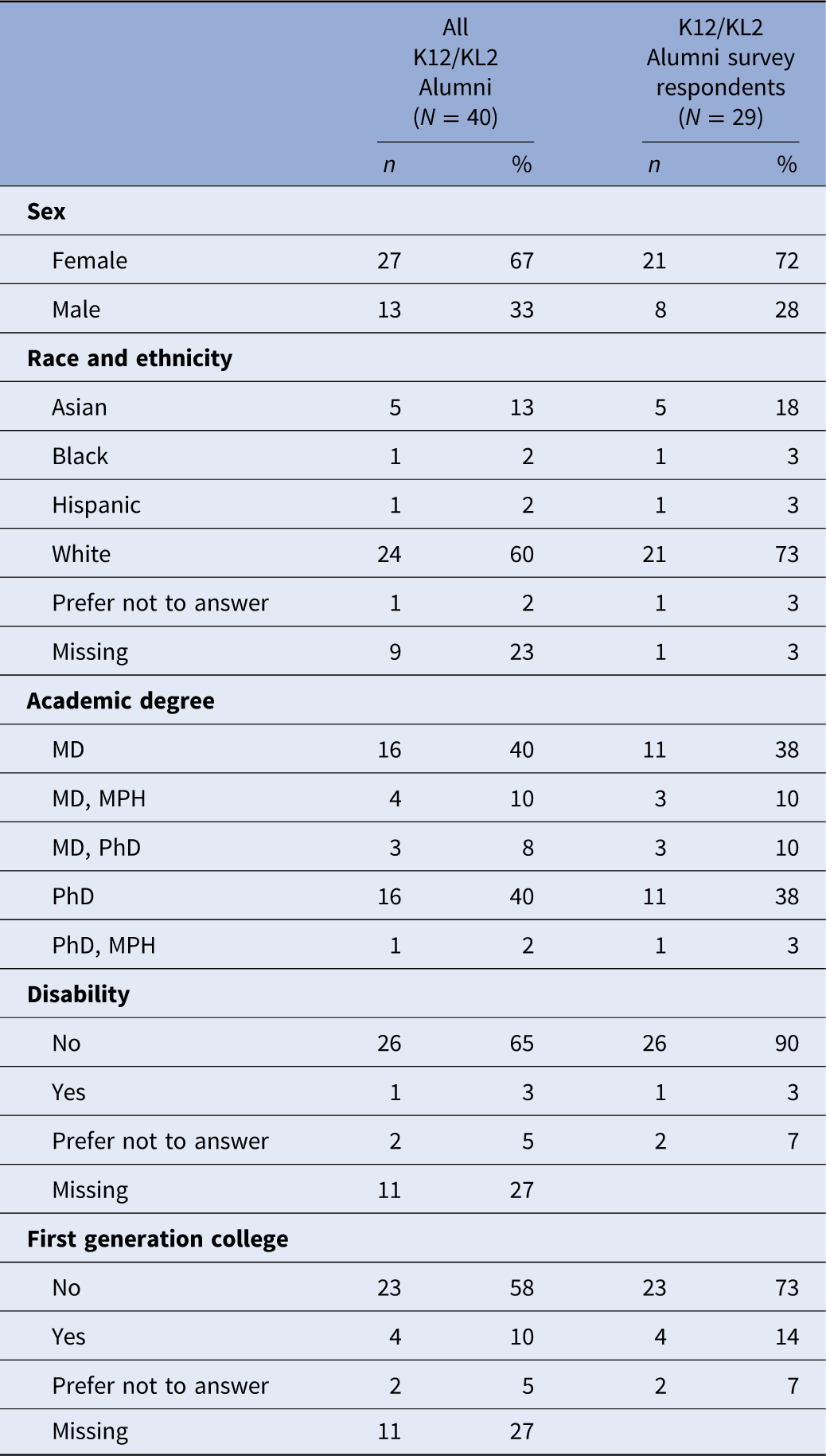
29 of 40 alumni (74%) responded. Average time since completing the K12/KL2 was 6.4 years (SD = 4.7, Range <1–14 years). Most survey respondents were women (67%), non-Hispanic White (60%), and held MD-degrees (58%). Respondent sociodemographic characteristics were similar to known characteristics of the whole cohort (Table 1).
Demographic characteristics of K12/KL2 Career Development Award scholars and alumni survey respondents (2008–2024)

Table 1. Long description
The table compares demographic characteristics of K12/KL2 Career Development Award scholars and alumni survey respondents. It has 40 rows and 6 columns. The columns are labeled as follows: All KL2/K12 Alumni (N = 40) with sub-columns n and percent, and KL2/K12 Alumni survey respondents (N = 29) with sub-columns n and percent. The rows are grouped into categories: Sex, Race and ethnicity, Academic degree, Disability, and First generation college. Each category has specific labels and corresponding values for n and percent. For example, under Sex, Female has 27 and 67 percent for All KL2/K12 Alumni, and 21 and 72 percent for KL2/K12 Alumni survey respondents. Under Race and ethnicity, White has 24 and 60 percent for All KL2/K12 Alumni, and 21 and 73 percent for KL2/K12 Alumni survey respondents. The table provides a detailed comparison of various demographic characteristics between the two groups.
Note: Disability refers to having a physical or mental impairment that substantially limits ≥1 major life activity. First generation college refers to having no parental figure who completed a college degree.
Most (86%) of survey respondents currently worked in an academic medical center, devoted ≥50% time to research (69%), and all (100%) had served as research mentors (Table 2). One-third were Full and one-quarter Associate Professors. 97% had been funded to perform research, with 83% receiving federal funding as Principal Investigator and 66% as Co-investigator. 79% of survey respondents secured an extramural NIH K-award or equivalent, 45% an NIH R01, and 21% an R21 or R03. Respondents indicated the K12/KL2 was extremely influential (72%) or influential (28%) to their career.
Research and academic activities of the K12/KL2 Career Development Award Program alumni (2008–2024), N = 29

Table 2. Long description
A table summarizing research and academic activities of K12/KL2 Career Development Award Program alumni. The table has 10 rows and 3 columns. Column headers are Current academic rank, n, and %. Row 1: Assistant professor, 8, 28. Row 2: Associate professor, 7, 24. Row 3: Full professor, 10, 34. Row 4: Nonacademic title, 4, 14. Row 5: Academic medical center, 25, 86. Row 6: Pharmaceutical industry, 2, 7. Row 7: Medical education organization, 1, 3. Row 8: Non-profit organization, 1, 3. Row 9: Other, 1, 3. Row 10: >=50%, 20, 69. Row 11: <50%, 7, 24. Row 12: Does not perform research, 2, 7. Row 13: Yes, 28, 97. Row 14: R01 or equivalent, 13, 45. Row 15: R21 or R03, 6, 21. Row 16: K-award or Career Development Award equivalent, 23, 79. Row 17: No, 1, 3. Row 18: Federal grants (e.g., NIH, NSF, DoD, VA), 24, 83. Row 19: Private/philanthropic foundation, 21, 72. Row 20: Pharmaceutical/industry, 6, 21. Row 21: Other, 3, 10. Row 22: Served as research mentor, 29, 100. Row 23: Graduate student, 20, 69. Row 24: Fellow, 23, 79. Row 25: Resident, 14, 48. Row 26: Faculty member, 16, 55. Row 27: Does not have a mentee, 2, 7.
No differences were observed by sex. The proportion of PhDs who currently engaged in ≥50% research was 83% versus 59% of MD alumni. More MDs engaged in research <50% time (41% versus 0%; p-values < .05).
Survey: CTS benefits
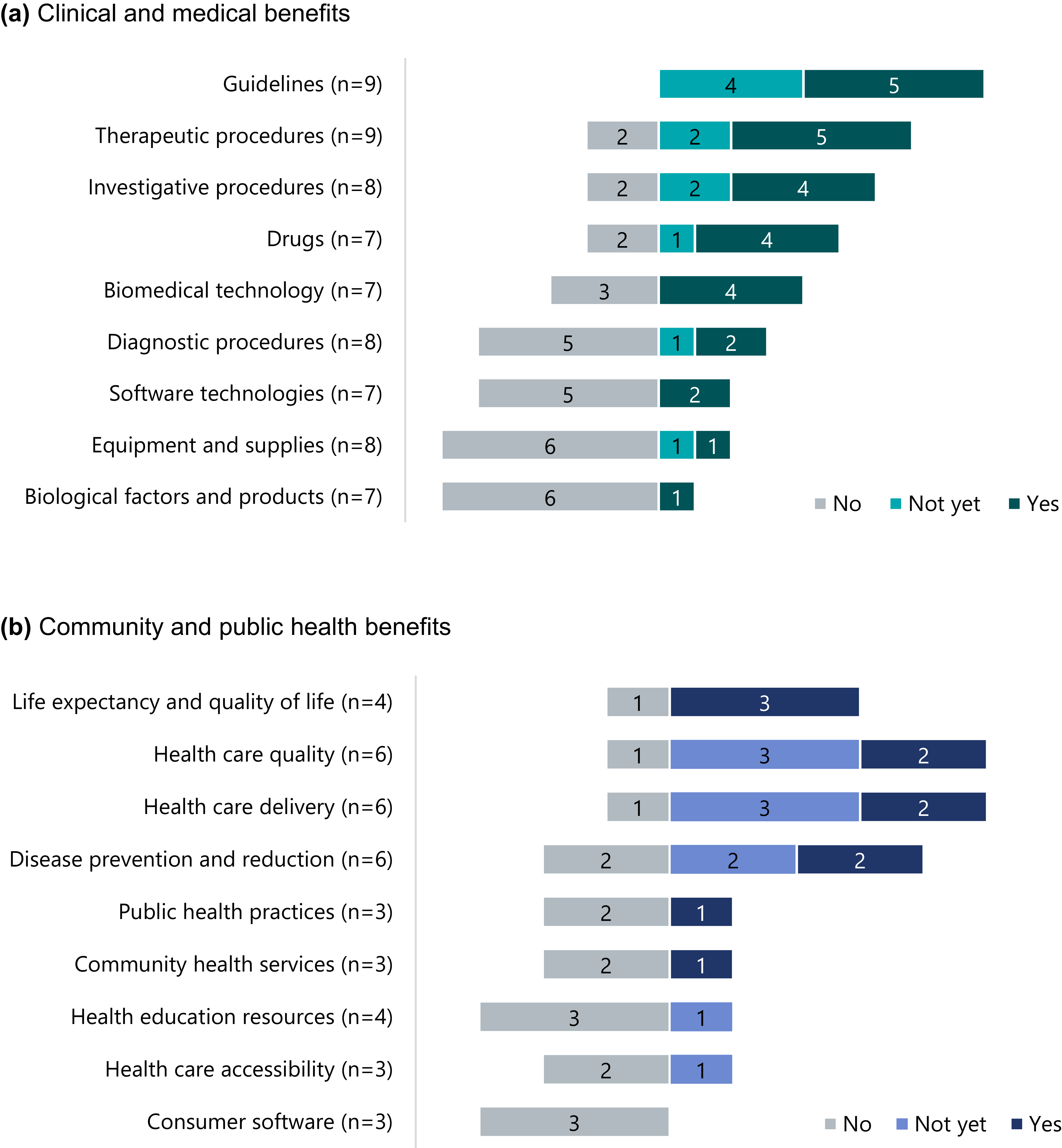
41% of survey respondents reported their K-funded research resulted in ≥1 TSBM-benefit. 31% reported clinical/medical benefits, mostly in the subdomains of practice guidelines and therapeutic procedures (Figure 1a). 17% reported community/public health benefits (Figure 1b). Three alumni indicated a community/public health benefit resulting from dissemination of findings that benefited patient life expectancy and quality of life. 7% of survey respondents reported research findings that demonstrated economic benefits, and 10% reported policy benefits. There were no TSBM-benefit differences by sex or degree. Alumni who reported ≥1 TSBM-benefit were further out from K12/KL2 completion than those who endorsed no benefit (8 versus 5 years, p < .05).
Detailed breakdown of K12/KL2 alumni’s perceived translational science benefits in two most endorsed domains: (a) clinical and medical benefits (≥1 reported by 36% of alumni) and (b) community and public health benefits (≥1 reported by 31% of alumni) of their research.

Figure 1. Long description
Panel A: A horizontal bar graph comparing the perceived clinical and medical benefits of translational science across different categories. The horizontal axis represents the number of responses, while the vertical axis lists categories: Guidelines, Therapeutic procedures, Investigative procedures, Drugs, Biomedical technology, Diagnostic procedures, Software technologies, Equipment and supplies, and Biological factors and products. Each category has three bars representing responses: No, Not yet, and Yes. The color scheme includes gray for No, teal for Not yet, and dark teal for Yes. Panel B: A horizontal bar graph comparing the perceived community and public health benefits of translational science across different categories. The horizontal axis represents the number of responses, while the vertical axis lists categories: Life expectancy and quality of life, Health care quality, Health care delivery, Disease prevention and reduction, Public health practices, Community health services, Health education resources, Health care accessibility, and Consumer software. Each category has three bars representing responses: No, Not yet, and Yes. The color scheme includes gray for No, blue for Not yet, and dark blue for Yes.
Qualitative findings: alumni
Mentorship
Alumni interviewees emphasized mentorship as one of the greatest benefits of participation, including mentorship from K12/KL2 program leaders, CTS mentors, and peers. K12/KL2 leaders provided guidance on career development and university processes, such as promotion. Alumni highlighted K12/KL2 leaders’ institutional knowledge, such as connecting them to potential collaborators, and their unbiased opinions as external faculty not directly invested in participants’ research. As an alumna explained, “It was nice having people outside of my section and area of expertise weigh in more on the career development and grantsmanship and more objective views of those things” (Quote 1).
CTS mentors provided subject matter expert feedback on research and career guidance. Alumni reported that mentors were beneficial in formalizing mentoring relationships, creating new research opportunities and connections, and helping navigate the transition from mentored early-career faculty to independent investigator. Peer-to-peer mentorship helped alumni make connections across campuses and learn about funding mechanisms and resources. Alumni appreciated learning from their K12/KL2 peers’ research and receiving feedback from outsiders’ perspectives. One alumna described, “[The program] helped me to grow my network of other people that are in a similar career stage that are in a different department, who I might not have otherwise encountered” (Quote 2).
Drivers of research independence
Another benefit centered on factors that supported research independence, particularly for physician-scientists. Alumni described that the protected time, salary, and flexibility afforded by the K12/KL2 were essential for collecting data and gaining necessary experience to apply for additional funding. One physician-scientist explained, “If I didn’t have that nice bridge of three years of protected time, and I couldn’t get a federal K [grant], I may have had to increase my clinical time and not be able to pursue research” (Quote 3). Having time to perform research also helped early-career faculty gain confidence in their skills and ability to lead a research program, as well as gain exposure to areas they were interested in pursuing long-term.
Comprehensive training
Alumni mentioned benefits of specific training or skills development offered through the larger CCTSI supported by the NCATS CTSA system, including the Colorado Mentoring program (CO-Mentor), mock study section/grant pre-review programs, writing accountability groups, and trainings in grants and research administration. CO-Mentor is a formal 4-session training program for mentor-mentee pairs to enhance mentoring relationships [Reference Nearing, Nuechterlein, Tan, Zerzan, Libby and Austin13]. Alumni shared that CO-Mentor facilitated getting the most out of their relationships with their mentors and increased their understanding of what kind of mentor they wanted to be themselves. Grant review meetings and writing accountability groups supported accountability, keeping on schedule, and learning mechanics of grant writing. An alumna described, “Learning how grants are reviewed is inevitably going to make me a better grant writer, because you understand the rubric, how they’re discussed, and everything else” (Quote 4). Participating in the process of grants/research administration helped alumni learn how to manage a grant and understand the logistics of managing a lab, which prepared them for success in obtaining future grants.
Qualitative findings: mentors
Transdisciplinary nature of program
Mentors highlighted the transdisciplinary nature of the K12/KL2, which allowed them to meet and learn from individuals with whom they would not have interacted otherwise. When asked about the most successful part of their mentoring relationship, one mentor said, “Really having that true translational partnership where I can’t create MRI sequences, and I have no intention of doing it, but I can help [my mentee] to place it in context…[and how it can] be applicable in clinical practice” (Quote 5). Mentors emphasized the program bridged connections between different schools on campus. One reflected, “We should continue to have these multidisciplinary programs on campus. It’s been an opportunity for those of us in the School of Public Health to collaborate with the School of Medicine faculty. The multidisciplinary [nature] of the program is very important” (Quote 6).
Meaningful relationships
Mentors described benefits of mentoring individuals further along in their careers, such as having intellectually stimulating conversations and learning from mentees. One mentor explained, “The discussion at the intellectual level, the professional level is even more stimulating and exciting. I get to learn from [my mentees] as well” (Quote 7). Another mentor explained their motivations for mentoring: “It is perhaps, at this stage in my career, the most important and the most valued and the most fun activity that I get to do.…You see the progress. You see the learning happening in real time, and that’s extremely gratifying” (Quote 8).
CCTSI-CTSA training/resources
Mentors indicated how their participation in the K12/KL2 enhanced their awareness of other CCTSI-CTSA resources on campus that strengthened their mentoring skills. One mentor said, “I think that my expectations in understanding how to set up an [individualized development plan], understanding how to think about timelines, understanding how to leverage on-campus resources in terms of K, pre-K,…CO-Mentor are all major assets” (Quote 9). Mentors and mentees described CO-Mentor as particularly beneficial. One mentor explained, “I think it [was] nice to hear about what other people are doing and what other strategies people use—either in lab management or…the basic day-to-day things, transitioning faculty or junior faculty to independence, all of those things. I enjoy hearing what other people do and hope to improve what I do” (Quote 10).
Discussion
A multimethod evaluation of an NCATS K12/KL2 program in Colorado (2008–2024) provides support for the core assumption that research mentoring is fundamental to the individual career success of early-career faculty [Reference Burnham and Fleming1]. Consistent with extant qualitative and/or quantitative investigations of the K12/KL2 [Reference Wilson Chavez and Srikant4–Reference Sweeney, Schwartz and Toto8], the value of research mentoring in the current evaluation was reflected in alumni’s quantitative metrics of success, with extramural federal grants, promotions, and retention in CTS careers, but also in the voices of alumni who shared that mentoring was key to career development and successful transition to independence. Moreover, most scholars are paying it forward, as all reported mentoring trainees in CTS. In line with past evaluations of mentoring in CTSA programs [Reference Wilson Chavez and Srikant4], experiencing effective mentoring often inspires mentees to take on the mentoring role themselves. Qualitative data also conveyed that, beyond mentoring received from designated K12/KL2 mentors, both scholars and mentors enjoyed mentoring from other individuals, extending benefits of mentoring beyond the traditional framework. Scholars spoke to the support from K12/KL2 directors and peer scholars and sponsorship from mentors to expand their professional networks. Mentors highlighted benefits that they enjoyed from mentoring, a concept often overlooked. Mentors appreciated mentoring early-career colleagues as an opportunity to learn from their mentees in a mutually beneficial way. Scholars and mentors both felt the K12/KL2’s positioning in the setting of a broader CCTSI-CTSA hub offered strong benefits, like a myriad of resources, formal/informal training, and opportunities for networking and interdisciplinary teaming that they deeply appreciated.
Despite resounding individual career benefits, only 41% of alumni perceived TSBM-benefits of their work. Alumni who endorsed TSBM-benefits were further along, 8 versus 5 years post-K12/KL2, and perceived clinical/medical or community/public health benefits. Additional time may be important to actualize benefits as delineated in the TSBM. It remains possible, however, that those who do not pursue a research career contribute substantially to translational impact. In the future, intentional and early integration of dissemination and implementation science training may help early-career scholars to better understand how their work translates into real world-impact, an approach critical to bridging the science-to-practice gap [Reference Emmons, Brownson and Luke14]. Efforts to more concretely operationalize TSBM constructs [Reference Sperling, Ghanem, Quenstedt and Saxena15] may help individual scholars’ early consideration of such benefits. Alternatively, the TSBM may be better suited to an organization/program-unit of analysis rather than at the individual scholar-level.
Caution should be exercised in generalizing these findings to other K12/KL2 programs. Although the survey response rate exceeded 70% and non-respondents/respondents were similar, results may have been biased to scholars with more engagement/retention in CTS. The sample was small and relatively homogenous. Although the basic structure and operations of our K12/KL2 program did not change substantially over the period of study, unmeasured factors (e.g., impact of the COVID-19 pandemic, changes in the academic medicine environment) may have affected the findings. Future evaluation should consider ways to optimize strengths of the K12/KL2 program for physician-scientists, including strategies that show promise and are likely to be cost-effective, such as group peer/near-peer mentoring [Reference Pololi, Civian and Brimhall-Vargas16,Reference Lovinsky-Desir, Chernick and Anderson17], group coaching [Reference Palmer, Wadhwa, Matulevicius, Rohatgi and Jacobe18], and communication training [Reference Cameron, Rull-Garcia and Meyer19]. Also, approaches to embed dissemination and implementation science training [Reference Ford, Rabin, Morrato and Glasgow20] into CTSA programs like the K12/KL2 merit consideration. While the current interviews were hypothesis-generating, in line with calls for enhancing the scientific rigor of CTSA research on mentoring [Reference Ianni, Samuels, Champagne, Nehl and DiazGranados2], multimethod evaluation with additional mentees/mentors, integration of quantitative data from mentors, and lengthier/longitudinal follow-up of scholar careers are warranted.
Supplementary material
The supplementary material for this article can be found at https://doi.org/10.1017/cts.2026.10825.
Acknowledgments
The authors thank the alumni scholars who took the time and effort to complete questionnaires and the alumni scholars and mentors who shared their views and perspective in interviews. The authors also thank the External Advisory Committee of the Colorado Clinical & Translational Sciences Institute K12 Program, Dr. Elizabeth Wellberg, Dr. Elizabeth Burnside, and Dr. Margaret (Meg) Zeller, for their support of this program and their ongoing guidance to improve its quality and capacity to support early-career scholars in clinical and translational science.
Author contributions
Lauren Shomaker: Conceptualization, Funding acquisition, Writing – original draft, Writing – review & editing; Goldie Komaie: Formal analysis, Investigation, Writing – original draft, Writing – review & editing; Grace Gonzalez: Data curation, Formal analysis, Investigation, Writing – original draft, Writing – review & editing; Paul MacLean: Conceptualization, Funding acquisition, Writing – review & editing; Kristen Nowak: Conceptualization, Writing – review & editing; Ellen Burnham: Conceptualization, Funding acquisition, Writing – review & editing
Funding statement
This work was supported by NIH/NCATS Colorado CTSA Grant Numbers K12 TR004412 and UM1 TR004399. Contents are the authors’ sole responsibility and do not necessarily represent official NIH views.
Competing interests
The authors have no competing interests to disclose.



 Open access

