Public health threats have long been a subject of European Union (EU) legislation. The emergence of epidemics such as SARS, avian influenza, and Ebola has attracted the attention of the public health community to cross-border health threats. Nuclear accidents, volcanic eruptions, earthquakes, and other disasters have shown that public health threats do not arise only from communicable diseases.
In 1996 the US Federal Emergency Management Agency was the first organization to develop the “all-hazards” planning model for disaster response. 1 The model was adopted by all US agencies and the Centers for Disease Control and Prevention (CDC), and it was expanded in 2009 after the 9/11 attack and Hurricane Katrina. 2 The accumulated experience of the international public health community facilitated dissemination of the all-hazards approach. The World Health Organization (WHO) and the EU have taken measures to detect and respond more effectively to communicable diseases. In 2005, the WHO published the International Health Regulations (IHR) to guide member states in building the capacity to detect, assess, report, and respond to public health threats. The IHR described special measures to minimize the cross-border dissemination of threats using the all-hazards approach. 3
The legal basis for the EU’s responsibilities and actions in the field of public health arises from Article 168 of the Treaty on the Functioning of the EU (TFEU). 4 This article charges the EU with ensuring “a high level of human health protection in the definition and implementation of all Union policies” and “taking action to complement national policies towards….early warning of and combating serious cross border threats to health.” 4 Depending on Article 168 of the TFEU, Regulation No. 851/2004/EU was published to establish the European Center for Disease Prevention and Control (ECDC) to act as an independent agency in the field of public health. 5 Decision No. 2119/98/EC was published to establish a network for the epidemiologic surveillance and control of communicable diseases. 6
The ECDC has extended this network to include the operation of early warning and response systems (EWRS). Meanwhile, the 2005 IHR charged EU member states with establishing EWRS in their respective countries. Decision 1082/2013/EU was published to apply these principles, including the all-hazards approach of the WHO, to cover all public health threats, preparedness and response planning, ensuring interoperability between health, food, and veterinary sectors, as well as preparedness planning between nations. 7
IMPLICATIONS OF DECISION 1082/2013/EU FOR CROSS-BORDER THREATS TO HEALTH
Decision 1082/2013/EU brought a new approach to the management of public health threats in EU member states. Innovations of this decision include establishing a Health Security Committee (HSC); preparedness and response planning; joint procurement of medical countermeasures; ad hoc monitoring for biological, chemical, and environmental threats; EWRS; recognition of emergency situations; and interoperability between various sectors.
The scope of this decision covers threats of biological origin, including communicable diseases, antimicrobial resistance, and health-care-associated infections related to communicable diseases, biotoxins, and other harmful biological agents not related to communicable diseases and threats of chemical environmental and unknown origin.
In the context of communicable diseases, this decision describes the term case definition as a set of commonly agreed upon diagnostic criteria to be fulfilled in order to accurately identify a health threat, while excluding the detection of unrelated threats. A list of diseases to be covered by epidemiologic surveillance system monitoring at the EU level was determined by Commission Decision 2000/96/EC. 8 This list remarks 50 diseases and special health issues. Decision 2002/253/EC published 53 case definitions for diagnosing and reporting communicable diseases. 9
Decision 1082/2013/EU requires member states to designate an institution responsible for the epidemic surveillance of communicable diseases. Designated competent authorities notify EWRS and determine the measures required to protect public health. Competent authorities represent member states in the HSC and aid in the coordination and cooperation of EWRS at the EU level. 9
Decision1082/2013/EU requires the member states and the Commission to consult with each other within the HSC regarding preparedness and response planning. This includes steps to develop, strengthen, and maintain their capacities of EWRS for cross-border health threats and to urge member states to report to the Commission every 3 years with updated information regarding the status of implementation and core-capacity standards for preparedness and response planning, as determined at the national level for the health sector, in compliance with WHO’s IHR reporting standards. 9
Epidemiologic surveillance and ad hoc monitoring are essential sections of the Directive 1082/2013/EU. A network operated by the ECDC was established to bring into permanent communication the Commission, the ECDC, and the national competent authorities responsible for epidemiologic surveillance. The national competent authorities are responsible for supplying compatible data on epidemiologic surveillance of communicable diseases, progression of epidemic situations, and unusual epidemic phenomena. Competent authorities are required to use the case definitions in Decision 2002/253/EC to ensure comparability of the data collected in the ECDC.
Decision 1082/2013/EU defines the health threats to be considered as serious cross-border health threats and to be notified through EWRS as follows:
-
∙ The threat is unusual or unexpected for the given place and time and/or it causes or may cause significant mortality and morbidity in humans, grows or may grow rapidly, or exceeds or may exceed national capacity;
-
∙ The threat affects, or may affect, more than one member state;
-
∙ The threat requires, or may require, a coordinated response at the EU level. 9
The Commission may also recognize a situation as a public health emergency in the case of (1) epidemics of human influenza that have pandemic potential, (2) serious cross-border health treats that endanger public health at the EU level, or (3) cases in which there is no satisfactory method for the diagnosis, prevention, or treatment of the threat at the EU level. 9
Notification of any health threats with these characteristics should be made through EWRS. The notification should include the following information to facilitate the response to the threat:
-
∙ The type and origin of the agent;
-
∙ The date and place of the incident or outbreak;
-
∙ Means of transmission or dissemination;
-
∙ Toxicological data;
-
∙ Detection and confirmation methods;
-
∙ Public health risks;
-
∙ Public health measures implemented at the national level;
-
∙ Measures other than public health measures;
-
∙ Personal data necessary for the purpose of contact tracing;
-
∙ Any other relevant information. 9
During transmission of this information, protection of personal data is required in accordance with Directive 95/46/EC, so that accidental or illegal destruction, loss or unauthorized access, and illegal processing of the data are avoided. 10
When a notification is received by the ECDC, if the notification is needed, the European Food Safety Authority is responsible for public health risk assessment. The results of the risk assessment are promptly made available to competent authorities and the HSC through EWRS. Member states consult within the HSC and, in liaison with the Commission, coordinate responses at national and EU levels.
OBLIGATIONS OF TURKEY IN THE PUBLIC HEALTH FIELD IN THE SCOPE OF EU ACCESSION
Turkey has been an acceding country to the EU since 1999. 11 Public health issues are described in Chapter 28 “Consumer and Health Protection” of EU legislation. Chapter 28 is among a limited number of chapters open to negotiation between Turkey and the EU. 12 The negotiations for Chapter 28 were opened in 2007 with 4 closing benchmarks on public health:
-
∙ Blood and blood components;
-
∙ Tissues and cells;
-
∙ Communicable diseases;
-
∙ Tobacco control.
The closing benchmark on communicable diseases requires Turkey to demonstrate that adequate institutional and administrative capacity is in place by the time of accession. EU reporting and coordination obligations include participation in the EWRS in the field of communicable diseases. In accordance with this closing benchmark, Turkey has been aligning its national legislation on public health with that of the EU. Thus, to fulfill the closing benchmark, Turkey has to:
-
∙ Adopt the EU’s public health acquis;
-
∙ Implement and enforce the health acquis;
-
∙ Develop adequate administrative and institutional capacity for this implementation.
For the EU’s public health acquis, Directive 1082/2013/EU has great importance, as it is the main EU legislation on cross-border public health threats and EWRS. In addition to Directive 1082/2013/EU, several related EU directives pertaining to the list of diseases to be notified, the establishment of EWRS, and case definitions are among the EU legislations to be adopted by Turkey. These EU provisions are as follows:
-
∙ Decision 2000/96/EC on the communicable diseases to be progressively covered by the community network under Decision No. 2119/98/EC of the European Parliament and of the Council 8 ;
-
∙ Decision 2000/57/EC on the EWRS for the prevention and control of communicable diseases under Decision No. 2119/98/EC of the European Parliament and of the Council 13 ;
-
∙ Decision 2002/253/EC, laying down case definitions for reporting communicable diseases to the community network under Decision No. 2119/98/EC of the European Parliament and of the Council 14 ;
-
∙ Decision 2003/534/EC, amending Decision No. 2119/98/EC of the European Parliament and of the Council, and Decision 2000/96/EC as regards communicable diseases listed in those decisions and amending Decision 2002/253/EC as regards the case definitions for communicable diseases 15 ;
-
∙ Decision 2007/875/EC, amending Decision No. 2119/98/EC of the European Parliament and of the Council, and Decision 2000/96/EC as regards communicable diseases listed in those decisions. 16
During the accession process Turkey is also obliged to adopt Council recommendations and case law on public health issues in Turkish national public health legislation.
PUBLIC HEALTH AND EWRS IN TURKEY
Turkey is a founding member of the United Nations and one of the first members of the Council of Europe, the North Atlantic Treaty Organization, and the Organization for Economic Co-operation and Development. Turkey is also a candidate country for membership in the EU. Turkey is among the emerging markets of the world, with a nominal gross domestic product per capita of US $10,482 and a population of 75,627,000 people. 17 More than two-thirds (67.3%) of its population is within the working age group. Those aged less than 15 years and 65 years or older constitute 25.3% and 7.3%, respectively. The annual population growth rate of Turkey in 2011 was 13.5%. 17 The Turkish health care system is inefficient and fragmented. There are different hospitals and insurance schemes for workers, public officers, and self-employed people, which infringes on the fair distribution of resources and creates inequalities in access to health care.Reference Jadoo, Aljunid, Sulku and Amrizal Muhammad Nur 18 In 2003, the Health Transition Program (HTP) was launched to develop accessible, efficient, effective, and fair health care services for all members of the population. The major components of the HTP are transferring all public hospitals to the authority of the Ministry of Health, extending the coverage of health insurance to the entire population, introducing a family practitioner scheme, and improving the administrative and financial autonomy of public hospitals.
Public health services were also restructured by the HTP. 19 The most significant step was the establishment of the Turkish Public Health Institute (TPHI), which is responsible for all primary health care services, public health measures, communicable diseases, and EWRS. Today the TPHI is an institution with 81 provincial directorates, 7 reference microbiology labs, and 83 district public health laboratories. 20 Primary health care services including vaccination are free of charge for the entire population, including refugees and migrants. However, there are still no custom-made health policies for vulnerable populations with different health needs, such as Roma people, LGBT individuals, and the Syrian refugees, whose population has reached 2.5 million in Turkey.
Since the opening of Chapter 28 to negotiations in 2007, Turkey has been working on adopting EU legislation regarding the development of administrative and implementation capacity on epidemiologic surveillance of communicable diseases and EWRS.
Preparedness and Response
Turkey has established the Prime Ministry Disaster & Emergency Management Presidency (PMDEM) as an umbrella institution to coordinate disasters and emergencies of biological, chemical, nuclear, and radiologic health threats. Although environmental health threats are not stated in the founding legislation of PMDEM, in practice, the PMDEM is in charge of any kind of disaster and emergency situation that threatens public health. PMDEM works with various ministries and agencies, depending on the nature of the threat. The TPHI is the competent authority in the field of communicable diseases.
Article 4(2)(a) of Decision No. 1082/2013/EU states that implementation of IHR core capacities is obligatory. Turkey has completed implementation of IHR core capacities by conducting with WHO 3 consequent EU-funded projects. The aims of the projects were to adopt the EU legislation, establish EWRS, support microbiological laboratories, and develop the required human capacity to make this system work effectively. As a result of these projects, the core capacity for the IHR is in coherence with Decision No. 1082/2013/EU. Three projects have been implemented in this regard:
-
1. Surveillance and Control of Communicable Diseases Project 1. This project was implemented during 2005 to 2008 and was a capacity-building project. Its major achievements included development of legislation and training. The most significant publications were “Bylaw on the Surveillance and Control Principles of Communicable Diseases” (OJ 30.05.2007/26537) and “National Strategic Plan (2009-2013)” for strengthening the communicable diseases surveillance and control system in Turkey. Approximately 9000 health personnel from all provinces, from the central to the peripheral level, were provided with short courses of epidemiology training.
-
2. Surveillance and Control of Communicable Diseases Project II. This project was implemented during 2007 to 2009 and was an investment project, complementary to the first project. It had 4 main components: ımproving the technical infrastructure, updating the notification network and data processing technology, improving the technical infrastructure of the outbreak investigation and control system, and completion and extension of training activities initiated in Project I.
-
3. Surveillance and Control of Communicable Diseases Project III. This project was implemented during 2010 to 2014. The project was financed by the EU and Republic of Turkey. The project was implemented by the WHO to support the Turkish government in its efforts to develop EWRS to detect, assess, report, and respond to health events and public health risks (hazards of infectious, chemical, radionuclear, or unknown origin) in line with the IHR and the EU communicable disease surveillance system acquis. The beneficiary of the project was the Ministry of Health.
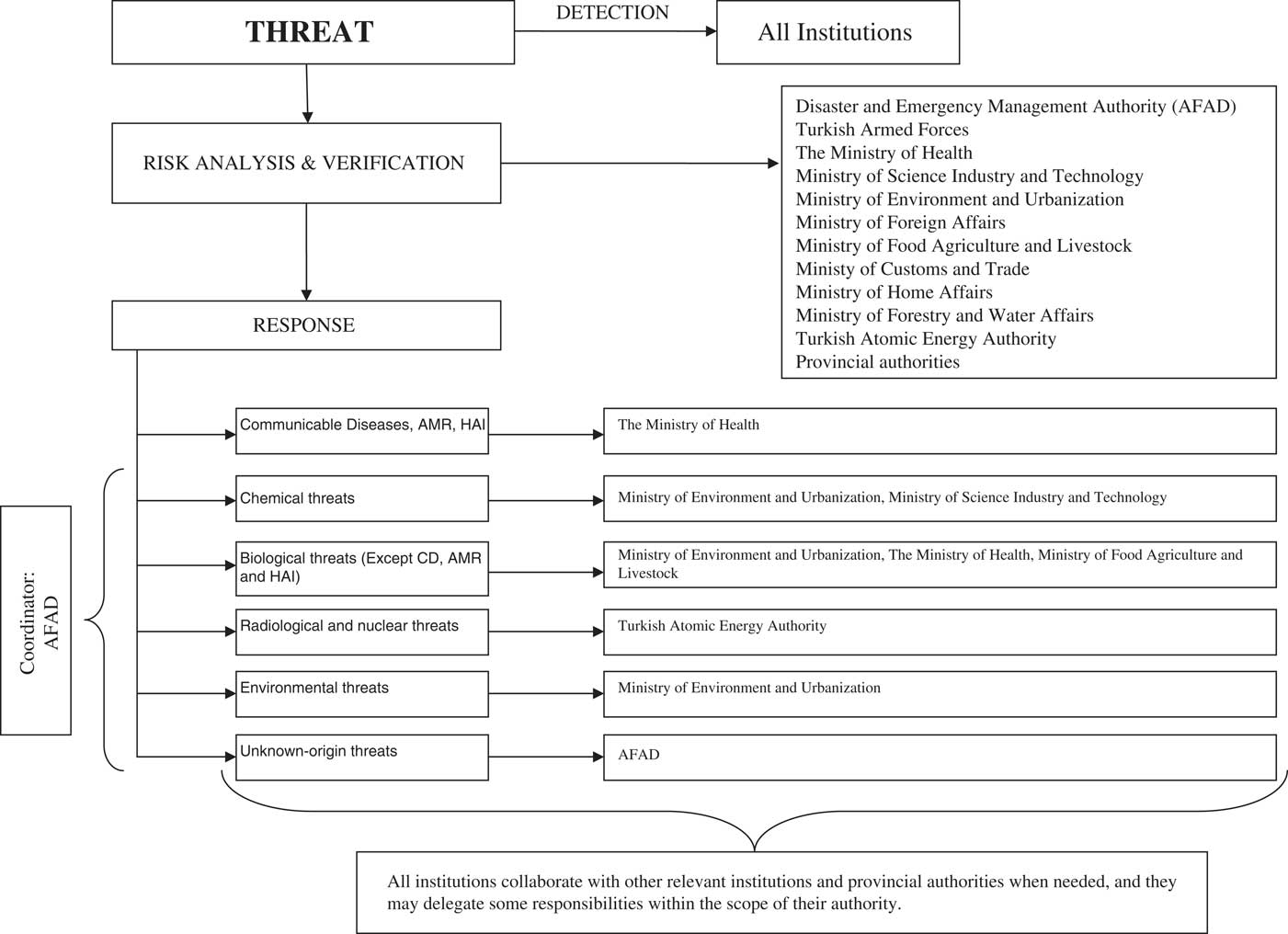
This project achieved 3 overall objectives, which were mutually supporting. The first objective was support to the Turkish government in its efforts to develop institutions, infrastructure, resources, and evidence-based policy/guidelines/practice to support requirements of communicable diseases surveillance and control to respond (detect, assess, report) to all public health risks under the IHR (Figure 1). The second objective was to institutionalize the national field epidemiology and microbiological laboratory training activities. The third objective was to consolidate and build upon the successes of Epidemiological Surveillance and Control of Communicable Diseases System (ESCCDS) Projects I and II, which were instrumental in improving the national capacity and competence for surveillance and control of communicable diseases.
Involved Organizations and Their Role in Reporting of Public Health Threats. Abbreviations: AMR, antimicrobial resistance; CD, communicable disease; HAI, health-care-associated infections.

Interoperability between the health sector and other sectors is referred to in Article 4(2)(b) of Decision No. 1082/2013/EU. It is a core concept for EWRS and it requires structures empowered with strategic administrative and policy-making functions. These functions included establishing a chain of command and operational structures or arrangements aimed at providing logistical functions and tools, particularly with regard to communication in the event of emerging serious cross-border health threats. Turkey has developed a preparedness and response plan to address threats including food-borne, zoonotic, and waterborne diseases; biotoxins and other harmful biological agents not related to communicable diseases; and threats of chemical, environmental, or unknown origin. The preparedness and response plan identifies sectors related to these diseases and strategic threats. A number of strategic sectors are identified as critical in case of an emergency with a serious cross-border threat to health. These sectors include energy, communication technology, transport, agriculture and veterinary sectors, food agriculture and livestock, forestry and water, customs and trade services, culture and tourism, security, traffic and emergencies services, search and rescue services, evacuation and settling planning services, and military and civil protection. 21
Epidemiologic Surveillance and Ad Hoc Monitoring
Referring to Directive 1082/2013/EU articles 6 and 15(a) and Decision 2000/96/EC Article 4, Turkey designated TPHI as the competent authority charged with collecting and communicating data regarding epidemiologic surveillance of communicable diseases. Provincial public health directorates and public hospital union general secretariats collect epidemiologic data on communicable diseases at the provincial level and transmit these data to the national TPHI database. 22
In accord with Article 7(1) of Decision 1082/2013/EU, the Disaster and Emergency Management Center is designated as the competent authority charged with collecting and communicating information relating to events caused by threats other than communicable diseases. 23 The national database includes information on epidemiologic surveillance of communicable diseases, antimicrobial resistance and health care-associated infections related to communicable diseases, as well as specific surveillance systems and databases for some disease control programs. These programs include Crimean Congo hemorrhagic fever, tuberculosis, and tularemia. Information is also collected on the progression of epidemic situations and information concerning unusual epidemic phenomena or new communicable diseases of unknown origin. The standards and content of the collected data are set by the National Health Data Dictionary. 24
The criteria for selection of communicable diseases and related special health issues to be covered by epidemiologic surveillance at the national level are consistent with Article 6(5)(a) and Annex of Decision 1082/2013/EU. The current criteria are as follows:
-
∙ Diseases that cause, or have the potential to cause, a significant public health problem across the country;
-
∙ Diseases whose prevention requires a regional or global approach for coordination by reason of their characteristics;
-
∙ Diseases for which specific programs are being conducted across the country or on a regional basis;
-
∙ Diseases that would not be recognized at the national level and where the pooling of data would allow hypothesis generation from a wider database and provide early warning;
-
∙ Diseases for which effective preventive measures are available;
-
∙ Diseases for which the obtained results from comparison by sharing information with international institutions and the Community network would contribute to the evaluation of national or international programs. 25
As a result of the existing coherence on the selection criteria, the list of communicable diseases and related special health issues covered by epidemiologic surveillance in Turkey includes all the issues listed in Article 6(5)(a) Decision 1082/2013/EU, Article 4 Decision 2000/96/EC, and Annex I Decision 2000/96/EC. These include diseases preventable by vaccination, sexually transmitted diseases, viral hepatitis, food and waterborne diseases, diseases of environmental origin, diseases transmitted by nonconventional agents, airborne diseases, zoonoses, vector-borne diseases, serious imported diseases, and special health issues such as nosocomial infections and antimicrobial resistance.
Case definitions for reporting communicable diseases are determined by Article 6(4) and 6(5)(b) of Decision 1082/2013/EU, Article 1 Decision 2002/253/EC, and Annex Decision 2002/253/EC. Turkey has not yet aligned its national legislation on case definitions with that of the EU, so there is limited compliance regarding diagnostic criteria to accurately identify cases of communicable diseases listed above. This has created the risk of producing inconsistencies in notifying and responding to cross-border health threats between Turkey and the EU.
Alert Notification
Article 9(1) Decision 1082/2013/EU, Article 1 Decision 2000/57/EC, and Annex I Decision 2000/57/EC all involve alert notification. TPHI provides national alert notification on acute gastroenteritis and influenza, but the remaining notifiable diseases and specific public health threats are up to event-based surveillance. Within this system, human clusters of cases of diseases or syndromes, unusual patterns of disease, unexpected deaths, diseases or deaths in animals, contaminated food products or water, environmental hazards, and chemical or radioactive events are reported at the national level. The nature and type of data transmitted in the alert system include all types of information required by Decision 1082/2013/EU listed above.
For public health threats other than communicable diseases, the Ministry of Environment and Urbanization, Ministry of Food, Agriculture and Livestock, Turkish Atomic Energy Authority, and Prime Ministry Disaster and Emergency Management Authority (PMDEMA) have set up electronic alert systems for rapid notification and coordination of response. Through this alert system, diseases or deaths in animals, contaminated food products or water, environmental hazards, and chemical or radioactive material events are notified.
Public Health Response
Competent regional and national public health authorities responsible for taking the measures required to protect public health and procedures for information, consultation, and coordination of events and measures adopted in response to health threats or indications for such health threats are determined in accord with Article 15(b) Decision 1082/2013/EU and Article 11 Decision 1082/2013/EU, respectively. Within this context, TPHI, the General Directorate of Emergency Health Services, and the General Directorate of Health for Border and Coastal Areas are responsible for responding to a public health threat at the national level. The provincial public health directorates, public hospital unions, and provincial hygiene committees are in charge of public health responses at the regional level in the case of a public health threat. 22 , 26 , 27
Each institution at a national or regional level has a focal point for information and data transfer. At the regional level, the Health Directorate provides the required coordination, in collaboration with the Provincial Hygiene Committee chaired by the Deputy Governor, whereas at the national level the PMDEM is in charge of all response coordination.
DISCUSSION
The adoption of the EU public health acquis in Turkish national legislation should not be considered an obligation arising from Turkey’s commitments in the EU accession process. The adoption should instead be seen as a requirement to have a better functioning public health and EWRS with an “all-hazards” perspective.
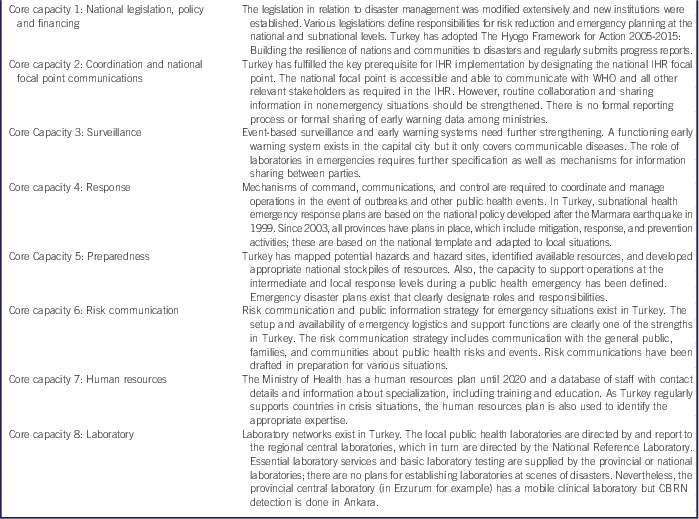
Turkey has been improving its public health system for the last decade. In 2010, the WHO published an assessment report on the IHR core capacities of Turkey (Table 1). In the report, it is stated that “the Turkish emergency response system has a strong legal framework, it is adequately staffed and well equipped. Regulations and detailed instructions at the national and regional levels define the coordination bodies, the designation authority and contingency requirements.” The issues that needed further improvement were “strengthening the capacity to assess the non-structural and functional vulnerability of critical health facilities and to introduce rapid health needs assessments as a key management issue relevant decision-making in the first 24 hours of an event.” 28
Key Findings of the WHO Europe Assessment of Health Systems Crisis Preparedness in Turkey 2010Footnote a

a Abbreviations: CBRN, chemical, biological, radiological, and nuclear; IHR, International Health Regulations; WHO, World Health Organization.
The establishment of the TPHI as a semi-autonomous institution may be considered as a crucial step in improving EWRS capacity. Despite the fact that administrative, technique, and human capacities of the institution need further improvement, the existence of an EWRS department is important for developing the capacity to deal with public health threats that involve communicable diseases.
However the EWRS and “all-hazards” perspectives require more than a department of public health institutes. A holistic approach, to cover all chemical, environmental, nuclear, and unknown origin public health risks and to develop a system for early detection, assessment, and response, is necessary to have a functioning and effective EWRS. PMDEMA is the body responsible for the coordination of all activities in this respect. However, there is still no mechanism for monitoring and evaluating the effectiveness and functionality of the system at the national and regional levels.
The preparedness and response plan of Turkey for serious threats to health emerging from communicable diseases has been developed by EU-funded projects, with direct involvement of the WHO. Hence, Turkey gained a critical advantage for importing international expertise to the plan. Furthermore, the Ministry of Health has undergone a structural reform and the TPHI was established within this reform with an all-hazards perspective.
There are serious concerns, however, about the coordination of the TPHI with PMDEMA and PMDEMA with other relevant sectors in the case of an epidemic. The absence of standard operating procedures for all relevant sectors and the lack of total compliance between the action plans of the TPHI and PMDEMA challenge the preparedness and response system of Turkey in case of a public health threat. Moreover, the data collection and information technology systems of relevant sectors do not relate to each other. Thus, in case of an emergency, transfer of collected critical data among relevant institutions will be limited. Assessment of the functioning of the alert notification system, its daily use, time for notification of alerts, and availability 24/7 of contact points is still inadequate. It is notable that an alert system has to date been established only for influenza and acute gastroenteritis. These weaknesses may cause serious problems for risk assessment and response planning. The interoperability of the system needs further development, with special attention to administrative and implementation capacity and coordination of data transfer.
The lack of coordination between authorities is most significant in the case of food-borne and waterborne diseases. According to an ECDC report on surveillance of 7 priority food-borne and waterborne diseases in the EU/EAA, Turkey is among the most frequently reported countries with infections involving travel-related campylobacteriosis and confirmed cases of travel-related nontyphoidal salmonellosis and travel-related shigellosis. 29 The recent literature on waterborne and food-borne outbreaks in Turkey reveals the lack of coordination.
In June 2014, an alert was received from Düzce province about a mass food poisoning following a funeral dinner. After the outbreak a retrospective cohort study was conducted. The results of the research revealed the lack of public education on food hygiene and nutrition habits and the need for strengthening the audit and inspection system for slaughterhouses and the cold chain for transfer of meat and poultry. Fixing these problems will require the active involvement and coordination of provincial food and agriculture directorates, veterinary services, municipal administrations, and other relevant partners.Reference Yenice, Göktaş, Sezgin, Temel and Gürbüzler 30 Similar results were found by researchers after field surveys in food poisoning cases in Manisa, Muğla, and Bursa in 2013 and 2014.Reference Zubaroğlu, Boz, Topal, Temel, Sucaklı, Levent, Atasoylu and Kızılelma 31 - Reference Demiralp, Kalkan, Göktaş, Nemli, Temel, Zho, Sucaklı and Torunoğlu 33
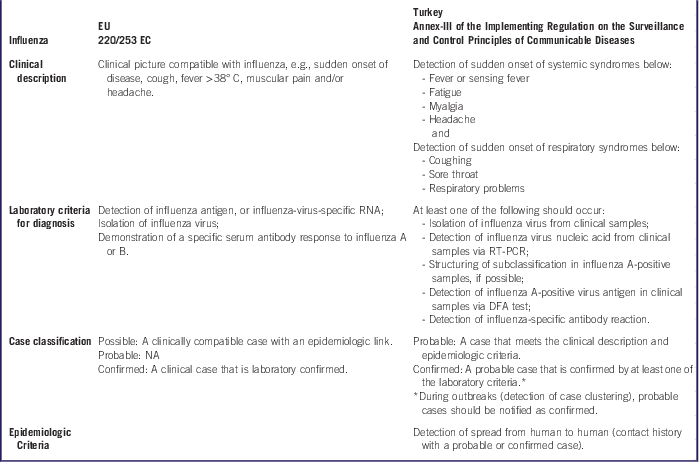
Another deficiency of Turkish EWRS in communicable diseases is the inconsistency of the case definitions in the Turkish legislation and EU acquis. In other words, the Turkish public health system may not identify a case subject for notification with the same deterministic criteria as the EU countries use. Hence, an event that would be considered a public health threat of communicable disease in the EU may not be recognized the same way in Turkey. For example, influenza case definitions in Turkey and the EU differ in clinical description, laboratory criteria for diagnosis, and case classification (Table 2). According to existing legislation, the Turkish public health authority would not notify a “possible case” because no “possible case” terminology exists in the Turkish case definitions, and would notify all “probable cases” as “confirmed cases” because it is indicated to do so in the legislation. These inconsistences will clearly create serious complications for both systems to work together to respond to public health emergencies.
Influenza Case Definitions in the European Union (EU) and TurkeyFootnote a

a Abbreviations: DFA, direct fluorescent antibody; NA, not applicable; RT-PCR, reverse transcription polymerase chain reaction.
The inconsistency in defining special concepts may be considered a risk for the compliance of Turkish EWRS with the systems of the EU. Health-care-associated infections are an outstanding example of that. In the Turkish EWRS, only infections arising from hospitals are registered. All other health care facilities, such as family physician practices, nursing homes, and hospices, are outside the system. This difference in conceptualization has practical implications. One of these is performing contact tracing only for hospital-associated infections and ignoring all other health care facilities. This may result in a delay in recognizing clusters of communicable diseases in a nursing home or a hospice.
In 2015, the ECDC performed a comprehensive assessment of capacity development, health governance, surveillance, preparedness, and response in the field of communicable diseases in Turkey. The final report of this assessment will be published shortly. This report will reflect the actual strengths and weaknesses of Turkish EWRS and contribute to plans to improve the system.
CONCLUSIONS
The Turkish public health system has improved over the last decade. Obligations arising from EU accession motivate the Turkish public health system to improve in accord with the EU. Turkey has implemented 3 EU-funded projects with the WHO to establish an EWRS and to develop core capacities for IHR. The EWRS and relevant legislation of Turkey are generally in coherence with Decision No. 1082/2013/EU, which is the main legislation for addressing serious cross-border threats to health. However, challenges remain for Turkey to set up a well-functioning and compatible EWRS. Several important problems still need to be addressed. These problems include the inconsistency in case definitions and some key concepts such as health-care-associated infections, deficiencies in data collection and data transfer among strategic sectors, limited interoperability of the systems, and the lack of a systematic assessment system.
Acknowledgments
Special thanks to Beverly Gilligan and Dennis Kinney for their contributions and Mine Sanem Işık, Ahnet Miraç Sönmez, and Arzu Melek Özgümüş for their work in graphic design.