Introduction
Habitat loss continues to be one of the greatest threats to biodiversity (Hanski Reference Hanski2011), and ways have been developed to prioritize protected areas in order to help practitioners allocate limited conservation resources effectively (Rodewald et al. Reference Rodewald, Strimas-Mackey, Schuster and Arcese2019). Return on investment (ROI) has been widely used as a financial metric to measure the return from an investment in conservation planning. The ROI approach brings together the costs and benefits of conservation investment to determine areas that offer a high conservation benefit per dollar invested (Ferraro Reference Ferraro2003), and it is applicable to single- or multi-objective optimization frameworks in order to identify optimal solutions for conservation investment decisions (e.g., Soh & Cho Reference Soh and Cho2019).
Calculating ROI requires quantified values of conservation benefit and cost. The conservation benefits of different ecosystems have been estimated through various simulation models. For example, terrestrial ecosystem modelling (TEM) forecasts long-run average future forest carbon storage (Hayes et al. Reference Hayes, McGuire, Kicklighter, Gurney, Burnside and Melillo2011) and Maxent modelling forecasts future geographical species distributions and ecological niches of species (Peterson et al. Reference Peterson, Soberón, Pearson, Anderson, Martínez-Meyer, Nakamura and Araújo2011). In comparison, the cost data to be used in calculating ROI have been controversial in the conservation literature (Armsworth Reference Armsworth2014). Many studies have relied on proxies for conservation cost data because of substantial challenges in attaining them (Cho et al. Reference Cho, Soh, English, Yu and Boyer2019). Regardless of whether actual cost data (or their proxies) are used, the conservation literature has employed ROI in conservation priority decision-making or as an input in the optimal decision-making framework. Conservation costs have two forms: one accounting solely for explicit cost and the other accounting for both explicit and opportunity costs as in relative opportunity cost.
The explicit cost has been represented by a socioeconomic indicator such as nominal gross domestic product (GDP) per capita (Eklund et al. Reference Eklund, Arponen, Visconti and Cabeza2011), a hypothetical per-unit cost estimated by non-linear regression with economic indicators as the independent variables (e.g., purchasing power parity and gross national income) and total area at the country level (Bode et al. Reference Bode, Wilson, Brooks, Turner, Mittermeier and McBride2008), average agricultural land value or productivity (Wu & Yu Reference Wu and Yu2017), net present value of agricultural and timber rent (Polasky et al. Reference Polasky, Nelson, Camm, Csuti, Fackler and Lonsdorf2008) and parcel-level real estate values of forestland and cropland (Rodewald et al. Reference Rodewald, Strimas-Mackey, Schuster and Arcese2019) (see Table 1). Explicit cost is typically closer to the actual conservation cost for smaller than for larger study areas because acquiring such data is easier for smaller than for larger study areas. For example, nominal GDP per capita at the country level is often used to represent cost for global or continental conservation investments (Moore et al. Reference Moore, Balmford, Allnutt and Burgess2004), while net present values of agricultural and timber rents are more representative of biodiversity conservation cost at the parcel level within a single river basin (Polasky et al. Reference Polasky, Nelson, Camm, Csuti, Fackler and Lonsdorf2008). In particular, parcel-level real estate tax assessment data and sales transaction data are fairly accurate representations of conservation acquisition costs in small study areas with consistent data management systems (Rodewald et al. Reference Rodewald, Strimas-Mackey, Schuster and Arcese2019).
Summary of the literature on various conservation cost estimates.

CRP = Conservation Reserve Program; GDP = gross domestic product; USDA = US Department of Agriculture.
Conservation cost often involves not just the explicit cost of acquiring a protected area, but also the opportunity cost of the protected area reflected in potential alternative uses. The relative opportunity cost of conservation investment has been calculated using returns from conservation and competing land uses (Cho et al. Reference Cho, Lee, Sharma and Hayes2021) (see Table 1). As examples, Cho et al. (Reference Cho, Lee, Sharma and Hayes2021) calculate the relative opportunity cost of protecting ecosystem services in forestland by subtracting annual urban return from annual forest return, assuming that urban land use competes with forestland use based on historical data from their study area. Naidoo and Adamowicz (Reference Naidoo and Adamowicz2006) calculate the expected opportunity cost of forestland as the product of returns to potentially competing agricultural land uses and forestland’s corresponding future probabilities of conversion to those uses.
Studies have used different types of actual cost data in calculating ROI to evaluate conservation areas for prioritization or as input into the conservation optimization framework (Rodewald et al. Reference Rodewald, Strimas-Mackey, Schuster and Arcese2019). Using proxy cost data to calculate ROI may lead to deviations in the accuracy of conservation priority recommendations or the optimal allocation of conservation investments (Armsworth Reference Armsworth2014). For example, Sutton et al. (Reference Sutton, Cho and Armsworth2016) show that using an average of agricultural land values as a proxy for the cost of acquiring protected areas results in overestimation of the total required budget for conservation programmes, and thus reduces the cost efficiency of those programmes. Despite the consequences for conservation-related decisions of using proxy cost data, guidelines do not exist for using either explicit or relative opportunity cost in calculating ROI.
Although it makes sense theoretically, incorporating the opportunity cost as part of cost estimation is challenging in practice. For example, the Conservation Reserve Program (CRP) offers payments for ecosystem services (PESs) to private landowners in exchange for furloughing environmentally sensitive land from agricultural or forestry production. The rental rates in contracts for land enrolled in the CRP are determined solely based on the land’s agricultural or forestry productivity. As a result, CRP rental rates capture the explicit cost of a protected area without considering the area’s opportunity cost associated with real estate markets and other competing land use options. The exclusion of opportunity cost in calculating CRP rental rates ensures a balance between providing conservation incentives and avoiding competition with land renters (Baker & Galik Reference Baker and Galik2009). The gap between theory and practice needs attention because ignoring opportunity cost as part of the cost of conservation investment often underestimates the latter cost, and thus potentially produces misleading solutions from using optimization frameworks. Such misleading optimal solutions would undermine the effectiveness of conservation investments and may result in a larger than optimal number of private landowners choosing other land use options over the PES programme.
That said, PES programmes, including the CRP, tend to be controversial, due in no small part to the costs they impose on society and what are often uncomfortably high levels of uncertainty about the economic consequences of such programmes. As an example of the latter, implementation of PES programmes appears to be contradictory in terms of its economic impact. Although several studies show that rural communities with high levels of CRP enrolment suffer adverse economic impacts (e.g., Sullivan et al. Reference Sullivan, Hellerstein, Hansen, Johansson, Koenig and Lubowski2004), others show that some PES programmes achieve positive economic impacts through cash payments to participating landowners (e.g., Sims et al. Reference Sims, Alix-Garcia, Shapiro-Garza, Fine, Radeloff and Aronson2014). The relevant literature commonly finds that low-income rural households and communities can economically benefit from PES programmes, but the degree of benefit depends on factors such as local economic conditions (Milder et al. Reference Milder, Scherr and Bracer2010).
The economic impact of PESs is relevant to identifying the role of opportunity cost in the cost of conservation investment because PES programmes are often perceived as ways to achieve conservation goals while promoting rural economic development (Bremer et al. Reference Bremer, Farley and Lopez-Carr2014). Despite their important implications, to date, no studies have been performed specifically examining both the cost efficiency and economic impacts of PESs using either explicit or relative opportunity cost. Thus, we examine how the cost of conservation investment with and without the opportunity cost of the protected area results in divergent optimal solutions under the multiple objectives of maximizing the cost efficiency of PES programmes and maximizing economic impacts. We optimize the multiple objectives of maximizing both forest-dependent biodiversity and economic impacts generated by forest-based PESs subject to a budget constraint at the county level in the Central and Southern Appalachian Region of the USA.
We hypothesize that the optimal spatial targets and their budget allocations, and the optimal trade-offs between the forest-dependent biodiversity and economic impacts generated by PESs, are affected by how the cost portion of the ROI is measured. We employ the return from forestland from timber production (referred to as ‘explicit cost’) and the difference between the return from forestland and its opportunity cost, measured by the return from urban use associated with forestland’s best alternative use (referred to as ‘relative opportunity cost’), as the two cost measures of conservation investment.
The opportunity cost typically used in the literature is different from ‘relative opportunity cost’. However, it is similar to ‘explicit cost’, as opportunity cost in the literature accounts for the return from the current land use while ignoring return from the best alternative use. For example, Naidoo and Adamowicz (Reference Naidoo and Adamowicz2006) rely on output prices and input costs of agricultural production to estimate agricultural land values as the opportunity cost without considering the return from the agricultural land’s best alternative use. The distribution of relative opportunity cost deviates from the distribution of the explicit cost because the difference is determined by the distribution of two completely different types of land returns in the former but only a single return in the latter. As a result, the spatial distributions of the two ROIs are expected to deviate from one another. Consequently, solutions to the multi-objective optimization problems are expected to be different depending on which investment cost measure is used.
Nevertheless, the two solutions are expected to be useful for different purposes. For example, the solution with explicit cost would be useful for determining spatial targets and their budget allocations for PES programmes like the CRP, which only account for the return from the current land use. Conversely, identifying the immediate application of the solution with relative opportunity cost may not be so obvious because the majority of the PES programmes do not account for the opportunity cost associated with the real estate market or other competing land use options. However, accounting for the return from the best alternative use, not just the return from the current land use, in the optimal solution is imperative particularly in areas where competition with other land use options is inevitable (e.g., areas with high development pressure).
Methods and data
We develop an optimization framework for the multiple objectives of maximizing both forest-dependent biodiversity and economic impacts generated by PESs with the two measures of conservation investment cost for the 231 counties in the 8 states of the Central and Southern Appalachian Region of the USA (see Supplementary Fig. S1, available online). This region’s forested area supports a large number of endemic species (Pickering et al. Reference Pickering, Kays, Meier, Andrew and Yatskievych2003), and forest-based PESs likely will result in spatially varying economic impacts given the region’s range of socioeconomic conditions (Porras et al. Reference Porras, Barton, Miranda and Chacón-Cascante2013).
The forest-dependent biodiversity benefit and the economic impact benefit used in the county-level ROIs for the region’s PES-eligible forestland area are estimated using Maxent modelling (Peterson et al. Reference Peterson, Soberón, Pearson, Anderson, Martínez-Meyer, Nakamura and Araújo2011) and Impact Analysis for Planning (IMPLAN 2020), respectively. We use annualized return from forestland as the explicit cost. The relative opportunity cost for each county is estimated as the return from urban use minus the return from forestland. All benefit and cost data are from approximately 2011, because the required data are available at or around that year. Specifically, the cost and eligible forestland data are for 2011, the forest-dependent biodiversity data are estimated using Maxent based on historical species occurrence data for 1950–2010 and climatic data for 1971–2000 (Zhu et al. Reference Zhu, Papeş, Giam, Cho and Armsworth2021) and the economic data for IMPLAN are for 2015 and deflated to 2011 US$ (US Bureau of Economic Analysis 2020). Although the forest-dependent biodiversity data are estimated using data prior to 2011, matching them with other 2011 data is not problematic, given the relatively stable climatic suitability of forest-dependent biodiversity in the study area for the data’s historical period (Lv & Zhou Reference Lv and Zhou2018).
To estimate the eligible forestland for PESs, we first excluded 30-m pixels that are classified as forests in the 2011 National Land Cover Database (US Geological Survey 2016) and also fall within publicly owned or permanently protected areas according to the Protected Areas Database of the USA (US Geological Survey, Gap Analysis Project 2016) (see Fig. S1). Then, we aggregated the remaining privately owned forest pixels to the county level. We only considered privately owned forests as eligible forestland because PESs would exclusively target private forestland owners for conservation.
Once the eligible forestland areas in 2011 were estimated, we used Maxent modelling developed by Zhu et al. (Reference Zhu, Papeş, Giam, Cho and Armsworth2021) to estimate the suitable habitat areas for forest-dependent species at the 1-km2 pixel level, which were then aggregated to the county level using the zone function. To account for the ecological condition of the landscape, we converted the aggregated suitable habitats to accumulated species ranges (see Text S1).
The total value added generated by IMPLAN was used as the economic impact triggered by net proprietary income through PES because it reflects the impacts of the contribution of the timber and logging industry on the overall regional economy (Willis & Straka Reference Willis and Straka2016). Specifically, we used IMPLAN version 3.0 (IMPLAN 2020) to estimate the total value added from proprietary income of private forestland owners with PESs and with logging separately (see Text S2 in Supplementary material). Then, we subtracted the total value added with PESs from that with logging to calculate the net economic impact under the premise that proprietary income through PESs is received in exchange for the logging income lost due to the ban on logging under the PES programme. We estimated a county’s net economic impact using the 2015 county-level IMPLAN data, deflated to 2011 US$ by the index of GDP per capita of the state where the county is located (US Bureau of Economic Analysis 2020).
The return from forestland for timber production as an explicit cost was estimated using soil expectation value (SEV), which is commonly regarded as the present discounted value of rents from forestland (Buongiorno Reference Buongiorno2001) (see Text S3). Estimating annualized urban return is challenging because it involves residential, commercial and industrial activities that are too complex to sort out. As a simplification, we roughly followed the procedure developed by Lubowski et al. (Reference Lubowski, Plantinga and Stavins2006) by separating land values from median housing prices and annualizing the land values to use as proxy for the annualized urban return (see Text S4).
Because the optimal solution to the multi-objective optimization problem is affected by correlations among the objectives (Moritz et al. Reference Moritz, Reich, Bernt, Middendorf, Blum and Ochoa2014), we investigated correlations between the economic impact ROI and the forest-dependent biodiversity ROI with explicit cost or with relative opportunity cost. Here, the forest-dependent biodiversity ROIs of the two types were calculated by dividing accumulated species range by explicit cost of annual return from forestland or relative opportunity cost, and the economic impact ROIs of the two types were calculated by dividing total value added by explicit cost or relative opportunity cost at the county level.
Then, we solved the optimization problems with hypothetical weights assigned to the objectives of maximizing accumulated species range as the forest-dependent biodiversity measure and maximizing total value added as the economic impact measure. The MINIMAX approach minimizes the maximum deviation between the values for two single-objective maximization problems (i.e., target values) and the values for multiple-objective maximization (i.e., actual values). We used the MINIMAX approach because it is efficient in finding Pareto-optimal solutions for problems with objectives measured in different units and it uses uncomplicated processes (Ragsdale Reference Ragsdale2006). The maximum value for each objective and the corresponding optimal budget distribution under each weight are determined by the optimal ratio of eligible forestland to total forestland for each county (i.e., the decision variable) (see Text S5).
Using the MINIMAX approach, we identified a set of optimal target counties with an optimal budget distribution given different weights between the two objectives. Specifically, we estimated ten alternatives: five weighting scenarios involving the two cost measures. Among them, we mapped the optimal budget distributions that were generated from assigned weights of 100%–0%, 75%–25% and 50%–50% between the objectives of maximizing forest-dependent biodiversity and economic impact with explicit cost and relative opportunity cost, respectively. We then developed the efficient frontiers between forest-dependent biodiversity and economic impacts reflected in the percentage of maximum achievable values with explicit cost and relative opportunity cost. Specifically, the efficient frontiers were generated from the optimal solutions for the two cost measures with various weights assigned to the two objectives.
Results
Figure 1 shows kernel density estimates of the distributions for explicit cost, urban return and relative opportunity cost in Fig. 1(a) and their distributions for forest-dependent biodiversity ROIs using explicit cost and relative opportunity cost in Fig. 1(b). Apparent visual dissimilarities exist between the distributions of the relative opportunity cost and the explicit cost, and they were not correlated (Pearson’s correlation coefficient –0.08, p-value = 0.24). Consequently, the distributions of the forest-dependent biodiversity ROI with either relative opportunity cost or explicit cost differ from one another (two-sample Kolmogorov–Smirnov test (Massey Reference Massey1951), p < 0.05).
(a) Kernel density estimates of the distributions for explicit cost, urban return and relative opportunity cost, and (b) their distributions for forest-dependent biodiversity returns on investment (ROIs) using explicit cost and relative opportunity cost.

The correlation coefficient of –0.11 between the forest-dependent biodiversity ROI with explicit cost and economic impact is significant at the 10% level and the correlation coefficient of –0.31 between forest-dependent biodiversity ROI with relative opportunity cost and economic impact is significant at the 5% level (see Fig. S2). The significantly negative correlations occur because the total value added generated by PESs in urban areas is higher than in rural areas, whereas the opposite is the case for forest-dependent biodiversity. The reason for the higher total value added in urban areas than in rural areas is that the total value added is a direct function of the economic multiplier effect, which measures how many times dollars are recirculated within a local economy, and thus is higher in urban areas than in rural areas (Psaltopoulos et al. Reference Psaltopoulos, Balamou and Thomson2006).
The relative opportunity cost is greater than the explicit cost in urban areas because the distribution of the relative opportunity cost is dictated by the distribution of urban return that is more positively skewed than the distribution of explicit cost (see Fig. 1). As a result, the forest-dependent biodiversity ROI with relative opportunity cost is smaller than with explicit cost in urban areas. Consequently, the magnitude of the negative correlation with economic impact is greater for the forest-dependent biodiversity ROI with relative opportunity cost than with explicit cost. These findings suggest that the forest-dependent biodiversity ROI would likely generate statistically different spatial targeting patterns and thus different budget distributions and trade-offs between the two measures of the cost of conservation investment.
Decreasing the weight on maximizing forest-dependent biodiversity from 100% to 75% and increasing the weight on maximizing economic impact from 0% to 25% from points A, a to points B, b in Fig. 2 yields trade-off ratios of 0.250 and 0.262 (see Table 2). Because the trade-off ratios are percentage changes of forest-dependent biodiversity divided by those of economic impact, they can be interpreted as elasticities. For example, the trade-off ratio of 0.250 means an increase of 1% in maximum achievable economic impact decreases the maximum achievable forest-dependent biodiversity by 0.25%. These trade-off ratios indicate the average sacrifice in forest-based biodiversity required to obtain a percentage-point increase in economic impact in moving from one point to another down the frontier. Further reducing the weight on maximizing forest-dependent biodiversity and further increasing the weight on maximizing economic impact from points B, b to points C, c, from points C, c to points D, d, and from points D, d to points E, e would yield trade-off ratios of 1.097 and 1.163, 1.249 and 2.154, and 4.295 and 5.222, respectively. Consistently increasing trade-off ratios suggest that greater amounts of forest-based biodiversity must be sacrificed to obtain an additional percentage-point increase in economic impact down the frontiers. Furthermore, consistently higher trade-off ratios down the frontier using relative opportunity cost than down the frontier using explicit cost suggests that greater sacrifice in forest-dependent biodiversity is required for a percentage-point increase in economic impact when assuming conservation investment cost is measured by relative opportunity rather than by explicit cost.
Efficient frontiers between forest-dependent biodiversity and economic impact reflected in percentages of maximum achievable values with different assigned weights between the two objectives.

Trade-off ratios between the five points in Fig. 2 with explicit cost and relative opportunity cost.

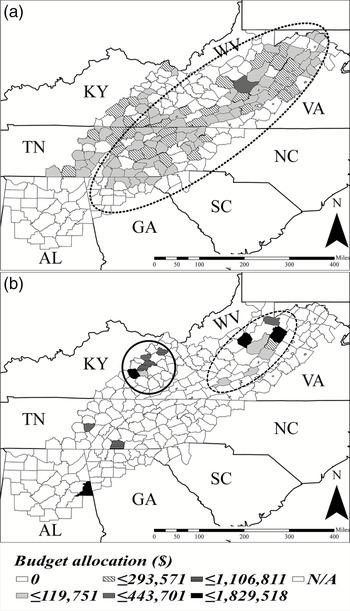
Figure 3 shows the optimal spatial budget distribution patterns for one point (A) on the efficient frontier with explicit cost and those for one point (a) on the efficient frontier with relative opportunity cost. The numbers of optimal target counties for the assigned weight are 107 for the optimal solutions with explicit cost and 19 for the optimal solution with relative opportunity cost (Fig. 3). Likewise, the numbers for the two assigned weights for the points (B and C) and the points (b and c) are 122 and 126 for the optimal solutions with explicit cost and 22 and 18 for the optimal solutions with relative opportunity cost. Thus, the optimal budget is distributed more narrowly among the counties when cost of conservation investment is measured by relative opportunity cost than by explicit cost. The significantly smaller number of optimally targeted counties with the relative opportunity cost than with the explicit cost results from a greater dispersion of the relative opportunity cost compared with the explicit cost. Specifically, the coefficient of variation is 1.92 for the relative opportunity cost while it is 0.82 for the explicit cost. Consequently, the distribution of the forest-dependent biodiversity ROI with relative opportunity cost stochastically dominates the distribution of the forest-dependent biodiversity ROI with explicit cost (two-sample Kolmogorov–Smirnov test, p < 0.05), which result in fewer optimally selected counties under the relative opportunity cost. In addition, the narrowly targeted counties using relative opportunity cost are mostly rural because of higher relative opportunity cost in urban counties and thus lower forest-dependent biodiversity ROI in those counties (see Table 3). For a 100% weight on forest-dependent biodiversity, approximately three-quarters (or 83 of 107) are distributed across the Ridge-and-Valley Appalachians and Blue Ridge Mountains (i.e., dotted circle) for the optimal solution with explicit cost (Fig. 3). Approximately three-quarters (or 15 of 19) are distributed across the border between West Virginia and Virginia (i.e., dashed circle) and across north-eastern Kentucky (i.e., bold circle) for the optimal solution with relative opportunity cost.
Optimal budget distributions under the 100% assigned weight to forest-dependent biodiversity and 0% weight to economic impact with (a) explicit cost or (b) relative opportunity cost.

Number of optimal target (urban) counties with explicit cost and relative opportunity cost under three different assigned weights between forest-dependent biodiversity and economic impact.

Note: The numbers in parentheses are the numbers of urban counties among the optimal target counties.
Figure S3 shows protected forestlands from the optimal budget distributions, which exhaust a hypothetical budget of US$10 million, under the 100% assigned weight to forest-dependent biodiversity and 0% assigned weight to economic impact with explicit cost or relative opportunity cost. Overall, these result in 3.28 million hectares of total protected areas in 107 selected target counties at the cost of US$3.04 per hectare for the optimal solution with explicit cost and 0.56 million hectares of total protected areas in 19 selected target counties at the cost of US$17.80 per hectare for the optimal solution with relative opportunity cost. It is worth noting that less than one-fifth of total protected areas can be protected if the relative opportunity cost is used instead of the explicit cost because of a higher relative opportunity cost than explicit cost.
In the neighbourhood of the optimal target counties for the objective of maximizing forest-dependent biodiversity, comparable numbers of target counties are selected for the 75%–25% and 50%–50% weights using either cost measure. Of the selected counties for the 100%–0%, 75%–25% and 50%–50% weights between forest-dependent biodiversity and economic impact using explicit cost, only 13.08% (or 14 of 107), 13.93% (or 17 of 122) and 11.90% (or 15 of 126) of counties, respectively, are also selected when using relative opportunity cost. These findings suggest that failure to reject the hypothesis means that the optimal spatial targets and their budget distributions between the forest-dependent biodiversity ROI and the economic impact ROI generated by PESs are affected by how the cost of the ROI is defined (see Text S6 for the sensitivity analysis of the main findings).
Discussion
Our results confirm significantly different optimal spatial targets, budget distributions and trade-offs between maximizing forest-dependent biodiversity and economic impact using explicit or relative opportunity costs. In particular, we find that the optimal budget is distributed more narrowly among counties that are more likely to be rural when the cost measure is relative opportunity cost than when it is explicit cost. We also find that the sacrifice in forest-dependent biodiversity for a unit increase in economic impact is higher for the optimized solution using relative opportunity cost than that using explicit cost.
Our findings can be used as a reference by conservation agencies interested in the spatial targeting of counties and their budget allocations for PES conservation investment. In practice, conservation agencies would consider more than the two objectives addressed in our analysis (e.g., habitat potential for species of policy concern). Nevertheless, they still can use the optimally selected counties as a reference when choosing target areas. For example, a conservation agency with given preferences between the two objectives can use our modelling framework to target broader geographical areas before zooming in with higher spatial resolution. At the very least, our methods can help a conservation agency understand that the optimal solutions can be different depending on how conservation investment cost is measured.
The more narrowly distributed optimal budgets among mostly rural counties when using relative opportunity cost than when using explicit cost suggest that the cost measure has important consequences for distributional equity among counties and between rural and urban areas. Specifically, in using explicit cost instead of relative opportunity cost in the multi-objective optimization, the PES budget distribution achieves greater distributional equity by having a larger percentage of urban counties among the target counties. Given that advancing equity in rural areas is a key objective of implementing PESs (Wegner Reference Wegner2016), this finding suggests that choosing explicit cost over relative opportunity cost may challenge the objective of rural equity.
The optimal spatial budget distribution patterns based on explicit cost are relevant for PES programmes such as the CRP, which does not account for the opportunity cost associated with real estate markets and other competing land use options. For example, the maps in Fig. 3(a) would be relevant for CRP contracts offered to landowners in the selected counties who have limited competing land use options. Because many of those counties are likely to be remote, landowners in rural counties are likely to be important for PES programmes that account for explicit cost without considering opportunity cost in the cost of conservation investment. Conversely, the optimal spatial budget distribution patterns based on relative opportunity cost are relevant for PES programmes that account for opportunity cost. Thus, the maps in Fig. 3(b) would be relevant for PES contracts offered to landowners of the selected counties who have competing land use options. Because many of those counties likely face development pressure, landowners in wildland–urban interface counties are likely to be important for PES programmes that account for opportunity cost.
Our optimization framework for conservation investment is at the county level instead of the parcel level, and thus choosing one cost measure for a county over the other may understate or overstate the ROIs as well as conservation investment cost for different forest parcels within the county. A parcel-level model would be difficult to produce, but improvements to our framework could be made. In future research, the counties could be sorted by whether or not forestland owners have significant competing land uses before executing the multi-objective optimization model. By doing so, we could use explicit cost or relative opportunity cost in the optimization model depending on whether the landowners in a county do or do not have significant competing land uses. One way to accomplish this partitioning would be to develop a land use model to identify counties with high or low development pressure. Once the sorting was done, we could calculate the county ROIs based on the most relevant cost measure and run the optimization model once for all the counties with their respective ROIs.
In our framework, we only deal with urban development as the competing land use for forestland. The choice of urban use as the competing land use makes sense because deforestation in our study area is dominated by conversion to urban use (Cho et al. Reference Cho, Lee, Sharma and Hayes2021). However, the opportunity cost of conserving forest-dependent biodiversity through protecting forestland in other regions might be the return from other competing land uses, including crop production or cattle production, as well as urban use. To provide broader implications for more diverse regions, future research could explore an optimization model with multiple competing land use options.
Conclusion
We evaluate how optimal conservation investment decisions that account for explicit cost only and combining it with opportunity cost result in different spatial targets, budget distributions and trade-offs between multiple objectives. By understanding the consequences of using one cost measure over another, a conservation agency can recognize and choose the cost measure that is most appropriate for their decision-making process. For example, using the explicit cost of conservation investment in calculating ROIs for use in our optimization framework may be of little concern when forestland owners have few competing land use options to consider. If a forestland parcel in a remote area were considered for a PES contract, using the return from the forestland as the explicit cost would closely represent the cost of conservation investment because its value in alternative uses (e.g., real estate or agricultural production) would be negligible. Conversely, if a forestland parcel considered for a PES contract faced development pressure, its opportunity cost would be considered in the cost estimate, because one of the landowner’s options would be to develop the forestland and forego the PES contract. Given this decision, the landowner would have to decide which alternative is greater, the return from development or the return from timber production, the higher of which would be the landowner’s opportunity cost of participating in a PES contract, and the conservation investment cost to the agency of obtaining a PES contract from the landowner would be at least as high as either the return from timber production or the return from development, whichever is higher.
Supplementary material
To view supplementary material for this article, please visit https://doi.org/10.1017/S0376892921000187.
Acknowledgements
We gratefully acknowledge BC English, J Menard, CD Clark, BP Sharma, B Wilson, L Lambert, T Kim, S Kwon, J Mingie, PR Armsworth, CB Sims, M Soh, OF Bostick, JG Welch, M Papes and X Giam for helpful discussions and data support. The usual disclaimer applies.
Financial support
We gratefully acknowledge grant support from the USDA National Institute of Food and Agriculture, Grant/Award Number: RI0018-W4133, 11401442, 111216290.
Conflict of interest
None.
Ethical standards
None.