This discussion forum originated in a panel discussion organized by Staša Babić and John Robb and sponsored by the European Journal of Archaeology at the twenty-first Annual Meeting of the European Association of Archaeologists, held in Glasgow in September 2015; it has since been augmented by other invited contributions to diversify the fields of expertise of the contributors as well as the viewpoints from various geographic backgrounds and disciplinary traditions. However, the final outcome demonstrates a somewhat surprising convergence of opinions. A number of concerns, already expressed in the discussion of European archaeology published in Archaeological Dialogues 15 (2008), still figure prominently in the texts below. Important new issues have also surfaced since—not surprisingly, given how the political climate of Europe has changed over the last decade. Moreover, this discussion has a slightly different focus from the 2008 dialogue. The central theme of the earlier discussion was how robust and united ‘European archaeology’ is as an academic field. While we consider this, we are also interested in the more global political implications of the concept, and with what position archaeologists should take in present political discussions. The fact that almost a decade later some burning issues of European archaeology, from the very meaning of the term to its aims, purposes, and burdens, remain unresolved proves that we should continue asking these fundamental questions and reconsidering our tasks as a disciplinary community. Moreover, the way new issues and doubts arise as the European political landscape shifts underscores once again the central connection between archaeological concepts, academic practice, and politics.
Introduction: ‘European Archaeology’ in a Crisis-ridden 2016
John Robb and Staša Babić
What do ‘Europe’ and ‘European archaeology’ mean for archaeologists today? In 2008, Archaeological Dialogues ran a seminal discussion feature on the question of whether a truly European archaeology exists. This feature presented a range of reactions to Kristian Kristiansen's (Reference Kristiansen2008) argument that archaeology in Europe oscillates historically between nationalism and internationalism; the overwhelming tenor of the many insightful comments was that an internationalist European archaeology would be a good thing, reflecting both academic arguments for trans-national archaeologies and the academic community's generally positive attitude towards integration.
The present discussion takes place in a different historical moment, and has a somewhat different focus. A week is proverbially a long time in politics; a lot has happened since 2008. The global financial crisis of 2008 put the brakes on a decade of fast economic growth and had extensive repercussions, particularly in the poorer economies of southern Europe. Greece was on the brink of dropping out of the Euro, and while it has so far remained in, helping maintain the strength of the currency in the Euro heartland as well, the crisis has generated hard feelings between the economic core of Europe—particularly Germany—and its weaker economies, whose citizens sometimes see the European Union (EU) as a tool for capitalist exploitation of its poorer members. Equally marked has been the rush of Eastern European countries to join the EU, which has almost doubled its membership since 2004. This enlargement increased the economic and labour power of the EU, and heightened the amount of internal movement, particularly from the poorer former Eastern bloc to the prosperous West. A third trend is the crisis of refugees fleeing from civil war and poverty, not only from the disastrous civil war in Syria, but also from a belt of instability extending from Libya to Afghanistan. All these aspects create a context for heightened identity politics rooted in the past; tension over the large number of Eastern European immigrants in Britain was a major factor in the British referendum result of 23 June 2016 in favour of leaving the EU (the so-called ‘Brexit’ vote). Elsewhere in Europe, fear and anxiety revolve around migration into Europe, whether it is over recent refugees or over the integration of long-standing Muslim populations, for example in France and Belgium. At the heart of both national and continental tensions is migration from the global south across the borders of Europe. The tension is often expressed, overtly or in coded terms, in terms of race or religion: a struggle over whether Europe is fundamentally a white, Christian place.
This scepticism over an understanding of the past rooted in an emotive sense of identity lends itself well to a post-Brexit analysis. Effectively, the referendum debate, culminating in Britain's historic vote in June 2016 to leave the EU, was a debate over whether Britain's approach to Europe should be guided by sentiment or by economic and political need. The main persuasion of voters who wanted to leave the EU was an emotive pitch that ‘our’ identity and ‘our’ country were being threatened by immigration—a naïve longing for a simpler, pre-EU childhood normality (it is no surprise that pro-Brexit voters were generally older than pro-Remain voters). In contrast, the main argument in favour of remaining in Europe was based on a simple fact: economic integration, political coordination, and the movement of labour underpin today's normality in a thousand ways. This is becoming evident as politicians attempt to sort out what Brexit actually means in practice, and find that all those threatening migrants— builders, waiters, programmers, dentists, farm workers, even archaeologists—are in Britain because the British economy actually relies on them.
Brexit would be simply a local neurosis, except that it reflects tensions throughout Europe: in most parts of Europe, there is a tension between a present-day normality of integration and a sentimental order of identity politics rooted in the past. In the former, trans-national movement of people, economic integration, and political coordination underpin everything from the labour market, continental security, and peace to common standards of health, rights, and environmental care. They often do so invisibly, but the result is an increasingly integrated and homogeneous Europe. In the latter, people adhere tenaciously to identities established a hundred years ago or more, in quite different political landscapes. Such identities are inherently oppositional. This is so whether such identities are on a local level (being ‘English’ as opposed to ‘French’) or a continental, racial, or religious level (and a term such as ‘European’ often bundles all three together). Another way of expressing the contradiction is through a single vignette. When English, or Czech, or Greek football supporters pour off airplanes to cheer their team on in a European competition, they are intensely nationalistic; they feel anything but ‘European’. But—whether or not they are conscious of these factors and the underlying organizational relationships enabling them—the budget-airline flights they take work within an integrated European market, their passports will be recognized with no reservations, their health and security will be guaranteed by agreements across national health services, interlinked police forces, and shared legal codes, the airports, bars, bathrooms, hotels, trains, and roads will function much as they do at home, and they will be able to use their mobile phones and ATM cards seamlessly wherever they go. Europe is a mode of organization, not an identity.
This has one major implication for archaeological policy, which stands perhaps in clear contrast to how the situation may have been seen a decade ago. Whether or not we see ‘Europe’ as a historically integrated phenomenon, using archaeology to try to build an emotive commitment to European identity is a bad idea. At worst, it won't work, and would come across as pushing an ineffectual, somewhat forced political agenda; how many monuments really inspire visitors with a sense of ‘Europeanness’? And even if successful, it could result in a hegemonic identity which suppresses knowledge of variation, permeability, and difference in the past and lends itself to exclusionary political ideologies. The Roman Empire, for instance, unified much of Europe; yet we cannot regard it as ‘European’, encompassing as it did North Africa and western Asia too. Similarly, if any one factor united the chaos of strife that was medieval Europe, it was Christianity; yet medieval Europe contained significant numbers of non-Christians—Muslims, Jews, and believers in the indigenous religions of northern and eastern Europe—and there was often conflict, even slaughter, between Christians (Catholics, Orthodox, and ‘heretics’). Europe has always been both internally heterogeneous and open, integrated with Asia, North Africa, and the Near East. And this state of affairs continues today; a sense of ‘Europeanness’ based on historical domination of a factor such as Christianity is a charter for domination in the present. We would reject any essentialized or closed idea of ‘Europe’ as both misrepresenting the past and politically dangerous in the present.
Instead, much as in the football example above, ‘European archaeology’ should be fostered in the organizational normality of the present—the sense of Europeanness which derives from a mutual recognition of things like working practices. It should encompass things such as political coordination for goals including the protection of cultural heritage, making it an accessible part of local cultural life, and establishing widely shared standards for archaeological practice and integrative networks for sharing knowledge. These will create an organizational, not emotive, normality for ‘European archaeology’, which will foster a more open-ended understanding of the past and make it more productive in terms of social relations and political dialogue.
Organization and action
These considerations suggest a range of directions in terms of organization and action. A first step is simply to use and defend academic authority. A key element of identity politics and exclusionary narratives is to discredit experts of all kinds — a tactic which worked splendidly in the Brexit debate in Britain. For example, when a Roman woman buried in York was identified through scientific analysis as probably of North African origin, this was decried in the tabloid press as academic political correctness with an agenda of multiculturalism run mad. As students whose knowledge of the past is grounded in hard-won knowledge, archaeologists should defend their ground.
Secondly, we should protect and promote diversity, both of archaeological concepts and practices and within our interpretations of the past. European archaeology is best understood not as a single, overarching theoretical framework — the European continent harbours many distinct and robust archaeological traditions — but as a coherent and widely shared set of practices. Moreover, archaeology needs to make marginalized archaeologies, and historically marginalized peoples, visible, and indeed to focus scrutiny on the process of marginalization itself. Europe has to decide whether to fully embrace its diversity or to try to push unifying processes; funding strategies have a relevant role in this respect. As far as we have seen until now, unification is difficult, and risky, as it creates marginality out of the mainstream (e.g. if funding insists only on major projects) and can easily be overturned by local attitudes and feelings: glocalism (a somehow already out-of-fashion term) should be supported, and relevant diversity appreciated.
In all these processes, the EAA has a central role to play. It is not only the largest professional organization for archaeology in Europe, with a role of advocacy for the subject and the profession, it is also an encompassing, wide, open association, not bound to a state or a union of states (like the EU), but acting as a forum of diverse archaeologies of Europe, as the annual meetings constantly show. In that sense, EAA has to be glocal too, while increasing its liaising role with international associations, and not only at a continental scale, in order to develop global strategies, based on local perceptions.
‘European Archaeology’: What's in the Name?
John Robb
Names are powerful: they create things as much as they describe them. What they create can be useful or harmful, a common resource or a sectarian banner; it is rarely simply a neutral statement of things. What is ‘European archaeology’? What does the phrase refer to, and what are the implications of setting it apart as a defined thing and calling it by that name rather than any other?
In this prelude to the discussion, I outline four major ways in which one can understand the phrase ‘European archaeology’. These differ considerably in what they encompass and in their political and practical implications. This introductory discussion lays out the key points of each strand, along with ways each has been used and some of its pros and cons.
Version 1. ‘European archaeology’ is the archaeology of ‘Europe’ as a geographical place
‘Europe’ is, in the first instance, a geographical term. It does not refer to a bounded continent, except conventionally; ‘Europe’ is really just the western end of the Eurasian landmass. However, it is often conventionally defined as the area bounded by the Mediterranean to the south, the Atlantic to the west, the Arctic to the north, and the Ural mountains to the east. Although this definition contains ambiguities (for instance, over Mediterranean islands such as Cyprus, or Atlantic islands such as Iceland), on at least three sides it is moderately clear-cut. Europe is both most open and most ambiguously defined towards the east, towards Asia, and the south-east, towards the Near East.
In a purely geographical usage, ‘European archaeology’ is simply the archaeology of the geographical area defined as Europe. This is the most obvious and primary definition, and to some extent all others presuppose that the starting point is a geographical referent. This is, however, straightforward to define, but very difficult to use productively in actual archaeological analysis because it frequently does not coincide neatly with culture-historical traditions (the second definition below), ideals about what constitutes ‘Europe’ (the third definition below), or modern political and scientific communities (the fourth definition below). Moreover, the human past within geographical Europe was often quite heterogeneous, and using a strictly geographical definition may imply that there was cultural homogeneity which allows us to speak of ‘Europe’ at once geographically and archaeologically.
Version 2. ‘European archaeology’ is the archaeology of Europe as a set of historical traditions
A second approach consists of asking what is distinctive about the human past of the area generally understood as Europe. It is empirically undeniable that Europe has been characterized by distinct cultural traditions, even when they rarely coincide neatly with the geographical borders of Europe. To take one example, the Bronze Age of Europe was by no means homogeneous, but Bronze Age societies as a whole are marked by institutions, practices, and material culture that set them apart from their neighbours in North Africa, the Near East, and the steppes. To take another example, medieval Europe stands apart from contemporary societies on other continents by virtue of its hegemonic Christianity, its feudal order, and many commonalities of economy, dress, and belief. It is these commonalities in ways of life which give coherence to synthetic works and textbooks about the European past.
Yet, as the comments below suggest, such a view can be reductionist, ideological, and exclusionary. Europe is poorly bounded. In most periods, polities and cultural traditions cross the bounds of geographical Europe. For example, the Roman Empire was not ‘European’; it encompassed important parts of the Near East and North Africa and omitted half of modern Europe. Similarly, Europe has always been internally heterogeneous. Medieval Europe was predominantly Christian, and it is difficult to understand medieval politics, culture, and landscapes without taking this into account; but Christians did not all believe and practise the same things, there have always been important Jewish, Muslim, and other populations, and at some points substantial parts of Europe were under Muslim hegemony.
Thus, deciding that one set of traditions represents ‘European archaeology’ can be an ideological tool, a means of essentializing an idea of ‘European’ which renders some elements of the European past hegemonic and others invisible. Effectively, as Babić and Milosavljević show below, it creates a situation in which all Europe's archaeologies are European, but some are more European than others. Moreover, particularly when used in contrast to constructed others such as the ‘Oriental’ or the ‘African’, it can involve a historically fallacious retroactive attribution of an identity which did not exist in the past. It can form a legitimating narrative in contemporary controversies about the historical nature of Europe and mobility into Europe.
Version 3. ‘European archaeology’ is archaeology as practised within Europe
We could define ‘European archaeology’ simply in terms of modern practice: it is ‘archaeology as Europeans do it’, archaeology as practised in Europe, regardless of the period or place which is the subject of archaeological study. For instance, the archaeology of Mexico, Japan, or South Africa may be considered ‘European archaeology’ if it is done in a distinctively European way.
At first sight, ‘European’ may not seem a particularly appropriate designation for ways of doing archaeology. For many groups of archaeologists, concept and practice cross continental boundaries, with a lot of common practice between (for example) American, European, and Australian archaeology. Instead, archaeology is fragmented by disciplinary traditions. For instance, Classical archaeologists working in Chicago, London, Paris, and Athens may have more in common with each other than they do with prehistoric archaeologists based in their home cities; the same may be true for Palaeolithic and medieval archaeologists. Moreover, while there is more sharing of methods and techniques, particularly in scientific archaeology, there remain quite strong national traditions within Europe, so it is difficult to define a ‘European archaeology’ which encompasses (for example) British, German, and Russian interpretive concepts.
What may bind ‘European archaeology’ together as a field, to the extent that it is one, may not necessarily be common concepts and methods so much as a common disciplinary and institutional framework: publishing in the same journals, attending the same conferences, and obtaining funding from the same sources. Here the efforts of the European Association of Archaeologists have been central, both through its steadily-growing annual conference and through publications such as the European Journal of Archaeology and the newsletter The European Archaeologist. European Research Council funding has been similarly important, through research grants, heritage grants, and funding for the movement of scholars such as the Marie Curie Fellowships. The internationalization of commercial and rescue archaeology has been the other important vector; particularly in the 1990s and 2000s the commercial and rescue sectors grew hugely in many parts of Europe. There has been increasing convergence across Europe in the standards and methods used, and some companies now routinely work in multiple nations. Such convergence enables archaeologists to move across borders within this sector, and it means production of an archaeological record which is internationally comprehensible.
Version 4. ‘European archaeology’: the archaeology of ‘Europe’ as an idea
A fourth possible usage of the term ‘European archaeology’ is ‘the archaeology of Europe as an idea’. At specific points in the past, people living in Europe began to perceive themselves as ‘Europeans’, a specific kind of people in contrast with ‘Asians’ or ‘Africans’. This self-classification has roots, within a narrow intellectual community, among Classical geographers such as Herodotus, but I would consider it as widespread for the first time in medieval times, when ‘Europe’ was pictured visually on mappae mundi as one of the three continents of the known world whose centre lay in Jerusalem, a distinction fleshed out by widely popular geographical works such as Mandeville's Travels. ‘Europe’ as a classificatory concept became self-evident and universally used from the fifteenth century onwards, with ever-expanding discoveries and colonizations in the Americas, Africa, Asia, and Oceania. ‘Europe’, in this view, was characterized by a highly evolved ‘Western Civilisation’ derived from Classical Greece and Rome. This historical charter, in turn, was laden with imputed values—democracy, freedom, individualism, humanism, reason, energy, innovation—which contrasted it both with other civilisations (above all, Asian civilisations) and with ‘uncivilised’ peoples around the world in a story of Western exceptionalism. ‘Europe’, in other words, was the necessary ideal of ‘Occidentalism’, an inevitable complement to ‘Orientalism’.
The notion of ‘the archaeology of Europe as an idea’ has yet to be developed. It does not really substitute for the others in their general utility; it would hold a narrow, discrete but critical place in intellectual and ideological history. In this view, ‘European archaeology’ would be an archaeology that is critical of Occidentalism, of the narrative of Western tradition and supremacy. An obvious place to start is critically and reflexively, through archaeology and museums’ own historic role in producing narratives about what constitutes Europe and where its origins lie; the construction of Ancient Greece and Rome in eighteenth and nineteenth-century western and northern Europe is probably ground zero for such studies. But such political ideals, of course, are constructed and promoted materially, giving a basis for such a broader, hands-on archaeology. One vector would be the imposition of new cultural forms in colonial contexts in the Americas, Africa, Asia, and Australia, the export not only of productive economies but of regimes of food, dress, manners, and religion. Another vector would be the reproduction of Europe's historical charter, or its invention as a tradition, for example, in the spread of neoclassical architecture tying eighteenth and nineteenth-century states to Greek and Roman roots, and in the use of medieval Gothic architecture as a visual idiom of power in the nineteenth century. We might even examine the export of ‘Europe’ for post-modern consumption elsewhere, for instance the recreation of Shakespeare's home in Stratford-upon-Avon in a Japanese theme park.
Discussion: The abuses and uses of vagueness, or polythetic definitions as tools of exclusion and inclusion
I have laid out the four understandings of ‘European archaeology’ above as separate definitions, but in fact they are rarely used in isolation. The two most common definitions are the first two, and it is frequent, indeed typical, to merge them explicitly or implicitly, describing Europe both as a geographical place and as a coherent set of historical traditions. Yet, as the discussions below suggest, this can be dangerous. It lends itself to the understanding that ‘Europe’ is a self-evident thing, an easy coincidence of geography and historical tradition. This raises the danger of foundationalism and origins narratives. Whether we like it or not, one of archaeology's roles for the public is to provide narratives for the European past, and these narratives are too easily understood as origins narratives providing a warrant or justification for what Europe should be in the present. For instance, if we describe Europe as possessing a single dominant historical tradition, we risk archaeology being used as justification for excluding diversity or change in contemporary Europe. This is most obvious in current polemics over multiculturalism, immigration, and religion in Europe.
To a certain extent, ambiguity and tension are inevitable. You cannot make a broad generalization (and terminology is a generalization) without abstracting from reality; and the choice of what to abstract is a political choice. Maps are acts of classification, of imposing categorical monothetic boundaries on a polythetic, continuously varying reality—but it is difficult to think without maps. If we deleted the word ‘Europe’ from our archaeological vocabulary entirely, we would avoid many dangers, but we would also be depriving ourselves of an important tool.
I would therefore argue that we should retain the concept of ‘European archaeology’, and we should allow it to have multiple definitions, as long as we understand what their values and dangers are. We should be pragmatic and politically aware rather than scholastic. Effectively, we are stuck with the first two definitions, both because there is some empirical validity to them (Europe is a geographical place of some sort and Europe has sometimes had some coherent cultural traditions). The challenge here is to use them in a way which recognizes diversity and historical contingent boundaries, and in a way which reveals the inclusive rather than exclusionary nature of the concept. The fourth usage may be a fascinating, important, but niche usage.
It is really the third notion, European archaeology as archaeology practised in Europe, which holds the biggest potential. The obvious parallel is ‘American’ archaeology. The ‘American’ in the Society for American Archaeology and its journal American Antiquity covers both ‘the archaeology of the Americas’ and ‘Archaeology as practised in the Americas’ (given the worldwide reach of American research, this becomes de facto world archaeology). If we use ‘European’ in a similarly polythetic sense, it allows ‘European archaeology’ to draw in participants, share practices, and allocate resources broadly and inclusively. For example, European funding agencies already fund high-quality archaeological projects based in Europe whose empirical activities lie outside Europe geographically. Similarly, it would be highly productive intellectually and collaboratively to attract more European archaeologists working outside Europe to the EAA meetings. Developing ‘European archaeology’ as a field means constructing institutional bridges without effacing difference. To take a concrete example, there are multiple theoretical communities within European archaeology, and that is both historically inevitable and a good thing. But in practical terms this means that peer reviewers in theoretical archaeology tend to reject applications from other national traditions; hence major European funding goes preferentially to archaeologies with more internationally-shared paradigms (for instance science-based archaeology, Roman archaeology, and Palaeolithic archaeology). All that is needed here to help the field develop significantly is some less local standard for what good research looks like. There are many examples where organizational endeavours—most minimally, sharing discussions at EAA meetings—can help enhance research, give access to funding, have more of a cumulative effect, and have a more powerful voice in issues of heritage and identity. Done well, ‘European archaeology’ can be an important intellectual tool and a creative political resource for integrating a twenty-first-century, unbounded, multicultural Europe.
European Archaeology as Reflexive Practice
Staša Babić and Monika Milosavljević
More often than not, archaeological knowledge is organized around geographical denominators, as presumed neutral technical terms. Maps, as two-dimensional graphic representations of these notions, serve as the consistent background against which material culture is plotted and inferences drawn on the grounds of observed regularities. However, these denominators and their visual representations reflect a number of pre-conceived ideas, necessary in this ‘process of reducing of infinitely complex to a finite, manageable frame of reference, requiring the imposition of artificial grids’ (Gaddis, Reference Gaddis2002: 32, 33). These preconceptions include not only conventionally agreed limits of individual natural phenomena, but also the ideas on the quality of human actions taking place among rivers, mountains, and seas. In this conflation of geographical, historical, cultural, and political descriptors, map-making may be described as ‘a light-handed exercise of power, which apparently leaves the world unchanged—only known’ (Humphreys, Reference Humphreys and Most2002: 209). The convention to mark the lands west of the Ural mountains and north of the Mediterranean sea as Europe is not an exception—it implies not only the geographical limits, but also the limits of human actions, however porous they may be conceived to be. The history of archaeology (and other humanities, for that matter) amply demonstrates that the discipline has not only observed this demarcation line, but has also contributed to solidify it (e.g. Humphreys, Reference Humphreys and Most2002; Díaz-Andreu, Reference Díaz-Andreu2007). Since the publication of the seminal volume Cultural Identity and Archaeology: The Construction of European Communities (Graves-Brown et al., Reference Graves-Brown, Jones and Gamble1996), a growing body of research demonstrates that the modern perceptions of the European continent's past have been very much shaped by the social and political circumstances of their formation and, in turn, that these ideas of origins have heavily influenced the decisions and choices of modern Europeans. Accordingly, the choices made by archaeologists concerning research priorities may transgress the boundaries of Europe set in seemingly purely geographical terms, including/excluding material traces of the past that may originate from the lands conventionally marked as European.
One possible example is the paradox offered by the Ottoman past: even though many monuments of the Ottoman Empire still exist in south-eastern Europe, from the viewpoint of common European archaeological narratives it is difficult to perceive that the Ottoman Empire ever existed on European soil. This peculiar absence does not stem from a lack of material remains, but corresponds to ideological blindness determining the adequate frame of reference for the European archaeological past (see Baram & Carroll, Reference Baram and Carroll2000, 3–32; Walker, Reference Walker and Smith2014). The stereotypes of the Ottoman Empire as a state overtly characterized by Islam, with anti-progressive social tendencies, have resulted in the image of a colonizer whose colonization is not perceived as ‘civilising’ and consequently excluded from the European heritage.
Though an illustrative example, the Ottoman past is not the only one marginalized, nor the only one perceived as pertaining to Otherness, indicating how European archaeology, through its practices, subtly discards chosen pasts and perspectives. In the process, purely geographical denominators may cease to hold true and other considerations are brought into play. A similar argument may be developed concerning the Byzantine Empire and its material remains on European soil. However, the reverse logic operates in the case of the Classical Greek culture: although geographically located in the southernmost part of the Balkan peninsula, the splendour of the Hellenes will rarely be listed as a part of Balkan archaeology. This south-eastern corner of Europe is often perceived as a liminal, ambiguous region bridging the opposites of East and West, and yet not fully belonging to either (Todorova, Reference Todorova1997; see also Babić, Reference Babić, Biehl, Gramsch and Marciniak2002). Locating ancient Greece—the eternal font of the European civilisation—in this ambiguous setting would go against the pan-Hellenic narrative, the thread linking the crucial traits of European identity to the Classical sources through a long string of emulations, imitations, and inspirations (Humphreys, Reference Humphreys and Most2002; Settis, Reference Settis2006). This essential role-model shaped after Greece has no doubt laid the foundations to many an achievement of the Europeans. Democracy and humanism come readily to mind. But, at the same time, in the words of Edward Said, to be a European means to belong ‘to a part of the earth with a definite history of the involvement in the Orient almost since the time of Homer’ (Said, Reference Said1978: 78). This persistent heritage of the Europeans, that of confronting it with the Oriental Other, needs to be assessed with the same rigour as the other, more desirable traits of the Classical ideal built into the European self-image.
The role played by archaeology in the process of fossilizing the East-West dichotomy is by no means negligible. It is therefore the responsibility of European archaeologists to deal with a series of questions: Is European archaeology reluctant to engage with the material traces in its soil which are, for one reason or another, not perceived as European heritage? Why are ‘other’ archaeologies disturbing? Is the triad of nation, race, and religion still the dominant framework in the construction of archaeological narratives within the European context? Finally, is this blueprint adjusted to a new meta-narrative, that of ‘Europeanism’ (sensu Gramsch, Reference Gramsch2000)? (According to Gramsch, ‘Europeanism’ refers to a conviction by interpreters of pre- and protohistoric material culture that it must be possible to find common European characteristics in their data that account for lasting European commonness. The EU conception of Europe defines it as unity in diversity, but it is ideologically founded in a similar way to national identity, instead of following from an academic conceptualization (Gramsch, Reference Gramsch2000).) Discussing some of these questions may bring us closer to understanding the processes of inclusion/exclusion behind the notion of European archaeology. This, in turn, may elucidate its interpretive potentials and limitations.
European archaeology needs to face not only the problem of a heterogeneous European past, but also the present fragmentation of its archaeological communities. In a simplified form, one might argue that north-western European archaeology is highly theorized, dominated by the postprocessual paradigm, yet open to new challenges. On the other hand, other archaeological professional communities are perceived as intrinsically conservative or, at best, lagging behind dominant trends. The ideal outcome is therefore for the latter to catch up with developments on a universally acknowledged ‘ladder of stages’ of archaeological theory and practice (Babić, Reference Babić, Stoddard and Popa2014, Reference Babić and Wright2015). However, the processes of knowledge transfer in academic communities are much more than a one-directional relationship between transmitter and receiver. In order to reach a more profound mutual understanding among various European archaeological communities, it may be useful to turn to the history of the discipline. For example, the German archaeological tradition (with its strong impact in central and south-eastern Europe) is usually described as a primarily atheoretical approach, in stark contrast to developments further west (Sklenár, Reference Sklenár1983; Babić, Reference Babić, Biehl, Gramsch and Marciniak2002; Raczkowski, Reference Raczkowski, Gramsch and Sommer2011; Novaković, Reference Novaković, Migotti, Mason, Nadbath and Mulh2012). More detailed research shows that these archaeological traditions are not in fact atheoretical, but reluctant to clearly articulate the theoretical standpoint, that of nineteenth-century positivism, implying a valid scientific procedure in which the truth is reached through empirical facts and their description. In this tradition, which goes well beyond the field of archaeology, cognitive activity is supposed to be neutral (Sklenár, Reference Sklenár1983; Raczkowski, Reference Raczkowski, Gramsch and Sommer2011: 197–214; Novaković, Reference Novaković, Migotti, Mason, Nadbath and Mulh2012: 51–71; Karl, Reference Karl2014: 1–4). This deeply ingrained intellectual tradition often leads to a reluctance of non-Western European archaeologists to engage in current theoretical debates.
Furthermore, the history of European archaeology includes in equal measure the British colonial experience, unilineal evolutionism, the ‘Kossinna syndrome’ (Veit, Reference Veit and Härke2002: 41–66; Brather, Reference Brather, Schlanger and Nordbladh2008: 327), and various later nationalistic claims (see Graves-Brown et al., Reference Graves-Brown, Jones and Gamble1996). Reassessing the past of archaeology as a discipline by locating these points of misuse—the deviating courses of archaeological theory and practice, occurring in some European countries under specific social and political conditions—could prepare us for the circumstances of a new paradigmatic change. The ‘factographical’ approach to the history of the discipline (Stoczkowski, Reference Stoczkowski, Murray and Evans2008: 346–59), limiting research to the adventurous tales of great explorers, will not serve that purpose. Rather, we should concentrate on the intertwining European intellectual traditions, which form an integral part of our own discipline. The world today poses possibly greater challenges than the ones endured by our predecessors in our field. It may therefore be argued that reflexivity in archaeology is and should be a vital component of the European archaeological tradition. In other words:
‘The archaeology in which I believe overflows disciplinary limits as well, not just to walk together with biology and physics, but also with philosophy, anthropology, geography, history and cultural studies. And, when I say walk together, I envisage an archaeology that instead of passively foraging from other fields, enlightens them. An archaeology that is relevant, therefore, not just because it manages heritage, works with communities and it is conscious of its public role, but that is relevant because it is intellectually powerful. Because it helps us to think and problematize society (past and present) as much as anthropology or philosophy, but in its own way. An archaeology, in sum, that produces theoretical insights and ideas for others to share and not just knowledge of the deep past’. (González-Ruibal, Reference González-Ruibal2014: 44)
But reflexivity does not produce the kind of certainty that can be readily translated into narratives that are easily recognizable by the general public, decision-makers, and funding agencies alike. What is highly valued in this arena is measurable output, expressed through quantification of archaeological data and reports replete with analyses from the hard sciences. The majority of large-scale calls for project proposals by the European funding institutions almost completely neglect the need for critical reassessment of the implications of harnessing ‘big data’ in establishing ‘Europeanism’ (Gramsch, Reference Gramsch2000), spending ‘big funds’ to procure scientifically ‘hard’ evidence for the eternal unity and uniqueness of European culture. Designing projects and writing narratives about the past involves neglecting the critical orientation of the discipline and its adaptation to the political goals and profitability of the European Union (Niklasson, Reference Niklasson2014: 60–62). In order to survive in the European academic market, archaeologists may show themselves willing to reorient their focus of research and adapt to these demands (see Kristiansen, Reference Kristiansen2014: 12–19). However, science can indeed be blind to, or obscure, the fact that we may be trotting down a path that has already had dire consequences:
‘Genetic research “raises fundamental questions about what it means to be human” Kristiansen states, and it is true, but more explicitly, it raises questions about difference and sameness, evident from its uses elsewhere in society, such as in ancestry testing and criminal profiling. When combined with question of origin it therefore—rather than raising new ones—taps directly into the same old questions asked within the framework of modernity for centuries, questions of belonging that archaeology as a discipline (as one out of many conditions) have made possible.’ (Niklasson, Reference Niklasson2014: 59–60)
The situation gets even more intricate in the ways European strategies are implemented towards countries striving for membership of the EU. It can be easily imagined how the priorities of European archaeology expressed through big data, quantification, modelling, and aDNA are laid layer after layer onto the basis of, for example, the archaeological communities heavily imbued by the tradition of nineteenth-century positivism. The increasing use of bioarchaeological analyses thus buttresses identity models in which identity is but a matter of perception, relegated to the body, a territory on which we should tread lightly; from this perspective, genetics are the ‘true reality’ (Voss, Reference Voss2015: 661–64). Therefore, to avoid misuses bordering on pseudoscience or ethically dubious inferences, European archaeology at the time of a new paradigmatic change needs to pay attention to the ever-increasing possibilities of the natural sciences to contribute to our understanding of the past, but equally it must not lose sight of the reflexive nature of archaeological thinking. In other words, archaeology remains relevant only while it still fosters diverse academic traditions and numerous epistemological positions, approaching the past in its full complexity and bravely facing novel challenging questions.
Spannen wir den Karren vor das Pferd? (Are We Putting the Cart before the Horse?)
Raimund Karl
John Robb has remarked quite rightly in his introduction that any defined terminology necessarily requires an abstraction from reality. Any such abstraction is always necessarily a simplification, that is, a reduction of the complexity of the reality we have to engage with. Thus, as Robb also correctly notes, abstraction entails choice: choice about what aspects of reality are deemed irrelevant for the definition, and what aspects are considered relevant.
That choice frequently can be political in the narrow sense of the word, as the contribution by Babić and Milosavljević clearly demonstrates. Political aspirations of individuals, communities, and particularly states can and do influence these terminological choices, the latter in turn influencing political aspirations. While recognizing, as Paludan-Müller suggests here, that the interconnectedness of the world, can help overcome this problem on an intellectual level, the underlying issue remains: some things are included in any defined term, while others are excluded from it.
While it goes without saying that any term must mean something, Karl Popper famously remarked in his Open Society and its Enemies that, in the sciences, all truly important terms must be undefined terms (Popper, Reference Popper1980: 26). That does not mean that they remain meaningless: if it did, communication would be impossible. Rather, words gain their meaning from the context in which they are used: their actual meaning is rarely clearly defined. Indeed words occupy quite fuzzy semantic fields: what they actually mean in any particular instance is defined by the semantic context in which they are used. And that, in turn, depends entirely on what their user wants to express with them.
It is certainly interesting, particularly within a European Association of Archaeologists, to debate what the term ‘European’ in its name is actually supposed to mean, and how a ‘European’ archaeology might be defined. After all, the use of this, rather than any other term, is a choice, too. Yet, I would argue that the fact that the term ‘European’ remains as undefined as it is constitutes its greatest advantage: it gives its users the greatest possible freedom to apply it as they see fit, and shape its precise meaning in the way they wish, rather than being restricted by definitions that ultimately require us as a community to make the choices of what to include and what to exclude within its meaning.
The term ‘European’ in the EAA's name, and indeed in archaeology more generally, seems more like a mostly superfluous addition, a historical accident more than anything: the EAA was founded in the geographical area commonly called ‘Europe’ by archaeologists from that very same area. Hence calling it ‘European’ seemed sensible at the time to distinguish it from other archaeological associations. But it hardly seems to have been founded (or pursued any policy ever since) to restrict itself, its membership, or indeed most of its activities, to any particular definition of Europe. The only exception to this seems to be the location of the EAA annual conference, which—at least so far—has only been held in places within the geographical boundaries of Europe. And that, I would argue, is mostly due to the convenience of the majority of its members than some conscious political choice.
In general, I find the two other elements in the EAA's name much more important and interesting: what do we mean by ‘association’ and ‘archaeologists’? Who are the ‘archaeologists’ who are ‘associated’, and how are they associated with each other? And, perhaps even more importantly, what consequences (should) arise from archaeologists associating? Who do we include and who do we exclude? For what purposes are we associated? Do we want to restrict ourselves to just meeting at an annual conference and publishing a journal, a newsletter, and a monograph series, or should our association aim for more? And if so, what is this ‘more’ it should aim for, and how do we best achieve it as an association?
Perhaps, rather than discussing what the term ‘European’ means, should we not be discussing some of these questions instead?
European Archaeologies as a Node of Problems and an Arena for Experimentation
Koji Mizoguchi
Introduction: ‘Europe as a concept’
Where did and does ‘Europe’ begin and end? We can draw as many boundaries as we wish to imagine what ‘Europe’ ought to be by mobilizing as many attributes (whether qualitative or quantitative) as can be differentiated and given different meanings and implications (again regardless whether cultural, social, political, economic, or other). In that sense, as has been claimed and accepted on numerous occasions, Europe is a construct, or a concept. And, because of that, because of the fact that many European countries once colonized many parts of the globe, because of the fact that many of the organizational principles, both mental and material, governing the ways in which we live our lives today emerged out of somewhere inside of this (roughly but not exactly definable) area on the western fringe of the Eurasian landmass, Europe is an arena; that is to say, a ‘referential horizon’ in which a large portion of those who inhabit this planet today position themselves at different points and live their daily lives and say what they want to say by drawing upon connections of all sorts they feel or believe they have with Europe.
The positionalities of European archaeologies
On those grounds, Europe matters significantly and inevitably to a large portion of us living outside this not-so-strictly-definable entity, and what is going on in archaeologies conducted on the inside (hereafter ‘European archaeologies’) matters a great deal to a large proportion of archaeologists living and conducting their daily archaeological practices outside it.
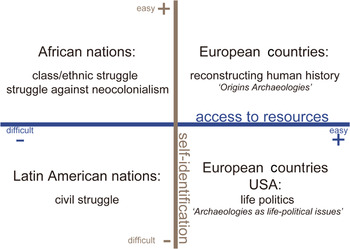
As I schematize elsewhere (Mizoguchi, Reference Mizoguchi2015), the current state of archaeology as a discipline, in terms of operational trends, can be grasped by heuristically categorizing the world's regions into a four-quadrant diagram, with the x axis indicating different degrees of ease/difficulty in accessing various resources, including economic and cultural/symbolic resources, and the y axis showing different degrees of ease/difficulty in acquiring self-identity (Figure 1).
Diagram mapping different modes of ‘living and doing archaeology’. X axis: access to capital and sources of wealth; + easy; – difficult; Y axis: self-identification, + easy; – difficult (after Mizoguchi, Reference Mizoguchi2015, with modifications).

Many ‘European’, mostly EU, countries, that once were colonizers and had experiences of attempting to ‘enlighten’ the colonized as well as their own citizens, are included in the first quadrant. In the process of the enlightenment as a modernizing project, and in the process of the establishment of modern nation states as ‘war machines’, each of which had to internally integrate agrarian communities into an artificial politico-economic entity and externally compete against one another over markets (see e.g. Mizoguchi, Reference Mizoguchi2006: Chapter 2), archaeology as a ‘scientific’ discipline was formed and mobilized, both consciously and unconsciously, for the achievement of those ‘Projects of Modernity’ (Mizoguchi, Reference Mizoguchi2006: 84).
The unique historical trajectory that many current European countries have been through, I would argue, is not only characteristic of the ways in which various archaeological practices have been and are conducted in these countries, but also defines the roles that ‘European archaeologies’ can play for the future(s) of world archaeologies in general.
Characteristic developments
Archaeological investigations of ‘origins’ as a continued Enlightenment project
The still ongoing pursuit of the project of enlightenment has driven European archaeologies to investigate ‘origins’ in human history. As long as the project was, and still to a large extent is, a European project, this prominent operational trend in European archaeological practices—embodied by the national schools and institutes in Rome, Athens, Cairo, and so on, and run by many European states—intrinsically embodies certain positionalities that do not coincide with that of the local scholars and citizens of the cities where these schools and institutes were established, and, in the past, led to the belief that ‘Europe’ was the righteous heir of almost all the essence of the ancient and Classical civilisations that had originated in the depths of human history.
In areas of the world outside the sphere of influence of these civilisations, the traces of autonomous development of complex societies were often interpreted as the results of contacts with, or migrations from, the core areas of those civilizations (see Connah, Reference Connah, Mitchell and Lane2013 for African examples, e.g. Great Zimbabwe). It should be noted that, after the de-colonization of these areas, archaeological investigations by local scholars were initiated to refute those pseudo-scientific interpretations, and that post-colonial archaeological practices were implemented to regain and re-vitalize/re-construct local traditions and identities once denied by European colonizers (Connah, Reference Connah, Mitchell and Lane2013).
Archaeologies as life-political issues
That many European countries maintain, albeit only just, their ‘core’ positionality in the modern world system means that all the tensions and contradictions generated out of their interventions in the semi-periphery and periphery, and systemic feed-backs through their interactions with them, can become ‘issues’ in them (e.g. Wallerstein, Reference Wallerstein1974). As the grip of globalization on the world tightens, thanks to the development of digital communication technology and social media, the relevance and significance of these issues to the citizens of European countries is growing by the day. With the ongoing fragmentation of our life-worlds and discursive spaces, which are making our self-identification increasingly difficult the world over, these issues increasingly become treated as ‘life-political issues’ (Giddens, Reference Giddens1990: Chapter 5, especially pp. 154–58). Commitment to such life-political issues is a matter of individual choice, often made to regain one's connection to the reality of the world. Hence, topics and genres of archaeological investigation become increasingly linked to those life-political issues: issues concerning our environment, landscape, gender inequality, minority rights, immigration, to name but a few. And it is particularly important to note, when it comes to the differentiation and establishment of a large number of archaeologies as life-political issues, that such issues are organically connected to the identities of those who commit themselves to those archaeologies and their strategies of self-identification. Therefore, the objectives of their operation become ever more detailed, specific, personal, and emotionally charged, and the discursive spaces they generate tend to be exclusive rather than inclusive.
Increasing tension/dilemma/contradiction
The two operational trends in European archaeologies outlined above, and specifically picked up among many for the purpose of this essay, connect those who adhere to them to make sense of what is happening across the world.
‘Origins archaeologies’ inevitably link the practitioners to the socio-cultural/political/economic context of the locations where they conduct their fieldwork and where they collect their data. Their interpretations could at times generate tension through contradicting interpretations put forward by their local colleagues; pseudo-scientific interpretations by some colonial predecessors had to be countered by local or indigenous archaeologists in the process of de-colonization (see for example Connah, Reference Connah, Mitchell and Lane2013), and archaeological counter-narratives put forward by these local or indigenous colleagues might at times place a scientifically naïve/uncritical/un-provable emphasis on aspects such as oral traditions to stress the proud ethnohistory of the region. Obviously, there is no definite solution as to how different interpretative frameworks, each drawing on a unique world view and self/group-identity, can be mixed/juxtaposed, and the only pragmatic solution is to open up and sustain a stable and open discursive space for dialogue.
‘Archaeologies as life-political issues’ also increasingly connect archaeological practitioners to those who adhere to the same life-political issues the world over. They share the same sets of life-world experiences and concerns, and that makes their international dialogues just as detailed, specific, and emotionally charged, leading to the rapid formation and establishment of new archaeological discursive spaces. The annual addition of new genres of archaeological enquiry is illustrated by the contents of the conference book of the EAA annual meetings.
This trend, which keeps European archaeologies permanently dynamic, leads to a range of positive consequences: 1) it allows young and up-and-coming scholars to set up new discursive spaces and build their careers on them; 2) it increasingly connects archaeological practices organically to contemporary social concerns, strengthening the position of archaeology in public perception; 3) it makes archaeological investigation into those issues more sophisticated, contributing to the continuous development of archaeological methods and theories; and 4) it enhances motivation for the exchange and sharing of concerns, thoughts, and ideas across the world.
However, this trend also leads to some negative consequences: 1) it promotes the fragmentation of the general archaeological discursive space, generating a sense of dis/mis-communication between fellow archaeologists; 2) it increasingly separates each genre-specific discursive space from the sphere outside it, because the topics of shared concern in each of them become more detailed and specific; 3) it enhances the fear of losing common goals; and 4) it can make us feel frustrated because we cannot say anything clear and definite.
The negative consequences and difficulties caused by the proliferation of the two operational trends in European archaeologies, i.e. ‘the origins archaeologies’ and ‘archaeologies as life-political issues’, precisely mirror the difficulties that European countries are currently facing: a) fragmentation of life-worlds, accelerated by the implementation of neo-liberal social policies by many governments, leading to the decline of stable employment, social welfare, and social safety-nets; b) the destabilization of self-identities, accelerated by the proliferation of neo-liberal ideologies attributing social problems not to the failure of political governance but to the failure of the individual; c) the dramatic increase in hatred and discrimination towards minority groups, including migrant communities or the LGBT community, caused not solely but significantly by the first aspects listed here; and d) growing tensions in international relations and the rise of autocratic governing styles/ultra-right-leaning policy implementations.
And, to me—as an archaeologist working in Japan, but trained in the UK and maintaining connections with, and a huge interest in, European archaeologies—an important aspect seems to be that the resurgence of interest and research investment in ‘origins archaeologies’ and ‘archaeological sciences’ is the unconscious reaction to those difficulties. ‘Origins archaeologies’ connect fragmented identities back to the origins of common human traits. And, ‘archaeological sciences’ ensure that stable causal connections can be identified between patterns recognized in phenomena observed by the natural sciences and archaeologically re-constructible phenomena, as far as the research-specific world view adopted in these approaches goes. Both of them powerfully help archaeologists reduce the genuine complexity of the phenomena under study and that of the social contexts in which research is conducted, and enable archaeologists to come up with very simple models. It is a natural, instinctive reaction to the difficulty. However, I must point out that such simplification strategies have an unconscious tendency to classify things, thoughts, meanings, and everything into such dichotomies as familiar/unfamiliar, relevant/irrelevant, useful/not useful, testable/untestable, can give quick returns/cannot, and so on (see Mizoguchi, Reference Mizoguchi2006: Chapter 5).
Concluding proposals: European archaeologies as a node of world archaeological problems
If we come back to my mapping of world archaeologies and their historical trajectories (Figure 1), it can be easily recognized that the situation captured by this four-quadrant diagram is the result of modernization of the globe led by European countries. It implies that, as globalization increasingly deepens, the problems that exist and are shown in the second, third, and fourth quadrants become inevitably fed back to those who live and work in the first quadrant. In that sense, European archaeologies conducted in the first quadrant have to react to those feedbacks. That makes European archaeologies a de facto experimenting ground for testing ways of coming to terms with problems across the world today. In such experimentations we have to invent novel ways to cope with the complexity of the past and present worlds and avoid excessive simplification when dealing with them. A balancing point or best mix can be found somewhere between the realm of ‘origins archaeologies’ and that of ‘archaeologies as life-political issues’; we need to know how complex and fluid our self-identity is, and through pursuing the historical trajectory of each of the components of our self-identity back to their origins, we need to learn how to make ourselves feel comfortable with this complexity and fluidity by knowing that our identities have always been like that.
The Elephant in the Room
Tim Murray
Some twenty years ago I took the opportunity of a need to mark the centenary of the death of Vere Gordon Childe to reflect on archaeology and European identity (Murray, Reference Murray1996). Even in 1996 it was no small irony that Childe celebrated the ideal of European civilisation as an Australian, Marxist, and secular humanist—a movement away from the ‘stultifying’ bonds of religion towards rationality and all the good things (such as science and democracy) that flowed from it. At that time, writing under the influence of a catastrophic war in the Balkans, separatist conflicts occurring everywhere from the Caucasus to the heart of Africa, and the return of radical right interpretations of ethnic essentialism, my major concern was to explore whether European archaeologists were better able to defend European society from the influence of ‘perilous ideas’ such as the supposed nexus between race, language, and culture, which had been fundamental to the rise of European nationalism.
In my reflection I stressed that Childe (unsuccessfully in my view) sought to defend the utility of concepts that lay right at the heart of culture-historical archaeology, through the application of the rationality of science for assessing the truth value of interpretations proposed by archaeologists and others. I found little reason for optimism, if only because the extent of epistemic polarization (or is it really atomization?) within the discipline of archaeology between science and non-science was so great as to make agreement about fundamental questions about the assessment of the value of interpretations pretty much impossible. Thus the absolutely critical task of finding ways in which quite clear abuses of such ‘perilous ideas’ could be unmasked and their use in contemporary politics constrained, had become more and not less difficult since Childe's passing.
Twenty years later it is clear that irony has been ‘upsized’. The same old epistemic and theoretical polarization exists within the discipline, notwithstanding the great impact that archaeological science has had on the ways in which the truth value of some theories can be assessed. Our incapacity to control ‘perilous ideas’ underwriting much culture-historical archaeology and social archaeology remains, as do abuses of archaeological interpretations by external groups advancing separatist (or even colonialist) agendas both within Europe and along its borders. But the world in which these continuing failures exist has changed more radically (and more quickly) than was generally thought possible.
Although the prospect of another round of navel-gazing about the nature and identity of European archaeology can be a bit daunting (so much self-obsession happening for so long and going where?), there can be little doubt that now, more than at any time in the past sixty or so years, archaeologists need to play their part in exploring and explaining Europe. We can all agree about so much: Europe can be geographically and politically defined (although they are not the same). European archaeology is done in Europe, by Europeans and others. European archaeology is also done outside Europe (the archaeology of the European diaspora, the archaeology of empires such as Rome, and the archaeology of the modern world system) by non-Europeans and Europeans. Europe is also a ‘region of the mind’, the source of firm cultural ties linking former colonial and imperial possessions across the globe. Thus the archaeology of capitalism, of the global trade in commodities, of mass migration and industrialization is also the archaeology of Europe. Perhaps even more so, the archaeology of ethnic conflict and dispossession (again within Europe as well as outside it) is also European archaeology. When we turn our attention to other aspects of Euro-culture, such as the Eurovision song contest, we find that the borders of Europe are very elastic indeed, now including Israel and (amazingly) Australia. So, what isn't European archaeology, does it really matter when compared to the current existential threat to Europe, and should that threat be of concern to non-Europeans?
Collapsing economies, rising unemployment and social dislocation, increasing military tensions, and the impact of mass migration, among other vectors of social and cultural stress, have created in Europe a highly combustible situation where the politics of ethnic essentialism are already beginning to play a part. In that sense, these politics have been bubbling away since the conflict in the Balkans and the collapse of the old Soviet empire in Eastern Europe some decades ago. Times of stress in Europe rekindle the attractiveness of nationalist and separatist politics (arguments for the separation of Scotland from the UK, or indeed of the UK from Europe, are just more recent examples), but the closing of borders, and conflicts within Europe over what to do with terrorism and the security of borders, pose an even greater threat to the idea of the open European society. It is up to all archaeologists (not just Europeans) to unmask dangerous misconceptions about the ethnic history of Europe which are being, and will continue to be, used as a basis for arguments supporting ethnic essentialism and the political and cultural separation that follows. This will be a difficult task primarily because those ideas are so deeply buried and so rarely exposed by archaeologists and others to rigorous analysis. But it is a task that we should undertake if we are to reform archaeological theory and protect society from archaeology. There is also a potentially high cost to pay in terms of exposing to public view the questionable assumptions that have supported the application of such ‘perilous ideas’ in archaeological interpretation. It is worth it. And could perhaps be the greatest gift of European archaeology to the project of world archaeology.
European Archaeology: Any Limits?
Carsten Paludan-Müller
There is nothing new in discussing the spatial extent of Europe. Nor is there anything new in the realization that working with the archaeology of European lands is meaningless without a perspective that includes the wider world. European lands are characterized by a spatial layout that has facilitated their connectedness both internally and with adjacent continental landmasses (Paludan-Müller, Reference Paludan-Müller2009). This has translated into tides that, from the earliest times, have shaped the dynamics of Europe's deep history. These tides can never be adequately understood from a perspective that segregates our past into ‘Classical archaeology’, ‘prehistoric archaeology’, ‘Islamic archaeology’, ‘medieval archaeology’, etc. While we need to dive deep into epochs and geographies, we need to do it with a strong awareness of their interconnectedness.
Today one of these historic tides is a condition of instability, poverty, and conflict that for many decades has affected the European Union's southern and eastern margin. Another, linked to that condition of poverty and conflict, is unfolding with accelerating pace in the form of a massive immigration that has affected and will affect the demographic and cultural fabric of Europe.
Cultural heritage itself is deeply affected by the conflicts raging on the periphery of Europe. The destruction of heritage in the adjacent conflict zones is also in painful ways affecting the many immigrants and refugees with whom we now cohabit.
If there are good scholarly reasons for questioning the relevance of a restricted geographical understanding of the concept of ‘European archaeology’, we could argue that, besides the scholarly arguments for a wider geographical perspective, we should see heritage (and by implication archaeology) as something that has to be defined with reference to people. The heritage of European citizens may no longer be perceived as restricted to the countries of our citizenship—but equally to the lands in which we have our roots.
In many parts of Europe, archaeology and cultural heritage are under pressure. Much of this has to do with the current economic crisis (Demoule, Reference Demoule, Schlanger and Aitchison2010; Schlanger, Reference Schlanger, Schlanger and Aitchison2010). But explaining this weakened standing solely with reference to the current crisis misses an important point: over the last five decades, the practice of archaeology has increasingly become dominated by developer-led investigations. Basically, archaeology has to a large degree become determined by the interaction of the legal framework with sources of funding rather than by the interaction of research questions with sources of funding. The result in the short run is not less money invested in archaeology but rather a poorer return of archaeological insights from these investments. With financial-legal logics in the driver's seat we have seen develop a fractured archaeology focused on single, site-specific issues more than on the big questions and long lines of enquiry that used to occupy the discipline.
The substitution of a strategic research funding rationale by a tactical-judicial funding rationale in the guiding of our practice has placed our discipline in a vulnerable position where it loses relevance in contemporary society in ways that threaten to delegitimize much of our practice.
Thus, too much of the archaeology that is being undertaken has been reduced to a bureaucratically legitimized exercise, where sites are excavated only because they are under threat from construction projects, and because excavations can then be prescribed by law and funded. Too often—though not everywhere and not always—the end product is a stock of artefacts, samples, documentation, and grey literature, left to oblivion in storage vaults and archives, because funding for the rest of the ‘food chain’, the production of new knowledge and giving it back to society, has been cut out (Kristiansen, Reference Kristiansen2009; Paludan-Müller, Reference Paludan-Müller and Lagerlöf2013b: 2). And, too often, cultural heritage management has failed to work in more inclusive ways with local communities, and with sufficient awareness of issues beyond those strictly pertaining to the sphere of cultural heritage.
In order to remain a viable historic discipline, archaeology needs to reconnect to what occupies people living in today's world. We as archaeologists must address big issues and identify long lines of enquiry when we shape the questions that guide our research strategies.
Archaeology has a privileged position from which it can illuminate us with insights into crucial issues such as the logics of urban development across time and space, cultural hybridity and connectedness, conflict and change, state and non-state interactions, climate and culture, and epochal transitions (Paludan-Müller, Reference Paludan-Müller2008, Reference Paludan-Müller, Bergerbrant and Sabatini2013a: 2). These are highly relevant issues in today's world.
Today, Europe is plagued by an inability to create the jobs necessary for the social inclusion of a growing fraction of its population. There is a concern among European politicians and in the European Commission that the European project is teetering on the edge of an ultimate failure to meet the basic expectations of its citizens. We need to think hard about how heritage can become a relevant part of a new equation, instead of a reminder of better days and the set pieces in ‘Heritage Theme Park Europe’. A new equation would have to address the need for inclusiveness in terms of citizenship and employment in a Europe that looks with confidence to the future and with openness to the wider world. We need to work with ‘big data’ (Gattiglia, Reference Gattiglia2014) in order to better see archaeology and heritage as sources of insights that help us understand and manoeuvre in long-term developments that are still unfolding and affecting our lives (Guldi & Armitage, Reference Guldi and Armitage2014: 88–116). And we need to see heritage less as a stock that needs conservation and more as an asset that inspires innovation. In previous periods of epochal transition, the European archaeology and heritage professions have been capable of connecting to big issues, and I believe we can do it again. But we must do it with awareness and integrity to avoid instrumentalizing history to divide and oppress.
An important discussion is now taking place within the discipline of history (Guldi & Armitage, Reference Guldi and Armitage2014) about how historians should shift their focus back to the longue durée by revitalizing a long time perspective for a better understanding of the major changes we are living through and which are so difficult to analyse and address with the short-term perspective currently guiding our political discourse and decision processes. Geopolitics, with its long-term and trans-national perspective, has re-emerged as an important discipline to support the understanding of international politics (Paludan-Müller, Reference Paludan-Müller, Bergerbrant and Sabatini2013a: 1). There is no reason why archaeology should not weigh in from its privileged position for analysing big data to understand long-term developments over vast spaces, be it in the growth of global power, economic structures, and empires, the shifting patterns of migration, or the response of human society to climate change.
Archaeology and history are parts of a long cultural tradition of self-reflection. When the Vienna conference of 1814–15 reordered Europe after the upheavals and wars following the French revolution, archaeology experienced a long, sustained period of growth and discoveries that revolutionized the understanding of the origins and development of humans and human culture. This took place within the framework of national institutions, but also within a pan-European community of scholars who shared insights and understandings, for instance of the origins and spread of agriculture, or of the Bronze Age across the European continent. At other times archaeology and heritage were instrumentalized in nationalistic political agendas to claim pre-eminence for some people over others and ‘historic’ rights to territories (Legendre et al., Reference Legendre, Olivier and Schnitzler2007). But at its best archaeology has provided encouraging perspectives, celebrating humankind's ability to reach beyond barriers and limitations, whether self-imposed or imposed by nature.
We need to re-engage with the big issues of our own time in order to let them be reflected in the deep mirror of the past, and we need to reconsider the ways in which we articulate and practise our profession in contemporary society. For instance, today we could use big data to focus on long-term and global patterns of cities and systems of cities, their growth, sustainability, occasional collapse, transformations, and mutations (Ortman et al., Reference Ortman, Cabaniss, Sturm and Bettencourt2014).
The Mirror of Perseus: Europe and the Destruction of Archaeological Heritage
Nathan Schlanger
One way to try and grasp this multifarious phenomenon that is ‘European archaeology’ is to assess it from the outside, as it were, as it reacts to some external stimuli. The deliberate destruction and looting of archaeological sites and finds carried out by the Daesh Islamic group since 2014 in Iraq and in Syria constitutes without doubt such a momentous event—especially since these cultural destructions are themselves set within a much broader religion-inspired humanitarian catastrophe. Condemnations have rightly poured out from international organizations, government agencies, professional associations, and civil society. Some of these reactions have been followed by unambiguous declarations and intentions to act, albeit at a distance, on a situation that remains geographically and ideologically out of reach. The nature and scale of the damage caused by Daesh need not be recapitulated here, nor do the various measures taken by the international ‘Western’ community. Rather, my suggestion is that these responses (concerning looting, legislation, museums, and technology) can actually reflect and shed light on some features and prospects of European archaeology—much like the mirror which, shielding Perseus from Medea's petrifying gaze, makes its demons all the more perceptible.
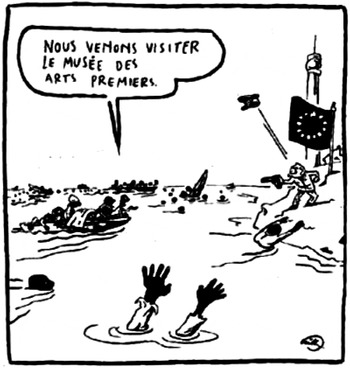
To begin with, European archaeology proves to be rather amnesic on matters of looting, erasures, and appropriations. Given the temporal and material depth it handles, archaeology has been good at documenting, as a research theme, the historical prevalence of destructions and damages deliberately inflicted on monuments—taken here in their etymological sense as commemorative constructions. From Classical temples to medieval monasteries, much devastation has been wrought on what opponents hold dear. In modern times, as archaeology became part of the nation-state apparatus, vandalism and iconoclasm have broadly evolved towards looting and spoliation. Some milestones here include the Napoleonic net cast over Europe, the heavy-handed colonial collecting drive, and the European-wide looting undertaken by Nazi experts. Strangely enough, these ideologically and geopolitically motivated accumulations, together with the institutions that embody them, are now poised to reap some collateral benefits from the latest outrage. When, for example, President François Hollande recently proclaimed that ‘The Musée du Louvre has been sheltering (‘abrite') since the nineteenth-century a collection of oriental antiquities which is now unique worldwide’, there is clearly an opportunistic attempt here to inject erstwhile accumulating practices with ethical ‘universal’ intents (Figure 2 makes a similar point for another museum, the Musée du Quai Branly).
‘We are only coming to visit the museum of primitive arts’. Caricature by Willem on the inauguration of the Musée du Quai Branly, 21 June 2006 (reproduced with permission of Willem and Libération).

Retrospective as it undoubtedly is, the notion of ‘shelter’ at least reflects in this case the structural binding of recorded museum objects within the public domain. Less so apparently in Britain, the other former colonial power in the region, where the rhetoric of universalism is more willing to meet the laws of the market. Thus, the ‘shelter’ granted to the Old Kingdom statue of Sekhemka, brought in by Lord Northampton two centuries ago and since held for the public at the Northampton Museum, proved notoriously insufficient to prevent its £15 million sale by the strapped-for-cash Northampton Borough Council. By March 2016, the lifting of its temporary export ban allowed its anonymous new owner to walk away with it—and, for all we know, smash it to pieces with iconoclastic fervour. Alongside museums, traders and auction houses also clearly profit from this unexpected moral laundering. As I have heard it said at the Drouot auction house in Paris: never ever shall we knowingly trade in recent unprovenanced antiquities from Syria and Iraq (… so get off our back on all the rest!). In this respect, the crisis confirms how Europe has been dragging its feet on matters of illicit trade and cultural properties protection, be it with regard to armed conflict (e.g. the 1954 and 1999 Hague protocols) or the lingering tension between private ownership and the common good.
The channelling of illicit antiquities from Iraq and Syria towards the salons of Geneva and Brussels has been entwined, as we know, with highly-mediatized, live-broadcast, spectacular acts of destruction on the ground. As if to counter the communications strategies deployed there, the West has been keen to advance its own dazzling reconstruction techniques. Ventures such as the Iconem digital preservation projects (http://iconem.com/) or the Institute of Digital Archaeology (http://digitalarchaeology.org.uk/dubai/, in partnership with Dubai's Museum of the future) are no doubt doing innovative work with regard to photogrammetry and 3D reconstruction of sites and monuments. The fact remains that such technological prowess entails a disciplinary realignment that cannot go without a dose of sceptical scrutiny. Besides serving as a convenient photo-op for a political class that is increasingly hostile to cultural and archaeological heritage back home, the reduced-scale re-erection of one of Palmyra's arches in London's Trafalgar Square in April 2016 seems also to shift emphasis (decades back, one might argue) to those grandiose, imposing, ‘monumental’ dimensions of the past … rather than its broader documentary, historical, and cultural significance, as critically explored through hands-on analytical and transdisciplinary skills. What is more, if ‘3D-doability’ is set to become the new ‘in’ criterion, then what was all the fuss about that statue of Sekhemka, infinitely reproducible with down-to-the-millimetre accuracy? If we leave such arguments unchallenged (on grounds of expediency or humanitarian emergency), the heady mixture of enticing technology, cost-savings, and virtual undertakings emanating from the east will end up reorienting, indeed distorting, the prospects and priorities of European archaeology for many years to come.
European Archaeology, Colonialism, and the Wider World
Alessandro Vanzetti
I would assume that European archaeology can be effectively identified as a shared set of theories, methods, and practices, with reference to a covering historical model. But when one tries to delve deeper, it is easy to get lost in the differences of traditions and approaches in different parts of Europe (e.g. Britain vs France vs Mitteleuropa vs Eastern Europe), or between different historical archaeologies (e.g. prehistoric vs Classical archaeologies), or to find more important the connections with North American archaeology than within the continent of Europe. This situation forms part of the more general diversity of the European experience: as a matter of fact, we keep having to recognize, and not only in archaeology, that diversity is an essential European trait. It is determined by the intricate historical development of Europe, but, as far as archaeology is concerned, it has its roots in the fact that it was the nation states emerging in the nineteenth century that promoted archaeology as a part of their identity-strengthening process (Kohl & Fawcett, Reference Kohl and Fawcett1995), and it was in this social context that positivist archaeologists, dissolving Christian religious bans on the time-scale and the driving forces of change acting in the past, started to interact intensively on the European scale. European archaeology thus came to be defined, from a geographic, social, and academic point of view, as the policy corresponding to the existing political and cultural interaction of Europe as a continent (Babeș & Kaeser, Reference Babeş and Kaeser2009).
Europe as a complex interaction zone
In order to better grasp the historical perspective of our European framework, we can seek help in the observations of evolutionary theory (Diamond, Reference Diamond1997) and identify Europe as one end of the largest, longitudinally disposed, and ecologically favourable continent, the Euro-Asian Continent. In this framework, interaction was easily activated through time, and chain effects would have taken place rapidly, even over long distances. In fact, Europe is the cul-de-sac of this landmass, facing an ocean impossible to cross for millennia, and it still is a consistent border. The variation in this wide but delimited environment forced interaction across the inland and the local seas and generated complex processes of competition and decision-making. Furthermore, the Mediterranean acted through time as a buffer zone, as a core of interaction, or as a border, where a diversity of social entities came into close contact, a fact that precisely shows the ambiguity of the modern geographical and political definition of Europe.
As archaeologists, we are continuously facing the complexity of the outcomes of interactions that took place inside the wide and diversified, but circumscribed, stretch of land we define as Europe. This is the case of the complex transition to anatomically modern humans that involved two different kinds of Homo sapiens, and possibly saw the development of complex artistic behaviour (Conard, Reference Conard2008, Reference Conard, Conard and Richter2011); of the peculiar interactions in the shift from the Mesolithic to the Neolithic (e.g. Borić, Reference Borić and Krauß2011; Guilaine, Reference Guilaine, Fowler, Harding and Hofmann2015; Thorpe, Reference Thorpe, Fowler, Harding and Hofmann2015); or in the development of megalithism (Renfrew, Reference Renfrew and de Laet1976), or of the Bronze Age (Childe, Reference Childe1958; Coles & Harding, Reference Coles and Harding1979; Kristiansen & Larsson, Reference Kristiansen and Larsson2005), a period in our narrative that is so bound up with the notion of Europe, as illustrated by the 1994–95 campaign of the Council of Europe promoting the Bronze Age as the first Golden Age of Europe. Ultimately, this is also the historical context in which the EAA took shape in 1993–94.
As research historians, we recognize very well the long-term essential differences in European traditions. As Robert (Bob) Chapman (Reference Chapman2003) pointed out, it is illusory to think of a unified tradition and theoretical debate, as local European archaeologies have specially nuanced traditions. Chapman particularly underlined the Spanish tradition and its differences from mainstream British archaeology, but one could have equally focused on two other major divides, i.e. the French tradition (Olivier & Coudart, Reference Olivier, Coudart and Ucko1995) and the Mitteleuropean German-speaking one (Gramsch, Reference Gramsch, Bintliff and Pearce2011), the latter having a durable influence on much of Eastern Europe and even Turkey, still recalling the alliances at the time of the First World War. And Italy has its peculiarities too, with its divided ties towards Europe and towards the Mediterranean, similar to the debate between Mitteleuropeanists and Mediterraneanists of the early twentieth century (Guidi, Reference Guidi, Champion and Díaz-Andreu1996; Broodbank, Reference Broodbank2013). But all these local attitudes assume the appearance of philosophical details, and fade in the face of basically shared cultural and historical paradigms, still emerging from the European nation states cultural milieu, as evident, for example, in the relevance of the three-age system, whose standard definition is attributed to the north (Rowley-Conwy, Reference Rowley-Conwy2007; Connah, Reference Connah2010) but which reflects a common European attitude.
From this point of view, we can probably better understand the differences between European and North American traditions, which constantly emerge in the different orientations of the debate across the Atlantic Ocean, even in periods of intense theoretical communication, such as the 1960s–1980s. We are speaking of a unified Western political and power system, acting together during Cold War times and jointly influencing the archaeological agenda later on. But it is evident that the unity of the Western archaeological tradition is put into question by the radical shift in the definition of archaeology in European and North American research, as noted, for example, by Kent Flannery and Joyce Marcus (Reference Flannery, Marcus, Bintliff and Pearce2011): in the North American tradition, archaeology is a problem of anthropological sourcing, and not a discipline, while in Europe archaeology is an independent discipline strictly bound to history (or ultimately a branch of history). This divide between anthropology-centred research in the United States and history-centred research in Europe can help illuminate the differences in the New Archaeology across the Ocean (e.g. Binford vs Clarke) or the importance attributed to theoretical and philosophical debate (Europe) vs empirical generalization (North America), a fact partially explaining the different impact of post-processualism in Europe and in the USA.
Having set out this general framework, we can return to the basic point defining the archaeologies of Europe, i.e. their historical development inside nation states, which furthermore acted as colonial powers in the past and are still working in a neo-colonial perspective.
European archaeology as a colonial/post-colonial tool
Today, we are well aware of the relations conducted between the archaeologies of Europe and the respective nation states; there was indeed, from the 1990s onwards after the fall of the ‘real Socialist’ bloc, a deliberate effort to achieve a more interactive and integrated European perspective, and the EAA has been a consistent part of it (Renfrew, Reference Renfrew1994; Rowlands, Reference Rowlands1994). The ‘archaeological dialogue’ on the existence of the ‘archaeology of Europe’ (Tarlow & Gramsch, Reference Tarlow and Gramsch2008) has since evaluated the results of ongoing processes. In this dialogue, Kristian Kristiansen (Reference Kristiansen2008) has observed that the last 25–30 years of archaeology in Europe have, on the one hand, promoted a wider orientation of general issues, but that, on the other hand, the translation of these issues has been increasingly local, revolving around significance at a scale smaller than the national level. This attitude can be considered glocal, setting the local as a strength in a global perspective, but is always on the verge of becoming parochial, and restricted in goals and process.
Setting aside any political evaluation, it is clear that the British decision to leave the EU, the Brexit we are now facing, and the split in Brexit vote between different parts of the United Kingdom (Northern Ireland and Scotland voting in favour of remaining vs the greater part of England and Wales opting to leave) corresponds exactly to the process outlined for archaeology, i.e. an increased localism, in a wider context, determined partly by the will to keep resources and decisions on a local scale, as a response to globalizing shifts in power.
The need to cope with globalization and with emerging countries (and even with different archaeologies) is framing European archaeology in a worldwide perspective. In order to understand this, we have to re-examine the strategies of colonial archaeology during the past one or two centuries. At the time of the formation of nation states, and of national archaeologies, European colonial enterprises took shape, and were adopted by all the advanced nations in Europe. It is evident that European archaeology and the colonial world were associated: expanding methods, ways of thinking, and interpretive arguments, all deeply rooted in the goal of justifying European supremacy. The best-known example of this situation is the activity of Sir Mortimer Wheeler in the Indian subcontinent, with all the bonds and legacies that it has generated. As Massimo Vidale (Reference Vidale2000) pointed out in his cutting review of Dilip Chakrabarti (Reference Chakrabarti1997), the end-effect is that even anti-colonial scholars, as embedded in an academic framework of respectful behaviour, become unable to see the deeply conditioning effects of patronizing colonial attitudes. And, as Mario Liverani (Reference Liverani2013: 3) remarked, much in line with Edward Said's view (Reference Said1978), Orientalism, or the definition of the Near East as the locus of the origin of civilisation, was part of the historiographical strategy of setting a preferential, unilinear, and direct axis from the East to the Classical world and to modern Western (Eurocentric) complexity, i.e. Occidentalism (see Hølleland, Reference Hølleland2010).
Even the Marxist approach adopted by founding scholars like Childe (Reference Childe1958) shares an idea of European peculiarity—such as the role of the artisans in the European Bronze Age—and of the social, political, and religious structures of Europe, ultimately resulting in its becoming a leading force in the understanding and transformation of the world: the rise of critical thinking, and its application in archaeology, was therefore itself part of an Occidentalist point of view. And in the present world, it is clear how far French, Spanish, British, and Italian traditions of research, acting in a de-colonized and post-colonial world, still maintain, and possibly strengthen and widen, the ties with Europe, as for example in francophone Africa, in Latin America, in the Indian subcontinent, or in Libya. Research continues in past colonial dominions, and the formation of local scholars tends to be embedded in (former) colonizing countries (González-Ruibal, Reference González-Ruibal, Lydon and Rizvi2010; van der Linde et al., Reference van der Linde, van den Dries, Schlanger and Slappendel2013); for instance, in Libya, the two main archaeological journals (Libyan Studies and Libya Antiqua) are still edited in Britain and Italy, respectively.
While it is clear that politically, and economically, the neo-colonial strategies of nation states aim to keep the flow of low-cost resources and labour constant in a globalizing world, being careful not to compromise their own wealth and welfare, one could say that European archaeology intends to retain the lead in archaeological thinking, its goal being to keep the historical centrality of Europe, given that history is the core argument for our identity. This again differs somewhat in approach, but not that much in facts, from the US imperialistic attitude (see Hardt & Negri, Reference Hardt and Negri2000), where attention is focused more on the capacity for expansion of theories, methods, tools, procedures, and in general evolution, than on the nuanced situations so much emphasized by European scholars. The type of community archaeology has instead fostered a type of community archaeology neatly involving indigenous communities in the archaeological process (Watkins & Nicholas, Reference Watkins, Nicholas and Smith2014). We could even say that, even if neo-colonial attitudes remain strong, a global language of archaeology is much more a reflection of the North American imperialistic attitude than of the European position, which could instead have taken advantage of its own internal diversity.
Concluding Remarks
Staša Babić and John Robb
These individual contributions are written by archaeologists from various parts of Europe, and indeed beyond—from Australia and Japan—and differing disciplinary practices—teaching academics, heritage, and museum specialists. The common trait is the inclination to reconsider our joint professional identity and the possibilities and limitations of the discipline. Our professional experiences of course do not cover the whole possible spectrum of European archaeology. The particular ways in which the contributors chose to answer the question: what is European archaeology?, and even more so: what should it be?, reflect a part of this spectrum highlighting a number of recurrent topics.
Almost all the contributions state that the term ‘Europe’ is the result of a convention linking the geographical and cultural phenomena of the area. On the other hand, throughout human history, both geographically and culturally, this part of the globe has been in various dynamic interactions with the lands beyond, sometimes even more so than inside the boundaries of Europe. Observing the limits of the continent thus inevitably leads to a series of reductions and exclusions, more often than not inbuilt into the history and tradition of archaeology (and other humanities as well). The modern history of Europe and the colonizing experience of its western part fortifies these exclusions through the grand narratives of the origins of European identity, stressing for example the Classical civilisations of Greece and Rome as unique and unsurpassable sources of a distinct set of values. Discussions on these topics inevitably set the practice of archaeology firmly into the present. Notorious examples of abuse in contemporary politics, pointing at the enormous importance of the past in the construction of modern identities, and at the same time the consequent responsibility of researchers, range from ideological claims, neglect of unfavoured archaeological material, to direct destruction of heritage motivated by ethnic or religious zeal. Even excepting these severe perils, archaeology has been intertwined with its contemporary surroundings in a number of fundamental ways, paramount among which is of course the question of funding the research. The tendency to steer the aims and topics of projects towards political agendas becomes stronger under economic pressure. In this respect, the fragmentation of the local archaeological communities emphasizes diverse local disciplinary traditions and their response to this pressure. Cutting across these local differences, an overarching divide inside the discipline becomes visible, i.e. the strong wave of scientifically oriented research. Growing numbers of professionals consider the union with the hard sciences to be of enormous benefit to archaeology and its interpretive potentials. On the other hand, concern is expressed that this reliance on sampling is not met with adequate epistemological reflection.
Finally, the terms Europe and archaeology are linked by the historical fact that the institutionalized research and academic practice we know today as the discipline of archaeology has been defined during the nineteenth century in the European countries, and this link persists in spite, or precisely because, of the many possible connotations of both words. It may safely be argued that this disciplinary institutionalization is the consequence of particular historical and cultural circumstances, part of which is the very process of the formation of the modern European identity. Asking ourselves, then, what European archaeology is may still be the most important question of our professional self-identification.