Introduction
Adult worms of the genus Gongylonema (Nematoda: Spirurida: Gongylonematidae) are easily recognized due to the verruciform cuticular thickenings of the anterior part of their bodies (Anderson, Reference Anderson1992; Chabaud, Reference Chabaud, Anderson, Chabaud and Willmott2009). Gongylonema pulchrum (Molin, 1857), also known as the “gullet worm” because of its localization in the epithelium of the upper digestive tract, is distributed worldwide and its definitive hosts are a variety of domestic and wild mammals, including cattle, sheep, goats, donkeys, cervids, equines, camels, bears, pigs, non-human primates, and humans (Alicata, Reference Alicata1935; Yamaguti, Reference Yamaguti1961; Skrjabin et al., Reference Skrjabin, Sobolev, Ivashkin and Skrjabin1967; Zinter and Migaki, Reference Zinter and Migaki1970; Lichtenfels, Reference Lichtenfels1971; Kirkpatrick et al., Reference Kirkpatrick1986; Anderson, Reference Anderson1992; Duncan et al., Reference Duncan1995; Brack, Reference Brack1996; Xu et al., Reference Xu, Yu and Xu2000; Haruki et al., Reference Haruki2005; Sato et al., Reference Sato, Une and Takada2005; Setsuda et al., Reference Setsuda2016). Transmission of the gullet worm to definitive hosts occurs through ingestion of intermediate hosts, such as infected dung beetles or drinking water contaminated with third-stage larvae (Cappucci et al., Reference Cappucci, Augsburg, Klinck and Steele1982; Anderson, Reference Anderson1992; Kudo et al., Reference Kudo1996).
With an almost identical morphology except for distinctly shorter left spicules relative to the entire body, Gongylonema nepalensis Setsuda et al., 2016 has recently been separated from G. pulchrum (Makouloutou et al., Reference Makouloutou2013b; Setsuda et al., Reference Setsuda2016; Varcasia et al., Reference Varcasia2017). This taxonomic revision was supported by molecular genetic analyses of the nuclear ribosomal RNA gene (rDNA) and mitochondrial cytochrome c oxidase subunit 1 gene (cox1) of Gongylonema worms of different origins (Setsuda et al., Reference Setsuda2016). This species has been isolated from water buffaloes (Bubalus bubalis) in Nepal and cattle (Bos taurus), sheep (Ovis aries), goats (Capra hircus), and wild European mouflon (Ovis aries musimon) on the island of Sardinia, Italy (Makouloutou et al., Reference Makouloutou2013b; Varcasia et al., Reference Varcasia2017).
As shown by our previous studies (Makouloutou et al., Reference Makouloutou2013a,Reference Makouloutoub; Setsuda et al., Reference Setsuda2016, Reference Setsuda2018; Varcasia et al., Reference Varcasia2017), molecular genetic analyses of the rDNA and cox1 sequences of Gongylonema worms allow us to speculate on the geographical distribution of different genetic lineages of the species and the transmission dynamics of worms among different host animals. In Japan, molecular approaches have proven that the transmission cycles of G. pulchrum in cattle and wild mammals, including sika deer (Cervus nippon), wild boars (Sus scrofa leucomystax), and Japanese macaques (Macaca fuscata), are distinct. Furthermore, they have led to the recognition of two genotypes (cattle-type and deer-type) of the rDNA, particularly the internal transcribed spacer (ITS) regions, and two major haplotypes (cattle-haplotype and wildlife-haplotype) of cox1.
In the present study, we collected additional Gongylonema worms in Japan and Sardinia, including G. pulchrum from feral alien Reeves's muntjacs (Muntiacus reevesi) on Izu-Oshima Island, Tokyo, Japan, and G. nepalensis from a red fox (Vulpes vulpes) and a wild boar (Sus scrofa meridionalis) in Sardinia, and analysed their genetic backgrounds to clarify the relationships with G. pulchrum and G. nepalensis populations prevalent in domestic and wild mammals in each country.
Materials and methods
Parasite collection and morphological examination
Full-length oesophagi of feral alien Reeves's muntjacs were collected on 26 January 2015 (seven animals), 25 and 26 July 2015 (15 animals), and 29 October 2016 (10 animals). Originally, a dozen captive Reeves's muntjacs escaped from Tokyo Municipal Oshima Park Zoo during a typhoon in the autumn of 1970 and subsequently became naturalized on the 91.1 km2 island. Control measures for this alien mammal species were initiated in 2007 and the total numbers of individuals trapped in 2014, 2015 and 2016 were 1022, 1412 and 2191, respectively (Tokyo Municipal Office, 2017). The latest estimated number of alien Reeves's muntjacs on Izu-Oshima Island is c. 13,000. Permission for the academic use of viscera from trapped individuals was granted by the Tokyo Metropolitan Government Office.
All Reeves's muntjacs were mature adults with body weights of 6.6–10.0 kg. Their age and sex were unknown. Frozen viscera including oesophagi were transported to the Laboratory of Veterinary Parasitology, Yamaguchi University. The mucosal surface was checked carefully with the naked eye and individual worms were removed from the oesophageal epithelium using fine forceps, and fixed in 70% ethanol or 10% neutral-buffered formalin solution.
Gongylonema worms were collected from the oral mucosa of a red fox on 31 January 2017 (shot in Urzulei, Ogliastra), from the oesophageal mucosa of a wild boar on 15 February 2017 (slaughtered in Tortolì, Ogliastra), and from the oesophageal mucosa of a domestic goat on 20 February 2017, at the Instituto Zooprofilattico Sperimentale della Sardegna, Tortolì, Ogliastra Province, Sardinia. Parasite samples were preserved in 70% ethanol.
Available male and female worms displaying no morphological damage were selected for morphological observation. Specimens preserved in 70% ethanol were placed on glasses to measure the body length and width, and cut the middle third of the entire body length for DNA extraction. The remaining anterior and posterior thirds of specimens were placed in a clearing solution with glycerol and lactic acid, and observed under a light microscope. Figures were drawn with the aid of a camera lucida. Measurements were performed on these drawn figures using a digital curvimeter type S (Uchida Yoko, Tokyo, Japan) when necessary. In addition, either the anterior or posterior part of the body length (less than half) of damaged specimens was used for DNA extraction. Collected specimens, excluding the portions used for DNA extraction, were deposited in the National Museum of Nature and Science, Tokyo, Japan, under specimen numbers NSMT-As4426–4449.
DNA extraction, polymerase chain reaction (PCR), and sequencing
Parasite DNA was extracted from sections of worms (four worms from different Reeves's muntjacs, two from a goat, and one from a red fox) according to Setsuda et al. (Reference Setsuda2016).
Polymerase chain reaction (PCR) amplification of partially overlapping rDNA fragments was performed in a 25 μl volume using different primer combinations as previously described (Makouloutou et al., Reference Makouloutou2013a). The cox1 region of G. pulchrum mitochondrial DNA (mtDNA) was amplified by a combination of two primers, Gpul_Cox1-F (5′-GTGGTTTTGGTAATTGAATGCTA-3′) and Gpul_Cox1-R (5′-ATGAAAATGTGCCACTACATAATATGTATC-3′), as described by Varcasia et al. (Reference Varcasia2017). PCR amplification of partial cox1 gene was also conducted using 19 stock DNA samples of G. pulchrum from wild mammals stored at –20°C (10 worms from four sika deer, five from five wild boars, and four from three Japanese macaques).
The purification of PCR products using a commercial kit and subsequent nucleotide sequencing, including that of partial rDNA genes containing ITS regions, were conducted as described in Setsuda et al. (Reference Setsuda2016). The obtained sequences were assembled with the aid of the CLUSTAL W multiple alignment program (Thompson et al., Reference Thompson, Higgins and Gibson1994).
New nucleotide sequences reported in the present study are available from the DDBJ/EMBL/GenBank databases under the accession numbers LC388743–LC388756 (rDNA) and LC388892–LC388914 (cox1).
Phylogenetic analysis
For phylogenetic analysis, the newly obtained cox1 sequences, 852 bp in length, of Gongylonema worms collected in the present study and those of the same genus retrieved from the DDBJ/EMBL/GenBank databases were used. The accession numbers of the sequences analysed in the present study are given in the figure showing the phylogenetic tree. Maximum likelihood (ML) analysis was performed with the program PhyML (Guindon and Gascuel, Reference Guindon and Gascuel2003; Dereeper et al., Reference Dereeper2008) provided on the ‘phylogeny.fr’ website (http://www.phylogeny.fr/). The probability of inferred branches was assessed by the approximate likelihood ratio test (aLRT), an alternative to the non-parametric bootstrap estimation of branch support (Anisimova and Gascuel, Reference Anisimova and Gascuel2006).
As indicated in the previous reports (Makouloutou et al., Reference Makouloutou2013a,Reference Makouloutoub; Setsuda et al., Reference Setsuda2016), any parts of the rDNA, including ITS regions, show minimal intraspecific variation, and therefore phylogenetic analysis has not been conducted.
Results
Morphological examination by light microscopy
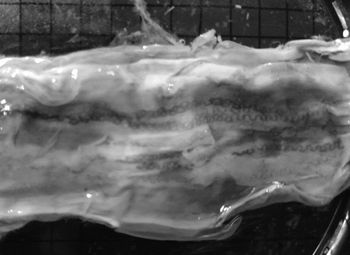
One female worm was isolated from one of seven feral alien Reeves's muntjacs collected in January 2015, two male and five female worms from six of 15 animals collected in July 2015, and three male and four female worms from four of 10 animals collected in October 2016. Only two of the 11 parasitized Reeves's muntjacs were infected with more than one worm (either two or four worms). Gongylonema worm tracts only (i.e. devoid of worms) were detected in the oesophageal mucosa of one Reeves's muntjac examined in January 2015 and one examined in October 2016 (fig. 1). Worms were long and slender, embedding themselves in a zig-zag manner in the oesophageal mucosa. The anterior portion of male and female worms was characterized by prominent cuticular bosses with symmetrical lateral alae on both sides. The posterior portion of male worms was characterized by asymmetrical caudal alae with up to six pairs of papillae each in pre- and post-cloacal areas. The caudal end of female worms was bluntly conical and the vulva was situated relatively close to the posterior end. The eggs in female worms of unisexual infection were not fertilized. As shown in table 1, the measurements of worms were comparable to those of G. pulchrum isolated from the oesophageal mucosa of cattle, distinct from those of worms isolated from sika deer.
Gross lesions of Gongylonema pulchrum worm tracts in the oesophageal mucosa of a feral alien Reeves's muntjac on Izu-Oshima Island, Japan. Grid lines on the bottom of the glass dish visible in the background are marked every 5 mm.

Comparison of measurements of Gongylonema specimens collected from ruminants (in mm).a

a Values clearly deviated from those of other groups are indicated by grey shading.
b From the anterior end
c From the posterior end
d Measurement of one worm
Two Gongylonema worms collected from the oral mucosa of a red fox were female (fig. 2). One male worm and one female worm were collected from the oesophageal mucosa of a wild boar. As shown in table 1, these four worms were smaller than those of worms previously isolated from wild ruminants (European mouflon) and domestic animals in Sardinia. The manner of parasitism and external morphological features resembled those of G. pulchrum described above. However, the proportion of left spicule length to entire body length was 21.2%, comparable to that of G. nepalensis but distinctly smaller than that of G. pulchrum.
Gross photograph of an adult female Gongylonema nepalensis (arrows) parasitizing in the mucosal epithelium of the lateral back of the tongue of a red fox on Sardinia Island, Italy.

Molecular genetic analyses of the rDNA
Long nucleotide sequences of the rDNA of four G. pulchrum worms from feral alien Reeves's muntjacs were obtained. The nucleotide sequences of the 18S rDNA (1782 bp), 5.8S rDNA (158 bp) and 28S rDNA (3544 bp) were identical among the four worms. These sequences were also identical to those of several G. pulchrum isolates from cattle in Japan and China (e.g. DDBJ/EMBL/GenBank accession nos AB513707, AB513711 and LC026017). Even with the remaining isolates from cattle, only one nucleotide substitution was detected in the 18S rDNA and also in the 28S rDNA, whereas no substitutions were found in the 5.8S rDNA. Concerning the ITS1 (385–392 bp) and ITS2 (229 bp) regions, the nucleotide sequences of which show intra-individual and inter-individual variations (Setsuda et al., Reference Setsuda2016), the ITS2 nucleotide sequences of the G. pulchrum isolates from Reeves's muntjacs had cattle-type repeats of units of a few nucleotide, which was distinct from the deer-type ITS2 nucleotide sequences (Makouloutou et al., Reference Makouloutou2013a; Setusuda et al., Reference Setsuda2016).
Newly sequenced Sardinian Gongylonema isolates from a goat (two worms) and a red fox (one worm) showed virtually the same rDNA sequence as that of G. nepalensis from domestic and wild ruminants on the island (accession no. LC278392); one or two nucleotide substitutions in the 18S rDNA (minimum identity of 99.89% over 1782 bp length), no substitutions in the 5.8S rDNA (100% identity over 158 bp length), and one or two nucleotide substitutions in the 28S rDNA (minimum identity of 99.94% over 3535 bp length). These Sardinian G. nepalensis isolates from a goat and a red fox also showed intra-individual and inter-individual nucleotide variations in the ITS regions, with different numbers of repeats of a certain nucleotide (such as ‘A’) or two-nucleotide unit (‘CA’). Table 2 shows the observed nucleotide variations in the ITS1 and ITS2 regions of Sardinian G. nepalensis isolates, spanning 397–412 bp and 237 or 240 bp, respectively.
Inter- and intra-individual nucleotide changes observed in the ITS regions of rDNA of Gongylonema nepalensis of different origins.

a Nucleotide position is expressed relative to each region of the rDNA sequence of G. nepalensis collected from water buffaloes in Nepal (DDBJ/EMBL/GenBank accession no. AB646107). Nucleotide unit for repeats is shown in parentheses. ‘—’ denotes no nucleotide.
Molecular genetic analyses of cox1
Partial 852 bp long cox1 sequences of G. pulchrum isolates from Reeves's muntjacs (four worms) and native wild mammals such as sika deer, wild boars, and Japanese macaques (19 worms) in Japan, and Sardinian G. nepalensis from a goat and a red fox (three worms) were newly obtained. Nucleotide substitutions across the available 852 bp long cox1 sequences of G. pulchrum and G. nepalensis occurred at 107 nucleotide positions (12.56% of all nucleotides), and interspecific differences were detected at 66 nucleotide positions. Two major haplotypes of G. pulchrum in cattle were based on 14 nucleotide substitutions (1.64% of all nucleotides). Three G. pulchrum worms from Reeves's muntjacs showed cattle-I haplotype, and one worm showed cattle-II haplotype; complete identities were observed to those in cattle (Setsuda et al., Reference Setsuda2016). Although only a few nucleotide substitutions were seen among G. pulchrum worms of the same cattle haplotype, substitutions among G. pulchrum worms from wild mammals were found at 18 nucleotide positions over the same cox1 fragment length (accession nos LC388896–LC388914).
As previously reported (Varcasia et al., Reference Varcasia2017), all cox1 sequences of G. nepalensis from cattle, sheep, goats and mouflon (accesssion no. LC278393), excluding one worm from a sheep (LC278394), showed absolute homology. One worm from a red fox examined in the present study (LC388893) showed one nucleotide substitution over 852 bp. This substitution was at a different nucleotide site from the aforementioned sheep worm (LC278394).
The translated amino acid (aa) sequences of G. pulchrum and G. nepalensis from a variety of mammals (analysed sequences are shown in fig. 3) based on the 852 bp long nucleotide sequences (i.e. 284 aa) were highly similar. The aa substitutions occurred at six sites (2.11%), indicating that most of the nucleotide substitutions of the cox1 fragments occurred at the third nucleotide position of codons; i.e. a substantial 97 out of 107 (90.65%) nucleotide substitution sites. The observed aa substitutions were not related to any specific group of G. pulchrum and G. nepalensis.
ML phylogenetic tree based on the cox1 mtDNA sequences of 818 bp length. Species names are followed by host names and country names (DDBJ/EMBL/GenBank accession numbers in parentheses). New sequences denoted by arrows. Abbreviations of country names: CN, People's Republic of China; EG, Egypt; ID, Indonesia; IT, Italy; JP, Japan; KH, Cambodia; LA, Laos; TH, Thailand. Abbreviations of prefecture names in Japan are shown in square brackets: HG, Hyogo; KC, Kochi; NR, Nara; WK, Wakayama.

The phylogenetic relationships of the different isolates of Gongylonema spp. based on long cox1 nucleotide sequences are shown in fig. 3. As typified by G. pulchrum worms in wild mammals in Japan and G. neoplasticum worms in wild rats in South-east Asia, Gongylonema spp. in wild mammals demonstrated diverse cox1 haplotypes, whereas G. pulchrum in domestic ruminants showed homologous cox1 nucleotide sequences. Although G. nepalensis in Sardinia and Nepal had distinct cox1 nucleotide sequences (Varcasia et al., Reference Varcasia2017), those of the worms from domestic and wild mammals in Sardinia showed little diversity.
Discussion
In an earlier study from our laboratory, one juvenile Gongylonema worm was found in the oesophageal mucosa of a feral alien Reeves's muntjac collected in June 2009 on Izu-Oshima Island. The worm was subsequently specified as G. pulchrum of cattle-genotype (Makouloutou et al., Reference Makouloutou2013a). In the same host species at the same locality, the present study detected a high rate (34.38%) of adult worms embedded in the oesophageal mucosa in typical zig-zag fashion. These adult worms grew and developed well in Reeves's muntjacs, alien cervids recently naturalized in Japan, and their morphometrics were comparable to those of worms in cattle, not those of worms in sika deer (table 1). Furthermore, their rDNA genotype corresponded with cattle-type, not deer-type, coincident with our previous report (Makouloutou et al., Reference Makouloutou2013a). The single juvenile worm analysed in our previous study showed cattle-I haplotype of cox1 (Makouloutou et al., Reference Makouloutou2013a); three of the four adult worms examined here showed the same cox1 haplotype. Intriguingly, the remaining worm showed cattle-II haplotype of cox1. Izu-Oshima Island is a small remote island with a limited variety of endemic and alien mammals; i.e. Japanese weasels, four species of rodents (Apodemus speciosus, Mus musculus, Rattus rattus and Rattus norvegicus), four species of bats, Reeves's muntjacs, alien Formosan rock macaques (Macaca cyclopis), and alien Taiwan squirrels (Callosciurus erythraeus), in addition to a small number of Holstein Friesian cattle (c. 30 at present). As reported previously (Makouloutou et al., Reference Makouloutou2013a; Setsuda et al., Reference Setsuda2016), cattle (at least in Japan and China) exhibit G. pulchrum of two cox1 haplotypes (cattle-I and cattle-II) and zoo animals such as squirrel monkeys display G. pulchrum of cox1 cattle-I haplotype. The origin of G. pulchrum detected in feral alien Reeves's muntjacs on Izu-Oshima Island (rDNA of cattle-genotype and cox1 cattle-I and cattle-II haplotypes) is unclear. It is not known whether these animals brought the parasite from their original endemic region, such as Taiwan or mainland China, or acquired the parasite after introduction to the zoo facility in 1938 and/or naturalization on the island in the 1980s. In the late 1980s, the population of Holstein Friesian cattle reached c. 1200 on the island, and it is speculated that frequent exposure of feral Reeves's muntjacs to the G. pulchrum infective stage in the environment may occur. In order to resolve this issue, it is vital to ascertain the infection status of Gongylonema sp(p). in this small cervid species from its original endemic regions and determine the rDNA genotype and mtDNA cox1 haplotype of the worms, if any are indeed present.
Based on 369 bp long nucleotide sequences, we previously demonstrated a remarkable diversity of cox1 haplotypes of G. pulchrum from wild mammals such as sika deer, wild boars and Japanese macaques (Makouloutou et al., Reference Makouloutou2013a; Setsuda et al., Reference Setsuda2016). Similarly, a high genetic diversity of cox1 haplotypes of G. neoplasticum in rats in South-east Asia has been demonstrated (Setsuda et al., Reference Setsuda2018). The present study's records of a red fox and a wild boar as definitive hosts of G. nepalensis are new, although pigs and wild boars are known to be highly susceptible definitive hosts for closely related G. pulchrum (Ward, Reference Ward1916; Zinter and Migaki, Reference Zinter and Migaki1970; Eslami and Farsad-Hamdi, Reference Eslami and Farsad-Hamdi1992). Considering that a wide variety of mammals classified in different categories, including bears, a species of the order Carnivora (the suborder Caniformia), are important definitive hosts for G. pulchrum (Kirkpatrick et al., Reference Kirkpatrick1986), the development of G. nepalensis in the oral mucosa of a red fox is not an aberrant finding. At present, only three haplotypes of cox1, with only one nucleotide substitution among them, have been noted in Sardinian G. nepalensis in various domestic ruminants, wild mouflon, and a red fox. It is possible that the highly homologous status of the 852 bp long cox1 nucleotide sequences can be partially ascribed to a special ecological feature of the location of the sample collections, i.e. an island. Although it is undetermined how G. nepalensis was distributed in mammals on Sardinia, dramatically reduced genetic variability of organisms on this small island is a well-known phenomenon (Nei et al., Reference Nei, Maruyama and Chakraborty1975; Frankham, Reference Frankham1997). As reported in Varcasia et al. (Reference Varcasia2017), the nucleotide identities of 369 bp long cox1 sequences of G. nepalensis in ruminants from Nepal and Sardinia were rather low, ranging from 92.95% to 93.22%. In contrast, the rDNA nucleotide sequences, including the ITS regions, were found to be highly similar (table 2). We therefore speculate that a fairly high genetic diversity of cox1 is a likely factor in the original endemic area(s) of G. nepalensis, but are unable to propose any candidate localities at present. Genetic surveys of cox1 nucleotide diversity worldwide may enable us to establish the true biogeography of G. pulchrum (believed to be cosmopolitan in distribution) and G. nepalensis (currently identified at limited localities and mainly from domestic ruminants). Such studies could indicate the locale where their ancestor originated before dispersion to different continents.
Another potential important application of molecular genetic analyses of Gongylonema worms is to aid the clarification of the transmission dynamics of the parasites in the natural environment. We do not know the reason why domestic cattle and wild mammals barely share the same genetic lineages of G. pulchrum in Japan. Gongylonema pulchrum of deer-genotype has not been seen in cattle, nor has G. pulchrum of cattle-genotype been seen in wild mammals, with the exception of sika deer in Hokkaido, which on a rare occasion were found to be infected with G. pulchrum of cattle-genotype (Makouloutou et al., Reference Makouloutou2013a; Setsuda et al., Reference Setsuda2016). As discussed previously (Makouloutou et al., Reference Makouloutou2013a), populations of sika deer in Hokkaido, one of the four main islands of Japan, experienced a dramatic population reduction, nearly extinction, c. 150 years ago as a result of overexploitation. Heavy snowfalls during the winters of 1879 and 1903 also took their toll on population numbers (Inukai, Reference Inukai1952; Nabata et al., Reference Nabata, Masuda and Takahashi2004). Thus, it is possible that this severe population decline of host sika deer induced the extinction of their original G. pulchrum of deer-genotype and may explain the scarcity of G. pulchrum parasitism in Hokkaido sika deer (Kitamura et al., Reference Kitamura1997) in contrast to its high prevalence in sympatric cattle (Suzuki et al., Reference Suzuki1992). Taking into account that Hokkaido sika deer were found to be parasitized only rarely with G. pulchrum and the worms were demonstrated to be cattle-genotype, not deer-genotype (Makouloutou et al., Reference Makouloutou2013a), sika deer appear to exhibit a degree of resistance to G. pulchrum of cattle-genotype in spite of the high likelihood of their ingestion of third-stage larvae. In contrast to this situation, feral alien Reeves's muntjacs appear to be sufficiently susceptible to G. pulchrum of cattle-genotype. As discussed above, the origin of G. pulchrum of cox1 cattle-I and cattle-II haplotypes in this alien mammalian species is unclear. In other words, it is uncertain whether G. pulchrum in feral alien Reeves's muntjacs on Izu-Oshima Island is indigenous or newly acquired after introduction to Japan. The growing accumulation of the genetic backgrounds of Gongylonema spp. in various animals worldwide will facilitate our understanding of typical frameworks of speciation and geographical dispersion of spirurid nematodes with a suspected wide host specificity. It will also help to define their local transmission dynamics, which will be of consultative use when considering other host–parasite relationships and understanding parasite transmission schema.
Acknowledgements
We thank Mr F. Salis, Parasitology Laboratory, University of Sassari, for his expert technical assistance.
Financial support
This research received no specific grant from any funding agency, commercial or not-for-profit sectors.
Conflict of interest
None.
Ethical standardards
The authors assert that all procedures contributing to this work comply with the ethical standards of the relevant national and institutional guides on the care and use of animals.
Author ORCIDs
H. Sato 0000-0002-5230-4677