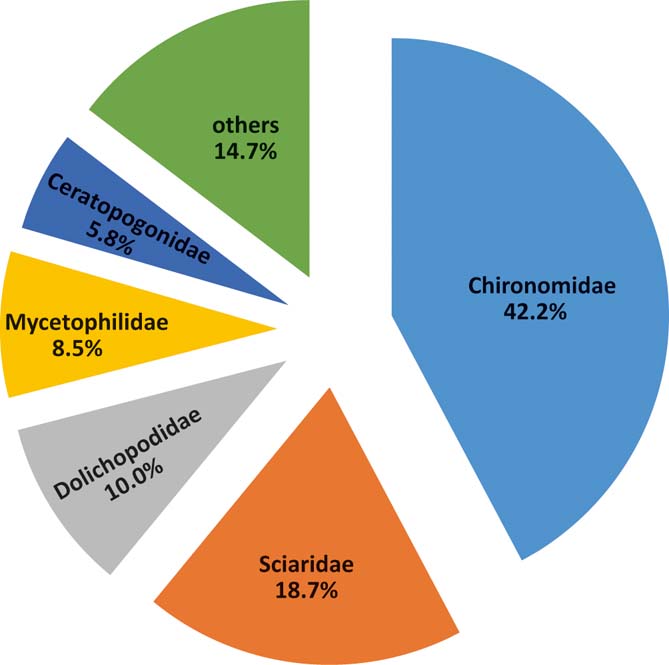
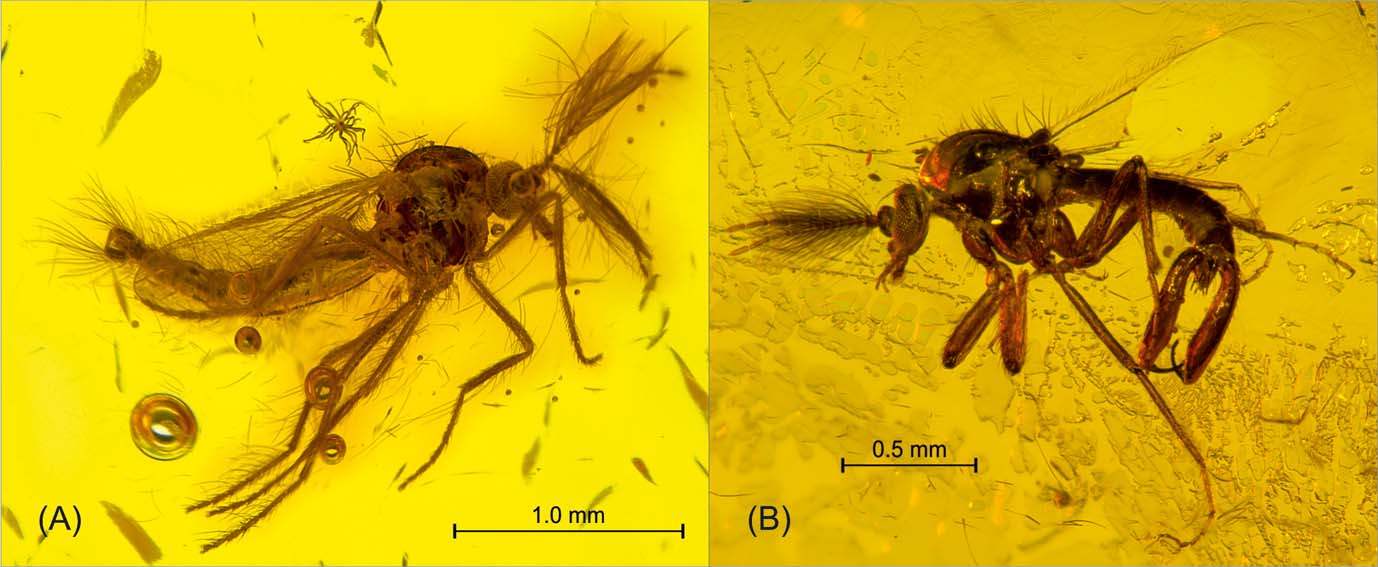
Biting midges (Diptera: Ceratopogonidae) are a relatively well studied, large family of nematocerous dipterans, inhabiting a wide range of aquatic, semiaquatic and terrestrial habitats, with almost 6,300 extant species in over 110 genera and four subfamilies. The phylogenetic history of the family probably goes back to the Jurassic, although the oldest records are dated as earliest Cretaceous (140–145 Ma) (Borkent et al. Reference Borkent, Coram and Jarzembowski2013). This family includes numerous fossils from the Lower Cretaceous to the Miocene, with over 280 species (4.3 % of the family) representing 49 genera (26 extant; 23 extinct) (Borkent Reference Borkent2016; present data). They are common amongst inclusions preserved in fossil resins (Fig. 1). Most fossil biting midges (253 species) have been described as amber inclusions, which preserved morphological details that allowed them to be studied with the same detail as extant species. The morphological criteria used in the identification of fossil genera and species are identical to those used in studies of the extant fauna and, as a result, the potential indicative value of fossils is reliable.
Percentage of biting midges in unselected sample of 2947 inclusions of Diptera in Baltic amber (E. Sontag, pers. comm. 2016).

1. Biting midges as indicators of geological ages of amber and deposits
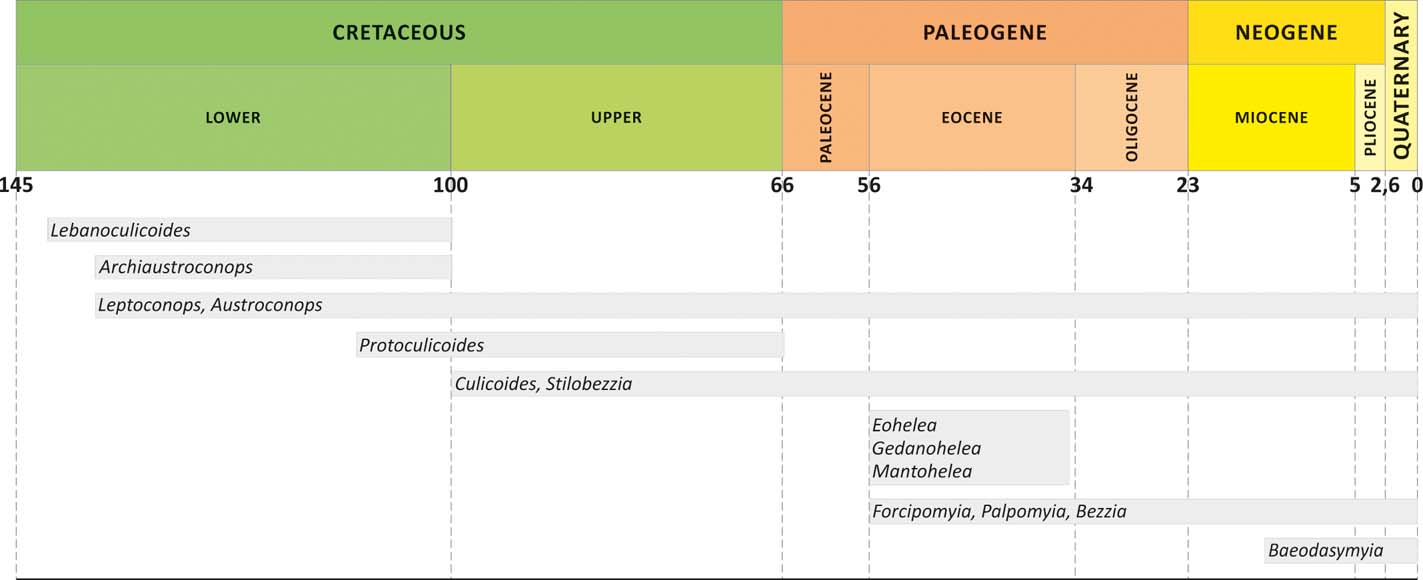
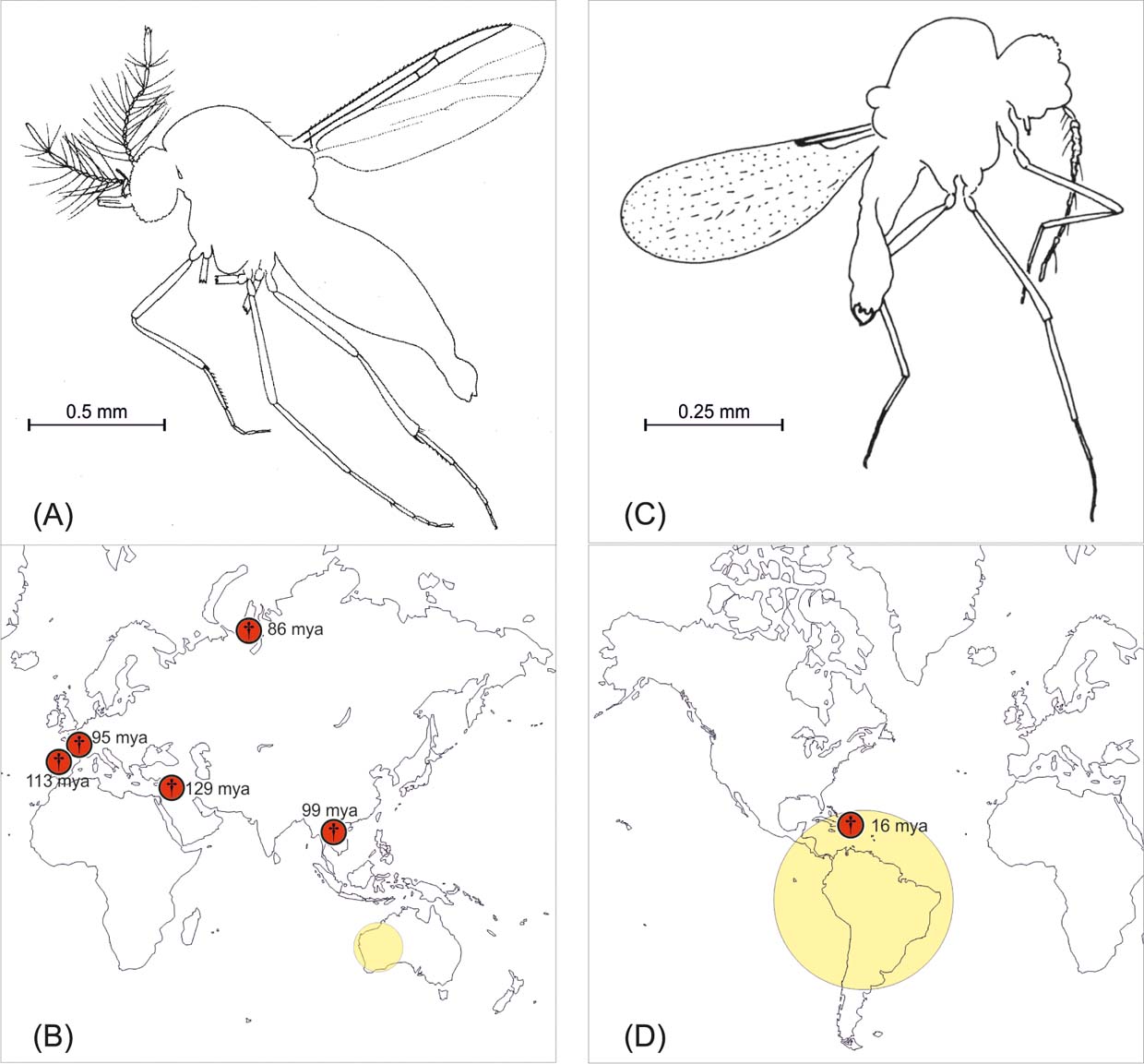
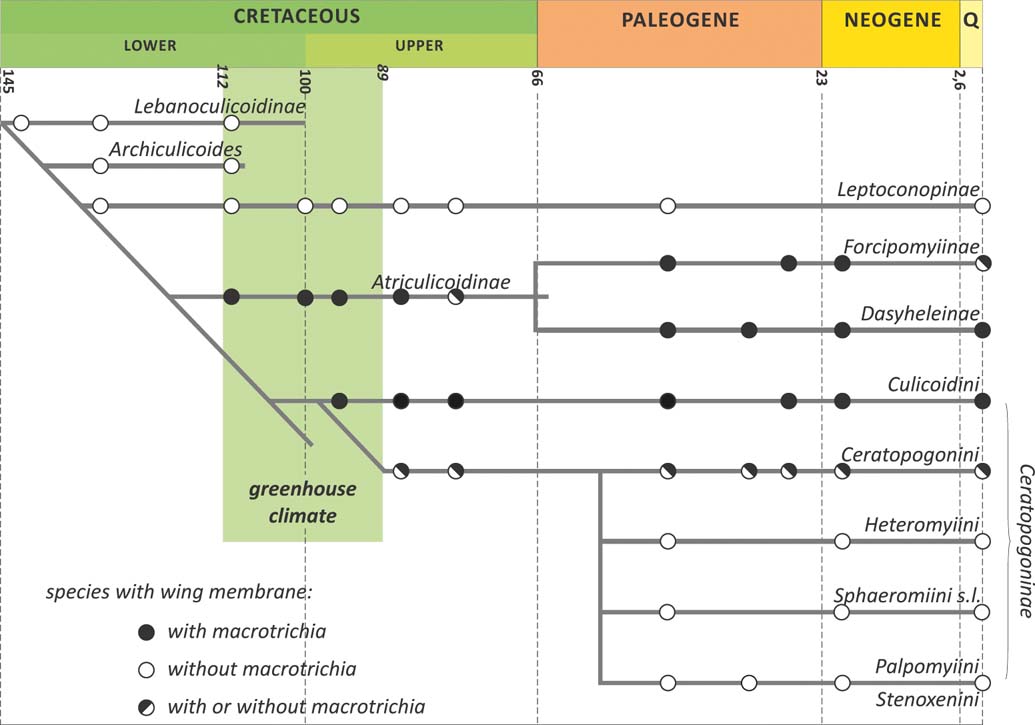
The family contains very old as well as younger genera (Fig. 2). Two relictual extant genera, Leptoconops Skuse and Austroconops Wirth & Lee, reported from Lower Cretaceous Lebanese amber are at least 125 million years old (Ma) (Azar et al. Reference Azar, Granier and Maksoud2015; Granier et al. Reference Granier, Toland, Géze, Azar and Maksoud2016; Maksoud et al. Reference Maksoud, Azar, Granier and Géze2016). In Oligocene–Miocene deposits, no extinct genera have been reported. They contain younger genera such as Baeodasymyia Clastrier & Raccurt, Phaenobezzia Haeselbarth and Heteromyia Say from Dominican amber, which is about 16 Ma (Szadziewski Reference Szadziewski2008; Penney Reference Penney and Penney2010) (Fig. 4B). Ceratopogonid genera indicative for the Lower Cretaceous are Lebanoculicoides Szadziewski, Archiaustroconops Szadziewski and Archiculicoides Szadziewski; genera indicative for the Upper Cretaceous include Protoculicoides Boesel, Brachycretacea Szadziewski and Peronehelea Borkent; and those for the Eocene include Gedanohelea Szadziewski, Eohelea Petrunkevitch, Fossihelea Szadziewski, Mantohelea Szadziewski, Ceratopalpomyia Szadziewski, and Wirthohelea Szadziewski (Fig. 3). The relictual extant genus Austroconops is indicative of the Cretaceous (Lower and Upper) period in the Northern Hemisphere (Szadziewski Reference Szadziewski2008) (Fig. 4A). Finally, it is worth mentioning than not only taxa of generic and specific level have indicative value in biostratigraphy. For example, Szadziewski et al. (Reference Szadziewski, Arillo, Urbanek and Sontag2016) found that an easily recognizable indicative character: macrotrichia on the wing membrane of adults, which evolved during the mid-Cretaceous, and is diagnostic for the Upper Cretaceous and Cenozoic (Fig. 5).
Examples of indicative genera of Ceratopogonidae in Lower Cretaceous, Upper Cretaceous, Eocene and Miocene amber deposits.

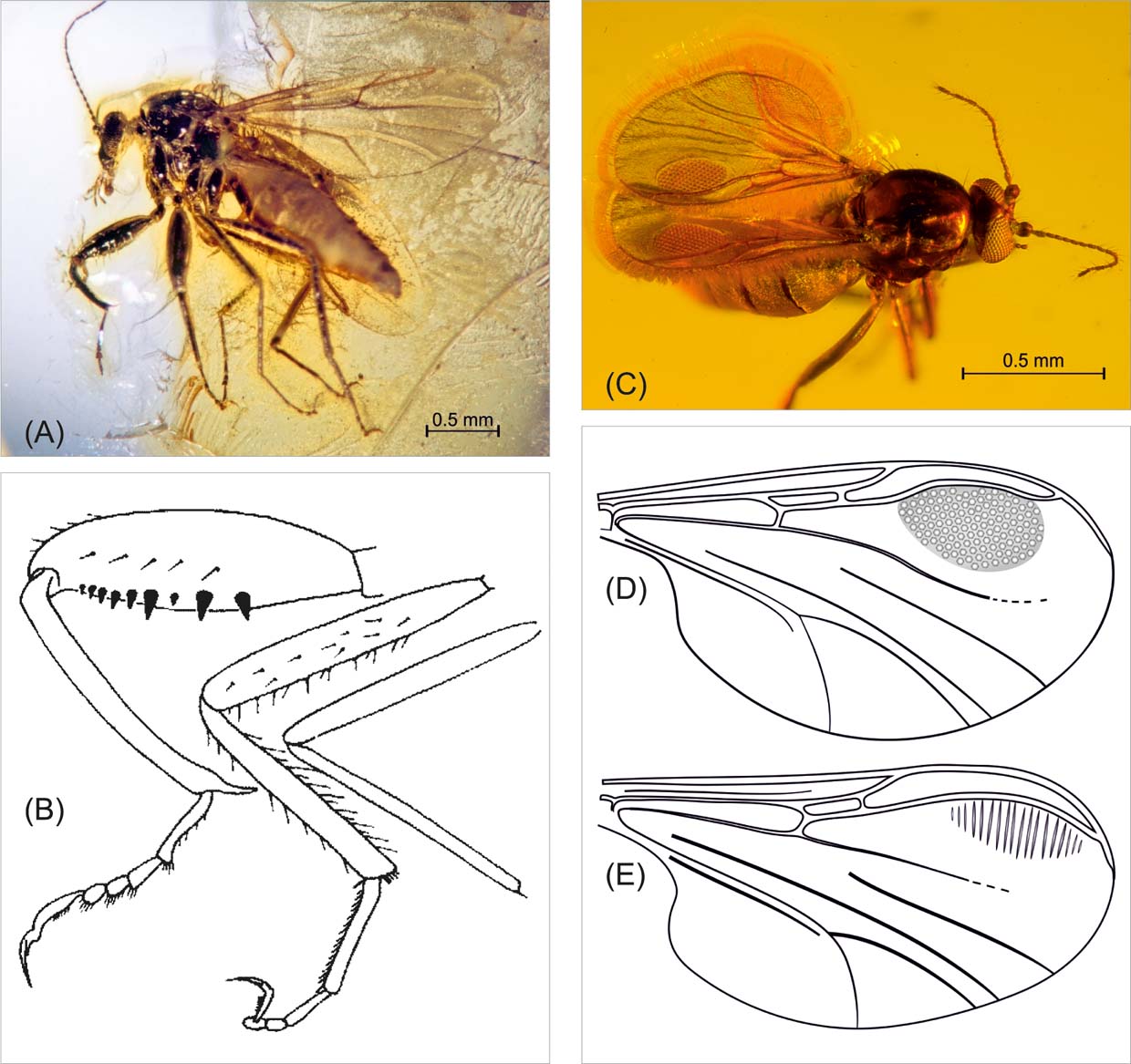
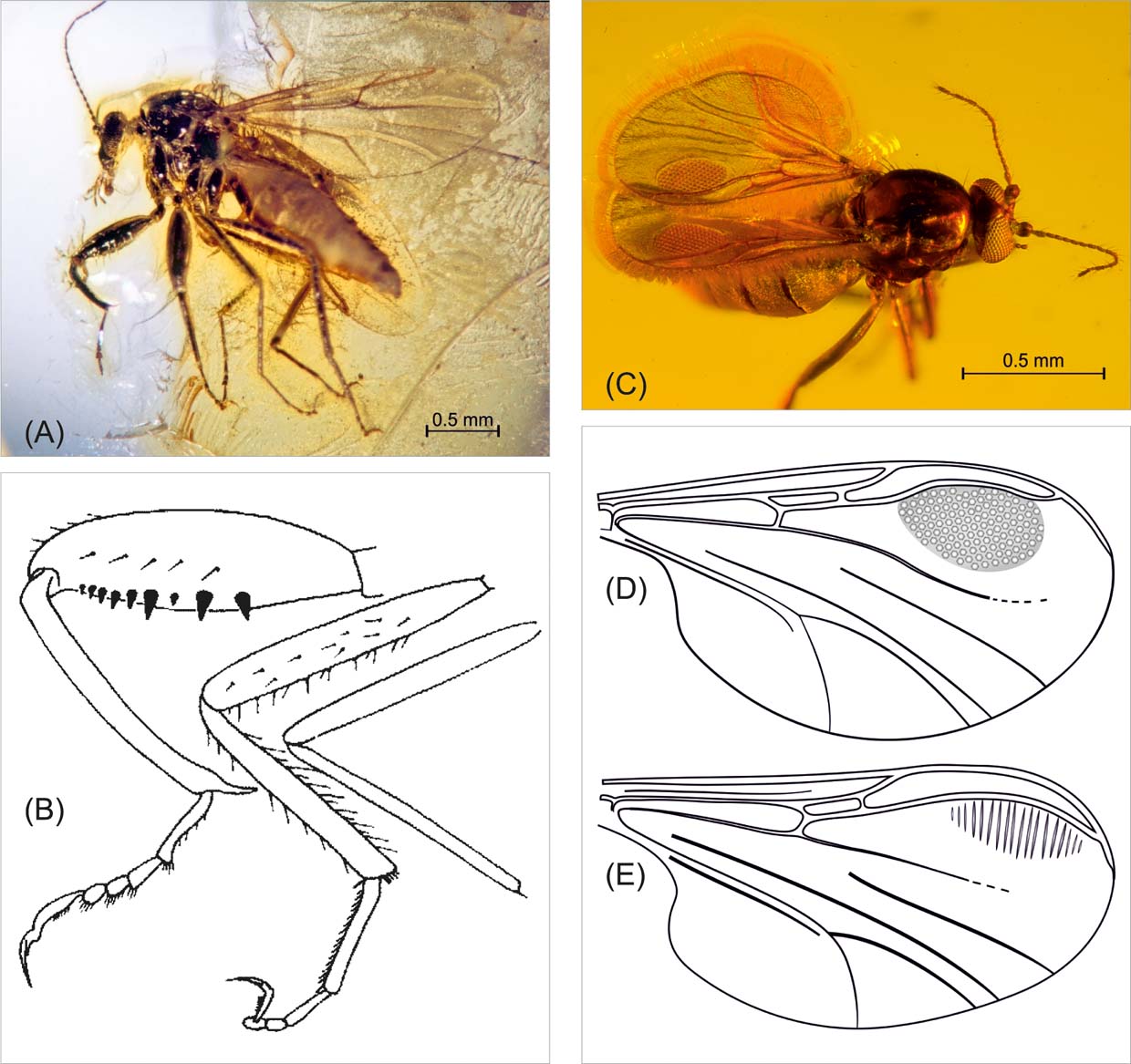
Extinct predaceous genera indicative for the Eocene. (A, B) Mantohelea with grasping forelegs: (A) female of Mantohelea laca (Meunier, Reference Meunier1904), indicative for Baltic amber (photo E. Sontag). (B) legs of M. laca (from Szadziewski Reference Szadziewski1988). (C–E) Eohelea with unique wing organ: (C) female of Eohelea petrunkevitchi Szadziewski, Reference Szadziewski1984 (photo E. Sontag); (D) female wing of E. petrunkevitchi, indicative for Baltic amber. (E) female wing of E. sinuosa (Meunier, Reference Meunier1904), indicative for Baltic amber.
Habitus and distribution of indicative extant genera. (A, B) The living fossil genus Austroconops, indicative for the Cretaceous in the Northern Hemisphere: (A) male of Austroconops sibiricus Szadziewski, Reference Szadziewski1996 from Siberian amber (after Szadziewski Reference Szadziewski1996); (B) distribution of extinct and extant species (after Szadziewski Reference Szadziewski2008, modified). (C, D) The extant genus Baeodasymyia, indicative for the Miocene (after Szadziewski Reference Szadziewski2008): (C) male of Baeodasymyia dominicana Szadziewski & Grogan, Reference Szadziewski and Grogan1994 from Dominican amber (after Szadziewski & Grogan Reference Szadziewski and Grogan1994); (D) distribution of extinct and extant species (after Szadziewski Reference Szadziewski2008).

A readily recognisable indicative character – macrotrichia on wing membranes – which evolved during the mid-Cretaceous (after Szadziewski et al. Reference Szadziewski, Arillo, Urbanek and Sontag2016, modified).

2. Biting midges indicative for ambers
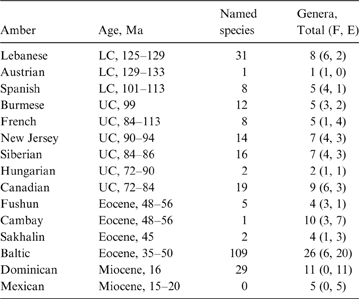
Inclusions of biting midges have been reported from nearly all amber deposits (Table 1). Their fauna is usually unique, as they include species known exclusively from their respective deposits/strata. Those species, which are unquestionably unique, can be regarded as “index fossils” of their respective amber deposits. For example, many species of Ceratopogonidae in Eocene amber from the Gulf of Gdańsk, Rovno and Bitterfeld are likely to be from the same source (Sontag & Szadziewski Reference Sontag and Szadziewski2011). They evidently indicate that amber from Ukraine (Rovno), Germany (Bitterfeld) and Poland/Russia (Gulf of Gdańsk) is the same Baltic amber (Szwedo & Sontag Reference Szwedo and Sontag2013). Sedimentary impression fossils of biting midges have no diagnostic value for their deposits because they are often only determinable to generic level, and thus only have palaeoecological value. Similar value is accorded biting midges from groups and genera which include indistinct taxa that are difficult to determine to species.
Species and genera of biting midges (Ceratopogonidae) reported from Cretaceous and Cenozoic ambers. Abbreviations: E = extant, F = fossil, LC = Lower Cretaceous, UC = Upper Cretaceous.

2.1. Lebanese amber
(Lower Cretaceous, Barremian, 125–129 Ma) (Szadziewski Reference Szadziewski1996, Reference Szadziewski2000; Borkent Reference Borkent and Grimaldi2000a, Reference Borkent2001; Choufani et al. Reference Choufani, Azar and Nel2014a, Reference Choufani, El-Halabi, Azar and Nel2015; Azar et al. Reference Azar, Granier and Maksoud2015; www.stratigraphy.org International Chronostratigraphic Chart v2016/10). A total of 31 species in eight genera (six fossil; two extant) have been reported from Lebanese amber:
†Archiaustroconops Szadziewski, Reference Szadziewski1996 (9 species)
A. annae Choufani et al., Reference Choufani, Azar and Nel2014a; A. bocoparvus Borkent, Reference Borkent and Grimaldi2000a; A. ceratoformis Szadziewski, Reference Szadziewski1996; A. cretaceous (Szadziewski, Reference Szadziewski1996); A. dominiakae Choufani et al., Reference Choufani, Azar and Nel2014a; A. hammanensis Choufani et al., Reference Choufani, Azar and Nel2014a; A. hamus Borkent, Reference Borkent and Grimaldi2000a; A. krzeminskii (Choufani et al., Reference Choufani, Azar and Nel2014a); A. szadziewskii Borkent, Reference Borkent and Grimaldi2000a
†Archiculicoides Szadziewski, Reference Szadziewski1996 (5)
A. acraorum (Borkent, Reference Borkent and Grimaldi2000a); A. punctus (Borkent, Reference Borkent and Grimaldi2000a); A. succineus (Szadziewski, Reference Szadziewski1996); A. schleei Szadziewski, Reference Szadziewski1996; A. unus (Borkent, Reference Borkent and Grimaldi2000a)
Austroconops Wirth & Lee, Reference Wirth and Lee1958 (4)
A. fossilis Szadziewski, Reference Szadziewski1996; A. gladius Borkent Reference Borkent and Grimaldi2000a; A. gondwanicus Szadziewski, Reference Szadziewski1996; A. megaspinus Borkent, Reference Borkent and Grimaldi2000a
†Fossileptoconops Szadziewski. Reference Szadziewski1996 (1)
F. lebanicus Szadziewski, Reference Szadziewski1996
†Jordanonoconops Szadziewski, Reference Szadziewski2000 (1)
J. weitschati Szadziewski, Reference Szadziewski2000
Leptoconops Skuse, Reference Skuse1889 (subg. †Palaeoconops Borkent, Reference Borkent2001) (2)
L. antiques Borkent, Reference Borkent2001; L. amplificatus Borkent, Reference Borkent2001
†Lebanoculicoides Szadziewski, Reference Szadziewski1996 (3)
L. bloudani Choufani et al., Reference Choufani, El-Halabi, Azar and Nel2015; L. daheri Choufani et al., Reference Choufani, Azar and Nel2014a; L. mesozoicus Szadziewski, Reference Szadziewski1996
†Minyohelea Borkent, Reference Borkent1995 (6)
M. bacula Borkent, Reference Borkent and Grimaldi2000a; M. falcata Borkent, Reference Borkent and Grimaldi2000a; M. lebanica (Szadziewski, Reference Szadziewski1996); M. minuta (Szadziewski, Reference Szadziewski1996); M. schleei Szadziewski, Reference Szadziewski1996; M. wirthi (Szadziewski, Reference Szadziewski1996)
2.2. Austrian amber
(Lower Cretaceous, Hauterivian, 129–133 Ma) (Borkent Reference Borkent1997).
†Minyohelea Borkent (1)
M. casca Borkent, Reference Borkent1997
2.3. Spanish amber
(Lower Cretaceous, Albian, 101–113 Ma) (Szadziewski & Arillo, Reference Szadziewski and Arillo1998, Reference Szadziewski and Arillo2003; Pérez-de la Fuente et al. Reference Pérez-de la Fuente, Delclòs, Peñalver and Arillo2011; Szadziewski et al. Reference Szadziewski, Arillo, Urbanek and Sontag2016). Only eight species in five genera have been reported from this relatively recently discovered amber:
†Lebanoculicoides Szadziewski (1)
L. excantabris Pérez de la Fuente et al., 2011
†Archiaustroconops Szadziewski (2)
A. alavensis Szadziewski & Arillo, Reference Szadziewski and Arillo1998; A. borkenti Pérez-de la Fuente et al., Reference Pérez-de la Fuente, Delclòs, Peñalver and Arillo2011
†Archiculicoides Szadziewski (1)
A. skalskii (Szadziewski & Arillo Reference Szadziewski and Arillo1998)
†Protoculicoides Boesel, Reference Boesel, Carpenter, Folsom, Essig, Kinsey, Brues, Boesel and Ewing1937 (3)
P. hispanicus Szadziewski & Arillo, 2016 (in Szadziewski et al. Reference Szadziewski, Arillo, Urbanek and Sontag2016); P. sanjusti Szadziewski & Arillo, 2016 (in Szadziewski et al. Reference Szadziewski, Arillo, Urbanek and Sontag2016); P. szadziewskii (Pérez-de la Fuente et al., Reference Pérez-de la Fuente, Delclòs, Peñalver and Arillo2011)
Leptoconops Skuse (s. str.) (1)
L. zherikhini Szadziewski & Arillo, Reference Szadziewski and Arillo2003
2.4. Burmese amber
(Upper Cretaceous, Cenomanian, 99 Ma) (Szadziewski Reference Szadziewski2004; Szadziewski & Poinar Reference Szadziewski and Poinar2005; Shi et al. Reference Shi, Grimaldi, Harlow, Wang, Wang, Yang, Lei, Li and Li2012; Szadziewski et al. Reference Szadziewski, Giłka and Urbanek2015a, Reference Szadziewski, Ross and Giłkab). Only 12 species in five genera are known from Burmese amber:
†Archiaustroconops Szadziewski (2)
A. gracilis Szadziewski & Poinar, Reference Szadziewski and Poinar2005; A. kotejai Szadziewski & Poinar, Reference Szadziewski and Poinar2005
†Archiculicoides Szadziewski (2)
A. andersoni Szadziewski et al., Reference Szadziewski, Ross and Giłka2015b; A. burmiticus (Szadziewski & Poinar, Reference Szadziewski and Poinar2005)
Austroconops Wirth & Lee (1)
A. asiaticus Szadziewski, Reference Szadziewski2004
Leptoconops Skuse (6)
L. burmiticus Szadziewski, Reference Szadziewski2004; L. ellenbergeri Szadziewski, 2015 (in Szadziewski et al. Reference Szadziewski, Giłka and Urbanek2015a); L. myanmaricus Szadziewski, 2004; L. nosopheris Poinar, Reference Poinar2008; L. rossi Szadziewski, 2004; L. subrossicus Szadziewski & Poinar, 2005
†Protoculicoides Boesel (1)
P. swinhoei (Cockerell, Reference Cockerell1919)
2.5. French amber
2.5.1. French (NW) amber of Anjou
(Upper Cretaceous, Cenomanian, 94–101 Ma) (Szadziewski & Schlüter Reference Szadziewski and Schlüter1992). Three species of biting midges have been reported from this amber:
†Protoculicoides Boesel (2)
P. cenomanensis (Szadziewski & Schlüter, Reference Szadziewski and Schlüter1992);
P. incompletus (Szadziewski & Schlüter, Reference Szadziewski and Schlüter1992)
Austroconops Wirth & Lee (1)
A. borkenti Szadziewski & Schlüter, Reference Szadziewski and Schlüter1992
2.5.2. French (NW) amber of Vendée
(Upper Cretaceous, Cenomanian 94–101 Ma) (Perrichot et al., Reference Perrichot, Néraudeau, Nel and Ploëg2007; Choufani et al. Reference Choufani, Perrichot, Azar and Nel2014b). Only two haematophagous species have been reported from this amber:
Culicoides Latreille, Reference Latreille1809 (1)
C. doyeni Choufani et al., Reference Choufani, Perrichot, Azar and Nel2014b
Leptoconops Skuse (1)
L. gravesi Choufani et al., Reference Choufani, Perrichot, Azar and Nel2014b
2.5.3. French (SW) amber of Charentes
(Upper Cretaceous, Albian-Cenomanian, 94-113 Ma) Choufani et al. Reference Choufani, Azar, Perrichot, Soriano, Tafforeau and Nel2011). So far, only one species has been recorded from this amber:
Leptoconops Skuse (1)
L. daugeroni Choufani et al., Reference Choufani, Azar, Perrichot, Soriano, Tafforeau and Nel2011
2.5.4. French (SE) amber of Provence (Upper Cretaceous, Santonian, 84–86 Ma) (Choufani et al. Reference Choufani, Perrichot, Girard, Garrouste, Azar, Nel, Azar, Engel, Jarzembowski, Krogmann, Nel and Santiago-Blay2013; Szadziewski et al. Reference Szadziewski, Arillo, Urbanek and Sontag2016). Only two species in two extant genera have been described from this amber:
Culicoides Latreille, Reference Latreille1809 (1)
C. brisaci (Choufani & Nel, 2013 in Choufani et al. Reference Choufani, Perrichot, Girard, Garrouste, Azar, Nel, Azar, Engel, Jarzembowski, Krogmann, Nel and Santiago-Blay2013)
Stilobezzia Kieffer, Reference Kieffer1911a (1)
S. roggeroi (Choufani & Nel, 2013 in Choufani et al. Reference Choufani, Perrichot, Girard, Garrouste, Azar, Nel, Azar, Engel, Jarzembowski, Krogmann, Nel and Santiago-Blay2013)
2.6. New Jersey amber
(Upper Cretaceous, Turonian, 90–94 Ma) (Borkent Reference Borkent1996, Reference Borkent and Grimaldi2000b; Grogan & Szadziewski Reference Grogan and Szadziewski1988). A total of 14 species in three extant and four fossil genera have been reported from this amber:
†Alautunmyia Borkent, Reference Borkent1996 (1)
A. elongata Borkent, Reference Borkent1996
Culicoides Latreille (5)
C. casei Grogan & Szadziewski, Reference Grogan and Szadziewski1988;?C. filipalpis Remm, Reference Remm1976; C. grandibocus Borkent, Reference Borkent1996; C. truncatus Borkent, Reference Borkent and Grimaldi2000b; C. yoosti Borkent, Reference Borkent and Grimaldi2000b
†Heleageron Borkent, Reference Borkent1995 (1)
H. grimaldii Borkent, Reference Borkent1996
Leptoconops Skuse (2)
L. copiosus Borkent, Reference Borkent1996; L. curvachelus Borkent, Reference Borkent1996
†Palaeobrachypogon Borkent, Reference Borkent1995 (2)
P. grandiforceps Borkent, Reference Borkent and Grimaldi2000b; P. remmi Borkent, Reference Borkent1996
†Protoculicoides Boesel (2)
?P. globosus (Boesel, Reference Boesel, Carpenter, Folsom, Essig, Kinsey, Brues, Boesel and Ewing1937); ?P. incompletus (Szadziewski & Schlüter, Reference Szadziewski and Schlüter1992)
Stilobezzia Kieffer, Reference Kieffer1911a (1)
S. kurthi Borkent, Reference Borkent and Grimaldi2000b
2.6.1. Remarks. Borkent (Reference Borkent1996, Reference Borkent and Grimaldi2000b) determined that three species of biting midges from New Jersey amber, were also present in older French amber (Protoculicoides incompletus), and in younger Siberian amber (Culicoides filipalpis) and Canadian amber (Protoculicoides globosus). I consider this doubtful, because these species have no unique diagnostic characters that indicate that they are only similar, not identical.
2.7. Siberian amber
(Upper Cretaceous, Santonian, 84–86 Ma) (Remm Reference Remm1976; Szadziewski Reference Szadziewski1996). The following 16 named biting midges have been reported from Siberian amber:
Austroconops Wirth & Lee (1)
A. sibiricus Szadziewski, Reference Szadziewski1996
†Brachycretacea Szadziewski, Reference Szadziewski1996 (1)
B. taimyrica (Remm, Reference Remm1976)
Culicoides Latreille (4)
C. filipalpis Remm, Reference Remm1976; C. kaluginae Remm, Reference Remm1976; C. sphenostylus Remm, Reference Remm1976; C. succineus Remm, Reference Remm1976
Leptoconops Skuse (2)
L. boreus Kalugina, Reference Kalugina1991; L. sibiricus Szadziewski, Reference Szadziewski1996
†Palaeobrachypogon Borkent (2)
P. macronyx (Remm, Reference Remm1976); P. taimyricus (Szadziewski, Reference Szadziewski1996), comb. nov.
†Peronehelea Borkent, Reference Borkent1995 (2)
P. frigida (Remm, Reference Remm1976); P. sibirica Szadziewski, Reference Szadziewski1996
†Protoculicoides Boesel (= Atriculicoides Remm, Reference Remm1976) (4)
P. dasyheleis (Szadziewski, Reference Szadziewski1996), P. macrophtalmus (Remm, Reference Remm1976); P. sibiricus (Szadziewski, Reference Szadziewski1996); P. taimyricus (Szadziewski, Reference Szadziewski1996)
2.7.1. Remarks
P. macronyx (Remm) and P. taimyricus (Szadziewski, Reference Szadziewski1996), comb. nov. are included in Palaeobrachypogon, as proposed by Borkent (Reference Borkent1995). The latter species was originally described in the extant genus Washingtonhelea Wirth & Grogan, Reference Wirth and Grogan1988. My re-examination of the type species of this genus, Washintonhelea frommeri Wirth & Grogan, Reference Wirth and Grogan1988, revealed that its legs lack palisade setae, but have small equal-sized simple claws and cylindrical fourth tarsomeres (as in species of Culicoides), sensilla coeloconica on the first flagellomere, pubescent eyes, wing membranes without macrotrichia, and female mandibles with eight coarse teeth and greatly reduced laciniae. Despite the fact that females of P. taimyricus have small, equal-sized claws on all legs, it cannot be included in Washingtonhelea because it has two incomplete rows of palisade setae on the hind basitarsus and the wing membrane has some macrotrichia. Therefore, I assign Washingtonhelea taimyrica Szadziewski, 1996 to Palaeobrachypogon.
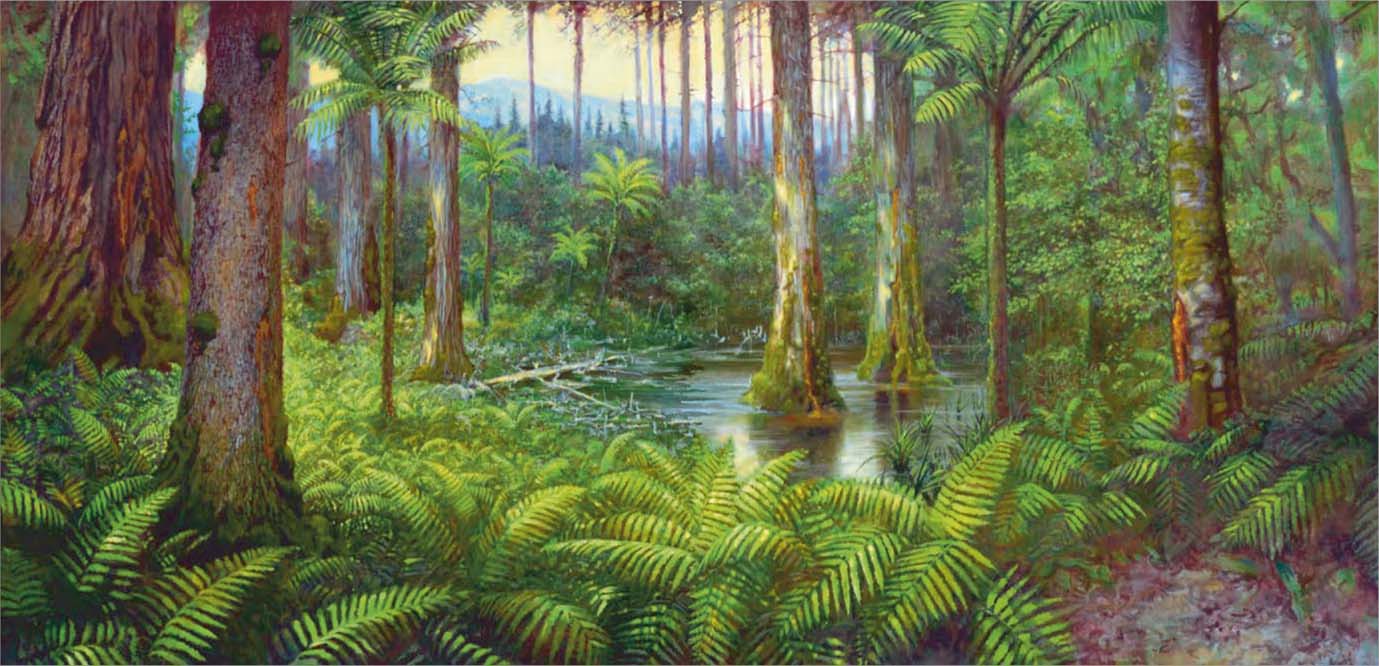
Diorama of the Baltic amber forest. Museum of Amber Inclusions, University of Gdańsk, Poland. Painting by K. Buczak.

It is worth noting that within the tribe Ceratopogonini, one row of palisade setae is present in most genera. Two rows of palisade setae are present only in the extant genera Stiloculicoides Wirth & Grogan, Reference Wirth and Grogan1988 and Echinohelea Macfie, Reference Macfie1940. Whereas an incomplete single row of palisade setae on the basal 2/3 of hind tarsomere 1 is present in Ceratopogon Meigen, Reference Meigen1803, Nannohelea Grogan & Wirth, Reference Grogan and Wirth1980 and Ceratoculicoides Wirth & Ratanaworabhan, Reference Wirth and Ratanaworabhan1971 (Urbanek et al. Reference Urbanek, Szadziewski and Dominiak2015).
2.8. Hungarian amber
(Upper Cretaceous, Coniacian–Campanian, 72–90 Ma) (Borkent Reference Borkent1997). Only two species have been recorded from this amber:
†Adelohelea Borkent, Reference Borkent1995 (1)
A. magyarica Borkent, Reference Borkent1997
Leptoconops Skuse (1)
L. clava Borkent, Reference Borkent1997
2.9. Canadian amber
(Upper Cretaceous, Campanian, 72–84 Ma) (Borkent Reference Borkent1995, Reference Borkent2012). A total of 19 named species have been reported from this amber:
†Adelohelea Borkent (1)
A. glabra Borkent, Reference Borkent1995
Culicoides Latreille (7)
C. agamus Borkent, Reference Borkent1995; C. annosus Borkent, Reference Borkent1995; C. bullus Borkent, Reference Borkent1995; C. canadensis Borkent, Reference Borkent1995; C. filipalpis Remm, Reference Remm1976; C. obuncus Borkent, Reference Borkent1995; C. tyrrelli (Boesel, Reference Boesel, Carpenter, Folsom, Essig, Kinsey, Brues, Boesel and Ewing1937)
†Heleageron Borkent (1)
H. arenatus Borkent, Reference Borkent1995
Leptoconops Skuse (1)
L. primaevus Borkent, Reference Borkent1995
†Minyohelea Borkent (1)
M. pumilis Borkent, Reference Borkent1995
†Palaeobrachypogon Borkent (3)
P. aquilonius (Boesel, Reference Boesel, Carpenter, Folsom, Essig, Kinsey, Brues, Boesel and Ewing1937); P. remmi Borkent, Reference Borkent1995; P. vetus Borkent, Reference Borkent1995
†Peronehelea Borkent (1)
P. chrimikalydia Borkent, Reference Borkent1995
†Protoculicoides Boesel (3)
P. ciliatus Borkent, Reference Borkent2012; P. depressus Boesel, 1937; P. globosus (Boesel, Reference Boesel, Carpenter, Folsom, Essig, Kinsey, Brues, Boesel and Ewing1937)
Stilobezzia Kieffer (1)
S. pikei Borkent, Reference Borkent2012
2.10. Fushun amber
(early Eocene, 48–56 Ma) (Stebner et al. Reference Stebner, Szadziewski and Wang2016b). Five named species have been reported from this amber in the genera:
†Eopalpomyitis Hong et al., Reference Hong, Guo and Ren2000 (1 species)
E. unca (Hong, Reference Hong1981)
Forcipomyia Meigen (1)
F. orientalus (Hong, Reference Hong1981)
†Gedanohelea Szadziewski (2)
G. fushunensis Stebner et al., Reference Stebner, Szadziewski, Rühr, Hammel, Kvifte, Singh and Rust2016a; G. liaoningensis Stebner et al., Reference Stebner, Szadziewski, Rühr, Hammel, Kvifte, Singh and Rust2016a
†Mantohelea Szadziewski (1)
M. sinica Stebner et al., Reference Stebner, Szadziewski, Rühr, Hammel, Kvifte, Singh and Rust2016a
2.11. Cambay amber
(early Eocene, 48–56 Ma) (Stebner et al. Reference Stebner, Szadziewski, Rühr, Hammel, Kvifte, Singh and Rust2016a, Reference Stebner, Szadziewski, Singh, Gunkel and Rust2017). Ten genera, with one named species, have been reported from this amber:
Camptopterohelea Wirth & Hubert, Reference Wirth and Hubert1960 (1)
C. odora Stebner et al., Reference Stebner, Szadziewski, Rühr, Hammel, Kvifte, Singh and Rust2016a
Brachypogon Kieffer, Reference Kieffer1899
Forcipomyia Meigen, Reference Meigen1818
†Eohelea Petrunkevitch, Reference Petrunkevitch1957
†Gedanohelea Szadziewski, Reference Szadziewski1988
Leptoconops Skuse, Reference Skuse1889
†Mantohelea Szadziewski, Reference Szadziewski1988
Meunierohelea Szadziewski, Reference Szadziewski1988
Serromyia Meigen, Reference Meigen1803
Stilobezzia Kieffer, Reference Kieffer1911a
2.12. Sakhalin amber
(middle Eocene, 45 Ma). (Szadziewski Reference Szadziewski1990; Szadziewski & Sontag Reference Szadziewski and Sontag2013). Phytostratigraphic studies by Kodrul (Reference Kodrul1999) determined that the age of Sakhalin amber is middle Eocene. Only two named species and four genera have been recorded from this amber:
†Eohelea Petrunkevitch (1)
E. sakhalinica Szadziewski, Reference Szadziewski1990
Stilobezzia Kieffer
Forcipomyia Meigen (1)
F. nadicola Szadziewski & Sontag, Reference Szadziewski and Sontag2013
Leptoconops Skuse
2.12.1. Remark
The indicative species for this amber is Eohelea sakhalinica.
2.13. Baltic amber
(Eocene, 35–50 Ma) (Szadziewski Reference Szadziewski1988; Szadziewski et al. Reference Szadziewski, Giłka and Sontag2007; Sontag & Szadziewski Reference Sontag and Szadziewski2011). I prefer the traditional name, Baltic amber in its broadest sense, including ambers named Danish, Lithuanian, Scandinavian, Saxonian, Ukrainian and Sambian (or amber from Bitterfeld, Rovno, Bay of Gdańsk, Sambia, Poland, Russia, etc.), as it may have been collected from or purchased in different countries. In addition, Baltic amber was dispersed by Paleogene seas and, more recently, by glaciers during the Pleistocene, and is still continuing to be washed out from Eocene deposits in the Gulf of Gdańsk into the Baltic sea (Szwedo & Sontag Reference Szwedo and Sontag2013). The age of Baltic amber still is under discussion. In the literature, its age mostly ranges from 35 Ma to 50 Ma (Weitschat & Wichard Reference Weitschat, Wichard and Penney2010; Standke Reference Standke2008; Ritzkowski Reference Ritzkowski1997; Grimaldi & Ross Reference Grimaldi, Ross, Fraser and Sues2017). I prefer a mid-Eocene age (45 Ma), because its fauna has links to well dated early to middle Eocene ambers of Sakhalin, Fushun and Cambay, as indicated by the common fossil genera of biting midges (Eohelea, Mantohelea, Gedanohelea).
This is the best studied amber, with 109 named species of biting midges in 26 genera (six fossil; 20 extant). Amongst many species described exclusively from this amber, there are very characteristic biting midges which are common and diagnostic for Baltic amber. I suggest treating as diagnostic the easily determinable females of Eohelea sinuosa (Meunier) (Fig. 3E), E. petrunkevitchi Szadziewski (Fig. 3C, D), or Mantohelea laca (Meunier) (Fig. 3A, B).
Serromyia alphea (Heyden, Reference Heyden1870) (= S. colorata Statz, Reference Statz1944, = S. austera Statz, Reference Statz1944, = S. spinosifemorata Statz, Reference Statz1944), described from Miocene deposits of Rott in Germany as compression fossils, is excluded from the list of species reported from Baltic amber in Bitterfeld and its designated neotype, which I consider invalid. Szadziewski (Reference Szadziewski1993) mistakenly redescribed the Miocene S. alphea, because at that time, the so called Saxonian amber from Bitterfeld and deposits from Rott were dated as Miocene. For S. alphea, mistakenly re-described and illustrated from Eocene Baltic amber from Bitterfeld by Szadziewski (Reference Szadziewski1993: 633), I propose the new name Serromyia errata Szadziewski, nom. nov. The holotype male (MBI -8-91) and three female paratypes (MBI-8-77) designated herein are deposited in the Museum für Naturkunde, Paläontologische Museum, Berlin.
A complete alphabetic list of species reported from Baltic amber is as follows:
Alluaudomyia Kieffer, Reference Kieffer, Alluaud and Jeannel1913 (1)
A. succinea Szadziewski, Reference Szadziewski1988
Atrichopogon Kieffer, Reference Kieffer and Wytsman1906 (1)
A. eocenicus Szadziewski, Reference Szadziewski1988
Bezzia Kieffer, Reference Kieffer1899 (1)
B. eocenica Szadziewski, Reference Szadziewski1988
Brachypogon Kieffer, Reference Kieffer1899 (7)
B. balticus Szadziewski, Reference Szadziewski1988; B. eocenicus Szadziewski, Reference Szadziewski1988; B. gedanicus Szadziewski, Reference Szadziewski1988; B. henningseni Szadziewski, 1988; B. miocaenicus Szadziewski, 1993; B. polonicus Szadziewski, 1988; B. prominulus (Meunier, Reference Meunier1904)
Ceratoculicoides Wirth & Ratanaworabhan, Reference Wirth and Ratanaworabhan1971 (1)
C. danicus Szadziewski, 1988
†Ceratopalpomyia Szadziewski, 1988 (1)
C. eocenica Szadziewski, 1988
Ceratopogon Meigen, Reference Meigen1803 (20)
C. bitterfeldi Szadziewski, 1993; C. ceranowiczi Szadziewski, 1988; C. crypticus Szadziewski, 1988; C. eminens Meunier, Reference Meunier1904; C. forcipiformis Meunier, Reference Meunier1904; C. gedanicus Szadziewski, 1988; C. grogani Szadziewski, 1988; C. hennigi Szadziewski, 1988; C. kotejai Szadziewski, 1993; C. margaritae Szadziewski, 1988; C. miocaenicus Szadziewski, 1993; C. nanalobus Borkent & Grogan, Reference Borkent and Grogan1995; C. paraeminens Borkent & Grogan, Reference Borkent and Grogan1995; C. piotrowskii Szadziewski, 1988; C. pisinnus Borkent & Grogan, Reference Borkent and Grogan1995; C. remmicolus Szadziewski, 1988; C. ritzkowskii Szadziewski, 1988; C. subeminens Szadziewski, 1993; C. succinicolus Szadziewski, 1993; C. tertiaricus Szadziewski, 1988
Culicoides Latreille, Reference Latreille1809 (9)
C. balticus Szadziewski, 1988; C. ceranowiczi Szadziewski, 1988; C. dasyheleiformis Szadziewski, 1988; C. eoselficus Szadziewski, 1988; C. gedanensis Szadziewski, 1988; C. prussicus Szadziewski, 1988; C. speciosus (Meunier, Reference Meunier1904); C. subgedanensis Szadziewski, 1993; C. succivarius Szadziewski, 1988
Dasyhelea Kieffer, Reference Kieffer1911b (4)
D. eodicryptoscenica Szadziewski, 1988; D. gedanica Szadziewski, 1988; D. miocaenica Szadziewski, 1993; D. stanislavi Szadziewski, 1988
†Eohelea Petrunkevitch, Reference Petrunkevitch1957 (6)
E. fossicola Szadziewski, 1993; E. gedanica Szadziewski, 1988; E. grogani Szadziewski, 1988; E. miocaenea Szadziewski, 1993; E. petrunkevitchi Szadziewski, 1984; E. sinuosa (Meunier, Reference Meunier1904)
Forcipomyia Meigen, Reference Meigen1818 (21)
F. berendti Szadziewski, 1988; F. bifidicola Szadziewski, 1993; F. eobreviflagellata Szadziewski, 1988; F. eocostata Szadziewski, 1988; F. eophytoheleana Szadziewski, 1988; F. eotrichoheleana Szadziewski, 1988; F. gedanicola Szadziewski, 1988; F. henningseni Szadziewski, 1988; F. krzeminskii Szadziewski, 1988; F. kulickae Szadziewski, 1988; F. lyneborgi Szadziewski, 1988; F. miocaenica Szadziewski, 1993; F. piriformis (Meunier, Reference Meunier1904); F. pseudomicrohelea Szadziewski, 1988; F. subgedanicola Szadziewski, 1993; F. succinea Szadziewski, 1988; F. succinicola Szadziewski, 1993; F. tuberculosa Szadziewski, 1993; F. turbinata (Meunier, Reference Meunier1904); F. uncula (Meunier, Reference Meunier1904); F. unculiformis Szadziewski, 1993
†Fossihelea Szadziewski, 1988 (2)
F. gracilitarsis (Meunier, Reference Meunier1904); F. miocaenica Szadziewski, 1993
†Gedanohelea Szadziewski, 1988 (3)
G. loewi Szadziewski, 1988; G. succinea Szadziewski, 1988; G. wirthi Szadziewski, 1988
Leptoconops Skuse, Reference Skuse1889 (2)
L. rovnensis Sontag & Szadziewski, Reference Sontag and Szadziewski2011; L. succineus Szadziewski, 1988
Mallochohelea Wirth, Reference Wirth1962 (1)
M. martae Szadziewski, Reference Szadziewski2005
†Mantohelea Szadziewski, 1988 (2)
M. gedanica Szadziewski, 1988; M. laca (Meunier, Reference Meunier1904)
Metahelea Edwards, Reference Edwards1929 (1)
M. serafini Szadziewski, Reference Szadziewski1998
Meunierohelea Szadziewski, 1988 (4)
M. gedanicola Szadziewski, 1988; M. miocaenica (Szadziewski, Reference Szadziewski1993); M. nielseni Szadziewski, 1988; M. wirthi Szadziewski, 1988
Monohelea Kieffer, Reference Kieffer1917 (2)
M. baltica Szadziewski, 1988; M. clunipes (Loew, Reference Loew1850)
Nannohelea Grogan & Wirth, Reference Grogan and Wirth1980 (2)
N. eocenica Szadziewski, 1988; N. grogani Szadziewski, 1988
Neurohelea Kieffer, Reference Kieffer1925 (1)
N. cothurnata (Meunier, Reference Meunier1904)
Palpomyia Meigen, Reference Meigen1818 (4)
P. erikae Szadziewski, 1993; P. jantari Szadziewski, 1988; P. riedeli Szadziewski, 1988; P. succinea Szadziewski, 1988
Physohelea Grogan & Wirth, Reference Grogan and Wirth1979 (1)
P. obtusa (Meunier, Reference Meunier1904)
Serromyia Meigen, Reference Meigen1818 (7)
S. anomalicornis (Loew, Reference Loew1850); S. errata nom. nov.; S. polonica Szadziewski, 1988; S. ryszardi Borkent, Reference Borkent and Bissett1990 in Borkent & Bissett Reference Borkent and Bissett1990; S. sinuosa Borkent, 1990 in Borkent & Bissett Reference Borkent and Bissett1990; S. spinigera (Loew, Reference Loew1850); S. succinea Szadziewski, 1988
Stilobezzia Kieffer, Reference Kieffer1911a (4)
S. falcata (Meunier, Reference Meunier1904); S. kutscheri Szadziewski, 1993; S. saxonica Szadziewski, 1993; S. wirthicola Szadziewski & Grogan, Reference Szadziewski and Grogan1998a
†Wirthohelea Szadziewski, 1988 (1)
W. trifida Szadziewski, 1988
2.14. Dominican amber
(Miocene, 16 Ma) (Szadziewski & Grogan Reference Szadziewski and Grogan1994, Reference Szadziewski and Grogan1997, Reference Szadziewski and Grogan1998a, Reference Szadziewski and Groganb; Penney Reference Penney and Penney2010). As diagnostic or indicative for this amber are several most distinct species, such as: Dasyhelea hispaniolae, Forcipomyia domibicolor, Baeodasymyia dominicana (Fig. 4), Heteromyia dominicana, and Phaenobezzia wirthi. The following list includes 29 named species in 11 extant genera from this amber:
Atrichopogon Kieffer, Reference Kieffer and Wytsman1906 (1)
A. dominicanus Szadziewski & Grogan, Reference Szadziewski and Grogan1998b
Baeodasymyia Clastrier & Raccurt, Reference Clastrier and Raccurt1979 (1)
B. dominicana Szadziewski & Grogan, Reference Szadziewski and Grogan1994
Brachypogon Kieffer (3)
B. americanus Szadziewski & Grogan, 1998a; B. dominicanus Szadziewski & Grogan, 1998a; B. prominuloides Szadziewski & Grogan, 1998a
Culicoides Latreille (5)
C. ambericus Szadziewski & Grogan, 1998a; C. antilleanus Szadziewski & Grogan, 1998a; C. brodzinskyi Szadziewski & Grogan, 1998a; C. hispanicolus Szadziewski & Grogan, 1998a; C. mammalicolus Szadziewski & Grogan, 1998a
Dasyhelea Kieffer (4)
D. antilleana Szadziewski & Grogan, 1998b; D. dominicana Szadziewski & Grogan, 1998b; D. hispaniolae Szadziewski & Grogan, 1998b; D. minuticola Szadziewski & Grogan, 1998b
Forcipomyia Meigen (10)
F. americana Szadziewski & Grogan, 1998b; F. antilleana Szadziewski & Grogan, 1998b; F. chrysosuccinea Szadziewski & Grogan, 1998b; F. domibicolor Szadziewski & Grogan, 1998b; F. frutetosuccinea Szadziewski & Grogan, 1998b; F. fusiparamera Szadziewski & Grogan, 1998b; F. grimaldii Szadziewski & Grogan, 1998b; F. lepidosuccinea Szadziewski & Grogan, 1998b; F. tertiaricola Szadziewski & Grogan, 1998b; F. woodruffi Szadziewski & Grogan, 1998b
Heteromyia Say, Reference Say1825 (1)
H. dominicana Szadziewski & Grogan, Reference Szadziewski and Grogan1997
Palpomyia Meigen (1)
P. wirthorum Szadziewski & Grogan, 1997
Phaenobezzia Haeselbarth, Reference Haeselbarth1965 (1)
P. wirthi Szadziewski & Grogan, 1997
Stilobezzia Kieffer (2)
S. antilleana Szadziewski & Grogan, 1998a; S. dominicana Szadziewski & Grogan, 1998a
2.15. Mexican amber
(Miocene, 15–20 Ma) (Szadziewski & Grogan Reference Szadziewski and Grogan1996; Solórzano-Kraemer Reference Solórzano-Kraemer2007, Reference Solórzano-Kraemer and Penney2010). A small number of inclusions in Mexican amber have been examined and determined to the generic level. Szadziewski & Grogan (Reference Szadziewski and Grogan1996) and Solórzano-Kraemer (Reference Solórzano-Kraemer2007) reported the following five genera:
Brachypogon Kieffer (subg. Isohelea Kieffer, Reference Kieffer1917)
Culicoides Latreille
Dasyhelea Kieffer
Forcipomyia Meigen
Nannohelea Grogan & Wirth
2.15.1. Remark
Nannohelea is pantropical; the others have a worldwide distribution today.
3. Biting midges as indicators of palaeoenvironments
Ceratopogonidae are useful for ecological reconstructions, as their biology and ecological requirements are greatly diversified and usually the same for all species within their genera. The immature stages of the genera included in the subfamily Ceratopogoninae are generally aquatic or semiaquatic and inhabit a wide variety of inland bodies of water including lakes, rivers, ponds, springs, pools and their margins (Szadziewski Reference Szadziewski1988; Szadziewski et al. Reference Szadziewski, Krzywiński, Giłka and Nilsson1997). The fossil record of adults in this subfamily indicate that aquatic or semiaquatic habitats were present in or near the ancient amber forest.
Biting midges of the subgenus Forcipomyia s. str. (Fig. 8A) are indicative for forests because their larvae and pupae are terrestrial and usually live under bark of rotting trees (Urbanek et al. Reference Urbanek, Richert, Giłka and Szadziewski2011). They are moderately common in Eocene Baltic amber (nearly 16 % of all biting midges; Szadziewski Reference Szadziewski1988), and very common in Miocene Dominican amber (nearly 42 % of all ceratopogonids; Szadziewski & Grogan Reference Szadziewski and Grogan1998b).
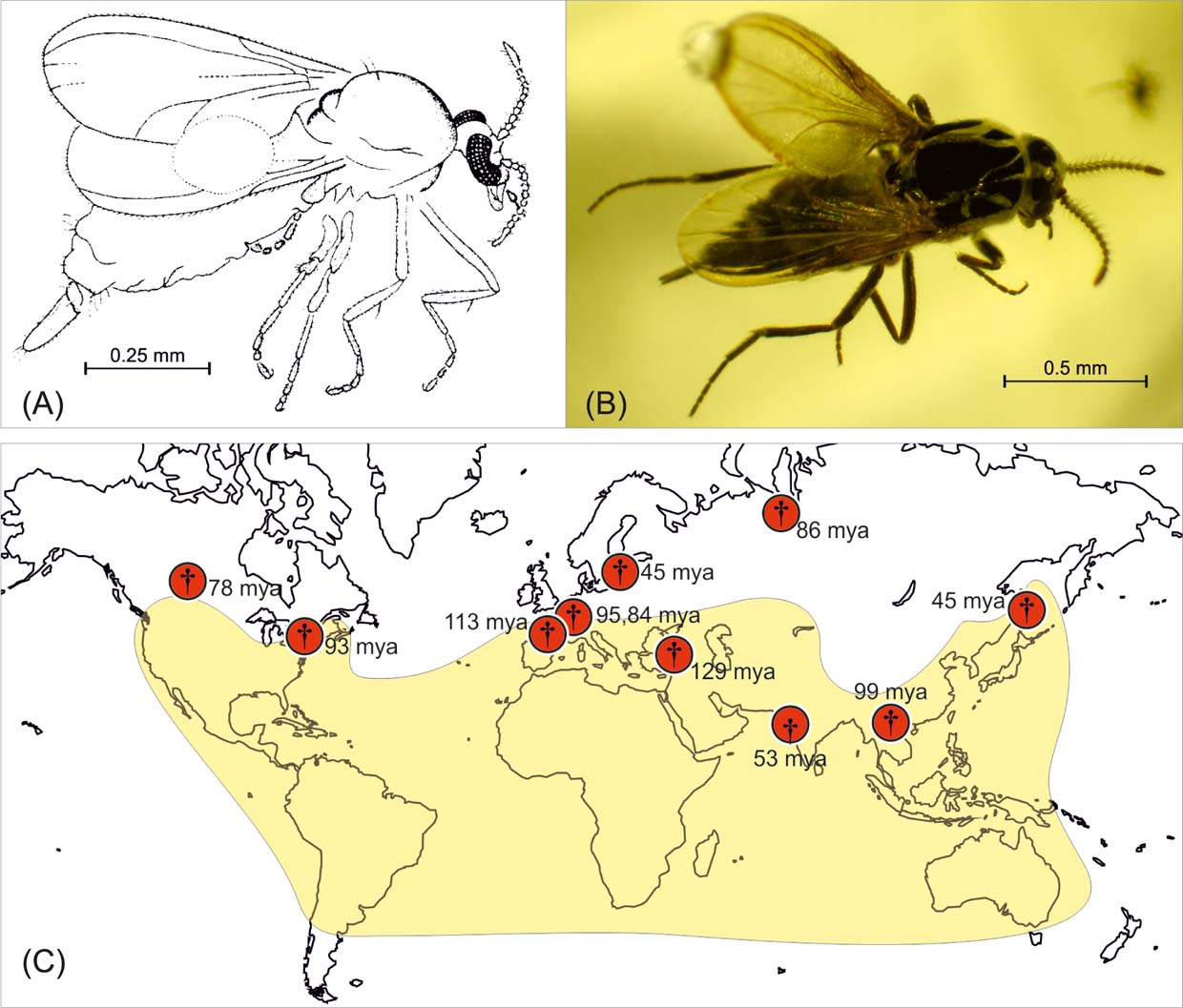
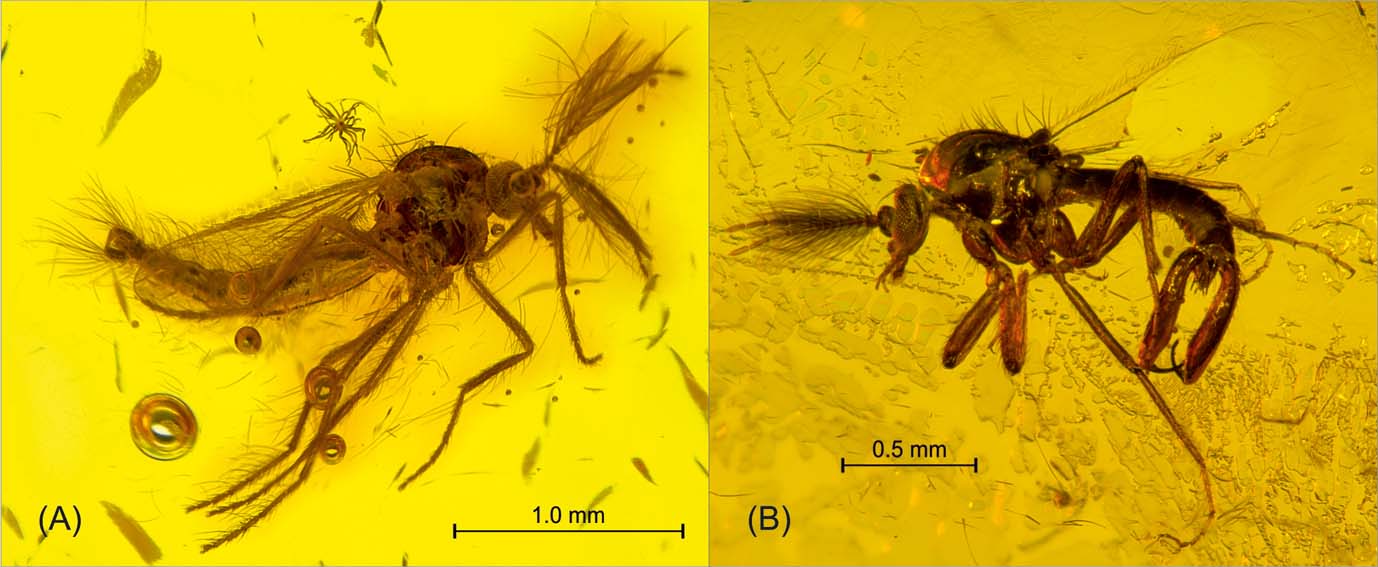
Species of the genus Leptoconops are good indicators of sea shore or estuarine environments near amber forests, as their larvae usually live in sand of coastal and inland beaches. Fossil records of Leptoconops, a relictual pantropical genus that was distributed worldwide during the Cretaceous (Fig. 7), indicate that coastal or estuarine ecosystems close to amber forests were present (Szadziewski et al. Reference Szadziewski, Giłka and Urbanek2015a).
Biting midges of the genus Leptoconops as indicators of seashore or estuarine sandy habitats and warm climates, with vertebrates as sources of blood meals: (A) Leptoconops zherikhini Szadziewski & Arillo, Reference Szadziewski and Arillo2003 from Spanish amber; (B) Leptoconops rovnensis Sontag & Szadziewski, 2011 from Baltic amber; (C) Distribution of extinct and extant species (after Szadziewski Reference Szadziewski2008, modified).

(A) Biting midges of the genus Forcipomyia are good indicators of moist forests with rotting trees. Male of unidentified Forcipomyia from Baltic amber (Photo E. Sontag). (B) Species in the genus Ceratopogon are indicators of boreal temperate or cold climatic conditions. Male of Ceratopogon forcipiformis Meunier, 1904 from Baltic amber (Photo E. Sontag).
Some Recent genera of biting midges that presently inhabit warm climate ecosystems are indicators of subtropical or tropical climatic conditions in the past. For example, extant species of Leptoconops are of pantropical distribution (Fig. 7) and Austroconops now includes just two extant species, which are only found in western Australia (Fig. 4A). These two genera, together with termites, indicate that during the Upper Cretaceous, the climate of the Taimyr amber forests of Siberia were much warmer than today (Szadziewski Reference Szadziewski1996). In addition, the pantropical recent distribution of the genus Nannohelea extended to more northern latitudes during the Paleogene and Neogene (Szadziewski Reference Szadziewski2008). The Oriental and Australian regions are currently limited to the distribution of the tropical genera Meunierohelea and Metahelea, which occurred in Europe in the Eocene (Szadziewski Reference Szadziewski1988, Reference Szadziewski2008).
The type genus of Ceratopogonidae, Ceratopogon (Fig. 7B), which includes 43 extant and 20 fossil species, is presently a boreal genus of Holarctic distribution. This relictual genus was moderately common in Eocene Baltic amber, but is now a relatively rare inhabitant of cold boreal regions of the Northern Hemisphere, and is restricted to isolated mountains in the southern-most regions of its present range (Szadziewski Reference Szadziewski1988, Reference Szadziewski2008; Borkent & Grogan Reference Borkent and Grogan1995; Hagan et al. Reference Hagan, Hassold, Kynde, Szadziewski, Thunes, Skartveit and Grogan2000). This pattern of occurrence may be explained by the presence of cold habitats in the Baltic amber forests, probably in mountains. However, the suggestion that this genus would serve as an indicator of cold climates or mountainous habitats requires further investigation.
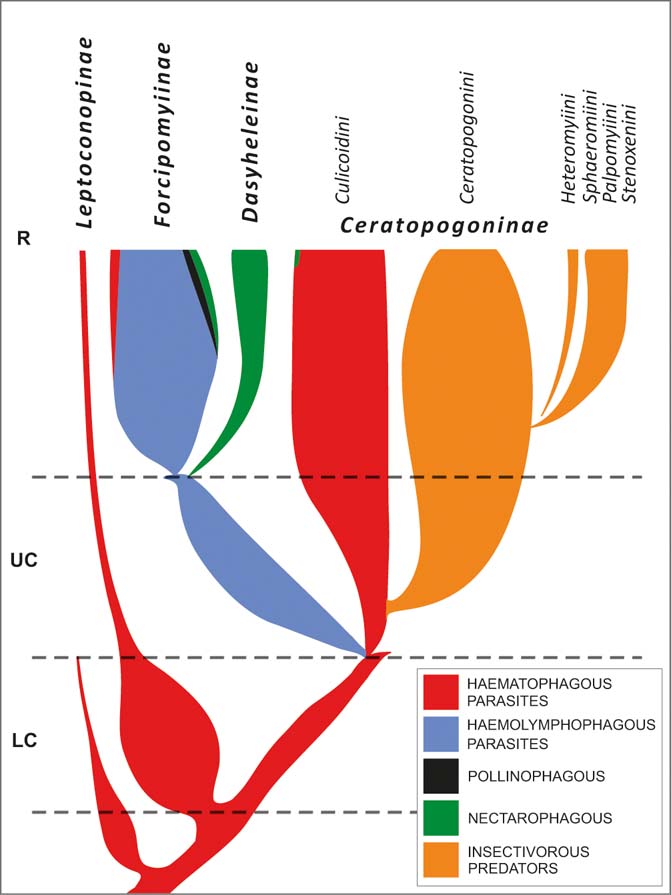
Information on food sources in palaeoenvironments is important for females in most genera of biting midges, as they require a protein-rich meal in order to produce a clutch of eggs. Feeding habits of biting midges are highly diverse (Fig. 9); however, both sexes of all biting midges visit flowers of angiosperms with easily accessible nectar. The females of the extant subfamilies Leptoconopinae, Forcipomyiinae and Ceratopogoninae, and of the extinct subfamilies Atriculicoidinae and Lebanoculicoidinae, require a protein–rich meal. Only females of Dasyhelea (Dasyheleinae) have greatly reduced, vestigial mandibles and laciniae and exclusively feed on nectar. Females of basal lineages, including Archiaustronops, Lebanoculicoides (Lebanoculicoidinae), all Leptoconopinae in the extant genera Leptoconops and Austroconops, Culicoides (subfamily Ceratopogoninae) and Forcipomyia in the subgenus Lasiohelea (Forcipomyiinae), feed on the blood of vertebrates, primarily mammals and birds (Urbanek et al. Reference Urbanek, Piotrowicz, Szadziewski and Giłka2014). Most species of Forcipomyiinae are ectoparasites and have mandibles with small teeth that allow them to pierce cuticles of other insects and feed on their haemolymph. Parasites of the extinct subfamily Atriculicoidinae (Protoculicoides) most probably fed on the haemolymph of other insects. Females in the tribes Ceratopogonini, Sphaeromiini, Heteromyiini, Palpomyiini and Stenoxenini have mandibles with large teeth and are predators of other, usually small insects (Szadziewski Reference Szadziewski1988; Urbanek et al. Reference Urbanek, Szadziewski and Dominiak2015).
Chart illustrating the lineages of Ceratopogonidae during the Cretaceous and Cenozoic and the evolution of adult female feeding habits.

4. Acknowledgements
I would like to thank Dr. Elżbieta Sontag of University of Gdańsk for preparing the illustrations. Special thanks are due to the reviewers, Dr. William L. Grogan (Florida State Collection of Arthropods, Gainesville, USA), Dr. Dany Azar (Lebanese University, Fanar –Matn, Lebanon) and Dr. Andrew Ross (National Museum of Scotland, Edinburgh, UK), for their critical reviews and valuable comments.