Introduction
Unemployment is a status that has been shown not only to have immediate negative effects for those struck, but also to leave measurable scars on income and job stability for many years following the end of an unemployment spell. Long-term unemployment entails a risk of breaking workers' accumulated human capital and reducing their employability through both psychological effects and the stigma placed on the unemployed by employers. This is, of course, an individual-level effect, but it also has consequences at the macro level. It is difficult for labour markets to recover completely from a temporary increase in unemployment levels, as the unemployment experience per se may render non employable those who have a longer unemployment experience. This phenomenon is usually discussed in terms of the hysterisis effect (De Vreyer et al., Reference De Vreyer, Layte, Wolbers, Hussain, Gallie and Paugam2000). Governments have looked for ways to minimise the human capital loss and maintain the employability of the long-term unemployed using different measures. A central tool, which has long been the practice in the Scandinavian countries and has been emphasised by the EU in the Lisbon process, has been to invest in active labour market policy programmes (ALMPs). ALMPs aim to maintain human capital by activating the unemployed or keeping their labour market skills up to date through training, or to actively support the matching process in the labour market by retraining the unemployed for expanding sectors in the economy. The resources spent on this are quite staggering. In 1993, the first year of this study, a typical OECD country spent 0.8 per cent of GDP on ALMPs, while Sweden, which was the highest spender, actually spent a whopping 2.9 per cent of GDP on ALMPs (OECD, 1996).
Despite the extensive investments in ALMPs, the actual effects of these human capital investments are contested. While some studies point towards positive effects, other studies have indicated neutral or even negative effects on job chances or earnings (Regnér, Reference Regnér1993; NUTEK Analys, 1994; Forslund, 1995; OECD, 1996). A problem for most previous studies, however, is that they have been limited, both in the particular measures investigated and in the time frame used. We argue that, because human capital investment can be regarded as a long-term investment it is also from a longer-term perspective that the effects should be measured. This article investigates the long-term (ten years) effects of participating in active labour market policy measures among Swedish unemployed. In order to take into account differences between ALMPs that could very well affect the long-term outcomes, ALMP measures directed towards maintaining human capital through subsidised employment and measures directed towards expanding or retraining are analysed separately. The article uses a longitudinal register database for the entire Swedish population, 1991–2003. From this database, a subsample of all long-term (more than six months) unemployed in 1993, who were well established in the labour market (income from work, no unemployment, not in education, no childbirth and transfers responsible for less than 10 per cent of income) in 1992, were followed during the following ten years.
The scarring effects of unemployment
The longer the spell of unemployment, the harder it becomes to keep and update acquired knowledge and proficiencies. The unemployed individual rapidly loses her/his value in the labour market and is put at risk of becoming unattractive to potential employers. The human capital effects of unemployment are also connected with discouraged worker effects among the long-term unemployed. Repeated rejection in the labour market is connected with lower interest in active job searching, as expectations for future employment are low (Regnér, Reference Regnér1997). We may add to this the serious risk that individuals with long unemployment spells will be at the very bottom of potential employers' lists, owing to the stigmata of long-term unemployment. Research shows that employers have negative attitudes towards hiring long-term unemployed workers (Harkman, Reference Harkman1999) and that employers discriminate against workers with earlier unemployment spells, as such spells are taken as a sign of unreliability and/or low productivity (Maguire, Reference Maguire and McLaughlin1992; Regnér, Reference Regnér1997; Harkman, Reference Harkman1999; Gallie and Paugam, Reference Gallie and Paugam2000; Calmfors et al., Reference Calmfors, Forslund and Hemström2002).
Unemployment scarring has been well documented in previous research. For instance, Groot et al. (Reference Groot, Schippers and Siegers1990) investigated the effects of interruptions in labour market participation and found that workers who become unemployed (or who interrupt their careers for other reasons) suffer from a decreasing human capital stock. Further, the longer the unemployment spell continues, the more underprivileged they become with regard to missing experience, in comparison with those whose careers are not interrupted. Educational investments during or after the unemployment spell reduce depreciation of the human capital stock and have been shown to limit scarring effects (Groot et al., Reference Groot, Schippers and Siegers1990; Gregg and Tominey, Reference Gregg and Tominey2005). This result, showing that career interruptions generate negative human capital effects, seems to correspond well with most other studies within the field that document scarring effects in terms of outcomes. For individuals, unemployment experience is connected with detrimental labour market employment prospects, and previous unemployment experiences have implications for the future labour market experience (Arulampalam et al., Reference Arulampalam, Booth and Taylor2000; Layte et al., Reference Layte, Levin, Hendrickx, Bison, Gallie and Paugam2000; Burgess et al., Reference Burgess, Propper, Rees and Shearer2003).
The experience of unemployment also increases the probability of downward occupational mobility, often to the unskilled manual class (Layte et al., Reference Layte, Levin, Hendrickx, Bison, Gallie and Paugam2000). In a two-country comparison between Germany and the US, Gangl finds that occupational mobility is connected with previous unemployment spells. More than 60 per cent of the US workers were re-employed into occupations other than their pre-unemployment job. The number of workers who experienced the same occupational mobility in Germany was about 30 per cent. Given that the main occupational mobility for the unemployed is downward, he also documents substantial wage losses connected with unemployment. Among US workers, the loss was about 20 per cent and for German workers a somewhat lower 16 per cent (Gangl, Reference Gangl2004).
Unemployment spells thus affect not only the occupation mobility rate but also wages. Relatively short periods in unemployment also have negative consequences for wages. For instance, estimates based on Swedish data showed that a spell of unemployment lasting ten weeks reduces wages by 7 per cent. This effect persists for more than six years (Björklund, Reference Björklund1981). Similar direct and delayed wage effects of unemployment have been widely documented in diverse labour markets. In the UK, the wage penalty associated with unemployment has been found to be about 6 to 10 per cent on re-employment, and 10 to 14 per cent after three years, whereas long-term effects from youth unemployment have been found to be as high as 13 to 21 per cent (Arulampalam, Reference Arulampalam2001; Gregg and Tominey, Reference Gregg and Tominey2005). Studying the situation in Germany, Bender et al. (Reference Bender, Dustmann, Margolis and Meghir1999) found that workers who were re-employed relatively quickly only lost up to 2 per cent of their pre-unemployment wage. Length of unemployment, however, was of importance for scarring, and those who spent over a year in unemployment before they found a new job suffered a ‘permanent additional wage penalty’ of 19 per cent (Bender et al., Reference Bender, Dustmann, Margolis and Meghir1999). In a US setting, wage scarring has been found to be even higher, around 20 per cent (Hipple, Reference Hipple1999; DiPrete, Reference DiPrete2002).
Active labour market programmes – a protection against scarring effects?
The fact that studies have shown that scarring is reduced by investments in education before, during and after unemployment (Groot et al., Reference Groot, Schippers and Siegers1990; Burgess et al., Reference Burgess, Propper, Rees and Shearer2003; Gregg and Tominey, Reference Gregg and Tominey2005) would seem to indicate that ALMPs could be an important tool in trying to reduce unemployment scarring due to long-term unemployment. Such a protective effect would be in accordance with the human capital perspective that has traditionally emphasised the importance of viewing skills and knowledge as a central form of capital in Western economies. From the point of view of human capital theory, productivity – and thus compensation and employability – could basically be reduced to the human capital investments an individual has made. The most important of these would be investments in the form of education and training (Becker, Reference Becker1993). As ALMPs aim to maintain, expand or re-adjust skills and training of the unemployed, we may expect them to have a positive impact on productivity and thus to reduce unemployment scarring. However, it is not possible to reduce human capital loss in unemployment to reductions in the value of existing skills, education and training. Self-confidence and mental wellbeing (see, for example, Kessler et al., Reference Kessler, Turner and House1989; Lahelma, Reference Lahelma1992; Patterson, Reference Patterson1997; Strandh, Reference Strandh2000), social skills and motivation (Regnér, Reference Regnér1997) have been shown to be affected by unemployment. These factors could affect scarring through discouraged worker effects or act as indicators of low productivity for potential employers. Here it is possible that ALMPs reduce scarring through activating the unemployed and increasing their sense of control (Bane and Ellwood, Reference Bane and Ellwood1994).
There are thus good reasons to expect positive effects of ALMPs on unemployment scarring. Yet despite this, findings have been somewhat inconclusive. A number of studies from different European contexts point towards positive effects of ALMPs, at least with regard to returning to the labour market (Lubyova and van Ours, Reference Lubyova and van Ours1999; Eichler and Lechner, Reference Eichler and Lechner2002; Gerfin and Lechner, Reference Gerfin and Lechner2002). In a Swedish and Scandinavian context, there are also a number of studies showing positive effects of ALMPs (Harkman et al., Reference Harkman, Jansson and Tamás1996). For instance, during the 1980s, more than 50 per cent of those attending ALMP training had a job, within the area of the training, in the regular labour market six months after the end of the programme. To this number another 10 per cent can be added: those who had a job but within a different area than that of the ALMP programme. In 1984, as much as 70 per cent got a job after the ALMP training period (Johansson, Reference Johansson and Furåker1989). Moreover, a similar study carried out in 2003 found that ALMP participants have greater probabilities of returning to the regular labour market than do unemployed individuals not participating in ALMP (AMS, 2005). Positive effects have also been found on wages, and programme participation appears to reduce unemployment scarring in the form of wage penalties. Edin (Reference Edin1988) finds that, in the long run, spending ten weeks in an ALMP decreases the risk of negative effects on wage development. In a Norwegian setting, ALMPs have been found to have positive effects on the probability of becoming self-sufficient among unemployed social assistance recipients (Dahl and Lorentzen, Reference Dahl and Lorentzen2005).
While many studies indicate positive effects of ALMPs, others point towards a non-effect or even negative effects. This is also the OECD's conclusion based on analysis of available studies of ALMP effects in OECD countries (OECD, 1996). Macro-economic analyses have pointed towards a non-effect of ALMPs on the outflow from unemployment (Puhani, Reference Puhani2003). This, of course, does not directly translate into a non-effect at the individual level. Such a non-effect, however, has been found in several micro-data analyses of Swedish programmes (AMS, 1997). Even negative effects on the outflow from unemployment to employment in the regular labour market are found. When studying unemployed youth's participation in training programmes, 1992–94, only negative effects were found on the probability of entering a job in the regular labour market as well as on the probability of entering a regular education programme within two years (Larsson, Reference Larsson2000). Other micro-level evaluations of programmes have similarly found no significant effects of individual participation in particular ALMPs, and wage trend analyses largely show that only a few individuals experience wage lifts after ALMP attendance as compared with openly unemployed control groups (Ackum, Reference Ackum1991; Regnér, Reference Regnér1993; AMS, 1997; Larsson, Reference Larsson2000). In a 1995 summary of Swedish studies on wage trend effects of ALMPs, Forslund and Krueger argue that, from a macro-economic point of view, if ALMP attendance raises the yearly income by 3 per cent over a period of 20 years, the value of the outcome balances the level of the costs for the Swedish economy. They find, however, that there is not enough support to draw the conclusion that ALMP attendance has an effect on participants' future wages (Forslund and Krueger, Reference Forslund and Krueger1995).
This inconclusiveness on the effects of ALMPs is also emphasised in a review of the effectiveness of Swedish labour market policy from the early 1980s. The tendency was that positive effects are more commonly found in studies from the 1980s, while studies from the 1990s more often indicated no or negative effects. However, it is not only a matter of when the study was made but also what kind of programme is being evaluated (Calmfors et al., Reference Calmfors, Forslund and Hemström2002). Most evaluations and studies have concentrated on the effects of particular programmes, and these programmes vary substantially in duration, quality and not least in direction. There are basically two types of ALMPs that serve very different purposes. One form is what could be labelled as subsidised employment, where the unemployed are supported as new entrepreneurs, and are temporarily employed in public programmes or through subsidised employment in the regular labour market. Another form of ALMP, which could be labelled ALMP training, aims to maintain, readjust or expand the human capital of the unemployed through training or education. The emphasis of ALMP training is more on the actual skill being achieved: on increasing human capital. In the case of ALMP employment, the aim is more to help individuals stay active, to establish networks and contacts and thus focuses more on creating and maintaining ability and social competence rather than building human capital in a more traditional sense.
Previous research suggests that such differences may very well underlie the differences found in effects, although findings point in different directions concerning which form of ALMP has better outcomes. Some studies indicate great differences between different AMLP programmes. Studying the situation in Switzerland, Gerfin and Lechner (Reference Gerfin and Lechner2002) find positive effects for an ALMP employment-type programme of subsidised temporary jobs in the regular labour market, whereas the effects of ALMP training are not as convincing. A Norwegian study by Dahl and Lorentzen (Reference Dahl and Lorentzen2005), on the other hand, indicates the opposite. Training programmes yield positive results and the employment programmes produce no significant effects. In Ireland, O'Connell (Reference O'Connell2002) finds that programmes with strong links to the labour market help increase employment duration and have positive effects on earnings from employment.
Naturally, the differences found concerning the effects of different forms of ALMPs in different countries may be dependent on the quality of the measures, thus indicating that programme content is of importance for their effects. One main factor for ALMP employment may be the extent to which ALMP employment programmes are tied to the regular labour market. Subsidising employment in the regular labour market does provide the desired network and contacts for the unemployed, the downside being, of course, that the risk of displacement effects is substantial. For ALMP training, the main factor is probably the quality of the training or education received by the unemployed. This is indicated in a Swedish study, where long vocational training (more than 100 days) showed better results than did short vocational training (fewer than 100 days). When comparing those attending vocational training with a control group, a slight positive effect on employment level was found for the group attending longer vocational training, while a negative effect on employment level was found for those with a shorter training period (AMS, 1997). Naturally, one problem associated with providing longer, quality training for the unemployed is the costs involved, especially when unemployment rates are high.
As we have seen, there are contradictory findings on the effect of ALMPs on job chances and unemployment scarring. This is true of both the general effects of ALMPs, although most Swedish studies appear to suggest negative or non-effects, and the differential effects of different types of ALPMs. The OECD points out two main problems with existing studies in this area. The first problem concerns the nature of the programmes. Most studies evaluate individual or only a few programmes. As these programmes have different aims, they serve different purposes and are also probably of varying quality, which makes it difficult to draw general conclusions. The second problem relates to measurement of the effects. In almost all cases, studies are based on immediate effects or on effects arising relatively soon after a completed programme. This is problematic from the perspective of ALMPs as human capital investments, where effects may be expected to be found on long-term labour market outcomes rather than on immediate outcomes (OECD, 1996). This is something which Calmfors et al. (Reference Calmfors, Forslund and Hemström2002) also argue, especially the importance to let more time pass from the point of ALMP activity to evaluation in times when the labour demand is low, as in the 1990s, as the time lag between ALMPs and effects are longer.
We would like to argue that, in order to understand the effects of ALMPs on unemployment scarring, one must first investigate ALMPs as a whole, at the same time as one takes into account the major differences between the two main forms of ALMPs. Second, as the concept of human capital growth concerns long-term investments, we must let time play a role in the study, allowing more time than is usual. Third, because human capital investments are long-term, it is of interest and importance to evaluate the extent to which the two different forms of ALMPs have differential impact over time.
Such differential impacts over time may well be found, given the major differences in how the two forms of programmes affect individual outcomes. The function of ALMPs in the form of training and education is to increase individuals' human capital through an increased level of education and skill, in order to improve long-term employability. Following participation, individuals either continue to further studies or look more broadly for work in the regular labour market, with new skills under their belts. The function of ALMP employment is somewhat different, as it is focused on human capital growth in the form of contacts/networks, ability and motivation. This gain is harder to use broadly in the labour market because it is difficult to formalise and, in the case of subsidised employment in the regular labour market, closely tied to a specific organisation, possibly making it less valuable outside that organisation. The effect of ALMP employment thus should be more immediate and in most cases connected with remaining within the organisation after the subsidisation period.
In this article, we will investigate the impact of the two forms of ALMPs from a long-term perspective. First, we will analyse, over a ten-year period, the extent to which ALMP training and ALMP employment impact on the probability of reaching pre-unemployment incomes, the probability of having an unemployment-free year, and the probability of completely leaving the labour market. Second, we will investigate whether the possible effects of the two forms of ALMPs are differently distributed over time. Our hypothesis here is that the differences in type of human capital investment between the two forms of ALMPs will produce effects that are differently distributed over time. Whereas the effect of ALMP employment will be immediate, with the positive effect declining over time, the effect of ALMP training will be lower, but stable or increasing over time.
Data and methods
Investigating the long-term effects of human capital investments in the unemployed places extreme demands on the data, both in terms of long reliable panels and the size of the panels. Most existing long-term survey-based panels are too small initially to enable detailed study of subgroups such as the unemployed, and suffer over time from problems of attrition. For researchers in the Scandinavian countries, a solution to these problems is to gain access to the comprehensive and electronically updated statistical register databases kept by the national statistics offices. In this study, we have made use of such a database, the LISA database (Longitudinell Integrationsdatabas för Sjukförsäkrings- och Arbetsmarknadsstudier) compiled by Statistics Sweden. LISA is a continuously updated database that contains yearly detailed demographic, income and employment/unemployment information, collected from public registers, on all individuals residing in Sweden.
The LISA data used for this study include information on all residents between the ages of 16 and 54 living in Sweden in 1992, who are followed yearly from 1991 to 2003, with some additional information, for example on class, collected from the 1990 Swedish census. All in all, the dataset from the outset consists of roughly 4.6 million individuals in 1991, with attrition caused by death (which is noted) or emigration leading to roughly 4.4 million individuals still being followed 12 years later. The dataset suffers from virtually no internal falling off and can be considered to represent all cohorts born 1937–1975 living in Sweden during those years, with the exception that it does not take into account individuals within the age span who migrated to Sweden after 1992.
The size and the quality of the data make it possible for us to use a two-pronged strategy for taking into account the selection issues that tend to plague research into ALMPs. There is here the possibility for selection both into unemployment in general and into ALMPs according to both measurable (which is no problem) and immeasurable qualities that can be connected with individual choices and qualities as well as labour market board policies. Our first strategy makes use of the fact that the size of the dataset enables subsampling, which helps us reduce selection effects into unemployment through creating a sample that is initially homogenous and well established in the labour market. The strategy here uses pre-unemployment information in order to minimise selection effects, with the assumption that previous labour market position is a good indicator of both measured and unmeasured qualities. The first years of the dataset are here used as selection years to obtain an unemployment sample that is initially homogenous, well established in the labour market and that has as few features as possible that might indicate a handicap in the labour market. Only those unemployed for more than half of 1993, who during 1992 had no unemployment or ALMP spells, had not been studying, had not had a child and had a labour market income exceeding 58,200Footnote 1 SEK and a total income more than 90 per cent related to labour market activity (and not transfers) were selected. With these limitations, the dataset used in the study ended up comprising 51,535 individuals followed over a ten-year period after their initial unemployment.
The second strategy used is the application of a Heckman two-step procedure in order to control for selection bias into the two types of ALMPs among the unemployed (see, for instance, Heckman, Reference Heckman1976, Reference Heckman1979; Breen, Reference Breen1996). In the first step the probability in the unemployed sample of participation in the two types of ALMPs was analysed using probit regressions where the available independent variables are included. The effects of the unmeasured characteristics are here assumed to be present in the residuals of the probit analysis. These residuals were then used to construct two selection bias control variables, lambda 1 and lambda 2, which are assumed to reflect the effects of all unmeasured characteristics, which are related to participation in ALMP training and ALMP employment. These are in the second step included in the substantial analyses as additional independent variables, where they reflect the unmeasured characteristics related to participation in ALMP training and ALMP employment, and catch the part of the effect of these characteristics, which are related to the dependent variables. The statistical package used (SPSS) normally provides no procedure for applying the Heckman two-step procedure, but, using procedures developed by Smits (Reference Smits2003), some additional computations can be used to fairly easily construct Heckman selection bias control variables.
What is important when using the Heckman two-step procedure is that the first step contains at least one variable that is not related to the dependent variable in the substantial analysis (the second step). This variable functions as an identifying variable that allows the separate identification of participation in and the impact of the programme. In our case we have succeeded in identifying variables that do have a strong impact on participation in the two types of ALMPs, but no or negligible impact on the dependent outcome variables. These variables were thus used in the first step of the Heckman procedure, but omitted in the substantial analysis.Footnote 2
Dependent variables
The article uses three indicators to investigate whether ALMPs serve to maintain and activate human capital while in unemployment. As the study is longitudinal, time is the central factor in the dependent variables, and dependent variables relate to the probability over time of an event occurring. The main dependent variable used relates to the development over time of yearly incomes from employment or self-employment. In order to get a correct picture of income development, yearly incomes have been calculated in 1991 year prices using the Consumer Price Index (CPI). Income development was then used to create a variable that indicated the time it takes until an unemployed individual reaches her/his pre-unemployment yearly income. By focusing on return to previous income we here try to catch whether the two unemployment groups experience diverse difficulties in returning to their pre-unemployment income level. This should provide a good indicator if participation in the two types of ALMPs helps the unemployed to bounce back quicker and thus limit unemployment scarring. Here, roughly 35,700 individuals had earnings equal to that of the year before the unemployment spell during the time period studied, while about 15,700 still had not reached their previous income level after ten years.
In addition to the income-related variable, two further variables are used that indicate the effect of ALMPs over longer periods of time. Stability in employment and endurance in the labour market are two key indicators of employability and the value of human capital. To investigate this, two variables are used. The first is the time until respondents experience an unemployment-free year while still in the labour market. We would like to argue that one year without interruption by unemployment periods should provide a good indicator of relative stability in the labour market. This corresponds with the Swedish cut-off line for employers where they have to duly notify of non-continuation of employment contracts as well as inform temporary employed of labour market rights. About 44,800 cases experienced a year free from unemployment spells, while about 6,700 cases were right censored in the sense that, during the ten-year period, they did not experience an unemployment-free year.
The second variable, meant to indicate endurance in the labour market, is time until labour market exit (here, being on parental leave is counted as still being in the labour market). The measure itself, to leave the labour market, is a strong indicator of employability and endurance. A weakness with the data is, however, that it is not possible to distinguish between different forms of labour market exits (other than parental leave). The implications of leaving the labour market for early retirement are of course quite different from leaving the labour market for regular education. Despite this limitation, we would like to argue that it serves as a decent indicator of labour market endurance. The typical exit in our sample will definitely not be for educational reasons. Confirming this, the relationship between the exit variable and age is strongly positive. The youngest age groups (for whom education should be a more common possible exit than for others) have very low exit hazards that slowly rise with increasing age up until the oldest age group, those aged 50 and over, who have disproportionally higher hazards of exiting (around one and a half times that of the closest group, the 45–49 year olds). About 8,400 individuals left the labour market, with 43,000 cases right censored, that is remaining in the labour market during the entire period.
Independent variables
ALMPs are, and for decades have been, an integral part of the Swedish labour market model. Individuals who are unemployed for any longer period of time take part in various types of ALMPs to reduce the risk of long-term unemployment and further negative effects following such a spell. This was also the case in 1993, the year studied in this article, although this year Sweden experienced the highest unemployment level since the Great Depression. With unemployment having quadrupled since 1990 and the number of unemployed involved in ALMP programmes more than tripled (AMS, 2006), taking 1993 as the year of study in many ways is the hardest possible test of the effects of ALMPs, as both quality and content could be expected to have suffered due to the huge increase. In the sample used in this article, of those who were well established in the labour market in 1992 and suffered from unemployment for at least half of 1993, more than 40 per cent participated in ALMPs for a shorter or longer proportion of their 1993 unemployment. To take into account participation and the length of participation in the two different forms of ALMP, the article uses two continuous variables that indicate the proportion of the unemployment time in 1993 spent in ALMP training and ALMP employment. It is possible that some of those who did not participate in ALMPs (who were openly unemployed) in 1993 might have entered programmes in later years. Unfortunately, we cannot control for this within our models. The fact that some openly unemployed in 1993 entered ALMPs at a later stage would, however, actually lead us to underestimate any positive effects of the two types of ALMPs, rather than to overestimate them (which we argue would be a more serious problem). Those taking part in ALMPs in 1994 (or later) would here receive any possible positive effects of ALMP:s without being counted as participants.
Having constructed the main independent variables, two additional variables were constructed to take into account selection bias in the two types of programme. Here two Heckman selection bias control factors were constructed: lambda 1 for ALMP training and lambda 2 for ALMP employment. The coefficients for these two variables represent and catch the effect of unmeasured characteristics related to participation in ALMP training and ALMP employment that are related to the dependent variables. A significant coefficient for lambda 1 or lambda 2 here indicates that participants in the type of ALMP programmes have unmeasured characteristics that are related to higher or lower hazards in relation to the dependent variable. The effect of the ALMP-type variable then reflects the difference between participants and non-participants after controlling for the unmeasured differences between the groups.
In addition to the central independent variables that relate to participation in ALMP programmes, a number of other variables are used as control variables. These are variables that have been shown to be related to participation in ALMPs, reemployment chances or unemployment scarring (see, for example, Ashenfelter and Card, Reference Ashenfelter and Card1999; Bender et al., Reference Bender, Dustmann, Margolis and Meghir1999; Gallie and Paugam, Reference Gallie and Paugam2000; Gregory and Jukes, Reference Gregory and Jukes2001; Burgess et al., Reference Burgess, Propper, Rees and Shearer2003). Here, sex, age, region and country of birth are used as basic background controls. For family situation, there is some problem in creating good variables, as cohabiting couples are noted in register data only once a shared child has been born. This has meant that we have access to a somewhat imperfect variable that differentiates between the married, those cohabiting with children and everybody else. There was, however, no problem in the data with the number of children in the household, and two variables are used: the number of pre-school children (0–6 years old) and the number of school-age children (7–17 years old) in the household.
Two variables are used to indicate skill and education. Education is measured as the highest achieved level of education in 1993. Social class is measured through the Swedish SEI (Socioekonomisk indelning) scale, which is similar to the EGP scale. One problem with the social class variable is that it only was available in the dataset for the year 1990. This means, first, that there is an error source through the two-year lag to the pre-unemployment year used for sampling and, second, that those in the sample who established themselves in the labour market after 1990 are unclassifiable (13 per cent of the sample). The unclassifiable are used as a category so as not to lose cases, but as the category is comprised of cases with varied and unknown class characteristics, interpretations of the category are difficult. In addition to this, three further variables are used as controls: labour market income in 1992, the previous sector of employment (public, private or other) and the number of unemployment days in 1993.
Methods
In order to address the questions raised in this study, we have made use of a longitudinal dataset that deserves to be used such that its power is utilised. In order to do so, we have used Cox regression to model the time to the occurrence of a possible event (that is, to reach pre-unemployment income, an unemployment-free year, exit from labour market). This technique enables us to examine the impact of a number of variables that we suspect may determine the probability of movement from one state to another. In Cox regression models, you predict a dependent variable (length of time to the occurrence of an event) as a function of a set of independent variables. Cox regression has the advantage over ordinary regression models of accommodating censored cases. This is important in our analyses, as not all of our observed cases experience the events used as dependent variables during the time period we are studying.
The assumption in Cox regression (which is also called a proportional hazards model) is that the ratio for two cases' hazards will be a constant for all time points in the analysis. This is, of course, a problem for the model, as the assumption is not applicable to all relationships. The ratio of the hazards could, for example, be large at early time points, but close to one at later time points. If this is the case, the problem can partly be solved by also introducing time-dependent variables, where time is included as a predictor variable. In the Cox regression analysis, the logarithmic hazard ratios are presented. The B coefficient for the ordinary variables (not the time-dependent variables) can be interpreted as the logarithm of the stable odds ratio of the event occurring, as compared with the reference category, during the years we study. Concerning the time-dependent variables, the B coefficient can be interpreted as how much the ordinary B coefficient decreases or increases for each year of the study.
Results
This article investigates the long-term impact of ALMPs on the probability of returning to pre-unemployment income levels, having an unemployment-free year and the risk of leaving the labour market. Two main issues are investigated: the general long-term effect of the two forms of ALMPs and how this effect is distributed over time. In order to investigate this, Cox regressions have been performed in a stepwise manner, which should allow us to answer these questions in turn for each dependent variable. The first step includes the two variables measuring the proportion of the 1993 unemployment spell spent in each form of ALMP, together with all the control variables but without controlling for unobserved selection into ALMPs. In the second step the two selection bias control variables lambda 1 and lambda 2 are included. This should allow us to draw conclusions about the overall ten-year effect of participation in the programmes controlling for unmeasured characteristics related to participation in ALMP training and ALMP employment. In the third step, time-dependent variables for the two ALMP participation variables are entered into the model in addition to the previously entered variables. Doing this allows us to see how this general effect is distributed over time: that is, whether it is a proportional hazard or whether it is an increasing or decreasing hazard over time.
As the sample used is a total sample, differences in the tables are actual differences. The issue of statistical significance thus becomes uninteresting (and non-applicable) as the actual issue is the size of the effect. For this reason the tables present B-coefficients together with their standard errors, allowing us to see the presence or absence of an effect as well as an indication of the reliability of the variable. Due to the size of the original tables, the tables in the text only present the regression estimates related to participation in ALMPs. For those interested, the full tables are appended.
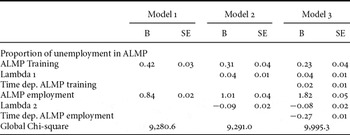
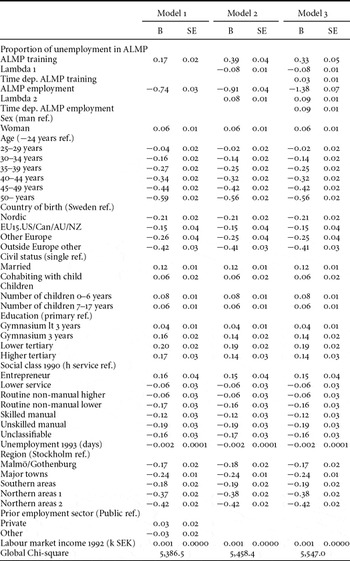
How, then, does participation in the two forms of ALMPs affect unemployment scarring? Starting with Table 1, we can see clear effects of both forms of ALMPs on the probability of reaching pre-unemployment yearly income over a ten-year period. In model 1, we can see that both forms of programmes have a strong positive overall effect on the probability, where participation in ALMP employment has a somewhat stronger effect than does participation in ALMP training. If one transforms the B-coefficients into hazard ratios, the impacts can be interpreted as about 50 per cent (ALMP training) and 100 per cent (ALMP employment) higher probability yearly, over a ten-year period, for those who participated for the entire 1993 unemployment period. This positive effect remains when introducing the selection bias control factors in model 2. The effect of ALMP training is somewhat reduced with lambda 1, indicating a selection bias into this form of ALMP that is related to higher hazards for reaching pre-unemployment incomes. For ALMP employment, the opposite is the case, with the introduction of lambda 2 substantially increasing the hazards, indicating that the selection bias into this type of ALMP is related to substantially lower hazards of reaching pre-unemployment incomes. Turning to model 3, it becomes apparent that the effects of the two different forms of ALMPs on the probability of reaching pre-unemployment incomes are not distributed equally over time. Introduction of the time-dependent variables shows some interesting effects.
Cox regression estimates on the hazards of achieving the same yearly labour market income (in 1992 prices) as the pre-unemployment year, 1994–2003

For ALMP training the original B-coefficient is reduced further while the time-dependent participation in ALMP training variable is positive. This means that the initial positive effect of ALMP training on the hazard is somewhat weaker than earlier indicated, but that this effect increases over the time period. For ALMP employment, introduction of the time-dependent variable has the opposite effect. The already strong original B coefficient is made even stronger by introduction of the time-dependent variable, whereas the time-dependent variable itself is strongly negative. This can be interpreted as follows: the initial effect of ALMP employment is extremely positive for the chances of quickly reaching pre-unemployment income levels, but this effect is reduced substantially over time. This would appear to conform to the hypothesis suggesting that investment in human capital in the form of ALMP training results in long-term and increasing advantages for participants, whereas ALMP employment has immediate positive effects, but does relatively little for the long-term competitiveness of the unemployed.
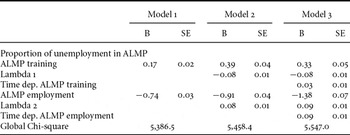
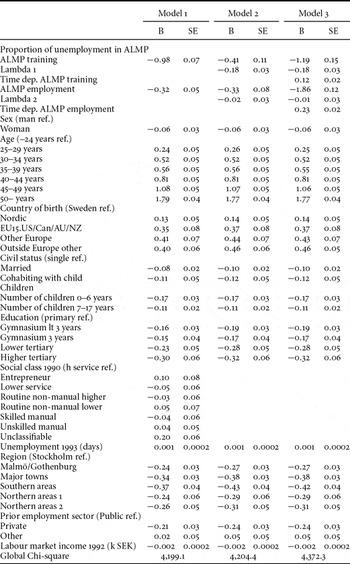
In Table 2, we turn from income effects to stability in the labour market. Here we see less clearly positive effects of ALMPs. Looking at model 1, we see a positive although not very strong effect of participation in ALMP training over the ten-year period. For ALMP employment, on the other hand, there appears to be a relatively strong negative effect. This pattern with a positive effect of ALMP training and a negative effect of ALMP employment is further accentuated in model 2 when the selection bias control factors are introduced. Lambda 1 indicates that the selection bias into ALMP training is related to lower chances of an unemployment-free year, leading us to initially underestimate the positive effect of this type of ALMP. Lambda 2 shows that the selection bias into ALMP employment is related to better chances of an unemployment-free year, and the negative effect of ALMP employment is thus further increased when this is taken into account.
Cox regression estimates on the hazards of having an unemployment-free year 1994–2003

Looking at how these effects are distributed over time with the entry of the time-dependent variables in model 3, we find that the effect of ALMP training is decreased somewhat but remains positive and that it increases over time. The effect of ALMP training on employment stability thus appears to conform to what was hypothesised. For ALMP employment, the originally strongly negative variable becomes even stronger with the entry of the time-dependent variable, while the time-dependent variable is positive. The negative effect of this form of ALMP on the hazards for an unemployment-free year is thus very strong initially, but reduced over time. A possible cause for this effect distribution could be that most re-employment from this form of ALMP would happen within the organisation where employment has been subsidised. In this case, there would be very little incentive for the organisation to cut short subsidisation for a regular employment contract or self-sufficiency as an entrepreneur, while the possibility of continued subsidisation might be an attractive option to explore for both individuals and organisations.
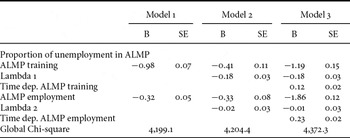
Turning to Table 3, the impact of participation in ALMPs on the probability of labour market exit is investigated. What should be noted when reading this table is that the direction of the dependent variable is opposite to that of the two previous variables, and that negative coefficients thus represent the desired outcome (a reduction in the risk of leaving the labour market). Here, model 1 shows very strong negative effects of ALMP training, while there is a less marked negative effect of ALMP employment. Thus, participation in ALMPs, and particularly in training, is related to reduced hazards of labour market exit during the ten-year period. Introducing the selection bias control factors in model 2, however, substantially decreases the effect of ALMP training. The introduction of lambda 1 halves the effect of ALMP training, although the negative effect still remains relatively strong. The selection bias into ALMP training is thus strongly related to low hazards of leaving the labour market, leading to the initial overestimation of the effect for the substantial variable. Lambda 2 virtually has no effect and the initial negative effect of ALMP employment remains.
Cox regression estimates on the hazards of leaving the labour market 1994–2003

In model 3, the time-dependent variables are positive, and entering them strengthens the effect of the ALMP variables, especially for ALMP employment, which was initially found to have the smaller effect. The distribution of the effects over time is thus similar for both forms of ALMPs, with initially very strong effects that are reduced over the time period. For ALMP employment, the size of the effects taken together indicates that the strong initial effect disappears relatively quickly and for the late years of the study actually becomes positive, creating the small overall negative effect found in models 1 and 2. For ALMP training, on the other hand, the initial effect is quite strong and the reduction over time much smaller, leading to negative effects also for the last years of the period. These findings would yet again seem to support the hypothesis and emphasise the longer-term effects of human capital investment in the form ALMP training.
Conclusions
Previous studies on the impact of active labour market policies on unemployment scarring have produced mixed results, showing both positive and negative overall effects. In most cases, these studies have had a short- to medium-term perspective on outcomes and primarily focused on particular programmes. In the present article, we have argued that conclusions about the effects of ALMPs must be analysed more as a whole, while taking into account the differences between different forms of ALMPs, and that investments in ALMPs are human capital investments, and as such need to be evaluated from a longer-term perspective in order to assess their effects properly. It has also been argued that two main forms of ALMPs – ALMP training and ALMP employment – represent different types of human capital investment, which should produce effects that are differently distributed over time. Here, our hypothesis was that the effect of ALMP employment would be immediate, with the positive effect declining over time, while the effect of ALMP training would be lower, but stable or increasing over time.
In this article, we have tried to analyse the impact of ALMP training and ALMP employment in such a manner, looking at the ten-year effects on the probability of reaching pre-unemployment incomes, the probability of having an unemployment-free year, and the probability of completely leaving the labour market. The analyses did show clear positive effects of both types of ALMPs on the probability of reaching previous income levels, a positive impact of ALMP training, but a negative effect of ALMP employment on the probability of having an unemployment-free year and a reduction in the risk of labour market exits for both forms. Looking at how the effects associated with the two forms of ALMPs were distributed over time lent support to our hypothesis about differential effects. For ALMP training, which represents more long-term human capital investment, the probability of reaching pre-unemployment incomes increased over time, for employment stability the trend was the same, while reduction in the risk of labour market exit was initially very high, with a slow decrease over time. For ALMP employment, there was initially a very strong effect on the probability of reaching pre-unemployment incomes, which disappeared over time, while this pattern was the same (although even more marked) for reduction in the risk of labour market exit.
Thus, on the basis of these findings, we can conclude that there are positive effects of active labour market policy measures on unemployment scarring and that these effects do look very different for the two different forms of human capital investment represented by ALMP training and ALMP employment. In many ways, these two forms represent two different options that could fulfill different purposes and be useful in different business cycle contexts or for different groups of unemployed. ALMP training produces longer-term advantages in the form of increased competitiveness and staying power in the labour market. A central factor for its effectiveness is, of course, the quality and duration of the training and education provided, although the very positive results found in this study were obtained in a situation where the quality was probably comparatively low. ALMP employment, in turn, does appear to be able to produce some impressive immediate positive effects, while the longer-term effects are more doubtful. This might be a useful tool for some groups in the labour market as well as in specific labour market conditions where a quick unemployment exit is feasible. A central factor allowing ALMP employment to have these effects is probably that it takes place in the regular labour market, which of course is problematic from the point of view of displacement effects.
These findings on the long-term effects of involvement in different forms of ALMPs also open some interesting avenues for future research. One issue is the question of the effects of ALMPs in different parts of the business cycle. This study was conducted using an unemployed sample taken during very poor labour market conditions. In one way, this made it the hardest possible test, as the quality of ALMPs during this time period was most likely relatively low. On the other hand, it is possible that during better labour market conditions ALMPs are not important in maintaining human capital in the same way, because there are better labour market prospects anyway, which could substantially reduce the effects of ALMPs on unemployment scarring. Another central issue is whether ALMPs in general, and the two forms of ALMPs, have the same impact on different groups of unemployed. The stock of unemployed is at any given time a relatively heterogeneous group. In this article, we have tried to accommodate this by holding that constant, but these differences could very well mean that ALMPs have a varying impact on different unemployed individuals. For example, it is possible that unemployed with tertiary education are differently affected by participation in ALMPs than are unemployed with low or vocational education. The labour market for the highly educated is more related to evidence of formal education, something that generally is not provided in ALMP training. This could lead to involvement in ALMP training having no or a negative effect for the better educated, and a positive effect for other educational groups. Finally, there is also a need for comparative research on unemployment scarring that would help us understand how the institutions in different labour market regimes – most importantly ALMPs, unemployment transfers and labour law – shape the long-term impact of unemployment experiences.
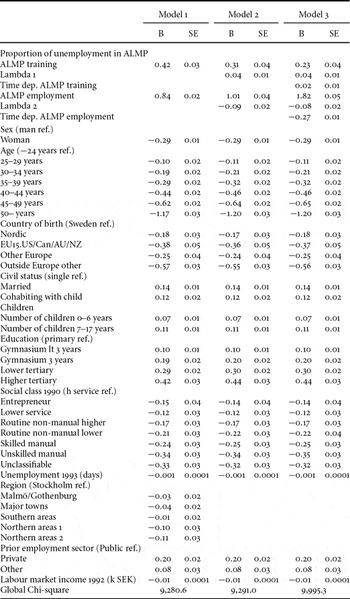
Appendix: Full versions of Tables 1 to 3 and logistic regression estimates (log odds) on the probability of participating in ALMP training and ALMP employment
Cox regression estimates on the hazards of achieving the same yearly labour market income (in 1992 prices) as the pre-unemployment year, 1994–2003

Cox regression estimates on the hazards of having an unemployment- free year 1994–2003

Cox regression estimates on the hazards of leaving the labour market 1994–2003

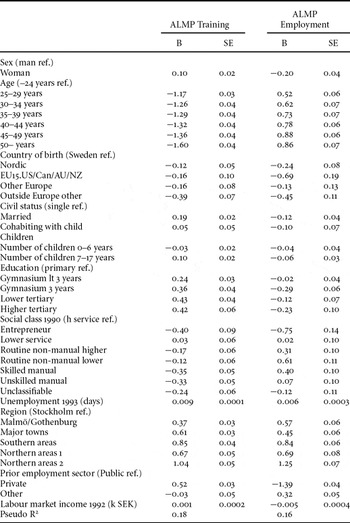
Logistic regression estimates (log odds) on the probability of participating in ALMP-training and ALMP-employment