Attachment refers to an individual's adaptation to the early caregiving environment, and forms a basis for the infant's sense of self, others and the world (Bowlby, Reference Bowlby1999/1969). Maternal substance use represents a risk in the development of infants’ attachment for various reasons. First, prenatal substance exposure directly affects children's health and neurodevelopmental regulatory capacities (for a review, see Minnes, Lang, & Singer, Reference McHugh, Wigderson and Greenfield2011), which posits challenges to caregiving. Second, substance-using mothers face multiple vulnerabilities, such as physical and mental health problems, and lack of social support (Conners et al., Reference Coles and Platzman2004; Kaltenbach, Reference Jüni, Witschi, Bloch and Egger2013), that are also likely to influence their caregiving capacities. These cumulative risks among substance-using mothers and their children affect infants’ developing attachment. An earlier descriptive review by Parolin and Simonelli (Reference Out, Bakermans-Kranenburg and van IJzendoorn2016) shows inconsistencies in results on how maternal substance use is associated with the security and disorganization of children's attachment behavior. Furthermore, they did not evaluate the evidence quantitatively, nor assess potential factors that moderate or mediate this association. Given that maternal substance use may have harmful consequences on children's attachment both directly and indirectly, there is a need to systematically evaluate the previous literature. Therefore, we conducted a systematic review and meta-analysis regarding the association between maternal substance use and attachment security and disorganization in young children, as well as potential moderating and mediating factors underlying this association. The focus was on children under school age because starting school may introduce changes in children's attachment relationships.
Patterns of attachment
Attachment behavior is conceptualized as an evolutionary-based tendency in infants and young children that drives them to maintain proximity to their primary caregiver (Bowlby, Reference Bowlby1999/1969). In the ideal case, a child uses his/her caregiver as a secure base that provides feelings of security, thus rendering the capacity for exploration and learning, and as a safe haven that provides comfort when under distress. Attachment behavior is accompanied by the organization of internal working models (IWMs) about self and others that continue to guide perceptions and behavior in subsequent close relationships. Within the caregiver–infant dyad, infants adapt their IWMs and the associated emotional, cognitive, and behavioral patterns to the recurring interactive style of their parents, which highlights the reciprocal nature of attachment (Marvin, Britner, & Russell, Reference Main, Solomon, Yogman and Brazelton2016).
Ainsworth, Blehar, Waters, and Wall (Reference Ainsworth, Blehar, Waters and Wall2015/1978) identified three attachment patterns to describe how infants’ IWMs of the caregiver provide means to maintain sense of security under distress. These include secure (B), insecure-avoidant (A), and insecure-ambivalent/resistant (C) patterns of attachment. From an evolutionary perspective, each pattern represents an adaptation to a specific caregiving environment (Simpson & Belsky, Reference Simon2016). A secure attachment develops under a responsive caregiving environment where children freely explore the environment under low stress and when distressed, they seek comfort from the mother and are easily soothed (Ainsworth et al., Reference Ainsworth, Blehar, Waters and Wall2015/1978). On the contrary, insecure patterns are thought to develop when the caregiver is unresponsive, rejecting, or inconsistent. Thus, insecurely attached children show an emotional distance to the mother, with a focus on independent coping (pattern A), or high conflict and oscillation between seeking and resisting contact with the mother (pattern C).
Later, a fourth, disorganized (D) attachment pattern was added to describe children with conflicted, disoriented, and fearful behaviors towards the caregiver (Main & Solomon, Reference Main, Solomon, Yogman and Brazelton1986). According to Main and Hesse (Reference Madigan, Moran and Pederson1990), the pattern may originate from situations, where the caregiver is both the source of distress and at the same time the only possible source of comfort. However, related empirical evidence is still not well established (Reijman, Foster, & Duschinsky, Reference Pigott and Polanin2018). Studies suggest that several kinds of disrupted caregiving behaviors, such as affective communication errors, disoriented and frightening/frightened behaviors, and the use of extremely incompatible caregiving strategies, could lead to children's disorganized attachment (Granqvist et al., Reference Goodman, Hans and Cox2017; Lyons-Ruth, Bronfman, & Parsons, Reference Lyons-Ruth, Bronfman, Parsons, Vondra and Barnett1999).; Madigan, Moran, & Pederson, Reference Lyons-Ruth, Bronfman, Parsons, Vondra and Barnett2006). Out, Bakermans-Kranenburg, and van IJzendoorn (Reference Oppenheim2009) further distinguished disoriented and extremely insensitive parenting and suggested that disoriented parenting especially may contribute to the development of disorganized attachment. These differences related to caregiving environment are essential in understanding the development of attachment in children born to substance-using mothers.
Maternal substance use and its effects on child development
Substance use refers to “the consumption of any psychoactive substance, including alcohol, nicotine and illicit drugs, and non-medical use of prescription drugs” (McHugh, Wigderson, & Greenfield, Reference McCullough2014, p. 15). Maternal substance use is a worldwide problem affecting not only mothers’ health but also the development of children both pre- and postnatally. Prevalence estimates of maternal pre- and postnatal substance use vary across countries depending on both cultural differences and measures used. The most commonly used substance during pregnancy is tobacco, with rates varying between 6% and 22% in high-income countries (Nichter et al., 2010). In the United States, estimates on the prevalence of past month alcohol and illicit drugs (e.g., marijuana, opioids, and cocaine) during pregnancy are 9.9% for alcohol, 4.7% for marijuana, and 0.9% for opioids, with the prevalence of cocaine missing due to low precision (SAMHSA, Reference Sameroff2018). Later parental substance use is also common: 12.3% of American children aged 17 or younger are living with at least one parent with substance use disorder (SUD; Lipari & Van Horn, Reference Lin, Ostlund, Conradt, Lagasse and Lester2017). It is noteworthy that substance use is often under-reported due to social stigma and difficulties in seeking help typical for substance-users. Moreover, SUD is a severe psychiatric disorder that does not include milder forms of substance use. Therefore, it is likely that the prevalence estimates of parental SUD omit a remarkable number of children living with substance-using parents.
It is generally acknowledged that both pre- and postnatal adversities shape infants’ biological and developmental systems that later affect children's health and behavior (e.g., Hertzman, Reference Hartung and Knapp2012). This implies that to understand the development of attachment in children of substance-using mothers, we need to consider multiple underlying factors that occur in pre- and postnatal periods. In this study, we conceptualize these factors with five different theoretical models (along the lines of Coles & Platzman, Reference Cohen1993): (a) Toxic model implies that prenatal substance use affects the mother physically, for example causing neural damage, which indirectly leads to developmental defects in the infant. (b) Teratogenic model highlights the direct damage to the fetus through placenta caused by maternal substance use during pregnancy. (c) Maternal functioning model assumes child outcomes are the result of maternal characteristics, such as caregiving qualities and mental health. (d) Sociological model puts an emphasis on social factors, for example, mother's social support and socioeconomic status, which are often problematic among substance-using mothers. Finally, (e) interactive model explains the effects of maternal substance use on child development through the interaction of multiple factors. Below, we discuss these models in more detail.
Factors linking maternal substance use and child attachment
Toxic
Maternal substance use is often associated with insecure attachment in children, and especially heightened prevalence of the disorganized pattern (for a review, see Salo & Flykt, Reference Rutherford, Williams, Moy, Mayes and Johns2013). This could partly be understood by toxic factors that, in the context of child attachment, rely on the neural circuits that occupy both addiction and caregiving behavior. Among substance-using mothers, a reduced neural activation has been found as compared to non-using mothers, in brain regions associated with reward, motivation, and cognitive control in response to infants’ communication cues (Kim et al., Reference Kettinger, Nair and Schuler2017; Landi et al., Reference Kuppens, Moore, Gross, Lowthian and Siddaway2011, Reference Landi, Montoya, Kober, Rutherford, Mencl, Worhunsky and Mayes2013). Findings suggest that this reduced neural activation associated with substance use alters the functioning of the caregiving system (Rutherford, Maupin, Landi, Potenza, & Mayes, Reference Rodning, Beckwith and Howard2017; Rutherford, Williams, Moy, Mayes, & Johns, Reference Rutherford and Mayes2011). Therefore, substance-using mothers may be less responsive to infants’ communication cues than non-using mothers and experience less reward and increased stress in interactions with their infants (the reward–stress dysregulation model of addiction; Rutherford & Mayes, Reference Rutherford, Maupin, Landi, Potenza and Mayes2017). This could predispose children to develop insecure attachment, but comprehensive understanding on these underlying toxic factors is currently missing.
Teratogenic
Prenatal exposure to alcohol and other substances, including tobacco, stimulants, and opioids, is known to cause pregnancy and birth defects, physical retardation, and central nervous system dysfunction in the fetus and the newborn (Minnes et al., Reference McHugh, Wigderson and Greenfield2011; Riley, Alejandra Infante, & Warren, Reference Reijman, Foster and Duschinsky2011). Later, impairments in children's cognitive and behavioral development are also detected (Behnke & Smith, Reference Beeghly and Tronick2013; Minnes et al., Reference McHugh, Wigderson and Greenfield2011). It is possible that these teratogenic effects could also play a role for children's attachment, for example, through regulation difficulties. Substance-exposed infants typically show high irritability and difficulty to soothe (Lin, Ostlund, Conradt, Lagasse, & Lester, Reference Liberati, Altman, Tetzlaff, Mulrow, Gøtzsche, Ioannidis and Moher2018), as well as less clear interactive cues towards their mother as compared to non-exposed infants (Minnes, Singer, Arendt, & Satayathum, Reference Minnes, Lang and Singer2005). In the early literature, teratogenic effects are proposed to transfer to child attachment through the caregiving environment (Beeghly & Tronick, Reference Beeghly, Frank, Rose-Jacobs, Cabral and Tronick1994), and some authors have found infants’ lower orientation and emotion regulation to be associated with disorganized attachment (Sprangler, Fremmer-Bombik, & Grossmann, Reference Siqveland and Moe1996). Therefore, maternal functioning seems to play a significant role in transferring also teratogenic effects into child attachment.
Maternal functioning
According to the maternal functioning model, the pathway from maternal substance use to children's attachment is proposed to occur mainly via experiences with the attachment figure. Several studies show, first, difficulties in dyadic interaction between substance-using mothers and their children as compared to non-using mothers, such as lower sensitivity and responsiveness (Konijnenberg, Sarfi, & Melinder, Reference Konijnenberg2016; Minnes et al., Reference Minnes, Lang and Singer2005) and higher hostility and intrusiveness (Belt et al., Reference Behnke and Smith2012; Mansoor et al., Reference Mansoor, Morrow, Accornero, Xue, Johnson, Anthony and Bandstra2012). Second, mental health problems (Jané-Llopis & Matytsina, Reference IntHout, Ioannidis and Borm2006) as well as traumatic experiences (Granqvist et al., Reference Goodman, Hans and Cox2017) that often affect caregiving and may lead to infants’ insecure or disorganized attachment are common among substance-using mothers. In sum, theory and empirical evidence emphasizes the importance of maternal functioning in the development of child attachment; however, a systematic review of these factors is currently missing in the maternal substance-use literature.
Sociological
Despite the importance of the caregiving environment in children's attachment development, numerous studies have suggested that substance use does not directly implicate poorer quality of caregiving. Instead, in line with the sociological model, substance use is linked with higher environmental adversities and cumulative risk factors, such as larger family size, mothers’ lower socioeconomic status (SES), and lack of social support (Kettinger, Nair, & Schuler, Reference Kelly2000; Suchman, McMahon, Slade, & Luthar, Reference Suchman, DeCoste, McMahon, Dalton, Mayes and Borelli2005), as well as involvement of child protective services (Canfield, Radcliffe, Marlow, Boreham, & Gilchrist, Reference Canfield, Radcliffe, Marlow, Boreham and Gilchrist2017). In meta-analytic evidence, the accumulation of socioeconomic risks is related to increased child attachment disorganization (Cyr, Euser, Bakermans-Kranenburg, & van IJzendoorn, Reference Conners, Bradley, Mansell, Liu, Roberts, Burgdorf and Herrell2010).
Interactive
Finally, as the interactive model proposes, it seems likely that children's attachment within the context of mother's substance use is shaped by multiple interacting and accumulating factors. Substance-using mothers with more cumulative environmental risks experience more parenting stress, thus exposing their children to poor parenting, and even to risk of child maltreatment and neglect (Nair, Schuler, Black, Kettinger, & Harrington, Reference Motyl, Demos, Carsel, Hanson, Melton, Mueller and Skitka2003). Furthermore, the accumulation of adversities along with caregiving problems may predispose substance-using mothers to invest less in their offspring (Simpson & Belsky, Reference Simon2016), thus potentially giving rise to the development of children's insecure attachment. Despite this recognition, and the empirical and theoretical findings presented above, to date, we are still lacking a comprehensive and systematic evaluation of the association of maternal substance use and children's attachment, as well as its’ underlying moderators and mediators that occur in pre- and postnatal environments.
Study aims
The aim of this study is to systematically evaluate the existing evidence of the association between maternal substance use and attachment in young children under 6 years of age. We addressed this aim with two research questions: First, how is maternal pre- and postnatal substance use associated with secure and disorganized attachment in young children? To answer this, we composed two separate meta-analysis of attachment security and disorganization. Second, what are the potential factors moderating or mediating the association between maternal pre- and postnatal substance use and attachment in young children? We evaluated these factors with a systematic review.
Method
Protocol and registration
The study protocol was specified in advance and submitted to PROSPERO (registration number #CRD42019138218) on 7 June 2019 and registered on 9 August 2019. We made an amendment to the protocol on 14 October 2019. We followed the PRISMA (Preferred Reporting Items for Systematic reviews and Meta-Analysis; Liberati et al., Reference Landis and Koch2009) Statement in reporting this systematic review and meta-analysis. All materials related to the work can be found at https://osf.io/ukv2c/.
Eligibility criteria and outcomes of interest
Eligible studies were written in English (selected at the database search phase), quantitative, and used cross-sectional, case-control, cohort, correlational, longitudinal, or retrospective study design. Studies were eligible for inclusion if participants included (a) children under 6 years of age, (b) biological mothers with pre- or postnatal substance use either receiving treatment or without treatment (substances included were alcohol, tobacco, cannabinoids, opioids, stimulants, and misuse of prescription drugs), and (c) foster / adoptive mothers if child's prenatal substance-exposure was known.
We examined three different outcomes. Concerning the first research question, we were interested in, first, the security of children's attachment. It was operationalized either as attachment distribution of secure (B) versus insecure (AC or ACD) patterns measured with observational tools, such as the Strange Situation Procedure (SSP; Ainsworth et al., Reference Abrams, Rifkin and Hesse2015/1978), or as a continuous variable of security measured with observer- or mother-reported Attachment Q-Sort (AQS; Waters & Deane, Reference Wan and Green1985). We also searched literature using representational attachment measures, for example, the Attachment Doll-play Interview (ADI; Oppenheim, Reference O'Connor, Sigman and Kasari1997), but none meeting other study criterion were found. Secondly, we were interested in the disorganized (D) versus organized (ABC) patterns of children's attachment measured with the same observational tools as security. Thirdly, concerning our second research question, we identified variables tested as moderating and mediating factors between maternal substance use and children's attachment. Along the lines of Coles and Platzman (Reference Cohen1993), we conceptualized these as toxic, teratogenic, maternal functioning, sociological, and interactive factors.
Search and study selection
The search was conducted on 26 June 2019 after the first protocol version had been submitted to PROSPERO. We conducted the search using the following electronic databases: MEDLINE (PubMed interface, 1966 onwards), PsycINFO (Ovid interface, 1806 onwards), Scopus (Elsevier interface, 1960 onwards), Web of Science (all databases, 1950 onwards), and The Cochrane Central Register of Controlled Trials (CENTRAL; Cochrane library). We scanned the reference lists of relevant reviews, included studies and other sources. We re-ran the search on 19 May 2020 finding 72 new studies out of which none met our inclusion criteria. After the re-run, we also found a published study of a conference abstract, which resulted in the exclusion of both because not all inclusion criteria were met.
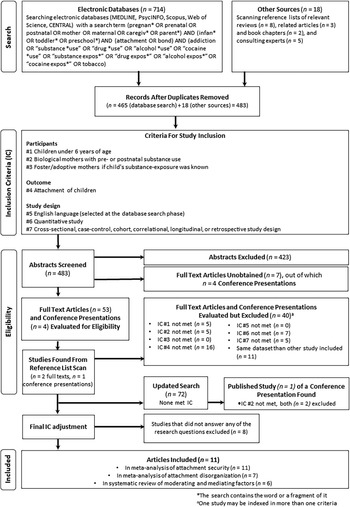
We searched the literature across title, abstract, and keywords with search terms related to pregnancy, infant, attachment, and addiction (see full search term in Figure 1). The first review author screened all titles and abstracts found with the search strategy and the second review author screened 23% (n = 112) of them. The same authors independently evaluated the eligibility of studies and their inclusion in the meta-analysis and systematic review. We calculated agreement between authors with Cohen's kappa that corrects for chance agreement (Cohen, Reference Cicchetti, Rogosch and Toth1960; Gisev, Bell, & Chen, Reference Gautam, Warner, Kan and Sowell2013). Kappa was .71 on the screening level and .68 on the eligibility level, indicating substantial agreement (Landis & Koch, Reference Landi, Montoya, Kober, Rutherford, Mencl, Worhunsky and Mayes1977). All disagreements were solved by consensus.
Flow of information in the systematic review and meta-analysis.

Data collection process and data items
We used a data extraction sheet prepared in advance. Extracted information included: authors, year of publication, peer-review status, study design, characteristics of the substance-use group, and the comparison group (sample size, mean age, country, race, SES, recruitment place, substance use profile), measure of substance use (self-report, biological specimen, registry information, or other), child mean age, measure and patterns of attachment, moderating/mediating factors and main results. For meta-analytical purposes, we extracted information required for effect size calculations. The first two authors conducted data extraction independently and resolved disagreements with consensus. Six studies (two with the same author) reported insufficient information to decide about eligibility or to extract required statistical information. In those cases, we contacted study authors by email and received three replies with additional information. As a result, we were able to include one of the studies (the remaining two did not eventually meet our inclusion criteria).
Agreement between coders was calculated for nine studies as the first two were used for training. Mean kappa for categorical variables was .79 (range .00–1.00) indicating substantial agreement (Landis & Koch, Reference Landi, Montoya, Kober, Rutherford, Mencl, Worhunsky and Mayes1977). Kappa value of .00 derived from zero variability of an item in one author's codes. Intraclass correlation for continuous variables was 1.00 for the total sample size indicating excellent agreement, but poor (.17) for the sample size of the substance-using group (Koo & Li, Reference Konijnenberg, Sarfi and Melinder2016). Poor agreement derived from one study where the other author combined original study groups that did not differ in maternal substance use and the other coded groups separately, and from another study where authors interpreted sample size differently. Percentage agreement was used in cases where the value of a variable varied between continuous, a range, qualitative, not applicable or missing. Mean percentage agreement was .87 (range .78–1.00).
Summary measures
Correlation coefficient (r) was the primary effect size measure of the strength of an association between maternal substance use and children's attachment. We used Fisher's Z transformation of r (Zr) to correct for methodological features of primary studies. If a study did not report direct correlation between variables of interest, we calculated correlations from frequencies or sample means and standard deviations with an online calculator (Lipsey & Wilson, Reference Lipari and Van Horn2001). One study reported three effect sizes concerning the association of maternal substance use and children's attachment security (O'Connor, Sigman, & Kasari, Reference O'Connor, Sigman and Brill1992). In this case, we used an averaged effect size to deal with the dependence of effect sizes (Card, Reference Canfield, Radcliffe, Marlow, Boreham and Gilchrist2012). One study provided an effect size at two time points (at 18 and 36 months of child's age; Seifer et al., Reference Schindler and Bröning2004). In this case, we chose the first time point to ensure the inclusion of the whole sample and to have uniformity in the attachment measures. Finally, each study in the meta-analysis provided one effect size estimate for attachment security and seven of those studies also another estimate for attachment disorganization.
Synthesis of results
Quantitative synthesis
We expected studies to be derived from different populations, and thus performed a random-effects meta-analysis with R software (version 4.0.0). We followed the guidelines presented by Harrer, Cuijpers, Furukawa, and Ebert (Reference Haltigan, Lambert, Seifer, Ekas, Bauer and Messinger2019) to answer the first research question concerning separately attachment security and disorganization. We used the Hartung–Knapp–Sidik–Jonkman (HKSJ) method to estimate the variance of true effect sizes (τ2) because it is more conservative (i.e., lower Type I error rate) than the traditionally used DerSimonian Laird (DL) method (Hartung & Knapp, Reference Harrer, Cuijpers, Furukawa and Ebert2001; IntHout, Ioannidis, & Borm, Reference Higgins and Thompson2014). We searched for outlier studies by inspecting the forest plot and identified influential studies with an influence analysis. We tested statistical heterogeneity by calculating a statistic Q and I 2 statistic. We used the Cochrane guidelines in the interpretation of I 2 statistic (Deeks, Higgins, & Altman, Reference Deeks, Higgins, Altman, Higgins, Thomas, Chandler, Cumpston, Li, Page and Welch2021). If high levels of heterogeneity (p < .1 or I 2 ≥ 50%) existed, we planned to perform subgroup or sensitivity analysis to explain the source of heterogeneity. It should be noted that these statistics often underestimate heterogeneity in small sets of studies (Deeks et al., Reference Deeks, Higgins, Altman, Higgins, Thomas, Chandler, Cumpston, Li, Page and Welch2021), and therefore we also assessed the risk of bias within each study as presented below.
Qualitative synthesis
Concerning our second research question on moderators and mediators, we specified a moderator as an interaction term, that is, a variable that affects the direction or strength of the association between maternal substance use and children's attachment. We specified a mediator as a variable that is affected by maternal substance use and that, in turn, affects children's attachment. We had pre-specified that each subset should include more than three studies for us to be able to perform a moderator analysis (Bakermans-Kranenburg, van IJzendoorn, & Juffer, Reference Bakermans-Kranenburg, van IJzendoorn and Juffer2003). We did not find enough evidence for any single moderator or mediator, and therefore synthesized those results qualitatively.
Additional analysis
We performed an additional analysis on the association of maternal prenatal substance use and the security of children's attachment. The analysis strategy followed the main analysis. A separate quantitative analysis of postnatal substance use was not possible due to insufficient number of studies (n = 2) focusing only on postnatal use. Thus, in the results, by maternal substance use we mean both pre- and postnatal use if not specified.
Risk of bias
Within studies
Risk of bias within studies was evaluated with the Quality Assessment Tool for Observational Cohort and Cross-Sectional Studies (National Heart Lung and Blood Institute, Reference Nair, Schuler, Black, Kettinger and Harrington2014). The tool includes 14 criteria, and for each criterion, an evaluation of yes / no / other (cannot determine, not applicable, not reported) is made (Supplementary Table 1). We used 12 of these criteria, leaving out Items 10 and 13 that concern a follow-up component not applicable to our research questions. The first two review authors independently assessed the risk of bias with moderate agreement (mean κ = .54 [range −.06–1.00] calculated from nine studies as the first two were used for training of the tool). An exception was Item 5 (Was a sample size justification, power description, or variance and effect estimates provided?) with poor agreement (κ = −.06) deriving from limited variability in the codes (i.e., all except one study was coded as no; Simon, Reference Shurell2006). We assessed risk of bias qualitatively within and across studies without creating a summary score because it can lead to biased evaluations (Jüni, Witschi, Bloch, & Egger, Reference Jané-Llopis and Matytsina1999; Liberati et al., Reference Landis and Koch2009).
Across studies
We assessed publication bias across studies with a funnel plot and Egger's test of funnel plot asymmetry.
Results
Study selection
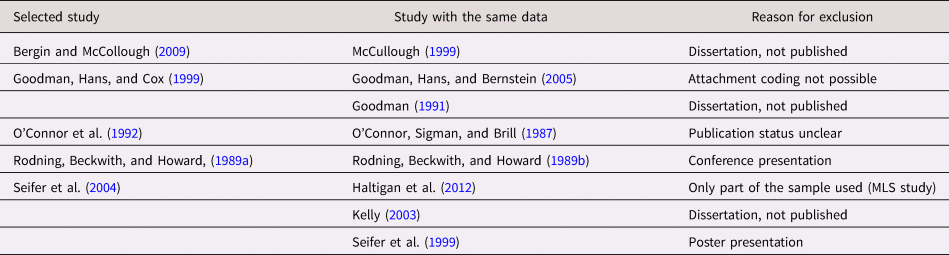
A total of 714 studies were identified by the search strategy and 18 studies from other sources (Figure 1). After removal of duplicates, 483 abstracts were screened, and based on screening, 53 full-text articles, four conference presentations and three additional studies found from reference list scans were assessed for inclusion. Finally, 19 studies met our initial inclusion criteria, but eight of them did not answer to either research question, because effect size calculations were not possible due to a missing comparison group of non-using mothers and moderating or mediating effects were not examined. Therefore, 11 studies (nine peer-reviewed) were finally included in the meta-analysis of attachment security. Out of those studies, seven (six peer-reviewed) were further included in the meta-analysis of attachment disorganization. Six studies assessed moderating or mediating effects. Several studies used the same sample, and in these cases, we included only one study to represent a specific sample (list of the same sample studies and selection criteria found at Appendix).
Study characteristics
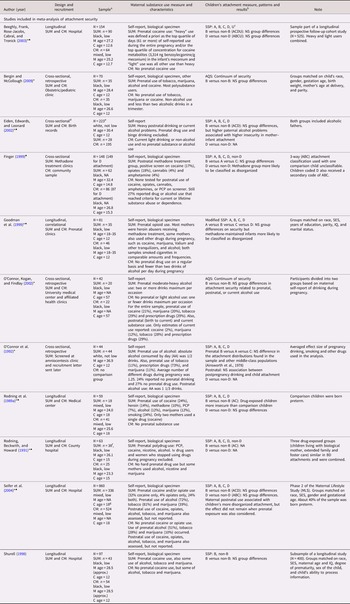
The main study characteristics are summarized in Table 1. The total number of participants was 1,841 in the meta-analysis of attachment security, 1,589 in the meta-analysis of attachment disorganization, and 1,404 in the systematic review. Sample sizes ranged from 42 to 860. Participants were recruited from hospital (36%), health clinics (45%), substance-abuse treatment (9%), or birth records (9%). Most studies (91%) included polysubstance-using mothers. Seven (64%) studies included in the meta-analysis of attachment security and five (71%) in the meta-analysis of attachment disorganization had a comparison group that was not completely free from substance use. Across all studies, majority focused on maternal prenatal substance use, with three studies assessing both pre- and postnatal use (O'Connor et al., Reference Nichter, Greaves, Bloch, Paglia, Scarinci, Tolosa and Novotny2002; O'Connor et al., Reference O'Connor, Sigman and Brill1992; Seifer et al., Reference Schindler and Bröning2004) and two studies assessing only postnatal substance use (Eiden et al., Reference Delker, Kim and Fisher2002; Finger, Reference Ellis, Boyce, Belsky, Bakermans-Kranenburg and van IJzendoorn1999). Participating children were mostly 12–24 months old, with one exception of 57 month-old children (O'Connor et al., Reference Nichter, Greaves, Bloch, Paglia, Scarinci, Tolosa and Novotny2002). All studies were conducted in a North American population.
Study characteristics

Note. *Peer-reviewed. ▴Included in meta-analysis of attachment disorganization.
SUM = substance-using mothers; CM = comparison mothers; SSP = Strange Situation Procedure; AQS = Attachment Q-Sort; A = avoidant; B = secure; non-B = insecure; C = resistant/ambivalent; D = disorganized; non-D = organized; U = insecure–other; NA = not available; NS = not significant.
a Characteristics reported for each sample in the following order: sample size, group size, race (white/black/mixed), socioeconomic status (low/not low/mixed), mother mean age in years (M age), child mean age in months (C age).
b Results reported for the associations of maternal substance use and secure versus insecure and, if studied, disorganized versus organized patterns. If the study did not statistically assess group differences on attachment, result is reported as NA.
c Four children in the substance-exposed group who were judged to be insecure but whose behavior could not be classified as avoidant, resistant, or disorganized were classified as insecure–other.
d Part of a longitudinal study but relevant data cross-sectional.
e Data used for this meta-analysis received from the author and combining study groups differed in the original publication (nonalcoholic vs. alcoholic father vs. alcoholic father + heavy drinking mother) and in this meta-analysis (nonalcoholic + alcoholic father vs. alcoholic mother + both alcoholic). Thus, characteristics are only available for the whole sample.
f Substance-use group size reported as n = 39 in the text, but n = 38 in the results.
g Attachment was also assessed at 36 months, but only the first assessment was included in the meta-analysis to ensure the inclusion of the whole sample and the uniformity of attachment measures.
Synthesis of results
Attachment security
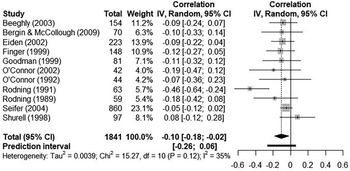
We found a significant pooled effect size of r = −.10 (95% CI [−.18, −.02], p = .018) concerning the association of maternal substance use and child attachment security (Figure 2). Maternal substance use was thus associated with insecure attachment of children, although the effect was small. The prediction interval, which estimates the range of an effect that will be observed in 95% of future studies, was from −.26 to .06. This indicates uncertainty in the significant result, even though heterogeneity among studies was only low to moderate (Q = 15.27, p = .123; I 2 = 35%). By inspection of the forest plot (Figure 2) and searching for outliers, we identified Rodning et al. (Reference Rodning, Beckwith and Howard1991) as an outlier study because the confidence interval of the study did not overlap with the confidence interval of the pooled effect size. With influence analysis, the same study was detected as contributing to the overall heterogeneity (Supplementary Figures 1 and 2). When removing this study from the pooling, the overall effect size became r = −.07 (95% CI [−.11, −.03], p = .003) with a prediction interval from −.11 to −.03 (Supplementary Figure 3). The effect size decreased but remained significant. However, the prediction interval was now narrower and below zero showing more precision in the estimate. Furthermore, the overall heterogeneity among studies was now reduced to very low (Q = 4.43, p = .881, I 2 = 0%).
Forest plot of child attachment security (n = 11).

When quantitatively assessing studies including only maternal prenatal substance use (k = 9, N = 1,470), we found a marginally significant pooled effect size of r = −.11 (95% CI [−.22, .00], p = .054) with a prediction interval from −.34 to .13 (Supplementary Figure 4). Heterogeneity among studies was moderate (Q = 15.07, p = .058, I 2 = 47%). As can be observed, uncertainty in the result increased when assessing only prenatal substance use compared to both pre- and postnatal use, partly due to increased heterogeneity among studies. However, the result was in the same direction as the overall result encompassing both pre- and postnatal use.
Attachment disorganization
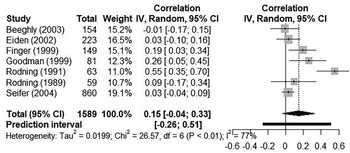
We found a nonsignificant pooled effect size of r = .15 (95% CI [−.04, .33], p = .101) concerning the association of maternal substance use and children's attachment disorganization (Figure 3). However, the prediction interval ranged from −.26 to .51 showing large uncertainty in the effect, and it is possible that the small number of existing studies was not sufficient to detect a true effect if it existed. Moreover, heterogeneity among studies was substantial (Q = 26.57, p = .000, I 2 = 77%), and there was a visible pattern of one study (Rodning et al., Reference Rodning, Beckwith and Howard1991) yielding a large positive effect, two studies (Finger, Reference Ellis, Boyce, Belsky, Bakermans-Kranenburg and van IJzendoorn1999; Goodman et al., Reference Goodman, Hans and Bernstein1999) a medium positive effect, three studies (Eiden et al., Reference Delker, Kim and Fisher2002; Rodning et al., Reference Riley, Alejandra Infante and Warren1989a; Seifer et al., Reference Schindler and Bröning2004) a small positive effect, and one study (Beeghly et al., Reference Beauchamp, Lowe, Schrader, Shrestha, Aragón, Moss and Bakhireva2003) a small negative effect. Generally, smaller studies showed larger effects with the exception of Rodning et al. (Reference Riley, Alejandra Infante and Warren1989a) who found a small effect with a small sample. We were not able to perform any subgroup analysis (e.g., related to different study designs) to better explain the source of heterogeneity due to insufficient number of existing studies (Higgins & Thompson, Reference Hertzman2004).
Forest plot of child attachment disorganization (n = 7).

Moderating and mediating factors
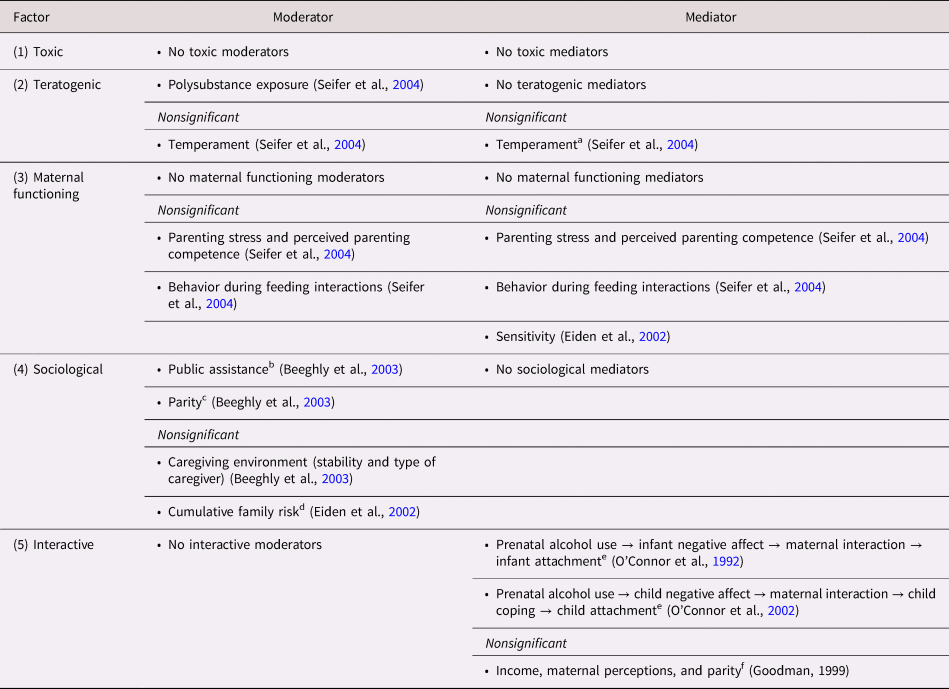
Evidence concerning moderators and mediators between maternal substance use and children's attachment was scarce. No studies assessed toxic factors. For teratogenic factors, polysubstance exposure moderated the association of maternal prenatal substance use and children's attachment in a large longitudinal sample (n = 860) of matched substance-exposed and non-exposed children (Seifer et al., Reference Schindler and Bröning2004; Table 2). Children who were exposed to both cocaine and opiates compared to only one or no substances showed higher prevalence of insecure (ACD) attachment. In the same study, infant temperament was found to be a nonsignificant moderator and mediation was not examined due to an unmet precondition (i.e., the association of maternal substance use and infant temperament was not significant).
Moderating and mediating factors between maternal substance use and attachment patterns in children

Note. All studies were included in the meta-analysis of attachment security.
a Substance exposure was not associated with temperament and, thus, the preconditions for mediation were not met.
b Attachment outcome was behavioral disorganization (on a 9-point Likert rating) that did not directly transfer to attachment disorganization.
c Attachment outcome was the level of avoidance (on a 7-point Likert rating) that did not result to avoidant pattern of attachment for most children in the sample because no main effect of prenatal substance use on children's attachment was found.
d Two risk scores were created: first included difficult infant temperament, fathers’ depression, mothers’ depression, fathers’ antisocial behavior, mothers’ antisocial behavior, fathers’ education, fathers’ aggression toward mother, mothers’ aggression toward father, fathers’ sensitivity during play, and mothers’ sensitivity during play (possible range 0 to 10), and second added parent's alcohol problems to the original risk score (possible range 0 to 12).
e Negative affect, maternal interaction (child coping in 2002 study), and attachment were concurrent measures.
f Attachment was rated on three indexes of attachment behavior: contact-maintenance, avoidance, and disorganization.
Related to maternal functioning, the existing studies found only nonsignificant moderating and mediating effects. In the same study described above (Seifer et al., Reference Schindler and Bröning2004), mother's parenting stress, perceived parenting competence, or behavior during feeding interactions did not moderate or mediate the effect of prenatal substance exposure on children's attachment (Table 2). Within a sample of predominantly middle-income, Caucasian nonalcoholic and alcoholic mothers and fathers, sensitivity did not mediate the path from maternal alcohol problems to mother–infant attachment (Eiden et al., Reference Delker, Kim and Fisher2002). However, this mediating effect was present for alcoholic fathers (n = 115), who were significantly more in number than alcoholic mothers (n = 28), suggesting that the nonsignificant effect for mothers may be partially due to sample size.
We found studies with both significant and nonsignificant sociological moderators, but no studies examining mediators. In a longitudinal study of 90 cocaine-exposed (61 light, 29 heavy) and 64 non-exposed children, families’ receipt of public assistance and mothers’ parity moderated the effect of heavy substance exposure on children's attachment (Beeghly et al., Reference Beauchamp, Lowe, Schrader, Shrestha, Aragón, Moss and Bakhireva2003; Table 2). Heavier prenatal cocaine exposure in combination with a lack of receipt (vs. receipt) of public assistance, was related to a higher level of children's behavioral disorganization. For parity, infants with heavier cocaine exposure whose biological mothers were multiparous (vs. primiparous) had the highest ratings of avoidant behavior during reunion with the caregiver. However, levels of behavioral disorganization and avoidance were measured on a continuous scale and did not directly transfer to categorizations of disorganized or avoidant attachment, respectively. In the same study, caregiving environment (i.e., stability and type of caregiver i.e., biological mother vs. nonmaternal primary caregiver) did not moderate the effect of maternal substance use on children's attachment security or disorganization. In another study, cumulative family risk did not moderate the association of parental alcohol problems and children's attachment security (Eiden et al., Reference Delker, Kim and Fisher2002; Table 2).
Finally, we found interactive factors that mediated the association of maternal substance use and children's attachment in two studies (Table 2). In a path model of 44 highly educated, middle-class alcohol-using women, maternal prenatal alcohol use was associated with infants’ negative affect (O'Connor et al., Reference O'Connor, Sigman and Brill1992). Mothers who drank more had infants who displayed more negative affect in interaction at 12 months. Further, infants’ more negative affect was associated with maternal interaction difficulties (i.e., less elaboration and stimulation). Finally, mothers’ less optimal interaction related to infants’ insecure attachment behavior. In a later study with 42 high-risk 4-year-old-children (20 prenatally moderately or heavily alcohol-exposed vs. 22 no or lightly exposed), the same mediating factors were identified, but Mother × Child interaction was quantified as mothers’ supportive presence (O'Connor et al., Reference Nichter, Greaves, Bloch, Paglia, Scarinci, Tolosa and Novotny2002). Furthermore, children's coping skills were a significant mediating factor between Mother × Child interaction and children's attachment, so that lower maternal supportive presence in the moderate-heavy exposed group was related to children's poorer coping abilities (i.e., degree of stress and frustration that children could cope with). Finally, poorer coping was associated with less secure attachment. In these path models, it should be noted that mediating factors were concurrent measures, and thus no causal relations can be interpreted. In another study, mothers’ income, parity, and perceptions of future infants’ anticipated differences (as compared to an average infant) and bothersomeness were all nonsignificant mediators between maternal prenatal substance use and child attachment behavior (i.e., contact-maintenance, avoidance, and disorganization; Goodman et al., Reference Goodman, Hans and Bernstein1999).
Risk of bias within studies
Risk of bias within the studies was evaluated in relation to study objectives, sampling, measures, and analysis (Supplementary Table 1). Related to objectives and sampling, eight (73%) studies clearly defined the objective of the paper before analysis. However, eight (73%) studies defined the study population unclearly (mostly missing the time period of participant recruitment), and six (55%) studies provided inadequate information concerning whether participants were recruited from the same or similar populations. Eight (73%) studies did not report participation rate of eligible persons or it could not be determined, and in two (18%) studies the participation rate was lower than 50% of eligible persons. None of the studies provided sample size justification or a priori power description (one study had insufficient information to determine).
In relation to measures, we considered a combined use of biological specimen and self-report as an objective and valid measure of substance use (Konijnenberg, Reference Kobak and Bosmans2015), and they were used in eight (73%) studies. Self-report only was used in three (27%) studies. All studies measured attachment with either SSP or AQS, which we considered as clearly defined, reliable, and valid tools. In two (18%) studies we could not determine whether coders of attachment were blinded to group status. Four (36%) studies measured maternal substance use concurrently with children's attachment, with two (18%) of them using insufficient timeframe to see an effect (i.e., lacking assessment of prior substance use), and two (18%) of them assessing prenatal substance use retrospectively. One study (Bergin & McCollough, Reference Belt, Flykt, Punamäki, Pajulo, Posa and Tamminen2009) used both a biological specimen at the first obstetric prenatal visit and a retrospective interview. Six (55%) studies examined different levels of maternal substance use as related to the outcome. Finally, in relation to the analysis, handling of confounding variables varied so that in nine (82%) studies at least mother's race and SES were controlled. In one (9%) study they were not and in another (9%) study controlling was not possible due to the study design.
Risk of bias across studies
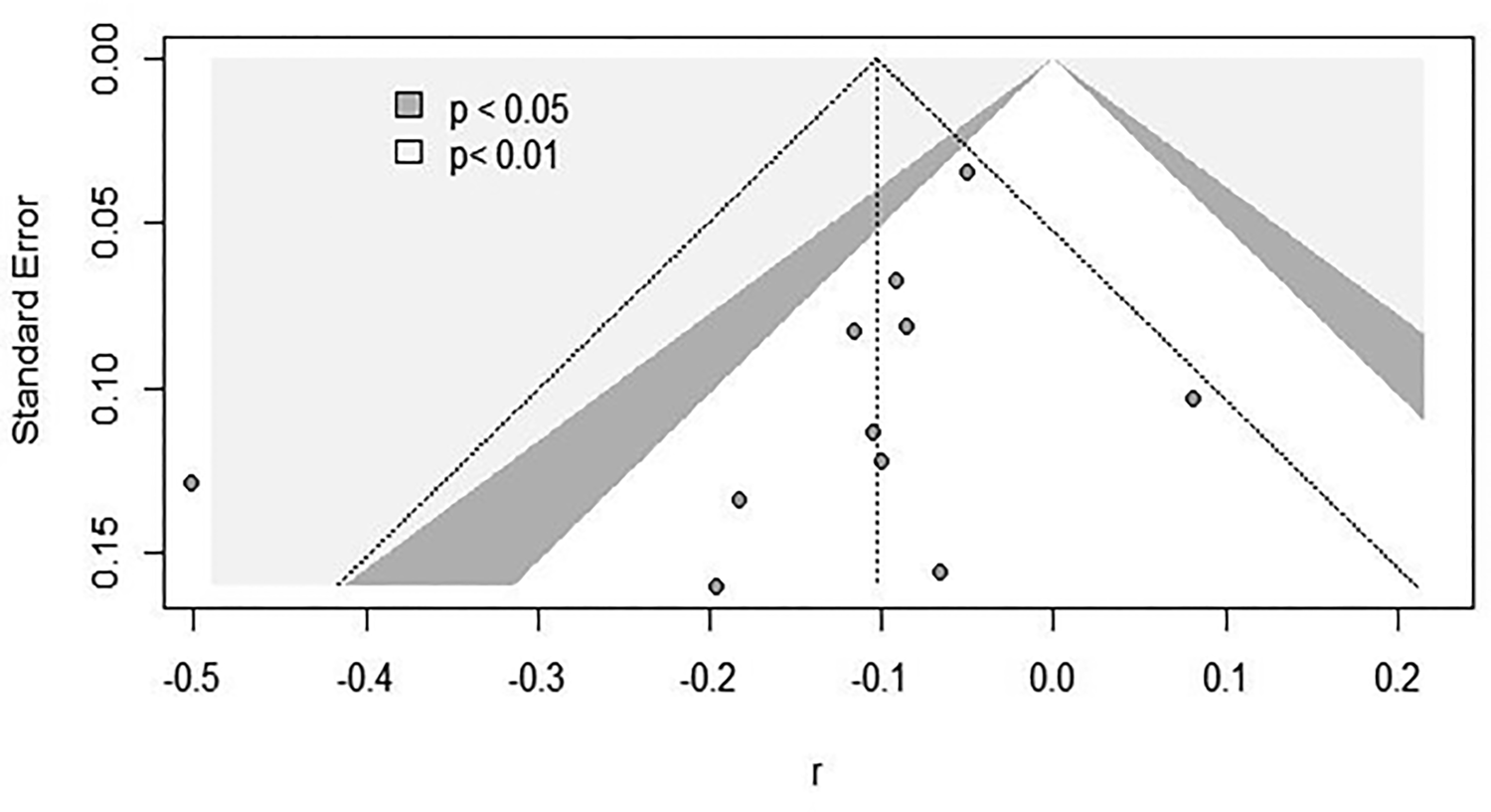
A funnel plot assessing publication bias among studies in the meta-analysis of attachment security is shown in Figure 4. By inspection of the figure, most studies were distributed relatively symmetrically across the pooled effect size within a form of a funnel, which indicates there is no strong evidence of publication bias. Nevertheless, as there was one study (Rodning et al., Reference Rodning, Beckwith and Howard1991) deviating from the funnel with a large effect and a small sample size, we tested funnel plot asymmetry with Egger's test and found no support of significant publication bias (p = .159). Therefore, we did not perform any bias correction techniques. For disorganization, the small number of studies may have reduced the power to detect bias if it existed. However, the result was similar with that of studies of attachment security with no strong evidence of publication bias (p = .101), although Rodning et al. (Reference Rodning, Beckwith and Howard1991) again strongly deviated from the rest and Seifer et al. (Reference Schindler and Bröning2004) showed a nonsignificant effect that did not fit into the funnel (Supplementary Figure 5).
Contour-enhanced funnel plot for child attachment security (n = 11): effect size (r) on the X-axis and standard error on the Y-axis. Each study is plotted as a circle. Studies that fall within the white area are not statistically significant. The unfilled triangular is centered on the pooled effect size of the random-effects meta-analysis. As seen in the figure, the studies fall within the shape of the funnel with one exception on the bottom left corner (large standard error, i.e., small sample size and large effect), which indicates no strong evidence of publication bias.

Discussion
Summary of evidence
Previous literature suggests (for reviews, see Parolin & Simonelli, Reference Out, Bakermans-Kranenburg and van IJzendoorn2016; Salo & Flykt, Reference Rutherford, Williams, Moy, Mayes and Johns2013) that maternal pre- and postnatal substance use may act as a risk factor for the development of children's insecure or disorganized attachment. In this systematic review and meta-analysis, we first assessed the association of maternal substance use and children's attachment security and disorganization. We found a significant but small association between maternal pre- and postnatal substance use and attachment security (r = −.10) of children under the age of 6, showing that children with maternal substance-use were more often insecurely attached. The association with disorganized attachment was not significant (r = .15). However, the small number of studies and large variation in sample sizes introduced uncertainties in the results, especially concerning attachment disorganization. Second, we reviewed factors that potentially mediated or moderated this association. Even though evidence was scarce, some studies indicated that teratogenic polysubstance exposure and sociological factors (i.e., public assistance and parity) may moderate the association between maternal prenatal substance use and child attachment security, behavioral disorganization, and avoidance, respectively. Finally, interactive teratogenic and maternal functioning factors mediated the path from maternal prenatal alcohol use to children's attachment security.
The finding that maternal substance use was associated with children's insecure attachment is comparable to a recent meta-analysis that found parental substance abuse as a risk factor for children's poorer physical, psychological, social, cognitive, and economic well-being over time (r = .15; Kuppens, Moore, Gross, Lowthian, & Siddaway, Reference Kühberger, Fritz and Scherndl2019). The magnitudes of the two effects were also comparable. Our result remained the same when we removed an outlier study and was in the same direction when we assessed only prenatal substance use. Recently, Funder and Ozer (Reference Fraley and Spieker2019) suggested that in psychological research, an effect size of r = .10 is small at the level of single events but may ultimately have consequences at larger scales. Thus, it seems plausible that maternal substance use during and after pregnancy, especially if recurring and continuous, may be considered as a risk factor for the development of children's attachment. However, no causal interpretations can be made based on our results, and on the level of an individual, different developmental pathways are likely to occur.
Interestingly, we did not find a significant association between maternal substance use and children's disorganized attachment. The heterogeneity among studies was substantial but explaining the source of it was not possible due to insufficient number of studies (Higgins & Thompson, Reference Hertzman2004). In Kuppens et al. (Reference Kühberger, Fritz and Scherndl2019) meta-analysis, authors found that the type of parental substance abuse (i.e., drug vs. alcohol vs. tobacco use vs. alcohol use disorder) significantly moderated the effect on child well-being, that is, the effect was stronger for drug use (r = .25) compared to other types of use (r = .13, .13, and .14 for alcohol, tobacco, and alcohol use disorder, respectively). The authors partially explained the effect by the illegal nature of drugs that often results in other severe consequences for the family (e.g., custodial sentences and fines). The same might hold true in our study, as drug-using mothers could show more dysregulated caregiving behavior than mothers with other types of use, which is a proposed pathway to disorganization (Abrams, Rifkin, & Hesse, 2006). However, this was impossible to assess as the studies in the meta-analysis included drug or polysubstance using samples with the exception of only one study focusing on alcohol (Eiden et al., Reference Delker, Kim and Fisher2002). It thus remains unclear, on one hand, whether there is no substantive association between maternal substance use and child attachment disorganization, and whether disorganization may better be explained by, for example, extreme dyadic interactional patterns or mothers’ traumatic experiences and psychopathology. On the other hand, the lack of significant result may derive from too few studies (n = 7), some methodological features of the studies (e.g., type of attachment measure or characteristics of study groups), or possible publication bias.
Our second research question was to evaluate the potential moderating and mediating factors between maternal substance use and children's attachment. Due to the low number of studies (n = 6), a systematic review of these factors was performed instead of a meta-analysis. We used a conceptual model along the lines of Coles and Platzman (Reference Cohen1993), including toxic, teratogenic, maternal functioning, sociological, and interactive factors. We did not find any studies assessing toxic moderators or mediators (i.e., factors related to neural circuits that occupy both addiction and caregiving) between maternal substance use and child attachment. The result suggests that the reward–stress dysregulation model of addiction (Rutherford & Mayes, Reference Rutherford, Maupin, Landi, Potenza and Mayes2017) has not yet been applied in the research of children's attachment among substance-using caregivers. Recently, it was hypothesized that parenting stress is important in understanding the compromised caregiving of these parents, as it may activate craving of substances and relapse and, thus, maintain addiction (Rutherford & Mayes, Reference Rutherford and Mayes2019), which may subsequently shape child attachment. These proposed mechanisms call for better understanding in future research.
Related to teratogenic factors, we found evidence that polysubstance-exposed children showed higher prevalence of insecure attachment compared to children exposed to either cocaine or opiates alone, or children without substance exposure. This finding could be explained through prenatal programming theory (for a review, see Monk, Lugo-Candelas, & Trumpff, Reference Minnes, Singer, Arendt and Satayathum2019); polysubstance exposure seems to affect infant neural networks and the developing brain (Gautam, Warner, Kan, & Sowell, Reference Funder and Ozer2015), also impairing infants’ self-regulation (Beauchamp et al., Reference Bakermans-Kranenburg, van IJzendoorn and Juffer2020), more severely than exposure to single substance. In a large prospective study of lower income mother–infant dyads, exposure to both tobacco and cannabis versus no exposure was similarly associated with infants’ less adaptive autonomic regulation at 9 months (Eiden, Schuetze, Shisler, & Huestis, Reference Eiden, Godleski, Schuetze and Colder2018). Exposure to tobacco alone was not associated with infants’ autonomic regulation (Eiden et al., Reference Eiden, Godleski, Schuetze and Colder2018). It is thus possible that infant regulation difficulties accumulate with other risks among substance-using mothers and elicit different caregiving, which further underlies insecure child attachment.
Concerning maternal functioning, puzzlingly, only nonsignificant moderating and mediating factors were found. Previous research has linked maternal substance use to caregiving difficulties (e.g., lower sensitivity; Konijnenberg et al., Reference Konijnenberg2016) and mental health problems (e.g., more psychiatric and personality disorders; Siqveland & Moe, Reference Simpson, Belsky, Cassidy and Shaver2014). In meta-analytic and review studies among non-using mothers, these factors have been associated with children's insecure attachment (Bakermans-Kranenburg et al., Reference Bakermans-Kranenburg, van IJzendoorn and Juffer2003; Wan & Green, Reference Verhage, Schuengel, Madigan, Fearon, Oosterman, Cassibba and van IJzendoorn2009). Our results could perhaps partly be explained by the methodological features of primary studies as several of them assessed caregiving (e.g., sensitivity) and mental health (e.g., depression) variables that were associated with children's attachment among substance-using samples, without being able to consider moderating or mediating effects due to small sample sizes or missing a comparison group. Furthermore, unexpectedly, there were no studies assessing mothers’ traumatic experiences as a moderating or mediating factor, although substance-using mothers are recognized to often have experienced traumatic events (Hakansson et al., Reference Groh, Fearon, Bakermans-Kranenburg, Van Ijzendoorn, Steele and Roisman2018; Haller & Miles, Reference Hakansson, Watten, Söderström, Skårderud, Øie, Håkansson and Øie2003), and mothers with traumatic experiences, especially with childhood abuse and neglect, often have insecurely attached children (Berthelot et al., Reference Bergin and McCollough2015; Cicchetti, Rogosch, & Toth, Reference Card2006). Our results highlight that although attachment theory and empirical studies emphasize maternal functioning, especially caregiving, as the core underlying factor in shaping child attachment, this link is yet to be firmly established among substance-using families.
Next, we found two significant sociological moderating factors. Among heavily cocaine-exposed (but not lightly or non-exposed) infants, those with mothers not receiving public assistance or being multiparous, showed higher levels of behavioral disorganization and avoidance, respectively, as compared to those whose mothers received public assistance or were primiparous. Not receiving public assistance is likely to be associated with more serious financial difficulties, which may be associated with parenting problems and ultimately with child developmental difficulties (Bøe et al., Reference Bick, Bernard, Dozier, Suchman, Pajulo and Mayes2014). Multiparity has been associated with lack of positive change in substance use among mothers at maltreatment risk (Delker, Kim, & Fisher, 2014). Furthermore, lack of public assistance and multiparity among substance-using mothers often appear together with single parenthood, losing child to custody, and instable and/or abusive partnerships (Nair et al., Reference Motyl, Demos, Carsel, Hanson, Melton, Mueller and Skitka2003), which creates an insecure environment for child development through the accumulation of risks (Cyr et al., Reference Conners, Bradley, Mansell, Liu, Roberts, Burgdorf and Herrell2010). The absence of literature concerning fathers was also visible in our study as only one study included both mothers and fathers. According to our results, it seems evident that sociological adversities appear together with substance use problems among caregivers and may negatively influence child attachment.
Finally, we found two studies with interactive risk factors examining the mediating effects of child regulation, Mother × Child interaction, and child coping between heavy substance exposure and insecure attachment. Children with heavier substance exposure showed more negative affect, which was associated with Mother × Child interaction difficulties and in turn lead to, either directly or via children's coping difficulties, more insecure attachment. This finding supports an earlier proposition that teratogenic factors can shape children's attachment through the caregiving environment (Beeghly & Tronick, Reference Beeghly, Frank, Rose-Jacobs, Cabral and Tronick1994). For example, when comparing cocaine-exposed and non-exposed children, those with low autonomic reactivity were found to be especially susceptible to environmental influences, such as caregiving (Eiden, Godleski, Schuetze, & Colder, Reference Eiden, Edwards and Leonard2015). Evaluating differential susceptibility of children in substance-using families could provide valuable insight into future research (for example, see Ellis, Boyce, Belsky, Bakermans-Kranenburg, & van IJzendoorn, Reference Eiden, Schuetze, Shisler and Huestis2011). However, it should be noted that the mediating effects found in this review were assessed in path models that do not allow causal interpretations. Nonetheless, these results may be an indication of early-life developmental cascades where the interaction and accumulation of different, especially teratogenic and maternal functioning factors shape the course of development, that is, child attachment (Masten & Cicchetti, Reference Marvin, Britner, Russell, Cassidy and Shaver2010). Due to these cascading and cumulating effects, substance-exposed children may be at risk for poor developmental outcomes later in life, as insecure and disorganized attachment have been linked with, for example, lower peer-competence and internalizing and externalizing symptoms (Groh et al., Reference Granqvist, Sroufe, Dozier, Hesse, Steele, van IJzendoorn and Duschinsky2014). Finally, our study highlights that research among substance-using families would benefit from the view of transactional model by encompassing parent–child and context-related factors that shape children's attachment that, in turn, influence the caregiving environment (Sameroff, Reference Sameroff1975).
Methodological considerations
The strength of the evidence found in this systematic review and meta-analysis needs to be evaluated by considering methodological aspects of the primary studies. Concerning the first research question of attachment security and disorganization, strong evidence of publication bias across studies was not found. This may relate to the fact that we were able to include also unpublished studies (Pigott & Polanin, Reference Parolin and Simonelli2019). However, the number of studies in the meta-analysis was small and sample sizes also varied notably in the primary studies, introducing the possibility of false positive findings especially in smaller studies. Overall, small sample sizes may partly derive from difficulties to recruit and maintain long-term contact with substance-using parents. Related to disorganized attachment, the heterogeneity among studies was substantial and smaller and older studies seemed to yield larger effect sizes (with one exception; Rodning et al., Reference Riley, Alejandra Infante and Warren1989a), which is generally observed in psychology (Kühberger, Fritz, & Scherndl, Reference Koo and Li2014). Furthermore, in 95% of future studies, the association of maternal substance use and children's disorganized attachment was estimated to vary between medium negative (r = −.26) and large positive (r = .51) effects, which makes the interpretation of our results uncertain and calls for more empirical evidence.
When considering the second research question of the moderating and mediating factors, methodological challenges of the primary studies were evident. Only six studies (55%) assessed mediating or moderating factors, but as they were based on cross-sectional designs or concurrent measures, no causal interpretations could be made. The scarcity of the research also limited us from synthesizing these results quantitatively. Furthermore, all studies either did not meet at least one of the risk of bias criteria or reported insufficient information concerning sampling, which limits the generalizability and replication of findings (Motyl et al., Reference Moreland and McRae-Clark2017). Related to measurement, a potential source of bias arose in two studies that used only a retrospective self-report of prenatal substance use (Konijnenberg, Reference Kobak and Bosmans2015). Finally, studies were uniform in measuring attachment with a validated measure, either SSP or AQS, but it is noteworthy that significant sociological moderators were found only with continuous attachment measures but not with categorizations of attachment. There has been increased discussion on attachment patterns being continuous rather than categorical (e.g., Fraley & Spieker, Reference Finger2003), and it is possible that the effects were detected due to the continuous attachment measures. However, a serious limitation of AQS is that it excludes the possibility to measure attachment disorganization (van IJzendoorn, Vereijken, Bakermans-Kranenburg, & Riksen-Walraven, Reference Unterrainer, Hiebler-Ragger, Koschutnig, Fuchshuber, Tscheschner, Url and Fink2004).
Clinical implications and future directions
Substance use is often associated with mother's own insecure attachment (Schindler & Bröning, 2015; Unterrainer et al., Reference Suchman, McMahon, Slade and Luthar2017), and the intergenerational transmission of attachment highlights the need to design interventions for substance-using parents from an attachment standpoint (Verhage et al., Reference Van IJzendoorn, Vereijken, Bakermans-Kranenburg and Riksen-Walraven2016). The most effective interventions are those that target both addiction and parenting (Moreland & McRae-Clark, Reference Monk, Lugo-Candelas and Trumpff2018). Interventions should start during pregnancy because, as also found in our study, developmental cascades seem to exist from substance exposure to infant regulation difficulties that accumulate in conjunction with compromised caregiving to insecure attachment in children. Furthermore, those children who are more heavily exposed to substances or experience parenting difficulties may be at heightened risk of developing insecure attachment. Early, preferably prenatal, interventions, can prevent attachment disorders (Wright et al., Reference Wright, Hackney, Hughes, Barry, Glaser, Prior and McMillan2017), and the treatment should always focus on the mother, the child, and the dyadic interaction, as well as on other potential environmental risks, such as providing financial assistance in the face of poverty, which was shown to be important for child attachment in our study. There are several effective attachment-based interventions targeted at substance-using families, for example Attachment and Biobehavioral Catch-up (Bick, Bernard, & Dozier, Reference Berthelot, Ensink, Bernazzani, Normandin, Luyten and Fonagy2013), The Mother and Toddler Program (Suchman, Decoste, McMahon, Rounsaville, & Mayes, Reference Sprangler, Fremmer-Bombik and Grossmann2011), and Mothering from the Inside Out (Suchman et al., Reference Suchman, Decoste, McMahon, Rounsaville and Mayes2017). These interventions support mothers’ mentalizing abilities (i.e., understanding inner states of oneself and others), mutual regulation, and interaction with the child, as well as maternal sensitivity which has been found as a crucial component in all parenting interventions (for a meta-analysis, see Bakermans-Kranenburg et al., Reference Bakermans-Kranenburg, van IJzendoorn and Juffer2003).
In conclusion, this study highlights a clear need to establish firmer knowledge on the role that maternal substance use plays in shaping children's attachment and on potential factors that moderate or mediate this association. More empirical evidence is especially needed on the effects of maternal postnatal substance use and different types of use (e.g., illegal and legal substances, dose, timing, duration, polysubstance use). Further, research is also scarce on the associations of maternal substance use and attachment among older children, or on representational attachment measures, on disorganized attachment, and on toxic stress–reward mechanisms underlying child attachment. Cross-cultural research is also lacking, as all the included studies were North American. Although not a topic of this systematic review and meta-analysis, studies including fathers were also rare and need to be accounted in future research. In addition, this study emphasized the importance of transparent reporting and conducting larger-scale studies, which is often a challenge among substance-using populations as, given the modest combined effect size, sample sizes would need to be much larger than in most of the studies included in this review. The focus should also be on controlled designs that consider multiple interactive factors relating to maternal substance use and child attachment. Of special notice, most of the studies were primarily designed in the 1990s when the harmful effects of cocaine on child development (Zuckerman, Frank, & Mayes, Reference Wright, Hackney, Hughes, Barry, Glaser, Prior and McMillan2002) started to influence public policy and clinical practice. It is thus possible that studies during that period may have targeted minority ethnic groups that were especially oppressed and marginalized. Little research has been conducted in the context of current drug-use legislation in the United States where, for example, marijuana has become legalized in many states and is also used for medical purposes. It is unclear whether similar findings would be obtained among legal users, who may have less cumulative risk factors. Finally, as already described by Bowlby (Reference Bøe, Sivertsen, Heiervang, Goodman, Lundervold and Hysing1999/1969), attachment is a reciprocal, dynamic interchange process between the child and the caregiver. Therefore, there is a need to adapt a more dynamic, complex approach and methodology in attachment research. For example, research exploring the distinction between trait and state attachment (e.g., Kobak & Bosmans, Reference Kim, Iyengar, Mayes, Potenza, Rutherford and Strathearn2019) could help us to develop more nuanced understanding of individual and within-person processes of attachment.
Supplementary Material
The supplementary material for this article can be found at https://doi.org/10.1017/S0954579421000134.
Acknowledgments
We would like to thank members of the Developmental Psychology doctorate seminar at Tampere University for their valuable comments. Special thanks to Jaakko Tammilehto for his suggestions on the work.
Funding Statement
This work was supported by the Finnish Cultural Foundation (NH).
Conflicts of Interest
None.
Appendix
Studies using the same data and the reason for exclusion