Introduction
Diving petrels (Procellariidae) are small, sub-Antarctic seabirds that nest in underground burrows. During the breeding season, these birds forage at sea (Bocher et al. Reference Bocher, Cherel and Hobson2000a) and periodically return to the burrow to provision a single chick after dark to avoid predation (reviewed by Warham Reference Warham1990).
Among birds, procellariiforms are known for their olfactory abilities (reviewed by Nevitt Reference Nevitt2008), but diving petrels were historically thought to have a diminished sense of smell (e.g. Cunningham et al. Reference Cunningham, van Buskirk, Bonadonna, Weimerskirch and Nevitt2003). Diving petrels have the smallest olfactory bulb of all procellariiforms (mean bulb to brain ratio for the common diving petrel Pelecanoides urinatrix (Gmelin, 1789) 18%, for all procellariiforms 29%, Bang & Cobb Reference Bang and Cobb1968). Moreover, the low aspect ratio of the diving petrel wing limits their ability to engage in dynamic soaring, a characteristic flight style of many procellariiforms. Instead, they rapidly flap their wings (12.3 Hz, Pennycuick Reference Pennycuick1996) and forage by diving to considerable depth (c. 33 m, maximum depth 60+ m; Chastel Reference Chastel1994, Bocher et al. Reference Bocher, Labidoire and Cherel2000b). This foraging style suggests that they do not track surface odours to locate prey resources (reviewed by Nevitt Reference Nevitt2008).
However, diving petrels have recently been shown to detect odour cues in contexts other than foraging. For example, during the breeding season, a variety of adult burrow-nesting procellariiforms, including both common and South Georgian diving petrels (Pelecanoides georgicus Murphy and Harper, 1916) have been shown to use scent cues to relocate their burrow when returning from foraging trips (Bonadonna et al. Reference Bonadonna, Cunningham, Jouventin, Hesters and Nevitt2003, reviewed by Hagelin Reference Hagelin2007) and in some species scent may play a role in individual recognition (Bonadonna & Nevitt Reference Bonadonna and Nevitt2004). Still, relatively little attention has been paid to investigating how these abilities develop in chicks. This is because petrel chicks do not typically leave their burrows until just before fledging and unless they are natally philopatric, these birds should not need to learn odours to relocate their burrow. However, we have recently proposed that odours associated with self/non-self recognition may be important for mate choice, and that learning self-specific odours begins before the chick leaves the nest in some species (for discussion see Nevitt Reference Nevitt2008, O'Dwyer & Nevitt Reference O'Dwyer and Nevitt2009). Since current evidence suggests that diving petrels use olfaction primarily in social rather than in foraging contexts, they may make an ideal model among birds for studying the development of social odour recognition.
In the present study, our goal was to determine whether common diving petrels could detect familiar, burrow related odours. Diving petrel chicks are not mobile enough to perform choice tests (e.g. O'Dwyer et al. Reference O'Dwyer, Ackerman and Nevitt2008), but olfactory responses can be tested using a simple wind tunnel (Cunningham et al. Reference Cunningham, van Buskirk, Hodges, Weimerskirch and Nevitt2006). Unlike Y-maze experiments, the wind tunnel does not require chicks to make a choice, but can be used to elicit behaviours related to olfactory search. Here we compared the behavioural responses of 23 common diving petrel chicks to the scents of soil from their nest chamber (nest soil), soil from the surface of the area surrounding the burrows (colony soil), and an empty Petri dish (control). Given that chicks tend to stay within the nest chamber of their burrow throughout development, we predicted that chicks would sit still and search less in response to their own burrow odour than to the other stimuli.
Materials and methods
This study was performed on Mayes Island (49°28′S, 69°57′E), Iles Kerguelen, from 21–25 February 2002. Pelecanoides urinatrix nests were identified and monitored daily during the incubation stage to determine hatch date for each chick. Chicks were then tested at 30 ± 0.9 (mean ± s.e.) days post hatching (fledging occurs at 50–55 days, Jouventin et al. Reference Jouventin, Mougin, Stahl and Weimerskirch1985). All trials were conducted between 10h00 and 14h00 local time at temperatures of 13.0 ± 0.5°C.
We performed experiments in a simple wind tunnel, which has been described elsewhere (see fig. 1 and text in Cunningham et al. Reference Cunningham, van Buskirk, Hodges, Weimerskirch and Nevitt2006). Briefly, the apparatus consisted of a testing arena (0.8 × 0.6 m, 0.3 m high) constructed of Plexiglas®, and was housed in a well-ventilated hut (1.5 × 1.5 m, 2.5 m high). Airflow (0.6–0.7 m sec-1) to the arena was generated by two tubeaxial fans (Mechatronics model UF12A12, Preston, WA, USA; air volume: 3 m3 min-1) mounted to the sides of a pressure box that was located at one end of the arena. These fans were positioned at a 90° angle to an exit port that directed air into the arena. Fans were coupled to two flexible air ducts (9 cm diameter), which, in turn, ran through wall vents to draw fresh air from outside. Air passed in through these ducts, into the pressure box and then exited into the arena. To reduce turbulence, air entering the testing arena passed through an egg crate, plastic lined with organdy fabric. The wind tunnel did not provide birds with a discrete plume of odour that they could follow to a source, rather birds were exposed to the presence or absence of the odour in the test arena.
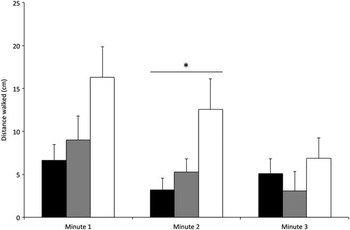
Mean distances (cm) walked by common diving petrel chicks in response to nest soil (black), colony soil (grey) and control presentations (white). Values are given as mean ± standard error. Repeated measures ANOVA revealed a significant difference among treatments during minute 2 (Greenhouse-Geisser: F{1.53, 33.56} = 3.94, P = 0.04). In minute 2, chicks walked farther in the presence of the empty dish compared to their own nest soil (Tukey's test: P = 0.05). The data were analysed using a square root transformation, but are presented here as raw numbers. There were no other differences in the distance walked (see text).

We tested 23 common diving petrel chicks for this experiment. Chicks were tested and handled one at a time. Prior to an experiment, a test subject was removed from its nest chamber located within its burrow. The chick was placed in a clean cotton bird bag and carried to the hut (10–100 m from the nest). Once inside, the chick was placed on a pre-defined start point within the wind tunnel. The start position was c. 40 cm downwind from a glass dish (radius 71 mm, height 41 mm). The glass dish held one of two test stimuli: soil (15 g) from the chick's burrow (hereafter called nest soil), or soil (15 g) from the colony in the region where the burrow was located (colony soil). Colony soil was collected at least 10 m from any known burrow entrance and had the same look and consistency as nest soil. The third test stimulus was an empty glass dish (control). Each chick was exposed to all three stimuli. Although no order effects were ultimately observed, to control for this possibility, we balanced the order of presentation for all three stimuli such that all six possible presentation orders were equally distributed amongst the chicks. To reduce the likelihood that chicks were able to detect an odour signature from a previous trial, the wind tunnel was washed with 75% methanol between trials.
Chicks were tested one at a time in dim lighting and videotaped from above using a Sony camcorder (model DCR-TRV30) under infrared illumination. At the start of each trial, chicks were allowed to acclimate to the testing arena for 30 sec. Following acclimation, we removed the lid of the dish and recorded the chicks’ behaviours for 3 min. This duration was chosen to minimize the amount of time chicks were out of the nest, and prior work on blue petrels (Halobaena caerulea (Gmelin, 1789)) suggested that activity was greatest within this time interval (Cunningham et al. Reference Cunningham, van Buskirk, Hodges, Weimerskirch and Nevitt2006). After the first 3 min trial, we introduced the next dish, and repositioned the chick at the start position. We repeated this procedure for the third stimulus. Once the experiment was completed, the chick was returned to its burrow. Chicks were away from their burrows for less than 35 min. Video images were projected using a Sony Trinitron colour video monitor (model PVM-1351Q) and analysed by a single ‘blind’ observer in real time using Jwatcher software (http://www.jwatcher.ucla.edu/).
Statistical analyses
Statistical analyses were performed using IBM SPSS Statistics (v.19) software (http://www-01.ibm.com/software/analytics/spss/). Data were analysed for differences in body turns (a turn of the body 45° to the right or left) and distances travelled (quantified by recording the chick's position at 15 sec intervals and then adding these distances together on a per minute basis) in response to the three stimuli. Because activity tended to vary over the time course of the experiment for this species, data were analysed in 1 min time bins. Prior to analysis, data were first normalized using a square root transformation. To determine if there were overall differences in the chick's responses to the three stimuli, we used a repeated-measures ANOVA on the transformed data, employing the Greenhouse-Geisser correction if the assumption of sphericity was violated. Where a significant difference was found, we used a Tukey's test on the transformed data to make pair-wise comparisons (Zar Reference Zar1996).
Results
Once chicks adjusted to the wind tunnel, we found consistent, significant differences in behaviour in response to odour stimuli, both in terms of distances travelled and turning behaviour.
Distance travelled
In minute 1, chicks walked statistically similar distances in response to the three stimuli (Fig. 1; repeated measures ANOVA: df = 2, F = 2.14, P = 0.13). However, in minute 2, mean responses to the three stimuli were significantly different (Greenhouse-Geisser: df = 1.53, F = 3.94, P = 0.04). Similar to our prediction, chicks walked significantly less distance when they were presented with their own nest soil compared to the control (Tukey's test: q = 3.44, P = 0.05). Mean distances walked were not significantly different between colony soil and control stimuli (q = 2.09, P > 0.20), or between nest soil and colony soil stimuli (q = 1.35, P > 0.50). In minute 3, there were no significant differences in the distance walked in response to the three stimuli (df = 2, F = 2.58, P = 0.09). This was probably due to reduced overall activity in minute 3.
Turning behaviour
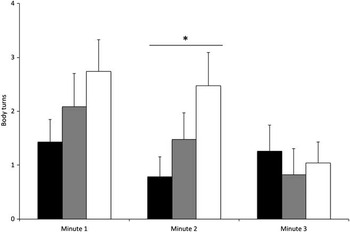
We observed similar patterns for body turns (Fig. 2). During minute 1, there were no significant differences in turning behaviour among the three groups (df = 2, F = 1.71, P = 0.32). However, during minute 2, chicks showed significant differences in response to the three stimuli (Greenhouse-Geisser: df = 2, F = 4.85, P = 0.01). As predicted, nest soils evoked less turning than control stimuli (q = 4.40, P = 0.01). However, turning behaviour was similar when comparing responses to either colony soil and control (q = 2.24, P > 0.20), or nest soil and colony soil (q = 2.17, P > 0.20). Chicks responded similarly to the three stimuli during minute 3 (df = 2, F = 0.89, P = 0.42).
Mean number of body turns by common diving petrel chicks in response to nest soil (black), colony soil (grey) and control (white) presentations. Values are given as mean ± standard error. Repeated measures ANOVA revealed a significant difference among treatments during minute 2 (F{2, 44} = 4.85, P = 0.01). In minute 2, chicks turned their bodies significantly more in response to the empty dish presentation compared to soil from their own burrow (Tukey's test, P = 0.01). The data were analysed using a square root transformation, but are presented here as raw numbers. There were no other differences in the number of body turns (see text).

Discussion
Consistent with our prediction, our data suggest that common diving petrel chicks can detect odours associated with their nest material. We saw the largest effects during minute 2, probably because chicks took longer to acclimate to the wind tunnel than we anticipated from prior work with blue petrels in response to food odours (Cunningham et al. Reference Cunningham, van Buskirk, Hodges, Weimerskirch and Nevitt2006). Chicks responded to burrow scents essentially by settling down and not moving. Given that chicks do not tend to move within their burrows unless an adult is present, our interpretation is that the scent of the burrow is a sufficient stimulus to trigger a “sit-still response”.
Staying still while in the nest chamber is probably adaptive for survival in colonies where chicks are at high risk of predation. Unlike other sympatric species such as blue petrels that dig complex burrows ∼2 m deep, common diving petrels dig short (< 1 m), simple tunnels that lead directly to the nesting chamber. Common diving petrel chicks are also smaller than most petrel chicks (fledging weight of common diving petrel: 115 g, fledging weight of blue petrel: 208 g, Jouventin et al. Reference Jouventin, Mougin, Stahl and Weimerskirch1985) and particularly vulnerable to predation by skuas (Catharacta skua lonnbergi Mathews, 1912, reviewed by Warham Reference Warham1996). Chicks do not emerge from their burrows until they fledge (Warham Reference Warham1990). Thus, it is not surprising that chicks tended to sit relatively still when exposed to the odours associated with the nest, since this is consistent with their normal behaviour. We did not test whether the “sit-still response” is a general response to petrel odour or more specific to the scent of an individual's burrow, but this question should be tested.
Chicks turned more and walked greater distances during the control presentations (Figs 1 & 2). Our interpretation is that, in the absence of familiar burrow odours, chicks responded by moving around in the arena, perhaps searching for a cue associated with the nest. Chicks also tended to walk less when presented with colony soil than to control conditions. We did not analyse scented compounds in colony soil as part of this preliminary study, however, nitrogenous wastes have been shown by others to be present in petrel colonies (Erskine et al. Reference Erskine, Bergstrom, Schmidt, Stewart, Tweedie and Shaw1998). We have recently shown that blue petrel chicks are sensitive to ammonia at picomolar concentrations suggesting a potential source of a familiar odour (Nevitt et al. Reference Nevitt, Bergstrom and Bonadonna2006). Petrel derived odours may also be present in colony soil, but this has not yet been demonstrated.
Given that chicks generally decreased both of their behaviours over the duration of the experiment, an alternate explanation for our findings is that chicks were stressed by the initial disturbance of handling and responded to this by turning more and walking further distances. Over time, particularly in the presence of the familiar burrow scent, chicks became less affected by the initial disturbance. This interpretation is interesting because it suggests that a familiar odour may act to mitigate the fear response in diving petrels as it does in chickens (Gallus domesticus L., 1758, Jones & Gentle Reference Jones and Gentle1985). Although our experiment was not originally designed to address this possibility, it is an exciting interpretation that warrants further study in the future.
In conclusion, we previously showed that adult common diving petrels can identify their burrows by odour cues alone (Bonadonna et al. Reference Bonadonna, Cunningham, Jouventin, Hesters and Nevitt2003). Our current findings expand on these results by suggesting that common diving petrel chicks can detect and respond appropriately to the scent of their nest material in a simple wind tunnel. The implications of this initial study are that, despite having smaller olfactory bulbs than other procellariiforms, diving petrels respond to odour cues associated with their burrows, and this behaviour is already expressed in chicks before they leave the nest. Given that diving petrels do not leave the nest prior to fledging, our study suggests that olfaction may be involved in the development of individual recognition, as it appears to be in Leach's storm-petrels (Oceanodroma leucorhoa Vieillot, 1818, O'Dwyer et al. Reference O'Dwyer, Ackerman and Nevitt2008). Our results further suggest that a simple wind tunnel can be used to examine olfactory specific behaviours without requiring birds to be motivated to make a choice between two alternatives. Thus, this methodology provides a useful alternative to Y-maze testing in the field.
Acknowledgements
This work was supported by IPEV (Program No. 109) and NSF (OPP-0229775 and IBN-0212467 to GAN) and by C. Burney, V. Chartendrault, and N. Delelis in the field. We thank Dr M. Willis for advice with the construction of the wind tunnel. Dr T. O'Dwyer, Dr R. Kihslinger, M. Losekoot and Dr J. DeBose graciously commented on earlier drafts of the manuscript. This manuscript was also greatly improved by two anonymous referees. We are also grateful to Dr N. Willits and the statistical consulting staff at UC Davis for useful advice with the analysis. Finally, we are indebted to Dr H. Weimerskirch for facilitating this research.