Introduction
Increased environmental dynamism, globalisation, and growing competition have forced many organisations to emphasise the innovative work behaviours (IWBs) of their employees (Janssen, Reference Janssen2000; Mustafa, Coetzer, Ramos, & Fuhrer, Reference Mustafa, Coetzer, Ramos and Fuhrer2021a). Despite their benefits, IWBs do not occur easily as they comprise of complex, nonroutine behaviours that require personal creativity, a willingness to take risks, and engagement in nontraditional modes of thinking (Škerlavaj, Černe, & Dysvik, Reference Škerlavaj, Černe and Dysvik2014). Hence, organisational scholars are increasingly interested in understanding why some employees may choose to engage in IWBs and not others (Bos-Nehles & Veenendaal, Reference Bos-Nehles and Veenendaal2019; Xerri & Brunetto, Reference Xerri and Brunetto2013). Prior research has sought to explain the driving forces behind IWBs using a range of contextual and individual factors (Montani, Battistelli, & Odoardi, Reference Montani, Battistelli and Odoardi2017; Woods, Mustafa, Anderson, & Sayer, Reference Woods, Mustafa, Anderson and Sayer2018). However, research on the psychological motivators behind IWBs remains limited (Anderson, Potočnik, & Zhou, Reference Anderson, Potočnik and Zhou2014; De Visser & Faems, Reference De Visser and Faems2015). Understanding the psychological motivators behind IWBs is important, as such behaviours are challenging and risky nature, thus requiring a high degree of self-motivation. Furthermore, it is the employee who makes a choice to engage in IWBs, and such choices are more likely to be spurred by employees who are psychologically motivated to do so. This study focuses on how different forms of employee attachment to their organisation influence their IWBs.
Employees who perceive and act like owners of the organisation are likely to feel that they have a greater responsibility to contribute to organisational functioning and success and be more committed to the organisation (Pierce, Kostova, & Dirks, Reference Pierce, Kostova and Dirks2001). Psychological ownership (PO) (Avey, Avolio, Crossley, & Luthans, Reference Avey, Avolio, Crossley and Luthans2009) is defined as feelings of possessiveness and of psychological ties to an object, which reflects the cognition that an object is ‘theirs’ (Pierce, Kostova, & Dirks, Reference Pierce, Kostova and Dirks2001). Rooted in the psychology of possession and the extended-self literature, PO theory suggests that employees who experience ownership feelings towards their organisation come to consider them as part of their extended self (Tian & Belk, Reference Tian and Belk2005), and are thus motivated to engage in discretionary behaviours to nurture, advance, and protect the organisation (Leyer, Hirzel, & Mooremann, Reference Leyer, Hirzel and Mooremann2020). However, the scarcity of empirical evidence directly speaking about the relationship between PO and IWB makes it important to extend the body of evidence in the field (Liu, Chow, Zhang, & Huang, Reference Liu, Chow, Zhang and Huang2019; Mustafa, Martin, & Hughes, Reference Mustafa, Martin and Hughes2016). Knowing if and how PO influences IWB is important because possessiveness, which underlies the conceptual core of PO and which serves as a powerful motivational force, may provide important new insights into why employees may engage in and persist with challenging and risky behaviours such as IWBs (Chai, Song, & You, Reference Chai, Song and You2020; Van Dyne & Pierce, Reference Van Dyne and Pierce2004).
Although a limited number of studies have suggested that PO is related to IWBs (Leyer, Hirzel, & Mooremann, Reference Leyer, Hirzel and Mooremann2020; Liu et al., Reference Liu, Chow, Zhang and Huang2019; Mustafa, Martin, & Hughes, Reference Mustafa, Martin and Hughes2016), the mechanisms through which PO enhances IWBs remain under-examined (Dawkins, Tian, Newman, & Martin, Reference Dawkins, Tian, Newman and Martin2017). Adopting a social identity perspective (Tajfel & Turner, Reference Tajfel, Turner, Worchel and Austin1985) we propose that affective organisational commitment (AOC) (Meyer & Allen, Reference Meyer and Allen1991) mediates POs influence on IWB. Social identity theory (SIT) (Tajfel & Turner, Reference Tajfel, Turner, Worchel and Austin1985) proposes that an individual's collective identity is shaped by their attitudes and behaviours within a group (Ashforth, Harrison, & Corley, Reference Ashforth, Harrison and Corley2008; Blader & Tyler, Reference Blader and Tyler2009; Tyler & Blader, Reference Tyler and Blader2003). Specifically, SIT (Tajfel & Turner, Reference Tajfel, Turner, Worchel and Austin1985) suggests that when employees identify with and see their fates as intertwined with that of the organisation, they are likely to commit themselves to it (Ashforth & Mael, Reference Ashforth and Mael1989). Referring to the relative strength of an individual's identification with and involvement in a particular organisation, AOC is defined as an employee's positive emotional attachment and identification with their organisation (Allen & Meyer, Reference Allen and Meyer1990). As a critical motivational force binding individuals to effective courses of action that sustain the organisation and its goals (Meyer & Herscovitch, Reference Meyer and Herscovitch2001), AOC has been related to IWBs (Xerri & Brunetto, Reference Xerri and Brunetto2013).
Drawing on PO theory (Pierce, Kostova, & Dirks, Reference Pierce, Kostova and Dirks2001) and SIT (Tajfel & Turner, Reference Tajfel, Turner, Worchel and Austin1985), this study proposes that the sense of belonging and identification arising from employees' ownership feelings may enhance and maintain their affective bonds with their organisations (AOC) (Han, Chiang, & Chang, Reference Han, Chiang and Chang2010; Mustafa, Mansilla, & Gibson, Reference Mustafa, Mansilla and Gibson2021b; Vandewalle, Van Dyne, & Kostova, Reference Vandewalle, Van Dyne and Kostova1995), and consequently foster their IWBs. Specifically, the study investigates whether ‘Affective Organisational Commitment (AOC) mediates the relationship between Psychological Ownership (PO) and Innovative Work Behaviour (IWB)’. We test our proposed hypotheses using a sample of 110 middle-manager–supervisor dyads from an IT service company based in Malaysia.
Our study advances theory in a number of key areas. Firstly, the adoption of identity-based theories to examine the effects of different forms of attachment on IWBs adds to the theory on what motivates employees to engage in IWBs. Doing so provides new insights into the intermediate psychological processes that would explain how and why different individual antecedents affect IWB (Yuan & Woodman, Reference Yuan and Woodman2010). Secondly, the study adds to the literature on PO, by exploring the mediating role of AOC in the PO–IWB relationship. This deepens the literature's understanding of how feelings of possession towards specific targets might influence discretionary work-related behaviours. Additionally, by integrating both SIT with PO theory, this study responds to recent calls in the literature to draw on identity-based explanations to understand the positive effects of PO in the workplace (Dawkins et al., Reference Dawkins, Tian, Newman and Martin2017).
Middle-managers' innovative work behaviour
Similar to De Jong and Den Hartog (Reference De Jong and Den Hartog2010), IWB is defined as the recognition of problems and initiation and intentional introduction of new and useful ideas, as well as a set of behaviours needed to develop, launch, and implement ideas with an aim to enhance personal and/or business performance. De Jong and Den Hartog (Reference De Jong and Den Hartog2010) identified four distinct dimensions of IWB: idea exploration, generation, championing, and implementation, which represent the different stages of the innovation process and the specific ways in which employees could contribute to it. Although theoretically multidimensional in nature (Lukes & Stephan, Reference Lukes and Stephan2017), IWB has traditionally been measured as a unidimensional construct (Janssen, Reference Janssen2000; Scott & Bruce, Reference Scott and Bruce1994) due to the high intercorrelations observed among the dimensions (Černe, Hernaus, Dysvik, & Škerlavaj, Reference Černe, Hernaus, Dysvik and Škerlavaj2017). Consistent with existing studies, we view IWB as the totality of these behaviours (idea exploration, generation, championing, and implementation) and thus treat it as a unidimensional construct (Chen, Jiang, Tang, & Cooke, Reference Chen, Jiang, Tang and Cooke2018; Scott & Bruce, Reference Scott and Bruce1994).
IWB can occur across all organisational levels and functions (Chen et al., Reference Chen, Jiang, Tang and Cooke2018; Garud, Tuertscher, & Van de Ven, Reference Garud, Tuertscher and Van de Ven2013). This study focuses on the IWBs of middle-managers. Middle-managers are those individuals within an organisation's hierarchy who are below top management and above first-level employees (Floyd & Wooldridge, Reference Floyd and Wooldridge1997; Hales & Mustapha, Reference Hales and Mustapha2000). As central organisational actors, middle-managers are well-positioned to share and convert the organisation's vision into innovation initiatives (Birken et al., Reference Birken, Lee, Weiner, Chin, Chiu and Schaefer2015; Chen et al., Reference Chen, Jiang, Tang and Cooke2018). Theorising around the behaviour of middle-managers suggest that they may engage in IWBs (Chen et al., Reference Chen, Jiang, Tang and Cooke2018) either by championing the ideas of frontline employees and the creation of innovative work cultures which support employee innovativeness (Chen, Chang, & Chang, Reference Chen, Chang and Chang2015), or by recognising opportunities and taking advantage of them via generation of new and novel ideas (Hornsby, Kuratko, Shepherd, & Bott, Reference Hornsby, Kuratko, Shepherd and Bott2009; Mustafa, Martin, & Hughes, Reference Mustafa, Martin and Hughes2016).
As IWBs are dynamic and context-bound in nature (Messmann & Mulder, Reference Messmann and Mulder2012), we argue that while middle-managers' IWB share similar characteristics to other employees, their organisational positioning and authority means that they are well placed to rapidly commercialise their ideas or adopt revolutionary new practices (Guo, Huy, & Xiao, Reference Guo, Huy and Xiao2017). Hence, middle-managers' IWB may be greater in magnitude compared to other employees (Mustafa, Martin, & Hughes, Reference Mustafa, Martin and Hughes2016; Wu, Ma, & Wang, Reference Wu, Ma and Wang2018). Given their challenging nature, engagement in IWBs requires a high degree of self-motivation (Bammens, Reference Bammens2016). Such self-motivation is likely to occur when middle-managers feel attached to their organisations and have a sense of responsibility towards it (Dawkins et al., Reference Dawkins, Tian, Newman and Martin2017).
Theoretical framework and hypotheses development
Middle-managers' psychological ownership
Comprising of both affective and cognitive elements, PO is defined as a state of mind in which individuals feel as though the target of ownership or a piece of that target is ‘theirs’ (Pierce, Kostova, & Dirks, Reference Pierce, Kostova and Dirks2001). The conceptual core of this definition is a sense of possession towards a particular target, which reflects a close connection between an individual and the target. The possessive tendencies behind PO (Etzioni, Reference Etzioni1993) suggest that it reflects a state of mind rather than a stable personality trait (Pierce, Kostova, & Dirks, Reference Pierce, Kostova and Dirks2003). PO serves three fundamental human needs, namely, efficacy, self-identity and belongingness (a sense of ‘place’), which may either promote or hinder individual attitudes and behaviours (Pierce, Kostova, & Dirks, Reference Pierce, Kostova and Dirks2003). According to PO theory, employees can develop feelings of ownership through three routes: controlling the target, intimately knowing the target, and investing themselves in the target (Pierce, Kostova, & Dirks, Reference Pierce, Kostova and Dirks2001). Those employees who have developed a sense of PO come to perceive themselves as ‘owners’, and the possessions become part of their self-concept (Tian & Belk, Reference Tian and Belk2005) hence forming their self-identities. Doing so generates feelings of responsibility and a sense of burden sharing for the functioning and success of the organisation (Pierce, Kostova, & Dirks, Reference Pierce, Kostova and Dirks2001).
Ownership feelings can occur in the absence of formal ownership and thus may exist among any employee in an organisation (Mustafa, Mansilla, & Gibson, Reference Mustafa, Mansilla and Gibson2021b). Ownership feelings may be particularly salient among middle-managers who are often at the core of service production because they are directly involved in reconciling top management's perspectives with the implementation at lower management levels (King, Fowler, & Zeithaml, Reference King, Fowler and Zeithaml2001). Middle-managers' central organisational positioning and authority further allows them to develop intimate knowledge about their workplaces and facilitate the implementation and development of innovative ideas (Mustafa, Mansilla, & Gibson, Reference Mustafa, Mansilla and Gibson2021b).
As a ‘root construct’ for a vast range of organisational phenomena and outcomes, identity has been acknowledged as a motivational force that influences how individuals act and behave (Blader, Patil, & Packer, Reference Blader, Patil and Packer2017). Thus, given that PO involves self-identification through close relations between an owner and the target, an identity focus provides a suitable framework to explain the relationships between PO, AOC, and IWB. PO theory proposes that when individuals develop a sense of ownership towards a target, a bond between the individual and the target is formed (Belk, Reference Belk1988; Dittmar, Reference Dittmar1992), thus making them psychologically tied to the target (Pierce, Kostova, & Dirks, Reference Pierce, Kostova and Dirks2003). Psychological oneness with a target may lead individuals to extend their ‘self’ onto the target and define themselves in relation to a target. This self-identification route of PO may motivate individuals to sustain their power in relation to the target by showing both territorial and discretionary behaviours to protect the target's interests (Brown, Lawrence, & Robinson, Reference Brown, Lawrence and Robinson2005).
How PO influences the development of AOC can be further explained by SIT (Tajfel & Turner, Reference Tajfel, Turner, Worchel and Austin1985). According to SIT, individuals classify themselves and others into different social categories to define and locate themselves within different environments. As an individual's propensity to identify with collectives is grounded on their fundamental need for belongingness (Blader & Tyler, Reference Blader and Tyler2009), self-categorisation as a member of the organisation, represents the first steps towards developing an affective attachment to it (Bergami & Bagozzi, Reference Bergami and Bagozzi2000). Such a notion has been supported by various studies showing how identification with targets (e.g., organisations) can be an important determinant of employees' emotional attachment towards the organisation (Lee, Park, & Koo, Reference Lee, Park and Koo2015; Meyer, Becker, & Vandenberghe, Reference Meyer, Becker and Vandenberghe2004; Stinglhamber et al., Reference Stinglhamber, Marique, Caesens, Desmette, Hansez, Hanin and Bertrand2015).
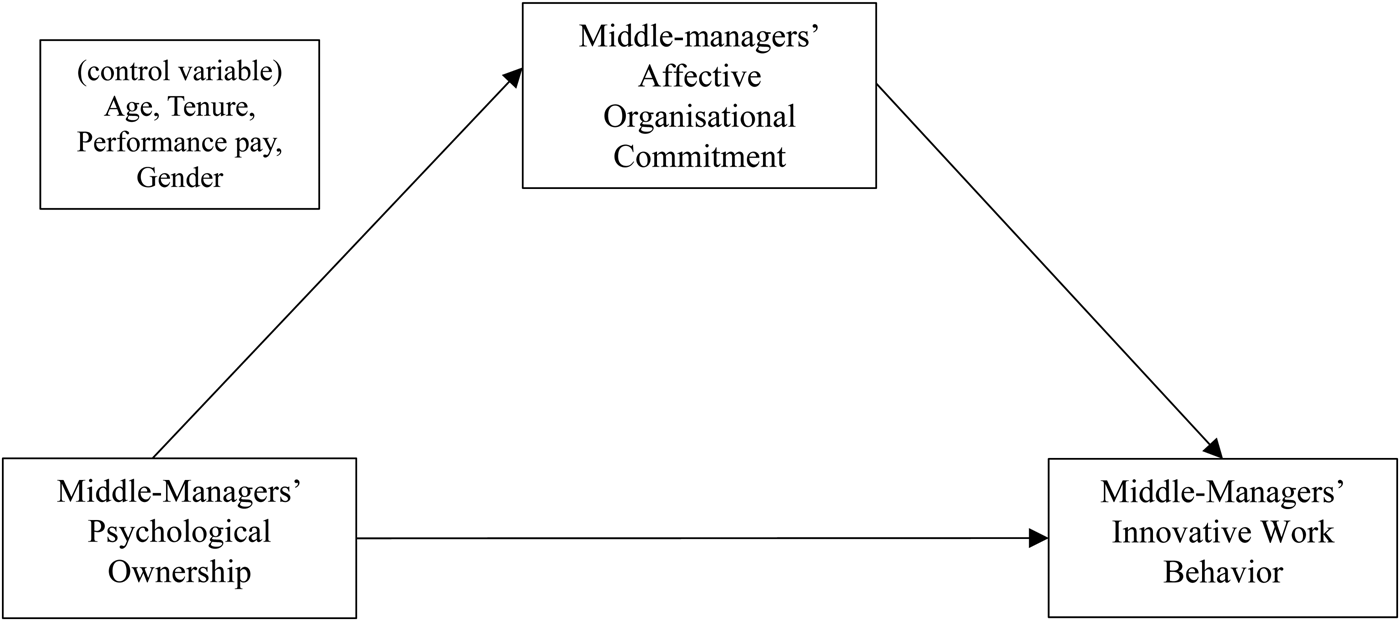
SIT further stipulates that as individuals are motivated to maintain or enhance their self-esteem, they are likely to identify with groups whom they perceive positively (Tajfel & Turner, Reference Tajfel, Turner, Worchel and Austin1985) and act in ways that support their functioning (e.g., Ashforth and Mael, Reference Ashforth and Mael1989). In line with the above assumptions, we suggest that when middle-managers feel that they ‘own’ the organisation, they are likely to extend their self to the organisation and consider it as part of their extended-self (Pierce, Kostova, & Dirks, Reference Pierce, Kostova and Dirks2001, Reference Pierce, Kostova and Dirks2003). Such psychological connectedness and self-identification (and underlying sense of PO) with the organisation can enhance middle-managers' AOC. In turn, AOC may motivate middle-managers to engage in IWBs. Figure 1 provides an overview of the theoretical model and the hypothesised relations in this study.
Conceptual model.

Middle-managers' psychological ownership and innovative work behaviours
Based on the theory of PO, we suggest that ownership feelings among middle-managers instil an ethic of responsibility and desire to safeguard and care for their organisation (Pierce, Kostova, & Dirks, Reference Pierce, Kostova and Dirks2001; Van Dyne & Pierce, Reference Van Dyne and Pierce2004). According to Fritze, Marchand, Eisingerich, and Benkenstein (Reference Fritze, Marchand, Eisingerich and Benkenstein2020: 2), ‘the psychological appropriation of objects helps people create and maintain their self-concepts, so they come to be considered as personal belongings’. As a consequence of developing ownership feelings towards the organisation, middle-managers may be motivated to invest personal time and energy in tasks and take personal risks (Pierce, Kostova, & Dirks, Reference Pierce, Kostova and Dirks2001) in recognising opportunities and generating novel ideas (Leyer, Hirzel, & Mooremann, Reference Leyer, Hirzel and Mooremann2020). Since PO instils a greater sense of personal responsibility, middle-managers are likely to champion their ideas to senior management (Hassi, Reference Hassi2019; Mustafa, Martin, & Hughes, Reference Mustafa, Martin and Hughes2016). By aligning their self-identities with that of the organisation, middle-managers may act to protect the organisation to protect their own self-concept. They may do so by pursuing initiatives that protect and promote the welfare of the organisation (Crant, Reference Crant2000). Additionally, the protective and nurturing behaviours associated with PO would motivate middle-managers to sustain enthusiasm and interest in pursuing IWBs despite the challenges and risks associated with such behaviours (Pierce, Kostova, & Dirks, Reference Pierce, Kostova and Dirks2003; Van Dyne & Pierce, Reference Van Dyne and Pierce2004). In support of our arguments, research has shown PO to be related to discretionary behaviours such as creativity and IWB (Avey et al., Reference Avey, Avolio, Crossley and Luthans2009; Dawkins et al., Reference Dawkins, Tian, Newman and Martin2017; Peng & Pierce, Reference Peng and Pierce2015; Wang et al., Reference Wang, Law, Zhang, Li and Liang2019; Zhang, Liu, Zhang, Xu, & Cheung, Reference Zhang, Liu, Zhang, Xu and Cheung2021). Therefore, we propose the following:
H1: Middle-managers' psychological ownership is positively related to their innovative work behaviour.
Middle-managers' psychological ownership and affective organisational commitment
AOC describes the emotional attachment an employee experiences with the organisation and their identification with and involvement in it, so that they have a personal and spontaneous desire to work toward the benefit of the organisation (Meyer, Allen, & Smith, Reference Meyer, Allen and Smith1993). PO differs from AOC, as the latter refers to a degree to which an individual wants to continue their membership in an organisation, while the former refers to the extent to which an individual feels ownership towards an organisation (Van Dyne & Pierce, Reference Van Dyne and Pierce2004). Although prior studies have established a strong relationship between PO and AOC (Dawkins et al., Reference Dawkins, Tian, Newman and Martin2017; Pierce, Kostova, & Dirks, Reference Pierce, Kostova and Dirks2003), few studies have explained the theoretical underpinnings of this relationship. This study proposes that the assumption underlying SIT may help frame the nature of the relationship between PO and AOC.
From an SIT perspective, employees who identify with their organisations are likely to merge the organisation's identity with their own (Ashforth & Mael, Reference Ashforth and Mael1989). Feelings of possession towards the organisation are illustrated by enhanced identification, integration, and belongingness with the organisation (Pierce, Kostova, & Dirks, Reference Pierce, Kostova and Dirks2001). Ownership feelings are likely to bind the employee to the organisation (Lam & Liu, Reference Lam and Liu2014; Meyer & Herscovitch, Reference Meyer and Herscovitch2001) pushing them to express and maintain their self-identities through their possessed objects (Pierce, Kostova, & Dirks, Reference Pierce, Kostova and Dirks2003). When possessions are viewed as part of the extended self, it follows that the loss of such possessions equates to a ‘loss or lessening of the self’ and is associated with detrimental consequences (Belk, Reference Belk1988: 142). Therefore, middle-managers' PO may trigger loss aversion and push them to seek ways to maintain and protect the connection between them and their organisations because of the unfavourable consequences that would arise if this connection is broken (Mayhew, Ashkanasy, Bramble, & Gardner, Reference Mayhew, Ashkanasy, Bramble and Gardner2007). Research has also shown that PO serves to satisfy the need for belongingness (Pierce, Kostova, & Dirks, Reference Pierce, Kostova and Dirks2003), a core element which fosters and employee's attachment to their organisation (Lam & Liu, Reference Lam and Liu2014). As such, middle-mangers' PO may motivate them to remain in the organisation, and as such foster their AOC (Pierce, Kostova, & Dirks, Reference Pierce, Kostova and Dirks2001).
The above argumentation suggests that middle-managers who view the organisation as an extension of their self may experience a higher degree of emotional attachment towards it (Van Dyne & Pierce, Reference Van Dyne and Pierce2004). The significant relationships between PO and AOC has been corroborated by several studies (e.g., Brown, Lawrence, & Robinson, Reference Brown, Lawrence and Robinson2005; Mayhew et al., Reference Mayhew, Ashkanasy, Bramble and Gardner2007; Vandewalle, Van Dyne, & Kostova, Reference Vandewalle, Van Dyne and Kostova1995). Therefore, we propose the following:
H2: Middle-managers' psychological ownership is positively associated with their affective organisational commitment.
Middle-managers' affective organisational commitment and innovative work behaviours
Innovative behaviours are more likely to be practiced by employees who are committed to their organisation (Xerri & Brunetto, Reference Xerri and Brunetto2011, Reference Xerri and Brunetto2013). Research has shown AOC as critical to enhancing the perceived attractiveness of anticipated behavioural outcomes and consequently increase efforts exerted to accomplish them (Seo, Bartunek, & Barrett, Reference Seo, Bartunek and Barrett2010). How middle-managers' AOC influence their IWB may be explained through the lens of SIT. SIT stipulates that identification with an organisation is derived from the demands for self-categorisation and self-enhancement (Smidts, Pruyn, & Van Riel, Reference Smidts, Pruyn and Van Riel2001). When identification occurs, employees' emotions and behaviours become based on the organisation's interest, rather than personal ones (Herman & Chiu, Reference Herman and Chiu2014). From an SIT perspective, AOC may motivate middle-managers to engage in IWBs via several ways.
Firstly, affectively committed middle-managers are likely to experience positive emotions and be emotionally attached to the organisation (Battistelli, Portoghese, Galletta, & Pohl, Reference Battistelli, Portoghese, Galletta and Pohl2013; Battistelli, Oboardi, Vandenberghe, Napoli, & Piccione, Reference Battistelli, Odoardi, Vandenberghe, Di Napoli and Piccione2019). Such positive emotions and attachment could be seen as akin to categorising and identifying themselves with the organisation. When middle-managers identify with the organisation, they are likely to experience higher levels of intrinsic motivation (Meyer, Becker, & Vandenberghe, Reference Meyer, Becker and Vandenberghe2004) and focus on behaviours that are beneficial to the organisation, such as knowledge and information sharing, which can increase IWBs (Auger & Woodman, Reference Auger and Woodman2016). Such arguments are consistent with prior research showing how the positive affective experiences associated with AOC can improve the development of new conceptual combinations by broadening one's momentary thought-action repertoire, thereby stimulating creative ideas (Baas, De Dreu, & Nijstad, Reference Baas, De Dreu and Nijstad2008).
Secondly, AOC is associated with increased trustworthy behaviours at work, which enhances the odds that employees will obtain the necessary resources to put creative ideas into practice (Meyer & Allen, Reference Meyer and Allen1991). Being considered as likeable and trustworthy members of the organisation by their subordinates and peers may facilitate middle-managers' access to critical resources and support necessary for the implementation of innovative ideas (Lau & Liden, Reference Lau and Liden2008). Finally, middle-managers' emotional attachment and identification with their organisation may also motivate them to challenge the status quo and experiment with new methods and strategies for working (Park, Zhou, & Choi, Reference Park, Zhou and Choi2018). Such arguments are consistent with earlier studies that have shown how employees with strong AOC invest in creating and applying novel solutions that help improve organisational effectiveness (Ribeiro, Duarte, Filipe, & Torres de Oliveira, Reference Ribeiro, Duarte, Filipe and Torres de Oliveira2020). Hence we propose the following:
H3: Middle-managers' affective organisational commitment is positively associated with their innovative work behaviour.
The mediating role of middle-managers' affective organisational commitment
In theorising the mediating role of AOC in the relationship between middle-managers' PO and their IWB, this study integrates both PO theory and SIT. PO theory suggests that middle-managers with high PO are more likely to invest their personal time and energy towards tasks within the organisation (Mayhew et al., Reference Mayhew, Ashkanasy, Bramble and Gardner2007). Such personal investments may lead middle-managers to experience a heightened sense of connection between themselves and their organisation, via the merging of their identities with that of their organisations (Dittmar, Reference Dittmar1992; Pierce, Kostova, & Dirks, Reference Pierce, Kostova and Dirks2003). These positive feelings will not only enhance middle-managers' evaluations of their personal adequacy and self-worth within their roles, but also heighten their sense of commitment towards the organisation (Van Dyne & Pierce, Reference Van Dyne and Pierce2004; Zhang et al., Reference Zhang, Liu, Zhang, Xu and Cheung2021) as affectively committed employees are more likely to experience positive emotions (Battistelli et al., Reference Battistelli, Portoghese, Galletta and Pohl2013).
From an SIT perspective, affectively committed middle-managers are likely to identify strongly with their organisation's values and goals, which propels them to act as good ‘organisational citizens’ and demonstrate their commitment to the organisation by putting the interests of the organisation above their own (Meyer & Allen, Reference Meyer and Allen1991). This encourages middle-managers to engage in IWBs (Odoardi, Battistelli, Montani, & Peiró, Reference Odoardi, Battistelli, Montani and Peiró2019). The above discussion suggests that middle-managers' PO may motivate them to engage in IWB through increasing their AOC. Therefore, we hypothesise that:
H4: Middle-managers' affective organisational commitment mediates the relationship between their psychological ownership and innovative work behaviour.
Method
Sample and procedure
Our sample consisted of 110 middle-manager–supervisor dyads from a single large Malaysian IT organisation with over 3000 employees. We chose to focus on a single IT service-based organisation for the following reasons: Firstly, the organisation in this study has a wealth of experience in the telecommunications and IT services industry and has grown significantly in the industry and region over the past two decades. Secondly, within the past five years, the organisation's senior leadership has been actively encouraging innovativeness and entrepreneurialism as part of business operations. Thirdly, since 2018, the organisation has been trying to develop an innovation culture and been trying to actively develop the capabilities and skills of its managerial workforce.
In 2019, the organisation's Chief HR Director was approached to help identify middle-managers for the study. Middle-managers are defined as ‘employees who link the activities of vertically related groups and who are responsible for at least sub-functional workflow, but not the workflow of the organisation as a whole’ (Floyd & Wooldridge, Reference Floyd and Wooldridge1997: 83). A multi-sourced data collection strategy was utilised to minimise common response bias. Firstly, questionnaire packages were distributed via electronic mail to all 215 middle-managers identified by the organisation's HR department, asking them to fill out questions related to their sense of PO, their AOC as well as basic demographic information. During this process, middle-managers were also asked to indicate their immediate supervisor. A total of 151 useable responses were returned.
One month later, the immediate superiors of the 151 middle-managers were e-mailed and asked to evaluate the middle-managers' IWB. A total of 68 superiors were emailed. Each superior was on average responsible for three middle-managers. In the end, we collected a total of 110 middle-manager–supervisor dyads representing a 51% response rate. The sample was 51.40% male with an average age of approximately 36 years (SD = 8.37) and an average tenure of 5.13 years (SD = 4.86). Approximately 48.20% of the sampled middle-managers held a basic undergraduate degree, while 39.10% had some sort of a postgraduate qualification.
Measures
Middle-managers' psychological ownership
Middle-managers rated their own sense of PO using seven items from Van Dyne and Pierce (Reference Van Dyne and Pierce2004). All items were measured using a 5-point Likert scale ranging from 1 = strongly disagree to 5 = strongly agree. The α reliability for this scale was .90
Middle-managers' affective organisational commitment
Middle-managers affective commitment was measured using six items from Meyer, Allen, and Smith (Reference Meyer, Allen and Smith1993). All items were measured using a 5-point Likert scale ranging from 1 = strongly disagree to 5 = strongly agree. The α reliability for this scale was .84
Middle-managers' innovative work behaviour
Middle-managers' IWBs were rated by their immediate-supervisor using six items from De Jong and Den Hartog (Reference De Jong and Den Hartog2010) and subsequently used by Coetzer, Inma, Poisat, Redmond, and Standing (Reference Coetzer, Inma, Poisat, Redmond and Standing2018). The six items reflect the four dimensions of IWB distinguished by De Jong and Den Hartog (Reference De Jong and Den Hartog2010): idea exploration, idea generation, idea championing and idea implementation. Consistent with earlier studies, IWB was measured as unidimensional construct due to the high intercorrelations among the dimensions (Coetzer et al., Reference Coetzer, Inma, Poisat, Redmond and Standing2018). All items were measured using a 5-point Likert scale with response options ranging from 1 = never to 5 = a great deal. The α reliability for this scale was .86
Control variables
The study controlled for the following common antecedents of IWB (Hammond, Neff, Farr, Schwall, & Zhao, Reference Hammond, Neff, Farr, Schwall and Zhao2011; Woods et al., Reference Woods, Mustafa, Anderson and Sayer2018): middle-managers' Gender (0 = female and 1 = male) and Tenure (in years), Age (in years) and whether the middle-managers received Performance Based Pay or not (0 = yes, 1 = no).
Results
Confirmatory factor analysis and data analytic strategy
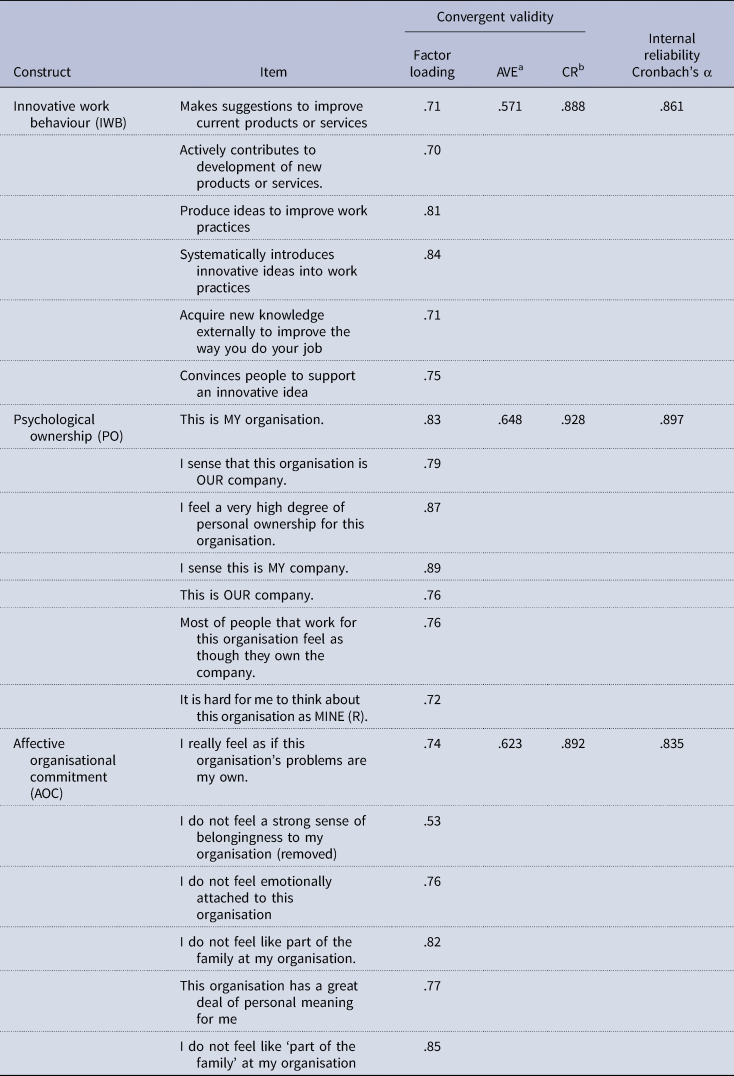
All variables demonstrated normal distribution with skewness and kurtosis values lower than 2 and 7, respectively (see Table 1). The goodness of fit was established using common indices including the χ2(df) statistic, the Comparative Fit Index (CFI), the Tucker–Lewis Index (TLI), the Incremental Fit Index (IFI), the root mean square error of approximation (RMSEA), and the standardised root mean square index (SRMR). Values below .07 for the SRMR, below .08 for the RMSEA, and above .90 for the CFI, TLI, and IFI indicate an acceptable model fit (Hu & Bentler, Reference Hu and Bentler1999).
CFA results

All items met the threshold factor loadings (.70) set by Hair, Black, Babin, and Anderson (Reference Hair, Black, Babin and Anderson2009). The AVE which represents the total amount of variance in the indicators of latent constructs was also assessed (see Table 1).
Results suggest that all scales had AVE higher than the recommended threshold of .70 (Hair, Ringle, & Sarstedt, Reference Hair, Ringle and Sarstedt2013) and were higher than the correlation values, suggesting good discriminant validity. Furthermore, the overall measurement model was found to have reasonable goodness of fit indices with χ2(110) = 231.290, p < .001, χ2/df = 1.62, RMSEA = .07, CFI = .925, IFI = .926, TLI = .909.
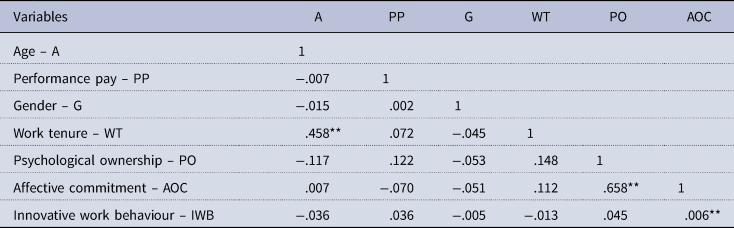
Table 2 reports the descriptive statistics and correlations among the study variables. PO was positively associated with AOC (.658**, p < .01) but not with IWB (.045, p > .05). AOC was also positively associated with IWB (.006**, p < .01).
Descriptive and correlations between main study variables

PO, psychological ownership; AOC, affective commitment and IWB-innovative work behaviour; *p < .05, **p < .01.
Hypotheses testing
Bootstrapping method using 95% bias corrected (BC) percentile was performed for mediation analysis. This analysis was performed using PROCESS MACRO (Hayes, Reference Hayes2018)
Direct effects
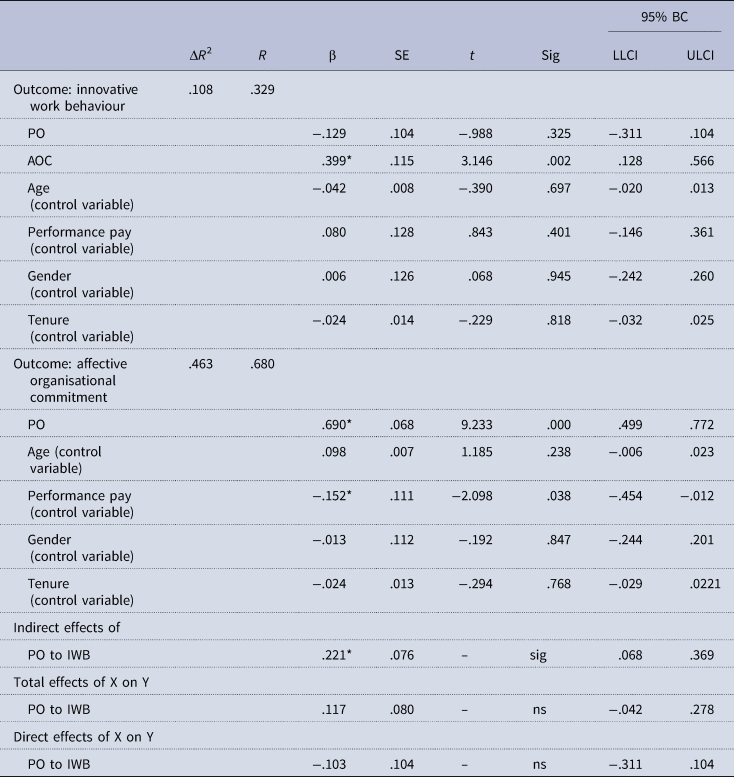
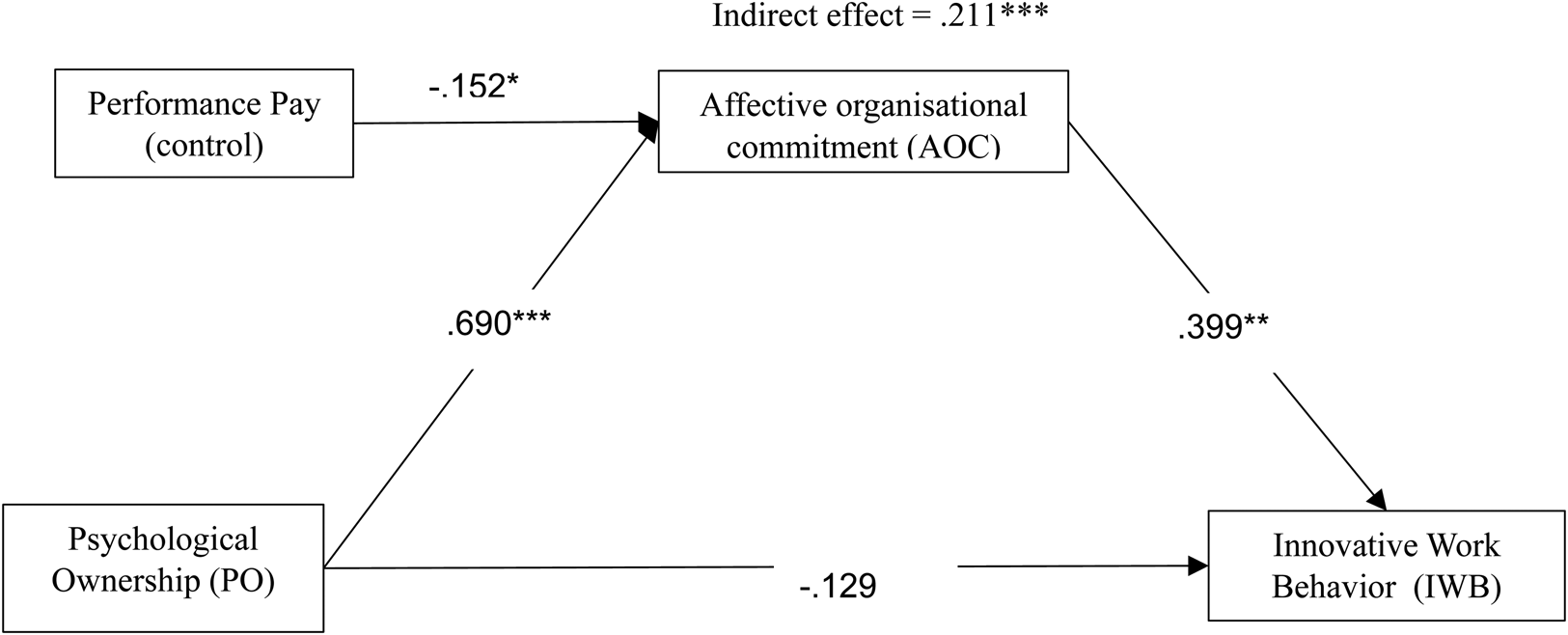
Table 3 illustrates the result for both direct and mediating effects of the main study variables. Analysis suggests that both PO and AOC accounted for 10.80% of the variance in middle-managers' IWB (R 2 = .108, F = 2.083, p < .001). Further results showed that PO (β = −.129, p > .05) had no significant direct effects on middle-managers' IWB but AOC (β = .399, p < .05) had significant positive direct effects on IWB. Thus, hypothesis H1 was rejected but H3 was supported. Additionally, PO had significant positive effects on middle-managers' AOC (β = .690, p < .001) and accounted for 46.30% of the variance (R 2 = .463, F = 17.964, p < .001) in AOC. Based on this, hypothesis H2 was supported.
Result for the mediating effects of affective commitment

PO, psychological ownership; IWB, innovative work behaviour; AOC, affective organisational commitment; * is marked for significant results.
Mediating effect
The mediation hypothesis was tested using the PROCESS MACRO (Hayes, Reference Hayes2018). PO had significant indirect effects on middle-managers' IWB (β = .221, LLCI = .068; ULCI = .369) via AOC acting as a full mediator. Therefore, hypothesis H4 was supported. These results are summarised in Table 4. Figure 2 illustrates the main findings of the abovementioned relationships.
Main findings. Note: **p < .01; p < .001.

Direct and indirect effects of study variables

PO, psychological ownership; IWB, innovative work behaviour; AOC, affective organisational commitment.
Discussion
The present study sought to examine the relationship between middle-managers' PO and their IWBs and whether their AOC mediates this relationship. Drawing on the theory of PO and SIT, the study found the effects of PO on IWB were mediated by AOC. In brief, PO played a critical role in developing middle-managers' IWB but did not impact IWB directly. This implies that when middle-managers develop ownership feelings for their organisations, they develop stronger AOC which in turn facilitates the development of their IWBs. This finding provides support to earlier studies which suggested that PO is likely to influence an employee's extra-role behaviours by enhancing their involvement, commitment, and integration in their organisation (Avey et al., Reference Avey, Avolio, Crossley and Luthans2009; Ramos, Man, Mustafa, & Ng, Reference Ramos, Man, Mustafa and Ng2014). SIT suggests that employees will increase their loyalty, efforts, and engagement when they experience a ‘psychological merging’ between themselves and the group, thereby encouraging them to care more deeply about the group's welfare (Tajfel, Reference Tajfel1982). Our findings suggest that middle-managers' PO may encourage them to form a stronger bond between themselves and the organisation (Lam & Liu, Reference Lam and Liu2014). Thus, when middle-managers feel emotionally attached to their organisation and are committed to it, they are more likely to engage in IWBs. This notion is consistent with earlier studies that IWBs are affected by AOC (Xerri & Brunetto, Reference Xerri and Brunetto2013).
The lack of significant direct effects of PO on IWB can be explained however by the theory of PO. PO theory suggests that ownership feelings may stimulate a sense of pride and responsibility towards a target (Pierce, Kostova, & Dirks, Reference Pierce, Kostova and Dirks2001). While such feelings may encourage discretionary behaviours, research has also shown that they may also serve as barriers to engagement and change in the workplace (Baer & Brown, Reference Baer and Brown2012). This finding is consistent with Avey et al.'s (Reference Avey, Avolio, Crossley and Luthans2009) suggestion that individuals with a preventive-focused PO are likely to devise goals that reduce the likelihood of punishment by prioritising obligations and rules over risky behaviours (Dawkins et al., Reference Dawkins, Tian, Newman and Martin2017).
Theoretical implications
This study has several theoretical and managerial implications. Firstly, we respond to Anderson, Potočnik, and Zhou (Reference Anderson, Potočnik and Zhou2014) and Bos-Nehles and Veenendaal (Reference Bos-Nehles and Veenendaal2019) call to further explore the individual-level psychological motivators and mechanisms behind IWBs. Scholars have acknowledged intrinsic motivators as a key currency of IWBs in the workplace (Anderson, Potočnik, & Zhou, Reference Anderson, Potočnik and Zhou2014). Specifically we add on to the literature regarding the role of different forms of attachment in fostering IWBs (Liu et al., Reference Liu, Chow, Zhang and Huang2019). Our findings showed how motivation to control, protect, and take care of an organisation by employees promoted IWBs by means of AOC. Such a finding demonstrated the complex path through which employees' attachment to their organisation may induce IWBs. This enhances our understandings of the psychological mechanisms underpinning IWBs and provides additional insights into the importance of AOC as a proximal attitude through which PO stimulates IWB.
Additionally, our identity-based approach to understanding the motivations behind IWB complements existing studies which have traditionally relied on exchange-based theories (Bani-Melhem, Zeffane, & Albaity, Reference Bani-Melhem, Zeffane and Albaity2018). Focusing on individual psychological motivators and the mechanisms to explain the emergence of IWBs represents a promising line of research as it can provide additional insights into why some employees are more likely than others to engage in these challenging and risky behaviours under the same contextual conditions. Such an approach is also consistent with the growth of actor-centric approaches to understanding IWBs (Bos-Nehles & Veenendaal, Reference Bos-Nehles and Veenendaal2019; Kör, Wakkee & van der Sijde, Reference Kör, Wakkee and van der Sijde2021).
Secondly, our study responds to recent calls by Dawkins et al. (Reference Dawkins, Tian, Newman and Martin2017) to better understand the impact of PO on a range of work-related behaviours. While studies have established a positive relationship between PO and extra-role behaviours such as OCBs, voice and helping behaviour (e.g., Bernhard & O'Driscoll, Reference Bernhard and O'Driscoll2011; Vandewalle, Van Dyne, & Kostova, Reference Vandewalle, Van Dyne and Kostova1995; Van Dyne & Pierce, Reference Van Dyne and Pierce2004), our understanding and empirical evidence of how PO influences innovative behaviours remain limited (Dawkins et al., Reference Dawkins, Tian, Newman and Martin2017). Our study responded to this issue in the literature by investigating the mediating role of AOC in the relationship between PO and IWB. Our findings highlighted the critical role that AOC plays in facilitating the effects of PO on IWB which had no direct impact on IWB. This shows that while ownership feelings can promote a host of pro-organisational behaviours, its role in cultivating discretionary behaviours like IWB is in part hinged on its ability to stimulate AOC which in turn fuels IWBs. Feelings of ownership then play a critical role in developing the organisational commitment of employees to stimulate innovative behaviours Hence, our study goes some way in addressing Dawkins et al.'s (Reference Dawkins, Tian, Newman and Martin2017) and Jia, Yan, Jahanshahi, Lin, and Bhattacharjee's (Reference Jia, Yan, Jahanshahi, Lin and Bhattacharjee2020) recent calls to open up the ‘black-box’ through which PO may encourage discretionary behaviours.
Finally, our use of SIT to understand how PO influences AOC and IWB responds to calls in the PO literature to integrate identity-based theories to understand the emergence and consequence of PO. The work of Pierce, Kostova, and Dirks (Reference Pierce, Kostova and Dirks2001) draws heavily on individual identity management functions of PO. SIT suggests that perceived membership of any social group has esteem-enhancing, or uncertainty-reduction functions (Hogg & Terry, Reference Hogg and Terry2000). Our study suggests that feelings of ownership among middle-managers help them to express their self-identity to others and maintain the continuity of their self-identity over time, thus helping in the formation of natural bonds between themselves and their organisations. Our finding here also complements existing identity-based explanations of AOC observed in the literature (Lam & Liu, Reference Lam and Liu2014)
Practical implications
This study has several practical implications for organisations and managers searching for ways to improve their innovativeness and increasing the contributions of their middle-managers. Firstly, our findings suggested that middle-managers affective commitment towards their organisations matter in fostering their IWB. This is because, middle-managers who are affectively committed to their organisations are more likely to invest more time and effort in their organisational roles by becoming more involved in behaviours that may not necessarily be part of their day-to-day roles. Thus, a challenge for many organisations and managers alike is to find ways to increase the AOC of their employees. Research has suggested AOC to be strongly associated with the work environment structure and perceptions of organisational support (Zhang et al., Reference Zhang, Liu, Zhang, Xu and Cheung2021). Hence, organisations and managers may wish to implement high-commitment work systems (HCWSs) (Kim & Wright, Reference Kim and Wright2011) as means of fostering AOC among their middle-managers. HCWSs seek to develop a long-term exchange relationship between organisations and employees and in doing so can reinforce middle-managers' organisational identity and psychological commitment to a long-term relationship with their organisation (Chen et al., Reference Chen, Jiang, Tang and Cooke2018). Such practices may encourage middle-managers to develop stronger bonds with their organisation and to become more committed to it (McClean & Collins, Reference McClean and Collins2011).
Secondly, besides fostering their affective commitment towards the organisations, organisations and managers may also consider enhancing middle-managers' ownership feelings. While our study showed that middle-managers' PO alone may not be sufficient to encourage IWB, ownership feelings are nevertheless important determinants of not only AOC, but also other pro-organisational attitudes such as job satisfaction (Mustafa, Mansilla, & Gibson, Reference Mustafa, Mansilla and Gibson2021b) and engagement (Ramos et al., Reference Ramos, Man, Mustafa and Ng2014). Given that such attitudes are desirable in organisations, senior managers may seek to encourage their middle-managers' PO through empowering and giving them opportunities to exert control over the work that they perform (Pierce, Jussila, & Cummings, Reference Pierce, Jussila and Cummings2009). This can be achieved through enriching middle-managers' jobs via job redesign to provide them with more control and autonomy in their roles or by giving middle-managers' opportunities to participate and become more involved in senior-level decision-making process.
Limitations and future research
The study is not without its limitations. Firstly, this study only focused on individual-level forms of attachment to an organisation as determinants of middle-managers' IWB. Given the lack of direct effect of PO on IWB, future researchers may wish to look at other forms of attachment and in particular identification as possible drivers of IWBs. Additionally, within organisational settings, employees may experience a variety of different attitudes other than AOC. Hence in addition to AOC, future research may wish to explore the roles of other pro-organisational attitudes and psychological states such as job satisfaction and work engagement as possible mediators in the PO–IWB relationship. In adopting an identity-based approach, we focused solely on how identification and ownership feelings may lead to feelings of commitment. However, commitment may also arise through social exchanges (Bos-Nehles & Meijerink, Reference Bos-Nehles and Meijerink2018). Hence it might be beneficial to also consider reciprocal arrangements and relationships between employees and their organisations. In line with Anderson, Potočnik, and Zhou's (Reference Anderson, Potočnik and Zhou2014) suggestion, we urge future researchers to adopt an interactionist perspective with respect to IWB by examining the effects of both individual attributes and organisational-related factors. Particularly worthwhile may be the use of multi-level studies which explore the role of contextual determinants such as HR and leadership practices on employees' attachment and pro-organisational behaviours (Woods et al., Reference Woods, Mustafa, Anderson and Sayer2018)
Secondly, our findings are limited in their generalisability because of the exclusive focus on middle-managers in a single organisational setting. Innovative behaviours are not solely limited to middle-managers and may exist throughout an organisation (Hornsby et al., Reference Hornsby, Kuratko, Shepherd and Bott2009). Consequently, future research should seek to compare the IWB of leaders across all levels in the organisations as well as different organisational settings. Specifically, given that IWBs are often context-specific (see Mustafa et al., Reference Mustafa, Coetzer, Ramos and Fuhrer2021a), future research may wish to explore how individual and organisational-level determinants influence employees' IWBs in diverse organisational settings such as new ventures, public and not-for-profit enterprises as well as in family businesses.
Thirdly, while this study conceptualised IWBs as a multidimensional construct, it was nevertheless measured as a unidimensional contrast. Prior research has shown that the different dimensions of IWB may be influenced by different individual and organisational-level antecedents (Wisse, Barelds, & Rietzschel, Reference Wisse, Barelds and Rietzschel2015). Accordingly, we encourage future researchers to provide a finer grained view of the determinants of IWB, by exploring how they influence its different dimensions. Finally, feelings of ownership and commitment towards an organisation may not necessarily be static in nature and may in fact be fleeting over time. However, in exploring the relationship between different forms of attachment and IWBs, this study drew on a cross-sectional survey design methodology hence limiting our ability to make causal inferences. Although we found a positive relationship between PO and AOC, it may also be possible that PO may not always lead to AOC given the changing nature of PO. Hence in-line with Zhang et al.'s (Reference Zhang, Liu, Zhang, Xu and Cheung2021), future research may wish to employ a longitudinal design to examine how feelings of attachment may vary over time and in different situations.
Dr. Michael Mustafa holds a PhD in Applied Psychology at the University of Nottingham. His current research interests include nonfamily employees and HRD in family firms and entrepreneurial behaviour in established firms.
Dr. Siti Khadijah is a member of the Department of Applied Psychology in The University of Nottingham, Malaysia Campus. Siti's current research area is work-design, work-life balance and psychological well-being.
Dr. Hazel Melanie Ramos holds a PhD in Clinical Psychology also at Ateneo de Manila University. Hazel's wide research interest has led her to do research on several areas such as work-family conflicts, work-life balance, stress and burnout among allied medical professionals, occupational health of migrant workers and psychological ownership in family firms.