Introduction
In the past decade, virtual reality (VR) technology has seen a shift from two-dimensional non-immersive projections to three-dimensional fully immersive experiences, allowing for the development of more sophisticated simulation (Aruanno and Garzotto, Reference Aruanno and Garzotto2019). The availability of this increasingly sophisticated technology has led to the development of successful applications of VR for several clinical indications, for example exposure therapy in individuals with anxiety (Opriş et al., Reference Opriş2012; Anderson et al., Reference Anderson2013), social skills and cognitive training in children with high-functioning autism (Didehbani et al., Reference Didehbani2016), and the reinforcement of self-directed compassion in Major Depressive Disorder (Falconer et al., Reference Falconer2016). Similarly, VR has been shown as an effective way to detect significant cognitive performance differences between adolescents with and without ADHD. Thus far, however, the application of VR for older adults has not been an area of prominent focus.
The growing prevalence of cognitive and affective disorders in the aging population has necessitated the development of innovative, scalable, and engaging interventions (Manera et al., Reference Manera2016). With VR technology becoming increasingly portable, user friendly, and affordable, its potential for use in older adults merits consideration. In order to leverage newer VR technology for use in this population and consider whether it may offer scalable solutions, we seek to conduct a review of the current state of the evidence for VR application for mental health in older adults.
Our primary aims are to assess the current evidence base for VR use in clinical settings with older adults and identify the most significant gaps in the literature, so that future research may focus on translating VR interventions to these areas and patient populations. We also assess the strength of experimental methods and VR interventional targets in the extant literature and identify VR programs commonly used across studies.
Methods
Database search
We conducted a search on PubMed and Web of Science in November 2019 using the following Boolean search: (“virtual reality” OR “VR” OR “VE” OR “virtual game”) AND (“older adults” OR “geriatric” OR “elderly”) AND (“dementia” OR “Alzheimers” OR “MCI” OR “cognitive impairment” OR “cognitive training” OR “cognition” OR “depression” OR “PTSD” OR “anxiety” OR “mood”). Search results were filtered to display articles published between January 2008 and October 2020 at the time of writing.
Article selection
We selected articles for review based on the following criteria: (1) Use of virtual reality, virtual environment, or virtual game application, (2) primary outcome(s) of cognitive functioning, psychiatric/psychological symptoms, or activities of daily living (ADL), (3) study population aged 50 and older with psychiatric diagnoses, and (4) peer-reviewed and presenting experimental data. We excluded articles based on the following: (1) Full text not available, (2) review or meta-analysis, (3) study focused solely on lifestyle interventions e.g. exercise (and not related to mental health outcome), (4) Intervention focused primarily on motor symptoms of Parkinson’s Disease or Parkinson’s Dementia. We determined by consensus that a review of Parkinson’s Disease was beyond the scope of our focus. Next, we created a focused matrix of evidence that we then compartmentalized into domains. Finally, we reviewed the full text of publications that met inclusion and exclusion criteria. Figure 1 displays a flow chart of the article selection process adapted from Moher et al. (Reference Moher2009).
PRISMA flowchart of literature search.

Data extraction and analysis
We extracted the following data from the included articles: number of study participants, study population, goal of the investigation, and the level of evidence. We categorized studies by the function of the VR technology being used (VR Indication), the study population (Domain of Psychopathology), and the study’s level of evidence based on the place of its experimental design in the hierarchy of evidence put forth by literature on evidence-based medicine (Thiese, Reference Thiese2014; Eldridge et al., Reference Eldridge2016; Saylor, Reference Saylor2020). The study’s level of evidence was rated on a 1–5 scale based on a simplified version of the Oxford Centre for Evidence-based Medicine levels of evidence (Phillips et al., Reference Phillips2009).
Results
Selected articles
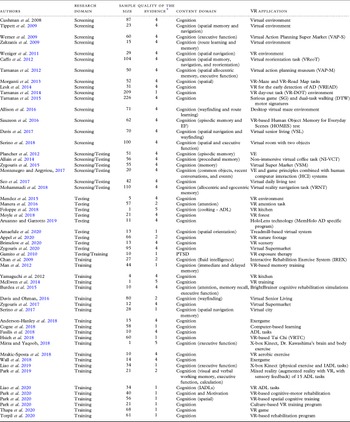
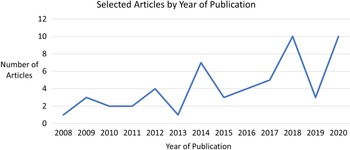
The database search yielded a total of 1554 results. No additional records were identified through sources other than the PubMed and Web of Science databases. With duplicates removed, the total number of records screened was 1428. Based on a screening of the article title and abstract, 1335 records were excluded for not meeting one or more of the inclusion criteria. Most frequently, articles were excluded at this stage for having no mention of VR in the title or abstract, a study population other than older adults, or a lack of access to the full text of the article. We assessed 93 full-text articles for eligibility. Of these 93 articles, 39 were excluded due to the following reasons: not studying a clinical population (18), not generating experimental data (12), no VR intervention (5), not testing primary cognitive or psychological outcomes (2), full-text not in English (1), not specific to a geriatric population (1). Figure 1 displays the PRISMA flowchart of the literature search and screening process for inclusion and exclusion criteria. A total of 55 articles were included in the final synthesis and are summarized in Table 1. Figure 2 displays the number of these selected articles by year of publication.
Summary of results

* Rating given on a scale of 1–5 based on a simplified version of the levels of evidence put forth by the Oxford Centre for Evidence-based Medicine (Phillips et al., Reference Phillips2009).
Selected articles by year of publication.

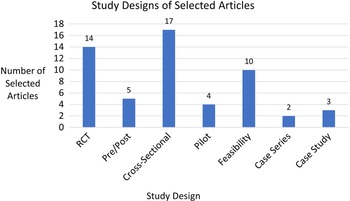
Overall, we found that the literature thus far captures studies conducted with forms of VR that are less advanced than the ones now available. We also note that the majority of studies published are cross-sectional, though we did note that the most recent studies included a growing number of randomized controlled trials (RCTs). Most of the current literature in older adults focuses on cognition and PTSD. Figure 3 reports the utilized study designs, with cross-sectional (17) and RCTs (14) as the most frequently used. The experimental groups in the cross-sectional studies were cognitively normal older adults, adults with mild cognitive impairment (MCI) diagnoses, adults with probable Alzheimer’s Dementia (AD), adults with mild AD, and adults with moderate AD. In one study, adults with MCI diagnoses were further subdivided into amnestic single-domain and amnestic multiple-domain MCI.
Study designs represented in selected articles.

Investigative aims and study populations
We identified a broad range of VR Indications and domains of psychopathology that had been studied. We noted three distinct use cases for VR: Testing, Training, and Screening. Testing articles investigated the feasibility and validity of using VR tasks with older adults by comparing VR task performance to performance on traditional neuropsychological measures. Training articles studied the cognitive effects of regular use of various VR applications, either by comparing the VR intervention to a traditional intervention or by comparing an individual’s performance on standard measures of cognition over time. Screening articles evaluated the ability of VR tests to differentiate between healthy controls and varying diagnoses of cognitive impairment. Of the 55 papers, 25 were categorized as Training (Chan et al., Reference Chan2009; Gamito et al., Reference Gamito2010; Man, Chung and Lee, Reference Man, Chung and Lee2012; Yamaguchi et al., Reference Yamaguchi2012; McEwen et al., Reference McEwen2014; Burdea et al., Reference Burdea2015; Davis, Ohman and Weisbeck, Reference Davis, Ohman and Weisbeck2017; Serino et al., Reference Serino2017; Zygouris et al., Reference Zygouris2017; Ali Mirza and Yaqoob, Reference Ali Mirza and Yaqoob2018; Anderson-Hanley, Barcelos, et al., Reference Anderson-Hanley2018; Anderson-Hanley, Stark, et al., Reference Anderson-Hanley2018; Cogné et al., Reference Cogné2018; Fasilis et al., Reference Fasilis2018; Hsieh et al., Reference Hsieh2018; Mrakic-Sposta et al., Reference Mrakic-Sposta2018; Wall et al., Reference Wall2018; Liao et al., Reference Liao2019, Reference Liao2020; Park et al., Reference Park2019, Reference Park2020; Park, Reference Park2020; Park, Jung and Lee, Reference Park, Jung and Lee2020; Thapa et al., Reference Thapa2020; Torpil et al., Reference Torpil2020), 21 were categorized as Screening (Cushman, Stein and Duffy, Reference Cushman, Stein and Duffy2008; Tippett et al., Reference Tippett2009; Werner et al., Reference Werner2009; Zakzanis et al., Reference Zakzanis2009; Caffò et al., Reference Caffò2012; Plancher et al., Reference Plancher2012; Tarnanas, Laskaris and Tsolaki, Reference Tarnanas, Laskaris and Tsolaki2012; Morganti, Stefanini and Riva, Reference Morganti, Stefanini and Riva2013; Allain et al., Reference Allain2014; Lesk et al., Reference Lesk2014; Tarnanas et al., Reference Tarnanas2014a, Reference Tarnanas2015; Zygouris et al., Reference Zygouris2015; Allison et al., Reference Allison2016; Sauzéon et al., Reference Sauzéon2016; Davis, Ohman and Weisbeck, Reference Davis, Ohman and Weisbeck2017; Fernandez Montenegro and Argyriou, Reference Fernandez Montenegro and Argyriou2017; Seo et al., Reference Seo2017; Mohammadi, Kargar and Hesami, Reference Mohammadi, Kargar and Hesami2018; Serino et al., Reference Serino2018), and 15 were categorized as Testing (Gamito et al., Reference Gamito2010; Plancher et al., Reference Plancher2012; Allain et al., Reference Allain2014; Mendez, Joshi and Jimenez, Reference Mendez, Joshi and Jimenez2015; Zygouris et al., Reference Zygouris2015, Reference Zygouris2020; Manera et al., Reference Manera2016; Fernandez Montenegro and Argyriou, Reference Fernandez Montenegro and Argyriou2017; Seo et al., Reference Seo2017; Foloppe et al., Reference Foloppe2018; Mohammadi, Kargar and Hesami, Reference Mohammadi, Kargar and Hesami2018; Moyle et al., Reference Moyle2018; Aruanno and Garzotto, Reference Aruanno and Garzotto2019; Amaefule et al., Reference Amaefule2020; Appel et al., Reference Appel2020; Brimelow, Dawe and Dissanayaka, Reference Brimelow, Dawe and Dissanayaka2020). Some articles met criteria for more than one VR Indication and were counted more than once.
We identified two primary domains of psychopathology in the literature – cognition and PTSD. The selected articles studied a cognitively impaired population, including prodromal AD, MCI and mild AD. Studies focused on these populations included 54 of the 55 selected papers. Among these papers, we noted a heterogenous focus on domains of cognition, with memory and spatial navigation most heavily represented (40%). A slightly smaller subset of articles (31%) focused on attention, executive function, or ADL functioning. A single article focused on a PTSD population and the potential use of VR to conduct virtual exposure therapy. Surprisingly, there were no articles that primarily studied a mood disorder population, though a small number (7%) of articles used mood, anxiety, or apathy inventories as supplementary measures.
VR environments
Across the literature, there were a wide variety of computer-based VR environments used, as opposed to other hardware such as virtual reality headsets. Nearly all the studies used a computer screen and mouse to interact with the virtual scenes, though immersive VR headsets were more common amongst more recently published papers, especially those published in 2020. Only one specific environment appeared in multiple studies included in this review, which was the Virtual Super Market (VSM). The three studies that used the VSM were published by the same authors (Zygouris et al., Reference Zygouris2015, Reference Zygouris2017, Reference Zygouris2020). Other VR environments included virtual kitchens, roads and cityscapes, mazes, and forests. These environments mostly focused on spatial navigation and completing ADLs, such as cooking or making a pot of coffee. However, there were no standardized VR environments used across multiple studies. For example, multiple studies used a virtual maze navigational task, but the design, layout, and features of the mazes varied across studies.
Clinical outcomes
Articles that investigated VR as a therapeutic intervention employed a variety of mood scales and standard neuropsychological tests to assess symptoms and cognitive performance before and after a period of VR use. Instruments used to assess psychiatric symptoms included the Beck Depression Inventory, the Impact of Events Scale Revised, and the Symptoms Checklist Revised. The most common neuropsychological test was the Trail-Making Test (A and B), which was used to assess executive function in 7 articles. The next most common tests were Digit Span for working memory and variations of a verbal learning test, which both appeared in 5 articles, and the Stroop test for executive function, which was used in 3 articles. Studies also used global measures of cognition, such as the Mini-Mental State Examination (MMSE) and the Montreal Cognitive Assessment (MCA), and comprehensive test batteries, like the Consortium to Establish a Registry for Alzheimer’s Disease neuropsychological battery. By demonstrating an effect on these widely accepted measures, VR interventions can establish their clinical value. Repeated studies on specific interventions at high levels of evidence will be needed to provide the empirical data necessary to support widespread use of VR in clinical settings.
Study results
Overall, the reviewed articles reported positive findings. Overwhelmingly, testing articles found that VR applications correlated well with traditional neuropsychological testing measures of the same cognitive skills. Training articles demonstrated the ability of VR to improve cognitive skills across a wide variety of domains, including spatial cognition, memory, executive function, and activities of daily living. Finally, screening articles provided support for VR’s use as a cognitive screening tool, as performance on VR tasks was able to distinguish between healthy control subjects, subjects with MCI, and subjects with AD.
Discussion
The primary goal of this review was to establish the extent and nature of current evidence to guide the use of VR for mental health applications among older adults. To this end, we found that VR technology has been used for four primary indications: 1) the assessment and diagnosis of degrees of cognitive impairment (Serino et al., Reference Serino2014; Parsons and Barnett, Reference Parsons and Barnett2017), 2) cognitive training or cognitive testing (Optale et al., Reference Optale2010; Ready et al., Reference Ready2010; Anderson-Hanley et al., Reference Anderson-Hanley2012; Levy et al., Reference Levy2016; Repetto et al., Reference Repetto2016; Hwang and Lee, Reference Hwang and Lee2017; Monteiro-Junior et al., Reference Monteiro-Junior2017; Doniger et al., Reference Doniger2018), 3) caregiver training (O’Connor, Arizmendi and Kaszniak, Reference O’Connor, Arizmendi and Kaszniak2014), and 4) designing novel and interactive approaches to treating cognitive impairment (Tarnanas et al., Reference Tarnanas2013; Coyle, Traynor and Solowij, Reference Coyle, Traynor and Solowij2015). We noted, however, that the overwhelming majority of studies were cross-sectional and of a preliminary nature. Longitudinal randomized trials remain few. There is evidence to believe VR applications provide greater ecological validity than traditional interventions and allow for creativity and innovation in the design of the task environment. Studies have explored the potential of VR to not only detect MCI and AD, but also distinguish between the two. One study that assessed performance on a VR memory task found that healthy controls performed significantly better on the task than subjects with AD (Fernandez Montenegro and Argyriou, Reference Fernandez Montenegro and Argyriou2017). Another pair of studies found that a cognitive task testing multiple cognitive domains was able to distinguish between healthy controls and subjects with MCI (Didehbani et al., Reference Didehbani2016; Falconer et al., Reference Falconer2016). VR tasks have also been able to distinguish between those with MCI and dementia (Manera et al., Reference Manera2016), as well as between healthy controls and certain MCI subtypes (Weniger et al., Reference Weniger2011; Mohammadi, Kargar and Hesami, Reference Mohammadi, Kargar and Hesami2018; Zygouris et al., Reference Zygouris2020). These findings suggest an imminent paradigm shift in diagnostic practices, as clinicians may be able to detect cognitive impairment earlier than the current model of diagnosis allows. VR environments may also facilitate performance-based assessment of functioning in situations older adults encounter in their lives, rather than controlled situations in clinical settings. For instance, the virtual environment grocery store (VEGS) may facilitate objective assessment of individual components of memory (Parsons and Barnett, Reference Parsons and Barnett2017). VEGS displayed a positive correlation to traditional neuropsychological measures of memory and executive function (Parsons and Barnett, Reference Parsons and Barnett2017).
Similar to diagnostic studies, treatment studies have supported the use of VR for providing immersive cognitive training to delay or prevent MCI and AD. VR can generate greater proximity to daily life and, therefore, VR-based training may be more easily translatable to real-world performance. For example, the VSM (Zygouris et al., Reference Zygouris2015, Reference Zygouris2017, Reference Zygouris2020) and VEGS (Parsons and Barnett, Reference Parsons and Barnett2017) are examples of immersive applications that may directly enhance cognition associated with navigation and wayfinding in older adults. Although it lacks diagnostic specificity, the VSM has been shown to be an effective tool for cognitive training that can differentiate healthy adults from those with degrees of MCI (Zygouris et al., Reference Zygouris2017, Reference Zygouris2020). VR has also been studied as a cognitive training tool to delay the onset of age-related disease. Across studies, participation in VR exercises demonstrated improvement in multiple cognitive abilities including memory, attention, and executive functioning (Man, Chung and Lee, Reference Man, Chung and Lee2012; Tarnanas, Tsolakis and Tsolaki, Reference Tarnanas, Tsolakis, Tsolaki, Brooks, Brahnam and Jain2014; Coyle, Traynor and Solowij, Reference Coyle, Traynor and Solowij2015; Fasilis et al., Reference Fasilis2018). VR can also be used to train functional skills like cooking or wayfinding, the lack of which can result in decreased quality of life for older adults (Che Me, Gramegna and Biamonti, Reference Che Me, Gramegna and Biamonti2015; García-Betances et al., Reference García-Betances2015; Foloppe et al., Reference Foloppe2018).
A growing body of literature is also demonstrating the validity of VR-based cognitive assessment in comparison to standard neuropsychological testing. For example, performance on VR tasks designed to measure executive function has been correlated with performance on the Stroop Test and Trail-Making Test, and performance on memory VR tasks has been correlated with performance on the California Verbal Learning Test and a free recall test (Parsons and Barnett, Reference Parsons and Barnett2017; Davison, Deeprose and Terbeck, Reference Davison, Deeprose and Terbeck2018; Corriveau Lecavalier et al., Reference Corriveau Lecavalier2020). One study reported a correlation between MMSE scores and performance on a VR spatial cognition task (Serino et al., Reference Serino2014), though a more recent study reported that the Virtual Supermarket Test had a higher correct classification rate when distinguishing between older adults with MCI and subjective memory complaints (Zygouris et al., Reference Zygouris2020). As this field matures, VR-based assessment may become the standard for cognitive assessment against which other tests may be measured.
Noteworthy gaps in the literature
Aside from 1 paper focused on posttraumatic stress disorder, we did not identify a single paper that focused on interventions for mood or anxiety disorders. These conditions have been studied extensively in younger adults (Opriş et al., Reference Opriş2012; Anderson et al., Reference Anderson2013; Falconer et al., Reference Falconer2016) but VR interventions thus far have not translated to older adults. The reason for this is likely multifactorial and points to an urgent need for at least early-stage studies on interventions such as exposure therapy, reminiscence therapy or mindfulness to be studied in the VR format. Other well-established interventions such as behavioral activation or problem-solving therapy may be translated to VR application (Wilhelm et al., Reference Wilhelm2005; Man, Poon and Lam, Reference Man, Poon and Lam2013). We also noted that the extant literature does not reflect significant recent advances in VR technology which is now accessed primarily via wireless headsets and is much more likely to be implementable in a broader range of settings. Finally, we noted that the literature on VR is generated predominantly from high income countries (HICs). While VR may hold the potential to create better access to assessment and interventions, major unanswered questions remain around whether the reported evidence can realistically translate to low and middle income countries (LMICs), whether the English-based approaches can apply to other languages, and finally how the costs of technology and need for some in-person infrastructure will translate to areas and populations that do not have economic or other resources.
The feasibility of using VR in populations with more severe cognitive decline also merits study, especially considering the onset of behavioral symptoms in dementia populations. Approaches using tablet devices have been found to be effective in managing behavior symptoms and dementia (Vahia et al., Reference Vahia2017). Beyond cognitive testing and rehabilitation however, there have not been reports of VR being used to target behavioral symptoms in dementia (BPSD). VR may provide a more engaging and immersive tool for activation of negative behaviors such as apathy or amotivation, even with the use of relatively simple apps such watching videos in VR format. It may also be help control more agitated behaviors or anxiety via tools such as mindfulness videos watched in VR. VR has the potential to amplify effects already observed with regular tablet apps because it is an immersive experience. These effects may have to be considered against the pragmatic challenges of engaging with a VR environment (e.g. wearing a headset, holding and manipulating a controller, and, in some cases, walking on a treadmill). Practical and ethical questions around using this technology with severely impaired older adults will need to be addressed. Finally, as with many emerging technologies, conversations around data privacy and confidentiality will need to preclude widespread use of VR in clinical settings.
Limitations
Our methodology does have some limitations that must be considered. We elected to restrict our search to PubMed and Web of Science, since our primary goal was to identify papers focused on geriatric mental health applications. While this may have left out some relevant literature, we do believe, however, that our search captures the salient trends around VR in late life. Also, because we searched only for papers published from 2008 onwards, there may be earlier relevant literature. However, given that VR technology is relatively new, we believe that this search timeframe captures the most relevant literature. We also acknowledge that our search period ends October 2020. This is a fast-growing area of the literature and will likley require updates as more studies are published.
Future directions
Freeman and colleagues (Freeman et al., Reference Freeman2017) postulate what will be required to fully reap the benefits that VR can provide, saying, “The treatment possibilities will only be realized if – with the user experience at the heart of design – the best immersive VR technology is combined with targeted translational interventions. The capability of VR to simulate reality could greatly increase access to psychological therapies, while treatment outcomes could be enhanced by the technology’s ability to create new realities. VR may merit the level of attention given to neuroimaging.” For older adults, our review indicates that we have only begun to scratch the surface of possibility. We anticipate that well established therapies such as mindfulness, exposure therapy and behavioral activation will begin to adopt VR as the platform of delivering interventions. This, in conjunction with ever improving ease-of-use of VR technology and the affordability of the equipment (as low as $15 for the simplest devices that rely on smartphones) will facilitate easy adoption at scale. While some of the issues we discuss above will merit attention, we believe that VR is poised for a major breakout as a tool to enhance geriatric psychiatric care, but we emphasize the need for developing evidence to guide care in conjunction with this scaled implementation.
Conclusions
In conclusion, our review identifies cognitive testing and cognitive training as the clinical applications of VR most supported by the evidence. However, most studies are early-stage and lag behind the sophistication of currently available VR technology. Many applications for children, adolescence, and young adults with mood, anxiety, and other psychiatric diagnoses have not yet been studied in older adults. Thus, the potential landscape for VR use in geriatric mental health remains under-explored with an extensive need for research, but rapid improvements in ease-of-use of VR technology combined with increased affordability suggests that the use of VR is likely to grow exponentially over the next few years.
Conflicts of interest
Dr. Vahia receives an honorarium from the American Association for Geriatric Psychiatry for editorial services, and research support from The National Institutes of Mental Health and the Once Upon a Time Foundation. Dr. Forester receives research support from the National Institute of Aging, the Spier Family Foundation, The Rogers Family Foundation, Biogen and Eli Lilly and serves as a consultant for Biogen. The other authors have no conflicts of interest to disclose.
Acknowledgements
The authors acknowledge the support of the McLean Institute for Technology in Psychiatry, the Technology and Aging Lab, and the Geriatric Psychiatry Research Program.
Author contributions
Miranda Skurla led the review of literature, selection of papers, extraction of data and preparation of the manuscript. Aniqa Rahman co-led the review of literature, selection of papers, extraction of data and preparation of the manuscript. Sarah Salcone, Liana Mathias and Bhumika Shah participated in selection of papers, extraction of data and preparation of tables. Brent Forester supervised the literature search and reviewed the content of the manuscript. Ipsit Vahia was the overall senior supervisor for the project and was responsible for conceptualizing it, reviewing all findings and preparing the manuscript.