Introduction
Seeking solutions to halt the loss of biodiversity is a major challenge for nature conservation today and this is exemplified increasingly by the roles played by large carnivores in international species and ecosystem protection campaigns. One has only to think of the global attention given to the plight of the polar bear, an animal portrayed in recent years by conservation and environmental groups, as well as by the media, as an iconic and charismatic animal roaming the Arctic on diminishing sea ice under threat from global climate change and overhunting. The presence of predatory animals in the form of large carnivores, whether they are polar bears, brown bears, wolves, tigers, lions, or sharks, is seen as being both characteristic of places defined as the wild and as an indicator of healthy ecosystems. It follows that the aim of much wildlife conservation has been to establish and sustain vibrant predator populations. In many places, however, this has led to local conflicts between people and animals, but also between people and conservation management, especially in areas of human population density, urban growth, tourism activity or agricultural production (Heberlein and Ericsson Reference Heberlein and Ericsson2003; McFarlane and others Reference McFarlane, Craig, Stumpf-Allen and Watson2007; Skogen and others Reference Skogen, Mauz and Krange2008; Buller Reference Buller2008). Of course, conflicts between humans and animal predators have deep roots in history, but recent literature in social sciences and conservation biology has shed some light on the changing nature of human relations to wild animals and the real or imagined threats posed by wildlife to human populations, livestock, and agricultural production (for example Knight Reference Knight2000; Knight Reference Knight2001; Philo and Wilbert 2000). Local, regional and national discourses often play on the opposition between human society and wildlife and they reinforce the socially constructed and historically determined boundaries between humans and animals. In parts of Europe and North America, the role of state intervention in managing human-predator animal relations has changed dramatically in recent years from policies supporting state-paid hunting bounties, and which saw extermination and eradication of predators as a management objective, to state-regulated predator conservation policies during the latter part of the 20th century (Breitenmoser Reference Breitenmoser1998; Schwartz and others Reference Schwartz, Swenson and Miller2003; Ermala Reference Ermala2003).
During the past few decades, international institutions have also acquired a strong role in how they act to influence national conservation policies. An example of this trend is the recent debate between Finland and the European Union (EU) on grey wolf (Canis lupus) hunting applications. In 2005, the EU began legal proceedings at the European Court of Justice against Finland (Case C-342/05) for violating the conservation targets of the EU's habitats directive (92/43/EEC), which forms the cornerstone of Europe's nature conservation policy. The EU appeal was related to a longstanding effort to combine Finnish hunting and animal husbandry traditions with EU conservation regulations (compare Finland 2005, 2007). The appeal was closed on the 3 April 2008, however, when the European Commission relented and stated that Finland has not threatened the sustainable level of its wolf population (European Union 2008).
Yet, the controversy over predators remains one that informs a continuing debate in Finland about the place of animals such as wolves and bears in a modern nation, but it is also a debate that challenges ideas about nature and the environment. The expansion of predator populations creates local tensions, including accusations of increased poaching and a distrust of scientific knowledge (Helsingin Sanomat 2008). In attempting to resolve these conflicts, special informal voluntary forums known as regional large carnivore consultative committees have been developed since 1998. These committees strive to enable the authorities and representatives of non-governmental organisations to mitigate predator related conflicts (Pellikka Reference Pellikka2005; Pellikka and others Reference Pellikka, Salmi and Ratamäki2008; Ratamäki Reference Ratamäki2008, Reference Ratamäki2009). A predator population estimation system has also been developed which aims to utilise information gathered from local predator sightings (Kojola and others Reference Kojola, Määttä and Hiltunen2006).
This article concentrates on research that the authors have been carrying out on the situation in the southeastern border regions of Finland's reindeer herding area, which is reported as being particularly critical (compare Castle Reference Castle2008a). According to our results, the wolf comprises a complex case in relation to consolidating nature conservation initiatives and locally sustainable livelihoods. We analyse contradictions related to conceptual, statistical and other management relevant knowledge and problems in hunting licensing. We discuss what are seen in this part of Finland as ‘wolf problematics’ with reference to the broader situation of predation and reindeer herding (compare Heikkinen and others Reference Heikkinen, Lakomäki and Baldridge2007). The article results from initial work under the auspices of a larger research project in which we are seeking to understand the contested borders and intersections between nature and culture and how managerial as well as natural systems interact during processes of socio-cultural-natural adaptations (for example Robbins Reference Robbins2004: xv–xvii), in which it is argued that both human and non-human actors have agency (Latour Reference Latour2005). Different actors, the most obvious being people, reindeer, and wolves, are part of the management landscape, but so are bureaucratic systems, EU directives, and the effects of political, administrative, and socially-defined borders, and we are concerned with the interplay between them. Our study draws on long term anthropological fieldwork related to reindeer herding, as well as in-depth analysis of media coverage on predator problematics in Finland since 1998 (for example Heikkinen Reference Heikkinen2002, Reference Heikkinen, Stammler and Beach2006; Moilanen Reference Moilanen2007). Building on long-term engagement with reindeer herders, further research was conducted in 2008 and 2009. Interviews were carried out with management authorities, herders in the southeast reindeer herding areas, leaders of Reindeer Herding Cooperatives (poroisäntä), predator watching entrepreneurs (that is people involved in developing nature tourism to view bears, wolves, and other wildlife), and environmentalists. Additional statistical data on reindeer herding in Finland were gathered from the Reindeer Herders’ Association and the Employment and Economic Development Centre of Lapland (TE-Centre), which, respectively, are concerned with, and responsible for, the state administration of reindeer herding, including subsidies and predation compensation systems. We also examined predator population data originally produced by the Finnish Game and Fisheries Research Institute (RKTL). Our aim is to analyse a situation of local conflict with particular focus on publicly debated contradictions that are related to conceptual, statistical and other management-relevant knowledge, as well as debates over sustainable reindeer herding (compare Heikkinen and others Reference Heikkinen, Lakomäki and Baldridge2007).
A note on research process and the study area
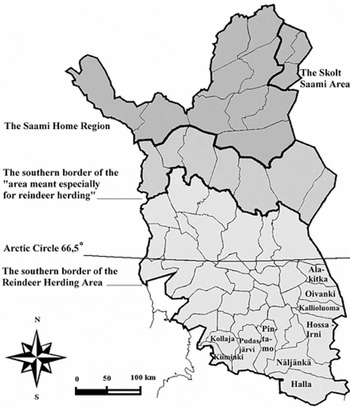
The research reported on in this article is part of a broader study focusing on nine southeast Reindeer Herding Cooperatives (RHCs, see Fig. 1) and the predator situation as it affects this border area. The number of breeding reindeer, the stock remaining after autumn slaughtering, varies in our study cooperatives between 1600 and 2800 animals.
The reindeer herding area of Finland. The study cooperatives are named.

Our basic study setting is twofold. Firstly, we built a general understanding of local reindeer/predation situations from official reindeer and predation statistics and we did some trial quantitative analysis for positioning and comparing locally emphasised points of view. Secondly we interviewed 24 local stakeholders about their understanding and practical experiences on predator related issues. For example, the interviews of municipal, state and game management authorities, of which there were 7, focused on their practical tasks in verifying killed reindeer or other domesticated animals, compensation bureaucracies and their experiences with different predators. Reindeer herder and farmer interviews, 9 in number, focused on their husbandry practices and particularly predators' effects on their livelihoods, as well as the experiences of state organised conservation hunting (or culling or cull hunt in some contexts). Five environmental activists were interviewed about their understanding of predators and about local effects and possible solutions. Because tourism activities focused on animal predators are often mentioned both as a threat and possibility for local communities in the near future, three predator watching (that is bear and wolf) tourism entrepreneurs were interviewed about their respective businesses and their opinions about predator issues, although in this article we concentrate mostly on the perspectives of husbandry related actors.
Herders, reindeer, and the predator situation and policies in Finland
To help move the reader onto the contested ground of predator and reindeer related policies in Finland, some background of the local situation must be provided as a starting point. In Finland both Sámi and Finns have traditionally engaged in reindeer herding, which is officially managed by 56 Reindeer Herding Cooperatives (RHC, Paliskunta in Finnish). The RHC system is especially emblematic for the southern reindeer herding areas (Heikkinen Reference Heikkinen, Stammler and Beach2006). Most of the land in the reindeer herding area is owned by the state and managed by the state enterprise Metsähallitus (Finland 2008), although in the more southerly parts the proportion of private lands is greater and landowners play a key role in, for example, the allocation and administration of hunting rights.
Herding in the Finnish southern reindeer area is based on free summertime grazing and a winter feeding period lasting from midwinter to April. Usually, between 70–90% of reindeer are enclosed in farm pens by the end of February. In recent years, the length of the winter farming period and also the percentage of farmed reindeer have both been increased as part of a strategy to protect reindeer from predation. Many southern herders are also small scale farmers. They keep sheep and cattle, grow hay for their reindeer, and may also produce some vegetable crops. However, although they grow fodder for their animals, much of what is consumed annually by reindeer and other livestock has to be bought. The increasing prices of gasoline and feed and the worsening predator situation have been the major reasons blamed by herders for the overall rapid decline of the profitability of herding. The overall average herder's income has continued to decline, from 2.90 Euros per hour in 2007 to 2.70 Euros in 2008 and the total number of reindeer owners has decreased to some 4900 in Finland (Heikkinen and others Reference Heikkinen, Lakomäki and Baldridge2007; Rantamäki-Lahtinen Reference Rantamäki-Lahtinen2008; Seeskorpi Reference Seeskorpi2008).
The human-reindeer ratios in the south are rather small compared to more northerly areas of Finland. In 2004–2005, the average owner in the northern part of the reindeer herding regions had some 43–48 breeding reindeer, while herders in the southern reindeer herding area had just 23. In the south, in 2003–2004, there were only 10 families which owned more than 200 breeding reindeer and only 15 percent owned more than 80 reindeer, which is the minimum number eligible for subsidies. Even though the sizes of private herds have expanded rapidly in the south, reindeer herding there remains a small sideline like occupation, although it is often an important auxiliary or even the only occupation in remote areas (Reindeer Herders' Association 2008; Rantamäki-Lahtinen Reference Rantamäki-Lahtinen2008).
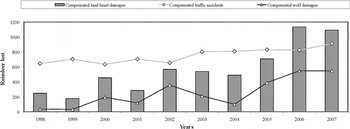
In general, the number of predators has increased steadily in Finland and so have the problems they create for reindeer management. In particular, wolf predation on livestock has become especially problematic. In our study area, reindeer herders have their farms and their reindeer and other animals in a region that stretches from the hinterland of the Gulf of Ostrobothnia to the Russian border, and includes sparsely populated regions of forest and wetlands. To give an idea of the extent of predation, Fig. 2 indicates compensated reindeer damages between 1998 and 2007. Compensated damages refers to money given to herders by municipal and state authorities in return for evidence for proved kills caused by wolves, lynx, brown bears and wolverines, as well as by traffic accidents.
Compensated predation, share of wolf damages and contemporary traffic accidents in the study RHCs.

Between 1996 and 2004, Finland's grey wolf population increased (Finland 2005) and the actual breeding population has since spread north and westward. The wolf problems along the southern border districts of the reindeer herding area are related to this extension. In predation statistics the years with increasing wolves can be seen as a peak in the number of compensated reindeer (Fig. 2). Yet, in spite of the distribution of wolves to new areas the wolf population is still concentrated mainly in eastern Finland near the Russian border (Kojola and others Reference Kojola, Määttä and Hiltunen2006).
The bear population is also concentrated in the eastern parts of the country, especially in northern Karelia. Currently the wolverine population is mainly concentrated in the northeastern parts of the reindeer herding area, but the lynx population is evenly spread in Finland and has increased steadily (Kojola and others Reference Kojola, Määttä and Hiltunen2006; RKTL 2008). In addition, the number of golden eagle pairs in Finland was around 460–470 in 2007. The eagle population is concentrated in the northern part of the country with 90 percent nesting in the reindeer herding area (Ollila Reference Ollila2008).
Despite the increase in predator populations in Finland in general, the official estimates show only a minor growth in predator populations in the country's reindeer herding areas (Kojola and others Reference Kojola, Määttä and Hiltunen2006; RKTL 2008). The mismatch between the annual increases in reindeer damages and the official statistics showing rather steady predator populations in reindeer herding areas is probably accounted for by the retrospective nature of state-regulated conservation hunting. This means that the land predators causing serious damages are defined as ‘harm animals’, which can be ‘removed’ with a special rogue predator hunting licence. As herders often point out, predators are also tracked in reindeer herding areas when reindeer kills are being assessed and they may react to this by wandering to more peaceful areas before the next official counting, which is usually arranged after midwinter.
The compensation system for predator damages in Finland is twofold. Firstly, the golden eagle damages are mostly restricted to reindeer, and the territorial compensation system encompasses only the reindeer herding area. Compensation is granted by the Ministry of Environment and is paid to the RHCs per nesting couple living in their area. Successful nesting is compensated threefold. The Metsähallitus Natural Heritage Services is responsible for counting nests and proving nesting success. Often the nests are searched in cooperation with reindeer herders (Ollila Reference Ollila2008; Sippola and others Reference Sippola, Norberg, Renko, Suopajärvi and Sutinen T.2005).
The land animal compensation system, however, is based on found and proved damages and kills and municipal agricultural officers have a responsibility to verify the damages. The amount of compensation depends on the killed animal and the rates are decided and paid by the Ministry of Agriculture and Forestry. For example, in 2006 the value of female breeding reindeer was an estimated 386 Euros and slaughter calves were estimated at 168 Euros. Reindeer damages were paid in double to encompass undiscovered reindeer kills, estimated reductions in calving success and the costs incurred for searching for carcasses. Finland has reviewed its compensation legislation and from 1 December 2009 onwards own risk excess limits has been removed, and the compensation is paid only 1.5 fold instead of 2 fold as previously (Finland 2009).
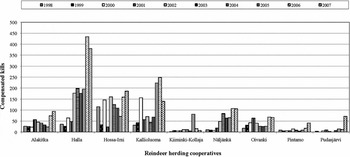
Reindeer losses from predation during the 20th century were concentrated near the Russian border, and also largely in the northern Sámi reindeer herding area (Sippola and others Reference Sippola, Norberg, Renko, Suopajärvi and Sutinen T.2005; Heikkinen Reference Heikkinen2002). During the last decade, the major change has been the large increase in southern reindeer losses mostly due to the expansion of predator populations from the south and east. This increase is evident in Fig. 3, even though it comprises only the proved, and as a consequence, compensated reindeer losses. The losses are especially remarkable in the most southeastern RHCs of Halla and Näljänkä, and in Kallioluoma and Hossa-Irni, which are close to Russian predator populations (compare Fig. 1; Finland 2005).
Compensated reindeer kills per southeastern RHC 1998 – 2007.

The rapid decrease of the productivity of reindeer husbandry is evident. For example, in the RHC of Halla the slaughter rate has decreased from some 25% to 10% during this decade (compare Castle Reference Castle2008b). In addition, the other applicable indicator of productivity is calving percentage (calves found per adult female reindeer) that is counted after autumn round-ups, but other natural circumstances, such as temperatures and precipitation, also affect calving success. However, according to recent ‘death bell’ that is radio-collar (silent mortality transmitter) studies in the RHC of Kallioluoma in 2005–2006, predator killed calves comprised 53% and wolf killed calves accounted for 45% of all dead calves found (Norberg and Nieminen Reference Norberg and Nieminen2007).
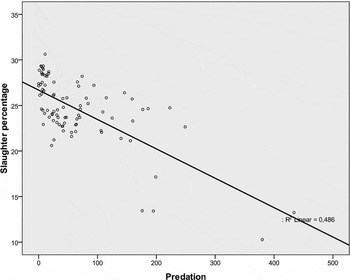
Summarising the quantitative analysis of gathered reindeer and predation statistics, we can conclude that the correlation (Spearman) between predation damages and calving (-,48) and slaughter (-,60) percentages is negative, which indicates that during the years of high predation both the calving and slaughter percentage tends to be smaller and vice versa (Fig. 4). However, the productivity is conditional upon several variables, so the numbers should be interpreted only as indicative. For example, in a year of favourable natural circumstances, the high calving percentage can enable high slaughter rates although simultaneously increase in predation losses, which can be also increased by the higher availability of reindeer. In addition, traffic accidents are also sometimes blamed for a reindeer's disappearance, but in Fig. 2 we can see a simultaneous increase in both the compensated predation and in traffic accidents. In interviews, herders noted that predation also tends to increase traffic accidents because, when pursued by wolves and other predators, reindeer are forced from forested areas to look for open spaces, like roads.
Correlations scatter between predation losses and slaughter rates. (N = 90, Kolmogorov-Smirnov test, threshold for normality 0,200, Spearman -,599).

Reindeer found alive in 2005, but shot by herders because its leg was so badly bitten by wolves. Archived photo from agricultural officer Hannu Nissi. The original photo was taken in authentic field conditions by a reindeer herder who happened to have a phone camera with him during a normal workday in the forest. The photo was used as proof when applying for compensation.

January inspection circumstances in Pudasjärvi. Photo by agricultural officer Hannu Nissi 2008.

The predator problem localised: the perspectives of herders and municipal officers
In earlier studies, the functionality of the compensation system has been found to have a direct effect on people's acceptance of predator damages in Finland (Sippola and others Reference Sippola, Norberg, Renko, Suopajärvi and Sutinen T.2005). We can agree with this conclusion, particularly from the viewpoint of how positive the effects of the territory based compensation system have been on the local tolerance of golden eagles in Finland. However, the issue with other animals is more complicated.
For example, research carried out in Wisconsin, USA, has shown that compensation does not necessarily influence tolerance towards wolf damage. Compensated hunters and livestock producers were not more tolerant than their counterparts who had not received compensation. Instead, the research concludes that the arrival of new urban dwellers and increasing recreational activities may support wolf recovery programmes (Naughton-Treves and others Reference Naughton-Treves, Grossberg and Treves2003: 1509). This is partially reminiscent of our findings, but without deeper inspection, it does leave us with the fruitless conclusion that, for example, rural livestock producers and hunters are predator hostile per se. Instead, our findings emphasise the fact that predator related problems vary between predatory animals and the forms of human engagement in question and the attitudes reflect specific local human-environment settings. With a similar emphasis, Sjölander-Lindqvist (Reference Sjölander-Lindqvist2009: 138) notes that in Sweden, forest-edge farmers' and hunters' attitudes towards a wolf recovery programme there can be explained by contradicting administrative and legal frameworks in addition to practical problems that wolves cause to their everyday activities, and the feeling that their contributions to the rural cultural environment are being overlooked.
In the next sections of this article, we discuss our empirical findings about the local situation in the southeastern border of the Finnish reindeer herding area. We concentrate particularly on the functioning of the practical compensation and conservation hunting arrangements, and the notions of justness and logic of the entire operational environment. In conclusion we put forward an idea concerning how, and with what limits, the actor-network theory (Latour Reference Latour2005) could contribute to a new understanding of modern human-environmental relations where it is hard to make clear distinctions between societal and biological spheres.
Local conceptualisations of large carnivores
During the 1990s, the scientific and public discussions about predatory animals in Finland heated up and focused notably on golden eagles and brown bears and their relation to reindeer calf losses, which were not included in the compensation system. With the territory based compensation system of eagle damages, a success story since 1999, illegal nest disturbances have decreased and herders' attitudes have changed towards a willingness for co-operation with management bodies because nesting success increases the sum compensated (Sippola and others Reference Sippola, Norberg, Renko, Suopajärvi and Sutinen T.2005; Heikkinen Reference Heikkinen2002).
However, brown bear damages are still a subject of debate. In interviews, herders and agricultural officers emphasised that, when they are not dormant during winter, bears hunt both adult reindeer and calves at all other times of the year. The situation with bears has been conceptualised as something particularly problematic because bears hardly leave any leftovers from killed calves, so that it is difficult to discover evidence of a kill, and they have a tendency to hide or bury adult reindeer so that they decompose. The basic problem is that there have been no effective means to prevent calving damages since the prohibition of the bear spring hunt in 1993. Since then, an entire generation of bears has emerged that travels even from Russia across the border to nearby reindeer calving areas in Finland. This ‘commuting’ begins when bears wake up hungry from their winter hibernations and continues until the autumn bear hunt begins in Finland, when many bears return to Russia. This local account of migration has also been recognised by Finnish border patrols. The suggested local solution is a simple one; allow the bear spring hunt again. As local herders put it to us, the idea is to maintain a situation where bears remain fearful of humans and prevent them from specialising on reindeer and benefitting from national hunting restrictions.
The wolverine situation was noted to have continued in a rather steady way. Damages happen mostly in certain limited areas near the Russian border and are concentrated during blizzards, when wolverines are understood by local people to ‘stock up.’ Herders have learned to limit these damages by drawing reindeer away from the risk areas, for example, into farm pens. This is important particularly before half-crust snow conditions in February, when the snow usually allows wolverines to travel across it, but which renders reindeer helpless in being able to move swiftly. However, the wolverine was mentioned by herders to be mainly a scavenger in the southern area, relying on leftovers from better hunters like wolves and lynx.
Instead, herders and agricultural officers told us, lynx-related reindeer damages have increased notably and correlate to the increase in the lynx population. The lynx is considered particularly problematic because it hunts reindeer throughout the year. Without the snow-preserving tracks, compensated lynx damages were considered as mere accidents. Herders and agricultural officers mentioned the period of frosty weather from January to March to be the worst because at this time the lynx kills repeatedly because of its inability to eat frozen carcasses. In addition, lynx damages were noted to be restricted almost exclusively to older forests where lynx hunt from trees, but this limits the utilisation of these traditionally important spring tree lichen pastures.
In all our herder and municipal officer interviews, the wolf was considered unanimously as being noncompliant with reindeer herding. It was emphasised that there can be, for example, certain rogue bears that can specialise in hunting reindeer, but these can be rather easily eliminated if appropriate hunting licenses are granted. In addition, some bears were noted to live near human settlements without any conflict with human interests. By contrast, wolves were conceptualised as clever hunters that utilise all potential prey animals as long as they are available and ‘preserve’ their prey, for example, by wounding their catch in a way it cannot escape from their territory.
One municipal agricultural secretary illustrated the effects of wolves according to his field experience in the following way:
Let's say we put water glasses floating on the lake, and we row with a boat beside those. Some would sink, but most of them will still float. But if we drive with a motorboat, all will sink. So in this way, the bear is like a rowing boat, but the wolf a motorboat. The wolf stirs up the whole system.
During interviews, informants expressed anxiety about wolves in anthropomorphic terms. The wolf was said to have ‘typical hunting habits,’ and was described as nasty, malevolent, brutal, cruel, bloodthirsty, and mean, an animal that was capable of ‘enjoying torture.’ On the other hand, however, it is considered wise, intelligent, innovative, and capable of learning and communicating, an intelligent animal that is often quite a match for an experienced group of hunters. Wolves just passing through an area were considered to do damage that was tolerable, but immediately after a breeding pair established a den a high regional peak in reindeer damage was noted to emerge. The other peak was noted to come when a wolf couple begins to teach hunting skills to its cubs. A wolf's habit to kill and wound more reindeer than they can eat provoked considerable negative anxiety amongst herders. By contrast, many environmentalists reasoned that this kind of behaviour is caused by human interventions and even a wolf's “immoral” behaviour serves other ecosystem functions, such as keeping up the natural levels of prey populations and ‘producing’ food for scavengers.
Local experience of conservation hunting procedures
The other frustrating issue identified and discussed during our interviews was the bureaucracy surrounding the application of licences for hunting special rogue animals under the auspices of conservation hunting methods (for northern Canadian examples of a growing literature on conservation hunting see Freeman and others Reference Freeman, Hudson and Foote2005 or Wenzel Reference Wenzel, Freeman and Foote2009). This licence is applied for personally, even on behalf of a community, such as an RHC. Before 2008, it was applied for directly from the Ministry of Agriculture and Forestry and required considerable documentation and background information. However, the rogue animal hunting licensing procedures were renewed in 2008, but at the time of our interviews, informants had not had experience of the working of this new system. In principle, the application criteria were the same, but the conservation hunting licences are applied for from local game management districts instead of from the Ministry of Agriculture and Forestry. This new system is generally hoped to speed up the application process.
For example, the RKTL is asked for a statement that confirms the existence of the animal in question and the effect of possible conservation hunting on the sustainable population level. The municipal agricultural officer's statement is needed, detailing the found and proved predator losses inside the region to which the application relates.
One of the problems mentioned concerned animal mappings that are not up-to-date. In one case, permission for conservation hunting was rejected on a basis of the official predator register that did not include the animal in question. It turned out that the mapping was based on a year old study. An agricultural officer certified dozens of reindeer during the previous months killed by the wolf pair in question. In general, agricultural officers felt aggrieved that their efforts for exact, up-to-date and documented predator damage information proving kills (including, for example, photographing carcasses and even autopsies of contested findings) were not taken in to account. Slow and complex licensing procedures were explained by the representative of the ministry to be caused by the immediate appeals from different environmental NGOs after a rogue animal hunting application form arrives at the ministry.
Our findings show that there seems to be a rather confusing gap between trust and knowledge. In one documented incident, both the herders' and municipal agricultural officer's statements were ignored and further information was asked for from the local game management district, which belongs to the regional game management system of the state. The district officer, living 100 km from the area in question, admitted to lacking local knowledge and sent a further request for information back to the local RHC leader, who was the original applicant. Only at this point was he considered the only stakeholder having up-to-date knowledge about the situation in the forest.
The normal application time for rogue animal hunting licences in 2007 was two to three months. When granted and issued, the hunting licence usually covered a hunting period of between 10–15 days during which the hunt had to be organised using the means specified in the application. The normal personal hunting licenses and hunting permissions from land owners had to be obtained and paid before hunting could begin.
Rogue wolf hunts were arranged in the municipality of Pudasjärvi three times during the autumn and winter of 2007. The first hunt was arranged at the end of September after an application process lasting two and a half months during which almost one hundred additional reindeer kills occurred. However, without snow the wolves were impossible to track down. When renewing the hunting licence for the winter time, the applicant did not realise that he needed to apply for separate permission to use snowmobiles. So, again the wolf pair was able to escape, this time to the nearby restricted nature reserve of Olvassuo where hunting is not allowed. Finally, the third licence application was successful and on the last day, 6 January 2008, over 200 hunters, of which a minority were herders, were able to track and restrict the wolf pair in an area where hunting was allowed and technically possible. The wolves were surrounded by using encircling tracks and flag lines scented with moose antler salt and diesel. At this time, the major problem was to secure hunting licences from local landowners and authorities before the wolves escaped back to the nature reserve. This was especially difficult because there were several privately owned forests in addition to state owned lands and the hunting licence area extended across the jurisdictions of three game management districts. All these licences had to be organised during one evening and night when hunters were able to keep the wolves surrounded in an area with a perimeter of 10 km.
The whole procedure of eliminating the wolves in our example described above, from midsummer 2007, when the first reindeer carcasses were found, to 6 January 2008, took almost seven months. The first rogue wolf hunting licence application was sent on 17 July, was renewed on 13 November and was renewed again on 19 December. During this episode the number of compensated and proved reindeer damages caused by this wolf pair increased to some hundred reindeer in the area of two neighbouring RHCs, Pintamo and Pudasjärvi. In addition, the slaughter animal number decreased, for example, in the RHC of Pudasjärvi from an average of 1200 –1450 to 1019 and calving percentage from average of 75% to 63%. The RHC leader and agricultural officer estimated that part of these losses was probably caused by spreading of the reindeer and failed round-ups because of terrified reindeer. In addition, the wolf episode took most of the RHC leader's work time from midsummer to January. Three other full time herders took also part in tracking the wolves and searching for killed reindeer, not to mention municipal agricultural officers whose work description was completely changed when they tried to find proof to answer the demands of the rogue wolf hunting licence procedure.
Local points of view about predator management policies
It was emphasised in interviews that the job description of herders and agricultural officers had changed from being concerned with reindeer husbandry activities to one that involved an arduous search for proof of reindeer kills in forest landscapes using all terrain vehicles and snowmobiles. The amount of time involved in this is considerable and the fuel costs are high. The compensation system was also criticised as being needlessly bureaucratic. After the discovery of a dead reindeer, herders begin to look for proof and a witness to sign the damage announcement. Then the damage application form will be filled and sent by the RHC leader to the municipal agricultural officer, who will consider the damage and the need for further investigation. Finally, the officer inputs the data into a geographical information system and forwards his statement and compensation request to the regional state authorities (TE-Centre) who evaluate the application and forward it to the Ministry of Agriculture and Forestry, which finally pays compensation from the budget according to the enacted regulations. This procedure slows down the whole process and the work load of municipal authorities is nearing the limits of local tolerance. In practice the number of killed reindeer is so large that de facto only 10–20% of damages are actually verified by spot checks.
Reindeer herders were in general frustrated because of their responsibility to search for, and prove, reindeer losses and particularly because, they say, the whole system remains embedded with mistrust despite their efforts. Moreover, it was noted that compensation should also cover the unproved predator damages more extensively. Protecting reindeer and looking for carcasses brings much extra work and costs both for herders and municipal agricultural officers. Both also agreed that the current own risk excess of 250 Euros per reindeer owner is unfair because of these extra costs that must be paid already.
Another source of frustration is the unrealistic hunting regulations and complex and time consuming rogue animal hunting licence bureaucracy which demands a considerable amount of paperwork. The hunting of certain rogue animals brings forth extra costs, for which there is no compensation. Herders emphasised that the earlier prescribed conservation hunting episodes are not part of their normal husbandry activities as interpreted by the state authorities. In short, the amount and logic of predator compensation was criticised as unjust from the point of view of individual herders and even municipal taxpayers who fund the work of the agricultural officers.
According to our interviews, the situation of bears, wolverines and lynx could be resolved by improving compensation systems, for example, by creating a territory based compensation system that is established on fair estimations of predator numbers and the average predation of reindeer. The only big problem mentioned was the poor trust with current predator counting methods and disagreement about the average reindeer catch. Similar problems have been reported in Sweden, where this kind of system is already in use (Sippola and others Reference Sippola, Norberg, Renko, Suopajärvi and Sutinen T.2005; Sjölander-Lindqvist Reference Sjölander-Lindqvist2009; Sandsröm and others Reference Sandström, Pellikka, Ratamäki and Allan2009). On the other hand, both herders and agricultural officers emphasised that predator information could be improved by combining different local sources, like the predator sightings gathered by border patrols, municipal authorities and hunters' associations. The use of local knowledge, even relying only on actors that are subject to official liability, should be improved.
In theory, herders, as ‘everyday forest lay specialists’, told us they were keen to participate in predator management and knowledge production, but in practice they were conscious about a general mistrust some officials have of them. As a realistic solution they were more eager to transfer all predator management burdens, including conservation hunting, to stakeholders responsible for predator conservation. They noted that their responsibility should be just to protect their reindeer herds, but to do that they would need more efficient means. These might include, for example, permission to carry a gun when tending reindeer or the use of bait or helicopters for removing certain rogue animals. The other favourite solution was that rogue animals should be removed by the police as is done in southern Finland and in other parts of Europe near human settlements.
Navigating in between reindeer and predator realms
It seems evident that the system of predator governance in the reindeer herding area of Finland and its vicinity needs to be reformed. The situation is one in which there is general distrust and contested knowledge, where the positions and perspectives of other stakeholders, especially reindeer herders, are ignored, and where the relationships between environmentalists, hunters and herders are poor. In fact, the predator management system has been criticised from the perspectives of all concerned, from those of conservationists, from reindeer herders, and even from some of the management authorities themselves. For example, even local official predator sightings were reported to be ignored and predator contact persons from both sides of the border of the reindeer herding area reported that local hunters had withdrawn from management co-operation because of their frustration and mistrust with the system (compare Sjölander-Lindqvist Reference Sjölander-Lindqvist2009; Sandsröm and others Reference Sandström, Pellikka, Ratamäki and Allan2009).
However, in this article our concern is with the points of view of those involved in reindeer herding for a livelihood, and we can conclude that available official predation statistics give only a narrow picture of the predator problematics when compared to local perspectives. This is probably related firstly to the compilation of statistics based on found, proved and compensated reindeer kills and secondly, on the strict regional nature of certain territory based predator problems. For example, the wolf hunt we described above concerned only the southern parts of two local RHCs. Instead the productivity numbers were rather good in some northern parts and this makes up for some of the local losses. It was emphasised by some herders that they had lost almost all the potential reindeer they had marked, or had planned to mark, for sale and that they had to save inferior breeder animals to keep their herd size fixed. The wolf damages spread over several administrative areas and the damages were compiled to the statistics of different RHCs and municipalities. But if we remember these kinds of limits in official statistics, they are still indicative of the herder's perspectives and agricultural officers' experiences of quite remarkable local losses.
Several solutions were suggested during our interviews for resolving predator questions pertaining to reindeer herding. Firstly, a buffer zone was suggested near the southern border of the reindeer herding area where predator levels would be kept low with effective hunting. Particularly, the criticisms of environmentalists of this solution focused on threats on sustainable population levels and halting the predators', especially wolves', natural breeding and movement from Finland and Russia to Sweden, where is a concern about inbred local predator populations (Finnish Nature League 2008; Mainio Reference Mainio2008). Secondly, the opposite was also suggested. Environmentalists we spoke to, as well as one disillusioned herder, suggested that a reindeer free buffer zone could be created and southern herders should be bought out of their profession by the state. This suggestion was opposed by most of the herders and agricultural officers by referring to their everyday experience and understanding of wolf behaviour. They suggested that wolves will just move northwards to the new reindeer herding border, a notion that receives support for example from the expansion of the wolf population in the European Alps (compare Glenz and others Reference Glenz, Massolo, Kuonen and Schlaepfer2001). Thirdly, it was proposed that the number of predators should be managed with renewed hunting regulations allowing more effective conservation hunting methods. However, the EU legislation sets rather strict limits for national applications, but also general public opinion, and possible media interventions, make these kinds of solutions, such as the use of poisons, helicopters or castration, highly unreliable when it comes to the repercussions for the implementers. In 2008, the environmental administration of the provincial government of Alberta in Canada, received a sharp backlash from the public and the media after suggesting wolf population control by using strychnine and castration (compare Cotter Reference Cotter2008; Foote Reference Foote2008). The fourth suggestion, that of improving the compensation system towards territory based applications, seems a relevant option according to our interviews, but still the wolf seems to be a special case to solve, as is noticed also in the conclusion of a study concerning the Swedish compensation system (compare Bosted and Grahn Reference Bosted and Grahn2008).
Taken together, predator policies in Finland form a highly conflicted issue with a great deal of practical local problems familiar to the academic field of political ecology (compare Robbins Reference Robbins2004; Biersack and Greenberg Reference Biersack and Greenberg2006). For example, there are similar kinds of suspicions that, behind the increase in the predator populations, lie hidden agendas of social, economic and environmental change, which brings to mind James Thompson's (Reference Thompson1993) argument that wolf recovery in the American west is really about superseding traditional land use (compare Kay Reference Kay1996). Also the sharing of costs and benefits between stakeholders is evidently unjust, which makes the co-existence of, for example, the predator watching and wildlife viewing tourism industry with reindeer herding highly contested. As a case in point, there was already a heated local conflict and debate between a bear watching tourism operator and the neighbouring RHC in the town of Kuusamo, near the Russian border, during our field work in 2008. There are also clear disputes about the methods of predator counting and an evident contradiction between local and expert knowledge on predators (compare Moilanen Reference Moilanen2007). The co-management systems and interaction between stakeholders concerned with predator conservation need to be improved and, a situation in which the EU, state and regional officials, researchers from different disciplines, environmentalists and local herders and hunters begin to learn and understand the perspectives of each other is a necessary first step towards achieving this (compare Bisi and others Reference Bisi, Kurki, Svensberg and Liukkonen2007; Hukkinen Reference Hukkinen2008).
Enhancing participatory possibilities is also recommended by Sjölander-Lindqvist (Reference Sjölander-Lindqvist2009: 139) for solving wolf recovery problems in Sweden, but she states that the existing participatory systems marginalise local perceptions and understanding from the start, because administrators insists that the participants' arguments must be built on scientific knowledge. This is also the primary dilemma in the Finnish co-management experiments. In addition, Sandström and others (Reference Sandström, Pellikka, Ratamäki and Allan2009: 43) have found that the regional large carnivore committees in Finland have only a poorly working consultative role, because they do not have any decision making power allocated to them by the state administration. With a lack of upward accountability, and with only informal downward accountability, their role in practice is more one of legitimating policies rather than true participation (Sandsröm and others Reference Sandström, Pellikka, Ratamäki and Allan2009: 46–47). Still, further development of existing and new round table and co-management approaches could be beneficial in the Finnish context because stakeholders' understandings of each other's perspectives seem to be extremely vague. Although in the long run it is obvious that local participation necessitates real decision making power allocated by local, regional and national authorities.
Even with this criticism, we can conclude that frameworks, applications and forums for settling predator disputes already exist in Finland, but the basic problem often identified by participants is the generalised and mutual feeling of distrust. This distrust is a key reason given for why there is still considerable local criticism against, for example, the functionality of co-research experiments (compare RKTL 2007), regional large carnivore consultative committees and the predator contact person network. Finnish predator management systems need to be reformed before there is a hope for a co-operative learning process, which is generally recognised as a starting point for resolving environmental conflicts (Daniels and Walker Reference Daniels and Walker2001).
Possible pathways for the future
Clearly, part of the problem for resolving predator related contradictions lies in the inability in knowing how to deal with the currently sectored and rather independent research and managerial realms of economics, ecologies, and socio-cultural and political spheres in which different overlapping empirical observations and experiences are difficult to handle and even discuss. A similar conclusion is reached by Sjölander-Lindqvist (Reference Sjölander-Lindqvist2009) in relation to the Swedish predator situation. The diversity of perspectives held by different actors, together with their intermingled networks of actions, form the current contested and contradicting environment for animal predators, but also for reindeer and herders, and both as living phenomena as managed reality. To overcome these differences, new innovative approaches are needed.
For example, drawing on Latour's actor-network theory (Latour Reference Latour2005), it is possible to argue that certain animals, as actors, can be interpreted to be predators which adapt to their surroundings from the basis of their species’ ‘typical’ behaviour, which includes both genetic drivers and learned habits. On the other hand, predators act in a space, or spaces, partially conforming to the rules and borders set by the wider society, and probably by reacting to signals received from other actors in their overlapping space of actions, such as the movements and deeds of hunters, herders and reindeer. We do not suggest that, for example, the behaviour of wolves is intentional in a way similar to that of humans. Instead, as herders argue, without a doubt, wolves notice whether they are hunted or not, and they learn where to find and seek out possible places of refuge in time and space, such as conservation areas, national borders and hunting seasons, or they come to recognise and learn which smells, species and settings are safe and which are not. In this way, the societal constructions or embedded cultural and natural products, such as hunting restrictions, free grazing traditions, and reindeer calving areas also ‘behave’ like an actor transforming the behaviour of ‘natural’ phenomena, such as wolves and bears.
In the world of action, intentional beings react in a context of other actions. Herders have to react to the limits and procedures set by administrative bodies at different levels, which on the other hand, are affected for example by the personal and collective actions of environmentalists to protect certain ‘natural’ actors from the effects conceptualised as ‘cultural’. The herders have to react to the behaviour of ‘semi-domesticated’ reindeer and, in a way, to the behaviour of ‘semi-culturalised’ predators, but also to their mutual interaction and changing behaviours. The scene of action is affected also by public opinion, media, changing moral codes and legislative codex, such as sanctions, subsidies and compensation systems, to which all actors, both ‘natural’ and ‘cultural’ have to adapt. Furthermore, it is illustrative of the myriad and complex ways in which space and place and human-animal relations are challenged and disrupted (Philo and Wilbert Reference Philo and Wilbert2000).
The end product is the rather common environmental situation of today, where it is impossible, and perhaps misleading in many cases, to separate natural, unintentional objects from cultural phenomena (compare Hukkinen Reference Hukkinen2008; Robbins Reference Robbins2004; Ingold Reference Ingold2000; Nadasdy Reference Nadasdy2007). The relevance of Latour's work for realistic policy-relevant settings, for instance, lies in the way we can think about conceptualising the environment in which stakeholders make their decisions for action. In this world, as Knight (Reference Knight2001) argues, animals and humans are many times equivalents as well as rivals with opposed interests, but we have to add that, in any case, we all are part of the overlapping process of socio-cultural-natural adaptations in which social, cultural and political representations of space, place, nature, and wild animals constantly shift and change.
It can be debated if the actors themselves or the relations between the actors are more important in understanding the network that forms our surroundings, as recently considered by Ingold (Reference Ingold, Knappett and Malafouris2008). Nevertheless an emphasis on both actors and relations between actors emphasises that the ‘meshwork’ of our environment will not get any clearer or manageable if the actors or relations between things are kept separate. Different co-management, participatory, and round table approaches have their deficits, but without such forms of open communication it is difficult, for example, to argue and recognise that animals are conscious and intelligent beings with reasonable motivations or to understand such phenomena as animosity or anxiety towards wolves.
Acknowledgements
This study was conducted as part of the Finland Distinguished Professor (FiDiPro) programme ‘Human–environment relations in the north: resource development, climate change and resilience’ funded by the Academy of Finland and based at the Thule Institute, University of Oulu, Finland and the Department of Anthropology, University of Alberta, Canada.