Introduction
The concept of ecotypes, defined as distinct genotypes (or populations) within a species resulting from adaptation to local environmental conditions (Hufford & Mazer Reference Hufford and Mazer2003), describes the geographical variation within a species and the balance between local adaptation and intra-specific hybridization (Begon et al. Reference Begon, Townsend and Harper2006). In lichenology, to distinguish between differentially exposed populations, the concept of ecotypes can be used, for example, to describe different altitudinal distributions (Nadyeina et al. Reference Nadyeina, Dymytrova, Naumovych, Postoyalkin, Werth, Cheenacharoen and Scheidegger2014). Another interpretation of structural changes in lichen thalli from different populations is often described as phenotypic plasticity. For example, different rates of photosynthesis occur as a result of differences in thallus hydration, due to structural changes, when comparisons are made between north- and south-facing populations of Ramalina capitata (Ach.) Nyl. (Pintado et al. Reference Pintado, Valladares and Sancho1997), and vagrant compared with attached thalli of Cetraria aculeata (Schreber) Fr. (Pérez-Ortega et al. Reference Pérez-Ortega, Fernández-Mendoza, Raggio, Vivas, Ascaso, Sancho, Printzen and de los Rios2012). Increasing the quantity of rhizinae is a modification that can improve thallus hydration and therefore photosynthesis, when comparing epilithic versus epiphytic populations of Parmelia pastillifera (Harm.) Hale (Tretiach & Brown Reference Tretiach and Brown1995). As a consequence of a decreased surface/volume ratio and increased water storage, the drying down rate of sun-exposed populations of Pseudocyphellaria dissimilis was shown to be slower when compared with shaded populations (Snelgar & Green Reference Snelgar and Green1981). Finally, Catillaria corymbosa (Hue) I. M. Lamb, an Antarctic endemic species, showed an increased water retention capacity and therefore more photosynthesis in shaded localities (Sojo et al. Reference Sojo, Valladares and Sancho1997).
In drylands, vascular plants are limited due to low water availability and therefore biological soil crusts (BSCs) become a dominant component of vegetation (Pointing & Belnap Reference Pointing and Belnap2012; Büdel et al. Reference Büdel, Colesie, Green, Grube, Suau, Loewen-Schneider, Maier, Peer, Pintado and Raggio2014). BSCs also occur in high alpine areas above the tree line, typically when the mean temperature of the warmest month is below 10°C (Körner Reference Körner1998), 70–80% of the precipitation falls as snow, and snow cover lasts for 270–300 days (Auer et al. Reference Auer, Böhm, Leymüller and Schöner2002). BSCs are small-scale poikilohydric lichen-bryophyte and microbial communities that are considered to be ecosystem engineers (Pointing & Belnap Reference Pointing and Belnap2012) that stabilize soil (Belnap et al. Reference Belnap, Büdel and Lange2003) and make significant contributions to the carbon and nitrogen fixation budgets (Elbert et al. Reference Elbert, Weber, Burrows, Steinkamp, Büdel, Andrae and Pöschl2012). Lichens often comprise a major proportion of vegetation at the climax stage of these communities (Büdel et al. Reference Büdel, Darienko, Deutschewitz, Dojani, Friedl, Mohr, Salisch, Reisser and Weber2009). Studies on soil lichen populations, including their functional aspects and morphological differences, are needed to facilitate prediction of climate change scenarios in these areas; these habitats are considered to be at high risk in recent climate change projections (IPCC 2012).
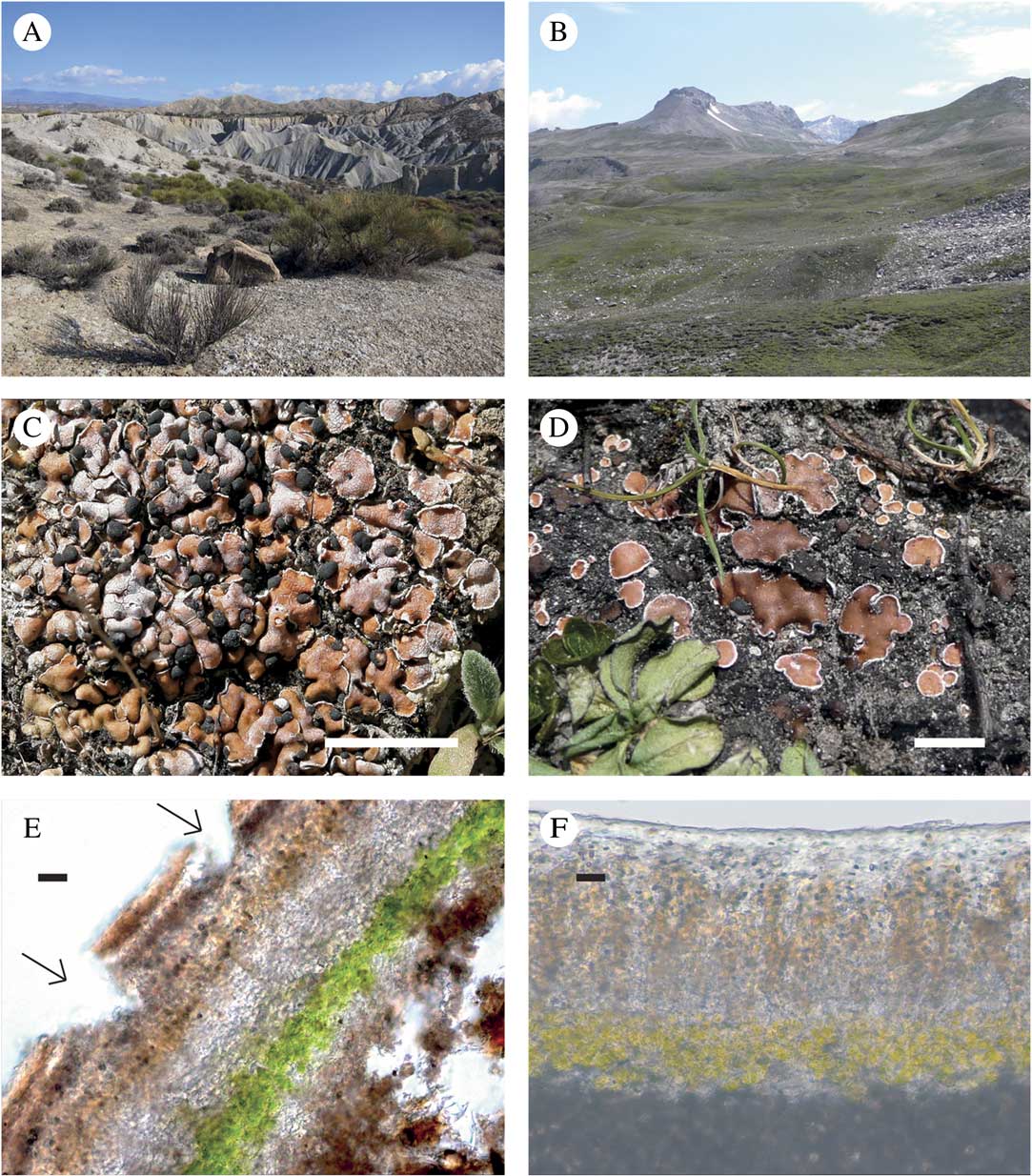
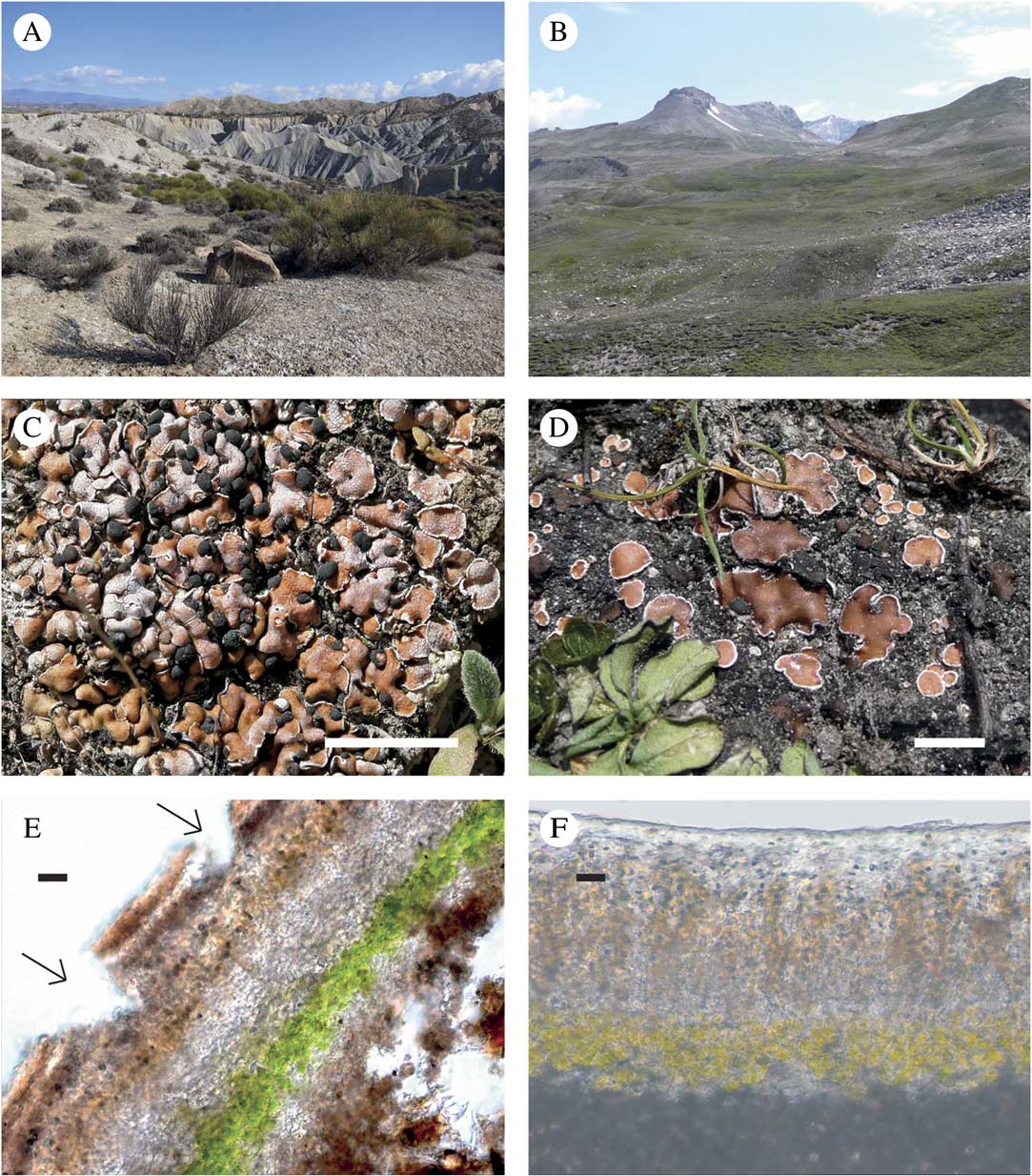
Here we studied the differences in morpho-anatomical and hydrological traits of two populations of Psora decipiens (Hedw.) Hoffm., a typical lichen occurring in the climax stage of biological soil crusts worldwide (Büdel Reference Büdel2003; Galun & Garty Reference Galun and Garty2003; Rosentreter & Belnap Reference Rosentreter and Belnap2003). Two contrasting areas with distinct populations were selected: a high alpine environment (‘Hochtor site’, Fig. 1A) and arid badlands (‘Almeria site’, Fig. 1B). Preliminary observations indicated 1) strong variance in overall thallus structure and appearance and 2) higher vitality of the alpine population (based on mean thallus size and vivid colour). Based on these field observations we hypothesized that local water availability is a major driver of morpho-anatomical differences in lichens and that these differences are linked to the optimization of thallus water relations.
A & B, study sites. A, Almeria, south-east Spain; B, Hochtor, Austrian Großglockner massif. C–F, Psora decipiens. C, appearance at the Almeria site (photograph: Martin Westberg); D, appearance at the Hochtor site; E, cross-section Almeria site, with a thick cracked (arrows) epinecral layer; F, cross-section Hochtor site, with a continuous epinecral layer and thick medulla including a thick photobiont layer. Scales: C & D=1 cm; E & F=20 µm.
Material and Methods
Study sites, organisms and sampling
We chose two sampling sites that support natural BSC occurrence but differ considerably in their environmental conditions. The ‘wet’ Hochtor site is a high alpine area at an elevation of 2500–2600 m a.s.l. on the Austrian Großglockner massif. The ‘dry’ Almeria site is located in south-east Spain. This location is considered to be one of the driest and sunniest in Europe and has been described in previous studies (Lázaro et al. Reference Lázaro, Rodrigo, Gutiérrez, Do and Puigdefábregas2001; Cantón et al. Reference Cantón, Solé-Benet and Domingo2004).
Psora decipiens is a pale pink squamulose-crustose lichen with conspicuous white-pruinose, often upturned margins. The lower cortex is white, poorly developed or absent and the attached hyphal net penetrates the substratum. It is a cosmopolitan lichen and is well known as an indicator species for intact BSC climax stages (Fig. 1C & D).
Thirty samples were randomly collected at each site in areas with homogenous BSC cover and no shading from plants. Each sample unit was a 9·2 cm2 section of an intact P. decipiens-dominated BSC, where several thalli were growing. Sampling at the Hochtor site took place in August 2013 and at the Almeria site in June 2013. Samples were dried at room temperature within 3 days of collection, transported and stored frozen. In the laboratory, the surrounding soil crust was removed from the thalli which were then washed.
Climate measurements
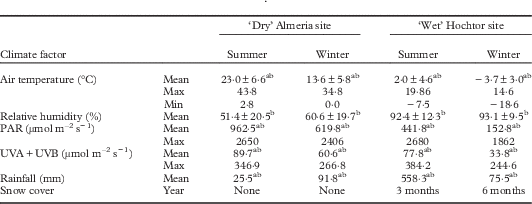
Both investigation sites were equipped with similar climate stations, capable of monitoring air temperature, humidity, solar radiation (photosynthetically active radiation (PAR), UVA and UVB) and precipitation. Climate data were recorded from both sites over 2 years, from April 2012–March 2014 at the Almeria site, and from August 2012–July 2014 at the Hochtor site. Air temperature and relative humidity were measured 1·5 m above ground and solar radiation at 2 m above ground. Snow cover was estimated from the length of time the various sensors were inactive. Mean
 $$\left( {\bar{x}} \right)$$
±SD values were calculated for summer and winter air temperature, humidity, PAR, UVA and UVB combined radiation. Additionally, maximum and minimum temperature and maximum UV and PAR radiation were extracted from the dataset.
Thallus morphology and anatomy
Thickness. The thicknesses of the lichen thallus, medulla, epinecral and photobiont layers were measured on sections prepared with a freezing microtome using the AxioVision software (Carl Zeiss, Jena, Germany) (for each site n=200 for both photobiont and medulla, and n=50 for the epinecral layer).
Specific thallus area (STA). To calculate the specific thallus area (mm2 mg−1), thallus size was first determined by microscopy using the aforementioned software. A standard procedure was used to delineate the extent of each lichen thallus. The lichen thalli were wetted to ensure maximum surface area, placed on graph paper and photographed. The corresponding dry mass of each thallus was determined by weighing after oven drying for 3 days at 60°C (n=21).
Specific thallus mass (STM). This was emphasized by Kershaw (Reference Kershaw1985) as being an important lichen parameter for water loss and water uptake and is the inverse equivalent of STA.
Hydrological traits
Drying rate. Drying rate was measured by determining the volume of water lost during one activity phase and using this to calculate the time needed for 1 µl of water to evaporate from one mm² of the thallus (min µl–1 mm–1). Activity was monitored by measuring chlorophyll fluorescence and the efficiency of PSII using an imaging-PAM chlorophyll fluorometer (Heinz Walz, GmbH, Effeltrich, Germany). To ensure water saturation before monitoring, specimens of roughly 10 mm² were submerged in water overnight (n=18). At the begining of the experiment these samples were weighed and then placed in a sealed plastic chamber (3 thalli per chamber) on a wire net over a saturated NaCl solution which maintained the relative humidity at 75%, equivalent to a water potential of -37 MPa at room temperature (Pardow & Lakatos Reference Pardow and Lakatos2013). Initially, the maximum quantum yield of PSII F v/F m of the hydrated and dark adapted (30 min) samples was measured as a reference. Subsequently, short saturation pulses were applied every 2 min to determine the fluorescence parameters for calculating PSII yield (Y=F v/F m). The time was measured from the beginning of the monitoring until a threshold of 0·2 PSII yield was reached. This was considered the time when samples were dry and inactive. The water loss for each thallus was determined by a second weighing directly after the measurement.
Water uptake. To ensure full water saturation prior to weighing, the samples were submerged in distilled water for 30 min. Excessive water and droplets were carefully shaken off before measurement of maximum wet mass (WMmax). The corresponding dry mass (DM) of these thalli was determined by weighing after 3 days at 60°C. The maximum water uptake relative to the thallus specific dry mass of the samples (n=36) was calculated as WMmax−DM/ DM (Pérez Reference Pérez1997).
Repellency. To measure water repellency/hydrophobicity of individual lichen thalli, the water drop penetration time (WDPT) was measured for 30 replicates. The WDPT test consists of placing a drop of water on the surface of the epinecral layer and measuring the time until complete absorption occurs. This is a commonly used test because of its simplicity (Letey et al. Reference Letey, Carrillo and Pang2000) and the value of information it provides, and it is considered to be the most indicative and sensitive way for the hydrological consequences of water repellency to be investigated (Doerr Reference Doerr1998; Leelamanie et al. Reference Leelamanie, Karube and Yoshida2008).
Optimum water content. CO2 gas exchange measurements were conducted under controlled laboratory conditions using a portable mini cuvette system (GFS 3000, Walz Company, Effeltrich, Germany). The response of net photosynthesis and dark respiration to thallus water content (WC) was determined for three replicates (each replicate was composed of c. 20 individual squamules) from each of the sites. The lengths of complete drying cycles (from water-saturated to air-dry thalli) were measured at 750 µmol photons m−2 s−1 (saturating light), ambient CO2, at 17°C (which is within the optimal temperature range for CO2-gas exchange of this species). Samples were weighed between each measurement and thallus WC was later calculated as a percentage of dry mass. Dry mass was determined after 5 days in a desiccator over silica gel. A reasonable estimate for optimal water content (WCopt) was considered to be that at which ≥90% of the maximum net photosynthesis occurred.
Water holding capacity. Water holding capacity (WHC) was calculated as: saturated wet mass – dry mass (mg)/ thallus area (cm–2) after shaking excess water off the lichen thallus. The corresponding dry mass of these thalli (n=20) was determined by weighing after drying for 3 days at 60°C. Thallus area was measured as described above.
Statistics
To determine differences between the anatomical features of the lichens and the climate of the two sites, student’s t-tests were used (Statistica 10, StatSoft). All data were normally distributed.
Results
Climate measurements
The data (Table 1) demonstrate the pronounced differences in temperature, humidity and precipitation between the sites, and also within the sites based on seasonality. In Almeria it was significantly warmer, drier and brighter than at the alpine Hochtor site. However, at the Hochtor site the growing season lasted only about 3 months due to the persistent snow cover.
Climate data differentiated by summer and winter for both investigation sites. Summer and winter are April–September and October–March respectively; duration of study was April 2012–March 2014 and August 2012–July 2014 for Almeria and Hochtor, respectively. Data presented are mean values with standard deviation where appropriate, maximum and minimum values recorded across the measuring period, average rainfall per season and snow cover duration. PAR and UV are based on daily mean and maximum values

a: values are significantly different within the sites (summer vs. winter), b: values are significantly different between sites (e.g. Almeria site summer vs. Hochtor site summer).
Thallus morphology and anatomy
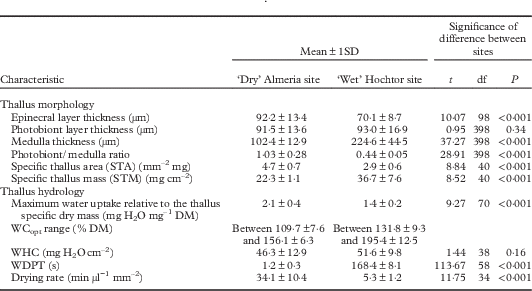
Thalli from Almeria had thicker epinecral layers but only half the medulla thickness compared to samples from Hochtor (Fig. 1E & F; Table 2). The photobiont layer showed no difference between the sites; the photobiont layer to medulla ratio of the thalli from the Almeria site was therefore twice as high. This indicates significant differences in the internal structure of the thalli between the populations. STA was also higher for samples from the Almeria site (Table 2), indicating that these thalli can support relatively large areas despite their reduced thallus matter. Consistent with this finding, STM was significantly higher for samples from the Hochtor site, indicating that these samples are thicker than those from the Almeria site.
Comparison of anatomical and hydrological characteristics of lichen thalli collected from the ‘wet’ Hochtor site and the ‘dry’ Almeria site
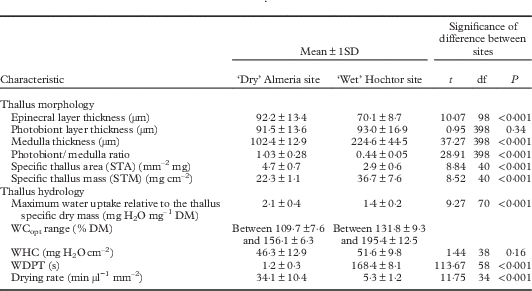
WCopt=Optimal water content; WHC=Water holding capacity; WDPT=water drop penetration time
Hydrological traits
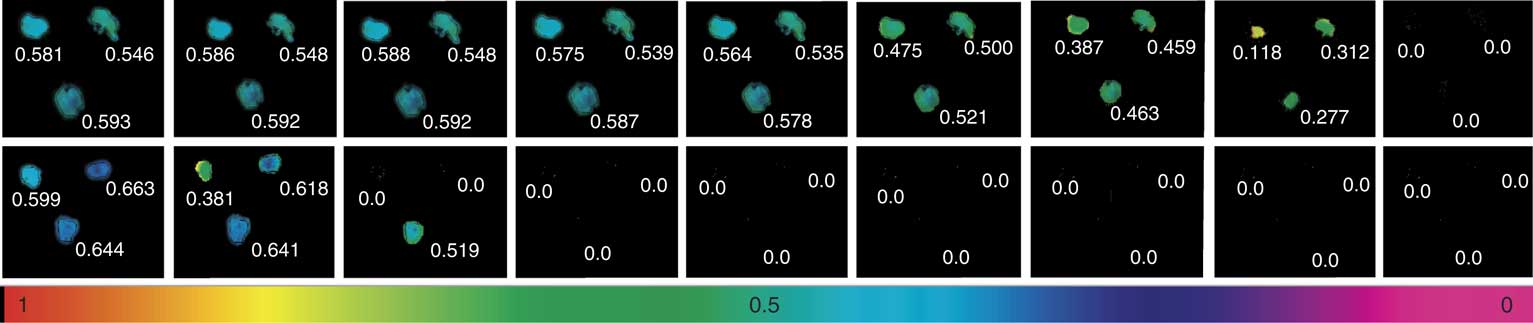
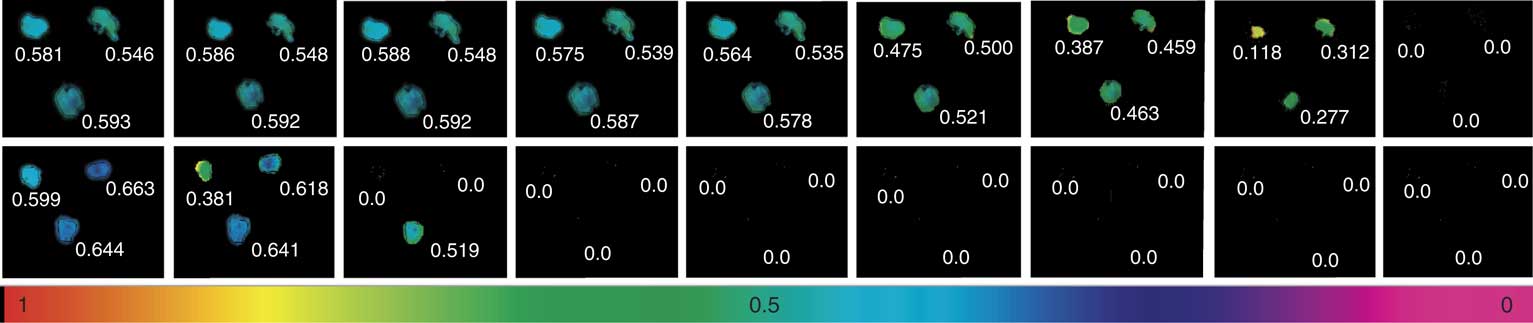
Both populations had similar water holding capacities per unit area (Table 2) and showed some common drying characteristics, independent of sampling site and thallus size (Fig. 2). For example, the initial activity of PSII was similar with high quantum yields of PSII at c. 0·6 (blue colour, Fig. 2). Additionally, these levels of activity remained relatively stable for periods of time independent of thallus size (c. 0·6). As soon as a threshold of desiccation was reached, the actual drying event occurred quickly and no fluorescence signal could be detected shortly after this. In contrast, the drying rate was different between the two populations. Thalli from the Almeria site dried six times slower than those from the Hochtor site (Table 2, Fig. 2). Additionally, P. decipiens specimens from Almeria took up water faster (1·2±0·27s compared to 168·4±8·1s for samples from Hochtor) and contained more water per dry mass than those from the Hochtor site (Table 2). The optimum WC for CO2 exchange extended over a significantly narrower range (109–156% DM) for samples from the Almeria site than those from the Hochtor site (131–195% DM).
Dehydration kinetics of Psora decipiens. False colour chlorophyll fluorescence images of the effective quantum yield (Y) of photosystem II distribution over three thalli from the Almeria site (upper row) and Hochtor site (lower row), obtained using an Imaging PAM (Walz GmbH, Effeltrich, Germany). Yield intensity is colour coded covering a range from 1– 0, with red indicating very high values and violet low values. Y values at a chosen area of interest in the image are indicated. Images were taken every 2 minutes.
Discussion
In the present study we have demonstrated distinct differences between two populations of the lichen species P. decipiens derived from climatically contrasting habitats. Morpho-anatomical differences appear to be reflected in differences in functional water relations and diffusion properties as a result of local water availability. We have identified eco-physiological and morphological mechanisms that underlie the high variability in P. decipiens and determine its ecological fitness in a particular habitat.
The most striking difference between the two populations is water gain. Considering the differing STA and the maximum water uptake relative to the thallus specific dry mass, thalli from both sites have the same water holding capacity on an area basis (WHC in Table 2). This indicates that not only surface area but also thallus internal structure must be studied to understand the drying processes in lichens. During the drying process, the amount of water in the thallus based on thallus area should be considered. The resulting calculation shows that drying from optimal water content to completely desiccated lichen thalli takes 2·5 minmm−2 for thalli from Hochtor compared with 15 minmm−2 for Almeria thalli. This result is supported by chlorophyll florescence which shows a much slower rate of decrease in activity in Almeria thalli (Fig. 2).
Samples from the dry Almeria site show both improved water uptake and reduced water loss. A reduction of water loss in lichens seems remarkable because lichens, as poikilohydric organisms, are known for their passive water control and unregulated loss of water over the whole thallus surface. Nevertheless, Beckett (Reference Beckett1995) showed that lichens from dry habitats seem to make better use of their water by maintaining turgor down to relatively low water contents. The reduced rates of water loss found here might be the result of increased resistance to diffusion caused by the thicker epinecral layer. This layer is often described as amorphous and is composed of decomposing hyphae with indistinct cell lumina; it forms a very dense layer that can act as a barrier to water loss, more so than the upper cortex. In the revised generic concept of Parmelioid lichens (Crespo et al. Reference Crespo, Kauff, Divakar, del Prado, Pérez-Ortega, Amo de Paz, Ferencova, Blanco, Roca-Valiente and Núñez-Zapata2010), a pored epicortex is an important diagnostic feature alongside molecular, morphological and chemical evidence. The epicortex probably provides an extra layer of protection against evaporation. A thick epinecral layer, as present in the samples from the dry Almeria site, might therefore account for such a reduction in water loss. Nevertheless, developing a thick epinecral layer also seems contradictory to improved water gain because it is reported to have hydrophobic properties (Lakatos et al. Reference Lakatos, Rascher and Büdel2006). The occurrence of hydrophobins, proteins unique to mycelial fungi, has been suggested to be important for the survival of lichens (Wessels Reference Wessels2000). According to Honegger (Reference Honegger1991), a hydrophobic lining of gas spaces allows efficient apoplastic transport of water and solutes between the symbionts and permits optimal gas exchange during wet periods. Therefore, very low water repellency of the samples from the Almeria site is unsurprising. The suggested explanation for this result derives from the structure of the epinecral layer itself and how this influences the lichen surface (Fig. 1C & D). In dried thalli, the epinecral layer has open cracks (Fig. 1E) which increases the surface area and facilitates water uptake by cohesion and adhesion, leading water towards the photobiont layer (Fig. 1E & F). The WHC of Psora decipiens matches the common intensities of dew and rainfall at the site with 10 mg H2O cm−2 equating to 0·1mm dew or rain (Gauslaa Reference Gauslaa2014). Values close to 50mg H2O cm−2, such as those recorded for specimens from the dry site Almeria (Table 2), indicate that these lichens use the infrequent rainfall even more often than dewfall. This is consistent with the hypothesis that liquid water is channelled to the photobiont layer by cracks in the epinecral layer. Both findings suggest that the role of the epinecral layer is to influence the lichen hydrology. To our knowledge this has not been previously described. The function of the epinecral layer is usually suggested to be protection against high light stress (Büdel & Lange Reference Büdel and Lange1994; Rikkinen Reference Rikkinen1995; Büdel et al. Reference Büdel, Karsten and Garcia-Pichel1997; Kappen et al. Reference Kappen, Schroeter, Green and Seppelt1998; Dietz et al. Reference Dietz, Büdel, Lange and Bilger2000). For chlorolichens, drying combined with light exposure can be particularly harmful (Gauslaa et al. Reference Gauslaa, Coxson and Solhaug2012) and it was suggested that the ability to recover correlates positively with increasing species-specific WHC values. In Almeria, light intensities and UV radiation are much higher throughout the year (Table 1) and in this population the thicker epinecral layer is therefore necessary to prevent light damage. In the Hochtor site, where light intensity is generally lower and exposure times to both PAR and UV are shortened due to snow cover, such protection would not be required or of extra benefit to the lichen.
At the wet Hochtor site, the lichens experience a different set of stresses. Water saturation for many hours a day may result in negative carbon gain for two reasons. First, high respiration rates during the night and under the snow cover can influence carbon balance negatively and second, CO2 diffusion resistance is high in water supra-saturated thalli, thus reducing the substrate for photosynthesis (Cowan et al. Reference Cowan, Lange and Green1992). The high WHC values indicate that these lichens are more often exposed to rainfall events of c. 40 mm precipitation (Gauslaa Reference Gauslaa2014), which explains their frequent water saturation. For lichens, it is essential to minimize periods of water supra-saturation. Indeed, the functional aspects that we report here for the lichens from the wet Hochtor site are fast desiccation times, high hydrophobicity, low maximum water uptake relative to the STM and a broad range of thallus water contents for optimal photosynthesis. These characteristics are at least in part a consequence of thallus anatomy, in particular a very thick medulla layer which is best quantified by the high STM values (Table 2). The medulla is the fungal zone in the lichen thallus, composed of hyphae, with cell walls that are often incrusted with crystalline secondary metabolites. Lange et al. (Reference Lange, Green, Reichenberger, Hesbacher and Proksch1997) showed that lichen substances did not maintain the water-free diffusion pathways and suggested that these pathways are rather maintained by structural changes. Together with numerous hydrophobic air spaces in the medulla, supra-saturation with water is minimized or even avoided (Lange et al. Reference Lange, Büdel, Heber, Meyer, Zellner and Green1993). The morpho-anatomical adjustments leading to water repellency of the upper layers involve reduced STA for the samples from site Hochtor. STA is analogous to specific leaf area (SLA) in higher plants, which can yield information about life strategies. Species with low SLA conserve acquired resources due to their large dry matter content, high concentration of cell walls and secondary metabolites, and high leaf and root longevity (Marron et al. Reference Marron, Dreyer, Boudouresque, Delay, Petit, Delmotte and Brignolas2003). In the same way, in lichens, the lower the STA the better the lichen can cope with resource-poor environments where retention of captured resources is a high priority and the more lichen material is needed to support the same surface area. Our results show that the low-STA lichens from the wet Hochtor site show this more conservative life trait. One conclusion from this result might be that the higher STA values for lichens from the dry Almeria site indicates that these lichens are productive, but are necessarily vulnerable to changes. This conclusion might be of general interest for regions with climate change predictions that include increased flood and heavy rain risks (IPCC 2012), as the conditions are expected to occur in the future in many areas that sustain natural BSC covers. Accumulations of such events might influence the natural BSCs more severely than increasing drought.
This study suggests that two populations of the lichen P. decipiens show variations in morpho-anatomical traits that result from the climatic differences of their natural habitats. These differences could result from ecotypic variation or phenotypic plasticity. Increasingly, recent studies on plant plasticity describe not only growth rates and morphological parameters, but also functional aspects of plasticity. The plasticity of functional traits (both long- and short-term) can contribute to the ability of species to occupy diverse and variable habitats in nature (Sultan et al. Reference Sultan, Wilczek, Bell and Hand1998). Phenotypic plasticity plays an important role in community ecology because it contributes to the ability of species to withstand environmental changes, such as those caused by human disturbance. The timescale of such changes is often too short for an evolutionary response, thus species that lack sufficient plasticity might be at risk of altered reproduction, degradation or extinction (Sultan Reference Sultan2000). On the other hand, the two populations may also be different on a genetic level. This would suggest that the observed differences are not due to the species plasticity and they could therefore be at risk from climate change and habitat loss. This study has focused on purely morphological and physiological characteristics of the lichen P. decipiens. In order to reveal a complete picture of the variation of this important soil crust lichen, molecular analysis has to be included. The next step is to investigate the genetic diversity and acclimation potential of both the algal and fungal partners of P. decipiens from the two populations at these climatically distinct sites.
This research was funded by the ERA-Net BiodivERsA program, with the national funding partners German Research Foundation (DFG), Austrian Science Fund (FWF), The Swedish Research Council for Environment, Agricultural Sciences and Spatial Planning (FORMAS) and the Spanish Ministerio de Economía y Competitividad (MINECO), part of the 2010–2011 BiodivERsA joint call. We express our sincere thanks to Thomas Peer and Roman Türk (University of Salzburg, Austria) and Roberto Lazaro Suau (Almeria, Spain) for their support in the field. We also acknowledge Martin Schaaf, Janick Peter and other students for their help with laboratory experiments, and Natalie Kunz for support with the calculations. We are grateful to our reviewers for helpful comments and suggestions on earlier versions of the manuscript.