The field of developmental psychopathology seeks to clarify the impact that biological, psychological, and social forces have on normal and abnormal development (Cicchetti & Toth, Reference Cicchetti and Toth2009). The National Institute of Mental Health (NIMH) promotes the use of a developmental psychopathology framework in understanding the ontogenesis of mental disorders and highlights the critical importance of considering the impact of culture on mental illness (NIMH, 2008). Despite the NIMH's plea for a greater focus on cultural influences, the field of developmental psychopathology has largely neglected to consider the impact of culture on development (Causadias, Reference Causadias2013). Few studies have examined developmental influences from multiple ecological levels (e.g., cultural, societal, school, family, and individual psychological functioning). Despite the critical need to examine how developmental trajectories of adaptation or maladaptation unfold over time, many studies have not included longitudinal data from multiple raters. A true developmental analysis “presupposes change and novelty, highlights the critical role of timing, and underscores multiple determinants” (Cicchetti & Toth, Reference Cicchetti and Toth2009, p. 16). Given these gaps in the literature, leaders in the field of developmental psychopathology have called for a comprehensive perspective that includes multiple ecological levels (Cicchetti & Toth, Reference Cicchetti and Toth2009), with a more intensive focus on culture (Causadias, Reference Causadias2013). The current study contributes to bridging these research gaps by examining the effects of multilevel risk factors, including cultural influences, on Latino adolescents’ longitudinal trajectories of internalizing symptomatology (e.g., depression, anxiety, and self-esteem).
Demographic Change and the Importance of Latinos
The United States is a racial and ethnic mosaic. In 2010, 16% of the US population identified as Latino (Ennis, Rios-Vargas, & Albert, Reference Ennis, Rios-Vargas and Albert2011), making this the largest minority group in the country (US Census Bureau, 2013). Because of immigration and high fertility rates, Latinos are the fastest growing sociodemogaphic group in America (Gil, Wagner, & Vega, Reference Gil, Wagner and Vega2000), accounting for over half of the increase in population growth between 2000 and 2010 (Ennis et al., Reference Ennis, Rios-Vargas and Albert2011). Projections suggest that Latinos will make up 31% of the US population by 2060 (US Census Bureau, 2013). The influx of Latino immigrants over the past three decades is altering the age demographic in the United States because Latinos are more likely than non-Latinos to be under the age of 18. Over one-third of Latinos are under the age of 18, compared to less than one-quarter of non-Latino whites (Ramirez & de la Cruz, Reference Ramirez and de la Cruz2003).
Prevalence of Internalizing Problems Among Latinos
Given that 36% of the Latinos living in this country in 2011 were foreign born and slightly over half of this group immigrated to the United States between 1990 and 2002 (Ramirez & de la Cruz, Reference Ramirez and de la Cruz2003; US Census Bureau, 2013), there are many Latino youth currently adjusting to life in a new country and culture. These youth face a host of challenges that might negatively affect their mental health. Latino youth, especially Mexican Americans, suffer from depression at a higher rate than Caucasian and African American youth (Roberts & Sobhan, Reference Roberts and Sobhan1992; Twenge & Nolen-Hoeksema, Reference Twenge and Nolen-Hoeksema2002), a pattern that is similar for Latino adults (Kessler et al., Reference Kessler, McGonagle, Zhao, Nelson, Hughes and Eshleman1994). In the US Centers for Disease Control's (CDC) 2011 biannual high school survey of a national sample of more than 15,000 adolescents, 33% of Latino adolescents reported that they had felt sad or hopeless almost every day for 2 or more weeks in a row during the 12 months before the survey (CDC, 2013). This is compared with rates of 29% of Asian, 27% of Anglo, and 25% of African American adolescents. In the same data, 17% of participating Latino adolescents, and 21% of Latinas, seriously considered attempting suicide. These indicators are related to depressive symptomatology, highlighting the significance of this mental health disparity for many Latino adolescents. Smaller investigations with Mexican American adolescents have also shown one-fourth to one-third of youth reported serious levels of depression and suicidal ideation (Hovey & King, Reference Hovey and King1996; Katragadda & Tidwell, Reference Katragadda and Tidwell1998).
Acculturation and Cultural Change
Research on adjustment in Latino families has largely centered on acculturation processes. Acculturation is a dynamic process of cultural change that occurs when individuals from two different cultural groups come into continuous contact (Berry, Reference Berry, Balls Organista, Chun and Marin1998; Redfield, Linton, & Herskovits, Reference Redfield, Linton and Herskovits1936). Smith and Guerra (Reference Smith, Guerra, Guerra and Smith2006) referred to acculturation as “the differences and changes in values and behaviors that individuals make as they gradually adopt the cultural values of the dominant society” (p. 283). This definition captures the unidirectional assimilation perspective that suggests immigrants are pressured to adapt to the host culture and in so doing change their values and behaviors. However, other theorists have maintained that immigrants do not change their culture-of-origin identities when adapting to the host culture but rather develop bicultural identities that integrate multiple sets of cultural values (Gonzales, Knight, Morgan-Lopez, Saenz, & Sirolli, Reference Gonzales, Knight, Morgan-Lopez, Saenz, Sirolli, Contreras, Kerns and Neal-Barnett2002; LaFromboise, Coleman, & Gerton, Reference LaFromboise, Coleman and Gerton1993; Smokowski & Bacallao, Reference Smokowski and Bacallao2010). This debate has occupied cultural psychologists for decades with mixed results. The existing literature on acculturation and mental health of Latinos is limited and generally focuses on adult samples, low socioeconomic status (SES), and urban areas, and therefore has limited generalizability (Balls Organista, Organizta, & Kurasaki, Reference Balls Organista, Organista, Kurasaki, Chun, Balls Organista and Marin2003; Gonzalez et al., Reference Gonzales, Knight, Morgan-Lopez, Saenz, Sirolli, Contreras, Kerns and Neal-Barnett2002; Rogler, Cortes, & Malgady, Reference Rogler, Cortes and Malgady1991). In addition, these studies have used simple markers for acculturation, such as language use or generational status, to index complex cultural constructs (Cabassa, Reference Cabassa2003; Gonzalez et al., Reference Gonzales, Knight, Morgan-Lopez, Saenz, Sirolli, Contreras, Kerns and Neal-Barnett2002; Rogler et al., Reference Rogler, Cortes and Malgady1991).
Despite methodological challenges, a number of researchers have hypothesized that internalizing symptoms in Latino youth may be attributed to stressors inherent in the acculturation process (Romero & Roberts, Reference Romero and Roberts2003; Rumbaut, Reference Rumbaut, Rumbaut and Cornelius1995; Schwartz, Zamboanga, & Hernandez Jarvis, Reference Schwartz, Zamboanga and Hemandez Jarvis2007; Smokowski & Bacallao, Reference Smokowski and Bacallao2006). The current study addresses past shortcomings by using a socioeconomically diverse sample of Latino parents and adolescents from metropolitan, small-town, and rural areas. In addition, a number of in-depth acculturation measures are used, moving beyond single items to bidimensional measurement of culture-of-origin and host culture involvement. The aim of the current study is specifically to examine if family system dynamics (e.g., parent mental health, marriage quality, conflict, and cohesion) that have often been overlooked in favor of acculturation processes when studying Latino families play an important role in predicting internalizing symptoms.
Mental Health in Latino Adolescents
Latino adolescents, especially those experiencing rapid cultural change, are at risk for suffering from poor mental health outcomes. For example, the Center for Disease Control and Prevention's Youth Risk Behavior Surveillance System found that these youth are at a high risk for harmful health behaviors such as substance use (i.e., alcohol, tobacco, and drugs), aggressive behavior, and suicide (CDC, 2013). A meta-analysis of 301 samples of children and adolescents ages 8–16 years old (N = 61,424) found that compared to Caucasians and African Americans, Latino youth had significantly higher rates of depression (Twenge, & Nolen-Hoeksema, Reference Twenge and Nolen-Hoeksema2002). Researchers have found that higher assimilation (i.e., orientation to US culture) has been related to internalizing problems, such as higher depressive symptomatology (Lorenzo-Blanco, Unger, Ritt-Olson, Soto, & Baezconde-Garbanati, Reference Lorenzo-Blanco, Unger, Ritt-Olson, Soto and Baezconde-Garbanati2011) and internalizing symptoms (Dawson & Williams, Reference Dawson and Williams2008). Given the inverse relationship between depression and self-esteem (Behnke, Plunkett, Sands, & Bamaca-Colbert, Reference Behnke, Plunkett, Sands and Bamaca-Colbert2011; Derdikman- Eiron et al., Reference Derdikman-Eiron, Indredavik, Bratberg, Taraldsen, Bakken and Colton2011; Glendinning, Reference Glendinning1998; Millings, Buck, Montgomery, Spears, & Stallard, Reference Millings, Buck, Montgomery, Spears and Stallard2012) and based on the high rates of depression in Latino adolescents, this group is also at risk for suffering from low self-esteem. Further, depression and anxiety often co-occur (Sartorius, Ustun, Lecrubier, & Wittchen, Reference Sartorius, Ustun, Lecrubier and Wittchen1996), suggesting that Latino adolescents may be predisposed to suffer from anxiety as well. Based on the potential constellation of negative mental health outcomes in Latino youth, it is imperative to increase understanding of the developmental trajectories of internalizing problems in this vulnerable group.
Theoretical Framework: A Social Cognitive Perspective
Social cognitive theory identifies human behavior as an interaction among personal factors, behavior, and the environment in which behavior can be modified or changed (Bandura, Reference Bandura1986). This theory complements the movement in developmental psychopathology to emphasize comprehensive perspectives that include multiple ecological levels (Cicchetti & Toth, Reference Cicchetti and Toth2009). In social cognitive theory, children learn by observing others and by receiving feedback from others. Children and adolescents imitate behaviors to which they are repeatedly exposed, especially if the behavior is reinforced (Bandura, Reference Bandura1973). These behaviors may be observed at home, in school, or from the culture at large. In the case of acculturation for Latino adolescents, behaviors might be learned during social encounters from external systems and then brought into the immigrant family's home (Smokowski & Bacallao, Reference Smokowski and Bacallao2010). In line with developmental psychopathology, social cognitive theory posits environmental forces across various ecological levels (e.g., family, school, and society) reinforce learning, and subsequent developmental growth; however, a special emphasis is placed on proximal relationships with salient people in the child's ecology. Similar to the dearth of ecological research in developmental psychopathology, studies testing social cognitive theory using indicators from multiple ecological levels are rare.
Social cognitive theory is commonly applied to parental behaviors that children view at home. Parents are constantly socializing their children with overt and covert messages, especially with parent–child and parent–parent interactions. For example, aggressive children sometimes have abusive parents who display little warmth or affection (Dake, Price, & Telljohann, Reference Dake, Price and Telljohann2003; Smokowski & Kopaz, Reference Smokowski and Kopaz2005). These parents use aggressive behaviors to obtain the goals of child obedience or spousal compliance. The use of aggression to achieve compliance models the importance of dominance and control in interpersonal relationships, which is then played out in the child's externalizing problems. Using social cognitive theory as a way to understand acculturation changes, Latino adolescents may reenact dominant-culture behavior patterns they witness at school and in their neighborhoods. This social learning allows acculturating adolescents to feel like they belong to the host culture; however, these behavioral changes cause stress when enacted at home, where culture-of-origin norms and behaviors are expected. Few extant studies have had enough of an ecological focus to consider social learning experiences from both family system interactions and contextual experiences (i.e., acculturation) external to the family milieu in the same investigation. The current study addresses this research gap.
Adolescent characteristics
Gender
Prior to adolescence (i.e., age 11), males and females have similar rates of depression. However, by age 16, compared to males, females are twice as likely to report symptoms of depression (Angold & Rutter, Reference Angold and Rutter1992), a trend that continues into adulthood (Gonzalez et al., Reference Gonzalez, Berry, McKnight-Eily, Strine, Edwards and Lu2010). Depression and anxiety often co-occur (Sartorius et al., Reference Sartorius, Ustun, Lecrubier and Wittchen1996), and adolescent females consistently report suffering from depression and anxiety at a higher rate than males. In a national survey of 10,123 adolescents, females were twice as likely as males to report suffering from either depression or anxiety (Merikangas et al., Reference Merikangas, He, Burstein, Swanson, Avenevoli and Cui2010), a finding that has been consistently replicated (Derdikman-Eiron et al., Reference Derdikman-Eiron, Indredavik, Bratberg, Taraldsen, Bakken and Colton2011; US Department of Health and Human Services, 2011). Perhaps because of these increased rates of internalizing disorders, compared to males, adolescent females report lower self-esteem (Derdikman-Eiron et al., Reference Derdikman-Eiron, Indredavik, Bratberg, Taraldsen, Bakken and Colton2011; Puskar et al., Reference Puskar, Bernardo, Ren, Haley, Tark and Switala2010). These findings are similar for Latino youth in terms of rates of depression (Cespedes & Huey, Reference Cespedes and Huey2008; McGee, Barber, Joseph, Dudley, & Howell, Reference McGee, Barber, Joseph, Dudley and Howell2005; Robles-Pina, Defrance, & Cox, Reference Robles-Pina, Defrance and Cox2008; Zeiders, Umana-Taylor, & Derlan, Reference Zeiders, Umana-Taylor and Derlan2012), anxiety (McGee et al., Reference McGee, Barber, Joseph, Dudley and Howell2005), and self-esteem (Zeiders et al., Reference Zeiders, Umana-Taylor and Derlan2012).
Age
In general, the risk of suffering from internalizing disorders increases with age. Rates of both anxiety and depression steadily increased in a national sample of adolescents between ages 13 and 18 (Merikangas et al., Reference Merikangas, He, Burstein, Swanson, Avenevoli and Cui2010), a finding that has been replicated (US Department of Health and Human Services, 2011; Twenge & Nolen-Hoeksema, Reference Twenge and Nolen-Hoeksema2002). Self-esteem also appears to increase with age (Wagner, Ludtke, Jonkmann, & Trautwein, Reference Wagner, Ludtke, Jonkmann and Trautwein2013), and in a sample of Latino adolescents, levels of reported self-esteem increased throughout high school (Zeiders, et al., 2013)
SES
Previous research on the influence of SES on adolescent mental health is inconsistent. Findings from a nationally representative sample of 15,112 adolescents yielded that a low SES was associated with an increased risk of suffering from depression (Goodman, Slap, & Huang, Reference Goodman, Slap and Huang2003), a finding that is in line with previous research (Goodman, Huang, Wade, & Kahn, Reference Goodman, Huang, Wade and Kahn2003; Roberts, Roberts, & Chen, Reference Roberts, Roberts and Chen1997). Contrary to these findings, a meta-analysis of 310 samples found that SES was not related to depression (Twenge & Nolen-Hoeksema, Reference Twenge and Nolen-Hoeksema2002). Another group of researchers found that there is a significant, negative relationship between SES and anxiety (Miech, Caspi, Moffitt, Wright, & Silva, Reference Miech, Caspi, Moffitt, Wright and Silva1999), a finding that mirrors national data indicating that SES is more strongly related to anxiety than to other affective disorders like depression (Kessler et al., Reference Kessler, McGonagle, Zhao, Nelson, Hughes and Eshleman1994). Given that individuals identifying as Latino are more likely to live in poverty than are individuals identifying as Caucasian or Asian (DeNavas-Walt, Proctor, & Smith, Reference DeNavas-Walt, Proctor and Smith2012), Latino adolescents may be at risk for suffering from depression and anxiety because of their increased risk of having low SES. There also appears to be a weak, but significant, positive relationship between SES and self-esteem (Mullins, Mullins, & Normandin, Reference Mullins, Mullins and Normandin1992; Twenge & Campbell, Reference Twenge and Campbell2002; Wiltfang & Scarbecz, Reference Wiltfang and Scarbecz1990). Finally, parent education level is often used as a measure of SES, and one study found that father's level of education had a small, positive effect on adolescent self-esteem (Wiltfang & Scarbecz, Reference Wiltfang and Scarbecz1990).
Family factors: Effects on adolescent mental health
Family processes are the most proximal, and arguably the strongest, factors for social learning in the adolescent's ecology. At the same time, families are complex systems with a number of different factors that can both model and reinforce social learning experiences.
Parent–child conflict
Adolescence marks a period of exploration when youth seek to obtain independence from their parents. However, because of the centrality of family in Latino culture (Leidy, Guerra, & Toro, Reference Leidy, Guerra and Toro2012), parent and family factors continue to impact adolescent mental health functioning. For example, parent–child conflict was associated with increased levels of internalizing problems and decreased levels of self-esteem in Latino adolescents in several investigations (Kuhlberg Pena, & Zayas, Reference Kuhlberg, Pena and Zayas2010; Smokowski & Bacallao, Reference Smokowski and Bacallao2006; Smokowski, Rose, & Bacallao, Reference Smokowski, Rose and Bacallao2010). Parent–child conflicts about culture may be particularly harmful: one study found that cultural conflicts with mothers and fathers were significantly associated with decreased self-esteem, and conflicts with fathers were associated with increased depressive symptoms (Behnke et al., Reference Behnke, Plunkett, Sands and Bamaca-Colbert2011). In addition, normative parent–child conflicts are often exacerbated by acculturation stress (Szapocznik & Kurtines, Reference Szapocznik, Kurtines and Padilla1980; Szapocznik, Kurtines, & Fernandez, Reference Szapocznik, Kurtines and Fernandez1980). In contrast, supportive parenting behavior was associated with increased self-esteem in a sample of 324 9th- and 10th-grade Latino students (Bamaca, Umana-Taylor, Shin, & Alfaro, Reference Bamaca, Umana-Taylor, Shin and Alfaro2005).
Parent mental health
Parent–child interactions can be negatively impacted by poor parent mental health (for a review, see Lovejoy, Gracyk, O'Hare, & Neuman, Reference Lovejoy, Graczyk, O'Hare and Neuman2000), suggesting that adolescent mental health is also affected by parental mental health. Adolescent and parental mental health functioning are inextricably linked. A depressed, anxious, or fearful parent might be unable to adequately care for a child's physical and emotional needs, resulting in distress for that child. An extensive body of literature documents that higher levels of current depressive symptoms in parents are associated with higher levels of internalizing symptoms (e.g., depression and anxiety; for a review, see Beardslee, Gladstone, & O'Connor, Reference Beardslee, Gladstone and O'Connor2011; England & Sim, Reference England and Sim2009; Fear et al., Reference Fear, Champion, Forehand, Colletti, Reeslund and Roberts2009) and lower self-esteem (Hirsch, Moos, & Reischl, Reference Hirsch, Moos and Reischl1985) in children and adolescents. In a 20-year longitudinal study of 151 children, those who had severely depressed parents were three times more likely to suffer from anxiety, depression, and substance abuse at all time points compared to their counterparts who did not have a depressed parent (Weissman et al., Reference Weissman, Wickramaratne, Nomura, Warner, Pilowksy and Verdeli2006). However, less is known about this link in Latino immigrant families.
Genetic heritability is one plausible explanation for these results (O'Connor, McGuire, Reiss, Hetherington, & Plomin, Reference O'Connor, McGuire, Reiss, Hetherington and Plomin1998; Thapar & McGuffin, Reference Thapar and McGuffin1996). However, parenting styles, marital relationships, and parent–child interactions are negatively affected by poor parent mental health (see Lovejoy et al., Reference Lovejoy, Graczyk, O'Hare and Neuman2000, for a review) and may be as influential as genetics because of social learning. For example, in one study of 527 mothers and fathers of 12-year-old children, increased parental anxiety, depression, and social dysfunction were associated with higher levels of punitive parenting, lower levels of authoritative parenting, and less parent involvement (Leinonen, Solantaus, & Punamaki, Reference Leinonen, Solantaus and Punamaki2003). The increased stress caused by conflict ridden parenting styles, poor marital relationships, and dysfunctional parent–child interactions contribute to the decreased mental health functioning of the children of depressed and anxious parents.
Further, one study compared 124 families with a mentally ill parent to 127 families without a mentally ill parent and examined parenting behaviors as well as internalizing disorders in children ages 11–16. Results demonstrated that children from the families with a mentally ill parent had higher rates of internalizing problems. Families with a mentally ill parent had a more negative family environment, and mentally ill parents monitored their children less (Loon, Ven, Doesum, Witteman, & Hosman, Reference Loon, Ven, Doesum, Witteman and Hosman2013). In addition, parental anxiety, fear, depression, worry, or hopelessness may incapacitate parents to such a degree that their child(ren) feel the need to take care of them. Children of mentally ill parents often become caretakers and give up age-appropriate activities, such as spending time with friends or playing sports, in order to care for their parent (Aldridge & Becker, Reference Aldridge and Becker2003). Taking on the adult role of caretaker may lead to poor mental health functioning for the child and cut the child off from other healthy environmental relationships. The majority of the extant literature examining the impact of parent mental health on adolescent mental health examines rates of depression. The authors were unable to find studies of how parent levels of hopelessness, fear, and humiliation influence their offspring, areas that this study addresses. These factors take on particular importance within the acculturation process for immigrant families (Smokowski & Bacallao, Reference Smokowski and Bacallao2010).
Parents’ marital relationship
Research suggests that marital conflict hinders the formation of positive parent–child relationships (see Erel & Burman, Reference Erel and Burman1995, for a review), and a poor parent–child relationship is a risk factor for poor child mental health (e.g., depression; Hair, Moor, Hadley, Kaye, & Orthner, Reference Hair, Moor, Hadley, Kaye and Orthner2009; Stein, Gonzalez, & Huq, Reference Stein, Gonzalez and Huq2012). In addition, children whose parents have conflict-ridden marriages are at risk for poor mental health outcomes, such as depression and anxiety (Cummings & Davies, Reference Cummings and Davies2010; for a review, see Grych & Fincham, Reference Grych and Fincham1990). It follows that less marital conflict is associated with improved mental health outcomes for children and adolescents (Hair et al., Reference Hair, Moor, Hadley, Kaye and Orthner2009). One way of gauging the level of conflict in marriage is to assess marital satisfaction, also termed dyadic adjustment. In a nationally representative sample of 3,316 adolescents ages 12–14, those whose parents reported poor marital quality had worse physical, mental health, and substance use outcomes (Hair et al., Reference Hair, Moor, Hadley, Kaye and Orthner2009). Given that marital conflict is a risk factor for poor adolescent mental health outcomes, positive family environments are commonly associated with healthy adolescent mental functioning (Bacallao & Smokowski, Reference Bacallao and Smokowski2007).
Familism
Familism is defined as close-knit attitudes, behaviors, and family structures within an extended family system and is believed to be one of the most important factors influencing the lives of Latinos (Coohey, Reference Coohey2001, p. 30). Familism is the belief in the importance and centrality of one's family and can be a protective factor that functions to strengthen Latino families. For example, familism was a deterrent to child maltreatment in both Latino and non-Latino families (Coohey, Reference Coohey2001) and was negatively associated with acculturation stress (Gil et al., Reference Gil, Wagner and Vega2000). High levels of familism are also associated with decreased parent–child conflict (Kuhlberg et al., Reference Kuhlberg, Pena and Zayas2010; Smokowski, Rose, & Bacallao, Reference Smokowski, Rose and Bacallao2008). In addition, familism buffered against mental health problems in adolescents; high levels of familism were associated with fewer internalizing problems and higher self-esteem (Smokowski & Bacallao, Reference Smokowski and Bacallao2006). However, the pressure of being part of a tight-knit, unified family that values familism might also cause stress for adolescents. In one study of 226 Latina females, high levels of familism were associated with increased internalizing disorders (Kuhlberg et al., Reference Kuhlberg, Pena and Zayas2010).
Family cohesion and adaptability
A positive family climate is one in which family members are united and can adapt to developmental or contextual changes. These family characteristics result in increased family satisfaction, a protective factor that results in positive youth developmental outcomes. Family satisfaction was associated with higher levels of self-esteem and optimism and lower levels of hopelessness in a sample of 278 middle and high school students. In contrast, high levels of negative affect in the family were associated with lower self-esteem and optimism scores and higher reported hopelessness (Phillips, Reference Phillips2012). Cohesive families (families with high levels of emotional closeness, dependability, support, and clear communication) likely have a positive family environment that serves to bolster adolescent mental health. In support of this assertion, one study of 282 parent and child dyads (ages 9–12) reported that increases in family cohesion predicted increased child problem-solving skills and social self-efficacy (Leidy et al., Reference Leidy, Guerra and Toro2012). In another sample of 1,876 Latino youth, family cohesion was significantly associated with decreased depressive symptoms (Lorenzo-Blanco, Unger, Baezconde-Garbanati, Ritt-Olson, & Soto, Reference Lorenzo-Blanco, Unger, Baezconde-Garbanati, Ritt-Olson and Soto2012), a finding that has been replicated in other samples of Latino youth (Williams, Reference Williams2010). Family cohesion is also negatively associated with anxiety (Varela, Sanchez-Sosa, Biggs, & Luis, Reference Varela, Sanchez-Sosa, Biggs and Luis2009). However, another study found that family cohesion and adaptability made little impact on Latino adolescents’ levels of depression (Copeland, Reference Copeland1998) indicating the need for additional research.
Acculturation experiences
Time living in the United States and assimilation
Minimal research investigates how the amount of time living in the United States impacts adolescent internalizing symptoms. An early study of Asian refugees resettling in Canada found that more time in the new country was associated with better mental health functioning (Beiser, Reference Beiser1988). This finding was replicated in a sample of 281 Latino adolescents ages 12–19 who had a reduced risk of reporting symptoms of anxiety and depression with increased time spent in the United States (Potochnick & Perreira, Reference Potochnick and Perreira2010). Given the initial shock of immigrating to a new country and being surrounded by a different language, strange customs, and an unfamiliar culture, it follows that this experience could negatively impact mental health.
As individuals become accustomed to their surroundings and the new culture, mental health may improve. Smokowski, Rose, and Bacallao (Reference Smokowski, Rose and Bacallao2010) reported that, over 3 years, Latino adolescents’ internalizing problems decreased and their self-esteem increased. However, this study of 349 Latino adolescents also found that increased time living in the United States was significantly associated with lower self-esteem (Smokowski, Rose, & Bacallao, Reference Smokowski, Rose and Bacallao2010). Perhaps increased time in a new country results in additional levels of acculturation stress, which is a known predictor of poor adolescent mental health (Hovey & King, Reference Hovey and King1996; Katragadda & Tidwell, Reference Katragadda and Tidwell1998; Sirin, Ryce, Gupta, & Rogers-Sirin, Reference Sirin, Ryce, Gupta and Rogers-Sirin2013; Stein et al., Reference Stein, Gonzalez and Huq2012). A third study found that time in the United States was not significantly associated with self-esteem (Cavazos-Rehg & DeLucia-Waack, Reference Cavazos-Rehg and DeLucia-Waack2009).
English fluency in the home is another indicator of assimilation in adolescents that has been linked to internalizing symptoms. In a sample of junior and senior high school students in Texas, the relative impact of SES, family composition, and linguistic fluency on anxiety was greater than any other factors (Glover, Pumariega, Holzer, Wise, & Rodriguez, Reference Glover, Pumariega, Holzer, III Wise and Rodriguez1999). Similarly, in a sample of multiethnic Latino high school students, English-language competence was linked with lower reports of depression (Rumbaut, Reference Rumbaut, Rumbaut and Cornelius1995). These inconsistencies in assimilation indicators and effects point to the need for additional research.
Acculturation conflict
The process of acculturation can be stressful and may result in negative mental health outcomes (e.g., depression, anxiety, and low self-esteem), especially if an individual's culture of origin and the dominant culture are conflicting. In one sample of 190 Latino adolescents in Grades 7 through 10, 75% reported acculturative stress (e.g., worrying about immigration, or discrepancies between culture of origin and host culture values; Stein et al., Reference Stein, Gonzalez and Huq2012). Acculturation stress has been associated with both anxiety and depression (e.g., Hovey & King, Reference Hovey and King1996; Katragadda & Tidwell, Reference Katragadda and Tidwell1998; Sirin et al., Reference Sirin, Ryce, Gupta and Rogers-Sirin2013, Stein et al., Reference Stein, Gonzalez and Huq2012). One study found that in a sample of 1,119 high school students, Latinos in the marginalized acculturation group (e.g., those with fewer attachments and adaptions to Latino and other cultures) reported higher rates of depression and lower levels of optimism compared to the bicultural group (Carvajal, Hanson, Romero, & Coyle Reference Carvajal, Hanson, Romero and Coyle2002). However, in a study of 1,922 Latino adolescents, acculturation stress was indirectly associated with increased depression through family conflict (Lorenzo-Blanco et al., Reference Lorenzo-Blanco, Unger, Baezconde-Garbanati, Ritt-Olson and Soto2012).
Acculturation conflict also appears to influence self-esteem. In a sample of Cuban adolescents, there was a significant correlation between acculturation conflicts and self-derogation (Vega, Gil, Warheit, Zimmerman, & Apospori, Reference Vega, Gil, Warheit, Zimmerman and Apospori1993). Another group of researchers found that acculturation stress was significantly associated with low self-esteem and that self-esteem mediated the effect of ethnic identity on externalizing problems (Schwartz et al., Reference Schwartz, Zamboanga and Hemandez Jarvis2007). This indicates that acculturation stress is associated with decreased self-esteem, which is a significant mediator between acculturation and behavioral outcomes.
Discrimination experiences
Discrimination experiences are another risk factor for poor adolescent mental health. Latino adolescents who did not primarily speak English at home were at an increased risk of being alienated and bullied compared to youth who spoke only English at home (Yu, Huang, Schwalberg, Overpeck, & Kogan, Reference Yu, Huang, Schwalberg, Overpeck and Kogan2003). Victimization experiences, especially perceived discrimination, predicted internalizing problems (e.g., depression and anxiety) and low self-esteem in a sample of Latino adolescents (Smokowski & Bacallao, Reference Smokowski and Bacallao2006, Reference Smokowski and Bacallao2007). In a sample of middle school students of Mexican descent, a higher number of stressors, which included in-group and out-group discrimination, were associated with depressive symptoms for both those born in the United States and those born in Mexico (Romero & Roberts, Reference Romero and Roberts2003). This finding was replicated in a sample of 442 middle and high school Latino students (Stein et al., Reference Stein, Gonzalez and Huq2012) and a sample of 1,124 Latino adolescents (Lorenzo-Blanco et al., Reference Lorenzo-Blanco, Unger, Ritt-Olson, Soto and Baezconde-Garbanati2011).
Culture-of-origin involvement
Culture-of-origin involvement refers to an individual's sense of belonging to his or her ethnic group and the influence that ethnic group membership has on individual perceptions, feelings, and behavior. Culture-of-origin involvement can be seen as a counterpart to assimilation on the spectrum of acculturation and describes an individual's connection to his or her native culture, whereas assimilation denotes the connection with the adopted culture. Some research suggests that Latino enculturation, maintaining aspects of traditional Latino culture, may be protective. McDonald et al. (Reference McDonald, McCabe, Yeh, Lau, Garland and Hough2005) found that, for adolescent Latinas, high affiliation with Latino culture protected those with low self-esteem from developing later internalizing symptoms. It seems that a degree of culture-of-origin involvement leads to positive mental health outcomes, such as ethnic identity and self-esteem (Gonzales, Knight, Birman, & Sirolli, Reference Gonzales, Knight, Birman, Sirolli, Maton, Shellenbach, Leadbetter and Solarz2004; Martinez & Dukes, Reference Martinez and Dukes1997; Phinney, Cantu, & Kurtz, Reference Phinney, Cantu and Kurtz1997; Phinney & Chavira, Reference Phinney and Chavira1995). In one study of 669 Latino, African American, and Caucasian US-born high school students, researchers found that ethnic identity was associated with higher self-esteem in all three ethnic groups. In contrast, assimilation (i.e., US culture identity) predicted self-esteem only for Caucasian adolescents (Phinney et al., Reference Phinney, Cantu and Kurtz1997).
The ability to maintain culture-of-origin identity and simultaneously adopt elements of the host culture (i.e., biculturalism) is associated with higher self-esteem, stronger social skills, and heightened psychological well-being (Bautista de Domanico, Crawford, & Wolfe, Reference Bautista de Domanico, Crawford and Wolfe1994; LaFromboise et al., Reference LaFromboise, Coleman and Gerton1993; Smokowski & Bacallao, Reference Smokowski and Bacallao2010). In addition, bicultural adolescents had the lowest levels of acculturation stress and were less likely to report low levels of family pride compared to low- and high-assimilated Latino adolescents (Gil, Vega, & Dimas, Reference Gil, Vega and Dimas1994). The positive outcomes of biculturalism extend to families as well. One study found that compared to low- and high-assimilated families, bicultural families displayed significantly lower levels of conflict and were more helpful, committed to, and supportive of family members (Miranda, Estrada, & Firpo-Jimenez, Reference Miranda, Estrada and Firpo-Jimenez2000).
Hypotheses
Following social cognitive and ecological frameworks, we posit that proximal interactions in the home will generally be more salient than distal cultural messages. Based on the extant literature, the following specific hypothesis were made: (a) adolescent characteristics (being female, having low SES, having a parent with low levels of education, and age) are all risk factors that will be associated with increased levels of adolescent internalizing symptomology; (b) poor parent mental health (i.e., higher levels of parent depression, fear/avoidance of social situations, hopelessness, humiliation, worry, and lower levels of parent self-esteem) will be associated with increased levels of adolescent internalizing symptomology; (c) family interactions: parent–child conflict will be a risk factor associated with increased levels of adolescent internalizing symptomology, while familism, family cohesion, and family adaptability will be inversely associated with levels of adolescent internalizing symptomology; (d) marriage quality (i.e., effective parental conflict tactics and positive parental relationships) will be inversely associated with levels of adolescent internalizing symptomology; (e) acculturation experiences (i.e., US assimilation, high levels of discrimination experiences, and high levels of acculturation conflict) will be risk factors associated with increased levels of adolescent internalizing symptomology; and (f) culture of origin involvement and biculturalism will be inversely associated with internalizing symptoms.
Method
Recruitment and data collection procedure
The current study uses data from the Latino Acculturation and Health Project, a longitudinal investigation of acculturation in Latino families in North Carolina and Arizona (Smokowski & Bacallao, Reference Smokowski and Bacallao2006). Researchers conducted in-depth, community-based interviews with Latino adolescents and their parents. Participating families were recruited from churches, English as a second language programs, and Latino community events. In order to increase the heterogeneity of the sample, approximately equal proportions of Latino families residing in small towns (35%), metropolitan areas (30%), and rural areas (35%) were interviewed. The majority of the interviews (i.e., 67%) took place in North Carolina, and the remainder were conducted in areas surrounding Phoenix, Arizona. As part of the recruitment process, families were informed that the purpose of this study was to help gain insight into how Latino adolescents and their parents adjust to life in the United States. In-person, structured, quantitative interviews were conducted in participants’ homes and usually lasted about 2 hr per family. A behavioral science internal review board at a research university in the southeast approved this study.
The quantitative interview protocol consisted of frequently used psychosocial measures that assessed cultural involvement, discrimination, familism, parent–adolescent conflict, and parent and adolescent mental health issues (e.g., depression, anxiety, and self-esteem). Bilingual research staff translated the measures from English to Spanish and then back-translated from Spanish to English to ensure accurate translation. The interviews were conducted in the participants’ preferred language, and both Spanish and English versions were available. Bilingual social work or public health graduate students who had spent time in Central or South America interviewed adolescents and one of their parents. Interviewers received extensive training in interviewing skills and had weekly supervision sessions to ensure that the interview protocol was closely followed. Interviewers worked in pairs so that adolescents and their parent could be interviewed separately and simultaneously. All consent forms and interview protocols were read aloud to participants to minimize missing data and to standardize administration across a wide range or literacy levels. Interviews were conducted at four time points at intervals of approximately 6 months. Parents and adolescents each received $20 for each interview completed.
Participants
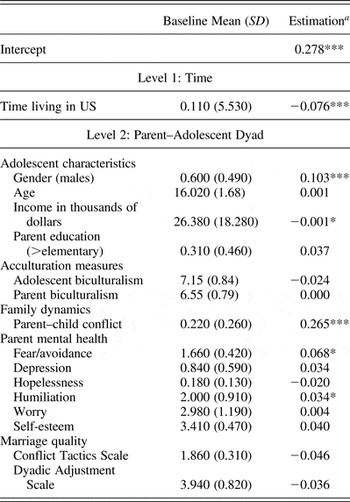
The sample consisted of 258 Latino adolescents each paired with one parent, for a total of 516 participants, 97% of whom were born outside of the United States. Sample demographics are presented in Table 1. On average, participants had lived in the United States for 4.77 years with a range of 1 month to 17 years. Almost the entire sample (96%) attended school, and ninth grade was the median grade. The majority of families (66%) were from Mexico, 21% were from South America, and 13% were from Central America.
Descriptive statistics and model based estimates for risk and protective factors predicting adolescent internalizing symptoms

Note: The reference groups are in parentheses. Parent and adolescent measures of acculturation conflict, discrimination, involvement in US culture, involvement in culture of origin, familism, family cohesion, and family adaptability were tested and dropped from the final model.
a Based on 10 imputed files.
*p < .05. ***p < .001.
Measures: Independent variables
Time
Because exact dates for each interview were obtained, the multilevel model (Raudenbush & Bryk, Reference Raudenbush and Bryk2002) used a variable occasions design for time in which time was measured continuously rather than with a fixed occasions design using the wave indicators (W = 0, 1, 2, 3, pertaining to baseline and 6-, 12-, and 18-month follow-ups, respectively). Wave indicators occur at arbitrary times for each respondent, making the variable occasions design preferable. In the context of our objective to examine the change in internalizing symptoms among Latino adolescents, years living in the United States anchored time to a common experience for all adolescents in the sample. We were thus able to more intuitively interpret change in internalizing symptoms relative to this common experience rather than to some arbitrary study time point. For adolescents born in the United States, years living in the United States was equivalent to their age. Time was centered on the mean years living in the United States for each adolescent over the four measurement occasions, a center that may have occurred between measurement occasions.
Because there were four measurement occasions, we included both linear (T) and quadratic (T 2) variables. In the presence of the quadratic term, the actual value of linear change depends upon the value of time at which it is assessed and is interpreted as the instantaneous rate of change in internalizing symptoms per month that the adolescent lived in the United States. With time mean centered, it is also possible to interpret the linear time coefficient as the rate of change at time zero or the adolescents’ mean time living in the United States. The quadratic component is the change in this rate at all time points, with positive values indicating that the slope increases or gets steeper over time and negative values indicating that the slope decreases or gets flatter over time (regardless of whether the slope is upward or downward). With the exact amount of time measured in years, we have greater precision in the time measure, which is essential given the use of quadratic time.
Child characteristics
Child characteristics included gender (1 = female, 0 = male), mean centered age (in years), parent education level (1 = elementary or no schooling, 0 = high school or higher), and sample mean-centered household annual income (in thousands of dollars). Child characteristics and all other independent variables were treated as time invariant and measured at baseline data collection at the beginning of the internalizing trajectory.
Parent and adolescent culture-of-origin involvement
Culture-of-origin involvement, the process of maintaining ethnic identity through use of native language, media use, and enacting traditions from one's native culture, was assessed using a 20-item subscale from the Bicultural Involvement Questionnaire (BIQ; Szapocznik et al., Reference Szapocznik, Kurtines and Fernandez1980). Items were rated on a 5-point Likert scale ranging from not at all to very much. Example items included “How comfortable do you feel speaking Spanish (at home, with friends, in general)” and “How much do you enjoy . . . music, television programs, books, and magazines from your native country?” Internal consistency reliability was 0.89 for adolescents’ and 0.90 for parents’ culture-of-origin involvement in the current sample.
Parent and adolescent US cultural involvement
US cultural involvement, defined as assimilation of host culture language, media, norms, and traditions, was also measured using a subscale of the BIQ (Szapocznik et al., Reference Szapocznik, Kurtines and Fernandez1980). This subscale exactly parallels the culture-of-origin involvement subscale and has 20 items that measure participants’ use of English language, non-Latino US food, recreation, and media. Items were rated on a 5-point Likert scale with anchors labeled not at all to very much. In this sample, internal consistency reliability was 0.90 for adolescents and 0.93 for parents.
Parent and adolescent biculturalism
Parent and adolescent biculturalism were calculated by adding the culture-of-origin involvement and U.S. cultural involvement subscales of the BIQ (Szapocznik et al., Reference Szapocznik, Kurtines and Fernandez1980). This rendered an overall continuous measure of the parent's and adolescent's involvement in both their culture of origin and the US culture (i.e., biculturalism). In this sample, internal consistency reliability was 0.91 for adolescents and 0.92 parents.
Parent and adolescent acculturation conflict
Acculturation conflict, the degree to which foreign-born individuals experience problems as a result of adopting US culture, was measured with a four-item scale created by Vega and colleagues (Reference Vega, Kolody, Aguilar-Gaxiola, Alderete, Catalano and Caraveo-Anduaga1998) and response options were measured on a 5-point Likert scale with anchors ranging from not at all to frequently. Items included the following: (a) How often have you had problems with your family because you prefer American customs? (b) How often do you think that you would rather be more American if you had a chance? (c) How often do you get upset at your parents because they don't know American ways [not in parent version]? (d) How often do you feel uncomfortable having to choose between non-Latin and Latin ways of doing things? In the current sample, internal consistency reliability was 0.76 for adolescents and 0.87 for parents.
Parent and adolescent perceived discrimination
Perceived discrimination, the degree to which individuals feel that they are treated unfairly because of their race, was measured using three items and a 5-point Likert scale with anchors ranging from not at all to frequently (Vega, Khoury, Zimmerman, Gil, & Warheit, Reference Vega, Khoury, Zimmerman, Gil and Warheit1995). One item asked, “How often do people dislike you because you are Latino?” The other questions asked about unfair treatment because of being Latino. Higher scores indicated increased perceptions of discrimination. Internal consistency reliability was 0.75 for both adolescents and parents in the current sample.
Adolescent report on parent–adolescent conflict
Parent–adolescent conflict was assessed using the Conflict Behavior Questionnaire—20 (Robin & Foster, Reference Robin and Foster1989). The 20-item questionnaire assesses positive and negative parent–adolescent interactions that occur in nonconflictual and argumentative exchanges. Items are rated as yes or no. Example items included “My parent(s) don't understand me” and “My parent(s) put me down.” The reliability was 0.89 for adolescents in this sample.
Adolescent report of familism
Familism refers to the degree of family unity and trust present in the family and was assessed using seven items rated on a 4-point Likert scale with anchors labeled as strongly agree to strongly disagree (Gil et al., Reference Gil, Wagner and Vega2000). Example items included “We share similar values and beliefs as a family” and “Family members respect one another.” Internal consistency reliability was 0.87 in the current sample.
Parent report of family cohesion
Family cohesion, the degree to which family members support one another and spend time together, was measured using 8 items from Olson's (Reference Olson1992) 16-item family cohesion subscale from the Family Adaptability and Cohesion Evaluation Scale II survey. Six items were not included because of translation difficulties and 2 items were removed because they were repetitive. Example items included “Family members are supportive of each other during difficult times” and “Our family does things together.” Items were rated on a 5-point Likert scale with not at all and all the time serving as anchors. Internal consistency reliability was 0.77 in the current sample.
Parent report of family adaptability
Family adaptability refers to the level of flexibility a family has regarding rules, roles, discipline, and negotiations. Twelve items from Olson's (Reference Olson1992) 14-item family adaptability subscale from the Family Adaptability and Cohesion Evaluation Scale II survey were used to assess levels of family adaptability. Two items were removed because they were repetitive. Example items included “Discipline is fair in our family” and “Our family tries new ways of dealing with problems.” Internal consistency reliability was 0.72 in the current sample.
Parent report of parent depression
Parent depression was measured using 12 items from the 20-item Center for Epidemiological Studies Depression Scale (Radloff, Reference Radloff1977). Eight items were removed because they did not assess constructs of depression (e.g., I felt fearful) or would not have been accurately translated into Spanish (e.g., I could not get going). Participants were asked to indicate how often over the past 7 days “I felt depressed” or “I had trouble keeping my mind on what I was doing,” and items were rated on a 4-point Likert scale (rarely or none of the time/less than once a day, some or a little of the time/1–2 days, occasionally/3–4 days, or most or all of the time/5–7 days). Internal consistency reliability was 0.81 in this sample.
Parent report of parent humiliation
Parent's fear of humiliation was assessed with Hartling's (Reference Hartling1995) seven-item fear of humiliation scale. Items were rated on a 5-point Likert scale with anchors of not at all and extremely. Example items included “At this point in your life, how concerned are you about being . . . Teased? Treated as invisible? Called names or referred to in derogatory terms?” Internal consistency reliability was 0.87 in the current sample.
Parent report of parent hopelessness
Parents’ level of hopelessness was assessed using 13 items from Beck's 20-item hopelessness scale (Beck, Weissman, Lester, & Trexler, Reference Beck, Weissman, Lester and Trexler1974). Seven items were removed for brevity on a long interview. Example items included “I look forward to the future with enthusiasm” and “My future seems dark to me.” Response options included true or false. Internal consistency reliability was 0.73 in the current sample.
Parent report of parent self-esteem
Self-esteem was measured using 7 items from Rosenberg's (Reference Rosenberg1965) 10-item self-esteem scale. Three items were removed to limit the length of the interviews. Items were rated on a 4-point Likert scale (strongly agree, agree, disagree, or strongly disagree), and example items included “I feel positive about myself” and “All in all, I feel that I am a failure.” Internal consistency reliability was 0.88 in the current sample.
Parent report of parent worry
Parents’ level of worry was assessed using 5 items from the 16-item Penn State Worry Questionnaire (Meyer, Miller, Metzger, & Borkovec, Reference Meyer, Miller, Metzger and Borkovec1990). A subset of items was chosen for brevity on a long interview. Items were rated on a 5-point Likert scale with anchors including strongly disagree and strongly agree. Example items included “My worries overwhelm me” and “I am always worrying about something.” Internal consistency reliability was 0.90 in the current sample.
Parent report of parent fear and avoidance
Parent fear and avoidance were measured with a 13-item modified version of the Fear Questionnaire (Marks & Mathews, Reference Marks and Mathews1979). Participants were asked, “How much do you fear and avoid the following situations?” and were then presented with potentially anxiety-producing situations (e.g., speaking in public, being embarrassed or humiliated, traveling alone by bus). Eleven of the original 15 items were used, and 2 additional items were added that specifically addressed fears of an immigrant population (i.e., Speaking in English and Speaking to Americans). Items were rated on a 3-point Likert scale (never, sometimes, or often), and internal consistency reliability was 0.84 in this sample.
Parent report of Dyadic Adjustment Scale
Dyadic adjustment assesses the quality of a marital relationship. Spanier's (Reference Spanier1976) 19-item Dyadic Adjustment Scale was used to assess marital quality in the current sample. Items were rated on a 5-point scale (all the time, most of the time, sometimes, hardly ever, or never). Example items included “How often have you considered divorce, separation, or terminating the relationship?” and “How often do you confide in your partner?” Internal consistency reliability was 0.98 in the current sample.
Parent report of Conflict Tactics Scale
Conflict tactics refer to how parent(s) handle conflict with their partner. Eight items from the 14-item Conflict Tactics Scale (Straus, Reference Straus1979) were used in the current study. Items were rated on a 5-point Likert scale (all the time, most of the time, sometimes, hardly ever, or never). Participants responded to the prompt “When you and your partner disagree, how often do you do the following?” Eight possible behaviors were listed, such as “I discuss things calmly” and “I hit my partner.” Participants then rated these eight behaviors for their partner. Internal consistency reliability was 0.95 in the current sample.
Measures: Dependent variables
Adolescent internalizing symptoms
Adolescents reported on their internalizing symptoms using the Youth Self-Report (YSR; Achenbach, Reference Achenbach1991). This subscale consists of 24 items using a 3-point Likert scale (not true, sometimes true, or often true), and example items included “There is very little that I enjoy” and “I cry a lot.” Prior studies indicate that the YSR has internal consistency reliability over 0.90 and a test–retest reliability of 0.80 (Achenbach, Reference Achenbach1991). The internal consistency reliability was 0.85 for adolescents in this sample.
Parents reported on adolescent internalizing symptoms using the 25-item internalizing problems subscale of the Child Behavior Check List (CBCL/4–18; Achenbach, Reference Achenbach1991). The CBCL/4–18 contains similar questions as the YSR, but they are answered by the parent about the adolescent. The CBCL has been widely used with Latino children (see Vega et al., Reference Vega, Khoury, Zimmerman, Gil and Warheit1995), is considered a “gold standard” of child mental health measures, and has been used in thousands of studies (Rush & The Task Force for the Handbook of Psychiatric Measures, Reference Rush2000). Parents rated their children on a number of internalizing behaviors, such as “cries a lot,” “feels worthless or inferior,” and “is nervous, high strung, or tense.” The internal consistency reliability was 0.89 in the current sample.
Analysis
In households where there were two or more adolescents, one adolescent–parent pair was randomly sampled for analysis. The other pair was dropped from the analysis sample. To assess the sensitivity of the random selection procedure, we compared the analytic sample with the participants whose records were discarded. The results of this sensitivity procedure showed that the discarded records were more likely to belong to boys (χ2 = 20.35; p < .001); adolescents with more educated parents (χ2 = 10.79; p < .01); and adolescents living in the United State for less time (t = 3.52; p < .001). None of the survey measures were significant. In addition, two cases in which only an adolescent or parent was sampled that were also deleted were not tested because of the small size of this group.
In this study, we used parent and adolescent ratings of the adolescent's internalizing symptoms as the dependent variable in a longitudinal hierarchical linear model with a rater effects structure (Guo & Hussey, Reference Guo and Hussey1999; Raudenbush & Bryk, Reference Raudenbush and Bryk2002). This model combined repeated measures of internalizing symptoms over four waves, nested within adolescents, with a rater model in which both parents and adolescents report on adolescents’ internalizing symptoms at each wave, to give us a three level model consisting of measurement occasions nested within dyads consisting of two raters per adolescent nested within individual adolescents. Rater-reported internalizing symptoms were regressed on variables representing measurement occasions to estimate change over time, and a set of time-invariant adolescent, parent, and family characteristics measured at baseline to estimate the influence of these characteristics on the differences between adolescents in the level of internalizing symptoms was reported.
Hierarchical linear model specifications
The unconditional intraclass correlation, which measures the proportion of variation (excluding variation over time) attributed to raters and adolescents, was shown to be 75% at the rater level and 25% at the participant level (with time included, 48% and 16%, respectively). These levels represent conclusive evidence that the data lacked the independence required of conventional linear modeling methods (such as ordinary least squares). Consequently, we used a hierarchical linear model (Raudenbush & Bryk, Reference Raudenbush and Bryk2002). The first level of the multilevel model consisted of parent and adolescent raters’ assessment of adolescent internalizing symptoms (INTS) taken at four time points with the time (T; instantaneous rate of change) and quadratic (T 2; change in change) variables.
 $$\matrix{{\hbox {INTS}}_{tij} &= {\rm \beta}_{0ij} + {\rm \beta}_{1\iota} T_{tij} + {\rm \beta}_{2ij} T^2_{tij} \cr &\quad {+}\, r_{tij} \, \lsqb r_{tij} \sim N \lpar 0\comma \; {\rm \sigma}\,^2\rpar \rsqb.}$$
The second level regressed the parameters of the first level model on population averages with accommodations made for variation in the intercept (β0ij ) and instantaneous rate of change parameters (β1ij ; no random effect was proposed for the quadratic term). This level contained only random effects pertaining to rater that adjusted for variation specific to how adolescents and parents’ perceived the adolescents' internalizing symptoms.
 $${\rm \beta}_{0ij} = {\rm \pi}_{00j} + u_{0ij} \quad \lsqb u_{0ij} \sim N \lpar 0\comma \; {\rm \tau}_0\rpar \rsqb \comma \;$$
 $${\rm \beta}_{1ij} = {\rm \pi}_{10j} + u_{1ij} \quad \lsqb u_{1ij} \sim N \lpar 0\comma \; {\rm \tau}_1\rpar \rsqb \comma \;$$
 $${\rm\beta}_{2ij} = {\rm \pi}_{20j}\comma \;$$
In the third level, the random intercept of Equation 2a was regressed on adolescent and family characteristics and random effects specific to variation between adolescents Equation 3a. In addition, the rater-level means of instantaneous rate of change (from Equation 2b) and acceleration (from Equation 2b) were then regressed on adolescent-level constants. The coefficients reported in the results are the γ coefficients, representing participant-level means of all effects.
 $${\rm \pi}_{00j} = {\rm \gamma}_{000} + X {\rm \gamma}_{001} + e_{00j} \lsqb e_{00j} \sim N \lpar 0\comma \; \rm\phi _{0}\rpar \rsqb \comma \;$$
 $${\rm \pi}_{10j} = {\rm \gamma}_{100} + e_{10j}\lsqb e_{10j} \sim N \lpar 0\comma \; \rm\phi _{1}\rpar \rsqb \comma \;$$
 $${\rm \pi}_{20j} = {\rm \gamma}_{200} \comma \;$$
As shown in Equation 3b, a random term associated with the linear time parameter was also tested.
Missing data
There were missing values throughout the data, including the dependent and independent variables. The dependent variable nonresponse rate was 10% at Wave 1, 14% at Wave 2, 23% at Wave 3, and 27% at Wave 4. Independent variables had nonresponse rates that varied from less than 1% (for parent education, gender, age, and time living in the Unites States) to 55% (for Conflict Tactics Scale; see Table 1). Both parent marriage variables had higher rates of nonresponse (with dyadic adjustment at 50% missing) than the other scales. Given the potential for bias from nonresponse, analyses were conducted on data subjected to multiple imputation (Schafer, Reference Schafer1997). After demonstrating that the data were not missing completely at random according to a chi-square test developed by Little (Reference Little1988), we conducted an extensive analysis to develop an informed imputation model that would help reduce the bias from the missing values. These analyses demonstrated that 10 imputations were sufficient, and that a model consisting of all 15 analysis variables as well as 36 additional “auxiliary” variables that had the potential to explain the missing values could be supported by the data without a high level of collinearity. All analysis variables were included in the model to ensure that the covariance structure between the analysis variables was represented in the imputed data (without it, the relationships in the observed data would be attenuated and the imputed values would reflect this attenuation, biasing the parameter estimates). The auxiliary variables consisted of unused demographic variables and scales, including several measures that have been used and reported in other studies (Smokowski & Bacallao, Reference Smokowski and Bacallao2010). Ten data sets were simulated in the imputation process. These procedures were completed using SAS Proc MI, and results from running the models on each imputed data set were summarized using SAS Proc MIAnalyze.
Sensitivity, robustness, and diagnostics
The model described in Equations 1a–3c was tested exactly as specified. Variations on this model were also tested. These alternative models included (a) variations that excluded random terms u 1ij (Equation 2b) and e 10j (Equation 3b); (b) variations that excluded the quadratic term; (c) variations that used the arbitrary wave-based time variable (with values 0, 1, 2, and 3 for all participants); and (d) models without the two variables measuring parent marriage quality, which as noted had very high rates of missingness. Variations a–d were all tested using model fit. Fit was assessed using a chi-square test of the difference in likelihood ratios, the Akaike information criterion (AIC), and the Bayesian information criterion (BIC). For the AIC and the BIC, values closer to zero indicated better fit. The final model was selected from the full model and variations a–c. For variation d, we focused on how the coefficients of the model changed after the parent marriage quality variables were removed. Collinearity of the models was assessed using a variance inflation factor, with values approaching 10 indicating a high level of collinearity. Particular attention was paid to the relationship between age and time living in the United States, because these are the same for the adolescents born in the United Sttes. Influence and normality diagnostics were assessed on the final model as well.
Model details
SAS version 9.1 Proc Mixed was used. Restricted maximum likelihood was used to estimate the reported models (a maximum likelihood version of each model was run to facilitate the comparisons between models with different fixed effects as described by model variations b, c, and d; refer to Snijders & Bosker, Reference Snijders and Bosker1999).
Results
Multilevel rater models
Model selection
Four main variations on the model were compared using fit statistics. In a comparison between the full model described by Equations 1a–3c and the model without the linear time random parameters using restricted maximum likelihood estimation, the model without linear time random parameters had better fit, as shown by the chi-square test (χ2 = 58.5; p < .001) and by the AIC (–321.6 without u 1ij and e 10j vs. –376.12 with) and BIC (–310.95 without u 1ij and e 10j vs. –358.95 with) being closer to zero. For subsequent tests, u 1ij and e 10j were left out of the model.
In the subsequent test between the quadratic model without u 1ij and e 10j and a similar model without the quadratic term conducted using maximum likelihood estimation, the model without the quadratic term was preferred as shown by the chi-square test (χ2 = 4.37; p < .05), the AIC (–397.18 with the quadratic term and –394.83 without) and the BIC (–331.03 with the quadratic term and –332.22 without the quadratic term). For the subsequent tests, the quadratic term was therefore left out of the model. Before moving to the next comparison, we reconfirmed the comparison between the model with and without u 1ij and e 10j , showing that these random parameters should not be in the model.
Finally, retaining the linear time model with time living in the Unites States and comparing this to a linear time model using wave time we found that time living in the United States produced better fit, because the model with wave time had an AIC of –399.41 and a BIC of –336.45, which are higher than the fit statistics reported in the previous comparison. A model in which parent dyadic adjustment and conflict tactics were removed also did not improve fit. The model with linear time living in the United States and without the random terms for linear time was selected as the best fitting model.
Model findings
Table 1 shows the parameter estimates and test statistics for the selected model. Time living in the United States was significantly associated with lower internalizing symptoms (b = –0.08; p < .001). Of the key parent mental health and marriage quality variables, parent humiliation (b = 0.037; p < .05) and parent fear (b = 0.07; p < .05) were significantly predictive of greater adolescent internalizing symptoms. Among the covariates, gender was associated with internalizing symptoms, with girls reporting higher symptoms (b = 0.09; p < .001); higher income (b = –0.002; p < .01) was associated with lower internalizing symptoms; and parent–adolescent conflict behavior (b = 0.26; p < .001) was associated with higher internalizing symptoms.
Robustness
This finding was robust to the choice of time variable and, consistent with the findings of fit reported above, whether the quadratic time was included or not. In comparison with the chosen model, the model with the same covariance structure but with wave time in place of time living in the United States had nearly identical parameter estimates and findings of significance. The final model shown in Table 1 was selected after a series of modeling alternatives were examined. Descriptions of variations in model building can be obtained from the authors upon request.
An examination of the distribution of the residuals from the final model using a normal probability plot indicated that the residuals had a normal distribution. Further, despite the relationship between the time variable measured by time living in the United Sates, the baseline measure of time living in the United States and adolescent age, the collinearity findings indicated by the variance inflation factor statistic did not suggest that the model was collinear.
Discussion
This investigation made several noteworthy contributions to research on Latino families. Although considerable attention has been paid to research on acculturation, few studies examine acculturation processes in context, taking into account family dynamics, parent mental health, marital quality, and individual variations. Most acculturation studies are cross-sectional rather than longitudinal even though acculturation is inherently a cultural change process that unfolds over time. Extant research also focuses on adolescents or adults, with few exceptions that integrate multiple family members. The current study addressed these shortcomings by modeling adolescent internalizing trajectories over 3 years rated by both adolescents and one parent. Acculturation dynamics were considered along with other salient family processes, such as dimensions of parent mental health, marriage quality, family cohesion, adaptability, and familism.
Our first hypotheses predicted that adolescent characteristics (being female, having low SES, having a parent with low levels of education, and age) would be risk factors associated with increased levels of adolescent internalizing symptomology. This assertion was partially supported. Females reported more internalizing symptoms than did males, confirming past research (Angold & Rutter, Reference Angold and Rutter1992; Derdikman-Eiron et al., Reference Derdikman-Eiron, Indredavik, Bratberg, Taraldsen, Bakken and Colton2011; Gonzalez et al., Reference Gonzalez, Berry, McKnight-Eily, Strine, Edwards and Lu2010; Merikangas et al., Reference Merikangas, He, Burstein, Swanson, Avenevoli and Cui2010; US Department of Health and Human Services, 2011; Sartorius et al., Reference Sartorius, Ustun, Lecrubier and Wittchen1996). This is an important finding for prevention program designers who need to consider focusing on Latinas with programs targeted to prevent depression and anxiety. Compared to male adolescents who are given substantial independence, Latinas are held closely to the family system with high expectations for meeting family obligations (i.e., helping younger children and performing well in school), high parental monitoring, and restricted privileges (Smokowski & Bacallao, Reference Smokowski and Bacallao2010). These dynamics may engender anxiety and depression in Latinas that go beyond typical gender differences in internalizing disorders. With adolescent Latinas closely involved in family processes, social learning messages, often from Latino mothers, convey the importance of putting family above one's personal concerns. This is the stressful aspect of familism that leads many Latina adolescents to feel anxious about their family's well-being and depressed that they have limited outlet for personal or social growth outside of their families (Bacallao & Smokowski, Reference Bacallao and Smokowski2007; Smokowski & Bacallao, Reference Smokowski and Bacallao2010).
SES, but not parent education, was also a significant risk factor for internalizing symptoms. Lower SES adolescents had more internalizing problems. This result is in line with past research (Goodman, Huang, et al., Reference Goodman, Huang, Wade and Kahn2003; Goodman, Slap, et al., Reference Goodman, Slap and Huang2003; Roberts, Roberts, & Chen, Reference Roberts, Roberts and Chen1997). The resources and social capital that comes with higher family incomes may mitigate the anxiety, stress, and depression that can come with poverty. Previous research is most consistent on the relationship between SES and anxiety; however, the current study combined anxiety and depression into internalizing symptoms. Poor immigrant families, in particular, may work multiple jobs and long hours to cope with the high cost of living in many areas in the United States. This engenders postimmigration changes in Latino family systems that lead to erosion of family time spent together and closeness in parent–child relationships (Bacallao & Smokowski, Reference Bacallao and Smokowski2007). Higher SES families may be better equipped to avoid these problematic postimmigration changes.
Our second hypothesis centered on acculturation experiences, positing that US assimilation, high levels of discrimination experiences, and high levels of acculturation conflict would be risk factors positively associated with levels of adolescent internalizing symptomology. At the same time, culture-of-origin involvement and biculturalism would be inversely associated with internalizing symptoms. This hypothesis was not supported by the data. Parent and adolescent measures of US and culture-of-origin involvement, discrimination experiences, and acculturation conflicts were tested, showed no statistically significant relationships with internalizing symptoms, and were all dropped from the final multilevel model.
Biculturalism measures for adolescents and parents were not significant, but they were retained in the model to note these effects. Adolescent biculturalism displayed a promising trend (p = .13), but it did not rise to conventional levels of statistical significance. While evaluating modeling alternatives, we found that when biculturalism was removed from the models, the magnitude of the coefficient for anxiety goes down, suggesting a suppression effect of biculturalism on the relationship between parent fear/avoidance and adolescent internalizing symptoms. It is intriguing to consider if biculturalism plays a role in mitigating the relationship between parent fear and adolescent internalizing symptoms; however, this requires more intensive examination in future research.
These null effects are important for acculturation research. Previous studies, even prior investigations using the current study's Latino Acculturation and Health Project data set, have interpreted many effects from these measures (Smokowski, Rose, & Bacallao, Reference Smokowski, Rose and Bacallao2008, Reference Smokowski, Rose and Bacallao2010). We believe null effects surfaced for the current analyses because of the inclusion of extensive measures of family dynamics and parent mental health. Parent mental health and family dynamics, specifically parent fear/avoidance, humiliation, and parent–adolescent conflict, overshadowed acculturation effects in our models.
Time spent living in the United States was the only variable related to acculturation that was statistically significant. As adolescents were in the United States longer, their internalizing symptoms tended to decrease. Few prior studies have examined simple markers of acculturation, such as time in the United States, alongside multidimensional acculturation scales. Those studies that have tend to report stronger effects for multidimensional scales (Smokowski & Bacallao, Reference Smokowski and Bacallao2010). The current investigation found the opposite. This suggests that time in the United States is capturing some process that is outside of involvement with the US culture, the culture of origin, discrimination experiences, or acculturation conflict, because all of these other measures were controlled for. Time in the United States may capture coping because of social learning rather than involvement with the dominant culture. Over time, immigrant adolescents may acquire new coping skills that facilitate their adaptation within their new ecology. These coping skills may be independent of simply being involved in the culture (e.g., using cultural media, foods, and socializing with certain groups). Social cognitive theory predicts that immigrant adolescents would see what behaviors are enacted by people around them and would choose their own behaviors based on reinforcement from the environment. This ongoing learning process entails dynamic interactions with individuals and scaffolding of coping skills that are reinforced over time. Time in the United States may serve as a marker for this process. This suggests that acculturation researchers should consider developing new cultural adaptation measures that not only center on involvement in the different cultures but also integrate coping and adjustment within each culture.
Our third hypothesis considers family dynamics, positing that parent–child conflict would be a risk factor associated with increased levels of adolescent internalizing symptomology, while familism, family cohesion, and family adaptability would be inversely associated. There was clear evidence for the first half of this proposition; parent–adolescent conflict was a strong risk factor for internalizing symptoms. This result confirms past research (Behnke et al., Reference Behnke, Plunkett, Sands and Bamaca-Colbert2011; Kuhlberg et al., Reference Kuhlberg, Pena and Zayas2010; Smokowski & Bacallao, Reference Smokowski and Bacallao2006). Parent–child conflicts about culture may be harmful because immigrant adolescents commonly have few supports outside of their families. At the same time, conflict with parents may disengage adolescents from positive factors and resources in immigrant families, leaving adolescents unsupported, anxious, and depressed (Smokowski & Bacallao, Reference Smokowski and Bacallao2010). The social cognitive messages from negative, conflicted relationships with parents may lead adolescents to feel poorly about themselves, blocking growth and engendering internalizing symptoms. More research is needed to explore this connection.
Familism, family cohesion, and family adaptability had no statistically significant relationships with internalizing symptoms and were not retained in the final model. The lack of an effect for familism was surprising because this family value has consistently been identified as a protective factor in the past (Coohey, Reference Coohey2001; Gil et al., Reference Gil, Wagner and Vega2000; Kuhlberg et al., Reference Kuhlberg, Pena and Zayas2010; Smokowski, Rose, & Bacallao, Reference Smokowski, Rose and Bacallao2008). However, familism and parent–adolescent conflict are closely related (Smokowski & Bacallao, Reference Smokowski and Bacallao2006, Reference Smokowski and Bacallao2010). The strong effect for parent–adolescent conflict may have overshadowed any protective effect for familism in our analysis.
Most investigations of acculturation and adolescent health in Latino families do not integrate measures of parent psychological functioning. In doing so, we hypothesized that poor parent mental health (i.e., higher levels of parent depression, fear/avoidance of social situations, hopelessness, humiliation, worry, and lower levels of parent self-esteem) would be associated with increased levels of adolescent internalizing symptomology. Parent depression, hopelessness, worry, and self-esteem measures did not display any statistically significant relationships; however, parent fear/avoidance of social situations and humiliation were both positively related to adolescent internalizing problems.
Following social cognitive theory, the parent's fear of social situations and humiliation may both serve as messages to the adolescent that the environment is not safe and may reinforce anxious feelings the adolescent is having. This is particularly interesting to consider for this sample of immigrant parents and adolescents. Immigrant parents, who may be in the United States illegally and have little command of English, experience many daily situations that would engender fear and potential humiliation (going to the bank, school, or doctor's office without a translator, watching for police checkpoints, and wondering about the family if deportation happens). This heightened state of arousal may impact the parent–adolescent relationship and serves as a model for adolescents to also become anxious about their environment. Fearful parents may both enlist their adolescents to help them navigate difficult situations (e.g., translating) and impose strict limitations on adolescent autonomy. This would increase adolescent responsibility while restricting their growth. Negative transactions at school, work, or in the community might further reinforce this fearful/avoidant social learning, heightening the adolescent's risk for internalizing symptoms. These novel relationships provide a fertile area for more research.
This relationship between parent fear/avoidance and adolescent internalizing symptoms requires further investigation. It will be important to examine parent fear/avoidance and humiliation experiences in future studies because these factors were more salient than any acculturation measures. Consequently, parent skills in coping with fear and feelings of humiliation may play a more important role than simple cultural involvement in potentiating adolescent internalizing problems, and consequently should be a target for prevention programming.
Finally, our fourth hypothesis, that marriage quality (effective parental conflict tactics and positive parental relationships) would be inversely associated with levels of adolescent internalizing symptomology, was not supported by the data. Measures of marital dynamics displayed no statistical relationship in predicting adolescent internalizing problems. It may be that Latino parents were adept at keeping their marital dynamics private from their children; however, the large amount of missing data on these measures could also play a role in these null effects.
Limitations
Our analyses were based on a nonrandom, community-based sample of Latino families living in either North Carolina or Arizona; therefore, caution is warranted in generalizing results to Latino communities outside of these areas. Latinos are a heterogeneous group, making it optimal to conduct subgroup analyses by country of origin. However, we did not have adequate subgroup sample sizes to conduct such refined analyses. This is another reason for caution in generalizing the overall results to specific country-of-origin subgroups. Finally, although this study is noteworthy for examining trajectories of internalizing symptoms, it would have been optimal to have a larger number of data points to analyze. Four waves of panel data provided the opportunity to examine quadratic models. However, without a larger number of longitudinal assessments, we cannot speculate on whether internalizing symptoms continued to decrease later in the trajectories.
Conclusion
This study addressed shortcomings in current developmental psychopathology, cultural psychology (Causadias, Reference Causadias2013; Cicchetti & Toth, Reference Cicchetti and Toth2009), and acculturation research with Latino immigrant families (Smokowski & Bacallao, Reference Smokowski and Bacallao2010) by exploring ecological predictors of internalizing symptoms in a socioeconomically diverse sample of Latino parents and adolescents from metropolitan, small-town, and rural areas. A number of in-depth acculturation measures were used, moving beyond single items to bidimensional measurement of culture-of-origin and host culture involvement, along with discrimination and cultural conflicts indicators. The aim was specifically to examine if family system dynamics (e.g., parent mental health, marriage quality, conflict, and cohesion) that have often been overlooked when studying Latino families play a more important role in predicting adolescent internalizing symptoms than do acculturation processes. Social cognitive messages from multiple relationships on different ecological levels in the adolescents' environments were considered.
Our analytic models combined repeated measures of internalizing symptoms over four waves, nested within adolescents, with a rater model in which both parents and adolescents reported on adolescents' internalizing symptoms at each wave, to give us a three-level model consisting of measurement occasions nested within dyads consisting of two raters per adolescent nested within individual adolescents. Missing data was handled by multiple imputation. This level of sophistication in statistical modeling is rare within acculturation research, providing a rigorous test of how family dynamics, parent mental health, and acculturation measures are related to adolescent internalizing symptoms.
Results revealed that parent–adolescent conflict and parent mental health (fear of social situations and humiliation) were significant predictors of adolescent internalizing symptoms. Acculturation indicators, other than time spent in the United States, were not significant predictors. Females and adolescents from lower SES families reported more internalizing symptoms, while participants who had been in the United States longer reported fewer internalizing symptoms. Using social cognitive theory as an interpretive lens, we saw these risk effects for parent anxiety and fear of humiliation as family messages that teach adolescents to be hypervigilant to potential dangers within the immigrant family's new environment. Females, who are often closely aligned to parents within immigrant family systems, and children who are in conflict with their parents may be even more profoundly influenced by these parental messages, resulting in high levels of intimmigration adaptation. Time spent in the United States may ease some of this anxiety by reinforcing coping strategies that facilitate adjustment.
These results suggest that prevention program designers should pay special attention to concerns for Latinas and address parent anxiety and fear of humiliation in intervention curricula. Program for Latino families should help adolescents reduce conflict with their parents. Although some programs integrate this content in helping immigrant families adjust (Bacallao & Smokowski, Reference Bacallao and Smokowski2005), more attention is warranted. Future research should integrate parent mental health measures in acculturation studies and should explore coping processes that may be captured by simple items such as the time spent in the United States.