Introduction: the Great War, local authorities and council housing
The standard narrative of the decision to build council houses after 1918 is that the Great War changed everything, bringing about a reconfiguration of social and political forces. This viewpoint was expressed by Bowley in her study written during World War II, which follows faithfully that of Christopher Addison in his classic, The Betrayal of the Slums.Footnote 1 Nearly all subsequent commentators on council housing are in broad agreement with this account, crucial to which is the Glasgow Rent Strike of 1915 which forced the government to pass the Increase of Rent and Mortgage Interest (War Restrictions) Act, 1915. Intended as a temporary measure this act made direct state involvement in the housing market inevitable, particularly when combined with the 1918 election slogan of ‘Homes Fit for Heroes’.Footnote 2 Even Daunton, one of the very few historians to disagree with the traditional emphasis upon the impact of the war, recognizes the significance of the 1915 Act and shares the view that this legislation represented a defeat for, or ‘sacrifice’ of, private landlordism.Footnote 3 In essence, the wage costs of big capital – shipbuilding, engineering, munitions – were protected at the expense of the rental income of the petit bourgeois property owners.
Writers on council housing agree on the key role played by the local authorities as the agency chosen by the state to implement the new policy of building houses through subsidy.Footnote 4 The Royal Commission Report of 1917 was quite clear: ‘The most convenient method, in our view, is that the State should impose the obligation on the Local Authority.’Footnote 5 While this is a simply incontrovertible fact, what is more interesting is a lacuna within the literature; the lack of attention given to the interests and motivations of the local authorities and the individual councillors responsible for implementing this new national policy. With the exception of Byrne's much neglected chapter on North Shields between the wars, there has been little attention directed to how bourgeois property owners sought to protect their own material interests while, in their role as local councillors, being charged with the responsibility of building council houses.Footnote 6 Byrne's call for similar studies has gone more or less unanswered and the standard narrative of council housing continues to present the local authorities as effectively objective, value-free bodies. While there is some recognition that there might have been greater or lesser enthusiasm for building council houses depending on the political complexion of individual administrations, there has been little exploration of the premises and values which underpinned the construction of the new housing estates. Daunton, in his aptly titled collection Councillors and Tenants, considers the role of the local authorities as builders and landlords but fails to consider properly the material interests of the councillors who were charged with putting the new policy into practice. Only the essay by Dresser on Bristol looks at the ‘social complexion and outside interests’ of councillors and the Housing Committee in particular, but this is not done in any depth nor is it integrated into a wider analysis.Footnote 7
Furthermore, it is argued that the actual building of council houses by the local authorities after the war was effectively acting against the interests of private enterprise and private landlords in particular. For Daunton, this was a distinct and friendless group which was ‘politically unpopular’ and whose interests continued to be sacrificed after the war for the benefit of ‘other classes of property’.Footnote 8 The long-term decline of private landlordism and its political significance is often dated precisely from the end of the Great War yet, at the same time, it is widely recognized that most councillors were local businessmen running small to medium-sized enterprises, who in many cases often were local landlords as well.Footnote 9 Property was not always their only wealth holding but could amount to a substantial part of the total. Given this, surely it would be illogical to imagine that such actors would hold any deep antipathy against private landlords. Rather, in constructing council houses post-1918, councillors had to balance various public and private interests, including their own.
If the private landlord and small businessman has become less prominent in local government, it would be wrong to date this immediately from the end of World War I. As McCrone and Elliott's work on landlordism in Edinburgh has shown, in 1935 fully 45 per cent of councillors owned property, most of which was residential,Footnote 10 while in 1946 ‘over half of Edinburgh's housing stock was still owned by private landlords’.Footnote 11 Given that private landlords often had other business interests, and many businessmen were owners of residential properties, it does not seem possible to agree, at least at the local level, with the view that ‘private landlords were on the periphery of the economic and social structures’.Footnote 12
Our purpose in this article is not to diminish the political and social significance of the decision to build council houses. We do, however, believe that it is necessary to look more closely at how this new responsibility placed upon local authorities was carried out in practice. The argument, therefore, is that in building council houses and taking on the duties of landlord, councillors were not acting simply to provide more homes for their fellow citizens but were doing this while, at the same time, protecting their own wealth and social position. Recognition of this dual role played by councillors may help explain how the urban landscape was not just changed but was consciously shaped during this period. Our study of three housing areas in Stirling – two council, one private – all built in the inter-war period shows that, even if the development assumptions behind each were mostly implicit rather than explicit, they were effectively planned communities.Footnote 13
Scotland is a particularly appropriate area of study for two reasons. One is that the sheer scale of council housing has been so much more significant north of the border. This, of course, is linked directly to the much worse state of working-class housing before the Great War in comparison with England and Wales. In 1911, while just over 7 per cent of the population of England and Wales lived in houses of two rooms or less, in Scotland almost 48 per cent lived in such homes.Footnote 14 Between 1919 and 1941, local authorities in Scotland were responsible for fully 70 per cent of all new build, whereas in England and Wales the comparable figure was just 28 per cent.Footnote 15 The second is that the ‘myth’ of non-political, Independent local councils was much more prevalent in Scotland. Labour had to contest against local Tories and Liberals standing either as Independents or in the bigger cities under the flag of Moderates or Progressives. This came to an end only in the mid-1960s and early 1970s when the Conservatives changed their title from Unionist and decided that its local activists stand under the party label. The result was partial suicide.Footnote 16
While the identification of council housing with the Labour party is a political truism, it is not the case that Labour built most council houses; the Conservative government of 1951–64 can claim that accolade nationally. In large parts of the country, including Scotland, non-Labour or anti-Labour administrations built council houses on a mass scale. Glasgow only secured a Labour administration as late as 1933, while other towns and cities such as Stirling remained resolutely ‘Independent’ until the 1980s. In Stirling, council house building in the inter-war years and beyond was undertaken by a supposedly non-political but certainly anti-Labour council. By examining house building during the inter-war period in what was a significant Scottish town, we intend to illuminate the role played by councillors as individual and class actors who sought to benefit from, while attempting to control the possible impacts of, this massive social experiment.
Stirling's housing ‘problem’
At the beginning of the twentieth century, housing conditions in Stirling were better than the average for Scotland as a whole. While 46 per cent of the Scottish population and almost 50 per cent of those in larger burghs were living more than two persons to a room, the figure for Stirling was 35 per cent only.Footnote 17 Nonetheless, prior to 1914, it had become evident that Stirling's major social problem was slum housing, particularly the medieval dens and wynds that lay immediately below the castle. Some of these properties were owned by a number of the town's prominent citizens, including the medical officer of health (MOH) and the burgh's lord provost.Footnote 18 The response of the council was the ‘St Mary's Wynd Improvement Scheme’. This intended to demolish a number of the most ‘dilapidated’ tenements in St Mary's and the adjoining Broad Street, build new tenements in their place while widening the streets and provide a children's playground.Footnote 19 Interestingly, the main mover was Andrew Fairlie Wilson, the MOH, and the scheme received the approval of the local government board.Footnote 20 While the council retained the right to build itself if it could not find anyone else to take a feu, it was confident that private enterprise would take the initiative as it was unlikely that there would be any ‘restriction on the rents’.Footnote 21
The scheme was opposed by Labour and local social reformers partly on the grounds of the cost and immorality of purchasing from slum landlords when there was much cheaper land available, the difficulty of rehousing all the tenants and the cramped nature of the proposed new houses. While most ‘would consist of one room and kitchen, scullery and w.c.’, there would be some single roomed apartments.Footnote 22 As one reform-minded candidate for the area put it in 1913, ‘there was no sense trying to get rid of one evil by setting up another in its place’.Footnote 23 The Labour and reform view was for cottage style houses with gardens, or ‘workmen's modern houses’ to be built on fresh sites.Footnote 24 As a trades council delegate pointed out, this was particularly easy for Stirling as the council ‘were in the unique possession of all the feuing land for that purpose’, through the aegis of the Cowane Trust.Footnote 25
Under the Housing of the Working Classes Act, 1890, the council had to hold a local inquiry before it could proceed with its scheme. This took place over one day in late 1912 and perhaps helps explain why Stirling almost totally ignored the Royal Commission on Scottish Housing which was established and began taking evidence the same year. There was no visit to Stirling by the members of the commission, as there was to neighbouring Falkirk, and the only evidence presented was a written submission by the trades council and oral evidence by Robert McLaurin of the trades council and the Rev. Primrose who was minister of Erskine United Free Church.Footnote 26 While both men called upon the town council to build new homes on fresh and cheaper sites, the local press (Liberal and Unionist) gave no coverage of their interviews in front of the Royal Commission sitting in Edinburgh.
Before the war was over, however, the council's own plans were effectively in tatters given the massive new national ambition of building ‘Homes fit for Heroes’, in the style of workmen's cottages. This policy was to dominate for only the early part of the 1920s, the ‘utopian’ period of council housing which took physical shape in Stirling at Riverside. This was the first of the three housing areas examined in our larger study and one of the findings was that the reputation of the immediate locality was transposed onto the new residents.Footnote 27
The council houses in Riverside were good-quality buildings which fitted in well with the existing villas, terraces and small tenements of the locality. The council tenants were similar to the white-collar and skilled working-class families who were already resident in what was recognized as a socially ‘respectable’ neighbourhood. The second locality chosen was the much larger scheme of Raploch which was started in the later 1920s, first under the less aspirational terms of the Wheatley Act and increasingly thereafter focussd on slum clearance. Although the existing village of the Raploch was completely overwhelmed by the new schemes of the late 1920s and early 1930s, this locality had a long-standing reputation for poverty and associated problems, made all the more prominent by high levels of Irish immigration from the mid-1800s. Our final choice was one of the very few inter-war private schemes; a small number of bungalows built within the Randolph Road area, a recognized upper-middle-class and professional enclave of Victorian villas into which the new residents easily assimilated.
In the years following the Great War no one in the council sat down with a master plan to create a ‘new’ Stirling. Nonetheless, those charged with the task of directly building or giving permission for the building of new houses had their own implicit assumptions regarding the relative social positioning and class status of these different neighbourhoods.
The politics of self-interest
Although the Stirling and Falkirk District of Burghs constituency returned a Labour MP in four out of the seven inter-war General Elections, the result was determined by the larger and more industrial Falkirk. The contrast between the two main regional towns was stark. Falkirk had worse housing conditions with 55 per cent of its population living more than two to a room.Footnote 28 And while Falkirk secured a Labour council in the early 1920s, a full decade before Glasgow, the market town of Stirling had but a minimal Labour presence. The party focused nearly all its efforts into a single ward, Cowane Street, which included most of the burgh's slum housing immediately below the castle, an area known locally as ‘Tap o’ Toun’.
Shortly after the Great War, the burgh's five wards were extended to seven, with the expanding Riverside being made a ward in its own right. Yet, despite Riverside being the location of some of the very first council houses in Scotland, it remained a Labour-free zone; so much so that the party never ran a single candidate there prior to World War II. Some efforts were made in Baker Street, also part of the old town centre, and an ‘Independent Labour’ candidate did win there in 1920. Thereafter, however, he sat on the council and was re-elected without any party affiliation.Footnote 29
Cowane Street was Labour's main hope, and in 1919, the party had the opportunity to contest all three seats in the ward, rather than the usual single seat election. One of the Labour candidates, Dick, was returned in third place. The local press was convinced that his success owed nothing to his political affiliation, but everything to him being well known as the chief booking clerk at Stirling railway station.Footnote 30 Later, the Cowane Street ward boundaries would be extended to incorporate the new housing schemes now being developed in the Raploch, which further served to identify that ward as Labour's only realistic hope.
Given Labour's absence, the social reform agenda in Stirling town council was largely sustained by one man, Councillor Moores, who represented Cowane Street also. Originally without affiliation, Moores was close to Labour in terms of his general advocacy of social reform, council housing, the development of a Child Welfare Centre and more recreation grounds for children.Footnote 31 After his defeat by a local businessman at the 1926 elections, Moores later returned to the council, regaining his seat in Cowane Street ward as a ‘Trades and Labour’ candidate.Footnote 32
Moores’ shifting affiliation serves to highlight the essentially ‘non-political’ nature of Stirling and Scottish local politics generally at that time. The fiction of Scottish local government before the Great War was that it was run by independent-minded men with no political affiliations; party labels being brought out only for the imperial parliament elections. In the larger cities, particularly Glasgow, Liberals and Unionists began to form coalitions against Labour in the years prior to 1914, an approach that became far more pronounced and organized post-1918 when the ‘threat’ posed by Labour became that much more tangible. The common label used by Liberals and Unionists was that of ‘Moderates’, which later changed to ‘Progressives’, a strategy that kept Labour out of office in Glasgow until 1933.Footnote 33 In Stirling, however, Labour's presence was so small that there was no need to adopt any flag of convenience. Indeed, when the sitting lord provost attempted to call a meeting of ‘certain “Moderates”’ immediately after the polls in November 1930, it caused an outcry and a public reprimand from the city treasurer.Footnote 34
With few contested elections, and Labour restricted largely to a single ward, the governance of the burgh was undertaken by a more or less self-selecting group of local businessmen, with a seat on the council being almost part of the family inheritance. It is striking that the same family names repeatedly reoccur in Stirling council records as councillors or people in positions of power and authority throughout the previous two centuries. Prominent among them were the Ronald and Gourlay families, who were councillors, landlords and builders. Interestingly, these firms moved seamlessly from private contracts to the new work involved in council house building, and the occasional school. Indeed, there was a clearly expressed view that such municipal contracts should be shared equally around local firms.Footnote 35
Riverside had long been home to a number of the local businessmen who dominated the council, such as the Ronald family. James Ronald senior had been responsible for building part of Riverside at the end of the nineteenth century and named two of the streets after himself; Ronald Place and James Street. By the early 1920s, the brothers Ronald, William F. and James E. (who sat on the council) no longer lived in Riverside but in the much more upmarket King's Park and Randolph Road areas. However, they still owned properties in Riverside, mostly in Ronald Place, and these comprised of a yard and store, a substantial ‘house and garden’ and 10 tenement flats. James E. Ronald was not only a councillor, but convener of the Housing Committee that built and set the rents for the original council scheme.
Another prominent councillor/builder was William Gourlay who also lived in Riverside in a fairly substantial property, and owned two others, one of which was tenanted by his son James junior. The total rental value of these three properties was some £130.00. Of a similar background was one John Merrilees, who ran a plumber's business in the town centre. Although not a member of the town council per se, Merrilees was a parish councillor and at that time sat on the Pubic Assistance Committee for Stirling.Footnote 36 In the 1920s, Merrilees was living in the King's Park but still owned three substantial tenement properties in James Street, Riverside comprising of 30 separate flats with a total annual rental value of £346.30. Another of the significant business families in the town were the McArees (who ran a prominent department store, which still operates today) who also owned rented property in Riverside as well as some slum properties in the Cowane area and were related through marriage to the Ronalds.Footnote 37
Whilst there is no evidence to indicate the motivations of these families, it is unlikely, to say the least, that with their interests in politics, property and the building trade, they would have wanted to challenge the status quo. And their social, political and economic status meant they were in a position to ensure others were not able to challenge these social barriers either. Further, as part of their own wealth and income was dependent upon renting property, they had to be careful not to create and be responsible for a powerful competitor in the shape of desirable and affordable council housing. Finally, a related consideration was that they had a direct interest in preserving the underlying value of the properties they owned, which meant not having the unskilled and poor inhabit the Riverside area. Given their prominence within the council they were in a position not only to profit from the construction of council housing, but could also control who went into these properties by determining the local rent structure.
The early ‘utopian’ scheme: Riverside
When the town council met to decide the rent levels to be charged for the first houses the local trades council sent a deputation to argue against the amounts suggested by the Housing Committee. The lone Labour councillor, Dick, moved an amendment proposing that the rents charged should be £16 and £14, as opposed to the suggested £28 and £24. Not surprisingly, this amendment failed to secure a seconder, though there were other motions arguing for some reductions in the rents proposed. After a series of votes, the Housing Committee's original proposal was accepted. Speaking for the trades council, Crockhart raised the issue of who exactly the new houses were intended for:
while they were told that the discharged soldiers were to have the first preference, essentially the two room and kitchen houses [the smaller and thus cheaper houses] were meant for the working classes, and as to the ability of the working class to pay the rents asked one had to remember that the cost of living was 125 per cent above pre-war level, and very few workmen in any trade had benefited to the extent of 125 per cent from increased wages.Footnote 38
The predominant view of the town council, which reflected widely held ratepayer views, was that the working class could afford to pay more for their housing, but chose not to. The standard middle-class ratepayer perspective was that there were ‘dozens’ of workers who could afford these rents, but they wanted to have cheap housing and keep their ‘big wages’. As one councillor put it, ‘if the Government were honest in their statement that we must raise these people to a higher standard of living it was the Government's duty to compel them to adopt the opportunity of rising to a higher standard’.Footnote 39
An oblique but well-aimed dig at Ronald and others on the council was made during the debate over rent levels. One councillor while arguing for lower rents, though not quite as low as those suggested by the trades council, commented that, ‘The landlords would be rather perturbed about the matter . . . but he did not think they ought to be because there would be very many tenants looking for houses for years to come.’Footnote 40
The total yearly rent or value of Ronald's properties was some £270.55, with the tenement rents ranging from a low of £18.20 to a high of £26.00; the median rent being £21.38. The tenants in Ronald's two tenements comprised two married or widowed women, with no occupations given, and eight men whose occupations were: cooper (2); postman; toymaker; clerk; ironmonger; plasterer; and grocer. This was a social mix very similar to that achieved in the adjacent new council housing.
There can be no doubt that when the first council houses were built they would have been highly sought after. Shiphaugh, the very first ‘scheme’ built in Riverside, was a mixture of semi-detached two-storey ‘cottages’ and ‘four-in-a-block’ flatted houses, which was a common housing style in Scotland at that time. It was not, however, tenemental, in that each property had its own garden.
Construction work began at Shiphaugh in 1919 and the 1922–23 Valuation Roll shows a total of 68 council houses completed and occupied. The actual rents charged ranged from £21 to £36 per annum, which reflects a wider range than was first announced, and noticeably higher than the rents charged by the local landlords, effectively debarring the poorer working class from ever applying. These rent levels are similar to those charged by Glasgow Corporation for its first municipal housing schemes; the minimum being £28 per annum. As Morgan has commented, this was a level ‘far beyond the pockets of all but the most highly paid skilled workers, white collar workers and even professionals’.Footnote 41 The employment pattern in Riverside lettings, as detailed below, reinforces this conclusion within the Stirling context.
Again, using the Valuation Rolls we can get some idea of the social complexion of this new community via the occupations listed for the tenants. The names on the rent books were overwhelmingly male with only five female tenants. Two of the listed female tenants were either married or widowed and had no occupation listed, while the other three were all single teachers. It is likely, however, that they would have had other dependants living with them. Of the 63 male tenants, one was listed as a pensioner and 54 were given occupations: engineer (5, including ‘motor’); clerk (4, including ‘railway’); joiner (2); chauffeur (2); foreman (2); blacksmith (2); storeman (2); linesman (2); miner (2); fitter; boilermaker; saddler; mechanic; assistant foreman; cashier; painter; draper; electrician; manager; baker; pastry baker; commercial traveller; machineman; ironmonger; carter; tinsmith; bank accountant; mason; french polisher; super(intendant) Forth Fishings; teacher; excise officer; lieutenant in the Royal Navy; Minister; civil servant; toy merchant; labourer; hewer; asphalter; and salesman.
Despite the occasional unskilled manual labourer, this list represents substantially lower-middle-class, clerical and skilled workers; very much the sort of people who already inhabited Riverside. Given that the Valuation Rolls tend not to distinguish between employer, employee and self-employed, it is likely that a number of small independent businessmen are included within the occupations listed.
As members of the town council, the corporate body, councillors were legally required to balance the books. So for this first development they opted to secure tenants whom they could be confident would pay the rents charged, thus avoiding any further burdens being imposed upon the ratepayers. At the same time, as previously discussed, given their business and property interests, providing too many council houses at a reasonable rent had the potential to reduce their personal income, so ensuring high rents were charged for new council houses was also in their best financial interests. ‘Respectability’ was secured given the income required, and this in turn guaranteed that the new council tenants were almost identical to those already resident within the neighbourhood.
Interestingly, within a couple of years the new tenants of Shiphaugh had petitioned the council for a rent reduction.Footnote 42 Their case was unsuccessful, being defeated in a vote in which Councillor Ronald played a significant opposition role.Footnote 43 As chairman of the Housing Committee, Ronald then instructed the town chamberlain, in his capacity as factor of the council properties, to take ‘legal proceedings’ against a tenant for failing to pay their rent.Footnote 44 That said, there were few such cases in Riverside, but in time council-initiated eviction became far more common, especially in the new slum-clearance estate of Raploch.
Slum clearance: Raploch
After the initial euphoria surrounding the ‘Homes Fit for Heroes’ programme waned, the national housing debate refocused again on those left behind, the slum dwellers. There had been marked hostility to the whole notion of council housing right from the very beginning, with one argument being that poorer tenants in private lodgings were effectively subsidizing, as ratepayers, the better-off.Footnote 45 This viewpoint became increasingly voluble as the decade progressed and the Great Slump turned into Great Depression.Footnote 46 The better-paid workmen should be able to secure their own homes within the private sector, with the public efforts refocusing on the poorer working classes and the slum dweller.Footnote 47
John Wheatley's Housing Act, 1924, which sought to provide more houses at cheaper rents, was an attempt to reinvigorate the ‘homes for heroes’ ambition. It did this partly by improving the level of rent subsidy available for the construction of new council houses, which had been reduced by Chamberlain's Housing, etc., Act, 1923, thus immediately increasing the number of workers entering the building industry as well as ensuring new supplies of materials. It also encouraged construction method experimentation in order to reduce the unit cost of housing.Footnote 48 On the other hand, build standards fell, thus representing a retreat from the ‘utopian’ aspirations set by the original Addison Act. Wheatley was trying to do the best he could in difficult circumstances, not least of which was Labour's position as a minority government. His success, however, was real enough; for throughout Britain Wheatley's Act got housing construction moving so that in 1927 a record 273,000 houses were built.Footnote 49
The first major scheme in Raploch was built under the Wheatley Act, for general needs provision (354 houses). Thereafter, most of the houses were built for re-housing, either for slum clearance or overcrowding. In these cases, the provisions of the 1923 Act (87), the Housing (Scotland) Act, 1930 (336) and the Housing (Scotland) Act, 1935 (464) were used. Started in 1928, the first Raploch scheme was built to the north and west of the castle on land effectively owned by the council through the Cowane Trust, thus ensuring a cheap purchase price, a prerequisite for affordable housing. The rents for the flats in Beatty Avenue were either £18 or £23 per annum. By contrast, 42–52 Raploch Road, built under the later 1930 Greenwood Act, comprised 26 flats and had rents set at either £12 or £15 per annum. In terms of the sheer number of houses built, the various Raploch schemes were far more ambitious than Riverside; but in terms of quality and amenity they were decidedly poorer.
While occupational details are not given consistently in the Valuation Rolls, it is possible to identify two areas within Raploch where occupations for most tenants are given in the Valuation Roll for 1932–33. For Beatty Avenue (Wheatley Act) all tenants were male, of whom 13 had no occupation listed. The 35 with occupations were: coal miner (5); grocer (3); clerk (4, one ‘builder's’); engineer (2); civil servant (2); police constable (2); ordnance labourer; housepainter; motor driver; colliery fireman; signalman; postman; fireman; oil depot foreman; telephone linesman; joiner; baker; rubberworker; engine driver; weaver; painter; tailor; and bus driver.
Within Raploch Road (Greenwood Act) five flats were tenanted by women, four of whom were either married or widowed, one being single, but none were given an occupation. Of the 21 male tenants 18 were identified by occupation, but this was a very limited list: labourer (8); coal miner (8); and carter (2). It is clear that there was a marked social distinction between these two streets, with occupation and ability to pay a higher rent being inextricably linked.
Further, there is an overlap between the ‘better’ part of Raploch and Riverside in terms of male occupations, though the Raploch tenants appear to have been more waged labour with fewer lower-middle-class occupations. This evidence of perceived complexities and social gradations within neighbourhoods, which are often minute and perceptible only to local residents, concurs with the findings of a similar study of a council estate in Norwich.Footnote 50 The evident similarity between the council tenants in Riverside and those in Beatty Avenue should not be a surprise, for during the inter-war period there was no new source of housing in the Stirling area for wage earners beyond that being built by the council, with demand constantly outstripping supply.
These distinctions were also very evident to those making decisions about new housing provision. During a council debate in 1931 about the precise location recommended by the Housing Committee for an additional scheme in Raploch (the convener of which was now Bailie Gourlay), opposition was voiced about the proposed choice of site, in that it was too damp and, therefore, unhealthy, and reference was also made to whether or not the proposed site fell within the prescribed boundaries of the Royal Palace (the castle). Clearly, there was a level of dissimilation going on about the chosen site until Baillie Morrison opted to address the issue head on. He ‘described the site selected as the best for this class of house. It keeps that class of tenant by themselves, and everyone would be satisfied.’ When asked directly why these tenants ‘could not be put on the other side of Raploch Road’, adjacent to the higher quality Wheatley Act council housing, Morrison replied, ‘Because there is another class of house there altogether. We are not going to put up houses that would probably spoil the letting of those other houses.’Footnote 51
Morrison conveniently articulated what everyone knew: Raploch was now to be a slum-clearance estate, housing ‘that class of tenant’. The intention behind building in Raploch had always been to re-house families from the overcrowded slums at the ‘Tap o’ Toun’. ‘The Raploch’, as it was often referred to, was an already recognizably poor and stigmatized area.Footnote 52 Countering that engrained reputation would have been difficult in any case, but once Raploch became the focal point of Stirling's slum-clearance programme, it became impossible.
Another social distinction between Raploch and Riverside was the large number of Irish surnames in Raploch and their almost total absence in Riverside, suggesting there was also, in addition to class distinctions, a religious/cultural discrimination operating in both the labour and consequently the housing market. As early as 1851, Irish migrants accounted for 23 per cent of the population of Raploch and 20 years later it was described as ‘a village . . . chiefly inhabited by Irish’.Footnote 53
While income was an effective means of allocating houses on a class basis, where this failed overt discrimination could be applied. From the records, it is still not at all clear how council houses were allocated in Stirling. While we know that generally tenants had to prove their acceptability to the council, officials charged with allocating houses the minutes do not indicate how this was measured exactly. The council minutes are quite vague on the matter, with one early letter of application simply being referred to the discretion of the town chamberlain.Footnote 54 According to one of our respondents, however, the allocation of council houses in Riverside was decided for many by years by the local Protestant Kirk session.Footnote 55 In the absence of any other documentary evidence and complaints about the opaqueness of the council's procedures, this seems as valid an explanation as any until the 1970s when needs-based housing allocation systems started to appear.
The catch-22 of slum clearance
In 1927, the council stated that there were 500 families on the waiting list for houses, but admitted that was almost certainly an underestimate. In the same year, the town suffered an outbreak of diphtheria which was located in a group of houses that had been condemned some 20 years previously.Footnote 56 At about the same time as the debate over the location of the next scheme in Raploch took place, the burgh's sanitary inspector reported that an estimated 418 houses were required to meet the needs of the town's inhabitants, and that there were currently 380 houses with people living in them that were actually uninhabitable.Footnote 57 Given that only 217 houses had been declared uninhabitable in 1920 and 397 declared by 1927, progress in eradicating the slums was effectively at a standstill.Footnote 58
The council's policy in declaring a house uninhabitable was not then to evict the tenants. Rather, recognizing that there was effectively nowhere else for these people to go, it was understood that allowing them to remain in such properties was the lesser evil. When the cheaper and smaller slum-clearance houses were eventually built in sufficient numbers, then the slum dwellers could be re-housed and the properties demolished. At rents of £12 or £15 per annum, the council by the mid-1930s appeared to be getting closer to housing the poor through providing accommodation within the reach of all but the most destitute. That said, even these lower rents were hard for some to sustain, as the growing number of eviction orders sought at the sheriff court for Raploch became a significant issue.Footnote 59 One contributory factor was undoubtedly the fact that Stirling rents were among the highest in Scotland (see Table 1).
Average rents charged in 1949 for pre-1946 council houses

Note: Figures provided are for rents charged in 1949. There is no reason to believe that the differential would have been any different prior to the war.
Source: Department of Health for Scotland, rents of houses owned by local authorities in Scotland, 1949 (Cmd 8046), HMSO (Edinburgh, 1950).
In apparently solving one problem the authorities were immediately creating another. The new Raploch tenants quickly caused concern both for the reform-minded councillor Moores and the burgh's MOH, William King. Indeed, as early as 1923, the MOH had warned against the plans to build two-roomed tenement flats, especially as ‘the class of people we are dealing with have large families, five and six children being quite common’. He briefly referred to birth control as one possible solution to the housing problem with the comment, ‘it seems logical to have a smaller number of healthy individuals, fit for work in peace and war, than a large number of underfed sickly weaklings who are a burden to the State’. King's main focus, however, was to argue for larger houses of at least three rooms which could only be made affordable by either more generous state aid ‘or [the state] provides employment ensuring a living wage’. He was adamant that the two-roomed tenement scheme, which might initially be occupied by young married couples would, within a decade, have 112 human beings living in a ground area of one fifth of an acre; ‘that is, a slum area once again’.Footnote 60
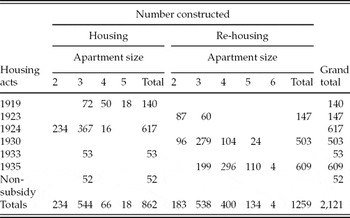
King was explicitly referring to a newly built tenement in Broad Street which comprised 16 two-roomed flats. This had been part of the original pre-1914 plan for the St Mary's Wynd Improvement scheme, now being pursued under the slum-clearance provisions of the 1923 Act. This was the only category of houses built under the post-1918 legislation that were predominantly of two rooms (87 out 147) though some schemes built under both the 1924 and 1930 Acts also included such small houses.Footnote 61 Of the 2,121 council houses built in Stirling between 1919 and 1938, two-apartment properties accounted for 20 per cent of the overall total, and by 1936 King was again drawing attention to the overcrowding that was ‘becoming almost as common in the housing schemes as in the slums’Footnote 62 (see Table 2).
Council houses constructed under the financial provisions of various housing acts, Stirling, 1919–38

Note: Separation between housing and re-housing equates to general needs and slum clearance/overcrowding. Two arithmetic errors in the original table have been corrected, and are shown in italics.
Source: SB1/1/46, ‘Annual report on the general sanitary condition of the burgh for the year 1938’ (Public Health Department, Stirling, 31 May 1939), 22.
At times, one gets the impression that those in authority were wilfully blind to what they were doing and to the real problem, namely poverty. In late 1934, the secretary of state in the national government, Sir Godfrey Collins, at a meeting with Stirling Council, ‘expressed approval of what the Town Council had been doing but emphasized that the slum clearance programme would be speeded up as rapidly as possible. Following upon slum clearance, the problem of overcrowding should be attacked as soon as possible or simultaneously with slum clearance.’Footnote 63
Housing the poorer working classes was a catch-22 situation: cheaper and therefore smaller houses were the only homes which poorer workers could afford. But smaller houses were not suitable for families, particularly large and often extended families, and quickly became overcrowded, replicating many of the problems evident in the old slum districts. The problem seemed insoluble: if the poorer working classes could not afford decent houses, then they were not going to get decent houses. The 1935 Act, however, sought expressly to address this dilemma through prioritizing overcrowding and Stirling responded by building for the first time predominantly larger, that is four- and five-apartment houses. By 1938, such housing accounted for 19 per cent of the burgh's stock, an achievement made possible by the creation under the same act of a unified Housing Revenue Account. This allowed the rents of the older stock to subsidize the real cost of providing the new. However, as Stirling's rents remained remarkably high in comparison with most of urban Scotland, this must have still acted as a barrier to many on low incomes.
Raploch was always a ‘problem’ neighbourhood, and the construction of new council housing merely exaggerated that existing stigma. The majority opinion on the town council was that providing this housing was the sum total of what was necessary for Raploch. When, in 1936, Councillor Moores proposed that a recreation hall be built to help foster community development, he got no support. His reasoning was that the population of the area would soon reach 6,500, and these were people whom the council, ‘acting under government orders . . . had upset the whole living conditions by sending them to the Raploch district . . . The district was drab and deserted, especially on dark nights, and there was not even a public house.’ The lack of concern among the majority can be glimpsed by the interrupted cry of ‘shame’ by an anonymous councillor and the remark by Councillor Gourlay that ‘he'd never heard of any town in Scotland providing such a facility’.Footnote 64 The dominant view appears to have been that the slum dwellers had got new housing, and thus should be grateful for that.
A contrasting social construction: Brentham bungalows
With only the occasional exception, council house building dwarfed private house construction in Scotland every year from after World War I until the late 1970s.Footnote 65 That was even the case for Stirling, a relatively prosperous burgh that was spared the worst of the depression; of the 1,772 houses built between 1929 and 1939, just 115 were constructed by private builders.Footnote 66 For instance, in 1936, a grand total of ‘17 bungalows and villas [were] erected by private enterprise’.Footnote 67 A significant proportion of the total of private build housing was located in the Livilands area adjacent to the new Stirling Royal Infirmary, which had opened in 1928. The driving force behind the construction of these houses was the Stirling Lands and Investment Company, owned by the Gourlay family, and in particular William junior. When, in 1930, the town council was considering the Company's application for permission to build, William senior, as a baillie of the burgh, had to declare a personal interest and excuse himself from the discussion. Needless to say the application was approved.Footnote 68
By 1941, there were 25 new houses within the three streets of Brentham Avenue, Brentham Mansions and Brentham Crescent branching off from Randolph Road. The rateable values (local property taxes) ranged from £15 to £80, though most fell between £35 and £40. Eighteen of the houses were occupied by their owners with the remaining seven being tenanted. Since the majority of Scottish middle-class households continued to rent at this time, there was no social differentiation between the two. Nine of the owner-occupiers were female, as was one tenant. Five of the women were either married or widowed and two were single; one a grocer, the other a teacher. Of the fifteen properties occupied by men, only two were not listed as having an occupation, though one of these was a ‘major’ so presumably a retired army officer. The thirteen male occupations were: commercial traveller; joiner; manufacturing confectioner; fishmonger; butcher; actuary; artist; coal salesman; insurance inspector; teacher; sales manager; market gardener; HM inspector of taxes.
This was a quite different social grouping from those being housed by the council, whether in Riverside or Raploch. To occupy these houses required capital and/or a significant steady income to sustain both the mortgage and rates or to meet the high end rents. Being built within an already well-established prestigious locale of large and smaller villas, this was always going to be an area that retained its exclusivity, and the occupants of the (mostly) bungalows that were built were seamlessly incorporated into the existing social structure.
Conclusion
By adopting a case-study approach to the building of council houses in the inter-war period, we have been able to move beyond the standard view of treating local authorities as simply corporate bodies responding to a national obligation to build housing with greater or lesser enthusiasm, and to explore and explain the forces behind the physical and social construction of communities. Recognizing councils and councillors as human agents, with their own self-interests, rather than merely ciphers of government allows a more subtle and better understanding about how intractable Scotland's housing problem has been and how and why so much of Scotland came to look the way that it did, and still does to a great extent. Furthermore, writing the private landlord out of the history too early ignores the fact after 1918 that the small business class continued to exert a huge influence over local politics, well into the 1970s at least. The Stirling case, therefore, adds weight to insights proffered by the often overlooked work of Byrne and McCrone and Elliot. The overt social polarization and hierarchies of these communities in Scotland's towns and cities in the twentieth century was consciously determined. It simply did not ‘happen’ in some tragic but unfathomable way.