

The President (Philip Scott, F.I.A.) introduced Professor Sir Brian Hoskins, who is Director of the Grantham Institute for Climate Change at Imperial College and Professor of Meteorology at the University of Reading. He has also had numerous national and international roles. Currently, he is on the board of the Met Office and chairs its scientific advisory committee. He is a member of the U.K. Committee on Climate Change. He is also a member of the Science Academies of the U.K., U.S. and China, and has received a number of awards in the U.K. and internationally.
He was knighted in 2007 for his services to the environment.
Sir Brian started his lecture on the challenge of climate change by explaining that most of the lecture would be about climate science, and he would explain what is on a firm basis, where the uncertainties are, and the level of that uncertainty. He would consider the global response in terms of mitigation of climate change and, in particular, the U.K.'s position.
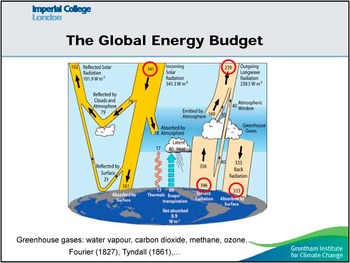
Illustrating the position with a slide, see figure 1, Sir Brian encouraged the audience to think of the energy budget of the earth, when you average it over the surface of the earth. At the top, in yellow, 341 W/m2 represents incoming solar radiation. It drives everything in terms of weather and climate, and only depends on our distance from the sun and the amount of energy coming out of the sun.
The Global Energy Budget

Because of clouds, particles in the atmosphere, and reflection from the surface, just about half gets down to the surface of the earth and stays there. The atmosphere itself absorbs very little on the way down: is almost transparent to solar radiation.
The surface of the earth is hot because it has been heated by the sun's energy. It gives off 396 W/m2 just because it is a warm body and it is giving off heat energy. The earth is so warm it is giving off more energy than the incoming solar beam.
The reason it can do this is that because most of that energy is absorbed by the atmosphere. Only 40 W/m2 manages to get out to space.
Sir Brian explained that the fact that the earth is so warm depends on the fact that the atmosphere is transparent to solar radiation but very much opaque to the long wave heat energy given off by the earth. That is the property of the atmosphere which is associated with the so-called greenhouse effect. That is what keeps the earth warm. Without that we would be a frozen planet.
He outlined that the primary greenhouse gas is water vapour, which is an interactive part of the climate system in that if more vapour goes in, then it will rain. He pointed out that it does depend on the temperature of the climate system. If the atmosphere is warmer, it can hold more water vapour and, in general, it does. That means more greenhouse gas.
The second greenhouse gas is carbon dioxide, which is the one that is most discussed. But there are others which should not be omitted such as: methane; ozone; nitrous oxide; and chlorofluorocarbons (CFCs).
He also explained that this is not new work: Fourier was involved in 1827, and Tyndall, who is associated with the forerunners of Imperial College, measured the effect of these gases in 1860.
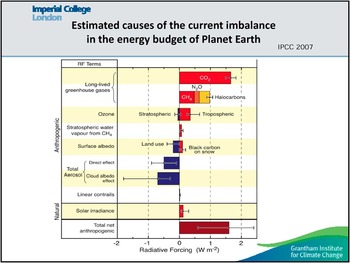
Sir Brian's next slide, see figure 2, indicated a quantification of the components of the current energy budget imbalance for planet earth.
Estimated causes of the current imbalance in the energy budget of Planet Earth

The change in carbon dioxide is top, giving about 1.7 W/m2, but other long-lived greenhouse gases such as methane, nitrous oxide and hydrocarbons, although smaller, should not be ignored.
Ozone in the lower atmosphere, or troposphere, does have a greenhouse effect and it is associated with our pollution.
Further down the slide we can see aerosols operating in the opposite direction. These are small particles in the atmosphere associated with industrial activity, agricultural burning or household fires etc.
The Professor explained that the error bars included in the slide were those current at the 2007 Intergovernmental Panel on Climate Change (IPPC) report. Since that time the numbers have remained much the same but the error bars have shrunk.
The slide also shows a view on the variability of the impact of the sun. It is not negligible, but is much less than the effect of carbon dioxide
Sir Brian then focused on carbon dioxide. He showed that in the past 650 thousand years there is a natural cycle, with the concentration of carbon dioxide moving from 180 parts per million (ppm) when the world is in a glacial period to around 280ppm when it is not.
The current level is over 390ppm which is a level not seen in the last million years.
He also indicated that it is expected that an excess of carbon dioxide input now will have an impact on the atmosphere for 100,000 years.
It is also clear that we are to blame for the increase to the current level. The increase accounts for about half of what is estimated has been added since the industrial revolution, with the balance going into the ocean and the land's surface. And the reduction in oxygen being consistent with what we would expect, given the amount of carbon we have burned, provides a further cross check.
Sir Brian then moved onto temperature increases, which have been around three quarters of a degree since the 1850s. This is around the level expected, and is lower than might otherwise be thought because of the dampening effect of the ocean. The top 2½ metres of ocean have the same thermal capacity as the atmosphere. There is 4 km of ocean and the turnover time of the ocean is about 1000 years. This leads to a lot of thermal inertia.
Sea levels increase for two reasons: one is that the ocean expands as it becomes warmer; and the second is that land ice melts.
Increasingly, in the last decade or so, it is believed that we are seeing an impact of the latter, with an increase of about 3 mm per annum in sea level. About a third of the increase is from melting ice and the rest from expansion of the sea. The key question is how much that will accelerate in future. The best estimate is around an increase of 1 m in sea levels in 100 years, plus or minus half a metre.
The next Thames Barrier has been designed with the best estimate being a 1 m sea level rise but being able to cope with 2 m sea level rise.
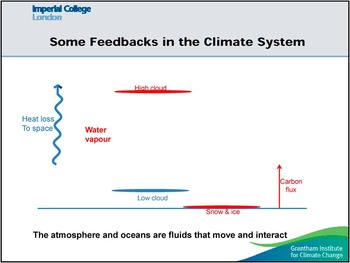
Sir Brian then went onto outline climate models, with the assistance of a slide, see figure 3.
Some Feedbacks in the Climate System

He explained that he would cover the processes at a high level only.
Starting from the left of the slide, if the climate system warms up, it loses more heat to space. So that tends to limit the amount of the warming. Then, moving to the right, if the climate system warms, then the warmer atmosphere can hold more water vapour. Water vapour is a very effective greenhouse gas which roughly doubles the effect of carbon dioxide, and leads to an even warmer climate system.
High cloud stops very little of the solar radiation, but it is very good at absorbing the heat from the earth and re-radiates it at a cold temperature, and is therefore very good at the greenhouse effect. Low cloud stops the solar radiation getting into the system and it re-radiates the heat at almost the same temperature.
Snow is a very good reflector of solar radiation. If the system warms and the area of snow and ice reduces, then more solar radiation is absorbed and the system warms.
Sir Brian also explained that a further element may need to be included in future models, and that is the impact of warming of the ability of the land to absorb carbon dioxide. In particular there is a lot of methane in the permafrost, some of which could be released as the temperature increases.
He also explained that models include the impact of vegetation, which itself is impacted by climate change, along with the impact of weather, both in the atmosphere and in the oceans.
Sir Brian then went on to consider recent records. The winter of 2009–10 was the coldest in Eurasia (and the U.K.) for a long time.
2010 was also arguably a record high for warmth, with the Russian heat wave. That same set of weather systems also gave rise to intense floods in Pakistan. The U.K. has experienced many floods in the recent past.
These extreme weather events cannot be said to be due to climate change per se, but the likelihood of their occurring has increased because of climate change.
Climate models vary in their accuracy, as expected, but in back-testing into the 20th century, the actual observations for global temperature lay within the range of the modelled outcomes. The actual outcome was not necessarily the same as the average of the modelled outcomes, as is expected given they do not attempt to represent the actual fluctuations, and they are less good for very local application.
If the greenhouse gas increases are not included, then the observed record lies outside the range of modelled outcomes, which gives strong evidence that the impact of greenhouse gases is a real one.
Professor Sir Brian did sound a note of caution around the back-testing, since people developing models would generally have tried to ensure that their models did give reasonable historical result as they were being developed.
There is, however, alternative evidence that warming is a result of greenhouse gases, in that it is the lower atmosphere which is warming, rather than the higher atmosphere. This is a good indicator that greenhouse gases are the explanation rather than solar radiation.
The professor then went onto outline what the models suggest for the future. The main points included:
- There has already been an increase of around three quarters of a degree, and there is expected to be a further increase of around one degree by 2050. Thereafter it depends on how successfully greenhouse gases are dealt with
- The best estimate would be an increase of around 3–4 degrees by the end of the century if things continue the way the way they are. More locally, this might imply a wintertime increase in temperature across northern Eurasia of about 8–10 degrees, due to the reduction in snow and ice, with implications for permafrost
- Because of the increase in temperature meaning more water vapour in the atmosphere we can expect some storms to be more violent leading to greater flooding even in areas where precipitation overall may be falling
- There may be more precipitation in higher latitudes and less in lower latitudes
- The more local the predictions, the more uncertainty exists
Sir Brian then went onto explain a little about the U.K. climate programme. In essence, very detailed models are used to calculate weather impacts on a 25 km grid across the U.K.
This is a significant amount of variability in climate systems globally, and care should be taken at each instance where more localisation is done. For example the calculations for the UK have significantly more variability than global indicators, so adopting a 25 km grid will demonstrate even more variability. The model data should be used as an example of what our systems should be resilient to, rather than a prediction of what will occur. In short, the data should be used with care.
Sir Brian then went onto discuss what can be done to tackle the global warming problem. This has to be done in the context of the whole world. A 50% increase in population is expected before reaching equilibrium, and a generic move towards western diet as people become richer.
In his view we are currently undertaking a dangerous experiment with our planet, and we only have one on which to experiment.
There are options of geo-engineering, perhaps by finding ways to remove carbon dioxide from the atmosphere and put it underground. It may also be possible to limit the amount of solar radiation which comes in by increasing the number of particles in the stratosphere.
A lot of work is going into assessing the impact of the latter, and although it may help to balance the energy budget, there may be other climate impacts such as less rainfall. It is also something that you have to keep doing once you have started.
The governance issues are also significant, and there would have to be a global alliance. But what would happen if something like the Pakistan floods could be thought to be down to the control activity?
We have to adapt to a changing climate but there is a big question over the extent to which we can do that. Or we can mitigate the impact and make a reduction in our greenhouse gases.
On mitigation the international situation is currently stalled, and the E.U. position will be important.
The U.K. is the first country to have a Climate Change Bill. It commits the U.K. to an 80% reduction in carbon dioxide emissions or equivalent by 2050 from 1990 levels. There are a series of 5 year budgets on the way to 2050 to ensure progress is made.
The targets have been devised by saying that there should be a 50% chance of warming not being much more than 2 degrees centigrade, and there being a negligible chance of it being 4 degrees.
Even with such a severe cut as 80%, there still remains a 10% chance that there will be an increase of 3.5 degrees above pre-industrial levels.
Doing the calculations, a 50% reduction in carbon dioxide emissions by 2050 by comparison to 1990 is needed. Assuming each citizen in the world has the same entitlement, leads to about 2 tonnes per person. The U.K. was around 10 tonnes per person in 1990, and hence the 80% reduction which is enshrined in law.
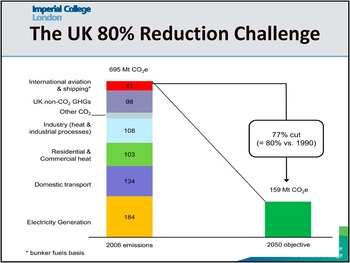
Using a slide to support the discussion, see figure 4, Sir Brian explained that a crucial part of achieving this is to almost decarbonise the electricity supply by 2030. By 2030, using nuclear renewables and carbon capture sequestration, we essentially have to reduce by a factor of 10 the carbon dioxide emissions by our electricity generation.
The UK 80% reduction challenge

Once we have done that, we can have electric vehicles which will look after the domestic transport part of the target. We can look after a lot of the residential requirement already. Of course housing would have to be leaking a lot less energy than now, and then we could use ground source heat pumps etc.
Sir Brian concluded by noting that we can eat away at all of the constituent parts on the slide, and there are various ways in which to achieve the target. But it remains a very real challenge.
Immediately following the lecture, and as part of the meeting, there were a number of table discussions. Comments raised included:
- To date, little account has been taken of climate change in setting assumptions in actuarial work;
- If we are to do so, it will be important to interact with those who have a real understanding of the system and its modelling so that we can better reflect the uncertainties associated with the system;
- Doing something about climate change will cost money and so there is a need to consider what might change in the risk reward trade off to attract investors;
- China is currently the leader in terms of photovoltaics, the wind industry and in considering the carbon intensity within their GDP. Given the large rural population, the welfare of the Chinese people is very sensitive to weather and climate fluctuations, and there is an incentive for China to make a difference;
- The life industry and the pensions industry have long term perspectives and should be more likely to take a lead in the development of projects which could have an impact on climate change. The sense, though, is that there is very little discussion on the topic within those industries at present, which provides an opportunity for the profession;
- actuaries and climate scientists both build complex models, and so we can learn from one another in how best to simplify and explain the outputs of those models to businesses. It may also be possible to use the Enterprise Risk Management framework to assist in this communication;
- actuaries have experience of risks, and in particular probabilities, and the interaction of risks, and may therefore be able to add value in understanding climate change risks and explaining them to business people;
- There has been some work done on catastrophe risks by large reinsurers and London market players, but there is much work still to do, particularly in working out how to price for catastrophe risks;
- Imperial College is one node of a European initiative called the Climate Knowledge Innovation Community (Climate-KIC). One component project is attempting to obtain open source modelling for catastrophe risks for the insurance industry, and in particular information on extreme events;
- In general insurance, there is already a recognition of more frequent extreme events, in particular flooding, but on the life side the impact will more probably come from changes in markets;
- Climate change is one of a number of uncertainties affecting the economic system, such as demographic impacts, political commitment and other uncertainties which we need to deal with as actuaries;
- Climate change is a global issue, but even within that there will be local uncertainty;
- Government policy needs to take a coherent and long term view, in order that industry can have confidence to invest, so that we can achieve what we need to by 2030 in terms of alternative ways of producing our electricity. Our Climate Change Bill did confer an advantage on us for a period, but the hiccups along the way have dented confidence;
- The models being used in climate change are becoming ever more complex, but we have to ensure that we can still draw out essential conclusions, and one way to do that is to continually cross check our understanding by comparing the output from models to the real world system. In that way we can choose between different models, based on that understanding;
- Actuaries could have a role to play in the independent validation of climate change models, particularly where there is a political angle at play;
- We need to be careful when confronted with cynicism about models, since that is often a response from those who do not want to mitigate climate change;
- It is difficult to find an appropriate time to start doing something about climate change. During recessions, people want to get through it, and when times are good people do not want to change direction;
- We also have to recognise that people perceive a threat to their lifestyle: emissions of carbon dioxide are inherent in our lifestyle, and so some things will have to change in our lifestyle;
An area of current concern is that of natural disasters, their incidence and their clustering, and much work is being done in terms of assessing the impact on the amount of capital which needs to be held;
- Actuaries have experience in building complex models based on scenarios, and communicating risk and uncertainty, which may be helpful in the climate change arena;
- The Profession has commissioned research on limits to growth, and in particular around the idea that our economy is structurally dependent on economic growth. Yet growth may be limited by factors such as climate change, resource depletion and energy costs, which may lead to a need for structural change in the financial system.
In conclusion Professor Sir Brian indicated that he felt that the meeting had been a very interesting start to a dialogue which he hoped would continue. He believed that actuaries can act as intermediaries who understand the complexity of modelling and the messages which climate scientists are trying to give.
The decisions made on finance will, to a large extent, determine whether and when we will be able to respond to the challenges for the climate system.