Eating disorders (EDs) affect over five million individuals in the United States (U.S.) each year, with approximately 21 million in the U.S. estimated to experience an ED in their lifetime (Deloitte Access Economics, 2020). EDs are associated with increased risk for other mental and physical health conditions (Field et al., Reference Field, Sonneville, Micali, Crosby, Swanson, Laird and Horton2012; Micali et al., Reference Micali, Solmi, Horton, Crosby, Eddy, Calzo and Field2015) and high economic burden (Deloitte Access Economics, 2020), underscoring the importance of efficient ED identification and intervention. Although some demographic groups may bear this burden more than others (e.g. Marques et al., Reference Marques, Alegria, Becker, Chen, Fang, Chosak and Diniz2011; Rodgers, Berry, & Franko, Reference Rodgers, Berry and Franko2018), identification of specific demographic groups who may be at greatest risk for EDs is needed to allocate resources most effectively.
Individuals of low socioeconomic status (SES) may represent one such group at elevated risk for EDs, given documented associations between food insecurity and homelessness with ED risk (e.g. Becker, Middlemass, Gomez, & Martinez-Abrego, Reference Becker, Middlemass, Gomez and Martinez-Abrego2019; Lydecker & Grilo, Reference Lydecker and Grilo2019; Rasmusson, Lydecker, Coffino, White, & Grilo, Reference Rasmusson, Lydecker, Coffino, White and Grilo2019; West, Goldschmidt, Mason, & Neumark-Sztainer, Reference West, Goldschmidt, Mason and Neumark-Sztainer2019). Once-monthly allocation of governmental food benefits (e.g. Supplemental Nutrition Assistance Program in the U.S.) is often insufficient to meet monthly nutritional needs (Carlson, Llobrera, & Keith-Jennings, Reference Carlson, Llobrera and Keith-Jennings2021), leading to a hypothesized feast-or-famine cycle of eating corresponding to binge-eating at the beginning of the month when SNAP resources are received in response to the significant dietary restraint needed toward the end of the month when the SNAP resources are depleted (e.g. Hazzard, Loth, Hooper, & Becker, Reference Hazzard, Loth, Hooper and Becker2020a; Stadterman, Karvay, Feuerstahler, & Burke, Reference Stadterman, Karvay, Feuerstahler and Burke2022). Structural barriers for those of low SES include limited financial resources for healthcare expenses (Sareen et al., Reference Sareen, Jagdeo, Cox, Clara, ten Have, Belik and Stein2007), which reduces access to mental health services for EDs (Steel, Dewa, & Lee, Reference Steel, Dewa and Lee2007). Additionally, perhaps due to historical stereotypes that framed EDs as diseases of affluence (Becker, Franko, Speck, & Herzog, Reference Becker, Franko, Speck and Herzog2003; Gard & Freeman, Reference Gard and Freeman1996; Sonneville & Lipson, Reference Sonneville and Lipson2018), individuals of lower SES with ED symptoms are less likely to perceive a need for treatment (Sonneville & Lipson, Reference Sonneville and Lipson2018). Similarly, societal and provider bias may contribute to disparities in diagnosis and care among individuals with EDs of lower SES, given historical ED stereotypes (Becker et al., Reference Becker, Franko, Speck and Herzog2003; Gard & Freeman, Reference Gard and Freeman1996). Together, these factors may constitute barriers to the identification of EDs among those of low SES.
Although these barriers, along with longstanding biases in data collection and interpretation, have fostered the erroneous notion that only individuals of higher SES experience EDs, EDs present across all SES strata, with some EDs reported at greater prevalence among those with more restricted financial means (Mulders-Jones, Mitchison, Girosi, & Hay, Reference Mulders-Jones, Mitchison, Girosi and Hay2017). However, recent efforts to collate the existing data regarding the associations between SES and ED risk have reported a lack of consistent patterns (Huryk, Drury, & Loeb, Reference Huryk, Drury and Loeb2021). Such discrepancies may be partly due to methodological inconsistencies. However, lack of attention to specific high-risk groups when considering the intersections of SES and other identifies may obscure the ways in which SES is associated with ED risk. Therefore, further attention to individuals of lower SES, a historically underrepresented group, is of great importance. Moreover, further research is needed to illuminate the possibility that SES disparities may be best understood by accounting for groups that hold additional socially-marginalized identities.
Intersectionality theory
Intersectionality theory provides a foundation for understanding ED risk and prevalence in multiply-marginalized groups (Burke, Schaefer, Hazzard, & Rodgers, Reference Burke, Schaefer, Hazzard and Rodgers2020). Founded on the work of Black feminist scholars and critical race theorists (e.g. Beale, Reference Beale and Cade1970; Crenshaw, Reference Crenshaw and Weisbert1993), intersectionality theory recognizes that structural and systemic factors (e.g. policies and practices fostering racism, classism, sexism, and heterosexism) influence individuals' multiple social identities and their level of risk and resilience in unique and potentially compounded ways (Cole, Reference Cole2009). Intersectionality theory posits that social identities are intertwined with societal aspects of power, privilege, and oppression, with minoritized identities often associated with greater risk for harmful experiences and negative outcomes. Consistent with this view, socially-constructed hierarchies of power and privilege shaped and embedded in historical and political practices have been shown to influence mental health disparities for persons from socioeconomically disadvantaged backgrounds (e.g. Williams, Priest, & Anderson, Reference Williams, Priest and Anderson2016), and for gender (Mayer et al., 2008), sexual (Mayer et al., Reference Mayer, Bradford, Makadon, Stall, Goldhammer and Landers2008), and racial/ethnic (e.g. Williams et al., Reference Williams, Priest and Anderson2016) minorities. In contrast with the more traditional additive model of risk, which assumes that risk associated with each individual identity is cumulative (Rouhani, Reference Rouhani2014), an intersectional approach allows for a more nuanced analysis of risk, acknowledging that multiple marginalized identities may confer greater or lower levels of risk than the sum of risks associated with each of identity. In other words, individuals with multiple intersecting marginalized identities (e.g. women of low SES) may experience disproportionate rates of risk for poor health outcomes due to systemic factors that may be obscured when comparing groups according to a single identity in isolation (e.g. women only; low SES only). By examining multiple aspects of identity simultaneously, considering group-specific resilience and strength factors that may counter societal stressors and discrimination related to minority status, and considering risk to be more than simply additive (Bauer, Reference Bauer2014), an intersectional approach allows for the possibility that one held identity may influence the experience of (and risk associated with) another held identity. In this respect, an intersectional approach facilitates deeper understanding of how, within the context of systems that influence one's lived experience, an individual's multiple identities may uniquely influence risk or resilience.
Emerging ED research has supported the theory's predictions, indicating that ED prevalence among groups with multiple marginalized identities may be disproportionate to the prevalence associated with each individual identity in isolation (Burke et al., Reference Burke, Hazzard, Karvay, Schaefer, Lipson and Rodgers2021a; Rodgers, Watts, Austin, Haines, & Neumark-Sztainer, Reference Rodgers, Watts, Austin, Haines and Neumark-Sztainer2017). For example, intersectional approaches have indicated that the interactions of gender and Latinx identity produce specific vulnerabilities, with Latina adolescent girls presenting some of the highest risks of ED behaviors compared to their peers (Beccia et al., Reference Beccia, Baek, Jesdale, Austin, Forrester, Curtin and Lapane2019; Rodgers et al., Reference Rodgers, Watts, Austin, Haines and Neumark-Sztainer2017). Similarly, research examining the intersection of sexual orientation and race/ethnicity indicates a particularly high prevalence of EDs among Latinx and Black sexual minority individuals (Feldman & Meyer, Reference Feldman and Meyer2007). However, existing intersectional ED research has focused primarily on the interaction between two domains of identity, with few studies (e.g. Austin, Nelson, Birkett, Calzo, & Everett, Reference Austin, Nelson, Birkett, Calzo and Everett2013; Beccia, Baek, Austin, Jesdale, & Lapane, Reference Beccia, Baek, Austin, Jesdale and Lapane2021) examining the interacting influences of more than two identities on ED risk. This limitation may obscure important group differences and impede the field's ability to identify specific subgroups at greatest risk for ED pathology (Austin et al., Reference Austin, Nelson, Birkett, Calzo and Everett2013). Therefore, research examining the intersecting influence of numerous salient identities on ED risk represents an important step for the field.
Current study
Low SES increases risk for many mental health concerns (Kivimäki et al., Reference Kivimäki, Batty, Pentti, Shipley, Sipilä, Nyberg and Vahtera2020), and intersectional approaches emphasize the importance of considering SES along with other salient social identities that are implicated in ED prevalence (Burke et al., Reference Burke, Schaefer, Hazzard and Rodgers2020). Applications of these approaches will advance our understanding of ED prevalence among multiply-marginalized populations, particularly as they are often overlooked in the context of ED research (Burke et al., Reference Burke, Schaefer, Hazzard and Rodgers2020). Such work would serve to identify specific populations at greatest risk for ED pathology and could be used to focus assessment and intervention resources appropriately. Therefore, the aim of the current study was twofold: to examine (1) the overall association between SES and ED prevalence, and (2) ED prevalence in the context of four relevant social identities (SES, gender identity, sexual orientation, and race/ethnicity) that independently relate to ED risk (e.g. Kamody, Grilo, & Udo, Reference Kamody, Grilo and Udo2020; Marques et al., Reference Marques, Alegria, Becker, Chen, Fang, Chosak and Diniz2011; Mulders-Jones et al., Reference Mulders-Jones, Mitchison, Girosi and Hay2017; Murray, Reference Murray2017) from an intersectional perspective. Given evolving quantitative approaches to examining intersectional risk, we compared additive and intersectional models when exploring aim 2. We hypothesized that individuals of lower SES would report equal or greater ED prevalence compared to their higher SES counterparts. Consistent with intersectionality theory, we hypothesized that those with multiply-marginalized identities may be at particularly heightened risk, but did not put forward a priori hypotheses regarding individual groups.
Method
Study design
Data came from the Healthy Minds Study (HMS), an annual, web-based survey about mental health in undergraduate/graduate students (Healthy Minds Network, 2022). Five years of data from 199 U.S. colleges/universities voluntarily enrolled between 2014–2019 were used. Data from the most recent wave were used for institutions with >1 wave of information (n = 25). At larger institutions, a random 4000-student sample was invited to participate. At smaller institutions, all students were invited. Students aged 18+ were recruited via email and were eligible to win a gift card regardless of participation. All procedures were approved by Institutional Review Boards at participating institutions, and all respondents provided informed consent.
Response rates ranged from 16% to 27% across waves. To account for non-response bias, sample probability weights were constructed based on gender, race/ethnicity, academic level, and grade point average. Weights were larger for respondents with underrepresented characteristics, ensuring estimates represented the full undergraduate/graduate student population in terms of these characteristics.
Measures
Gender identity
In the 2014–2015 survey, participants self-identified as male, female, or transgender in response to the question, ‘What is your gender?’. In the 2015–2016 and subsequent surveys, participants were asked their (1) assigned sex at birth (male or female) and (2) gender identity (male, female, trans male/trans man, trans female/trans woman, genderqueer/gender non-conforming, or other identity)Footnote †Footnote 1. To have at least 10 respondents in each gender identity × sexual orientation × race/ethnicity × SES stratum, the current sample was restricted to cisgender men and women.
Sexual orientation
Participants self-identified as heterosexual, questioning, bisexual, gay, lesbian, or another sexual orientation to ‘How would you describe your sexual orientation?’. To have at least 10 respondents in each gender identity × sexual orientation × race/ethnicity × SES stratum, the current sample was restricted to heterosexual, bisexual, gay, or lesbian respondents.
Race/ethnicity
Respondents self-identified as White, Black/African American, Hispanic/Latino/a, Asian/Asian American, Native Hawaiian/Pacific Islander, American Indian/Alaskan Native, Middle Eastern/Arab/Arab American, and/or as ‘other’ racial/ethnic identity. Respondents could select as many response options as were applicable. In the 2015–2016 survey, race and ethnicity were assessed via separate questions, with Hispanic/LatinxFootnote 2 assessed via the ethnicity question. Other survey years, race and ethnicity were assessed simultaneously via one race/ethnicity question. If participants selected ‘other’ as a response (n = 2977), they could write in their racial/ethnic identity. Certain ‘other’ responses were recoded back into the original racial/ethnic identity mappings (n = 288). More specifically, participants who selected ‘other’ and wrote in a racial/ethnic identity that matched the identity language used within the original question were recoded into the original identity that their response mapped onto (i.e. if an individual wrote in ‘Latina’, they were recoded into the ‘Hispanic/Latinx’ race/ethnicity identity). To have at least 10 respondents in each gender identity × sexual orientation × race/ethnicity × SES stratum, the current sample was restricted to monoracial respondents (i.e. those identifying with a single race/ethnicity) who identified as White, Black/African American, Hispanic/Latinx, or Asian/Asian American.
Socioeconomic status
In the 2014–2016 surveys, participants were asked, ‘Which of the following best describes your socioeconomic background?’. For the current study, responses of ‘very poor, not enough to get by’ or ‘had enough to get by but not many ‘extras’’ were categorized as lower SES, and responses of ‘comfortable’ or ‘well to do’ were categorized as higher SES. In the 2016–2019 surveys, participants were asked, ‘How would you describe your financial situation while growing up?’. For the current study, responses of ‘always stressful,’ ‘often stressful,’ or ‘sometimes stressful’ were categorized as lower SES, and responses of ‘rarely stressful’ or ‘never stressful’ were categorized as higher SES. These delineations and SES conceptualizations are consistent with recommendations for measuring SES in psychological research (Diemer, Mistry, Wadsworth, López, & Reimers, Reference Diemer, Mistry, Wadsworth, López and Reimers2013) and similar to previous work (e.g. Neumark-Sztainer et al., Reference Neumark-Sztainer, Wall, Choi, Barr-Anderson, Telke and Mason2020; Price, Choi, & Vinokur, Reference Price, Choi and Vinokur2002). For sensitivity analyses, another variable using a stricter cut-off for lower SES was also defined, such that only responses of ‘very poor, not enough to get by’ (2014–2016 surveys) or ‘always stressful’ (2016–2019 surveys) were categorized as lower SES. Participants' SES background v. their current SES was used in analyses given scarcity's longstanding influence on current behaviors (Mullainathan & Shafir, Reference Mullainathan and Shafir2013).
Eating disorder pathology
ED pathology was assessed with the five-item SCOFF (Morgan, Reid, & Lacey, Reference Morgan, Reid and Lacey1999), a widely used ED screening tool. Item response options are dichotomous (yes = 1, no = 0), with total scores ranging from 0 to 5. The cut-off for a positive screen (i.e. likely ED diagnosis) was ≥2 affirmative responses, which yields the optimal trade-off between sensitivity and specificity (Mond et al., Reference Mond, Myers, Crosby, Hay, Rodgers, Morgan and Mitchell2008). Positive screening was used as a proxy for prevalence (e.g. Burke et al., Reference Burke, Hazzard, Karvay, Schaefer, Lipson and Rodgers2021a). The SCOFF has been validated and utilized across gender (e.g. Mitchell et al., Reference Mitchell, Masheb, Smith, Kehle-Forbes, Hardin and Vogt2021), sexual orientation (e.g. Hazzard et al., Reference Hazzard, Simone, Borg, Borton, Sonneville, Calzo and Lipson2020b), race/ethnicity (e.g. Mitchell et al., Reference Mitchell, Masheb, Smith, Kehle-Forbes, Hardin and Vogt2021), and SES (e.g. Thielemann et al., Reference Thielemann, Richter, Strauss, Braehler, Altmann and Berger2019).
Statistical analysis
The analytic sample included 120 891 undergraduate and graduate students with information on all variables of interest. Analyses were conducted in Stata 16.1 and incorporated sample probability weights to account for non-response. Age-adjusted prevalence estimates of positive SCOFF screens with corresponding 95% confidence intervals (CIs) were predicted via log-binomial regression models in which gender identity, sexual orientation, race/ethnicity, and SES were included as model predictors.
The primary model, which we will refer to as the intersectional model, included a four-way interaction term between each of these social identities, and all lower-order interaction terms. We tested for interaction (corresponding to differences in absolute risk) using the identity link function for the binomial model. Age-adjusted prevalence estimates from the intersectional model were compared across social strata, with non-overlapping 95% CIs indicating statistical significance.
For contrast, we also ran a model without any interaction terms (i.e. only including main effect terms for each social identity), which we will refer to as the additive model. The additive model assumes additive ‘risk’ based on each social identity, whereas the intersectional model allows for ‘risk’ that is less than or greater than the sum of the independent ‘risks’ for each social identity. Non-overlapping 95% CIs between the age-adjusted prevalence estimates from the additive and intersectional models for a specific social stratum indicated a statistically significant departure from additivity, meaning the identified point estimate was significantly greater or lesser than the summed risk associated with the individual identities. The overall association between SES and positive SCOFF screen is also reported from this additive model, as well as from a separate model adjusted only for age.
For sensitivity analyses, all analyses were conducted using the alternative operationalization of SES with a stricter cut-off for lower SES. The results of these sensitivity analyses are reported as Supplemental material.
Results
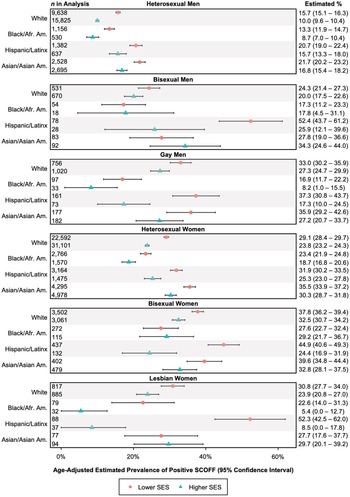
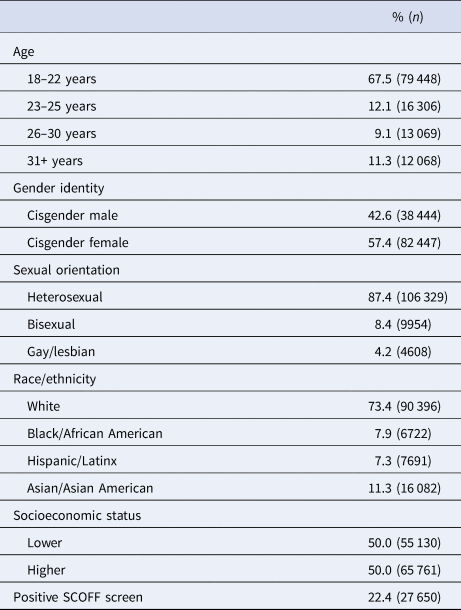
Nearly a quarter of the sample met criteria for elevated ED pathology (see Table 1), consistent with other college student populations screened with the SCOFF (e.g. Hill, Reid, Morgan, & Lacey, Reference Hill, Reid, Morgan and Lacey2010; Tavolacci et al., Reference Tavolacci, Grigioni, Richard, Meyrignac, Déchelotte and Ladner2015). Sample sizes of the intersectional social strata are presented in Fig. 1.
Age-adjusted prevalence estimates of positive SCOFF based on intersectional model.

Sample characteristics (N = 120 891)

Note. Frequencies represent observed counts; percentages are weighted to account for non-response.
Socioeconomic Status
When adjusting only for age, participants of lower SES had 1.33 (95% CI 1.31–1.36) times greater ED prevalence than those of higher SES. After additionally adjusting for gender identity, sexual orientation, and race/ethnicity, participants of lower SES had 1.27 (95% CI 1.25–1.30) times greater ED prevalence than those of higher SES.
Intersectional model results
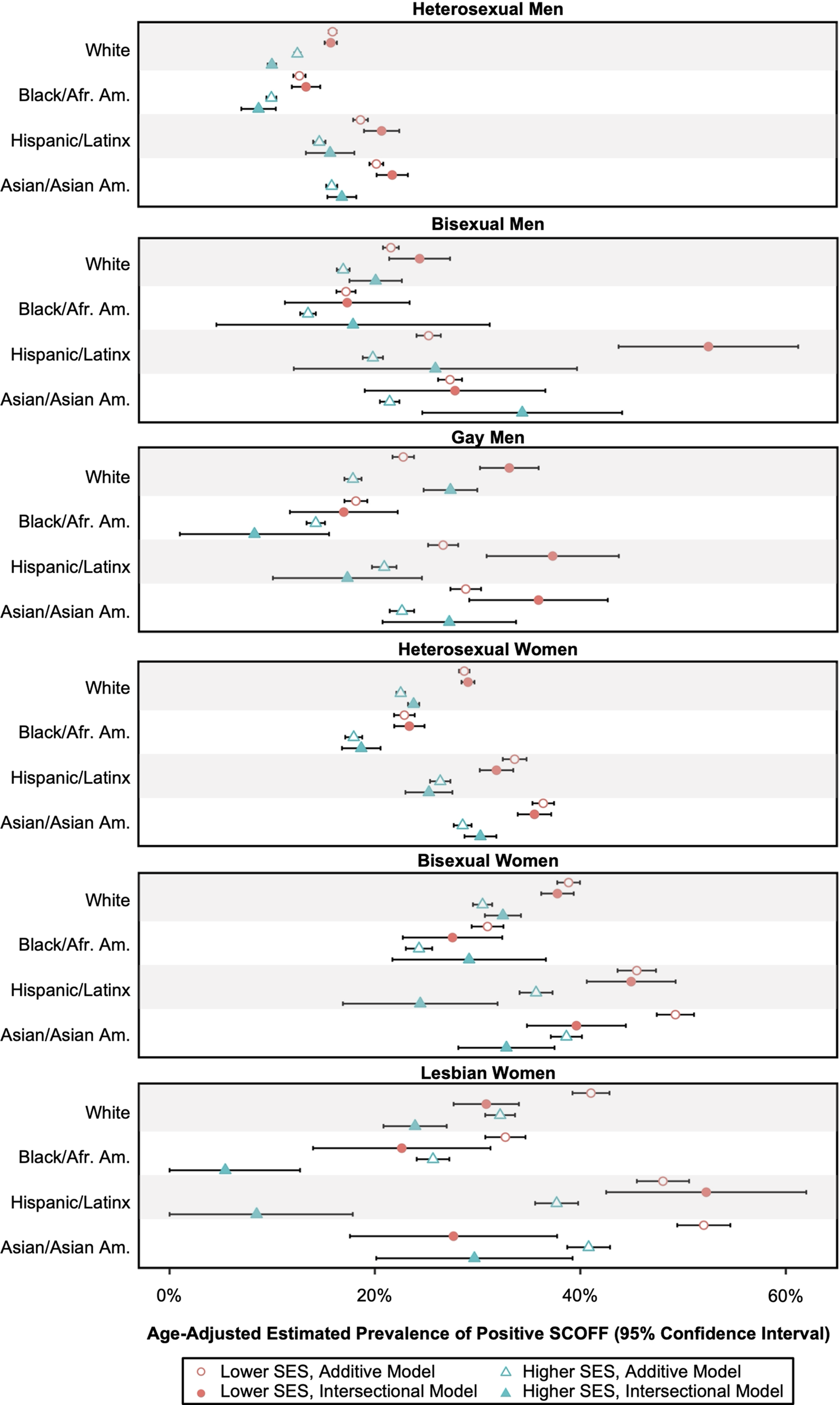
Generally, results (see Fig. 1) revealed more heterogeneity in ED prevalence estimates across racial/ethnic and SES strata among bisexual (ranges: 17.8–52.4% and 24.4–44.9%, respectively) and gay/lesbian (ranges: 8.2–37.3% and 5.4–52.3%) men and women, relative to heterosexual men and women (ranges: 8.7–21.7% and 18.7–35.5%, respectively). Similarly, more heterogeneity was present among Hispanic/Latinx individuals (8.5–52.4%) compared to all other racial/ethnic groups, and among lower SES (13.3–52.4%) v. higher SES (5.4–34.3%) individuals.
When examining more specific patterns, ED prevalence estimates across both men and women tended to be particularly high among Hispanic/Latinx sexual minorities of lower SES. For example, the estimated prevalence among bisexual Hispanic/Latino men of lower SES was 52.4%, significantly higher than other subgroups of men except bisexual Asian/Asian American men of higher SES and gay Hispanic/Latino men of lower SES, who had prevalence estimates of 34.3% and 37.3%, respectively. Relatedly, the estimated prevalence among lesbian Hispanic/Latina women of lower SES was 52.3%, significantly higher than all other subgroups of women except bisexual Hispanic/Latina and Asian/Asian American women of lower SES, who had prevalence estimates of 44.9% and 39.6%, respectively. Conversely, prevalence estimates across both men and women were lowest among Black/African American participants of higher SES who identified as gay or lesbian. For example, the estimated prevalence among gay Black/African American men of higher SES was 8.2%, though several other subgroups of men exhibited prevalence estimates that were not significantly different. The estimated prevalence among lesbian Black/African American women of higher SES was 5.4%, significantly lower than all other subgroups of women except lesbian Hispanic/Latina women of higher SES, who had a prevalence estimate of 8.5%.
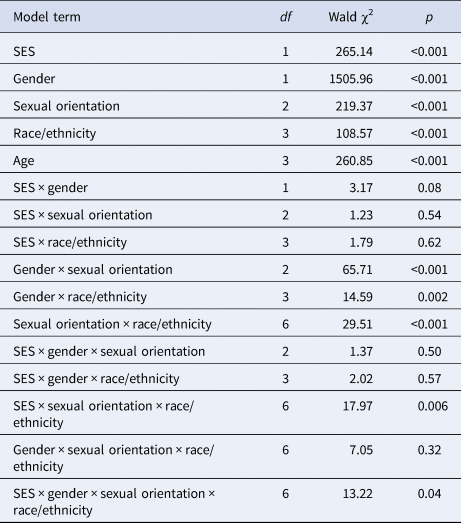
A significant four-way interaction between gender identity, sexual orientation, race/ethnicity, and SES in the intersectional model was observed (joint test p = 0.04). The results of all joint tests from the intersectional model are reported in Table 2.
Joint tests from the intersectional model
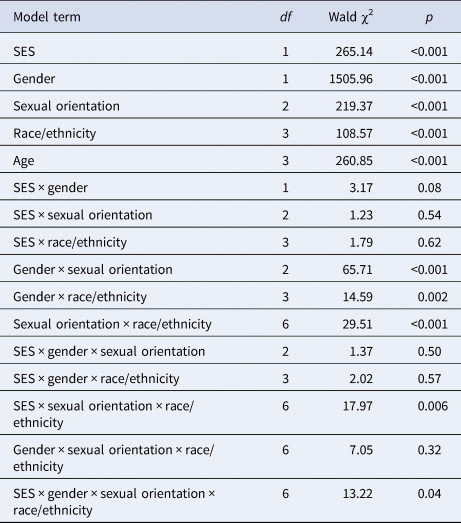
df, degrees of freedom; SES, socioeconomic status.
Note. The model terms presented here represent a total of 96 unique combinations (e.g. lower SES × female × lesbian × Black/African American) included in the model, tested in a generalized linear model with a binomial distribution and identity link function.
Additive and intersectional model comparisons
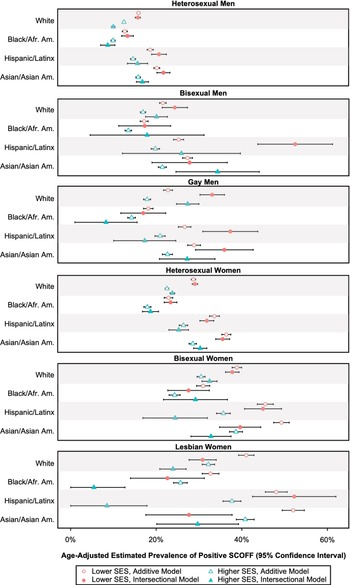
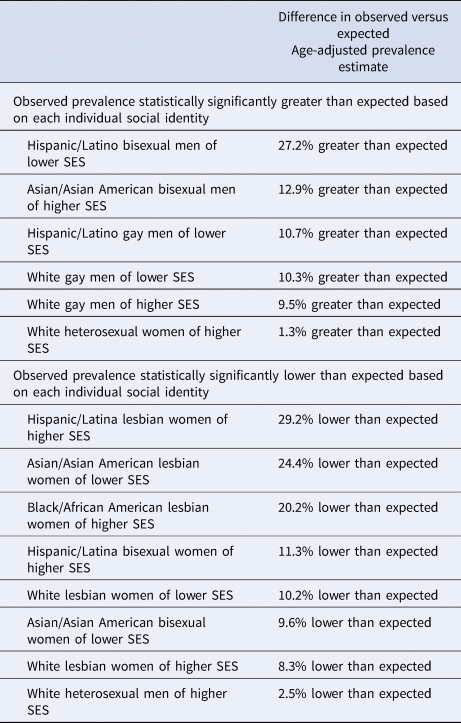
The additive model results are presented alongside the intersectional model results in Fig. 2, allowing evaluation of departures from additive risk for each specific social stratum. Departure from additive risk is observed when prevalence estimates between the additive and intersectional models differ and confidence intervals do not overlap. Several statistically significant departures from additivity were observed in these data (summarized in Table 3). Among men, all but one statistically significant departure from additivity reflected higher than expected prevalence of ED pathology (bisexual and gay Hispanic/Latino men of lower SES, bisexual Asian/Asian American men of higher SES, and gay White men of both lower and higher SES), while one group (heterosexual White men of higher SES) exhibited slightly lower than expected prevalence. In contrast, all but one statistically significant departure from additivity among women reflected lower than expected prevalence of ED pathology (bisexual Hispanic/Latina women of higher SES, bisexual Asian/Asian American women of lower SES, lesbian White women of both lower and higher SES, lesbian Black/African American women of higher SES, lesbian Hispanic/Latina women of higher SES, and lesbian Asian/Asian American women of lower SES), while one group (heterosexual White women of higher SES) exhibited slightly higher than expected prevalence. We have highlighted some of the findings and encourage readers to review Figs 1 and 2 for additional groups of interest.
Age-adjusted prevalence estimates of positive SCOFF based on additive and intersectional models.
Statistically significant differences in age-adjusted prevalence estimates of positive SCOFF based on intersectional (‘observed’) v. additive (‘expected’) models
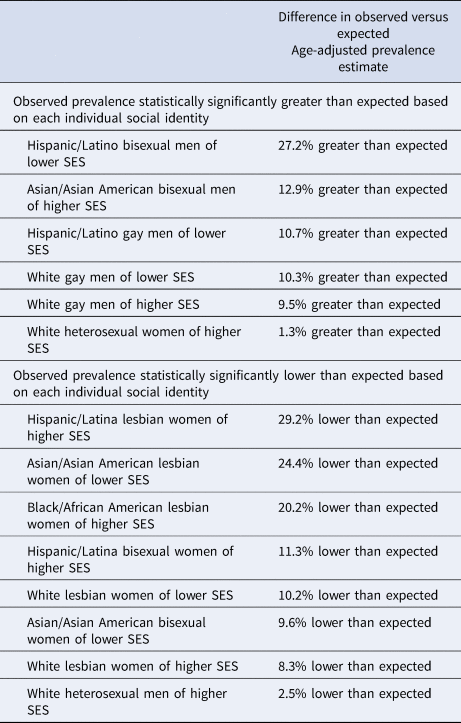
SES, socioeconomic status.
Note. Within each section of the table, differences in observed v. expected age-adjusted prevalence estimates are listed in descending order by the magnitude of difference.
Discussion
Given how little is known about SES and EDs, particularly in the context of other identities, the present study had two main aims: to examine the (1) overall association between SES and ED prevalence, and (2) intersections of SES, gender identity, sexual orientation, and race/ethnicity on ED prevalence. Overall, findings indicated that ED prevalence was greater among undergraduate/graduate students of lower SES compared to those of higher SES. However, the strength of the relationship between SES and ED varied across gender, sexual orientation, and race/ethnicity groupings. Consistent with intersectionality theory, particularly high ED prevalence was reported by certain groups with multiple minority identities, reinforcing the importance of recognizing identity as a complex and multi-layered construct when aiming to identify groups at disproportionate ED risk. In addition, our findings highlight important discrepancies between the additive and intersectional risk models, providing further support for intersectional theory and newer quantitative approaches for examining group variation in ED prevalence. Taken together, the present findings advance the ED research base and further dispel the myth that EDs are solely experienced by affluent individuals within a homogenous, narrow, and privileged set of demographic characteristics.
Consistent with our hypothesis, and similar to other areas of mental health (Meyer, Castro-Schilo, & Aguilar-Gaxiola, Reference Meyer, Castro-Schilo and Aguilar-Gaxiola2014; Reiss, Reference Reiss2013), the current study provides evidence of increased ED risk among individuals of lower SES. Though more research is needed to understand the mechanisms underlying the association between SES and ED risk, several factors may be at play. Structural oppression and income inequality contribute to health disparities (Homan, Brown, & King, Reference Homan, Brown and King2021), which is consistent with intersectionality theory's focus on systems – v. identities – conferring risk. Financial difficulties frequently contribute to interpersonal stress, trauma, and negative affect (Sturgeon et al., Reference Sturgeon, Arewasikporn, Okun, Davis, Ong and Zautra2016), which are in turn all linked to the development and maintenance of ED pathology (e.g. Arcelus, Haslam, Farrow, & Meyer, Reference Arcelus, Haslam, Farrow and Meyer2013; Brewerton, Reference Brewerton2007; Fairburn, Cooper, & Shafran, Reference Fairburn, Cooper and Shafran2003; Sturgeon et al., Reference Sturgeon, Arewasikporn, Okun, Davis, Ong and Zautra2016). Food insecurity, which is more common among those of lower SES (Coleman-Jensen, Rabbitt, Gregory, & Singh, Reference Coleman-Jensen, Rabbitt, Gregory and Singh2019), may increase risk for ED pathology (Hazzard et al., Reference Hazzard, Loth, Hooper and Becker2020a). Attempting to control one's outward appearance may also be perceived as a way to increase one's social standing, in particular for women (Wang, Teng, Chen, & Poon, Reference Wang, Teng, Chen and Poon2020). Given the robust disparity in ED risk for individuals of lower SES, further investigation into the mechanisms of this association will be a critical step on the path toward improved health equity.
Importantly, the relationship between SES and ED prevalence was moderated by other dimensions of identity. Although reviewing results for each individual group is beyond the scope of this discussion, select findings are commented upon in more depth below. Based on the intersectional model, ED prevalence across both men and women tended to be particularly high among Hispanic/Latinx sexual minorities of lower SES, adding to research observing higher prevalence of ED pathology among sexual minorities compared to heterosexuals (Calzo, Blashill, Brown, & Argenal, Reference Calzo, Blashill, Brown and Argenal2017; Feldman & Meyer, Reference Feldman and Meyer2007; Miller & Luk, Reference Miller and Luk2019), and among Latinx sexual minorities compared to Black and White sexual minorities (Feldman & Meyer, Reference Feldman and Meyer2007). While U.S. Latinx adults have indicated similar rates of acceptance of non-heterosexuality as the general public, views on sexual orientation vary by immigrant generational status, with those of first-generation status typically less accepting compared to later generations (Taylor, Lopez, Martinez, & Velasco, Reference Taylor, Lopez, Martinez and Velasco2012). It is possible that systemic factors influencing aspects of identities not assessed here (e.g. generational status, acculturation) may partially explain the current study's findings; however, additional research is needed to determine this.
Notably, for several groups, ED risk was more – or less – than would be expected based on additive models, highlighting the importance of using intersectional models. For instance, as overall ED prevalence for women is higher than for men (Murray, Reference Murray2017); the additive model broadly assumes greater risk for women and lesser risk for men, potentially overestimating and underestimating risk, respectively, in certain populations. Further, several important findings – particularly for sexual minority groups – were obscured in the additive model. For example, among Hispanic/Latina lesbian women of high SES, the additive model overestimated ED risk by roughly 30%, which concealed a nearly 44% difference in risk between high and low SES groups. In addition, comparison of intersectional and additive analyses indicated that ED prevalence was higher than expected were risk to be additive among Hispanic/Latino gay and bisexual men of lower SES, and similarly lower than expected were risk to be additive among Hispanic/Latina lesbian and bisexual women of higher SES. These results underscore the capacity of intersectional models to identify heightened levels of risk and resiliency in specific groups. However, again here, additional research is needed to uncover the specific mechanisms underlying these findings. Variables of interest may include religiosity and religious affiliation (Horowitz, Reference Horowitz2013; Taylor et al., Reference Taylor, Lopez, Martinez and Velasco2012), outness (i.e. the degree to which sexual orientation is disclosed to others; Feldman & Wright, Reference Feldman and Wright2013; Kosciw, Palmer, & Kull, Reference Kosciw, Palmer and Kull2015), and variations of acceptance of sexual minority identity by one's community or culture of origin (Giano, Currin, Wheeler, & Hubach, Reference Giano, Currin, Wheeler and Hubach2020; Kosciw et al., Reference Kosciw, Palmer and Kull2015; Poushter & Kent, Reference Poushter and Kent2020).
Intersectionality theory acknowledges that risk operates within social, political, and economic systems that benefit some, as much as they disadvantage others (Cole, Reference Cole2009). While many groups identifying with the four historically marginalized identities examined within this study evidenced heightened risk, several multiply-marginalized groups exhibited relatively low levels of ED risk. For instance, Black lesbian women of higher SES (who experience ‘triple jeopardy’ due to the combination of their race/ethnicity, sexual orientation, and gender identity; Bowleg, Reference Bowleg2008), evidenced the lowest ED prevalence of all groups, which warrants questioning what might be particularly protective for this group. Overall, Black women tend to report less ED pathology compared to their White, Hispanic/Latina, and Asian/Asian American peers (e.g. Burke et al. Reference Burke, Schaefer, Karvay, Bardone-Cone, Frederick, Schaumberg and Thompson2021b; Rakhkovskaya & Warren, Reference Rakhkovskaya and Warren2016), which may be attributable to deriving supportive appearance-based messages from culturally-specific sources (e.g. ethnic media outlets, church, family, and friends) that are protective (Rogers Wood & Petrie, Reference Rogers Wood and Petrie2010). In addition, it is possible that this group's higher financial resources allow for participation in community and social groups that may especially facilitate resilience (Meyer, Reference Meyer2003). However, the lower prevalence rate may also be due to measurement issues as the SCOFF may not fully capture eating- and body-related experiences for this group. Although the current research represents an important step in understanding how complex social identities relate to ED prevalence, additional quantitative and qualitative work is needed to better understand these relationships.
From a clinical perspective, the present findings underscore the need for clinicians to approach individuals holistically, considering the interplay between unique risk/resilience factors associated with each aspect of patient identity and social positionality. For example, person-centered assessment techniques embrace multiple aspects of identity and should be considered for evaluation and treatment planning (e.g. the Cultural Formulation Interview; Lewis-Fernandez et al., Reference Lewis-Fernandez, Aggarwal, Baarnhielm, Rohlof, Kirmayer, Weiss and Lu2014; Lewis-Fernandez, Aggarwal, & Kirmayer, Reference Lewis-Fernandez, Aggarwal and Kirmayer2020). In addition, community healthcare institutions, which typically serve diverse populations and patients of lower SES often include regular screenings for early detection of anxiety and depression (Mulvaney-Day et al., Reference Mulvaney-Day, Marshall, Downey Piscopo, Korsen, Lynch, Karnell and Ghose2018). Such institutions should also consider adding brief ED screens to better serve these at-risk populations.
From the research perspective, results from the intersectional model support the basic tenets of the intersectionality theory that an individual's level of ED risk/resilience is dynamically influenced by the unique interactions of their multiple social identities (Burke et al., Reference Burke, Schaefer, Hazzard and Rodgers2020) that are fostered within systems of power, priviledge, and oppression. The present study also provided evidence that additive models of risk may overestimate/underestimate ED risk, by failing to account for multiple identities with varying degrees of power and privilege that can influence risk. Comparatively, intersectional models may more accurately capture the real-world phenomenon of lived human experience. Finally, the present work highlights particular groups at disproportionate risk for ED pathology for whom researchers and granting agencies should orient resources, conduct further quantitative and qualitative work, adapt treatments, and screen more regularly for EDs. Identification of factors related to resilience and strength in the face of multiple stressors is especially encouraged, as identified factors/experiences could be utilized to fortify existing interventions and improve their efficacy.
The current study had several strengths including clarification of ED risk among multiply-marginalized groups who are often ignored in ED research using a large sample size that facilitated simultaneous examination of four important social identities, consistent with the identities originally conceptualized in intersectionality discourse (e.g. Combahee River Collective, Reference Guy-Sheftall1977/1995). In addition, the comparison of two different statistical approaches provided important information regarding the relative ‘fit’ of these techniques with intersectionality tenets. Limitations included the exclusion of transgender and multiracial individuals, both of whom may be at heightened risk for ED pathology (e.g. Burke et al., Reference Burke, Hazzard, Karvay, Schaefer, Lipson and Rodgers2021a; Nagata, Ganson, & Austin, Reference Nagata, Ganson and Austin2020), due to small sample sizes. In addition, although the SCOFF is widely used to assess ED pathology and has accumulated evidence to support the validity of scale scores in numerous samples (see Method section), the scale may not adequately capture culturally-relevant forms of ED symptoms for all groups, which is a broader issue in ED measurement (e.g. Kelly et al., Reference Kelly, Mitchell, Gow, Trace, Lydecker, Bair and Mazzeo2012; Murray et al., Reference Murray, Nagata, Griffiths, Calzo, Brown, Mitchison and Mond2017; Wilfred & Lundgren, Reference Wilfred and Lundgren2021). Therefore, continued development of and research using alternative measures is encouraged. Additionally, though weighting accounts for the lower response rates of those with lower SES, nonresponse bias by SES could potentially have influenced our results. Data were obtained from both public and private schools distributed broadly across the US; nevertheless, college student samples limit generalizability, particularly as lower SES individuals may be underrepresented in a college sample (ACSFA, 2001). Consequently, those with the greatest financial hardships may not be adequately captured in this sample. SES was conceptualized in the current study as financial resources, in direct comparison to antiquated notions of EDs as ‘diseases of affluence’ (Bruch, Reference Bruch1975) and in consideration of the income-related stereotypes that influence ED identification and treatment in low SES populations (Huryk et al., Reference Huryk, Drury and Loeb2021). Nevertheless, SES is a complex, multidimensional construct (Diemer et al., Reference Diemer, Mistry, Wadsworth, López and Reimers2013), and it is possible that other SES-related factors (e.g. education, occupation) may be differentially related to ED risk. Related to the use of sample probability weights to account for non-response, the present study used a traditional interaction term-based approach to examine intersectionality rather than multilevel analysis of individual heterogeneity and discriminatory accuracy (MAIHDA; Evans, Williams, Onnela, & Subramanian, Reference Evans, Williams, Onnela and Subramanian2018), a novel statistical method for examining intersectionality, because conventional statistical software do not yet have the capability to incorporate sample probability weights into Bayesian multilevel models such as those used in MAIHDA. Finally, further research is needed to replicate the current results as some of the subgroups were quite small, assess other relevant aspects of identity and associated factors (e.g. weight status, acculturative stress, outness, etc.), and clarify the mechanisms – including systemic factors – through which these associations persist.
In sum, the current findings support previous research dispelling the notion that EDs effect only affluent individuals and highlight previously overlooked groups in need of assessment and intervention. Improving our capacity to identify high risk groups is an important endeavor for better resource allocation, as well as targeted prevention, and these findings contribute to our understanding of the nuances of ED risk among individuals based on their intersecting identities. In addition to replication of these findings, further research is needed to better understand the mechanisms underlying variations in ED prevalence, and to continue to illuminate and eventually dismantle the factors that place individuals with multiply-marginalized identities at greater risk for ED and other mental health concerns.
Supplementary material
The supplementary material for this article can be found at https://doi.org/10.1017/S0033291722001015
Acknowledgements
The authors would like to thank Yvette G. Karvay, M. A., for her work coding the race/ethnicity variables utilized in the current study.
Financial support
This research was supported in part by the Fordham University Faculty Fellowship (N. L. B.), the National Institute of Mental Health grant number T32MH082761 (V. M. H.), the National Institute of General Medical Science grant number 1P20GM134969-01A1 (L. M. S.), and the National Institute of Minority Health and Health Disparities K99MD015770 (M. S.).
Conflict of interest
None.