‘You Catholic or you pagan?’ The old Tiwi woman's question came as a shock to me, a white woman made uncomfortable by language loaded with what, to me, are colonial overtones. The Tiwi Islands, off the coast of the Northern Territory of Australia, were the site of the Nguiu Catholic mission, commenced in 1911. The categories of Catholic and pagan are important for an older generation of Tiwi people, raised on the mission. The old women are decidedly not pagan. Many explained that when missionary priests denigrated Tiwi ceremony, calling it pagan, they were mistaken. ‘He said that this ceremony is a pagan ceremony, he said. But that's not true, that was in Tiwi, Tiwi law’, one told me.Footnote 1 Another remembered that the priest ‘thought we were all pagans, but we were baptised, we were Catholics’.Footnote 2
Tiwi people's opinions on the Church vary widely. Among the older generation, almost all identify as Catholic. When I asked how Tiwi culture and Catholic identity might fit together, many told me a conversion story, but not the story of their conversion. Instead, Tiwi people insisted that the Church itself converted in order to embrace them.
This article turns to stories told by Tiwi people in order to understand Aboriginal conceptions of conversion in their own histories. In a corrective to histories of Aboriginal missions that privilege non-Indigenous agency and perspectives, oral histories of Indigenous people demonstrate how Tiwi people position themselves as central actors in their history. Though many have pointed to the missionary imperative to ‘vernacularise’ or ‘inculturate’ their message, this article shows how Indigenous peoples interpreted these moves.Footnote 3 This nuances accommodationst models of Indigenous conversions and puts forward an Aboriginal understanding of conversion. This case study concerns Tiwi accounts of a ‘Road to Damascus’ ‘turning’ of a Catholic priest who ‘went native’ in what he considered a move to ‘inculturate’ the Catholic faith through the Tiwi Pukumani ceremony. The Tiwi, however, do not remember his actions this way but understand his ‘conversion’ as submission to their cultural and spiritual authority; he converted, not them. Through telling this story, Tiwi people invert missionary assumptions. They hint that conversion, in some cases, might occur as spiritual communities themselves turn and change in the act of embracing new peoples.
Histories of Indigenous conversions
Conversion is a slippery concept. Lewis Rambo, a psychologist of religion, sparked fresh discussion of the concept in 1993 when he framed it in terms of ‘turning’, towards or away from religious communities, beliefs, behaviours or deities.Footnote 4 Thomas Tweed took up Rambo's spatial metaphor, describing conversion as ‘crossing’ boundaries in a search for belonging.Footnote 5 Rob Wilson, likewise, described it as much more than ‘salvation’ or ‘finality of belief’ but rather about ‘experimentation’ and ‘crossing over’. It is a process of recreating and reimagining oneself.Footnote 6
These metaphors of turning and travelling helped scholars to understand how Indigenous peoples embraced Christianity while upholding existing traditions. Though a previous generation of ‘salvage’ anthropologists considered Indigenous Christianities to be corruptions of Indigenous cultures, many are finding that Indigenous peoples creatively incorporated Christianity into their worlds.Footnote 7 Diane Austin-Broos has argued that the assumption that the spread of world religions would homogenise cultures turned out to be false.Footnote 8 She complicates the spatial metaphors. For her, religious conversion has a relational aspect, not just reorienting, but new forms of relatedness. More than ‘travel’, conversion involves ‘an encultured being arriving at a particular place’.Footnote 9 It is a cultural entanglement.
There are many examples from around the world of this entanglement. Focusing on Africa, Lamin Sanneh emphasised Christianity's ‘translatability’ in how it diversified across cultures.Footnote 10 Others subsequently emphasised the agency of Indigenous converts.Footnote 11 For Andrew Walls, the Christian message was ‘set loose in Africa’ and came into ‘creative and critical encounter with African life’.Footnote 12 Jean and John Comaroff argued that the Tswana converted, but not as missionaries recognised conversion.Footnote 13 In North America, Susan Sleeper-Smith also found that Native American Catholicism was based on ‘adaption and accommodation’, not erasure.Footnote 14 Tracey Leavelle, therefore, called for a ‘dynamic and flexible’ understanding of conversion, accounting for ‘the changes in all participants’ over conceptions that emphasise the abandoning of Indigenous religion for an ‘orthodox’ Christianity.Footnote 15 In the Pacific, Māori found that new interpretations of the translated Christian Scriptures opened up political and spiritual opportunities to resist the colonisers (including missionaries themselves).Footnote 16 Missionary and Indigenous people alike were transformed by their encounters with each other and, in Gardner's words, ‘created a new Heaven’ as they reimagined Christianity together.Footnote 17 In Australia, Aboriginal experiences have until recently largely been overlooked in studies of Christianity and conversion.Footnote 18 Some suggested that Christian doctrines and Aboriginal cosmologies are such that Aboriginal people are unlikely to convert.Footnote 19 Yet Aboriginal theologians themselves have articulated ways in which their ‘Dreaming’ fits in dynamic relationship with Christian ideas.Footnote 20 Aboriginal people created ways of being Christian and upholding their spiritual insights about time and place.Footnote 21 Numerous anthropologists and historians, therefore, are pointing to continuities with longstanding traditions embedded in Aboriginal Christian practices and creative syncretisms within Aboriginal conversions to Christianity.Footnote 22 Noel Loos wrote of Aboriginal people who were both ‘profoundly Christian’ and believed ‘as profoundly in [their] Aboriginal belief system’.Footnote 23 Tony Swain saw that Aboriginal people went beyond ‘syncretisms’ to ‘a major reformulation of their understanding of the nature of existence’.Footnote 24 Many Aboriginal people went on to evangelise their kin, and some even sought to convert whites.Footnote 25 In the 1920s, David Unaipon set out to explain his culture to whites, even as he preached Christianity.Footnote 26 Djiniyini Gondarra wrote of sharing the Aboriginal experience of revival: ‘Black preachers and evangelists have preached many years to convert the white church … we want them to be free.’Footnote 27
By now, the shortcomings of the ‘salvage anthropology’ approach that failed to appreciate Indigenous agency in reinventing Christianity are widely acknowledged.Footnote 28 Histories of conversion by creative accommodation are becoming so common as to be the new orthodoxy.Footnote 29 The concern of this article, however, is the potential of the ‘creative accommodation’ model of conversions to overshadow Indigenous people's own conceptions of their histories, imposing non-Indigenous categories on Indigenous experiences. It is necessary instead to understand Indigenous societies on their own terms, not through the lens of their colonisers.Footnote 30 Only by doing this can we understand Indigenous peoples as full historical agents, not merely as reactors or resistors to the incursions of Europeans.Footnote 31 While many have demonstrated that missionaries were compelled to change when they encountered Indigenous peoples – in a relationship of ‘mutual conversion’ – this article asks how Indigenous peoples themselves viewed these changes. Similarly, although recent insights about creative incorporation and adaptation have given fresh understandings of Indigenous Christianities, the ways in which Indigenous peoples themselves understood their ‘conversion’ (if it should be called that) is not well understood, especially in Australia.Footnote 32 Through the Tiwi case study, this article builds on existing research about Indigenous ‘syncretism’ and evangelism, but differs in an important way in that it seeks to understand Indigenous people's own interpretation of religious changes at missions and considers Indigenous people as evangelists, not of Christianity, but of their own encultured spiritualities.
Tiwi people's recent experience of missions and colonisation, compared to that of Indigenous peoples in other places, has made it possible to interview those who remember the mission days and to shed light on Indigenous people's perspectives of their own history. Interviewees' inevitable self-selection can leave researchers with a vision of the community's past as more unified than was experienced at the time. Oral history might seem further limited by the selectiveness of memory. Yet these very ‘inaccuracies’ are useful because they point to the significance of historical events for a community. In Allessandro Portelli's words, oral sources ‘lead us through and beyond facts to their meanings’.Footnote 33 Oral history is also vital as a way of recognising Aboriginal historical knowledge and avoiding reproducing a power relationship of the past that might silence Aboriginal voices. It allows historians to foreground Aboriginal people's concerns and to read their cultural priorities into the mission archive.
This approach also means acknowledging lived spiritual realities in Tiwi lives.Footnote 34 Secular academia has a tendency to explain away people's religious experiences as phenomena of underlying social, material or political factors, rather than considering the spiritual world itself as a motivator in people's lives. To overcome this tendency, the example of Robert Orsi, a pioneer in the English-speaking world of the study of ‘lived religion’, is followed.Footnote 35 Orsi discussed the challenge of including spiritual powers as actors in persons’ lives and so agents in history.Footnote 36 In Australia, some historians have also begun to foreground the spiritual in Aboriginal history.Footnote 37 The spiritual world profoundly shaped the experiences and motivations of Tiwi people and missionaries alike. Since religion mattered to them, it should be understood in its own terms.
The mission to the Tiwi
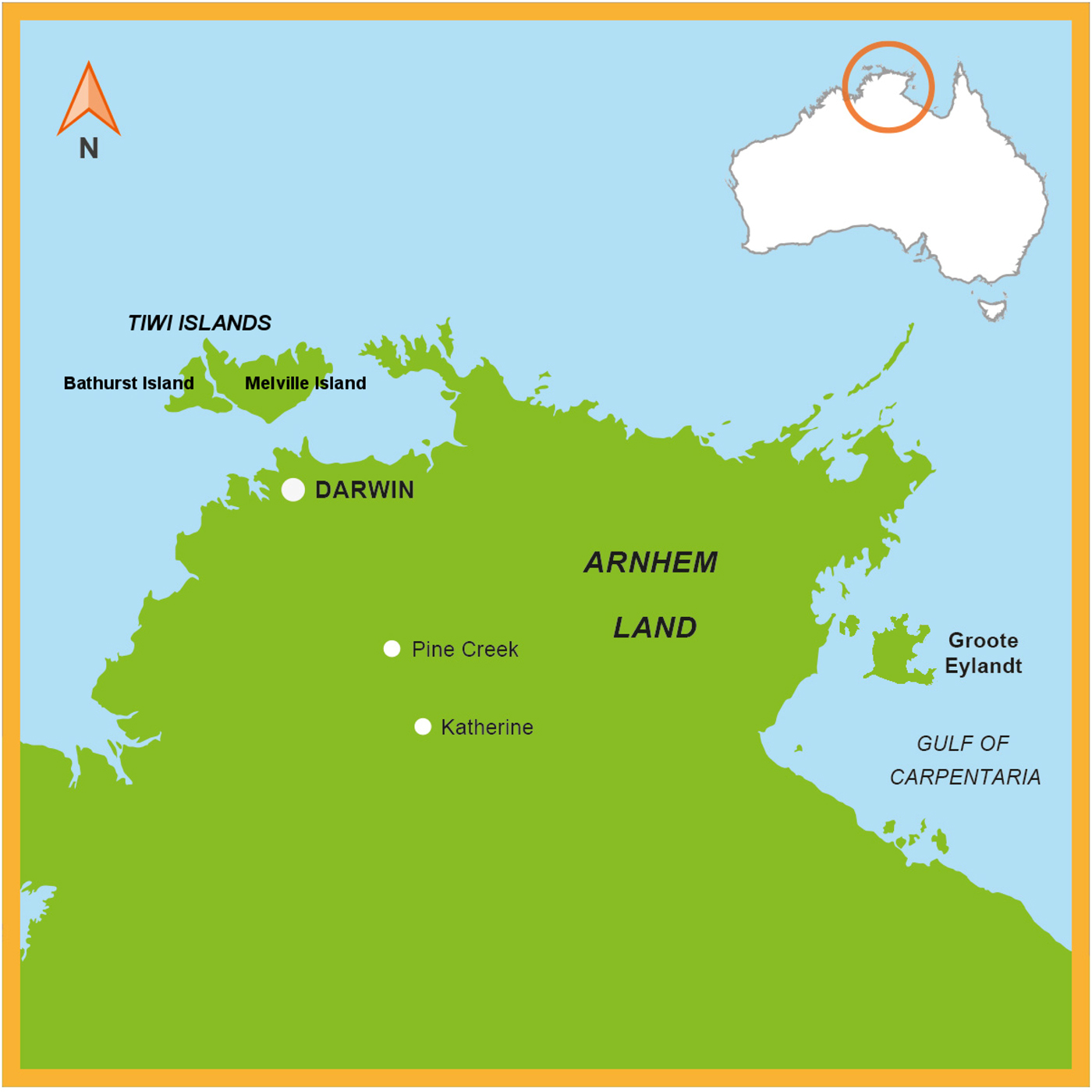
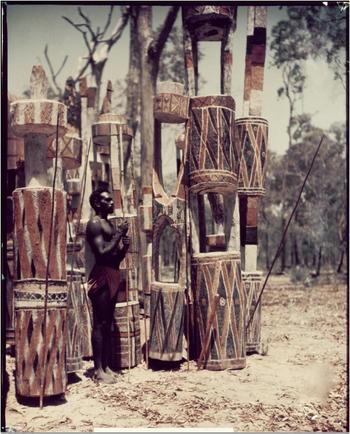
The Tiwi Islands lie just off the coast to the north of Darwin (see fig. 1). Tiwi culture is distinct in many ways from that of other Australian Aboriginal people. They are known especially for their mortuary rituals that involve the creation of unique grave posts: the Pukumani poles (see fig. 2).
Location of the Tiwi Islands. Map by FreeVectorMaps.com: < http://www.freevectormaps.com>.

Pukumani memorial poles, Melville Island 1948 (photograph by Axel Poignant). Pukumani, Melville Island, Tiwi Islands, Northern Territory, October 1948 collection, National Library of Australia, PIC/14211/11.

When someone dies, they become a mobuditi (sometimes called ‘devils’Footnote 38). Mobuditi are so light that they can walk on the surface of the water.Footnote 39 They linger where the person once lived and where their body lies, but eventually they travel onwards to the world of the mobuditi. They can be dangerous: if lonely or upset, they might kill. Tiwi people practise elaborate mortuary rites to assist the mobuditi. These are also incredible displays of Tiwi art, dance and music, including, famously, the Pukumani poles. The poles protect the spirit of the deceased from malevolent mobuditi. Footnote 40 They also keep the spirit at the grave site and comfort it. Each pole is unique. Their symbols match the spiritual identity and kinship of the deceased and help to carry the spirit into the world of the mobuditi.Footnote 41 The largest ceremonial event happens up to a year after the death and burial of the deceased. This is the most important ceremony in one's existence, marking the close of existence in the world of the living.Footnote 42 At this event, the relatives of the deceased dance and sing among the Pukumani poles.
Pukumani also refers to an entire complex of ritual mourning, given to the Tiwi by their creator-ancestor, Purrukapali. Tiwi people called him ‘the Father, creator’.Footnote 43 On the death of Purrukapali's son, his rival, the Moon-Man, offered to bring the boy back to life on the third day. But Purrukapali refused, declaring ‘you must all follow me; as I die, so you all must die’.Footnote 44 He carried the child's body into the water, where he joined his son in death. Purrukapali's choice means that all Tiwi must follow Purrukapali; all will die.Footnote 45
Today, most Tiwi are Catholic. Francis Xavier Gsell, who later became bishop of Darwin, established the mission on Bathurst Island in 1911. Gsell was a priest of the Missionaries of the Sacred Heart (Missionnaires du Sacré-Cœur [MSCs]), an order of priests dedicated to spreading the Catholic faith. Born in 1872 in Strasbourg, Gsell joined the MSCs at the age of eighteen. He was sent to Sydney before arriving on Bathurst Island to establish the mission. Other priests joined him and, within a few years, Daughters of Our Lady of the Sacred Heart arrived to evangelise and to deliver Western education and medical care.
Gsell attracted Tiwi people to the mission through providing rations in exchange for labour. Tiwi people built the church, the convent and presbytery. He soon established a dormitory for girls, compensating families for taking their daughters with flour and tobacco. Missionaries taught the Catholic faith to the next generation of mothers, believing that this was the key to converting the community. Their strategy seemed successful. In 1927 Gsell reported that ‘the Little Flower [St Thérèse of Lisieux] has filled her Church’.Footnote 46 This influx continued for the next decades; missionaries reported many Catholic marriages and baptisms in the early 1940s.Footnote 47 Tiwi oral histories are consistent with these reports: ‘They all came from their tribal lands, they came to this area … [Gsell] gave them Christianity. Their first Christianity. He baptised them all. Nice one. I'm glad my Nana got baptised and became Catholic. That's why I'm one of them and follow that.’Footnote 48
As the mission consolidated its presence in the Tiwi community, it took harsher measures against ‘pagan’ elements of Tiwi culture. Old people told me that they resented being forbidden from visiting the ‘pagans’, that is, their relatives who camped nearby. They also resented that, as schoolchildren, they were not allowed to attend ceremonies. Traditional ceremonies, however, continued. The annual Kulama (yam) initiation and increase ceremony, Tiwi people remember, went on in the bush without missionary interference.Footnote 49 This was despite Gsell's belief that it was incompatible with Catholicism.Footnote 50 The missionary Fr John Fallon likewise remembered that he considered the kulama a ‘pagan and superstitious ceremony’ in the 1960s and attempted to eradicate it.Footnote 51 Missionaries’ requirements for school and work attendance operated to prevent Tiwi from attending the event since it stretched over a number of days.Footnote 52 Though memories of the degree to which missionaries tolerated Kulama are mixed, both Tiwi and missionary accounts confirm that missionaries were very concerned about Tiwi mortuary rites, the Pukumani.
Their concern was not arbitrary; Pukumani could have disturbing meanings when translated into their own theological understandings. According to the anthropologist Jane Goodale, in the 1950s every Tiwi person over five could recite Purrukapali's fateful words verbatim; the story of how death came to the world was common knowledge at the mission.Footnote 53 When, by the late 1960s, Tiwi people recounted the story using Christian terminology – saying, ‘we shall all follow [Purrukapali] all of us down into hell’Footnote 54 – it is likely that missionaries understood the Pukumani mortuary ceremonies as a rejection of the Christian heaven. The missionaries also drew connections between Christ's resurrection and the Pukamani ceremony.Footnote 55 When offered the hope of resurrection for his son, Purrukapali stubbornly refused: he seemed an archetypal pagan. For Catholic priests, Purrukapali's role in Tiwi cosmology must be that of Adam or, perhaps worse, Satan himself. Although writing years later, Martin Wilson msc interpreted the Purrukapali story as Adam's ‘selfish human passion’ in Eden.Footnote 56 A ceremony following Purrukapali's command, seemingly damning all Tiwi to death or even hell, was deeply disturbing and spiritually dangerous.
Though missionaries scorned the ceremony, Tiwi people continued to practise it. When the anthropologist Charles Mountford visited the Tiwi Islands in 1954, he found the Pukumani ceremony under a ‘complete ecclesiastical ban’.Footnote 57 Likewise, Goodale recorded that the mission gave non-Christian people Christian funerals and buried them in the cemetery by the mission. This caused great distress as it meant no Pukumani could be held.Footnote 58 After her visit in the 1960s, Goodale wrote that the Pukumani ceremony was still ‘virtually banned’ at the mission but permitted at Snake Bay (now Milikapiti), a government settlement nearby on Melville Island. If a ‘pagan’ resident of the mission died, mission residents would travel to Melville Island and hold a Pukumani there. In fact, at every ceremony that Goodale witnessed, there were always mission residents present.Footnote 59
In response, Fr Fallon refused holy communion to participants in Pukumani.Footnote 60 Fr John O'Carrigan wrote of the ‘vast differences displayed in two mourning ceremonies’ in 1964. One ‘provided all of the traditional marks’, including ‘five hours of dancing’. The other ‘consisted of a feast accompanied by a discussion about the man being mourned’ with the attendees wearing ‘European clothing’.Footnote 61 This was evidence to him that the Tiwi were replacing the Pukumani. Still, enforcement was necessary. In 1968 missionaries encouraged relatives of deceased people to sign statements promising that they would not hold a Pukumani ceremony.Footnote 62 By 1976 Br John Pye wrote approvingly that the mission had effected a transition from the ‘totem pole’ to the cross. Pye attributed the mission's success in converting the community to its refusal to accept Tiwi people as Christian converts until they had renounced their ‘pagan’ ceremonies. Conversion, for him, was marked by renunciation of Pukumani.Footnote 63
The conversion of the priest
‘You want to know why Christianity and Tiwi?’, Tiwi people would ask. When I replied that I wanted to understand how Tiwi culture and Catholic religion came to fit together, I was told the story of Fr Fallon and his encounter with a mobuditi.Footnote 64 Fallon worked on Bathurst Island from 1958 until 1970. He took his final vows in 1967.
‘Long time, no, long time nothing’; there was no engagement between Tiwi culture and Catholicism.Footnote 65 Tiwi influences were kept out of the church until Fallon encountered the Tiwi spiritual world. Sometime in the 1960s Kalikalini, an old man known for his rejection of missionaries and his violence (Tiwi people called him a ‘murderman’) died. Kalikalini had refused baptism, insisting, like Purrukapali, ‘I want to go to hell.’ He called himself ‘Mobuditi’, perhaps to provoke the missionaries.Footnote 66 Given the ways in which missionaries could read the Purrukupali story and Kalikalini's identification with death and hell, it was not surprising that his Pukumani ceremony became the critical moment that changed the relationship between Church and Tiwi people. Barry Puruntatameri was one among many who told me of the pivotal event:
Some Tiwi, Tiwi was working with the missionary. And he saw the big mob. He look in the bushes here … and it was on Sunday. Sunday was big ceremony, biggest ceremony they had: Pukumani. This Tiwi guy, he went down and he said, ‘Oh, I gotta go tell the priest.’ He went down and he saw the father. He said, ‘Father there is big ceremony, Pukumani in the bush.’
And he said, ‘where?’
‘In the bushes.’
Everyone was dancing, clapping, everyone dancing. Few of those men saw it, you know, Father was coming. He just walked gently, but they didn't see him. And he was right behind them, watching. Next thing they saw and he just bolted through here. They all just ran out in the bush, they went and left the ceremony. He went and threw that Pukumani, he knocked it down, Pukumani pole.
And after that, after that, he went across to Melville and he had an outboard motor, he was going to make mass to the other community, on Milikapiti. Anyway, that boat engine came out. It went under the water. That was punishment for that.Footnote 67
The old people cautioned Fallon that he was making a mistake. Some had been forewarned in a dream:Footnote 68 ‘Those old people said to him, “something got to be happen to you” and he came across by boat and he try start that engine then he run right in the middle of the water to stop. That engine stopped.’Footnote 69 Knowing what was to come, the old people sat on the shore, waiting for Fallon to call for help.Footnote 70 Though the priest had done wrong, they were not angry because Fallon knew not what he did: ‘He came and shook the cemetery pole. The old people weren't angry, they weren't. They were sitting with spears and fighting club, but they knew it was because the mission didn't understand.’Footnote 71 The mobuditi (Kalikalini's spirit), disturbed by the priest's toppling of the poles, did mischief, sabotaging the outboard motor (remember, mobuditi can walk on water). Another storyteller told me that the boat began to sink, the priest nearly drowned, ‘that's when he called out for help. “Help! Help!”’ before Tiwi people rescued him.Footnote 72 The story is reminiscent of St Peter's attempt to walk on water. Fallon had no faith in Tiwi culture, so he sank down, saved only when he turned to the Tiwi people. But the story is also reminiscent of Purrukapali himself. Not realising that he was in the danger from the angered mobuditi, Fallon was inadvertently following Purrukapali to a watery grave. When Fallon turned and accepted Tiwi help, he experienced a resurrection like that the Moon-Man offered, choosing to follow a better way.
The story continues: the offending priest saw he was in error and repented. ‘After that, maybe six months later, one year later he apologises.’Footnote 73 Using the genre of Christian conversion stories, but applying these to the priest and the Church, Tiwi people demonstrated in their story-telling their Christian understanding. In a role-reversal, the Tiwi people pronounced forgiveness on the repentant priest: ‘He said sorry to our older people. He went back, the next day he went back. “Sorry, sorry, but I know”, you know, “God gave you your culture and like Christian way”.’Footnote 74 Tiwi people remember teaching the priest the meaning of ceremony and about the truths of the spiritual world. Not only did the priest repent of his actions but was ‘converted’ to Tiwi tradition:
They brought him back here to Bathurst and they explain to him. ‘What you did back there was wrong. You shook the poles and knocked the pole over. That's why the spirit got you. What we did back there, we wasn't worshipping evil, we were having ceremony for a deceased person, a family member. That's why when you shook the poles and you got in the middle, the spirit got you.’ That motor went underwater, the bung went missing. That's when he believed in our culture.Footnote 75
The priest's error was not mere disrespect, but failing to understand that this Pukumani ceremony was, for Tiwi people, not pagan but a Catholic ceremony. Fallon had said ‘you all pagan mob’, but he was mistaken.Footnote 76 Tiwi people had a broader vision of what could be authentically Catholic: ‘He just knocked all the ceremony poles. It was very wrong because that's the culture … I don't know why, but he knocked all the poles. He wouldn't accept it. He thought we were all pagans. But we were baptised. We were Catholics.’Footnote 77
Tiwi stories also emphasise the geography of Fallon's turning. Each told how his travels were dramatically interrupted by the angered mobuditi. They also included his return to the Tiwi Islands as a sign of true conversion: ‘That priest finally understood. He came back. He understood our culture and he participated too. He took part in our dancing. Even buried here in the ceremony there, Tiwi way. We danced for him too.’Footnote 78
When Fallon died, he was buried on the Tiwi Islands after a Catholic funeral and Pukumani dances. His burial in this location, for the Tiwi, indicated his eventual belonging in the Tiwi community This is because, for many Aboriginal people, spirituality, morality and geography are intertwined.Footnote 79 In his work with the Gurindji people, Minoru Hokari found that their instruction to ‘follow the right way’ had both a moral and spatial dimension.Footnote 80 ‘The right way’, he explained, ‘includes a geographical Dreaming track as well as ethical behaviour.’Footnote 81 It had to do with the travels of Creative Beings across the landscape in the Dreaming. The ‘right way’ was not an abstract concept of moral living but actually a way of travelling and being in their country. Likewise, when Fallon returned to the Tiwi Islands and was buried, he signalled a full reversal of his previous ways. Rather than exorcising the island and its people of their traditions, he became part of it, embedded in the island, its people and culture. Fallon's burial on Bathurst Island, therefore, can represent a pilgrimage of the Church itself, whereby it came to settle in Tiwi land and culture.
Fallon's conversion was, for the Tiwi, the catalyst for a change throughout the diocese and Church. After his apology to the Tiwi, in an act of penance, he wrote to the bishop:
[Fallon] write a letter to bishop: ‘we should leave this cultural thing. That's their culture. They believe in their culture.’ Bishop O'Loughlin, yeah, that's him.
And bishop said, ‘all right’.
He came across and he apologised to all the Tiwi. The bishop apologised. He apologised to Tiwi. He said, ‘I didn't know that you had a cultural, a cultural ceremony.’Footnote 82
Archival evidence suggests that this conversation with the bishop took place over many years. In 1967 the bishop of Darwin, J. P. O'Loughlin, still held that it was doubtful if an Aboriginal person ‘thoroughly indoctrinated in his stone age philosophy’ by participating in ceremonies could ever ‘make a success of life in the 20th Century’. A Tiwi man corrected him, explaining that the Tiwi reached an agreement with Fallon that ‘it was possible to follow both the European and Tiwi customs’, suggesting that, by then, Fallon cooperated with Tiwi on ceremonial matters whereas O'Loughlin was yet to do so.Footnote 83 After much urging from missionary priests, O'Loughlin established a Mission Board in 1968, consisting of priests, nuns, Aboriginal representatives and himself (previously the bishop alone controlled the missions).Footnote 84 This Board went on to promote greater engagement with Tiwi culture by missionaries including through the Nelen Yubu Missiological Unit, established in 1977. According to Tiwi storytellers, Fallon influenced the other priests and nuns, instructing them on the importance of respecting Tiwi traditions. For the Tiwi, though Fallon went out to shake and destroy the poles, his experience in fact ‘shook’ the missionaries. It made them re-think their entire mission strategy.Footnote 85
Looking beyond the reliability of this story to its meaning confirms the importance of the priest's conversion for the community's spiritual identity.Footnote 86 A younger man, born decades after the events, also told me the story. In his version, the offending priest was not Fallon but Gsell, the founder of the mission himself. Whether he had conflated Gsell and Fallon himself, or whether this was how he received the story, was not clear. Nevertheless, in this history, the event occurred when Gsell ‘set up a first mass’ but nobody came because they were all at the Pukumani ceremony. After Gsell overturned the poles and the spirit punished him, the old people explained Tiwi culture to him. ‘That's when he believed in our culture, and now Tiwi and Christianity, they've come together.’Footnote 87 By placing the story of the conversion of the priest at the very beginning of the history of the Tiwi engagement with Catholicism, he suggests that there was never a time when Tiwi culture and Catholic faith were in conflict. Being Catholic, for young Tiwi today, never meant abandoning or altering their ritual practices. On the contrary, the Tiwi converted their first missionary.
Inculturation, conversions and the Second Vatican Council
Non-indigenous accounts of a ‘conversion’ of the Church in the 1960s invariably turn to the Second Vatican Council. Indeed, the Council has been described as ‘an event of conversion … for the Catholic ecclesiastical imagination’. Footnote 88 The Council's call, not only to respect other cultures, but to learn from them, propelled a shift in missiological theory and practice. The Council was eurocentric. Yet it presented opportunities for the Church to embrace cultures and approaches from beyond Europe.Footnote 89 Nostra aetate, for instance, taught that the Catholic Church ‘rejects nothing of what is true and holy’ in non-Christian religion.Footnote 90 Although the Declaration left the ‘good things’ of other religions undefined, Nostra aetate opened possibilities for infusing the liturgy with Aboriginal symbols. Sr Robyn Reynolds, from the nearby Wadeye mission, argued that the Easter Wadeye Baptism, replete with Aboriginal symbolism, was a response by Aboriginal people to the call for liturgical inculturation.Footnote 91 Aboriginal leader and former MSC priest, Patrick Dodson, also remembered that the Council opened up opportunities for encounters between Aboriginal ritual practices and the Roman rite (though he was ultimately disappointed, believing that, in Australia, the Council's vision of the ‘community of believers’ drifted back to ‘hierarchy… conformity and compliance’).Footnote 92
When Fallon published an account of his ‘conversion’ in the MSC magazine in 1991 he placed it firmly in the context of the Vatican II reforms. He likened his experience to St Paul's and called it his ‘metamorphosis’.Footnote 93 His version has many similarities to Tiwi memories. The Pukumani had drawn people away from mass, so he disrupted it:
It was a Sunday. There was nobody in the church – only a few – and I could hear the sounds of a Pukamani [sic] coming across the Aspley Strait from Paru, on Melville Island. My Mass was totally distracted – and made short! I got myself across the strait and immediately scolded the people in good dramatic language with all the show of anger and shame that I could muster. This was early in my zealous days. I even shook one of the sacred posts, belonging to Minnipinni, Thomas Woody's father. He asked me to stop. I didn't. Such a pagan symbol deserved shaking, just as they all did! I'd forgotten this part, but Thomas Woody reminded me in 1986 … Within a fortnight of this happening I was on my way over to Paru once more … when I lost a brand new Mercury 25HP outboard motor, over the side of the boat, never to be retrieved. So I was duly punished for shaking that post, according to Thomas.Footnote 94
Fallon did not mention who or what ‘punished’ him. Did he believe in the mobuditi? Perhaps. Versed in St Paul's dramatic conversion, Fallon might have understood that the mobuditi broke into his experience in a similar way, creating a spiritual rupture in him by turning him from misplaced zeal towards a deeper truth. Yet Fallon claimed that he had forgotten this part of the story, so crucial in Tiwi versions. Writing for a non-Indigenous readership, perhaps uncomfortable with the possibility that a priest could experience the Tiwi spiritual world as a living reality, he attributed his change to intellectual reflection more than supernatural intervention. Soon after these events, Fallon left the islands. This, he said, gave him the space to rethink his approach to mission. When he returned, the teachings of the Second Vatican Council were fresh in his mind, that is, ‘we enculturate Jesus’ word with [other] cultures’.Footnote 95 For him, his conversion happened over a period of years, formed from reflection on his experiences with the Tiwi and the ideas coming from Rome.
MSC priests in the Northern Territory were intrigued by the cross-cultural opportunities of Vatican II. Their perception was that the bishop was reluctant to push on with the Council's reforms, but they found their own ways to pursue change.Footnote 96 The establishment of the Mission Board in 1968 was a direct outcome of the Council in the Northern Territory.Footnote 97 It explored open approaches to Aboriginal cultures. Michael Sims msc, for example, reflected the new thinking in the early 1970s. Pastors must ‘study the culture’ in which they work and understand whether their liturgy is ‘attuned’ to the people. He suggested that the ‘Roman Rite’ needed a more thoroughgoing cultural translation for the Tiwi context.Footnote 98 Similarly, Fallon embraced ideas about what came to be called ‘inculturating’ the Gospel. He not only learned to dance in the Tiwi way, but led a movement to bring the Pukumani into the church. In 1968 he arranged for the installation of Pukumani poles in the Nguiu church; the legs of the altar would be made of six miniature poles. According to the lay missionary John Morris, Fallon intended to encourage Tiwi to ‘draw a parallel with the Lord's pukamunni [sic] – His death and resurrection’.Footnote 99 By 1975 missionaries were discussing including Pukumani dances in the funeral mass, including blessing the poles.Footnote 100 These moves, they believed, would make Catholicism more comprehensible and attractive to Tiwi. Perhaps it was simply coincidence that Fallon's conversion experience at the Pukumani took place during this period of ‘conversion’ of the global Catholic Church. Yet, it could also be said that it was the Tiwi people – or even the mobuditi spirit – that caused the conversions of Vatican II to come alive in North Australia.
Though missionary priests understood their embrace of Tiwi culture as signalling a respect, their ‘conversion’ could also represent a new form of mission interference in Tiwi lives. The Comaroffs argue that the impact of colonialism was in the ‘long battle for the possession of salient signs and symbols’.Footnote 101 That is, colonisation entails a struggle to control meaning, the way people represent themselves and the world. Missionaries around the world were compelled to change – to ‘convert’ – and make concessions to Indigenous cultures if they were to make their faith ‘meaningful’ to Indigenous people. Yet, the Comaroffs point out, these moves were also directed at entangling Indigenous people ‘in a web of symbolic and material transactions that would bind them ever more securely to the colonising culture’.Footnote 102 Westerners have long been attracted to the idea of ‘going native’, finding in Indigenous cultures answers to their own needs or agenda. ‘Going native’ can calm colonisers’ anxieties about the injustice of dispossession.Footnote 103 Perhaps here displays of cultural engagement calmed priests’ anxieties. As they became more aware of their Church's actions in denigrating Indigenous cultures, ‘going native’ could be their act of penance. Moreover, by guiding and even driving the ‘indigenisation’ of the Church, missionaries could hope that Christianity would remain under their influence, never fully subject to reinterpretation along Indigenous lines. Missionaries could remain the authority on Christian practices and even establish themselves as authorities on Tiwi culture, rather than following Indigenous leadership. Michael McNally's critique of inculturation noted this tendency; inculturation became a ‘prescriptive term of post-conciliar Catholic missiology’ rather than ‘an autonomous expression of Indigenous Christian thought’.Footnote 104 That is, ‘inculturation’ could be a process indicative of missionaries’ desire for repentance, conversion or control rather than of the creativity of Indigenous people.
On the question of their ‘conversion’, the Tiwi acknowledge that they changed upon contact with missionaries. There was a time, before the mission, when they were not baptised and they did not know Catholic teachings. They speak quietly of the ‘bad things’ that they no longer practise: polygamy, infanticide, geronticide. For Tiwi, these were not abandoned simply because missionaries insisted – missionaries, for instance, misjudged the Pukumani as a ‘bad thing’; instead, through discussion with missionaries (and not without conflict), Tiwi people decided they need not be intrinsic to their culture. They emphasise that Catholicism is perfectly consistent with Tiwi culture – ‘God gave us culture, Tiwi culture’ – so it would be incorrect to consider their Tiwi ancestors as ‘pagan’.Footnote 105
There has been some blending of ritual practice and story, led by Tiwi themselves. The anthropologist Maria Brandl found that Tiwi also made parallels between Purrukapali and Adam, the Moon-Man and Christ in the late 1960s.Footnote 106 In the 1980s Andrée Grau noticed that Tiwi compared the Catholic service to their rituals, commenting, for example, that the use of incense in church was similar to their use of smoke.Footnote 107 Tiwi women's Kuruwala songs include Catholic hymns translated into Tiwi. Other songs blend both traditional Tiwi and Catholic spirituality.Footnote 108 Christopher ‘Fox’ Tipungwuti sang songs about going to heaven in a 1969 Kulama, as does Bernard Tipiloura today.Footnote 109
Despite these examples, Tiwi people are reluctant to integrate Catholic and Tiwi ritual and story. An older woman explained that ‘we got two: Christian faith and our culture’.Footnote 110 Like other Aboriginal people in North Australia, they have been concerned to maintain distinctions between ritual spheres in ways that maintain their own authority in ritual matters.Footnote 111 Another explained that there is only piecemeal integration of Tiwi culture in the church, though she hoped it would become deeper.Footnote 112 When I asked if there were parallels between biblical stories and the Purrukapali story (could, for example, Purrukapali be ‘Adam’) I was told ‘we've gotta still work it out’; there is a reluctance to make explicit parallels as Catholic priests have done.Footnote 113 Some insisted that biblical stories were not equivalent to their stories and resisted suggestions that they could be equivalents.Footnote 114 From a missiological perspective, inculturation was always meant to be more than evangelising cultures in a ‘thin veneer’ (to use the words of Pope Paul vi).Footnote 115 The priests, no doubt, thought that they were creating this deep engagement when permitting the Pukumani poles in church. Yet according to my interviewee, there remains a ritual shallowness to this engagement in the Church. Incorporation, adaptation and accommodation are absent from her understanding of the historic relationship between Tiwi and Catholic cultures. Yet this absence does not threaten her Tiwi Catholic identity; it points to the failure of the Church to convert fully to the Tiwi world.
Missionaries around the world have long made accommodations to Indigenous cultures (sometimes deliberately, sometimes less so), translating their message into local forms in the hope that their Gospel would be received.Footnote 116 Historians and anthropologists subsequently pointed out that Indigenous people creatively infused new Christian ideas into their own traditions, translating the Gospel for themselves, resulting in a ‘mutual conversion’ of missionaries and Indigenous people alike. Though the nature of this Indigenous ‘creative accommodation’ of Christianity varied and sometimes even disturbed missionaries, it was, in fact, just what many missionaries hoped would take place through their efforts to ‘go native’ and cross cultures.
It could be said that this global pattern included the efforts of missionary priests on the Tiwi Islands who, in the wake of the Vatican Council, turned to the Pukumani ceremony to ‘inculturate’ the faith for the Tiwi. Looking at the missionary archive alone might give historians such an impression. But Tiwi Catholics themselves do not understand their history that way. ‘Mutual conversion’ is not how the Tiwi interpret their history of encountering missionaries, nor do they emphasise creative incorporation of a new faith into their culture. Instead, according to Tiwi people, they have long been Catholic. Tiwi narratives of conversion insist that the Church did not understand their Catholicism until the intervention of their spirits. Their mobuditi caused a dramatic rupture in the priest's spiritual understanding when, in a moment of crisis, Fallon turned to Tiwi ritual knowledge for safety, calling to the Tiwi elders for help. In this moment, the Tiwi elders acted as the faithful priests, ministering to the wayward Fallon. They modelled Christian virtues to the priest who learns to confess, do penance and convert to Tiwi culture. Whereas priests were proud of their progressiveness and willingness to ‘go native’ to reach Indigenous souls Tiwi interpretations disrupt and overturn this vision of inculturation, subverting moves which might, in the Comaroffs’ words, ‘colonise their consciousness’.Footnote 117 For them, priests’ attempts to accommodate them was, in fact, appropriate submission to their elders and spirits. As another Tiwi woman explained, ‘if you want someone to follow your religion, you've gotta come to them’.Footnote 118
The Tiwi case study suggests that by foregrounding Indigenous understandings of a mission's history, therefore, it might be possible to nuance understandings of mission history that would present Indigenous people as reactors, however creative, to the incursions and ideas of missionaries. By focusing on Indigenous histories, this article reveals the care that must be taken to resist reading missionary concerns and perspectives into Indigenous experiences and instead consider that perhaps Indigenous people interpreted events differently. Research into the historical interpretations of other Indigenous peoples might reveal similar, or perhaps further unexpected narratives of religious change. Other historians have found that Aboriginal people reconciled Christianity with their cosmology of changelessness by tying Christianity to their ancient traditions, but here I find the Tiwi took another route. Their Christianity meant (and means) waiting for the Church to change and turn to them, to overcome its homogeneity in favour of their localism and become embedded in their islands. As they insist through the Fallon story, especially his dancing and burial on their land, the real conversion was that of the Catholic Church becoming Tiwi.
Tiwi history, therefore, offers fresh insights on the enigma of religious conversion. The insight of the Tiwi perspective is that it reveals that for people to become part of spiritual communities, the community and its spirituality change. Religious institutions themselves can be converted as the very people that they include reinterpret and perform their faith in different ways.Footnote 119 Tiwi memories reveal that, as the Church incorporates more peoples, it changes and grows. As it turns and embraces new peoples and cultures – even their ancestors and spirits as the Tiwi recognise – the Church is, in a sense, converted to them.