INTRODUCTION
Lakshadweep is an archipelago of coral islands consisting of atolls, reefs and submerged banks and is located on the Laccadive–Chagos ridge. This archipelago is well known for its rich floral and faunal diversity (CMFRI, 1989; Venkataraman et al., 2004). However, there are previous works on anomuran decapod crustaceans in the Lakshadweep (e.g. Borradaile, Reference Borradaile and Gardiner1903, Reference Borradaile and Gardiner1904; Alcock, Reference Alcock1905). The family Porcellanidae is not recorded in this region. That there is a series of studies on porcellanids in India by various authors, seems to indicate that the Porcellanidae is not a so ‘less known' group in the Indian anomuran decapod fauna. As various authors have studied porcellanids in India, it is a relatively well-known group of the anomuran decapods in this region.
Recent report of coastal information database of the Gulf of Mannar, Tamilnadu, India (Ramesh et al., Reference Ramesh, Nammalwar and Gowri2008) included only two porcellanid species belonging to the genus Porcellanella White, 1852 (these species were incorrectly placed in the family Galatheidae), however, the previous reports had indicated the occurrence of 16 species belonging to 11 genera from this region (Southwell, 1906, Reference Southwell and Hornell1909; Gravely, Reference Gravely1927; Sankarankutty, Reference Sankarankutty1961a, Reference Sankarankuttyb, Reference Sankarankutty1963). Venkataraman et al. (Reference Venkataraman, Jeyabaskaran, Raghuram and Alfred2004) provided the coral reef associated faunal checklist for the Andaman and Nicobar Islands, Gulf of Mannar, Gulf of Kutch and Lakshadweep, but the list did not include any porcellanids. As the genus Petrolisthes Stimpson, 1858 has various Indo-Pacific records, the occurrence of species of the genus in Lakshadweep is expected. This paper reports four Petrolisthes species from the archipelago for the first time. In the Indian localities, Petrolisthes coccineus (Owen, 1839), P. tomentosus (Dana, 1852) and P. lamarckii (Leach, 1820), are so far reported from Nicobar Islands, Gulf of Mannar and Ratnagiri (Heller, Reference Heller1862, Reference Heller1865; Gravely, Reference Gravely1927; Sankolli, Reference Sankolli1966), whereas P. moluccensis (De Man, 1888) represents a new record in India.
MATERIALS AND METHODS
The union territory of Lakshadweep is located on the Laccadive–Chagos ridge that is supposed to be the continuation of the Aravali Mountains. It consists of several inhabited and uninhabited islands, and lies between the latitudes 08o00′N and 12o30′N and longitudes 71o00′E and 74o00′E. The studied area has the lagoon on the west coast of Agatti Island and the total area below the lagoon is about 17.5 km2 as compared to the land area of 2.71 km2 of the island (Venkataraman et al., 2004).
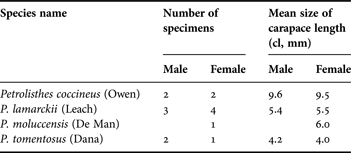
Preliminary survey was made only in the intertidal region, on the east side of Agatti Island during December 2010–January 2011 (Figure 1) and live specimens were collected by hand without causing any damage to the body and pereiopods. The identification up to species level was done by selected literature such as Haig (Reference Haig1965) and Osawa & Chan (Reference Osawa and Chan2010) and subsequently identified as Petrolisthes coccineus, P. lamarckii, P. moluccensis and P. tomentosus. Colour photographs were taken by Nikon SLR camera and notes on colour patterns of four porcellanids were based on live or recently preserved specimens. The examined specimens were preserved in 5–10% seawater–formalin and deposited in the National Zoological collections of the Marine Biological Regional Centre (MBRC), Zoological Survey of India (ZSI), Chennai, Tamilnadu. The number and size (carapace length (cl), mm) of the specimens collected are shown in Table 1.
Map showing the study area: Agatti Island, Lakshadweep, India.

List of Porcelain crabs collected from Agatti Island, Lakshadweep, India.

RESULTS
SYSTEMATICS
Order DECAPODA Latreille, 1802
Infraorder ANOMURA MacLeay, 1838
Family PORCELLANIDAE Haworth, 1825
Genus Petrolisthes Stimpson, 1858
Petrolisthes coccineus (Owen, 1839)
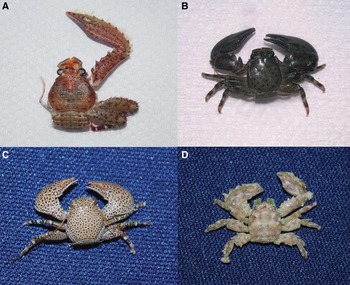
(Figure 2A)
Entire animal dorsal view (A) Petrolisthes coccineus (Owen, 1839), male, cl 9.6 mm; (B) Petrolisthes lamarckii (Leach, 1820), male, cl 5.3. mm; (c) Petrolisthes moluccensis (De Man, 1888), ovigorous female, cl 6.0 mm; (D) Petrolisthes tomentosus (Dana, 1852), ovigerous female, cl 4.0 mm.

SPECIMENS EXAMINED
1 ♂, (cl 9.6 mm), intertidal, Agatti Island, Lakshadweep Archipelago, MBRC/ZSI M1-09, 10o50′39.67″N 72o11′16.29″E, coll. S. Prakash & M. Gopi, 23 December 2010.
1 ♂ & 2 ♀ (cl 9.6 mm and 9.5 mm, 9.6 mm), same collection data as in above specimen.
DISTINGUISHING FACTORS BASED ON PRESENT SPECIMENS
Carapace with strongly convex branchial regions, bearing long transverse ridges; rostrum relatively narrow and triangular; pair of supraocular and epibranchial spines present; gastric region with distinct transverse ridges. Propodus of cheliped with spines and setae on dorso-extensor margin of propodus and dorso-flexor (posterior) margin nearly smooth except with distal spines near base of dactylus; carpus with five teeth on dorso-flexor margin and with distinct transverse ridges on dorsal surface. Second periopod (first ambulatory leg) with three corneous spines on flexor margin of dactylus; carpus with distal spine on extensor margin; merus with ten spines and setae on extensor margin, lateral flexor margin with large distal spine, lateral surface with distinct transverse ridges and setae. In fresh coloration, carapace and chelipeds red or reddish brown; ridges brownish or dark red; propodi and dactyli of ambulatory legs red, propodi each with two or three white bands.
HABITAT
The present specimens were found between mid and lower intertidal regions, under the rocks.
DISTRIBUTION
Wide but scatteredly recorded from the Indo West-Pacific. North to Honshu in Japan, south to Indonesia, west to eastern African coast, and east to Tuamotu Archipelago and Hawaiian Islands (Osawa & Chan, Reference Osawa and Chan2010). For Indian waters P. coccineus was previously recorded from the Nicobar Islands (Heller, Reference Heller1862).
REMARKS
Petrolisthes coccineus is firstly recorded from the Lakshadweep. This species was readily distinguished from the other three species reported below by the narrower rostrum and more strongly convex branchial margins of the carapace.
Petrolisthes lamarckii (Leach, 1820)
(Figure 2B)
SPECIMENS EXAMINED
1 ♂, (cl 5.3 mm) intertidal, Agatti Island, Lakshadweep, MBRC/ZSI M1-10, 10o50′39.72″N 72o11′16.25″E, coll. S. Prakash & M. Gopi, 23 December 2010.
2 ♂ & 4 ♀ (cl 5.4 mm, 5.5 mm and 5.3–5.7 mm), same collection data as in above specimen.
DISTINGUISHING CHARACTERS BASED ON PRESENT SPECIMENS
Carapace with short delicate ridges on gastric and anterior branchial region; rostrum weakly trilobate; no supraocular spine; 1 epi-branchial spine present on anterior end of cervical groove; branchial margin convex. Propodus of cheliped with short delicate striae on dorsal surface, dorso-extensor (anterior) margin early smooth; carpus with three blunt teeth on dorso-flexor margin, each tooth bearing small distal spine. Ambulatory legs with three corneous spines and tufts of setae on flexor margin of each dactylus, carpi and meri unarmed on margins. In fresh coloration, carapace and chelipeds dark brown or greenish-brown. Chela with orange mark on proximal part of cutting edge; dactylus with small orange spots on distal tip. Ambulatory legs with pale bluish bands and dull white bands alternatively on proximal and distal ends of propodi.
HABITAT
This species was abundant in the lower intertidal region of the present collection site and commonly found under the rocks.
DISTRIBUTION
Found throughout the Indo-West Pacific (Osawa & Chan, Reference Osawa and Chan2010). For Indian waters, it has been reported from Ratnagiri coast (Maharashtra) (Sankolli, Reference Sankolli1966) and the Nicobar Islands (Heller, Reference Heller1865).
REMARKS
This is the first record of P. lamarckii in Lakshadweep. This species is known to include two different morphological forms (Osawa & Chan, Reference Osawa and Chan2010). Our specimens have weakly trilobate rostrum, carpus of cheliped with three teeth on the dorso-flexor margin, carpi and meri of all the ambulatory leg unarmed on the margins; these characters agree with those of one form reported by Osawa & Chan (Reference Osawa and Chan2010). The other form possesses a triangular rostrum, carpus of the cheliped with 4–5 teeth on the dorso-flexor margin, and second pereiopod armed with a small distal spine on the lateral flexor margin of the merus and with a disto-extensor spine on the carpus (see Osawa & Chan, Reference Osawa and Chan2010).
Petrolisthes moluccensis (De Man, 1888)
(Figure 2C)
SPECIMENS EXAMINED
1 adult ♂ (ovigerous), (cl 6.0 mm), intertidal, Agatti Island, Lakshadweep, MBRC/ZSI M1-11, 10o50′38.83″N 72o11′15.95″E, coll. S. Prakash, 8 January 2011.
DISTINGUISHING CHARACTERS BASED ON PRESENT SPECIMENS
Carapace with numerous long, transverse ridges bearing minute setae on dorsal surface; branchial margin convex; rostrum slightly trilobate; epibranchial spine present but supraocular spine absent. Cheliped relatively stout; carpus with 6 teeth on extensor margin and 4 teeth on dorso-flexor margin; carpus and propodi covered with distinct ridges bearing short setae on dorsal surface. Ambulatory legs with 3 corneous flexor spines on each dactylus; propodi each with 4 spines on flexor margin, meri each with row of spines and setae on extensor margin. In fresh coloration, carapace and pereiopods yellow with numerous brown dots; propodi of ambulatory legs with marked reddish brown bands.
HABITAT
Found in the intertidal region, under rocks. Only single specimen was available for us and rarely seen during the survey. Thus, this species was uncommon in the Lakshadweep Archipelago.
DISTRIBUTION
Indian Ocean: Somalia, Red Sea, Persian Gulf, Seychelles, Mauritius, Abrolhos Islands off Western Australia. Pacific Ocean: eastern Indonesia, Nansha Islands in China, Palau, Ryukyu Islands and Chesterfield Islands (Osawa & Chan, Reference Osawa and Chan2010). Now from India.
REMARKS
This is the first record of P. moluccensis from Indian waters. This species has two extremes of colour patterns with intermediate colour forms (see Osawa & Chan, Reference Osawa and Chan2010). The carapace and pereiopods of Osawa & Chan's specimen were generally greenish-brown with brown dots unlike those of the present specimen which are yellow with brown dots.
Petrolisthes tomentosus (Dana 1852)
(Figure 2D)
SPECIMENS EXAMINED
1 ♂ (ovigerous), (cl 4.0 mm) intertidal, Agatti Island, Lakshadweep, MBRC/ZSI M1-12, 10o50′38.69″N 72o11′16.01″E, coll. S. Prakash, 8 January 2011.
2 ♀ (cl 4.1, 4.3 mm), same collection data as in above specimen.
DIAGNOSIS
Carapace bearing numerous setae; dorsal surface with rounded elevations on gastric, anterior branchial, and cardiac regions; no supraocular spine, but tiny epibranchial spine present; branchial margins convex. Cheliped covered with short plumose setae on dorsal surface of propodus; carpus with 3 large teeth on dorso-flexor margin. Ambulatory legs with short setae on extensor margin; dactyli each with 3 corneous flexor spines; meri with short bended transverse ridges bearing setae on lateral surface. In fresh coloration, carapace, chelipeds and ambulatory legs entirely creamy white.
HABITAT
Found in the lower intertidal region, under the rocks. This species was found in meagre from the present collection site.
DISTRIBUTION
Indo-West Pacific; Indian Ocean: from Somalia and Madagascar to Nicobar Islands and Western Australia; Pacific: from Taiwan and Palau to New Caledonia, Chesterfield Islands and Tuamotu Archipelago (Osawa & Chan, Reference Osawa and Chan2010). For Indian waters it was previously reported from the Nicobar Islands (Heller, Reference Heller1865).
REMARKS
This is the first record of P. tomentosus from the Lakshadweep waters.
ACKNOWLEDGEMENTS
The authors are grateful to Dr M. Osawa, of Shimane University for helping in species identification, providing necessary literature, critically reviewing the manuscript and suggesting necessary changes. We also thank the authorities of the Centre of Advanced Study in Marine Biology, Faculty of Marine Sciences, Annamalai University for encouragement and support. Thanks are extended to the Centre for Marine Living Resources and Ecology (Ministry of Earth Sciences) for providing financial assistance.