For southern Irish loyalists, the foundation of the Irish Free State in twenty-six counties was the culmination of a long period of ‘crisis and decline’.Footnote 1 The trauma of a third Home Rule emergency from 1912 to 1914, the Great War, revolutionary violence between 1919 and 1921, the transition from British control in 1922, and continuing communal and fratricidal conflict into 1923 resulted in a deeply felt loss of status and confidence. By its most crude measurement, it saw the loss of a substantial proportion of the minority Protestant population in the twenty-six counties between 1911 and 1926, much the result of emigration.Footnote 2 Southern Irish loyalists (mostly but not exclusively Protestant)Footnote 3 were not alone as a minority population suffering a crisis of identity during the nationalist wars that marked the decline of multi-ethnic European empires after 1918. Tim Wilson, for instance, has fruitfully compared the Irish experience to that of the German minority in Prussian Poland; his Frontiers of violence gives a comparative perspective on loyalist violence and identity in Ulster and Upper Silesia.Footnote 4 Palestine in the same period offers another useful, if limited, comparison to Ireland, not only as a theatre of British counterinsurgency, but also in terms of the creation of a post-Ottoman Palestinian identity.Footnote 5 Awad Halabi has described the post-war years as a ‘liminal’ period, during which ‘Ottoman and Islamic loyalties persisted among both Turks and Arabs’ in Palestine.Footnote 6 In broader terms, Wilson has pointed out that while interwar ‘ethnic’ or ‘ethno-nationalist’ conflicts were ‘more sporadic and less predictable’ than what had come before, ‘these new divisions mobilised whole communities against each other’.Footnote 7 The southern Irish experience can, then, be viewed within the context of interwar minorities facing the challenges of nationalist hegemony. It is also relevant to a growing literature on colonial and post-colonial British loyalism that has emphasized a more dynamic, complicated relationship with the empire.Footnote 8
How did southern Irish loyalists express their loyalty during this period of conflict and upheaval, and how can we reconcile behaviour with allegiance? How did they articulate their loyalty in the years after independence? Focusing on what the ‘various subjects of the collapsing Ottoman Empire actually said and did during this liminal period’, Halabi argues, ‘contradicts and challenges nationalist narratives on the loyalties they supposedly offered immediately to their emerging nations’.Footnote 9 In a similar way, what Irish loyalists ‘actually said and did’ can challenge our understanding of the nature of southern loyalism and inform discussion on community support for the republican campaign in Ireland. The most common approach taken by historians interested in issues of violence and identity during the Irish Revolution has been through local case-studies, usually based around a single county.Footnote 10 Gemma Clark's work on ‘everyday’ violence takes a similar, but broader, survey of three counties, while Tim Wilson has examined the province of Ulster.Footnote 11 This narrow focus makes it possible to engage more fully with what Peter Hart suggested might be ‘the best-documented modern revolution in the world’, and effectively chart and explain instances of violence, intimidation, and flight.Footnote 12 For the purposes of this article, it is necessary to focus more specifically on the geographical unit with which people identified most closely in their daily lives, the town and parish. Clark has persuasively demonstrated how the administrative records and testimony generated by post-revolutionary compensation schemes can offer enlightening perspectives on community experience and these documents will be similarly used here to explore southern Irish loyalist experience and identity.Footnote 13
In the midst of the Irish Civil War, the British and Irish Free State governments began work on the difficult and complex issue of compensating civilian victims of recent revolutionary violence. Conscious of its duty to former citizens of the Union and hardship caused by delays in dealing with compensation claims, the British treasury funded an Irish Distress Committee in May 1922 to assist Irish refugees in Britain. In March 1923, this was reconstituted as the Irish Grants Committee (IGC) and its remit expanded to include southern Irish loyalists still resident in Ireland. Following pressure from politicians and lobby groups, a second IGC first met in October 1926 to treat the issue of redress and decide on cases of compensation to southern Irish loyalists for loss and injury sustained between 11 July 1921 and 12 May 1923.Footnote 14 The surviving records of applicants to the scheme now constitute over 200 boxes of claim files and the present article will offer a detailed examination of a sample of thirty-seven claimants from one district: Arva (or Arvagh), in County Cavan.Footnote 15 It will not paint Arva as a ‘typical’ district during the Irish Revolution, but examine how loyalism, dissent, and victimization are expressed in one sample of claim files. The files are a rich source of first-hand, near-contemporary witness testimony covering a broad range of experiences, but are also applications for compensation and thus open to embellishment, reconstruction, or fictionalization. Amounts sought can, for example, be an unreliable marker as a natural reaction is often to claim for more in the hope of getting enough. Moreover, how does one put a monetary price on the effects of fear, isolation, and social ostracism? The dates under consideration, rigidly adhered to by the committee, may also serve to distort the full picture. Details of injuries occurring prior to 11 July 1921 were immediately ruled out of scope and not subject to interrogation while applicants may have excluded events or rearranged chronologies to fit the committee's criteria. The IGC records must, therefore, be subject to rigorous evaluation before their full value can be realized. Nevertheless, the files profiled here provide important insights into the experiences of loyalists and the nature of loyalism in Cavan; the individuals sampled are all self-proclaimed loyalist victims of revolutionary terror. The sample files were also created and examined under the same criteria as over 4,000 other loyalist compensation claims and can, therefore, speak more broadly on issues of loyalism, community relationships, and financial redress for revolutionary violence.
I
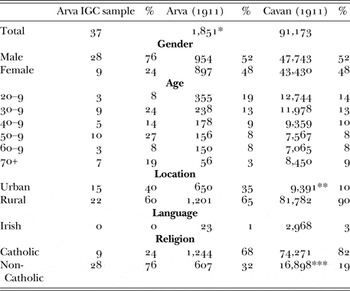
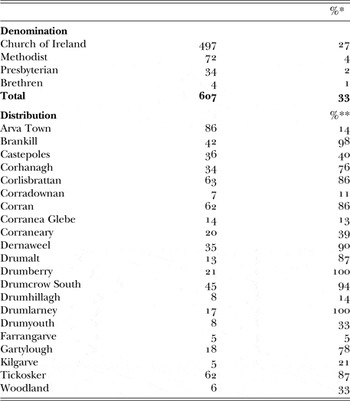
The District Electoral Division (DED) of Arva, County Cavan, is located in the west of the county, bordering Leitrim and Longford. In 1911, Arva was broadly in line with the rest of the county in terms of gender, age, and proficiency in the Irish language, but comprised a proportionally larger urban population than the county as a whole, centred around Arva town. One of the district's distinguishing features was its large Protestant minority, far higher than the county average. Most non-Catholics (27 per cent of the total) were members of the Church of Ireland, but there were also small numbers of Methodists, Presbyterians, and Brethren. Protestants were proportionally less numerous in Arva town but made up almost half of Arva's rural population, most heavily concentrated to the north-west of the town in the townlands of Ticosker, Drumalt, Drumcrew South, Corran, and Brankill; Drumberry and Drumlarney, also north of the town, contained small, exclusively Church of Ireland populations (see Tables 1 and 2).
Demographics

* This is the figure from a search of the digitized 1911 census returns. The figure given in the published parliamentary report (Table vi, p. 362) is 1,846.
** This figure represents the number of inhabitants living in towns of 500 or less: David Fitzpatrick, ‘The geography of Irish nationalism, 1910–1921’, Past and Present, 78 (1978), p. 138.
*** Information was refused in four cases and these have been excluded.
Sources: ‘Population (Ireland): census returns, 1911’, Province of Ulster, County of Cavan, House of Commons Parliamentary Papers, Cmd 6051, vol. cxvi.1, iii; digitized 1911 census returns, www.census.nationalarchives.ie.
Distribution of non-Catholics in Arva, 1911
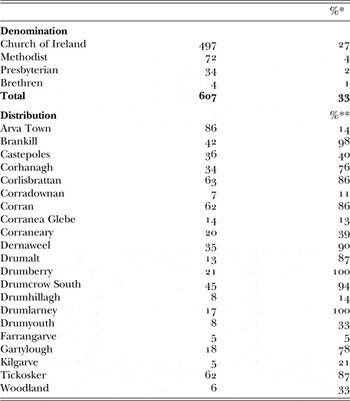
* Refers to % of the DED's total population.
** Refers to % of the townland's total population.
Source: Digitized 1911 census returns, www.census.nationalarchives.ie.
Nine fatalities directly related to revolutionary conflict were recorded in Cavan between January 1919 and December 1921 and in that period no civilian was killed in Arva.Footnote 16 Two policemen stationed in the town were shot by the Irish Republican Army (IRA) on the morning of 1 May 1921, but only after they had walked over the border into Fyhora, County Longford, on private business.Footnote 17 A successful IRA attack on Arva Royal Irish Constabulary (RIC) barracks on 25 September 1920, the first in the county, effectively left the area without an RIC police presence and a district inspector later described the effect: ‘the locality of Arva became a centre of disorder – raids for arms, destruction and looting of property being of frequent occurrence. Loyal people carried their lives in their hands, and during this time suffered heavy financial losses, by loss of markets and plunder.’Footnote 18 Within a month, the county inspector noted that Arva was second only to Ballyconnell in its desperate need for a police barracks but ‘with the difference that Ballyconnell is entirely rebel whilst in Arva there are a good many loyal subjects’.Footnote 19 The following month's report was bleak:
The County was not in a very satisfactory state and remained disturbed especially in the Ballyconnell and Arva areas. There are no police in the last two named places and the result is that the Sinn Feiners have a free hand in the localities. The men who are on the run after the shooting of the police in Swanlibar have taken refuge in these localities and have at the point of the revolver, taken away clothing, boots and other necessaries from the peaceably disposed residents, who are in a state of terror. It is urgently necessary to reopen police stations at these places and also at Carrigallen in Co. Leitrim adjoining.Footnote 20
The authorities responded quickly and a garrison of ‘Black and Tans’ (referred to erroneously by the IGC applicants as Auxiliaries) arrived in Arva in February 1921 with, the county inspector reported, good effect.Footnote 21 In March, the new barracks (a commandeered building in the town) was attacked unsuccessfully. Afterwards, it ‘came in for particular attention’ in the form of occasional sniping.Footnote 22 There may have been little direct violence against Arva civilians, but the local IRA continued to harass and persecute the local loyalist population through boycotting, ostracism, and, occasionally, physical violence. The sample, therefore, offers an imperfect but useful insight into the character and nature of the less obvious dynamics that influenced revolutionary experience.
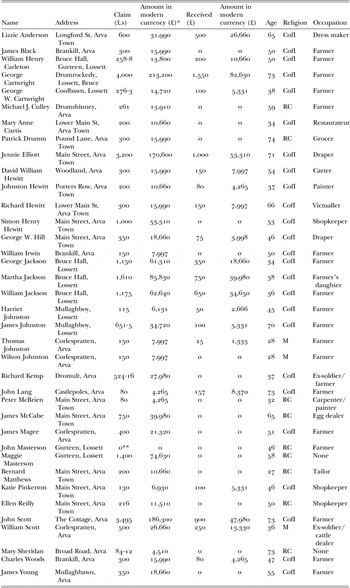
II
The Arva IGC sample (see Table 4) had much in common with their neighbours. None spoke Irish and all were middle-class merchants or landowning farmers living in good-quality houses: of twenty-two living on the same property in 1911, only one applicant's house was enumerated as ‘3rd Class’, while five individuals occupied ‘1st Class’ accommodation (including three siblings sharing the same house) and the rest ‘2nd Class’ properties.Footnote 23 In other ways, they were an exceptional group. Males made up a disproportionate majority of claimants (76 per cent) and, even for a district with a large non-Catholic minority, Protestants were over-represented (76 per cent, made up of twenty-five members of the Church of Ireland and three Methodists). Applicants were generally older, with a median age of fifty; seven were in their seventh decade.Footnote 24 In terms of age, gender, and religion, however, though, they were broadly in common with other IGC applicants from the county (see Table 1).Footnote 25 Cavan applicants, the Arva sample included, were also more likely than their neighbours to work in either commerce or industry, suggestive of a strong middle-class base to loyalism in the county.Footnote 26
The Cavan Finance Compensation files held in the National Archives of Ireland and the Compensation (Ireland) Commission register of claimants for Cavan hold applications for seven of the current sample: Jennie Elliott, George Cartwright, James McCabe, William Carleton, George Hill, and James and Harriet Johnston (who submitted a joint claim).Footnote 27 Unlike the IGC, which was restricted to southern loyalists, the Damage to Property legislation under which they had applied was open to anyone who could prove they had suffered loss at the hands of an ‘unlawful or seditious’ (but usually republican) organization.Footnote 28 George Cartwright (who died before his claim was awarded) gave a detailed description of the night his house was burned at an undefended county court hearing. On 5 March 1922, he had been raided – his ill wife dragged outside – and told first that his home would be burned before instead being given a fortnight to leave. Despite assurances from the Provisional Government that he would not be harmed, raiders returned a week later and burned the house with furniture and possessions inside; the Cartwrights were granted £930 compensation (c. £50,000 in modern currency).Footnote 29 Jennie Elliott had also claimed compensation through the county courts on a number of occasions, including for goods commandeered by men who handed her a receipt on behalf of ‘ “A” Company 1st Battalion U.V.F.’Footnote 30 The IGC stipulated that claimants should have previously applied to the Irish Free State for compensation but this was not strictly enforced and an explanation that fear, threats, or even ignorance had prevented a claim were accepted.Footnote 31 Only four applicants offered a reason for their failure to apply for compensation earlier: John Lang (‘My life was threatened by I.R.A. if I took any action’), James Young (‘I put in for none nor dare not at the time as I was safe to get out with my life’), William Irwin (‘I was afraid to go anywhere as there was no Civic Gards here’), and James Black (‘there was neither law nor order at the time’).Footnote 32 James McCabe and Harriet Johnston declined to mention that they had applied for, and received, compensation.Footnote 33 Most of those who had already sought redress through the Free State were clearly discouraged from applying to the IGC – two had requested application forms but decided against submitting a claimFootnote 34 – but this new scheme of redress also encouraged many others to come forward for the first time, and to do so specifically as southern Irish loyalists. That they now came forward, some having admitted to being previously frightened, suggests that fear of retribution had subsided enough not to deter many from applying.
All thirteen applications from the town described a loss of trade as a result of an IRA boycott. Three urban applicants (Richard Hewitt, Johnston Hewitt, and George Hill) claimed for additional losses owing to damage to property or looting and another (Jennie Elliott) for a stolen motorcar.Footnote 35 Almost all of the rural claimants were landowning farmers. Six (siblings Martha and William Jackson, siblings William and Thomas Johnston, Richard Kemp, and William Scott) claimed for boycotting of their farms and another, John Scott, his milk trade.Footnote 36 Mary Sheridan claimed for the loss of her ex-soldier son's income after he was threatened and forced to quit the area.Footnote 37 Harriet Johnston described how her husband had been ‘rigorously boycotted for many years’, though her monetary claim was for loss of the use of a piece of bog.Footnote 38 Her brother-in-law, James Johnston, was prevented from selling his farm, driven from his land in April 1921, and later forced to accept £600 (£32,000 in modern currency) for land valued at £1,000 (over £53,000).Footnote 39 Both George W. Cartwright and James Young were deprived of their land for a period of time but were later able to return. George Cartwright (no relation of George W. Cartwright) had his home burned on 13 March 1922 and claimed refuge in the house of a nearby Protestant farmer.Footnote 40 William Carleton, a neighbour of Cartwright, fled his own home after a raid by armed and masked men left him fearing the same treatment; he was reinstated in July 1924.Footnote 41 Twelve rural applicants reported raids on their homes and most took place in the first half of 1922 (George W. Cartwright was raided in April and September 1921, James Johnston in April 1921). Reverend W. A. MacDougall, the Church of Ireland rector for the parish, blamed this on the disbandment of the RIC: ‘Everyone who was raided has more or less a claim on the British Government for it was their policy of surrender & weakness which made the raids possible.’Footnote 42 Five applicants described a night in June 1922 when armed and masked men raided homes in Brankill and Corlespratten.Footnote 43
Only five of the Arva sample (11 per cent) described suffering physical violence. George Jackson claimed to have been beaten during a raid in April 1922.Footnote 44 His sister, Martha, who lived in the same house, claimed she was also attacked during the same raid, a blow to the head resulting in a permanent need to wear spectacles. She had also been shot at and wounded as she cycled to warn William Carleton that his house would be burned down.Footnote 45 During the June 1922 raids, Charles Woods's son was allegedly ‘kidnapped’ and badly beaten, losing nine of his teeth, before being taken ‘barefooted’ and ‘made travel before’ the raiders as they visited other homes.Footnote 46 Thomas Johnston was struck on the head with a rifle butt ‘inflicting a severe wound and causing considerable loss of blood’, while his brother Wilson was also assaulted. Thomas did not have the wound medically treated for a number of months, he said, as he was two miles from a doctor and afraid to make the journey.Footnote 47 George Cartwright told the county court he had been hit with the butt of a rifle on the night his house was burned but did not mention this on his IGC claim form.Footnote 48
The claim files suggest that the pattern of boycotting was directly related to the arrival of the new police garrison in February 1921. Dressmaker Lizzie Anderson was first subject to ‘ill-feeling’ when they began visiting her house that month.Footnote 49 Mary Anne Curtis claimed her trade began to suffer after the shooting of the two policemen in May.Footnote 50 The advent of the Anglo-Irish truce on 11 July 1921 brought more intense boycotting. ‘As soon as the truce became operative and protection ceased’, a supporting statement for Lizzie Anderson claimed, ‘the boycott was able to be completely enforced and Applicant's business as dressmaker was ruined’.Footnote 51 A referee for John Lang wrote that ‘Directly the truce was arranged Mr Lang was boycotted in his sale of farm produce and cattle’ (Lang himself simply stated that this took place between 1921 and 1922).Footnote 52 It therefore appears that the arrival of the garrison in February 1921 prompted a number of traders to open business with them, thereby marking themselves as deviant in the eyes of the IRA. With police intervention curtailed by the truce, boycotting increased in frequency and intensity. A referee described the efficiency of the boycotting suffered by Richard Kemp:
So perfect was the system of espionage of the I.R.A. and their friends that once a man incurred their censure it was absolutely impossible for him to sell cattle or goods publicly but if one of their own favourites bought privately, at half the value of the article, they conveniently shut their eyes.Footnote 53
In October 1921, the West Cavan IRA Brigade noted that ‘The R.I.C. in Arva have limited there [sic] patrols to the town’ and the rural population were further exposed to republican control.Footnote 54 By mid-1922, the restricted police presence had been completely withdrawn.
III
Part 5 of the application form asks applicants, ‘Do you claim that the loss or injury described was occasioned in respect or on account of your allegiance to the Government of the United Kingdom? If so, give particulars on which you base this claim.’ While the injury must have occurred after 11 July 1921, it did not matter if the evidence of loyalty was pre- or post-truce.Footnote 55 Answers offer revealing insights into applicants' sense of their own loyalism. As religious denomination is not mentioned on the form, any mentions of religion are significant. In the case of the Arva sample, they are notably absent. Among the twenty-eight non-Catholic applicants, only two refer to their denomination. William Irwin wrote, ‘I was always loyal to the British government and my father before me I am a Protestant And I was in the Ulster Volunteers or rather a member.’Footnote 56 Johnston Hewitt described how ‘I am a house painter by trade and the majority of my employers or customers were Roman Catholics although I myself belong to the Church of Ireland.’Footnote 57 Among a larger sample of sixty-five non-Catholic Cavan applicants, the figure is higher (nine) but still relatively small. In contrast, the thirteen West Cork Methodists who applied to the IGC, studied by David Fitzpatrick, were more willing to equate Protestantism with loyalty or revolutionary animosity; over half (six) used the terms ‘Protestant’ and ‘loyalist’.Footnote 58 Although Fitzpatrick's study is restricted to Methodist applicants, there is no allusion to a particular victimization of Methodists and none specifically referred to their Methodism.Footnote 59
Reverend MacDougall attested that ‘every Protestant house was visited not because they were Protestant but because every Protestant had and has a liking for the Union Jack’, but for the self-proclaimed loyalists of Arva religion does not appear to have been a defining feature of their loyalism.Footnote 60 Though he insisted that all Protestants in Arva were friendly with the police, only twenty-five of his own congregation (and three Methodists) applied for compensation, supporting Peter Hart's suggestion that most avoided the kind of contact with crown forces that might lead to trouble.Footnote 61 Applicants, however, remained acutely aware of religion as a factor in community life. Mary Anne Curtis, a Church of Ireland Protestant, was clear that she had specifically lost all her Catholic customers.Footnote 62 Simon Henry Hewitt, a shopkeeper, auctioneer, and member of the Church of Ireland, was similarly sure that 50 per cent of his customers had been Catholic prior to the imposition of a boycott against him and that ‘since July 1921 not a single Roman Catholic has patronised me, many of them having informed me that they were sorry to have to leave me, but that they had been threatened with dire penalties if they transacted business with me’.Footnote 63 Painter Johnston Hewitt, a nephew and co-religionist, made an identical claim.Footnote 64 Bernard Matthews, a tailor, had written that ‘Owing to my working for the members of the Royal Irish Constabulary during years 1920–21 I became obnoxious to the Sinn Feiners and their sympathisers on whom I was largely dependent for trade support’, and in a later letter to the committee his wife mentioned that ‘the I.R.A. boycotted him and all his Roman Catholic customers withdrew their trade and never returned’.Footnote 65
The failure to associate Protestantism directly with allegiance to the British administration can, to some extent, be put down to the perceived motivations for revolutionary violence among groups of victims. IGC claims suggest that in districts where the non-Catholic loyalist presence was strong, but not strong enough to protect against republican incursion, loyalists who applied for compensation (and thus for whom we have records) were less likely to associate their loss with their religion. Michael Farry's study of Protestant IGC applicants in Sligo led him to conclude that while a ‘campaign of loyalist extermination’ was mentioned at least three times in claims, religion was not often noted in response to part 5 of the claim form. Over half of the Sligo applicants were Protestant (Sligo only had a non-Catholic population of 8·75 per cent in 1911) but tended to come from the eastern half of the county where ‘the non-Catholic population was significant’, while the more rural west, where Protestants were ‘thinly scattered’, generated no applications.Footnote 66 In Arva, applicants did not come from areas with dense concentrations of non-Catholics – only five came from the area to the north of the town where non-Catholics were most numerous and none from the two townlands in the county with exclusively Church of Ireland populations – but neither were they totally isolated among Catholic neighbours. A large number of claims came from Arva town, for instance, where there was a significant Protestant minority.
A distinction can also be drawn here between urban and rural loyalism. Andy Bielenberg has noted that ‘urban populations faced a different set of challenges during this period’ and Protestant emigration was highest in urban areas between 1911 and 1926 (though much of this can be explained by the withdrawal of British forces from towns and cities).Footnote 67 The minority experience was, however, highly localized and it was Munster towns that recorded the highest non-Catholic decline. But even this pattern is subject to exceptions and Gemma Clark has referred to ‘a small contingent of strong Protestant families that hung on to their wealth and status in the towns’ of Limerick, Tipperary, and Waterford.Footnote 68 Counties like Cavan, with a greater share of the minority population, were more resilient to change in urban centres and recorded smaller declines in the non-Catholic population than those in Munster and Connaught.Footnote 69 By laying low and avoiding attention, families with strong economic roots within urban loyalist communities could remain relatively undisturbed during the transition between British and Irish rule. While pragmatic inactivity allowed many to remain under the republican radar, so too could force of personality permit more politically active Protestant loyalists to thrive in the new state. Jasper Travers Wolfe, a Methodist lawyer and active crown solicitor in West Cork, is a noteworthy example. Wolfe was the ‘most celebrated target for intimidation’ in West Cork up to 1922 but managed to avoid harm through his local popularity, influence, and wide range of clientele. His complete adjustment to the new order is evidenced by his election as an independence representative to parliament for West Cork on three occasions between 1927 and 1933.Footnote 70
Isolated Protestants, or those forming part of a tiny minority, were most likely to describe their persecution as anti-Protestant to the IGC. Sligo Presbyterian Jesse Hunter, living in a townland with only one neighbour in a largely Roman Catholic DED, wrote in response to part 5 that ‘I was a well known Protestant loyalist living in a very disaffected area and because I was alone, unprotected and a supporter of British rule in Ireland these persistent outrages were committed on me.’Footnote 71 Methodists in West Cork, as distinct from their Church of Ireland neighbours, were a ‘tiny minority twice over’ and this may explain the high proportion of Methodist IGC applicants from the area who attributed their victimization to their denomination, even if they did invoke Protestantism rather than Methodism.Footnote 72 Gemma Clark has argued that in small ‘Protestant enclaves’ it was possible ‘to easily identify and root out virtually the entire minority population’.Footnote 73 Even if this had not been attempted at all, victims may have perceived that it was happening or chosen to frame it that way after the event. Claimants surrounded by a reasonable number of co-religionists tended to refer to their politics rather than their religion. Richard Kingston noted that he lived in a ‘strong Protestant locality, and so did not suffer as much as other loyalists’ in Cork; in response to part 5 he wrote, ‘I believe that all these losses were due to the fact that I was known to be loyal to the British connection.’Footnote 74 Henry and George Smith, Church of Ireland Protestants in urban Mountmellick (where there was a non-Catholic population of 11 per cent in 1911), were sure that it was ‘Only Unionist houses raided in Mountmellick’ and in Mountrath (where non-Catholics accounted for 13 per cent of the 1911 population) Elizabeth Sydes described how she was ‘Boycotted in common with other loyalists’.Footnote 75 Even isolated Protestant applicants failed to refer to their religion when they felt part of a targeted minority: Church of Ireland Protestant Thomas Good, whose father and brother were shot by the IRA, was a ‘Loyalist living in a neighbourhood of rebels’.Footnote 76 As Peter Hart and Jane Leonard, among others, have argued, the IRA's definition of ‘anti-Irish’ or ‘other’ could be broad enough to include Freemasons and ex-servicemen, as well as those on the fringes of society.Footnote 77
The most common evidence of allegiance offered was a connection to the crown forces, found in twenty-seven of the thirty-seven applications (72 per cent). The majority (twenty-two) claimed to have provided the RIC with supplies, services, hospitality, or information and twelve offered a direct personal or family connection to service in the police or military: Richard Kemp joined the Irish Guards in 1909 and lost a leg in 1914 while William Scott volunteered with his brothers in 1914 and subsequently joined the RIC in December 1921; Charles Woods joined the Ulster Special Constabulary in January 1921 and was disbanded in September 1922; Mary Sheridan (a Catholic) had a husband and son with service in the British army while William Carleton's son fought in the Great War; James McCabe (a Catholic) was an RIC pensioner and James Culley (also Catholic) was the son of an RIC pensioner; the three Jackson siblings and James Magee mentioned brothers who had refused to resign from the RIC until disbandment; James Black's son joined the Ulster Special Constabulary and served in Fermanagh. Six Protestant applicants referred to an association with a loyalist organization: Charles Woods, William Irwin, James Black, and William Carleton claimed membership in the Ulster Volunteer Force, John Lang was master of the local Loyal Orange Lodge, district master of the Royal Black Preceptory, and deputy grand master for the county Grand Black Chapter, and Harriet Johnston's husband had preceded Lang as master of the Arva Orange lodge.
‘Spies and informers’ – the perennial scourge of Irish rebels – are the perceived deviants who have drawn most attention from historians.Footnote 78 In general, however, loyalists rarely gave valuable information to police or military. Studies of IGC claims in Cork and Sligo, by Peter Hart and Michael Farry respectively, found only a small minority who claimed to have given information to the RIC.Footnote 79 While a certain reticence may have remained regarding admissions of informing when claims were being written up, these figures are informative given the added value of such an admission to a claim. In Cavan, where the IRA killed three civilians (compared to eighty-nine in Cork), the police avoided contact with known loyalists for their own safety:
A very close watch is kept over all the County, on people who are known to be on friendly terms with the police, the result being that, in the interests of the well-disposed the police avoid as much as possible getting in touch with such people, as the slightest suspicion is sufficient in the eyes of the I.R.A. to justify the murder of suspected persons.Footnote 80
Very often they did not have access to intelligence of any great significance anyway. After the killing of Hugh Newman, a Cavan farmer and ex-soldier, shot and labelled as a spy, the RIC county inspector flatly denied Newman had been in contact with the police: ‘He never gave us any information nor had any to give as the I.R.A. take good care that Loyal people such as this ex-soldier will be kept in the dark as to their movements or intended movements.’Footnote 81 Michael Culley is the only Arva applicant who explicitly mentioned passing information to the police, claiming that the night before the attack on the local police barracks he warned Sergeant Curran and Constable Early that there was an ambush waiting for them.Footnote 82 Several of the sample describe being accused of being RIC informers, or include letters from referees who insist they gave information, but do not describe an instance themselves where they did so.Footnote 83 For the loyalists of Arva, therefore, informing did not form part of their claim to a loyalist identity. But neither did it have to. Their support for the maintenance of the British connection was instead defined by the significantly more mundane acts of supplying, trading, and being ‘friendly’.
For the purposes of receiving redress for losses and indignities suffered, this definition of allegiance proved problematic. Socializing with crown forces was, as R. B. McDowell has noted, normal social behaviour for loyalists.Footnote 84 It was often difficult for compensation claimants to prove that this ‘normal’ behaviour equated to loyalty. Moreover, its very nature made identifying and quantifying a boycott difficult and eight of the fourteen applicants who claimed their businesses were boycotted in the town received no award (57 per cent). Three who did receive compensation had also claimed for separate losses and were only compensated for these, meaning that almost 80 per cent of claims for urban boycotts were rejected. This is a far higher rejection rate than the overall figure of 44·5 per cent, but it is the reason these claims were rejected that gives them added significance.Footnote 85 There was little doubt on the committee's part that Arva claimants had supplied the town's crown forces. Rather, the issue was whether they had suffered a loss of trade solely on the basis of a boycott, and whether that boycott was the result of their allegiance to the British government.
Simon Henry Hewitt claimed he had a successful business as a vintner, grocer, and auctioneer prior to 1921. When the garrison of police arrived in February 1921, they ‘flocked’ to him for ‘liquid refreshments and tobacco as I was the only loyalist publican in the Town’. Soon ‘the Sinn F[einers] issued an edict that none of these should deal with me, and so my business was rigidly boycotted by the local rebels who “blacklisted me” as one who had supported the “Foreign Enemy” (meaning England)’. The committee rejected Hewitt's claim, noting his passbook lodgements did not match a statement that his profits went from £200 per annum before 1921 to nil afterwards. Further, his lodgements indicated an increase in 1920 and 1921 and only a marginal drop later on. The committee's secretary, Major Alan Reid Jamieson, concluded that it was ‘preposterous for applicant to claim he was the victim of an extensive boycott and I submit that his loss of profit was due to economic conditions and trade depression’. Attempts by Hewitt's wife, and Reverend MacDougall, to explain the discrepancy were without success.Footnote 86 Similarly, Richard Hewitt claimed he was boycotted for supplying meat to the RIC. MacDougall confirmed that he had been raided and recalled some threats but could not be sure about a boycott. Jamieson concluded that ‘the Royal Irish Constabulary and Government Forces were such good customers, that other trade could be ignored; boycotting made it impossible to trade for a time, but that the departure of their customers was the chief cause of the loss’.Footnote 87 Serving crown forces during the ‘troubled times’ was their main basis for loyalty but the Arva claimants generally failed to prove they had done so because of an avowed loyalty to British rule in Ireland, and not simply because it made financial sense.
There was a recent, instructive precedent for the behaviour found in Arva town in 1921 and 1922. In November 1907, the United Irish League (UIL), a radical agrarian organization agitating for the redistribution of land to small farmers, announced a boycott against the McNeill family in Aughavas, County Leitrim.Footnote 88 The McNeills were Church of Ireland Protestants who occupied a farm formerly held by an evicted Catholic tenant. Initially, they could secure supplies from local Protestant traders or in nearby towns, but by January 1910, the boycott had intensified and the McNeills were forced to travel to Arva and Killeshandra for provisions. They were shadowed there by UIL members and during a trip to Arva fair in late January, Robert McNeill was assaulted and a riotous crowd dispersed by police.Footnote 89 The following month, the Arva branches of the UIL and Ancient Order of Hibernians passed resolutions calling on traders to boycott the McNeills and anyone friendly with them, while a boycott against Arva trader Robert Keith was also reported. The RIC county inspector stated that Keith – later a referee for several Arva IGC applicants – ‘is a Protestant and Roman Catholics have ceased to deal with him. However, as the Orange part is strong in that neighbourhood, and is backing up Keith his trade has really increased.’Footnote 90 As Miriam Moffitt has pointed out, the towns of Arva and Killeshandra had ‘sufficient Protestant populations to withstand a nationalist boycott’.Footnote 91 In March, the county inspector described a ‘contest in boycotting’ between Catholic and Protestant traders and ‘the turning of what was an agrarian dispute into a party and religious matter’, but the behaviour remained grounded in economics. Protestants in Arva could support Robert Keith and keep up profits – the county inspector had speculated that the boycott would be short-lived as ‘the boycotters and their friends would lose more than the boycotted’ – while the majority of Aughavas Protestants, regardless of their politics, adhered to the UIL's boycott for fear of being boycotted themselves.Footnote 92
IV
The committee's rationale in dealing with claims can often tell as much as the applicants' own testimony, and for that reason it is important to understand the criteria by which they were judged. Grants were awarded based on a ‘thorough examination of references, medical certificates, bank and account books and expert evidence’.Footnote 93 Applicants were required to provide the names of two ‘responsible persons’ from whom the committee could obtain references, and local clergymen, bank managers, solicitors, and policeman were most often consulted. Applicants from the same community usually drew from a small pool of respected individuals.
Philip O'Connor has suggested that those who gave evidence to the IGC were invariably members of the Southern Irish Loyalist Relief Association (SILRA) and ‘No attempt was even made to hear evidence from any Irish source that might contradict or challenge the claims made or the background stories provided.’Footnote 94 Many claims were forwarded through SILRA, and letters of reference often came from sources that can be easily identified as fellow loyalists (neighbours who had also applied, former policemen, soldiers, etc.), but this was likely as much through necessity as a conscious effort on the part of the committee. A survey of the Arva claims highlights the difficulty in securing an award and challenges Pat Muldowney's assessment of the IGC as a ‘gravy train’ for loyalists.Footnote 95 The total amount claimed was just over £25,000 (c. £1,300,000 in modern currency), but the total received little more than £7,200 (c. £383,000). Seventeen Arva applicants (45 per cent) received no award, matching the overall failure rate; eleven of these were considered insufficiently substantiated by referees. Only one (that of Maggie Masterson) was considered ‘Not Genuine’. Another (William Pinkerton) was received late, two more (Bernard Matthews and Mary Sheridan) were deemed ‘Out of Scope’, James Young was found to be unable to provide any evidence of his losses, and Richard Kemp received ‘no recommendation’.Footnote 96
This is not to imply that there were not issues with the committee's sourcing of information. When the local Garda Síochána and Office of Public Works investigated George Cartwright's Damage to Property claim in 1923, they heard that ‘somebody had years ago been evicted from the farm, and advantage was taken by irregulars of the trouble then existing, to get possession of the farm’, and noted that Cartwright's wife and daughter had offered no explanation for the burning.Footnote 97 Cartwright's various accounts of the events surrounding the burning are consistent, and were not in dispute, but he repeatedly neglected to mention a potential agrarian motivation and his claim file suggests that the IGC remained unaware of it. Miriam Moffitt noticed something similar with claims submitted by the McNeill family in Aughavas.Footnote 98
The committee secretary considered Reverend MacDougall, the most common referee submitted, ‘a very respectable reference’.Footnote 99 A number of claims were refused as MacDougall would not offer his full backing to the applicant and his evidence often trumped that provided by other referees. Jamieson wrote of Johnston Hewitt's claim that ‘although the evidence [of boycotting] is not altogether complete, it appears sufficient, particularly as the Rev. W. A. McDougall is responsible for the presentation of the claim to justify a very small recommendation’.Footnote 100 Ex-soldier William Scott's claim was originally ruled out of scope but reopened on MacDougall's evidence.Footnote 101 It was likely important for the IGC to have one consistent, reliable source of evidence for the district as claimants would, naturally, seek references from people whom they knew would support their claim. With the exception of ex-policemen who had left the area, those who were asked to provide evidence were usually close neighbours of the applicant and this may have influenced their evidence. Local solicitor William Reid was unable to confirm the details of Michael Culley's claim and hoped his letter would not be read by anyone outside the committee ‘as it might get me into serious trouble here’.Footnote 102
There were, however, flaws in relying so heavily on MacDougall to establish facts about losses suffered by claimants. First, he had only been appointed incumbent in Arva in February 1921 and had limited knowledge of the pre-truce loyalty of Arva residents. When asked to provide a reference for Peter McBrien, he admitted as much and recommended that McBrien seek another referee.Footnote 103 Jamieson stated that he was basing his recommendation of no award to John Scott on evidence supplied by MacDougall, but when Scott presented evidence at a hearing it was decided that MacDougall's opinion was inaccurate and Scott was awarded £900 (almost £50,000 in modern currency).Footnote 104 Secondly, as a Church of Ireland rector, MacDougall had the most intimate knowledge of his co-religionists and, even then, often claimed to have been unaware of individual raids or boycotts against Church of Ireland applicants.
None of the Roman Catholic applicants from the district received an award and this was at least in part due to MacDougall's failure to provide suitable evidence on their behalf. MacDougall had, in fact, suggested that the committee ‘give all the Protestant claimants some little compensation for they all suffered more or less for their attachment to the British connexion’.Footnote 105 This attitude – malicious, subconscious, or otherwise – influenced how he responded to queries and was likely directly responsible for a number of decisions made by the committee. This hardly means that no Roman Catholics suffered harm or threat in Arva, but rather reflects an ignorance of the Catholic community and a personal bias towards his own flock. When the committee enquired into Roman Catholic shopkeeper Ellen Reilly's claim, they received a ‘characteristic reply’ from MacDougall: ‘there is no person of this name in business in Arva. I would go further and state that no person of that name in Arva in business or not was ever boycotted on account of loyalty to the British Government.’ As Reilly was able to provide suitable evidence that she had, in fact, run a small business on Arva's Main Street (she appears there on the 1911 census), the committee sought a new informant. Reverend George Ingham, who had acted as preacher while the district was without a Church of Ireland incumbent prior to February 1921, confirmed that Reilly ‘cannot be charged with loyalty to the British Government as her efforts in that direction tended towards ordering goods from Belfast firms and when the northern boycott came on refusing to pay for them’. This new information saw a final rejection of Reilly's claim.Footnote 106 She had earlier remarked that ‘A friend told me that I had no chance of getting anything from your Committee as I am a Roman Catholic, evidently my friend was correct in his opinion.’Footnote 107 More generally, the ‘reliable persons’ recommended by the committee were members of the educated middle class and could, therefore, be influenced by class, religious, and gender divisions inevitably generated within communities. Rather than favouring the applicants, this was often to their detriment. Gemma Clark has also noticed ‘snobbery’ within the process, indicating that ‘the British government generously compensated those better able to articulate their cause or provide references from a respected community figure’.Footnote 108
Personal grudges could guide the evidence available to the committee. John Scott was ‘under the impression that someone who does not wish him well has written to the committee to prejudice his case’.Footnote 109 One W. Johnston wrote to SILRA stating that a number of applicants from the area were, in fact, ‘well-known Republicans and were responsible for many of the outrages which took place in his district’. Johnston appeared to Major I. H. G. White of SILRA to be ‘somewhat illiterate’ but named James McCabe, Patrick Drumm, and Maggie Masterson along with two others of whom there appears to be no record of an application.Footnote 110 McCabe, Drumm, and Masterson all had their claims rejected. Despite several references from neighbours and RIC pensioners supporting her claims to loyalty, Masterson's claim was described as ‘Not Genuine’.Footnote 111 According to his census return, Patrick Drumm was fifty years old in 1911, probably ruling him out as an active republican gunman in 1921.Footnote 112 He had been fined £20 by the West Cavan Boycott Committee in October 1921 for disobeying the Belfast boycott and was, according to the police report, ‘determined not to pay’.Footnote 113 But neither does this refusal to pay a fine necessarily define Drumm's politics, and his true allegiances (if any) remain unknown.
James McCabe was well into his fifties in 1921, similarly ruling him out as a likely participant in republican action, but not his offspring.Footnote 114 An RIC report mentions a twenty-six-year-old egg dealer named Patrick McCabe giving orders to an IRA party in Lossett on 29 October; James McCabe's son Patrick was seventeen in 1911.Footnote 115 On his IGC application form, where he claimed his business had been ruined by an IRA boycott, McCabe declared that:
Being myself a police pensioner [I] bore allegiance to the British Government & that by supplying British forces during the trouble I was as a matter of fact looked upon as a spy. My son, also being an ex-British soldier of the great war had sworn allegiance to the British government.
He further added that his daughter had ‘got to know one of the young English chaps and according to public opinion now I and my family are called nothing but Black and Tans’.Footnote 116 McCabe's claim appears plausible at first view but he had also made an earlier application to the Irish Free State for compensation offering a very different description of allegiance. Claiming £350 for a motorcar taken by ‘Black and Tans’ after one of his sons had refused to drive them, McCabe was awarded the ‘inadequate’ sum of £45 and blamed the ‘small amount’ on the ‘active part’ he and his sons had taken in the war.Footnote 117 In December 1925, he wrote to the Department of Finance requesting the money he had been awarded, explaining that he was considering closing up his business over Christmas, and begging them to do ‘all possible in your power to see to my case immediately as if not it means destroying the home and life of a family who have assisted the state in all means possible’.Footnote 118 Writing in 1934, during a failed attempt to have his case reviewed under the Damage to Property (Amendment) Act, MacCabe outlined his republican credentials:
I had 3 sons one a Captain in the Volunteers who has since died and the other is now seeking a Pension and I know of no man in this or surrounding counties who gave the same support or treated as harshly as I was. Any of the then existing officers or men of the 3 surrounding counties can corabate [sic] me as it was the means of putting me on the road.Footnote 119
Later, following up on his ‘genuine claim’, he insisted that:
The I.R.A. Officers serving in North Longford, N. Leitrim & West Cavan at that time can certify it. We had three heavy claims to go before Circuit Court but on principle did not get them listed as in fact we gave all & got nothing in the Anglo-Irish War. Hoping we are not asking too much of you as we would like if you would make enquiry into our activities & hospitality during Anglo-Irish War our record is very good. If we are entitled to consideration I may tell you we could do with it.Footnote 120
Much of what McCabe wrote in both applications is verifiable: he was pensioned from the RIC and had at least one son in the IRA. It is in terms of loyalty and allegiance that his claims are contradictory. It may be that the failure to have his award increased in 1925 encouraged McCabe to take a chance and apply to the IGC, playing up his status as an RIC pensioner, where his claim was rejected in early 1927.Footnote 121 Remaining in poor financial straits in 1934, the amendment to the Damage to Property Act offered another opportunity to press for financial relief, and McCabe was sure this time to emphasize (or exaggerate) his family's contribution to the struggle for independence. The realities of community life made interaction with both sides of the revolutionary divide almost inevitable. William Scott, an ex-soldier and policeman, was described by Reverend MacDougall as ‘not a mere lip loyalist’, but MacDougall also pointed out that Scott had escaped murder owing to his having ‘a couple of friends among the rebels’.Footnote 122 As southern Ireland experienced violent revolution and moved from British rule to independence, the practicalities of being ‘Irish’, ‘British’, or ‘loyalist’ were changing. Violence and the coming of a new political order influenced behaviour and allegiance; rather than operating at either end of two neatly defined poles, they instead operated in a blurred and fluid middle ground.Footnote 123
V
In September 1922, the Church of Ireland bishop of Kilmore told the annual diocesan synod that ‘the Church had suffered severely’. Emigration from the south and west had been ‘calamitous’, and ‘Even in their own diocese a considerable number of people had left the country.’Footnote 124 Rural dean's reports for the Church of Ireland community in Arva record a drop from 119 families in 1920 to 84 in 1921, a drastic decline that seems odd in light of a significant increase in attendance at Sunday services and the relatively stable enrolment and average attendance at the two Church of Ireland schools in the district.Footnote 125 The 1922 report recorded eighty families and a reduced average congregation of 150 each Sunday, while school enrolment saw only a marginal fall. That year, incumbents were requested, in the case of a noticeable drop in church numbers, to speculate on its cause and MacDougall wrote, simply, ‘Migration’.Footnote 126 The figures hint at an exodus as revolutionary violence intensified and a change of government in southern Ireland became inevitable. But how much of that migration can be said with any certainty to have resulted from revolutionary terror or intimidation alone?
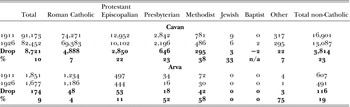
A surviving record of Protestant migration into Fermanagh includes 145 Protestant persons or families who left Cavan between 1920 and 1925.Footnote 127 Eleven of those recorded left from Arva though none applied for compensation with either the Compensation (Ireland) Commission, the IGC, or under the Damage to Property Acts, suggesting that revolutionary terror was not a primary motivation. This is a small sample from one possible destination for outward migration but it reflects a broader pattern found in recent studies by David Fitzpatrick and Andy Bielenberg suggesting that revolutionary violence and intimidation can only account for a small proportion of Protestant migration.Footnote 128 It is possible to trace a notable Protestant decline in Arva around 1921 and 1922 but, while war and civil war are part of the broader context of that migration, the direct link to revolutionary victimhood is less obvious. In fact, the Church of Ireland community in Arva (which was the most likely to apply for compensation) was more resistant to emigration than other non-Catholic denominations. The much smaller Methodist and Presbyterian populations in the area had been reduced by over half between 1911 and 1926, while ‘Other’ denominations (four Brethren in 1911) had been reduced by 75 per cent. The size of the community, therefore, can be seen as an important dictator of its survival. This is a similar pattern to that found in Sligo by Michael Farry, and broadly matches Andy Bielenberg's findings for the twenty-six counties, mentioned above, but district variations again remain important.Footnote 129 The Church of Ireland decline in Arva was far less pronounced than in the county as a whole, while the drop in Presbyterian and Methodist numbers was significantly greater (see Table 3).
Population decline, 1911–1926

Sources: Digitized 1911 census returns, www.census.nationalalarchives.ie; Saorstát Éireann: census of population, 1926, iii, Table 9, ‘Counties 1861–1926: number of persons of each religion in each county and county borough in Saorstát Éireann on 18th April, 1926’; Saorstát Éireann: census of population, 1926, iii, Table 12, ‘District Electoral Division: number of persons of each religion in each District Electoral Division in Saorstát Éireann on 18th April, 1926’.
The Arva sample

* Modern amounts are calculated based on a factor of 53·3 between 1927 and 2014, www.measuringworth.com/ppoweruk. Arva claims were submitted on varying dates between 1926 and 1928.
** See Maggie Masterson claim.
Key:
RC – Roman Catholic
CofI – Church of Ireland
M – Methodist
Sources: Irish Grants Committee, TNA, CO 762/3–212); digitized 1911 census returns, www.census.nationalarchives.ie. Ages are as supplied on Irish Grants Committee claim forms.
Despite any fear, disruption, dislocation, or financial difficulty suffered by the Arva IGC sample during the Irish Revolution, over a decade later it could be said they had remained relatively stable. Some of the younger generation had left – Mary Sheridan's son was ‘ordered to leave the country’ in 1921, Lizzie Anderson's daughter moved to Northern Ireland with her husband (a disbanded policeman) in 1922, George Cartwright ‘had to assist three of my children to emigrate’, and James Black claimed it was not safe for his son to return after service with the Ulster Special Constabulary in Fermanagh – but the older loyalists who applied to the IGC had stayed.Footnote 130 Charles Woods unsuccessfully requested more money to allow his son emigrate to Canada, as ‘there is nothing open to us here only to Perish’; James McCabe had ‘no bussiness & no capital’ and was hoping to use a grant to emigrate to England but remained where he was. It was failing businesses, and not discrimination or persecution, that influenced Woods and McCabe, and none of their fellow applicants recorded any desire to leave in the late 1920s.Footnote 131 Five had been removed or lost access to land between 1921 and 1922, but all bar one had been restored in 1924 and the IGC concluded that James Johnston, who remained in the district, ‘does not appear to have made a bad deal’.Footnote 132 George Cartwright had been unable to rebuild his house but retained possession of the land and also remained living in Arva.Footnote 133 In 1927, James Johnston complained to the IGC that he had not been granted an old-age pension as ‘the Irish Free State will not give it to us Loyalists’, but this somewhat disingenuous statement is hardly reflective of the loyalist position in the Irish Free State.Footnote 134 More representative, perhaps, was William Carleton. Carleton signed a 1927 letter to the IGC as ‘A Southern Loyalist’.Footnote 135 Just a few years earlier, he had signed correspondence relating to his Damage to Property claims as ‘a Humble Citizen of the F.S.’.Footnote 136 This may simply have been an attempt to play up to the bodies to which he was applying, but is also indicative of a willingness to accept the new order and suggests some success in reconciling what would appear to be conflicting identities. Carleton's neighbour George Cartwright represented a process that many went through after independence: Lord Farnham testified that Cartwright had been ‘a most loyal and fearless supporter of British interests in this country’ before 1922; a 1924 Garda report described how ‘Mr. Cartwright has been a Unionist, but since the Treaty became a supporter of the Free State.’Footnote 137
In January 1922, the Church of Ireland Gazette had counselled that for southern loyalists,
Ireland is their country. Thousands of them will never leave its shores; they are determined to make the best of things, continuing in the future, as in the past, to work for the good of their native land…In accepting the new scheme of things without demur, the loyalists of the South and West are taking a considerable risk. They are committing themselves and their children to the unknown, and their only guarantee is their instinctive faith in the justice of their fellow-countrymen.Footnote 138
For most, assimilation came easily, if not always graciously, and residues of old loyalties remained.Footnote 139 The opportunity to seek redress for losses, slights, or wrongs endured once again exposed the complicated community relationships of the revolution. Southern Irish loyalists went through a process of identity reconciliation and formation during the interwar years, an experience shared by many others. In a wider European context, it was a relatively peaceful transition.