Introduction
Fish farming produces animal protein in small spaces and in a short period of time, and is expected to increase exponentially as global population growth drives an increase in food demand (Brooks & Conkle, Reference Brooks and Conkle2019). However, the disorderly growth of aquaculture without strategic planning represents a serious impact on water bodies due to increased risk of introducing non-native species and their pathogens to native biota (Manchester & Bullock, Reference Manchester and Bullock2000; Lusk et al., Reference Lusk, Lusková and Hanel2010; Maury-Brachet et al., Reference Maury-Brachet, Gentes, Dassié, Feurtet-Mazel, Vigouroux, Laperche and Legeay2018).
Another important impact of aquaculture is the eutrophication of water bodies, a phenomenon characterized by an increase in nutrients, such as phosphorus and nitrogen, available in water (Martins et al., Reference Martins, Reissmann, Favaretto, Boeger and Oliveira2007; Bohnes et al., Reference Bohnes, Hauschild, Schlundt and Laurent2019). Fish farming can produce a eutrophic effluent comprising feed remains, animal faeces and excess fertilizer, which accumulates throughout the cultivation cycle, contributing to the eutrophication of natural environments when not treated (Yoo et al., Reference Yoo, Masser and Hawcroft1995; Macedo & Sipaúba-Tavares, Reference Macedo and Sipaúba-Tavares2010; Chary et al., Reference Chary, Aubin, Sadoul, Fiandrino, Covès and Callier2019).
Aquatic ecosystems suffer not only from the impacts of fish farming, but also chemical and organic pollution from other sources, such as the release of domestic sewage, agriculture or mining waste into untreated water bodies, which alter the population dynamics in natural environments (Audry et al., Reference Audry, Schäfer, Blanc and Jouanneau2004; Quinatto et al., Reference Quinatto, Zambelli, Souza, Rafaeli Neto, Cardoso and Skoronski2018; Zhang et al., Reference Zhang, Zhi, Xu, Zheng, Bilong, Pariselle and Yang2019). Fish and their parasites respond to these changes and can be used as signalling organisms for these impacts (Chubb, Reference Chubb1979; Blanar et al., Reference Blanar, Munkittrick, Houlahan, MacLatchy and Marcogliese2009; Chapman et al., Reference Chapman, Marcogliese, Suski and Cooke2015; Bezerra et al., Reference Bezerra, Lacerda and Lai2019).
These parasites also respond to changes in the abiotic parameters of water (Buchmann & Lindenstrøm , Reference Buchmann and Lindenstrøm2002; Falkenberg et al., Reference Falkenberg, Golzio, Pessanha, Patrício, Vendel and Lacerda2019). Water temperature, pH, electrical conductivity, dissolved oxygen and transparency directly influence the occurrence and community composition of monogeneans (Barker & Cone, Reference Barker and Cone2000; Tubbs et al., Reference Tubbs, Poortenaar, Sewell and Diggles2005; El Amin & Al-Harbi, Reference El Amin and Al-Harbi2016). Changes in abiotic conditions can be seasonal or anthropogenic. This study aimed to identify gill monogeneans in Nile tilapia and analyse their relationships with abiotic factors during ontogenetic development in the fish culture cycle in Mato Grosso do Sul, Brazil.
Materials and methods
Study area and collection of fish and parasites
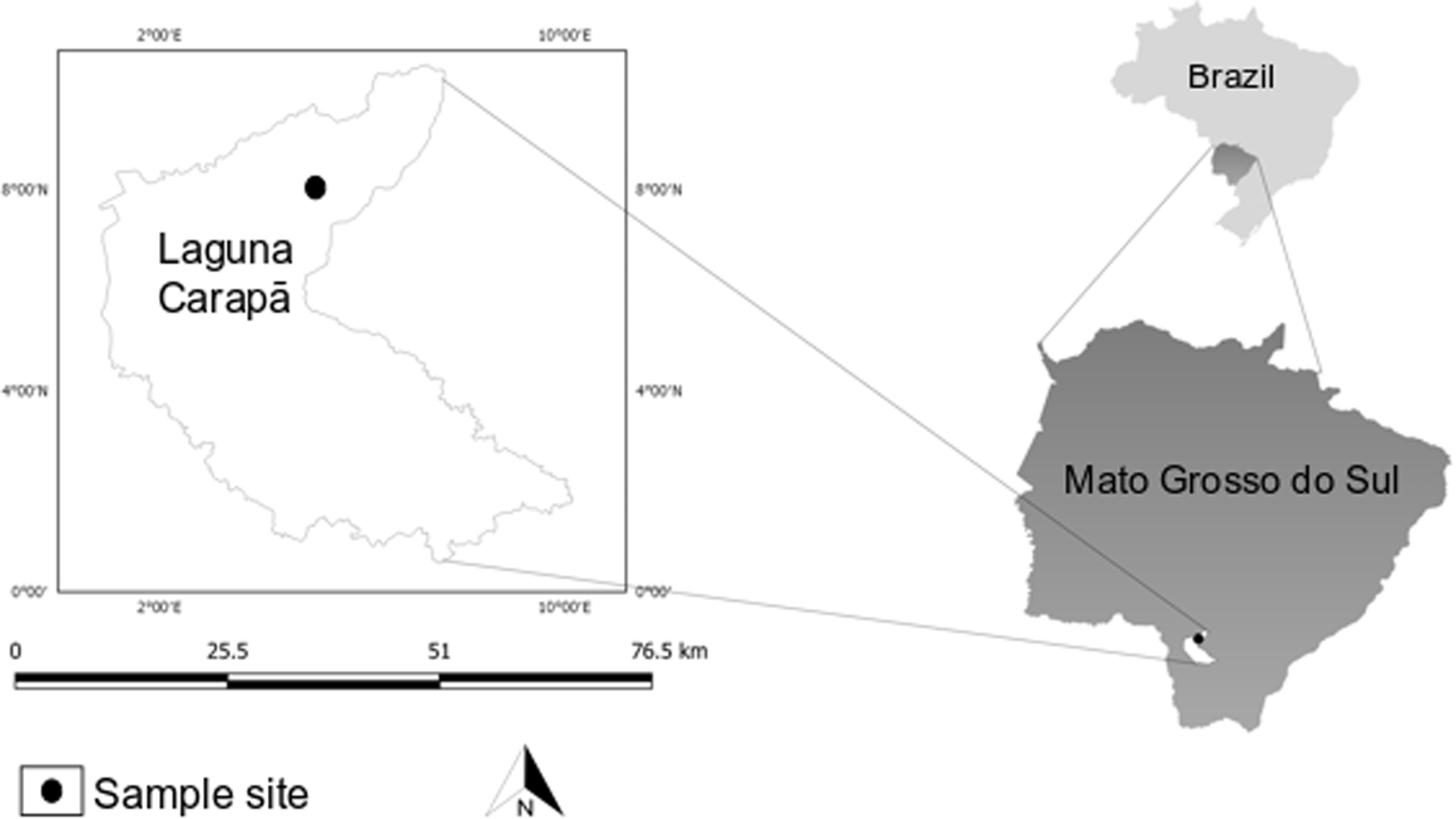
Sampling was performed on a fish farm located in Laguna Carapã (22°30′13.6″S, 55°06′53.3″W), Mato Grosso do Sul, Brazil (fig. 1). Four earthen ponds (176 m2) with independent water inlets from a single stream near the property were used. Before Nile tilapia fingerlings were stocked, the ponds were each dried and disinfected with 20 kg of limestone. The earthen ponds received fingerlings from the same batch, which were subjected to the same extruded commercial diet and stocked at the same density.
Location of the fish farm used in the study.

The culture cycle was initiated during October 2017. The fingerlings had an average weight of 0.68 ± 0.15 g and stocking density of three individuals per square metre. The duration of the culture was eight months from stocking to harvest, and a total of 200 fish were collected with casting nets (25 per collection, randomly in the four ponds). After collection, the fish were transported to the Laboratory of Applied Aquatic Biology at the Federal University of Grande Dourados (UFGD), where they were euthanized with lethal clove oil (50 mg/L−1), as authorized by UFGD's Ethics Committee (protocol number 20/2018 – /UFGD). Then, the samples were weighed and measured. At the end of the culture cycle, the fish had an average weight and body length of 686 ± 0.69 g and 31.08 ± 1.82 cm, respectively. According to body size, the fish were grouped into three classes (fingerlings, juveniles and adults).
The gills were removed and stored in hot water (60°C). In accordance with Boeger & Vianna (Reference Boeger, Vianna and Thatcher2006), the gills were vigorously stirred for the relaxation and dislodgment of parasites, and fixed with 10% formalin after 40 minutes. Subsequently, the monogeneans were collected from the gills and fixation liquid with the aid of a drying needle. The parasites were counted and stored in 70% ethanol. For identification, the slides were mounted in Hoyer's mounting medium (Eiras et al., Reference Eiras, Takemoto and Pavanelli2006), since the sclerotized parts, such as the haptor and copulatory complexes, were used to identify the species. The slides were analysed under a microscope with a camera lucida (tube design). Taxonomic studies, such as Ergens (Reference Ergens1981), Douëllou (Reference Douëllou1993), Pariselle & Euzet (Reference Pariselle and Euzet1995) and Pariselle et al. (Reference Pariselle, Bilong Bilong and Euzet2003), assisted in the identification process. The prevalence (P% = fish infected by a parasitic species/total examined fish × 100) and average abundance (AM = number of individuals of a given parasitic species/total examined fish) were calculated according to Bush et al. (Reference Bush, Lafferty, Lotz and Shostak1997).
The specimens were deposited in the Helminthological Collection of the Oswaldo Cruz Institute (CHIOC collection) and the Helminthological Collection of the Department of Parasitology (CHIBB collection) of the Biosciences Institute of Botucatu, São Paulo, Brazil.
Physical and chemical water parameters
Before fish sampling, the physical and chemical parameters of the water, including the temperature, dissolved oxygen concentration, pH and electrical conductivity, were measured using a Hanna HI9829® multi-parameter probe (Woonsocket, Rhode island, USA) . Meanwhile, the transparency was measured using a Secchi disk.
The amount of organic matter in the ponds was also measured monthly according to the fluorescence intensity (Figueiró et al., Reference Figueiró, Oliveira, Russo, Caires and Rojas2018). For this purpose, water samples were collected and stored at 10°C (Agra et al., Reference Agra, Klink and Rodrigues2012). The fluorescence intensity was measured using a Cary Eclipse (Varian) spectrophotometer (Mulgrave, Victoria, Australia), with water samples at approximately 22°C. The excitation spectra used were within a wavelength range of 200–450 nm, and the spectra recorded were at emission wavelengths ranging from 200 to 700 nm, spaced at 5 nm intervals in the excitation domain.
Data analysis
Before univariate analyses, the assumptions of normality and homoscedasticity were tested. When the assumptions were not satisfied, Box–Cox transformation was implemented using the ‘BoxCox.lambda’ function in the ‘fpp’ package (Hyndman, 2013) . To verify any statistical differences in the monogenean abundances between the ponds, a one-way analysis of variance (ANOVA) was performed using the total species abundance. The significant differences concerning the abundances and size classes (fingerlings, juveniles and adults) of monogenean species during the culture cycle (months) were tested using a two-way ANOVA with the package ‘vegan’ (Oksanen et al., 2019).
To verify the associations regarding the physical and chemical parameters, a canonical correspondence analysis (CCA) was performed that incorporated the source pond, size class and culture time along with the abundance of monogenean species during the fish culture cycle. For the elaboration of the CCA matrix, the physical and chemical water parameters were standardized, and the ‘envfit’ function (vegan package) was used to assess the significance of each variable in relation to the abundance of monogenean species, with 999 permutation tests. Only the variables with a significance level of P ≤ 0.05 were considered in the ordination.
To assess the responses of the parasitic community to the physical and chemical parameters, a Spearman correlation analysis (rs) was performed between the parasite abundance and the dissolved oxygen, pH, transparency, temperature, electrical conductivity and organic matter intensity of each species. Values of P ≤ 0.05 were considered significant, and all statistical analyses were performed in using R-Studio v1.1.383 software (RStudio IDE, Boston, USA).
Results
The physical and chemical water parameters fluctuated during the culture cycle. The dissolved oxygen ranged from 7.44 to 2.41 mg/L−1, pH ranged from 8.49 to 6.08, temperature ranged from 21.20 to 29.10°C, transparency ranged from 83.00 to 21.10 cm, electrical conductivity ranged from 0.08 to 0.05 μS/m−1 and intensity of organic matter ranged from 88 to 209 nm.
The parasitic community was composed of five species of Monogenea: 88 specimens of Cichlidogyrus halli (CHIOC 40041, CHIBB 395), 4194 specimens of Cichlidogyrus sclerosus (CHIOC 40042, CHIBB 405), 2087 specimens of Cichlidogyrus thurstonae (CHIOC 40044, CHIBB 425), 1118 specimens of Cichlidogyrus tilapiae (CHIOC 40043, CHIBB 415) and 1250 specimens of Scutogyrus longicornis (CHIOC 40045, CHIBB 435). The most prevalent species during the fish culture cycle was C. tilapiae (P% = 61.5), and C. sclerosus had the highest mean abundance (MA = 20.9 ± 55.1).
There were no significant differences concerning the parasitic abundances between the ponds (one-way ANOVA, F 3 = 1.09, P = 0.35). However, there were significant differences between the fish size classes (ontogenetic development): C. tilapiae (two-way ANOVA, F 2 = 8.04, P < 0.01), C. thurstonae (two-way ANOVA, F 2 = 28.81, P < 0.01), C. sclerosus (two-way ANOVA, F 2 = 23.85, P < 0.01), C. halli (two-way ANOVA, F 2 = 8.54, P < 0.01) and S. longicornis (two-way ANOVA, F 2 = 35.49, P < 0.01).
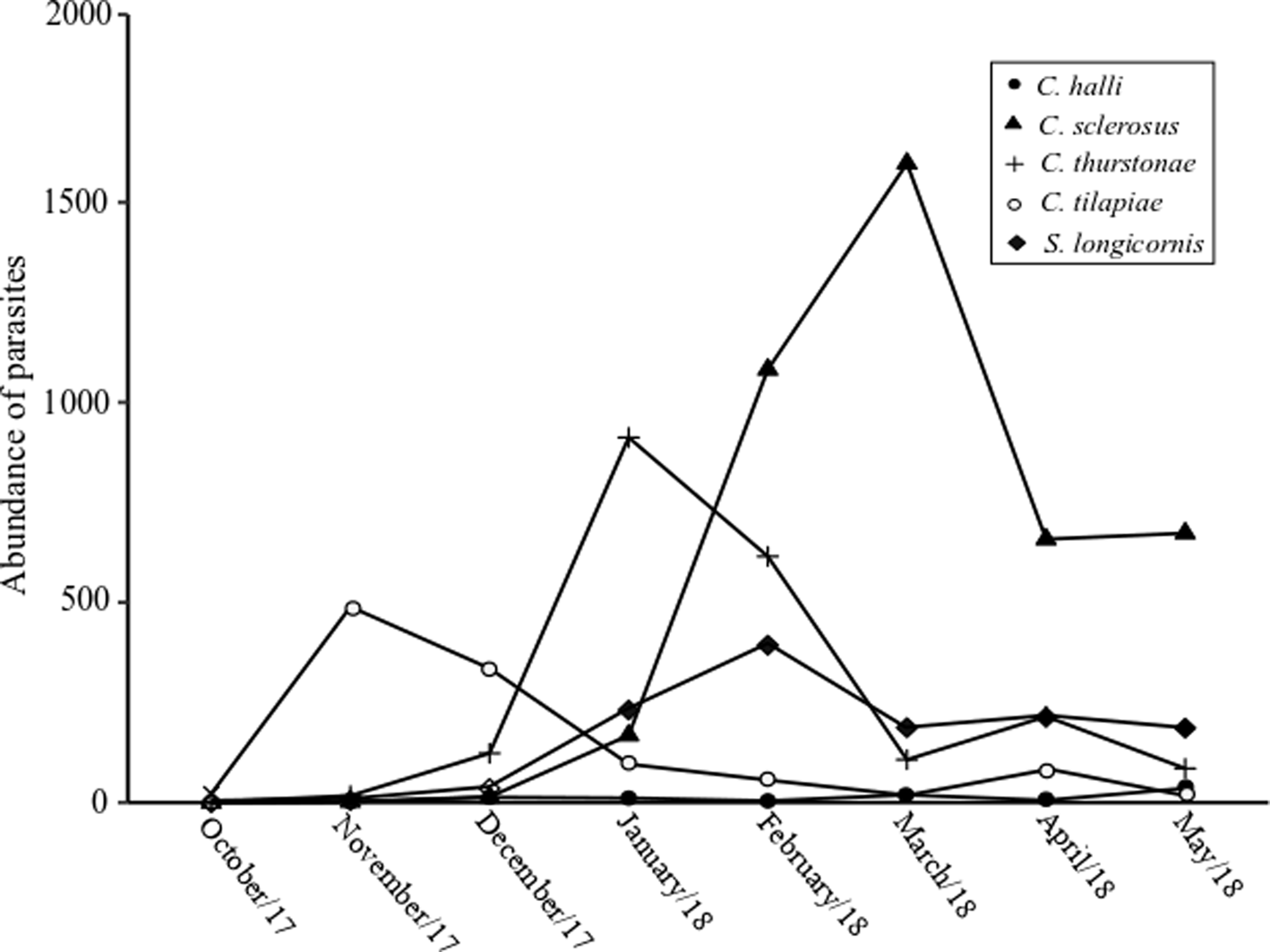
The abundances of the five monogenean species varied over the culture months (fig. 2), with significant differences for C. tilapiae (two-way ANOVA, F 7 = 8.58, P < 0.01) and C. sclerosus (two-way ANOVA, F 7 = 5.04, P < 0.01). Cichlidogyrus tilapiae was the most abundant species at the beginning of the culture cycle (October, November and December). Cichlidogyrus thurstonae (two-way ANOVA, F 7 = 0.94, P = 0.45) was the species with the largest number of specimens in January, reaching a population peak at this time. Scutogyrus longicornis (two-way ANOVA, F 7 = 1.34, P = 0.24) showed the highest population during February; however, it was not the most abundant species during this month. Cichlidogyrus sclerosus was the dominant species in February, March, April and May. Finally, C. halli (two-way ANOVA, F 7 = 1.61, P = 0.17) was present in most of the culture cycle at a low abundance.
Abundance of monogenean species during the culture cycle.

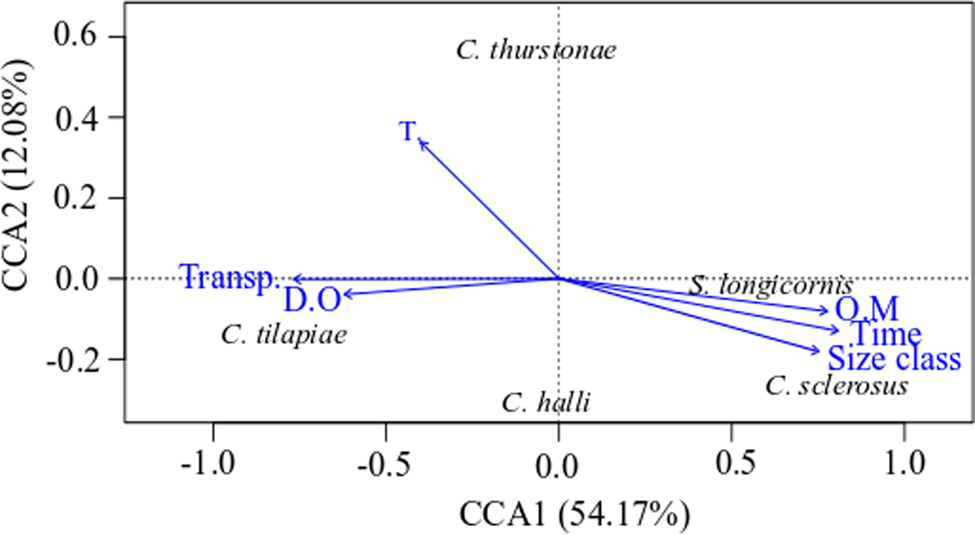
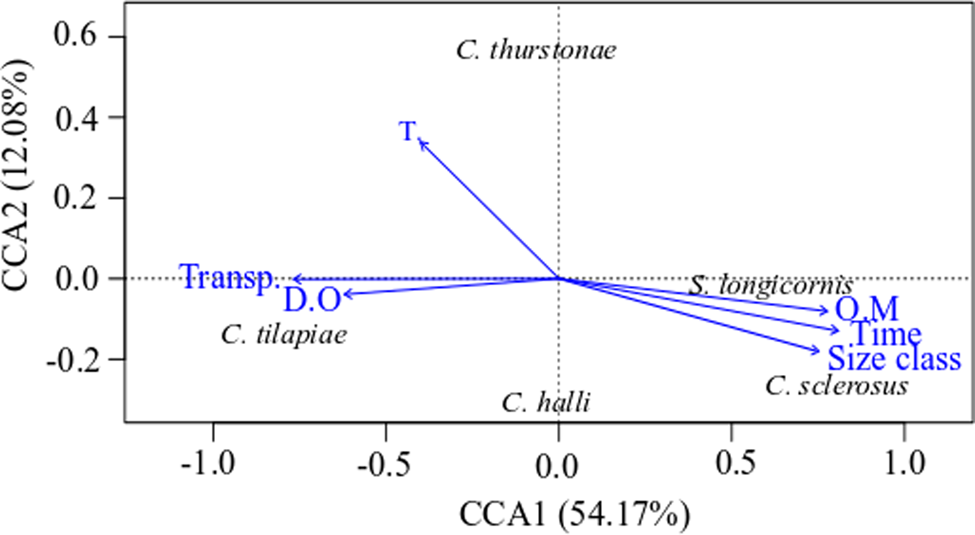
The first two CCA axes explain 66.25% of the variation in the data (fig. 3). The abundance of C. tilapiae was associated with transparency and dissolved oxygen, while C. thurstonae was associated with temperature. The abundances of C. sclerosus and S. longicornis showed associated with organic matter intensity, time and size class.
Canonical correspondence analysis (CCA) showing the association between the abundances of monogenean species (C. halli, C. sclerosus, C. thurstonae, C. tilapiae and S. longicornis) and physical and chemical water parameters, size class and culture time. Abbreviations: D.O, dissolved oxygen; O.M, organic matter intensity; Transp., transparency; T., temperature.
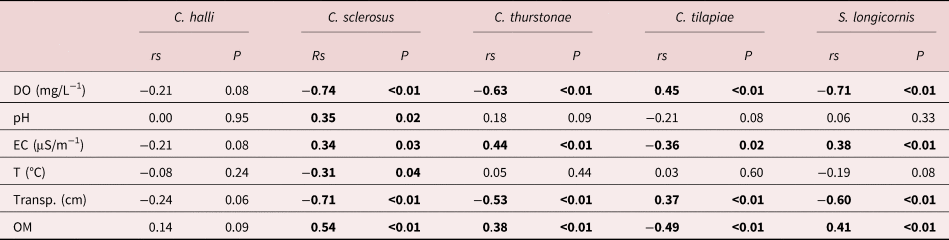
According to the Spearman's correlation results, C. tilapiae showed significant positive correlations with dissolved oxygen (rs = 0.45) and transparency (rs = 0.37), and negative correlations with organic matter intensity (rs = −0.49) and electrical conductivity (rs = −0.36). The abundances of C. sclerosus, C. thurstonae and S. longicornis showed significant negative correlations with dissolved oxygen (rs = −0.74, −0.63 and −0.71, respectively) and transparency (rs = −0.71, −0.53 and −0.60, respectively), but was positively correlated with organic matter intensity (rs = 0.54, 0.38 and 0.41, respectively) and electrical conductivity (rs = 0.34, 0.44 and 0.38, respectively). In addition, the abundance of C. sclerosus was negatively correlated with water temperature (rs = −0.31) and positively correlated with pH (rs = 0.35). Cichlidogyrus halli did not show significant correlations with any physical or chemical water parameters (table 1).
Spearman correlation coefficients (rs) and statistically significant values (P) relating to the physical and chemical water parameters in association with the abundances of monogenean species.

DO, dissolved oxygen; EC, electrical conductivity; T, temperature; Transp., transparency; OM, organic matter intensity. Statistically significant correlations (P ≤ 0.05) are indicated in bold.
Discussion
The occurrence of Cichlidogyrus and Scutogyrus infecting Nile tilapia, including in regions where the host has been introduced, is commonly reported in fish farming and natural environments (Jerônimo et al., Reference Jerônimo, Speck, Cechinel, Gonçalves and Martins2011; Mahmoud et al., Reference Mahmoud, Mona, Abdel, Hossam, Osman and Attia2011; Dotta et al., Reference Dotta, Brum, Jeronimo, Maraschin and Martins2015; Lerssutthichawal et al., Reference Lerssutthichawal, Maneepitaksanti and Purivirojkul2015; Blahoua et al., Reference Blahoua, Yao, Etilé and N'Douba2016). In Mori et al. (Reference Mori, Chedid, Braccini, Ribeiro, Oliveira, Pretto-Giordano and Vargas2015), monogeneans are present in tilapiculture during the entire culture cycle, with fluctuations in abundance, which corroborates the observations of this study.
The abundance, composition and structure of the parasitic community can be influenced by biotic (related to host) and abiotic (environmental conditions) factors (Violante-González et al., Reference Violante-González, Mendoza-Franco, Rojas-Herrera and Guerrero2010; Ibrahim, Reference Ibrahim2012; Dallarés et al., Reference Dallarés, Pérez-del-Olmo, Montero and Carrassón2017). Especially the ontogenetic development may cause several changes in the biology and ecology of the host, enabling the occurrence mainly of heteroxenous parasites acquired through the trophic chain (Poulin, Reference Poulin1995; Muñoz et al., Reference Muñoz, Grutter and Cribb2006), which is not the case of monogeneans.
In this study, the significant differences concerning the monogenean abundances among host size classes may be related to the gill size, because larger fish (older) have a greater area and exposure time for parasitic colonization (Poulin & Leung, Reference Poulin and Leung2011; Tombi et al., Reference Tombi, Akoumba and Bilong Bilong2014). Other important factors for parasite infection are the condition of the host's immune system, stocking density and environmental conditions required for the parasites to remain and reproduce (Choudhury & Dick, Reference Choudhury and Dick1998; Akoll et al., Reference Akoll, Fioravanti, Konecny and Schiemer2012).
The abundance of monogenean species reported in this study varied according to the changes in the physical and chemical water parameters during the culture cycle. This corroborates the findings of previous studies showing that the population abundance of Cichlidogyrus is related to seasonal variations as well as chemical and organic pollution (Madanire-Moyo et al., Reference Madanire-Moyo, Matla, Olivier and Luus-Powell2011; Vidal-Martínez & Wunderlich, Reference Vidal-Martínez and Wunderlich2017; Reynolds et al., Reference Reynolds, Hockley, Wilson and Cable2019).
The abundance of C. tilapiae was inversely proportional to organic matter, but positively correlated with dissolved oxygen and transparency, responding to the decrease in the population of the species in combination with the dissolved oxygen and transparency. Over time, in excavated nursery culture systems with low water renewal, a decrease in these parameters is frequently reported, as well as increases in the organic matter concentration (Baccarin & Camargo, Reference Baccarin and Camargo2005; Rafiee & Saad, Reference Rafiee and Saad2005; Leonardo et al., Reference Leonardo, Tachibana, Corrêa, Gonçalves and Baccarin2009).
As the fish grow, the demand for oxygen increases, along with the waste from the uneaten feed and animal excreta, which make the environment rich in organic matter and nutrients (Ernst et al., Reference Ernst, Ellingson, Olla, Wicklund, Watanabe and Grover1989). These conditions also alter the entire trophic chain of fish farming (Sipaúba-Tavares et al., Reference Sipaúba-Tavares, Millan, Capitano and Scardoelli-Truzzi2019). Different groups of organisms can experience population rises as species exploit the eutrophication and sudden fluctuation of dissolved oxygen (Snieszko, Reference Snieszko1974; Neofitou et al., Reference Neofitou, Papadimitriou, Domenikiotis, Tziantziou and Panagiotaki2019).
There were significant negative correlations between the abundances of C. sclerosus, C. thurstonae and S. longicornis and the dissolved oxygen. This may be related to a decrease in the food intake by fish, which is common in waters with low concentrations of dissolved oxygen, leading to fish experiencing physiological stress and consequently impaired immune systems, thus increasing the susceptibility to parasites (Mellergaard & Nielsen, Reference Mellergaard and Nielsen1995; Baldisserotto, Reference Baldisserotto2013; Paredes-Trujillo et al., Reference Paredes-Trujillo, Velázquez-Abunader, Torres-Irineo, Romero and Vidal-Martínez2016).
As parasite abundances are positively correlated with organic matter intensity and negatively correlated with transparency, they apparently prefer environments with more available nutrients. The positive correlations of three of the parasite species abundances (C. sclerosus, C. thurstonae and S. longicornis) with electrical conductivity reinforce this trend, as water with a high electrical conductivity often also has a low transparency and high organic matter content (Sipaúba-Tavares, Reference Sipaúba-Tavares2013; Ojha et al., Reference Ojha, Suman, Saini and Surnar2019).
Aquatic environments with a higher load of organic matter may contain more suspended particles, which can cause irritation in the gills, inhibit defence mechanisms and leave a host susceptible to infection by gill parasites (Skinner, Reference Skinner1982; Madi & Ueta, Reference Madi and Ueta2009).
In Sanchez-Ramirez et al. (Reference Sanchez-Ramirez, Vidal-Martinez, Aguirre-Macedo, Rodriguez-Canul, Gold-Bouchot and Sures2007), the abundance of C. sclerosus was related to the content of heavy metal sediments, such as polycyclic aromatic hydrocarbons and polychlorinated biphenyls, which increased in treatments with low to fairly high pollutant concentrations, but decreased at high concentrations. Cichlidogyrus sclerosus also showed a higher mean intensity in Coptodon zillii due to the decrease in oxygen and increase in organic pollution in a lake in Syria (Dayoub & Salman, Reference Dayoub and Salman2015).
Among the parasites studied, only the abundance of C. sclerosus was negatively correlated with temperature and also positively correlated with pH. Regarding the temperature, there is a decrease in the fish feeding activity in colder waters, which is directly linked to the host's health and resistance to parasites (Borghetti & Canzi, Reference Borghetti and Canzi1993; Lamková et al., Reference Lamková, Šimková, Palíková, Jurajda and Lojek2007; Bowden, Reference Bowden2008). Temperature also influences the parasite's life span, development, reproduction and infective stage (Karvonen et al., Reference Karvonen, Kristjánsson, Skúlason, Lanki, Rellstab and Jokela2013; Awharitoma & Ehigiator, Reference Awharitoma and Ehigiator2019). For example, monogenean eggs hatch faster in higher temperatures (Flores-Crespo et al., Reference Flores-Crespo, Velarde, Flores-Crespo and Vazquez-Pelaez1992). Similarly, negative correlations were found between the combined abundance of Cichlidogyrus and Scutogyrus and the water temperature in Veracruz, Mexico (Aguirre-Fey et al., Reference Aguirre-Fey, Benítez-Villa, León and Rubio-Godoy2015).
Many organisms are sensitive to variations in the pH of their environment (Shinde et al., Reference Shinde, Pathan, Raut and Sonawane2011). Ojwala et al. (Reference Ojwala, Otachi and Kitaka2018) found that in more alkaline waters (pH of 8.52–11.31) the average abundance of Cichlidogyrus spp. was higher than that in waters with a pH of 7.50. In the present study, the pH ranged from 6.08 to 8.49, and was positively correlated with the abundance of C. sclerosus.
In conclusion, the abundances of C. tilapiae, C. sclerosus, C. thurstonae and S. longicornis responded to changes in the physical and chemical water parameters during the culture cycle. Furthermore, the host size classes and C. halli showed no significant correlations with the abiotic parameters due to the low number of specimens. Therefore, understanding the relationships between the host, parasite and water quality in aquaculture systems can prevent peaks in abundance and subsequent sanitary problems.
Acknowledgement
The authors gratefully acknowledge the financial support of the Brazilian agency CAPES.
Financial support
Financial support of the Brazilian agency CAPES.
Conflicts of interest
None.
Ethical standards
The authors assert all fish were killed following the standards of practice according to Ethics Committee of the Federal University of Grande Dourados (Protocol No. 20/2018 - UFGD, Brazil).