According to the Centers for Disease Control, CHD occurs in approximately 1% of live births, amounting to approximately 40,000 patients per year in the United States of America, making it the most common congenital defect. 1 Of those 40,000 patients, nearly 25% are born with critical CHD, requiring intervention in the first days to weeks of life, most often due to the need for patency of the ductus arteriosus for either pulmonary or systemic blood flow. 1 This includes patients with hypoplastic left heart syndrome.
Infants born with hypoplastic left heart syndrome, a condition that is universally fatal in the absence of palliation, have been considered one of the highest risk populations in the world of congenital pediatric cardiology. These children will typically undergo three staged surgeries in the first several years of life, starting with the Norwood procedure shortly after birth, followed by a second-stage superior cavopulmonary anastomosis around 4–6 months of age, and finally, a Fontan-type procedure several years later. Reference Norwood, Lang and Hansen2–Reference Glenn3
Prior to initiation of the home monitoring program, patients were discharged home without any method for caregivers to monitor their vital signs, nor a consistent, qualified contact person for urgent needs. They also were seen in cardiology follow-up clinic at varying intervals, typically every 1–2 months until their second-stage palliation.
In 2004, the cardiology team at Children’s Hospital of Wisconsin published data from the initiation of a novel program, home monitoring for babies born with hypoplastic left heart syndrome. Reference Ghanayem, Hoffman and Mussatto4 The team in Wisconsin demonstrated a reduction in interstage mortality to 0% after implementing their home monitoring. Inspired by their work, the newly formed National Pediatric Cardiology Quality Improvement Collaborative chose the interstage period to become the first area of research they would focus on, monitoring multiple variables from their members’ institutions. The main priorities of the collaborative initially were “improving care and outcomes for children with univentricular heart after the Norwood operation and specifically to reduce interstage mortality, decrease interstage growth failure, and reduce interstage hospital readmissions for major medical events”. Reference Anderson, Beekman RH and Kugler5,Reference Rudd, Ghanayem and Hill6,Reference Lannon and Peterson7,Reference Anderson, Iyer and Schidlow8 Data points monitored via chart review included caregiver education prior to discharge, clinic visit data such as oxygen saturations, growth and feeding plans, communication with the primary care provider regarding concerns about nutrition/growth, and “red flags” that guided caregivers to contact their cardiology team. Through this work, interstage mortality had decreased from 10 to 15% nationally to 5.3% by mid-2013. Reference Glenn3,Reference Anderson, Beekman RH and Kugler5,Reference Rudd, Ghanayem and Hill6 A similar reduction in interstage mortality was noted at our institution, decreasing from 18 to 3.8% as of 2020 following the introduction of home monitoring in 2009.
Institutional experience
Initially, our institution began a home monitoring program in 2009 after joining the National Pediatric Cardiology Quality Improvement Collaborative and becoming a member site. Prior to this our interstage mortality rate was 18%, with inconsistent follow-up and monitoring based on provider preference and patient clinical status. Once the program was started, guidelines were implemented as recommended by the collaborative which included daily weights, daily oxygen level checks using a pulse oximeter, and a list of “red flag” reasons to contact the medical team. Reference Anderson, Beekman RH and Kugler5 These “red flag” reasons were: fever greater than 100.5, oxygen saturation less than 75%, increased fussiness, vomiting, no weight gain for 3 days or weight loss, weight gain of more than 100 g in one day, or any other concerns. Reference Baker-Smith, Goldberg and Rosenthal10 Caregivers were provided with a three-ring binder and measurement forms to record weight, oxygen, and heart rate. They were given a pager number to contact with any “red flag” violations and were seen in clinic by their cardiologist 1–3 months after discharge from Norwood procedure, depending on provider preference and availability. A program coordinator called caregivers weekly to discuss concerns and for caregivers to provide the weights, oxygen saturation, and heart rate recorded in the previous week.
This process was tedious and inefficient. It required caregivers to use outdated methods and the program coordinator to spend several hours per week contacting families and recording the information on a spreadsheet that was not integrated into the medical record. As the process evolved, significant changes to the program were made. This included giving caregivers an easier way to contact the coordinator via cell phone and seeing patients sooner and more frequently in clinic to better track development and weight gain, as well as to identify hemodynamically significant changes via echocardiogram earlier and in a more consistent manner. Having an advanced practice provider in the role of the program coordinator allowed patients to be triaged via phone for simple problems, referred to local providers for further examination, directed to the emergency department, or readmitted to the Heart Center in a more efficient manner than was previously available. Patient problems were identified earlier, and potentially serious or even fatal problems were quickly triaged, allowing for a hospital readmission instead of a patient death. This overall experience was mirrored across the country and is now the standard of care. Reference Oster, Ehrlich and King11
Caregivers verbalised high levels of satisfaction at having a designated and consistent contact person with relevant experiential knowledge, decreasing their anxiety levels during the transition from hospital to home. Reference Stoffel, Spirig and Stiasny16 Based on chart review and caregiver feedback, there was expressed appreciation for having more “one-stop shopping” for expert advice from the advanced practice provider, not only for cardiac issues but also for feeding issues and common pediatric problems such as diaper rash and colic. Issues such as feeding intolerance, poor weight gain, and developmental delays were identified earlier and steps could be taken over the phone without requiring parents to seek treatment in person.
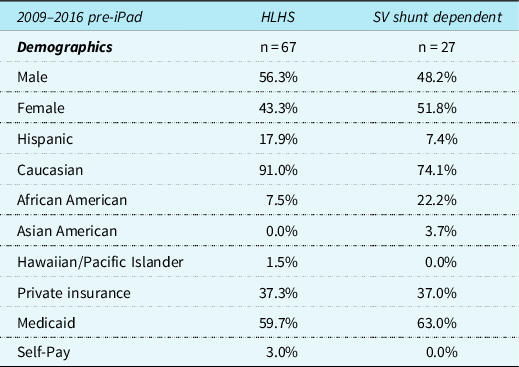
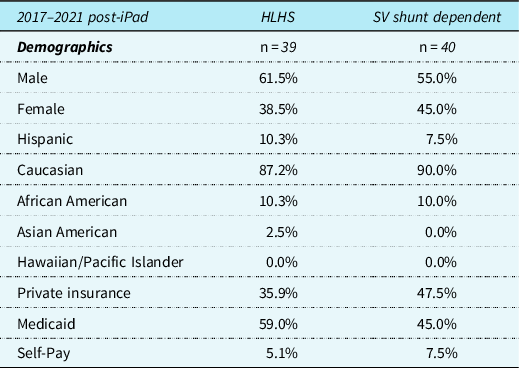
The location of our hospital and payer mix is typically mostly Caucasian with Medicaid being the most common payer across our hospital services. This was also seen in our patient groups. Frequency tables were run to summarise gender, ethnicity, race, primary insurance, and survival status both for the whole cohort and broken down by group. Comparisons between the groups were made using Fisher’s exact test for ethnicity in the pre-iPad group and post-iPad group comparisons, primary insurance, race, and status at second stage. Analyses were performed using SAS version 9.4 (SAS Institute, Inc., Cary, NC, United States of America). The demographics, specifically gender, ethnicity, and race were similar between the hypoplastic left heart syndrome and single ventricle shunt-dependent groups both pre- and post-iPad initiation except for race in the pre-iPad group (Tables 1 and 2). With a p-value of 0.0481, there was a statistically significant difference amongst races in that group, with 91% being Caucasian. There was no statistically significant difference in transplant-free survival between either group in the pre-iPad or post-iPad group.
Pre-iPad demographics.

Post-iPad demographics.

The main diagnosis for the initial group was hypoplastic left heart syndrome, unbalanced atrioventricular canal, and double inlet left ventricle with transposition of the great vessels and aortic valve atresia, all of which required aortic arch reconstruction, were palliated with a shunt, and would have persistent single ventricle hemodynamics. Our expanded group consisted mostly of shunt-dependent single ventricle patients such as double inlet left ventricle, double outlet right ventricle, and other combinations necessitating shunt-dependent circulation as the first stage of their palliation.
Utilizing technology
The success of the home monitoring program resulted in requests to participate from other families with infants with single ventricle physiology. The medical team began to identify patients that could benefit from the program, but that initial iteration of the program did not have the bandwidth to expand to more patients due to the labour-intensive nature of the binder recording system. Different types of technology were attempted with varying levels of success. Black et al, reported challenges with recruitment while being unable to demonstrate a reduction in interstage mortality. Reference Black, Sadanala, Mascio, Hornung and Keller25 The team at Children’s Mercy Kansas City introduced a novel program called the Cardiac High Acuity Monitoring Program. Reference Shirali, Erickson and Apperson24 This program was the first of its kind to incorporate technology into interstage home monitoring as well as connecting patient data to the electronic medical record. When our institution was able to begin to incorporate technology into our home monitoring program, the Cardiac High Acuity Monitoring Program was solely available at Children’s Mercy. Our team then looked for alternative options. We met with Locus Health System in mid-2016 regarding their iPad application, a system that uses an iPad tablet and software platform to streamline home monitoring in various patient populations, with implementation in March 2017. The Locus Health System involves supplying patients with a program-specific iPad to allow tracking of a variety of data points that then uploads to an encrypted and HIPAA-compliant platform, allowing the medical team access to data in real time. Both the medical team and the caregivers could now easily display data in a line graph format with specific data points highlighted, making data readily accessible and trends easier to identify.
The iPads are equipped with a cellular connection in addition to wireless capabilities, allowing caregivers the ability to use the system regardless of their level of telephone or internet access. The devices are restricted to the use of the Locus app; no other internet access is permitted, and other apps cannot be downloaded or installed. The iPad capabilities have been expanded to include photo and video capabilities, and a Spanish language version has been added, allowing us to include that population in the iPad program. The information is imported into the electronic medical record system weekly with a log of caregiver-entered data.
Since the initiation of the iPad with the home monitoring program, our interstage mortality rate has been 0% in our hypoplastic left heart syndrome population. Given the success of the original home monitoring program in the hypoplastic left heart syndrome population, with decreased mortality as well as having the ability to streamline the data collection process by using the Locus software system, our institution supported an expansion of the home monitoring program to other populations. Our home monitoring program now includes all shunt-dependent single ventricle patients, as well as other high-risk populations such as single ventricle patients with pulmonary artery banding, complex biventricular patients with lengthy hospital stays, and other comorbidities. Using this new technology in a unique way, we are now able to monitor more than twice the number of high-risk infants, increasing from 12 infants in 2014 to 44 infants in 2020.
Transplant-free survival varied between the groups but did not reach statistical significance. Interestingly, the mortality rate increased in the single ventricle shunt-dependent group after initiation of the iPad program, whereas in the hypoplastic left heart syndrome group, the transplant-free survival rate was 100% (Table 3). This is likely due to patient complexity and a smaller sample size between the groups.
Overall transplant-free survival outcomes.

We also were able to collaborate with Locus Health and Cerner to incorporate the data collected into the electronic medical record. This improved access of clinical data in this fragile patient population to other specialties as well as primary care providers. This also allowed us to meet requirements necessary to bill insurance for the service. Information is currently uploaded to our Cerner electronic medical record as a weekly PDF with a list of all raw data entered the prior 7 days. If caregivers do not enter data, then a PDF is not generated. These data include all data entered by caregivers, including daily weights, oxygen saturations, heart rate, intake, mode of intake, and emesis. The Locus system has the capability of syncing discrete data with the electronic medical record on an individual data point basis. As an institution we opted to start with the PDF format based on provider feedback and to allow for a more fiscally viable option as that feature is a higher price point.
Compliance prior to initiation of the Locus program was not tracked, though anecdotally was inconsistent and varied wildly from caregiver to caregiver. After initiation of the Locus platform, compliance from the start of the program has been tracked by two metrics, engagement and adherence. Engagement is defined as a caregiver who tracked at least one variable per day and adherence is the rate at which caregivers record each piece of data possible.
Since April 2017, engagement has been reported at 50.94% and adherence has been reported at 45.45%. In 2021, Locus Health launched a “bring your own device” option, or BYOD. This allowed caregivers to follow instructions to create a widget on their smartphone with the ability to track data, including pictures and video. This function is compatible with both iOS and Android operating systems. We began utilizing the BYOD option in December of 2021. When we isolate those patients (n = 6) for engagement and adherence from 1 December 2021 until 1 April 2022, the engagement was 43.9% and adherence was 25.13%. This is a very small number of patients with a short time frame of recording data, so the data are purely anecdotal at this point.
Caregiver experience
Caregiver stress is well-documented, with caregivers of children with CHD having higher and more intense levels of stress than other caregivers of special needs children, particularly in the first year of the child’s life. Reference Lisanti18–Reference Latal, Fischer and Tomaske19 Furthermore, research has shown that there is increased psychological morbidity, particularly in mothers of single ventricle infants, including anxiety, depression, and post-traumatic stress disorder. Reference Lawoko and Soares20–Reference Chowdhury, Hope and Arthur22 Prior to initiation of the home monitoring program, these patients were discharged to home with inconsistent follow-up, no means of monitoring their child’s oxygen or weight, and an indirect way to contact the medical team for issues via phone triage nurses. After initiation of the home monitoring program, patients were seen every 2 weeks through the interstage program in the cardiology outpatient clinic. Caregivers were also given a contact person in the form of the program nurse practitioner. In 2017, the iPad program added additional points of data for caregivers to report on, including emesis, output, medications, and seasonal administration of Synagis prophylaxis. These data points were not previously recorded using the binder system.
With more monitoring burden placed on the caregivers, despite the more concise electronic manner in the addition of the iPad, the concern from the healthcare team was that this would increase caregiver stress, not alleviate it. Another capability of the Locus Health platform is the ability to push out surveys via the daily task list for caregivers to complete. Using that application, two surveys were sent to families enrolled in the home monitoring program. They were deployed at set intervals, one at the initiation of the program prior to hospital discharge and one 3 weeks later. Caregivers were asked to rate various questions on a scale from strongly disagree to strongly agree. They could also choose not to answer.
Overall, prior to hospital discharge, caregivers agreed that the home monitoring program and the iPad tool helped them to feel more confident caring for their child at home (96.4%), more comfortable leaving the hospital (100%), and more connected to care team (98.2%).
The post-discharge results were reassuring, showing that caregivers continued to feel supported and empowered using the home monitoring program iPad tool. Most caregivers (90.2%) agreed that they were satisfied with the home monitoring program 3 weeks post-discharge. Survey responders overwhelmingly agreed that they felt more confident at home because of the home monitoring program (91.8%). Over 95% agreed that they felt more confident leaving the hospital (95.1%). Most caregivers reported feeling connected to their care team with the home monitoring program (88.3%).
When caregivers were given the opportunity to leave narrative comments a majority gave positive feedback:
“The home monitoring program is really awesome. It also feels really good to know how much support you have while being away from the hospital in such a fragile time. That your still connected to the doctors and nurses. I love it. I’m so happy they came up with something like this”.
“The home monitoring program is wonderful. We feel connected to our team and confident in our ability to complete the extra tasks our son needs to stay healthy and growing during this stage”.
Not all parents felt that the home monitoring program was helpful, with 5% answering that they strongly disagreed with all the post-survey questions. Comments included:
“Having a little bit of a hard time keeping up with putting the info in the tablet with being so focused on baby and school but I'm getting better”.
“It kinda takes up more time. I feel more like nurse then a mom when having to chart all time”.
Clearly, not all of those who participated in the program felt that it lessened their stress levels at home. However, a majority agreed that the home monitoring program iPad program helped them feel more confident at home and more connected to their child’s medical team.
Billing and reimbursement
The cost of the program can be a limitation to implementation. In our institution, the program was initially funded through the philanthropic branch of the hospital known as the Riley Children’s Foundation. After demonstration of feasibility, parent satisfaction, and incorporation into the electronic medical record, a business case was made to the organization and the program was operationalized. Establishing return on investment was also key to make the program as fiscally viable as possible. Given that home monitoring programs are now the standard of care for monitoring single ventricle/shunt dependent patients at home, the burden of necessity was met. In addition to that, our parent satisfaction surveys were almost universally positive. Once we were able to document the iPad information that parents entered into the electronic medical record, billing insurance for the home monitoring program service was feasible. Using CPT codes 99453 (enrolment into the program), 99454 (device supply for >15 days) and 99457 (remote monitoring medical management of at least 20 minutes per month), patients were billed. Time spent by providers for monthly documentation of the service for billing purposes, as well as billing itself, is approximately 1 hour per month. Reimbursement for 2019 was ∼11% total billed amount, while in 2020 reimbursement rate doubled to 22% of the billed amount. Reimbursement in both 2019 and 2020 was entirely from private insurance companies with no reimbursement of billed amounts from government insurance such as Medicaid. The improved reimbursement rate is likely due to increased use of remote home monitoring program across the healthcare spectrum with the global pandemic and the trend towards care digitalization. Reference Chowdhury, Hope and Arthur22
Discussion/future implications
Interstage home monitoring programs are now considered the standard of care as part of the post-Norwood/Hybrid medical management plan. Our institution noted a dramatic decrease in mortality after the initiation of the home monitoring program in the hypoplastic left heart syndrome population. After implementation of the digital monitoring program through Locus Health System, our institution was able to increase the availability of the home monitoring program to other high-risk, shunt-dependent infants. Utilisation of innovative programs and devices can enable providers to allow families better access to care, particularly during unique times such as a global pandemic. Reference Gerke, Shachar and Chai23 Using the Locus system, it is possible to input discrete data into the Cerner electronic medical record platform. The decision by our institution to not use discrete data, but instead use a weekly PDF, was based on provider input, with the emphasis on making the data available in one location to limit the amount of chart mining for providers. Also, utilization of a lower cost option with the PDF option being less expensive than the discrete data option as one would expect. At the time of electronic medical record integration, our home monitoring program was the only program of its kind in the Indiana University Health System. The customization of the Locus platform allows us as a team to tailor measurements to be patient specific in both measurements and alert parameters, as well as modality whether iPad or the BYOD. Currently, the program is being utilised by five additional services within Riley Hospital, including cardiac transplant, heart failure, pulmonary hypertension, gastroenterology, and the outpatient antibiotic team. With the addition of additional teams, it may be reasonable to consider transitioning to a discrete data system at some point in the future.
The platform is not without its challenges. The platform is available in English and Spanish only, which has been a challenge for our patients who speak other languages, such as Burmese or French. In those cases, our translation services translate the necessary documents into the language needed on a patient-by-patient basis using the paper binder previously used. We also have patients who are a part of the Amish community where the use of electronic devices is not permitted, thus requiring us to use the paper binder. We have struggled getting the devices returned from families, primarily after a patient death or in instances where the social situation is in flux such as cases where the patient enters the foster care system. Introduction of the BYOD option has provided us with a solution for these situations, allowing us to monitor patients without the cost-burden of replacing devices. Connectivity has been an issue in rural areas where cell service and wireless connections are challenging, in which case parents are encouraged to take the device with them to areas where there is a more reliable connection. Fortunately, data are stored on the device regardless of connectivity, so they are uploaded once a connection is resumed. As we transition to the BYOD piece, this should be easier for caregivers as they typically have their cell phones on hand.
Finally, it is unclear as to why the non-Norwood group had increased interstage mortality after initiation of the Locus program. Most likely, the answer lies in the complexity of the individual patients and the fact that, while helpful and efficient, the Locus program is merely a tool in the arsenal of home monitoring program’s and not the primary source of outcome improvements. As mentioned previously in this article, the introduction of a home monitoring program to the Norwood hypoplastic left heart syndrome interstage population demonstrated reduced mortality collaborative wide prior to the introduction of the Locus platform and other similar programs, such as the Cardiac High Acuity Monitoring Program. Reference Ghanayem, Hoffman and Mussatto4,Reference Anderson, Beekman RH and Kugler5
Overall, caregivers reported a positive experience using the iPad platform to assist with the home monitoring program with many expressing a greater sense of connection to their child’s team and confidence in their ability to care for their infant at home. Such programs can successfully integrate into the electronic medical record and allow for billing insurance companies, helping to improve communication amongst specialties and providers as well as offset the cost of the program. There are no perfect program or tools, and some parents expressed frustration with the time required to collect and enter data or feeling like their infants’ “nurse”. As a care team, we need to continue to work with families, utilizing available tools to help with survival while maintaining an appropriate level of expectation for both the team and the families. It is clear, however, that looking outside of the box can help improve patient care, lessen parental stress, and connect caregivers in new and innovative ways. This type of program should be considered in other patient populations as a part of an over-arching plan of care.
Acknowledgements
None.
Financial support
This research received no specific grant from any funding agency, commercial, or not-for-profit sectors.
Conflict of interest
None.