Introduction
Horseweed is a problematic broadleaf weed species found in many cropping systems, particularly in no-till soybean production fields (Davis et al. Reference Davis, Gibson and Johnson2008; Gibson et al. Reference Gibson, Johnson and Hillger2006). Horseweed was ranked as the third most troublesome weed in broadleaf crops in a 2016 Weed Science Society of America (WSSA) survey and tied with waterhemp [Amaranthus tuberculatus (Moq.) J. D. Sauer] as the most troublesome weed in soybean fields (Van Wychen Reference Van Wychen2017). In the United States, horseweed has evolved resistance to 14 active ingredients across five herbicide mechanisms of action, but there is no documented resistance to group 4 or synthetic auxin herbicides (Heap Reference Heap2018). The flexibility of in-season applications of 2,4-D and dicamba in herbicide-resistant crop varieties, in addition to conventional preplant applications of the synthetic auxins, will further impose selection pressure of these herbicide active ingredients on horseweed.
Halauxifen-methyl is a new herbicide that represents a synthetic auxin chemical family that is different from those that include 2,4-D and dicamba. The differentiating herbicidal action of the arylpicolinate herbicide from other auxin herbicides is due to alternative binding affinity at the site of action, the TIR1/AFB auxin receptor family (Bell et al. Reference Bell, Schmitzer and Robinson2014). In addition to the low field use rate of 5 g ae ha−1, halauxifen-methyl has shown a high level of efficacy on horseweed, redroot pigweed (A. retroflexus L.), and other broadleaf weed species (Braz et al. Reference Braz, Oliveira, Zobiole, Rubin, Voglewede, Constantin and Takano2017; McCauley et al. Reference McCauley, Johnson and Young2018; Zimmer et al. Reference Zimmer, Young and Johnson2018).
Reduced auxin herbicide efficacy in the field has been reported as a function of growth stage and increased weed height in many crop and weed species. Up to 77% visual injury on cotton (Gossypium hirsutum L.) was documented after an application of 2,4-D (40 g ae ha−1) on prebloom growth stages compared with an average of 32% injury from applications made to first-bloom cotton (Byrd et al. Reference Byrd, Collins, Culpepper, Dodds, Edmisten, Wright, Morgan, Baumann, Dotray, Manuchehri, Jones, Grey, Webster, Davis, Whitaker, Roberts, Snider and Porter2016). Craigmyle et al. (Reference Craigmyle, Ellis and Bradley2013) reported 28% less control of 30-cm waterhemp compared with 15-cm tall plants after foliar applications of 2,4-D at 0.84 kg ha−1. Research that specifically examined the influence of horseweed height or developmental stage on auxin herbicide efficacy remains inconclusive owing to conflicting evidence. A foliar application of 560 g ha−1 2,4-D ester resulted in 100% control of 30-cm actively growing horseweed, but less than 50% control was reported on “moisture-stressed” rosette-sized plants at the same rate (Wiese et al. Reference Wiese, Salisbury and Bean1995). The Wiese et al. (Reference Wiese, Salisbury and Bean1995) study included multiple application timings throughout the growing season; therefore, environmental factors such as temperature and rainfall may have confounded the results. There was no influence of weed height on 2,4-D or dicamba efficacy when applied at 560 and 280 g ae ha−1, respectively, to horseweed ranging from 0- to 30-cm tall, with all visual ratings recorded as 90% or greater at 28 days after treatment (Kruger et al. Reference Kruger, Davis, Weller and Johnson2010). Variability in the influence of horseweed height on herbicide efficacy is not exclusive to auxin herbicide applications. Mellendorf et al. (Reference Mellendorf, Young, Matthews and Young2013) reported a differential influence of horseweed height on saflufenacil activity. Mayo et al. (Reference Mayo, Horak, Peterson and Boyer1995) also reported an influence of plant height of the efficacy of multiple POST herbicides on Amaranthus species.
The limited amount of comparative data available on herbicide efficacy with respect to horseweed height, under controlled environmental conditions, has focused on glyphosate. Multiple researchers have confirmed that horseweed height at the time of herbicide application influences the level of glyphosate sensitivity, with less control of bolted plants compared with rosette-stage plants at comparable application rates for both glyphosate-resistant and -susceptible horseweed biotypes (Shrestha et al. Reference Shrestha, Hembree and Va2007; VanGessel et al. Reference VanGessel, Scott, Johnson and White-Hansen2009).
In addition to characterizing auxin herbicides on the basis of efficacy, research supports that translocation of auxin herbicides can vary by active ingredient (Bukun et al. Reference Bukun, Gaines, Nissen, Westra, Brunk, Shaner, Sleugh and Peterson2009), target weed species (Bell et al. Reference Bell, Burke and Prather2011), and herbicide application time of day (Johnston et al. Reference Johnston, Eure, Grey, Culpepper and Vencill2018). Specifically, the exclusive use of diflufenzopyr, a semi-carbazone auxin-transport inhibitor, with dicamba (Anonymous 2017a) calls into question the influence of the WSSA group 19 herbicide on horseweed control when tank mixed with other auxins such as 2,4-D and halauxifen-methyl. Research suggests that the action of diflufenzopyr to inhibit auxin translocation redirects and concentrates auxin at the “growing points” (Bowe et al. Reference Bowe, Landes, Best, Schmitz and Graben1999; Grossmann et al. Reference Grossmann, Caspar, Kwiatkowski and Bowe2002), but the precise mechanism of diflufenzopyr activity has not been determined.
When applied alone to broadleaf plants at rates ranging from 28 to 112 g ae ha−1, diflufenzopyr efficacy ranges from little to no herbicidal activity (Lym and Deibert Reference Lym and Deibert2005) to significant plant suppression (Bowe et al. Reference Bowe, Landes, Best, Schmitz and Graben1999; Matocha et al. Reference Matocha, Baumann and Matocha2013). Field studies with diflufenzopyr combined with various synthetic auxin herbicides have resulted in conflicting reports of efficacy. The addition of diflufenzopyr to aminopyralid or picloram had no influence on Russian knapweed [Rhaponticum repens (L.) Hidalgo] control compared with the auxin herbicide alone (Enloe and Kniss Reference Enloe and Kniss2009). Similarly, there was no difference in leafy spurge (Euphorbia esula L.) or Canada thistle [Cirsium arvense (L.) Scop.] regrowth after foliar applications of 2,4-D alone or 2,4-D tank mixed with diflufenzopyr (Lym and Deibert Reference Lym and Deibert2005). Interestingly, in the same study, there was increased efficacy of dicamba plus diflufenzopyr on leafy spurge compared with dicamba alone, but no influence of diflufenzopyr on dicamba activity on Canada thistle was observed (Lym and Deibert Reference Lym and Deibert2005).
Whole-plant dose-response assays continue to be the typical approach to evaluate herbicide resistance, but greenhouse availability and the time requirement for results are likely major limiting factors that affect the utility of this type of experiment. Molecular assays are an important tool for confirming herbicide resistance in weed species, notably when the mechanism of resistance is well documented. These assays are not as accurate when the specific mechanism of resistance is unknown, and they can yield false-negative results. As reviewed by Burgos et al. (Reference Burgos, Tranel, Streibig, Davis, Shaner, Norsworthy and Ritz2013), agar-based seedling assays provide a rapid way to analyze herbicide resistance profiles in which seedlings are grown in agar supplemented with a herbicide dose. A resistance in-season test was used to adapt the use of agar-based assays to confirm resistance to acetyl coenzyme-A carboxylase– and acetolactate synthase (ALS)-inhibiting herbicides in six different grass species, using a discriminating dose with seedling survivorship as the response (Kaundun et al. Reference Kaundun, Hutchings, Dale, Bailly and Glanfield2011). This test has been further validated to include additional weed species such as horseweed, common waterhemp, and annual bluegrass (Poa annua L.), and to include dose-response treatment structures for glyphosate and trifloxysulfuron (Brosnan et al. Reference Brosnan, Vargas, Reasor, Viggiani, Breeden and Zobel2017; Kaundun et al. Reference Kaundun, Hutchings, Harris, Jackson, Shashi-Kiran, Dale and McIndoe2014).
The agar-based assay is not always an appropriate diagnostic test. Comparison of a whole-plant and agar-based assays yielded conflicting results in confirming simazine resistance in annual bluegrass (Brosnan et al. Reference Brosnan, Vargas, Reasor, Viggiani, Breeden and Zobel2017). This suggests that methods need refinement for specific herbicide chemistries and species of interest for valid methodology and interpretation of the results. Research that includes synthetic auxin herbicide sensitivity using the agar-based approach has been limited to model plant species, not field-collected weed species (Walsh et al. Reference Walsh, Neal, Merlo, Honma, Hicks, Wolff, Matsumura and Davies2006).
Because the use of synthetic auxins throughout the growing season is expected to increase, it is imperative to understand the sensitivity of horseweed to different synthetic auxin herbicides, particularly when applied to a range of developmental stages or plant heights. This study provides a benchmark analysis of two Indiana horseweed populations to 2,4-D, dicamba, and halauxifen-methyl. To our knowledge, this research is the first to investigate auxin herbicide activity on bolted horseweed under greenhouse conditions and to expand the agar-based bioassay for use as a simplified dose-response experiment with synthetic auxin herbicides. Our overall objective for this research was to characterize the response of horseweed to halauxifen-methyl relative to 2,4-D and dicamba, using multiple greenhouse and laboratory-based experiments. Specifically, we examined the influence of horseweed developmental stage and height on the response to 2,4-D, dicamba, and halauxifen-methyl under controlled conditions. In addition, the interaction between each auxin herbicide and diflufenzopyr was characterized when applied at varying rates. Finally, an agar-based root inhibition assay was developed for use as a simplified dose-response to investigate auxin herbicide response in horseweed and provide an additional metric of auxin herbicide comparison.
Materials and Methods
Population Collection
Horseweed seed was collected from two locations, one near Cortland, IN (38.98ºN, 85.95ºW) and the other near Brookston, IN (40.59ºN, 86.76ºW). At each location, two seed collection methods were used and permitted the simultaneous investigation of horseweed response to auxin herbicides at different growth stages and heights. Seeds were collected from mature seed heads at the end of the growing season or the top layer of soil was collected in December. Mature seed and soil were stored at 4 C until planting. Seeds taken from mature seed heads maintained a rosette growth stage after emergence in the greenhouse. Seed acquired via soil collection bypassed the rosette growth stage in the greenhouse and immediately bolted after emergence.
Auxin Dose Response
Horseweed plants at three stages (rosette, and 10- and 20-cm tall) were sprayed with three synthetic auxin herbicides—2,4-D, dicamba, and halauxifen-methyl—at six rates. Horseweed propagation for rosette plants was initiated by directly sowing horseweed seed collected from the field into a commercial potting medium (Sun Gro Propagation Mix; Sun Gro Horticulture, Bellevue, WA) in 25- by 50-cm plastic flats. Field soil containing seed collected from both locations was spread on the surface of the same potting medium and flats to establish horseweed that would develop into bolted plants. The greenhouse temperature was maintained at 23 to 29 C; supplemental light (1,100 µmol m−2 s−1 photon flux density) was provided with high-pressure sodium bulbs set to a 16-h photoperiod. Once seedlings reached the three- to five-leaf stage, individual plants for the rosette and bolted target heights were transplanted into 100- and 177-cm2 pots, respectively, containing the same commercial potting medium. Plants were watered as needed, fertilized weekly (Jack’s Professional 20-20-20; JR Peters Inc, Allentown, PA), and treated with larvicide to control fungus gnats (Gnatrol®; Valent U.S.A. Corporation, Walnut Creek, CA).
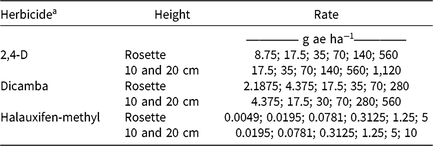
All horseweed plants were sprayed at the same time regardless of target height (i.e., 5- to 8-cm rosette and the two bolted heights: 10 and 20 cm). Treatments included halauxifen-methyl (Elevore™; Dow AgroSciences LLC, Indianapolis, IN), 2,4-D dimethylamine salt (Weedar® 64; Nufarm Inc., Alsip, IL), and dicamba diglycolamine salt (Clarity®; BASF Corporation, Research Triangle Park, NC) at six herbicide application rates that varied by active ingredient and target height to achieve a complete response range (Table 1). Herbicide applications were made using a single-nozzle, track-mounted sprayer with a single flat fan XR 8002E nozzle calibrated to deliver 140 L ha−1. Visual ratings were recorded weekly after herbicide application through 21 days after treatment (DAT). At 21 DAT, aboveground biomass was harvested and dried at 45 C until constant weight for dry weight determination. The experiment consisted of four replications and was conducted twice.
Auxin herbicide rates used in greenhouse dose-response experiment on rosette and bolted horseweed.

a Nonionic surfactant (Activator 90; Loveland Products Inc., Greeley, CO) was added at 0.25% vol/vol to all treatments.
Data from each horseweed field collection were pooled because of a nonsignificant interaction with herbicide treatment in the ANOVA. Visual control data were analyzed using a three-parameter log-logistic model (Equation 1), and aboveground dry biomass data were analyzed using a four-parameter log-logistic model (Equation 2) using R software (R Foundation for Statistical Computing, Vienna, Austria) and the DRC package (Knezevic et al. Reference Knezevic, Streibig and Ritz2007).
 $$f\left( x \right) = {\rm{}}{d \over {1 + {\rm{exp}}\left[ {b\left( {\log \left( x \right) - \log \left( e \right)} \right)} \right]}}$$
 $$f\left( x \right) = c + {\rm{}}{{d - c} \over {1 + {\rm{exp}}\left[ {b\left( {\log \left( x \right) - \log \left( e \right)} \right)} \right]}}$$
Diflufenzopyr Mixture
For the trials examining the interaction between each auxin herbicide and diflufenzopyr, seeds collected from Brookston, IN were used. Seeds from mature seed heads were sown in flats and later transplanted; herbicide treatments were applied to 6- to 10-cm horseweed rosettes, as previously described. Treatments included halauxifen-methyl, 2,4-D, and dicamba alone, and in combination with diflufenzopyr (diflufenzopyr sodium salt; LGC Standards, Manchester, NH) at a fixed ratio of 1:2.5 diflufenzopyr to auxin herbicide. This ratio represents the relative amount of diflufenzopyr and dicamba in commercialized herbicide products and was chosen to provide a standard comparison for synthetic auxin active ingredients that have varying application rates (Anonymous 2015, 2017a). The auxin herbicide doses in the treatment design targeted approximate 10%, 25%, 50%, and 75% reductions in growth rate (GR10, GR25, GR50, and GR75, respectively) values, which were selected on the basis of preliminary research to provide a range of responses and to investigate rate-dependent interactions. The effectiveness of diflufenzopyr was investigated by including rates up to 400 g ae ha−1 of diflufenzopyr alone.
Visual ratings were recorded weekly after treatment through 21 DAT. At 21 DAT, shoot biomass was harvested and dried at 45 C until constant weight for dry weight determination. The experiment consisted of four replications and was conducted twice. Data from each experimental run were pooled because of a nonsignificant run by treatment interaction in the ANOVA. Visual rating and aboveground biomass reduction, as a percentage of the nontreated control, were analyzed using the GLM procedure in SAS, version 9.4 (SAS Institute Inc., Cary, NC). Herbicide and rates were considered fixed effects and run as a random effect. Data were additionally analyzed using the MIXED procedure in SAS and the interaction model described by Colby (Reference Colby1967) (Equation 3).
 $$E = {{XY} \over {100}}$$
In this model, X and Y represent the response to individual herbicides at specific rates compared with the nontreated control, and E represents the expected response value of the herbicide mixture. The adaption proposed by Flint et al. (Reference Flint, Cornelius and Barrett1988), in which a statistical test is applied to compare the slopes of log-transformed response variables, was used to determine herbicide interactions.
Agar-Based Root Inhibition Assays
In the agar-based root inhibition assay, polystyrene microplates (6-well, 35-mm diameter) containing 1× Murashige and Skoog basal medium with vitamins (PhytoTechnology Laboratories, Shawnee Mission, KS) supplemented with 0.4% vol/vol agar (Sigma-Aldrich, St. Louis, MO), 0.8% sucrose (Fischer Scientific, Asheville, NC), and herbicide treatment were used. Based on preliminary experiments using different seed-sterilization methods, the combination of seed-surface bleach sterilization and a broad-spectrum fungicide in the medium was necessary to control fungal contamination during culture in the microplates. Thus, chlorothalonil (Echo® 720; Sipcam Agro USA, Inc., Durham, NC) was included at 500 ppm in the medium to control bleach-resistant endophytic pathogens from the field-collected seed. Herbicide treatments used technical-grade herbicides dissolved in 50% vol/vol dimethyl sulfoxide and diluted so that 100 µL of stock solution could be added to 9 mL of medium in each well. For each herbicide, nine concentrations ranging from 0.0001 to 1 µM were included. Each herbicide and rate combination represented an individual treatment. A comparable amount of dimethyl sulfoxide was added to the nontreated control agar.
Horseweed seeds collected from the Cortland and Brookston sites were surface sterilized in 30% vol/vol commercial bleach with 0.005% vol/vol nonionic detergent (Tween 20; Bio-Rad Laboratories, Hercules, CA) and rinsed four times with sterile water. Approximately 10 seeds were placed in each well and each well represented a treatment. Seeded plates were incubated at 25 C under continuous fluorescent lighting (30 to 50 µE m−2 s−1). Individual seedlings were removed from the agar with forceps for root measurement 14 d after seeding. The experiment included six seedlings per treatment and was conducted twice. Data from each seed location were pooled because of a nonsignificant location by treatment interaction in the ANOVA. Data were analyzed using the three-parameter log-logistic model (Equation 1) using R software and the DRC package (Knezevic et al. Reference Knezevic, Streibig and Ritz2007).
Results and Discussion
Auxin Dose-Response
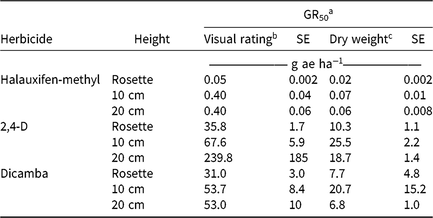
The developmental stage of horseweed plants influenced the efficacy of 2,4-D, dicamba, and halauxifen-methyl. The GR50 values calculated on the basis of visual rating and dry weight for halauxifen-methyl on rosette-sized horseweed were 0.05 and 0.02 g ha−1, respectively (Table 2). There was no difference in the GR50 values, for both visual rating and dry weight reduction, for halauxifen-methyl on the 10- or 20-cm bolted target height. For horseweed up to 20-cm tall, only 0.4 g ha−1 halauxifen-methyl was required for a 50% reduction in visual rating—more than 10 times less than the labeled use rate of 5 g ha−1 (Anonymous 2017b). Interestingly, the application rate of halauxifen-methyl required for a 50% reduction in biomass was only 0.06 g ha−1 for the 10- and 20-cm bolted heights. This flat dose response, the induction of herbicide symptomology, particularly at low rates across bolted plants of different heights, is indicative of a high level of herbicide efficacy (Monaco et al. Reference Monaco, Weller and Ashton2002).
GR50 value estimates from a whole-plant bioassay of two Indiana horseweed populations (data combined) following foliar application of three synthetic auxin herbicides applied to rosette and bolted heights under controlled environmental conditions.

a The rate needed to generate a 50% growth reduction of each response variable.
b GR50 value estimates for visual rating were generated using the three parameter log-logistic model (Equation 1).
c GR50 value estimates for dry weight were generated using the four parameter log-logistic model (Equation 2).
The GR50 value for visual control for 2,4-D on rosette-stage horseweed was 36 g ha−1 (Table 2). Interestingly, given the difference in typical field use rate of dicamba (280 to 560 g ha−1) and 2,4-D (560 to 1,120g ha−1), the GR50 value for dicamba on rosettes was 31 g ha−1, comparable to the value for 2,4-D (Anonymous 2010, 2018). The GR50 value for halauxifen-methyl on rosettes was 0.05 g ha−1—100 times less than that of the labeled field use rate of 5 g ha−1 (Anonymous 2017b). In comparison, the rates needed for the same response after 2,4-D and dicamba applications were approximately 16 to 32 and 9 to 18 times less, respectively, than the labeled use rate.
Similar to the action of halauxifen-methyl, there was no difference in the application rate required for a 50% reduction in visual rating for bolted horseweed treated with dicamba. For both halauxifen-methyl and dicamba, the GR50 value on bolted horseweed was approximately 9% of the maximum recommend field use rate. Conversely, there was an influence of height on horseweed response to 2,4-D, with a higher application rate of 240 g ha−1, compared with 68 g ha−1, required to observe a 50% visual control of 20- and 10-cm horseweed, respectively (Table 2). This observation provides evidence that dicamba and halauxifen-methyl exhibit a higher level of activity on horseweed up to 20-cm tall compared with 2,4-D.
These data also indicate there was no rate response for growth stage with halauxifen-methyl, a small rate response with dicamba, but a large rate response with 2,4-D. We compared these auxin active ingredients under consistent environmental conditions and nutrient availability, and removed the variability inherent to field research with regard to horseweed emergence or plant vigor throughout the growing season.
The GR50 values of dry plant biomass were calculated but did not contribute to a meaningful interpretation in the dose response analysis (Table 2). Inconsistent correlation between dry plant biomass and visual rating in response to auxin herbicides was observed in this study and has been noted by previous researchers (Devkota et al. Reference Devkota, Whitford and Johnson2016, Dowler Reference Dowler1969, Roskamp et al. Reference Roskamp, Chahal and Johnson2013). Although a quantitative measurement of response is preferred for investigating herbicide response in weeds, analyzing dry weight after sublethal applications of auxin herbicides is often not representative of phenotypic plant response, based on our research and previous references (McCauley et al. Reference McCauley, Johnson and Young2018).
Diflufenzopyr Mixture
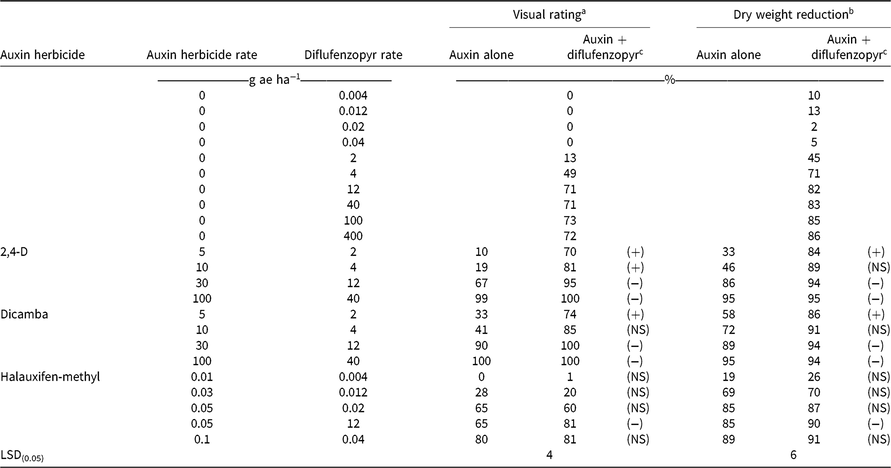
A differential effect of adding diflufenzopyr to each auxin herbicide was observed. When added at a ratio of 1:2.5 (diflufenzopyr to halauxifen-methyl), diflufenzopyr had an additive effect (not significantly different) on the efficacy of halauxifen-methyl at all rates (Table 3). Given the low rate of halauxifen-methyl needed for the range of phenotypic response, the diflufenzopyr rate included in the tank mixtures at the 1:2.5 ratio was also less than the amount included with the 2,4-D and dicamba treatments. When diflufenzopyr was added at 12 g ha−1, the same rate added to 30 g ha−1 2,4-D and dicamba, diflufenzopyr antagonized the efficacy of halauxifen-methyl at 0.05 g ha−1. This observation should not be characterized as “false antagonism” described by Hugie et al. (Reference Hugie, Bollero, Tranel and Riechers2008), which can occur when one of the herbicides applied alone results in plant death with no opportunity for a response other than “less than additive” for the herbicide mixture, due to limitations of the evaluation-scale limits. In our research, we did not observe false antagonism for this herbicide combination, because the herbicides applied alone or in tank mixture did not result in plant death.
Efficacy of auxin herbicides and diflufenzopyr on rosette horseweed as influenced by herbicide rate under controlled environmental conditions.

a Visual rating on a scale of 0 (no injury symptoms) to 100 (plant death) of herbicide efficacy compared with the nontreated control at 21 days after treatment.
b Dry weight reported as percent aboveground biomass reduction compared with the nontreated control at 21 days after treatment.
c Values in parentheses indicate the tank-mixture interaction (α = 0.05) as: (+) synergistic, (NS) additive/nonsignificant, or (−) antagonistic, according to Flint’s adaptation of Colby’s method (Colby Reference Colby1967; Flint et al. Reference Flint, Cornelius and Barrett1988).
The addition of diflufenzopyr to all 2,4-D and dicamba application rates resulted in a uniform response interaction (Table 3). At the low rate of 5 g ha−1 for both 2,4-D and dicamba, the tank mixture with diflufenzopyr resulted in synergy for visual injury and dry-weight reduction compared with each compound alone (Table 3). There was an additive response when diflufenzopyr was tank mixed with 10 g ha−1 dicamba for both response variables; the same result was observed with 2,4-D for the dry-weight reduction response. At the higher auxin rates, diflufenzopyr antagonized herbicide efficacy for 2,4-D and dicamba. This result is characteristic of false antagonism, due to the high level of control provided by 2,4-D and dicamba each alone at the rates of 30 and 100 g ha−1.
These results indicate that diflufenzopyr activity is not only complementary to dicamba activity, as some have suggested (Grossmann et al. Reference Grossmann, Caspar, Kwiatkowski and Bowe2002; Lym and Deibert Reference Lym and Deibert2005), but diflufenzopyr tank mixed with 2,4-D can result in herbicide synergy, as well. The data do not support any potential use of diflufenzopyr with halauxifen-methyl on horseweed, because synergy was not observed and a significant improvement in horseweed control would not be expected.
These results also indicate difference between arylpicolinate chemistry and 2,4-D or dicamba. Halauxifen-methyl’s low use rate, unique auxin-receptor binding, and the differential response of herbicide efficacy when tank mixed with diflufenzopyr all further differentiate it from other synthetic auxins. Diflufenzopyr was applied to rosette-stage horseweed at rates up to 400 g ha−1 to investigate its efficacy. There was no difference in horseweed efficacy for rates ranging from 12 to 400 g ha−1 (Table 3). The GR50 estimates for the visual rating at 21 DAT and dry-weight data after diflufenzopyr treatment were 3.2 and 2.0 g ha−1, respectively (data not shown). Thus, this research supports the use of diflufenzopyr only in mixtures with auxin herbicides such as 2,4-D or dicamba for horseweed control, because complete plant death was not achieved with diflufenzopyr alone, even at high application rates. The efficacy of diflufenzopyr as a synergist with auxin herbicides is herbicide specific, with no benefit for the combination with halauxifen-methyl on horseweed. Because only one weed species was evaluated in this research, additional analysis with these combinations should be conducted to determine if the auxin herbicide interactions with diflufenzopyr are also specific to the target species.
Agar-Based Root Inhibition Assays
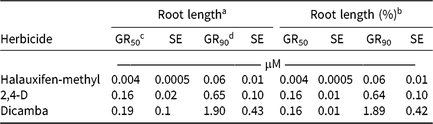
The trend of horseweed root inhibition was consistent for 2,4-D, dicamba, and halauxifen-methyl. An increase in herbicide concentration corresponded to a decrease in root length after 14 d of growth for each herbicide active ingredient. The GR90 values for root length were 0.06, 0.65, and 1.90 µM for halauxifen-methyl, dicamba, and 2,4-D, respectively (Table 4). Although there was a decrease in the magnitude of difference among treatments, this is the same relative ranking of GR50 values calculated for the whole-plant dose response experiment. In general, results from the agar-based seedling assay support the observations of the whole-plant dose-response experiment; that is, higher rates of 2,4-D and dicamba are required for a comparable horseweed response compared with halauxifen-methyl. This conclusion is analogous to previous research by Brosnan et al. (Reference Brosnan, Vargas, Reasor, Viggiani, Breeden and Zobel2017) that determined agar-based assays could detect resistance to glyphosate and ALS-inhibiting herbicides in annual bluegrass without the requiring whole-plant assays. Additional work is needed to determine how these methods could be adapted to other herbicide sites of action and weed species to provide a rapid assay to compare a putative resistant biotype with a known susceptible biotypes or to investigate relative response within an herbicide chemistry.
GR50 and GR90 value estimates from an agar-based bioassay of two Indiana horseweed populations (data combined) for root length and root length as a percentage of the nontreated control in response to three synthetic auxin herbicides.

a Measured in mm after 14 d of growth.
b Converted to a percentage of the nontreated control.
c The rate needed to generate a 50% growth reduction of each response variable (GR50) of each response variable generated using the three parameter log-logistic model (Equation 1).
d The rate needed to generate a 90% growth reduction of each response variable (GR90) of each response variable generated using the three parameter log-logistic model (Equation 1).
This study demonstrates the application of the agar-based bioassay to investigate differences in herbicide response as a function of herbicide chemical family within a single mode of action. Calculated GR50 and GR90 values for the agar-based root inhibition assay, although on a different scale, enable a similar comparison among the three different auxin herbicides as calculated from a whole-plant greenhouse dose-response assay. The agar-based root inhibition assay generated auxin herbicide response data within 14 d, compared with over 50 d for the greenhouse dose-response experiment. In addition to the shorter time needed to produce results, the agar-based root inhibition assays require less space and personnel time, but they require access to an autoclave and a laboratory with a laminar flow hood. The agar methods may simplify research activity in which many plant populations and herbicide chemistries need to be investigated, without a comparable increase in space and labor costs.
The sterile environment required for agar-based assays necessitates thorough seed decontamination and presents a challenge for using field-collected seed. Various seed sterilization methods are available that may be useful when using seed that contains endophytic pathogens (Barampuram et al. Reference Barampuram, Allen and Krasnyanski2014). Efforts to apply these techniques, such as a 70% ethanol wash or overnight chlorine gas treatment, were not as successful, because decontamination methods that successfully sterilized the seed also compromised seed germination (data not shown). In this research, supplementing the growth medium with a fungicide was acceptable and sufficient to manage contaminant growth throughout the experiment. As described by other researchers, work is required to expand this assay to investigate additional herbicide sites of action and other plant species (Brosnan et al. Reference Brosnan, Vargas, Reasor, Viggiani, Breeden and Zobel2017).
Collectively, these studies illustrate a differential response of horseweed to halauxifen-methyl compared with 2,4-D and dicamba in terms of whole-plant efficacy, horseweed size, interaction of the auxin herbicides with diflufenzopyr, and horseweed root inhibition. The differential phytotoxicity and commercial use rates among these chemical families are interesting and work investigating the explanation of these difference is justified to additionally delineate this mode of herbicide action. Dicamba-resistant crops (e.g., soybean, cotton) and 2,4-D-resistant crops (e.g., corn, soybean, cotton) provide an alternative weed management option that allows for more flexible use of these auxin herbicides. Given this change in preplant and potential in-crop applications, it is likely there will be increased incidence in weed resistance to these herbicides as well.
We investigated horseweed biotypes that were sensitive to auxin chemistry and our research provides a foundation for understanding horseweed response to 2,4-D, dicamba, and halauxifen-methyl. In short, the efficacy of halauxifen-methyl on horseweed in this research was similar to or greater than current auxin standards, 2,4-D and dicamba, across a range of horseweed heights (McCauley et al. Reference McCauley, Johnson and Young2018). The differing influence of diflufenzopyr on the efficacy of 2,4-D and dicamba compared with halauxifen-methyl was unexpected, but further confirms differences in the physiological response of plants among auxin chemistries.
Author ORCIDs
Cara L. McCauley https://orcid.org/0000-0001-7971-4409
Acknowledgments
The authors thank Julie Young and Amanda Graf for their assistance in these studies and the members of the Purdue Weed Science program and Corteva Agriscience for their continued support. No conflicts of interest have been declared. This research received no specific grant from any funding agency, commercial, or not-for-profit sector.