INTRODUCTION
Parkinson’s disease (PD) is often associated with cognitive decline, with some of the earliest and most robust changes occurring in executive function (see Salmon & Filoteo, Reference Salmon and Filoteo2007 for a review). Declines in executive function likely contribute to decrements in other higher-level functions, including abstract reasoning and problem solving, which often emerge in PD (Cronin-Golomb & Braun, Reference Cronin-Golomb and Braun1997; Lange, Robbins, & Marsden, Reference Lange, Robbins and Marsden1992; Ogden, Growdon, & Corkin, Reference Ogden, Growdon and Corkin1990). The current study examined the contributions of executive function to problem-solving performance in PD, with a specific focus on self-directed cognitive flexibility. For the present purpose, self-directed flexibility refers to the generation of concepts in the absence of external guidance, and contrasts with other forms of cognitive flexibility (e.g., set shifting) that are triggered by external cues (Eslinger & Grattan Reference Eslinger and Grattan1993; Tomer, Fisher, Giladi, & Aharon-Peretz, Reference Tomer, Fisher, Giladi and Aharon-Peretz2002).
Several theories of cognitive performance in PD posit that patients manifest deficits primarily on tasks that demand a high level of self-directed cognitive flexibility and that PD performance varies with the availability of external guidelines for performance. (Bondi & Kasniak, Reference Bondi and Kasniak1991; Brown & Marsden, Reference Brown and Marsden1990; Taylor, Saint-Cyr, & Lang, Reference Taylor, Saint-Cyr and Lang1986). Recent evidence indicated that planning impairments among PD patients emerged only when the goal state of a problem failed to disambiguate the necessary response sequence (McKinlay et al., Reference McKinlay, Kaller, Grace, Dalrymple-Alford, Anderson, Fink and Roger2008). When the solution strategy could be inferred from the goal state of the problem, PD patients performed normally. It may be that certain goal states support performance by priming potential solution strategies. Patients with PD are less fluent in their generation of response strategies on a variety of cognitive tasks (Cohen, Bouchard, & Scherzer, Reference Cohen, Bouchard and Scherzer1994; Farina, Reference Farina1994; Price, Reference Price2006; Swainson et al., Reference Swainson, SenGupta, Shetty, Watkins, Summers and Sahakian2006), which may contribute to problem-solving impairment.
The current study investigated this possibility using a problem-solving paradigm that emphasizes the ability to generate possible solutions in a self-directed manner: arrangement problems (Greeno, Reference Greeno and Estes1978). Previous examinations of picture arrangement problems have consistently found PD-related deficits (Ogden et al., Reference Ogden, Growdon and Corkin1990; Sullivan, Sagar, Gabrieli, Corkin, & Growdon, Reference Sullivan, Sagar, Gabrieli, Corkin and Growdon1989). One common type of arrangement problem, the anagram, requires rearranging strings of letters (e.g., PLPAE) to form words (APPLE). To resolve the anagram, one must flexibly manipulate the problem’s components to generate partial solutions, and then determine if they satisfy the constraints of the problem (Newell & Simon, Reference Newell and Simon1972; Novick & Sherman, Reference Novick and Sherman2003). If problem-solving impairment among PD patients reflects a difficulty generating potential solutions, then patients should have difficulty resolving the anagram puzzles and this impairment should be remediated by the provision of cues designed to prime potential solutions.
In addition to a difficulty generating potential solutions, declines in other aspects of executive function, including inhibition, set shifting, or working memory, may create problem-solving deficits among patients with PD. Difficulty inhibiting or shifting away from inappropriate solutions and working memory deficits may limit the mental manipulation of a problem necessary to evaluate the appropriateness of a potential solution. Among PD patients, working memory and inhibition have been shown to predict performance on planning tasks, including the Tower of London (TOL; Altgassen et al., Reference Altgassen, Phillips and Kopp2007; Lewis et al., Reference Lewis, Cools, Robbins, Dove, Barker and Owen2003) and relational problems, including the Raven’s Progressive Matrices (RPM; Cronin-Golomb & Braun, Reference Cronin-Golomb and Braun1997; Cronin-Golomb et al.,Reference Cronin-Golomb, Corkin and Growdon1994; Hanes et al., Reference Hanes, Andrewes, Smith and Pantelis1996). It is unclear whether the constellation of executive functions demanded by planning and relational problems generalizes to arrangement problems (e.g., anagrams). Moreover, anagram puzzles may be characterized by unique executive demands that are compromised in PD, including semantic retrieval processes (Copland, Reference Copland2003; Crescentini, Mondolo, Biasutti, & Shallice, Reference Crescentini, Mondolo, Biasutti and Shallice2008).
To summarize, the current study examined the impact of PD on problem-solving performance with a particular focus on the contribution of self-directed cognitive flexibility. If previously noted PD-related problem-solving impairments generalize to arrangement problems, then patients should perform poorly on the anagram task. To examine the possibility that cues may remediate problem-solving deficits in PD, half of the anagram puzzles were partially resolved so as to prime potential solutions. If patients with PD experience difficulty generating potential solutions to the problem, this modification should support more successful resolution. Additionally, to the extent that difficulty resolving arrangement problems reflects challenges to particular aspects of executive function, anagram performance should be associated with relevant measures of neuropsychological performance.
METHOD
Participants
Fifteen individuals with mild to moderate PD (Stage 1: n = 7; Stage 2: n = 3; Stage 3: n = 5; Hoehn & Yahr, Reference Hoehn and Yahr1967) were recruited from local PD support groups and from the Movement Disorders clinic of the Penn State Medical Center. PD patients had been diagnosed by a board-certified neurologist an average of 6.47 (SE = 1.2) years prior to the study. Based on patients’ reports regarding the side and presentation of motor symptoms, seven were classified as right-onset and eight were classified as left-onset; disease severity did not differ by side of onset, p > .60. All patients were under the care of a neurologist and were considered to be optimally medicated. Four patients were taking L-dopa medication alone, two were taking MAO inhibitor (MAOi) medication alone, six were taking a combination of MAOi and L-dopa and three were taking a combination of L-dopa, MAOi, and dopamine agonist medication. Twelve healthy age-matched control participants were either spouses of participating PD patients or were recruited through advertisements posted at local community centers.
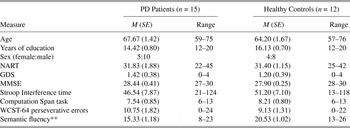
The control and patient groups were matched in gender, age, years of education, and premorbid intelligence, as determined by performance on the National Adult Reading Test (NART; Crawford, Parker, & Allan, Reference Crawford, Parker and Allan1991). All participants were nondemented, (Mini-Mental State Exam scores > 27; Folstein, Folstein, & McHugh, Reference Folstein, Folstein and McHugh1975) and nondepressed (Short Form of the Geriatric Depression Scale – Short Form scores < 5; Sheikh & Yesavage, Reference Sheikh and Yesavage1986). All participants indicated that English was their first language. Participants reported no history of alcoholism, psychiatric illness, stroke, other neurological illness or prior brain surgery. Table 1 provides additional information on the demographic and neuropsychological characteristics of the two groups.
Demographic characteristics and neuropsychological scores of participants

Note
M (SE) = Mean (Standard Error); MMSE = Mini-Mental State Examination (Folstein et al., Reference Folstein, Folstein and McHugh1975); GDS = Geriatric Depression Scale (Sheikh & Yesavage, Reference Sheikh and Yesavage1986); NART = National Adult Reading Test (Crawford et al., Reference Crawford, Parker and Allan1991); WCST-64 = Wisconsin Card Sorting Task–Short form (Axelrod et al., Reference Axelrod, Henry and Woodard1992).
** p < .01.
Materials and Procedure
During one 90-minute session, participants completed the anagram task followed by a series of neuropsychological tests. This research was approved by the Institutional Review Board of the Penn State Medical Center and was completed in accordance with the Helsinki Declaration.
Anagram task
Participants completed two conditions: In the baseline condition, participants viewed the anagram by itself, and in the cued condition, participants viewed the anagram and a set of blanks indicating the number of letters in the word with the final two blanks filled in correctly. A total of 18 single word nouns were selected as target words; each condition included two 4-letter, three 5-letter and four 6-letter words. The particular subset of words selected for each condition was randomly determined for each participant, and the order of conditions was counterbalanced within each group.
Prior to starting the task, participants were given the following directions: “On this task, you will see a set of letters that can be unscrambled to form a word. On some trials, you will also see a set of blanks with some of the letters correctly filled in already. Please use this cue as a guide. On each trial, please work to unscramble the word as quickly as you can. Once you know the correct answer you should press the space bar. At that time you will enter the answer using the computer keyboard. If you have not unscrambled the word after 45 seconds, the trial will end. The experimenter will provide you with the correct answer, then you will advance to the next trial.” Participants completed three practice trials with the baseline, each involving a 5-letter word, followed by the experimental task.
Neuropsychological assessment
Participants completed a series of neuropsychological measures of executive function. Set shifting ability was determined by the number of perseverative errors on the Wisconsin Card Sorting Task-64 (WCST-64; Axelrod, Henry, & Woodward, Reference Axelrod, Henry and Woodard1992). Inhibitory control was determined using the response time measure of interference on the Stroop Color-Word Interference test (Stroop, Reference Stroop1935). Semantic verbal fluency was measured with the Controlled Oral Word Association Test (COWAT; Benton & Hamsher, Reference Benton and Hamsher1976), based on the total words generated from a single category prompt (e.g., animals). Working memory capacity was determined based on the total number of correctly recalled items on the Computation Span task (CSpan; Salthouse & Babcock, Reference Salthouse and Babcock1991).
RESULTS
For each trial, the elapsed time between stimulus onset and space bar response was recorded as the response time (RT); the time required to enter the word using the keyboard was not recorded. Each participant’s median RT for all correct responses and the proportion of correctly resolved anagrams were computed for each condition. These dependent measures were each analyzed using a repeated measures analysis of variance (ANOVA) with condition (baseline vs. cued) as the within subjects factor and group (PD vs. HC) as the between subjects factor. In addition to analyzing group differences on the anagram task, correlation analyses were conducted within each group to examine the relationship between problem solving and neuropsychological function and disease/demographic characteristics.
Response time
Figure 1 summarizes the median RT for the PD and control groups in the two conditions. Performance was faster among healthy controls (M = 5405, SE = 333) than PD patients (M = 6914, SE = 298), F(1, 25) = 11.39, p < .01. Participants’ RT varied by condition, F(1, 25) = 12.24, p < .01, and the effect of condition on RT varied by group, F(1, 25) = 4.95, p < .05. Paired samples t-tests conducted within each group indicated that healthy controls performed similarly across the two conditions, p > .25. Among PD patients, RTs were significantly slower on the baseline than on the cued condition, t(14) = 3.73, p < .01. Comparisons of the two groups indicated that PD patients responded significantly slower than controls on the baseline, t(25) = 4.30, p < .001, but responded comparably with controls on the cued condition, p > .20. Within the PD group, performance varied according to the side of disease onset. On the baseline condition, left-onset patients responded more slowly (M = 8719, SE = 489) than right-onset patients (M = 7120, SE = 555), t(13) = 2.21, p = .05. No difference emerged on the cued condition, p > .90.
Mean response time for PD patients and healthy controls (HC) on the baseline and cued conditions of the anagram task. Error bars indicate standard error of the mean.

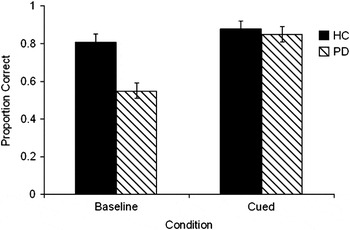
Proportion correct
Figure 2 summarizes the proportion of correctly resolved anagrams for each group. The proportion correct varied by condition, F(1, 25) = 26.68, p < .001. Healthy controls correctly resolved a higher proportion of anagrams (M = .84, SE = .04) than did PD patients (M = .70, SE = .04), F(1, 25) = 7.14, p < .05, although the effect of group varied across conditions, F(1, 25) = 9.58, p < .01. Planned comparisons of the two groups indicated that PD patients performed significantly worse than controls on the baseline condition, t(25) = 3.17, p < .01, but the two groups performed comparably on the cued condition, p > .4. Paired-samples t-tests conducted within each group indicated that performance in both groups was better on the cued than on the baseline condition [healthy controls: t(11) = 2.61, p < .05; PD patients: t(14) = 4.96, p < .001]. Collapsing across conditions, left-onset PD patients correctly resolved fewer anagrams (M = .63, SE = .06) than did right-onset patients (M = .77, SE = .06), although this difference was not significant p > .10.
Mean proportion of anagrams correctly resolved by PD patients and healthy controls (HC) on the baseline and cued conditions of the anagram task. Error bars indicate standard error of the mean.

To summarize, patients with PD were considerably slower and less successful than age-matched controls at solving the anagram puzzles. However, with the availability of cues, patients performed comparably with controls.
Predictors of anagram performance
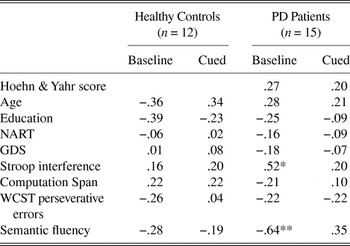
The two groups were compared on the following neuropsychological measures: (a) Stroop Interference RT, calculated as the difference between the RT on the interference condition and RT on the naming condition, adjusted by RT of the naming condition [(Interference RT – Naming RT) / Naming RT], (b) total number of items recalled on the CSpan task, (c) number of perseverative errors on the WCST-64, and (d) semantic fluency on the COWAT. A series of independent t-tests were conducted to compare the performance of controls and PD patients on these tasks. Following these comparisons, correlation analyses were conducted to determine whether neuropsychological performance was associated with RT on either anagram condition. In addition, a series of correlation or t-test analyses were computed to assess the relationship between anagram performance and disease/demographic characteristics, including disease severity, age, education, premorbid intelligence, mood, and sex. The results of these analyses are summarized here and presented in greater detail in Tables 1 and 2.
Correlations of anagram response time and neuropsychological performance

Note
Numbers reflect Pearson r values based on correlations conducted within each group. (n = 15). GDS = Geriatric Depression Scale; NART = National Adult Reading Test; WCST = Wisconsin Card Sorting Task.
*p < .05; **p < .01.
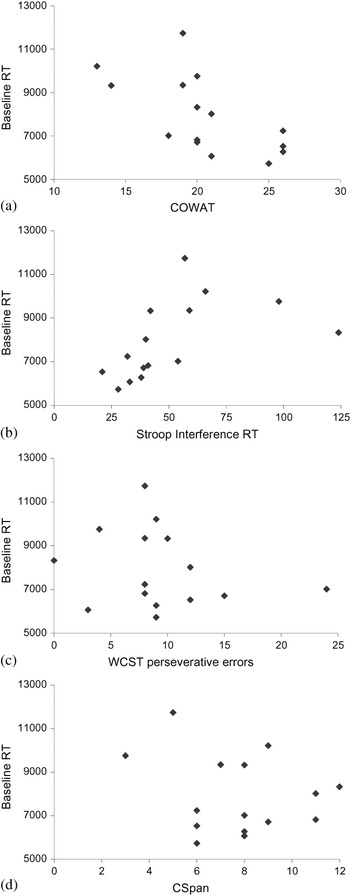
With one exception, the two groups differed little in neuropsychological performance. Patients with PD generated significantly fewer words on the semantic fluency portion of the COWAT, F(1, 25) = 7.81, p < .01. No group differences emerged in set shifting, working memory, or Stroop interference, p > .10. Correlation analyses conducted within the PD group indicated that verbal fluency and Stroop interference scores were associated with baseline anagram performance, p < .05; no associations emerged with cued anagram performance. Figure 3 illustrates the relationship between baseline anagram performance and each of the four measures of neuropsychological performance. No other relationships emerged between anagram and neuropsychological performance within the PD or control group; anagram performance was also not associated with disease or demographic characteristics. Collapsing across the two groups, a t-test revealed that gender did not significantly impact performance on the baseline task or cued task, p > .28 in each case (within-group analyses revealed a similar pattern of null results for gender, p > .20 in each case).
Individual response time (RT) on the baseline anagram condition, plotted as a function of (a) verbal fluency scores on the Controlled Oral Word Association Test (COWAT), (b) Stroop Interference RT, (c) WCST perseverative errors, and (d) words recalled on the Computation Span task (Cspan) measure of working memory.

DISCUSSION
The present findings indicate that the PD-related problem-solving impairments previously noted on planning and relational problems (e.g., Cronin-Golomb & Braun, Reference Cronin-Golomb and Braun1997; Owen, Doyon, Dagher, Sadikot, & Evans, Reference Owen, Doyon, Dagher, Sadikot and Evans1998) generalize to arrangement problems. Impairment was especially pronounced among PD patients with greater dopamine loss in the right hemisphere (left-onset PD). However, provision of cues designed to prime the target word enabled both left- and right-onset PD patients to perform comparably with controls. These data suggest that certain problem-solving deficits may be remediated by cues that support the generation of potential solution strategies.
Fundamental to solving arrangement problems is the ability to generate potential solutions in a self-directed manner (Greeno, Reference Greeno and Estes1978). Patients with PD have difficulty generating hypotheses or strategies on a variety of tasks (Cohen, et al., Reference Cohen, Bouchard and Scherzer1994; Price, Reference Price2006; Swainson et al., Reference Swainson, SenGupta, Shetty, Watkins, Summers and Sahakian2006; Tomer et al., Reference Tomer, Fisher, Giladi and Aharon-Peretz2002), and this aspect of cognitive flexibility appears to contribute to problem-solving impairment. In the current study, patients who had difficulty generating verbal responses to a semantic cue on the COWAT measure were also less successful at resolving the anagrams. Furthermore, anagram performance among PD patients improved considerably when solution generation was supported by partially resolving the anagram; control participants did not appear to benefit from the cue. Semantic generation among PD patients is particularly poor when available stimuli are insufficient to support the “bottom-up” activation of relevant information (Longworth, Keenan, Barker, Marslen-Wilson, & Tyler, Reference Longworth, Keenan, Barker, Marslen-Wilson and Tyler2005; Copland, Reference Copland2003; Crescentini et al., Reference Crescentini, Mondolo, Biasutti and Shallice2008). In the current study, the partial resolution of the anagram may have provided sufficient bottom-up activation to prime potential responses. Similarly, previous work demonstrated that PD-related difficulty in solving planning problems was remediated when the goal state of a problem primed potential solution strategies; regardless of the problem’s complexity, deficits emerged only when the goal state of the problem failed to disambiguate possible solutions (McKinlay et al., Reference McKinlay, Kaller, Grace, Dalrymple-Alford, Anderson, Fink and Roger2008). Taken together with the present findings, these data indicate that cues available within the problem may help PD patients overcome difficulties generating possible solutions.
Solution generation appears to be especially pronounced among patients with greater dopamine loss in the right hemisphere (left-onset PD). In the present study, anagram resolution on the baseline condition was less efficient among left-onset relative to right-onset patients, but the two groups of patients performed comparably on the cued condition. Although it is difficult to make a strong argument regarding laterality effects given the relatively small sample included in the present study, these findings are consistent with previous evidence. Tomer, Aharon-Peretz, & Tsitrinbaum, (Reference Tomer, Aharon-Peretz and Tsitrinbaum2007) found that left-onset patients generated fewer responses than right-onset patients when performing the Alternate Uses Task, which requires participants to generate alternative uses for common objects (e.g., paperclip). These data are consistent with evidence that strategy generation exhibits some degree of right lateralization. Goldberg et al. (Reference Goldberg, Podell and Lowell1994; Reference Goldberg and Podell1999) proposed that right prefrontal cortex supports the generation of novel cognitive strategies, whereas the left prefrontal cortex is thought to support routine or algorithmic decision making. Neuroimaging evidence from verbal and spatial arrangement problems indicates that solution generation is associated with right prefrontal activation, and activation of this region decreases with the availability of contextual cues that prime potential solutions (Goel & Vartanian, Reference Goel and Vartanian2005; Vartanian & Goel, Reference Vartanian and Goel2005).
In addition to priming possible solutions, the cues in this study may have offered an additional benefit of helping participants inhibit the highly salient anagram stimulus. Successful resolution of the anagram requires the capacity to inhibit a dominant or salient stimulus (e.g., the anagram) in favor of alternative arrangements. Baseline anagram resolution was faster among those exhibiting stronger levels of inhibitory control, reflected in Stroop task performance, but no such relationship emerged with the cued anagrams. It is possible that partially resolving the anagram reduced the perceptual dominance of the anagram stimulus, thereby reducing the necessity of inhibitory processes.
Although the current findings indicated relationships between anagram performance and inhibitory control and verbal fluency, there was no relationship with other aspects of executive function, namely working memory or set shifting ability. These findings conflict somewhat with evidence from planning-focused problems (e.g., TOL), relational problems (e.g., RPM), and deductive reasoning problems, which indicate that stronger problem-solving performance is associated with increased working memory and set shifting ability, as well as greater inhibitory control (Cronin-Golomb & Braun, Reference Cronin-Golomb and Braun1997; Cronin-Golomb et al., Reference Cronin-Golomb, Corkin and Growdon1994; Hanes et al., Reference Hanes, Andrewes, Smith and Pantelis1996; Lewis et al., Reference Lewis, Cools, Robbins, Dove, Barker and Owen2003; Morris et al., Reference Morris, Downes, Sahakian, Evenden, Heald and Robbins1988; Owen et al., Reference Owen, Sahakian, Hodges, Summers, Polkey and Robbins1995). Such variability across problem types emphasizes the need to consider multiple paradigms when examining problem-solving performance in a particular population.
In summary, patients with PD were less successful than controls at resolving the anagram puzzles, although deficits emerged primarily when the anagram puzzle provided no context to support the generation of possible solutions. Deficits were remediated when the anagram was partially resolved by providing the final two letters of the word. That anagram performance was associated with verbal fluency and Stroop performance suggests deficits may reflect inefficient semantic generation and inhibitory processes. By priming possible solutions, contextual cues enabled PD patients to overcome these deficits. These data suggest certain mild cognitive deficits experienced by patients with PD may be alleviated through the availability of relevant cues within the environment.
ACKNOWLEDGMENTS
This study was supported by an Elizabethtown College Faculty Grant awarded to the author. I thank Renee Fortinper, Jennifer Knapp, and Kelly Wall for their help with data collection.