Introduction
The demand for poultry products is growing rapidly with the fastest increases in developing countries (Ravindran, Reference RAVINDRAN2012; Food Outlook, 2013). Global poultry meat production increased from 56 million metric tons in 1996 to 104 million metric tons in 2012, and this has been projected to reach 108 million metric tons in 2013 (Poultry Trends, 2013). Between 2000 and 2012, world egg production increased by 28.4% (Poultry Trends, 2013). Ease of production and preparation, nutrient profile, low cost and minimal religious taboos are among several reasons influencing the World's trend in poultry production and consumption. In the South Pacific region, poultry meat and eggs are in high demand and this trend will continue due to expected population growth, preferred taste and health consciousness of poultry products and fast changing life styles. Despite high demand, the poultry sector is still less developed in the South Pacific region and domestic production does not meet demand in most countries.
The South Pacific is a region in Southern Oceania consisting of 22 small island countries with an estimated 11 million people. Root crops (taro, cassava and sweet potato) are the staple energy sources, and livestock and poultry is mainly farmed in a traditional manner, with no up to date statistics being available. Developments in poultry industries, the region can be categorised into; i) countries that have a fairly well established industry where the sector is mainly driven by larger companies and ii) those where the industry is predominantly traditional (based on family poultry, FP) with few small private investments in some countries. Fiji falls in the former category and Samoa in the latter. The focus of this paper is on the poultry industries in Fiji and Samoa. The main features and major issues affecting the industries in these countries and the opportunities are discussed. Information provided is based on annual reports of the Livestock Department of the Ministries of Agriculture and Fisheries as well as personal interviews with those involved in poultry production.
The poultry industry in Fiji
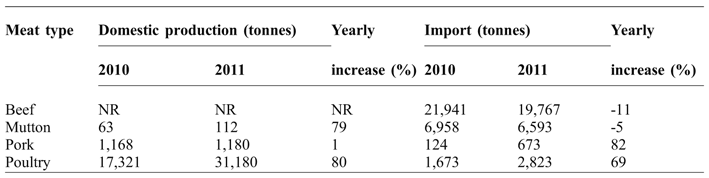
Available data in Fiji are mostly regarding the commercial poultry sector with little or no statistics on family poultry. Chickens are the main species reared, although ducks may be found on small scale systems run by sugarcane farmers and around urban centres where there is high demand for duck meat. The restriction on pig and beef by Hindus (an important proportion of Fiji's population) makes poultry the most popular meat in the country. Poultry in Fiji in relation to other meats is shown in Table 1 .
Poultry meat production in relation to other meats in Fiji from 2010 to 2011.

NR: not recorded. Source: Fiji Animal Health and Production (2013, Annual report)
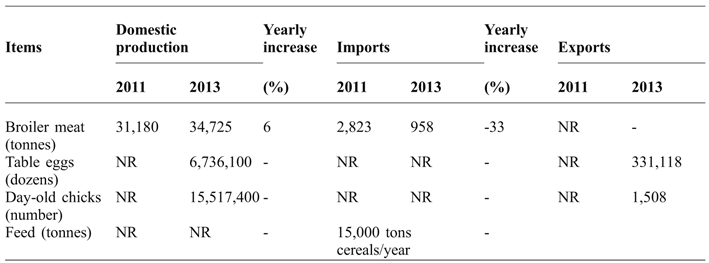
There are currently 125 registered broiler farms in Fiji owned by two major companies (Crest and Rooster) as well as contract growers and smallholder farms. During the periods 2010 to 2011 and 2011 to 2013 broiler meat production increased by about 80 and 11.4% respectively while imports decreased by 66% in 2013 compared to 2011. Virtually all the meat produced is consumed locally.
A total 59 registered farms consisting of large, medium and smallholder farms produce table eggs to meet the local demand. In 2013 egg exports to countries within the region was reported. There are four commercial hatcheries, which meet the local demand for day-old chicks (DOC), and with some exported to Tuvalu, Wallis and Futuna. Currently, the local demand of feed is met by seven mills (four commercial and three smallholder mills) and feed is exported within the region. Fiji's poultry industry is expected to keep growing as a result of the increasing domestic consumption and the ready export market regionally. Production levels for the poultry industry in Fiji are shown in Table 2
Performance of the poultry industry in Fiji from 2011 to 2013.

NR: not recorded. Source: Fiji Animal Health and Production (2013, Annual report)
The poultry industry in Samoa
Like most countries of the region, the poultry industry in Samoa is characterised by a very high demand for the products and low domestic production, with domestic chicken being the only species of poultry farmed. Currently, there are no commercial broiler farms in the country and supply is met by imports from Australia, New Zealand and United States, small scale family farms and recently spent layers from a few farms producing table eggs. There are no hatcheries or functioning feed mills in Samoa. Feed and DOC are imported from New Zealand and Fiji at high cost, mainly due to freight.
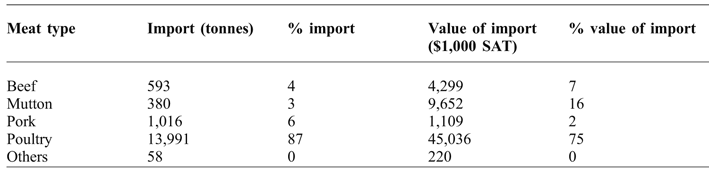
Between 2012 and 2013 poultry meat import to Samoa represented 87% of all meat imports and 75% of the value of meat imports (MAF-APHD, 2014, Annual report). There are three commercial egg farms with a total of 91,000 laying hens. Domestic production meets up to 90% of current demand for eggs. Meat from spent layers is increasingly contributing to the local supply. One farm has recently built a small scale slaughter plant to improve meat supply from this sector. Table 3 summarises the volume and value of poultry meat import in relation to other meats in Samoa.
Relative volume and value of meat imports in Samoa from July 2012 to June 2013.

Source: MAF-APHD (2014, Annual report)
Meat from FP system commands a premium price (three times or more) compared to imported broiler meat on account of its perceived flavour. Although FP production is receiving attention in Samoa, average flock sizes are still small and productivity is low (Diarra et al., 2016, unpublished data). Previous attempts to improve productivity of this system have been made. A project funded by FAO to improve chicken production in a ‘permaculture’ system started in 2004 and ended in 2008. , and was reported to have failed due to poor collaboration among project counterparts. A new project, named the Samoan Agricultural Competitiveness Enhancement Project (SACEP) funded by FAO (ID: P115351) is now underway to assist farmers in the country improve their productivity. A total of 144 registered FP farmers with the Ministry of Agriculture and Fishery (MAF) are expected to benefit from SACEP assistance.
Challenges of poultry industries in the region
Commercial poultry production in the region is confronted with several challenges including high cost of feed (all countries) and day-old chicks (most countries), market and environmental issues. Poor knowledge and lack of any production base to improve productivity of FP despite the high demand for the products in all countries of the region is a major factor.
high cost of production
High cost of inputs, especially feed and DOC mainly due to cost of freight, is a major issue affecting the growth of the poultry sector in most countries of the South Pacific region.
Rising global feed cost poses a particular problem for the region. Ayalew (Reference AYALEW2011) reported a 56 to 100% increase in retail prices of commercial poultry feeds in Papua New Guinea (PNG) from 2003 to 2011 representing a 7-12.5% yearly increase. Even in Fiji, where there are commercial feed mills, virtually all the ingredients are imported at high prices. Common feed ingredients are not readily available and research into alternative sources has not received much attention at a commercial scale. Low level of agricultural diversification and agro-processing, poor knowledge of the value of feed or alternative ingredients and lack of processing facilities hinder s production in the region. This renders producers unable to produce at a competitive price compared to imported poultry products. The average cost of imported and locally produced poultry products in Samoa are summarised in Tables 4 and 5.
Chicken meat prices on the Samoan market (landed C.I.F price plus 12.5% VAGST).

VAGST: Value added good and services tax; WS$ 1 = US$ 0.40. 1Samoan Ministry for Revenue (2014, Annual report); 2Diarra and Devi (2015, personal communication)
Prices of imported (landed C.I.F price plus 12.5% VAGST) and locally produced eggs in Samoa.

VAGST: Value added good and services tax; WS$ 1 = US$ 0.40. Samoan Ministry for Revenue (2014, Annual report)
marketing
This high cost of input coupled with the competition in the world broiler meat market and the signing of regional and international trade agreements e.g. world trade organisation and the Melanesian spearhead group free trade area agreements by countries of the region will further slowdown the development of the industry in most countries, especially those where the poultry sector is less significant. Producers in these countries will not be able to compete with imported products. A country like Fiji with a fairly well established poultry industry could take advantage of this situation to increase production for the export market within the local region. In addition to DOC, companies in Fiji have begun to export poultry eggs locally to other islands, and this market is likely to grow.
wastes production and management
Manure and slaughter by-products are important waste from intensive poultry systems which need to be well managed for the system to be sustainable, and may exceed disposal means (e.g. composting or soil applications) in most countries. An estimated 1,820 - 2,548 tons of manure was reported to have been produced in Samoa in 2015 and less than 30% of this was used mainly on crop farms and over 70% dumped into the environment (Diarra, Reference DIARRA2016, unpublished data). Nitrogen and phosphorus from commercial systems can a serious environmental concern, ranging from water eutrophication, ammonia volatilisation (Kim et al., Reference KIM, PATTERSON, RODRIGUEZ-LECOMPTE and RICKE2013) and ground water contamination (Saylor, Reference SAYLOR2000; Kim et al., Reference KIM, PATTERSON, RODRIGUEZ-LECOMPTE and RICKE2013) all of which are major threats to human health and the sustainability of the poultry industry. Waste production may pose more problems in Fiji where commercial poultry rearing is growing fast. A more centralised collection and rendering strategy for slaughter by-products would minimise their effects on the environment and reduce spending on imported protein concentrates. This should be a priority for the major companies (Crest and Rooster). Poultry farms in the region must develop sound manure management plans to ensure the sustainability of the industry.
Opportunities in poultry industries in the region
Despite the numerous challenges, there are opportunities in the development of the poultry industry in the South Pacific region. The nature of these opportunities will of course vary depending on the current state of the industry in each country.
feed research
The purpose of commercial poultry systems is to convert feed materials and by-products into high quality meat and eggs. More diversified agriculture will promote the development of agro-industries and make the by-products available for poultry feeding in the region. A company in Samoa has plans to promote maize and soybean contract growing in conjunction with coconut, to reduce feed cost in the country. Research into crops with lower nutritional value may also reduce the cost of on-farm feed. An example is the white cultivar of giant taro (Alocasia macrorrhiza) which grows well in the region but has no food value in most countries. Analysis of giant taro root meal at USP Alafua central laboratory (Diarra and Perera, 2015, unpublished) showed it had 11 MJ gross energy and 120 g/kg crude protein. However, calcium oxalate has been identified as the major anti-nutritional (ANF) factor in the root (Pham et al., Reference PHAM, NGUYEN and DANG2005) which may be overcome by adequate supplementation with inorganic calcium sources (Ravindran et al., Reference RAVINDRAN, SIVAKANESAN and CYRIL1995). Appropriate feed technologies that would improve the value of such crops for poultry diets need to be researched. Recently, Diarra (Reference DIARRA2016) reported improved performance of laying hens fed diets containing coconut oil slurry supplemented giant taro root meal as a replacement for maize. Copra meal (CM) is readily available in most countries of the region. The Pacific Oil Company in Samoa produces between 800-1200 MT of copra meal/year (Diarra and Devi, Reference DIARRA and DEVI2015, personal communication). Although not estimated, copra meal is also available from small scale oil processing plants in the region. CM currently costs between US$ 0.12-0.28/kg for cold and expeller pressed meals respectively, but high fibre and low nutrient density limit its utilisation in poultry, and requires more research into ways to improve this. Diarra et al. (Reference DIARRA, KANT, TANHIMANA and LELA2015) reported improved laying in hens fed 25% dietary expeller copra meal when supplemented with an exogenous enzyme cocktail. Since commercial enzyme products are not readily available to small scale farmers in the region, research into strategies to maximise inclusion of such cheap ingredients in the diet needs to be increased.
Giant African snails (Achatina fulica) which are major pests on Samoa may be utilised as a raw material to reduce feed cost in small scale systems. Complete replacement of fish meal with cooked snail meal in broilers (Diomandé et al., Reference DIOMANDÉ, KOUSSEMON, ALLOU and KAMENAN2008) and laying hens (Diarra et al., Reference DIARRA, KANT, TANHIMANA and LELA2015) has been reported to reduce the cost of production with no adverse effects on performance and sensory quality of the products. Optimum use of snails in poultry diets would save costs for chemical pest control and protect the environment. As scavenging poultry meet their protein needs from a wide variety of insects, farming insects could be a useful way of providing protein meal for more intensively farmed birds, although the seasonal availability of most alternative ingredients may not warrant their use on a large commercial scale.
The need for basic feed processing equipment for maximum utilisation of locally available raw materials is important. The cost of such equipment may be too high for small and medium scale producers, and cooperative ownership of small scale feed processing plants could provide access instead. The presence of ANFs is a major limitation to the use of alternative feed ingredients in poultry diets. Many ANFs cannot be analysed in most countries of the region but this could be done through collaboration with overseas laboratories especially in Australia and New Zealand.
cost of day-old chicks
In countries where there are no hatcheries, freight is the major cost in the procurement of DOC. The small and medium scale nature of the industry may not justify the high operation cost of a hatchery, and again, small cooperative hatcheries with capacity adapted to demand could ease the supply of DOC in this region. Establishment of small hatcheries could also promote contract growing and further increase domestic supply of poultry products. Importation of fertile eggs is cheaper than importing chicks or managing breeding flocks in many countries at the moment. Hatchery by-products could be effectively utilised to provide part of the protein concentrate for diets currently imported at high cost.
marketing
The increasing demand for poultry products in the region will create more market opportunities for larger poultry companies owing to trade liberalisation. Investment in the commercial poultry sector will increase in Fiji to exploit new intra-regional trading opportunities such as the Melanesian spearhead group free trade area. This can be seen already by the export of DOC and eggs. However, companies in Fiji will need to do more research in the area of feed production to be able to compete at competitive prices with companies elsewhere.
Many countries in the region will not be able to grow to meet domestic demand of poultry products or participate in the export market. The priority of such countries should be to improve productivity of FP to reduce spending on importation. Improvement in the FP sector will require more research, training and extension. Researchers, extension staff and poultry farmers in the region could learn more from successes achieved in FP improvement from other developing countries of Asia and Africa. Intervention from international funding agencies like FAO, World Bank and Asian Development Bank in the development of FP should be sought.
waste management
Currently there are no functional poultry by-products rendering plants in the region. Waste accumulation from intensive poultry systems can have serious environmental consequences and compromise sustainability of the system. Small island countries would be more vulnerable to dumping of wastes on account of their small land areas. Composting and use of manure on agricultural land or partial re-use in poultry houses will reduce cost of production and minimise the risk of pollution. Commercial farmers in collaboration with the Ministry of Agriculture and researchers should investigate into more environmentally friendly and cheap waste management policies in the region.
protection from major poultry diseases
Outbreak and re-emergence of highly infectious poultry diseases which have adversely affected the poultry industry in many parts of the world are not yet major production constraints in the region. This is an important asset to the industry which should be carefully monitored through sound prophylactic measures at both regional and individual country levels.
Conclusions
The poultry sector in the South Pacific region is characterised by high demand for the products and insignificant levels of domestic production. Lack of vertical integration and high cost of inputs are the major factors affecting commercial poultry production in the region. Productivity of family poultry is low due to lack of technical input. These production constraints coupled with the signing of international trade agreements will potentially make the region a large market for poultry companies. The current priority of most countries in the region should be to encourage small scale production and reduce spending on imports. The variability in composition and seasonal availability of local raw materials may not justify their use in commercial feed production but they could be used to reduce cost of FP and small scale feed production in the region. Community ownership of feed processing plants and hatcheries will further reduce cost and promote small scale production. There is a need to improve the productivity of FP in the region through research, extension and training.