INTRODUCTION
Planktonic ciliates are important components of microplankton communities and play a crucial role in the functioning of microbial food webs (Finlay et al., Reference Finlay, Bannister and Stewart1979, Reference Finlay, Berninger, Clarke, Cowling, Hindle and Rogerson1988; Azam et al., Reference Azam, Fenchel, Field, Gray, Meyer-Reil and Thingstad1983; Pratt & Cairns, Reference Pratt and Cairns1985; Sherr & Sherr, Reference Sherr and Sherr1987; Caron & Goldmann, Reference Caron, Goldmann and Capriulo1990). They have long been considered as important mediators of energy transfer from pico- and nanoplanktonic production to higher trophic levels (Stoecker & McDowell-Cappuzzo, Reference Stoecker and McDowell-Cappuzzo1990; Gifford, Reference Gifford1991; Legendre & Rassouldezgan, Reference Legendre and Rassouldezgan1995; Sime-Ngando et al., Reference Sime-Ngando, Gosselin, Roy and Chanut1995; Elloumi et al., Reference Elloumi, Carrias, Ayadi, Sime-Ngando, Boukhris and Bouain2006; Xu et al., Reference Xu, Song, Warren, Al-Rasheid, Al-Farraj, Gong and Hu2008). With their rapid growth and delicate external membranes, ciliates react more quickly to environmental changes than most other eukaryotic organisms and can serve as bioindicators of water quality (Xu et al., Reference Xu, Choi, Yang, Lee and Lei2002, Reference Xu, Song, Warren, Al-Rasheid, Al-Farraj, Gong and Hu2008; Gong et al., Reference Gong, Song and Warren2005). Although the importance of planktonic ciliate ecology is increasingly recognized, data on annual variation in planktonic ciliate communities are scant (Kchaou et al., Reference Kchaou, Elloumi, Drira, Hamza, Ayadi, Bouain and Aleya2009).
Jiaozhou Bay is a large shallow eutrophic semi-enclosed bay near Qingdao, northern China. It covers an area of about 390 km2 with an average depth of about 7 m, and is connected to the Yellow Sea via a narrow opening about 2.5 km in width (Shen, Reference Shen2001). The water mass movement in this bay is dominated by tidal events and the stratification is weak even in summer, especially in the area near the mouth of the bay (Weng et al., Reference Weng, Zhu, Wang and Liu1992; Yang & Wu, Reference Yang and Wu1999), because of limited freshwater flux and strong tidal turbulence mixing (Liu et al., Reference Liu, Wei, Bai, Zhang, Liu and Liu2007). For several decades Jiaozhou Bay has been influenced by anthropogenic activities both in and around the bay (e.g. industry, agriculture and aquiculture) and as a consequence it is subject to eutrophication events (Fan & Zhou, Reference Fan and Zhou1999; Liu et al., Reference Liu, Wei, Liu and Zhang2004). Furthermore, environmental conditions (e.g. water temperature, salinity, pH and nutrients) are often highly variable on short spatial and/or temporal scales resulting in significant changes in the abundance, biomass, diversity and community structure of microplanktonic organisms (Nuccio et al., Reference Nuccio, Melillo, Massi and Innamorati2003; Xu et al., Reference Xu, Song, Warren, Al-Rasheid, Al-Farraj, Gong and Hu2008). Although there have been a number of investigations on plankton community dynamics in Jiaozhou Bay (Shen, Reference Shen2001; Zhang & Wang, Reference Zhang and Wang2001; Liu et al., Reference Liu, Zhang, Chen and Zhang2005, Reference Liu, Sun, Zhang and Liu2008), annual dynamics of planktonic ciliates have yet to be investigated.
In the present study, a one-year baseline survey was carried out from June 2007 to May 2008 in Jiaozhou Bay, in order to analyse the spatial and temporal dynamics of the ciliate communities. The main objectives were: (1) to document the taxonomic composition of planktonic ciliate communities; (2) to investigate temporal dynamics in terms of planktonic ciliate species number, abundance and biomass; and (3) to determine the relationship between planktonic ciliate communities and environmental parameters.
MATERIALS AND METHODS
Sampling strategy
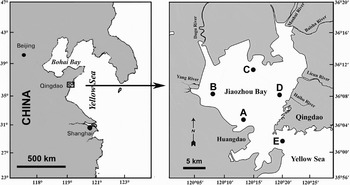
Five sampling sites (A–E) were selected in Jiaozhou Bay near Qingdao, northern China (Figure 1). A total of 24 cruises were carried out biweekly over a one-year period from June 2007 to May 2008. Water samplings (referred to as 10-Jun-07 etc.) were carried out from a depth of about 1 m. Both for quantitative measures and for identification of ciliates, 1000 ml of seawater was fixed with acid Lugol's iodine solution (2% final concentration, volume/volume) (Pitta et al., Reference Pitta, Giannakourou and Christaki2001; Kchaou et al., Reference Kchaou, Elloumi, Drira, Hamza, Ayadi, Bouain and Aleya2009). Water temperature (T), pH, salinity (S), chlorophyll-a (Chl a) and dissolved oxygen concentration (DO) were measured in situ, using a multi-parameter kit (MS5, HACH). Samples for nutrient analyses were preserved immediately upon collection. Soluble reactive phosphate (SRP), ammonium nitrogen (NH4-N), nitrate nitrogen (NO3-N) and nitrite nitrogen (NO2-N) were determined using a UV-visible spectrophotometer (DR-5000, HACH) according to the Standard Methods for the Examination of Water and Wastewater (APHA, 1992).
Sampling stations of planktonic ciliates in Jiaozhou Bay.

Identification and enumeration
For purposes of identification and of enumeration, 1000 ml Lugol's fixed seawater was settled for 48 hours resulting in 30 ml of concentrated sediment (Utermöhl, Reference Utermöhl1958). For enumeration of ciliates a 0.1 ml aliquot of each concentrated sample was placed in a Perspex chamber and the ciliates were counted under a light microscope at a magnification 400×. A total of 0.5 ml concentrated samples were counted and yielded a standard error (SE) of <8% of the mean values of counts. Tintinnids were identified using lorica morphology and species description according to Kofoid & Campbell (Reference Kofoid and Campbell1929, Reference Kofoid and Campbell1939), Nie (Reference Nie1934) and Yin (Reference Yin1952). Other ciliates were identified following Song et al. (Reference Song, Zhao, Xu, Hu and Gong2003). Those individuals whose identity could not be ascertained following examination with Lugol's-fixed specimens were picked out with a micropipette and identified using protargol impregnation after re-fixating with Bouin's solution (Montagnes & Humphrey, Reference Montagnes and Humphrey1998). The taxonomic scheme used was mainly according to Lynn (Reference Lynn2008).
Biovolumes were determined from measurements of their linear dimensions and using volume equations of appropriate geometric shape (Winberg, Reference Winberg1971). Conversion factors of carbon biomass for non-loricate ciliates were 0.14 pg Cm−3, and 0.053 pg Cm−3 for loricate (tintinnid) ciliates (Putt & Stoecker, Reference Putt and Stoecker1989; Stoecker et al., Reference Stoecker, Sieracki, Verity, Michaels, Haugen, Burkill and Edwards1994).
Data analyses
Species diversity (H′), evenness (J′) and richness (d) of samplings were calculated as follows the equations H′ = −∑i=1SPi(lnPi), J′= H′/ln(S) and d = (S–1)/ln(N), where Pi = proportion of the total count arising from the i th species; S = total number of species; and N = total number of individuals (Xu et al., Reference Xu, Song, Warren, Al-Rasheid, Al-Farraj, Gong and Hu2008).
Multivariate analyses of temporal variations in planktonic ciliate communities were analysed using the PRIMER v6.1 package (Clarke & Gorley, Reference Clarke and Gorley2006; Kim et al., Reference Kim, Chae, Hong and Jang2007; Xu et al., Reference Xu, Min, Choi, Jung and Park2009) and the PERMANOVA+ for PRIMER (Anderson et al., Reference Anderson, Gorley and Clarke2008). Bray–Curtis similarity matrices were computed on log-transformed data. The clusters of species were assigned by the routine CLUSTER and tested by the ANOSIM (Clarke & Gorley, Reference Clarke and Gorley2006), while the temporal patterns of communities were summarized using the submodule canonical analysis of principal coordinates (CAP) of PERMANOVA+ on Bray–Curtis similarities. Differences between groups of samples were tested by the submodule PERMANOVA (Anderson et al., Reference Anderson, Gorley and Clarke2008). The contribution of each species to the average Bray–Curtis similarity among samples was analysed using the SIMPER program (Clarke & Gorley, Reference Clarke and Gorley2006). The submodule BIOENV was used to explore the potential relationships between environmental parameters and the biotic data. The significance of biota-environment correlations was tested using mental test (RELATE analysis) (Clarke & Gorley, Reference Clarke and Gorley2006).
Univariate analyses of correlations were carried out using the statistical program SPSS v16.0 on log-transformed data (Xu et al., Reference Xu, Song, Warren, Al-Rasheid, Al-Farraj, Gong and Hu2008).
RESULTS
Environmental parameters
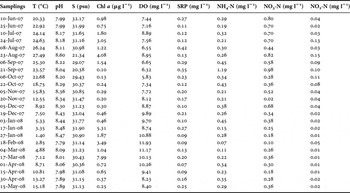
The mean values of eleven environmental variables for a total of 24 samplings are summarized in Table 1.
Environmental variables in Jiaozhou Bay water samplings between June 2007 and May 2008.

T, water temperature; S, salinity; Chl a, chlorophyll-a; DO, dissolved oxygen concentration; SRP, soluble reactive phosphate.
Water temperature followed a clear seasonal pattern, ranging from 1.40°C to 27.49°C (mean 14.74°C).
Salinity was around 30.0 psu and maintained relatively stable levels throughout the year, although with sharp drops in late August (21.34 psu) and again in late September (20.38 psu) due to the heavy rainfall.
The pH values ranged from 7.79 to 8.60, averaging 8.18. Concentrations of Chl a peaked three times, in late August (4.08 µg l−1), in mid-January (5.31 µg l−1) and in mid-March (7.99 μg l−1). Values of DO varied inversely with temperature.
Soluble reactive phosphate ranged from 0.07 mg l−1 to 0.42 mg l−1 (mean value of 0.18 mg l−1) with a minor peak in early August.
The concentrations of NH4-N and NO3-N were peaking in late September whereas low concentrations of NO2-N were maintained throughout the year apart from a minor increase between July and September.
Taxonomic composition and annual species distribution
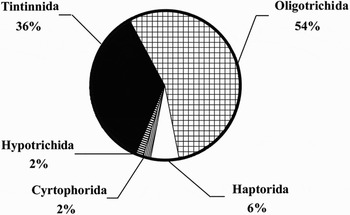
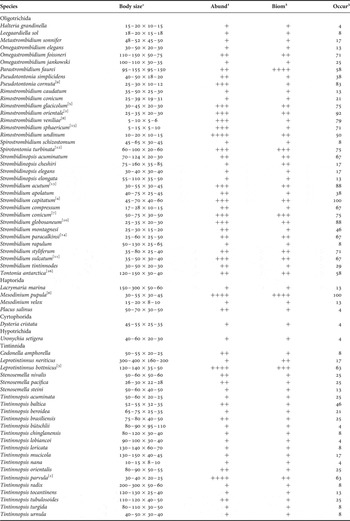
The taxonomic composition of ciliate communities observed during the study period is summarized in Table 2. A total of 64 ciliate species, representing 24 genera and five orders (Oligotrichida, Haptorida, Cyrtophorida, Hypotrichida and Tintinnida), were identified during the one-year survey. Oligotrichids and tintinnids represented the highest numbers of species, accounting for 54% and 36% respectively of the total (Table 2; Figures 2 & 4A). The contribution of the top 16 species to the average Bray–Curtis similarity (90.99%) within samples was summarized using similarity percentage (SIMPER) analysis; the numbers in the square brackets showing the rank (Table 2).
Taxonomic composition of planktonic ciliate communities and the percentage of cumulative number of species recorded throughout the period of sampling.

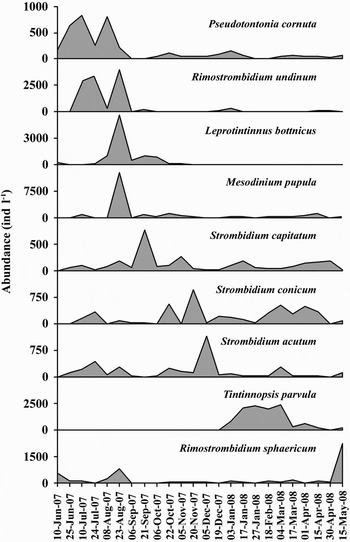
Annual variations in abundances (ind. l−1) of the nine dominant ciliates from June 2007 to May 2008.

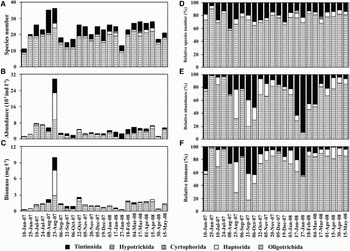
Annual variations in species number (A), abundance (B), biomass (C), relative species number (D), relative abundance (E) and relative biomass (F) of planktonic ciliates in Jiaozhou Bay, China, from June 2007 to May 2008.

List of the species of ciliates from Jiaozhou Bay recorded in 120 samples, including body size, annual average abundance, biomass and occurrence.

*, body size (μm) (length × width); 1abundances (ind. l−1) (+ = 0–10, ++ = 10–100, +++=100–400, ++++ = over 400); 2biomass (μg l−1) (+ = 0–10, ++ = 10–100, +++ = 100–200, ++++ = over 200); 3occurrence (%); numbers in the superscript square brackets = ranks of the top 16 contributive species to the average Bray–Curtis similarity (90.99%) within 120 samples.
There were nine dominant species, each of which at some time during the sampling period contributed more than 25% of the total planktonic protist abundance (Figure 3). These were: Pseudotontonia cornuta, Rimostrombidium undinum, Leprotintinnus bottnicus, Mesodinium pupula, Strombidium capitatum, Strombidium conicum, Strombidium acutum, Tintinnopsis parvula and Rimostrombidium sphaericum. Five of these species (Pseudotontonia cornuta, Strombidium capitatum, Strombidium conicum, Strombidium acutum and Rimostrombidium sphaericum) peaked during more than one season of the one-year cycle whereas dominance of the other four (Rimostrombidium undinum, Leprotintinnus bottnicus, Mesodinium pupula and Tintinnopsis parvula) was confined to one season only (Figure 3).
Annual variation in species number, abundance and biomass
The temporal variation in species count showed a unimodal distribution peaking in late August with 36 species (Figure 4A). Tintinnids and oligotrichids were primarily responsible for the peak. The lowest species number (11 species) was found in early June (Figure 4A).
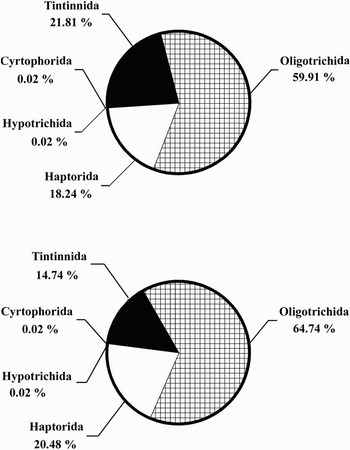
The ciliate abundances also exhibited a unimodal variation with generally low values (mean 5.03 × 10³ ind. l−1) over the one-year period and a distinct peak in August (maximum value 29.54 × 10³ ind. l−1). Haptorids (e.g. Mesodinium pupula), oligotrichids (e.g. Rimostrombidium undinum) and tintinnids (e.g. Leprotintinnus bottnicus) were primarily responsible for the peak, reaching abundances of 13.36 × 10³ ind. l−1, 9.49 × 10³ ind. l−1 and 6.69 × 10³ ind. l−1 respectively (Figure 4B). Of the total ciliate abundance, oligotrichids accounted for 59.91%, tintinnids 21.81%, haptorids 18.24%, and hypotrichids and cyrtophorids 0.02% each (Figures 2 & 5A).
Proportions of average abundances (A) and biomasses (B) of planktonic ciliates from June 2007 to May 2008.

The variation in biomass showed a similar temporal pattern to that of abundance with one peak (maximum value 9.96 mg l−1) in August (Figure 4C). Haptorids (e.g. Mesodinium pupula), oligotrichids (e.g. Spirotontonia turbinata) and tintinnids (e.g. Leprotintinnus bottnicus) were the major contributors to the peak when their biomasses reached 4.66 mg l−1, 2.90 mg l−1 and 2.40 mg l−1 respectively (Figure 4C). Oligotrichids, haptorids and tintinnids accounted for 64.74%, 20.48% and 14.75% respectively of the total ciliate biomass whereas hypotrichids and cyrtophorids each accounted for only 0.02%. These values are fairly consistent with those for relative abundances (Figure 5B).
Temporal patterns of community structure
Although oligotrichids, haptorids and tintinnids appeared in almost all samples, the ciliate community structure at the 24 sampling points demonstrated a clear temporal succession with respect to species composition, abundance and biomass (Figure 4D, E & F). In terms of the relative abundances, the ciliate communities might be distinguished as four structural types, each of which dominated at different times during the period of study: (1) oligotrichids dominated the ciliate communities from March to July; (2) tintinnids from August to October with a bloom of haptorids in the sampling 23-Aug and 21-Sep; (3) oligotrichids from late October to January; and (4) tintinnids from late January to February (Figure 4E). The relative biomasses showed a similar temporal pattern to that of the relative abundances (Figure 4F).
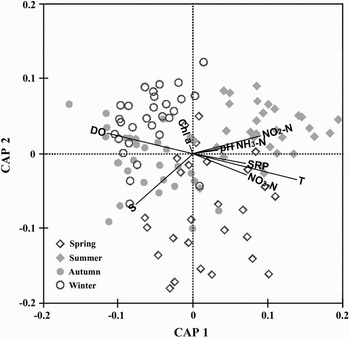
A seasonal pattern of ciliate communities was discriminated by canonical analysis of CAP on Bray–Curtis similarities from log-transformed species-abundance data of 120 samples from the five sites (Figure 6). The first canonical axis separated the ciliate communities sampled in summer (on the right) from those in autumn and winter (on the left), while the second canonical axis discriminated the samples in spring (lower) from summer and winter (upper) (Figure 6). The PERMANOVA test demonstrated a significant difference between each pair of seasonal groups (P < 0.001).
Canonical analysis of principal coordinates (CAP) on Bray–Curtis similarities from species-abundance data of 120 samples from five sampling sites in Jiaozhou Bay during the annual cycle from June 2007 to May 2008, and correlations of environmental variables with two CAP axes. See Table 1 for abbreviations.

Vector overlay of environmental variables with the CAP axes is also shown in Figure 6. The sample cloud of spring and summer (right) was in a positive correlation with the abiotic variables (e.g. NO3-N, NO2-N, NH3-N, SRP, pH and temperature), that of autumn and winter (left) with salinity, DO and Chl a (Figure 6).
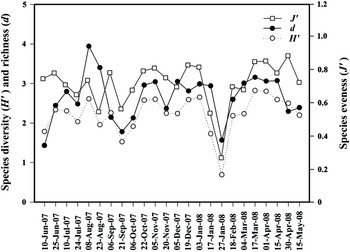
The temporal variation in species diversity (H′), evenness (J′) and richness (d) indices in 24 ciliate samples during the sampling period is shown in Figure 7. All three community parameters showed a similar temporal variation with peaks corresponding to the season over the one-year cycle and a distinct lowest in January (Figure 7).
Annual variations in species diversity (H′), evenness (J′) and richness (d) of planktonic ciliate communities from June 2007 to May 2008.

Interaction between biotic data and environmental variables
RELATE analysis revealed that there was a significant correlation between temporal variations in ciliate community structure and changes of environmental variables (R = 0.363; P < 0.05). Biota-environment (BIOENV) analysis showed that ciliate communities were significantly related to the variability in the combination of nutrients (NO3-N, NO2-N and SRP) and water temperature/pH, in terms of both abundance (R = 0.462; P < 0.05) and biomass (R = 0.417; P < 0.05).
DISCUSSION
So far there has been little understanding of the annual patterns of planktonic ciliate communities in Jiaozhou Bay, although a few studies on spatial distribution of large-sized tintinnids have been carried out in this area (Zhang & Wang, Reference Zhang and Wang2001; Zhao et al., Reference Zhao, Zhang, Sun, Song, Zhang and Li2007).
In our study, a total of 64 ciliate species representing 24 genera and 5 orders, were identified during one annual cycle in Jiaozhou Bay. Similarly Kchaou et al. (Reference Kchaou, Elloumi, Drira, Hamza, Ayadi, Bouain and Aleya2009), using the same sampling method, found 56 planktonic ciliate species in eutrophic waters in the Gulf of Gabès, Tunisia, over a period of 1 year. The data for the tintinnid species in Jiaozhou Bay are also consistent with those reported by Zhao et al. (Reference Zhao, Zhang, Sun, Song, Zhang and Li2007)
Annual variations in planktonic ciliate abundance have previously been reported for Jiaozhou Bay (Zhang & Wang, 2001; Zhao et al., Reference Zhao, Zhang, Sun, Song, Zhang and Li2007). According to these studies the abundances ranged from 0 to 1.74 × 10³ ind. l−1 and 0.01 × 10³ ind. l−1 to 21.30 × 10³ ind. l−1, which compare closely to those reported here (1.34 × 10³ ind. l−1 to 29.54 × 10³ ind. l−1). Maximum ciliate abundances in other eutrophic marine habitats have been reported as follows: Laizhou Bay, China, 2.38 × 10³ ind. l−1 (Zhang & Wang, Reference Zhang and Wang2000); north-west shelf, Australia, 1.53 × 10³ ind. l−1 (Moritz et al., Reference Moritz, Montagnes, Carleton, Wilson and McKinnon2006); Chesapeake Bay, USA, 22.50 × 10³ ind. l−1 (Dolan & Coats, Reference Dolan and Coats1990); Gulf of Gabès, Tunisia, 50.35 × 10³ ind. l−1 (Kchaou et al., Reference Kchaou, Elloumi, Drira, Hamza, Ayadi, Bouain and Aleya2009). The planktonic ciliate biomass in Jiaozhou Bay also showed a similar pattern to those listed above. This suggests that Jiaozhou Bay is similar to other eutrophic marine habitats in terms of its planktonic ciliate abundance and biomass.
In addition, our study revealed that planktonic ciliates exhibited a clear annual/seasonal variation in terms of species composition, abundance and biomass. For example, ciliate species composition demonstrated a seasonal pattern being high in summer and winter, low in spring and autumn whereas abundance and biomass showed similar temporal patterns to each other, each with one distinct peak in August. These findings are consistent with previous reports for periphytic ciliates in Jiaozhou Bay (Gong et al., Reference Gong, Song and Warren2005) and planktonic ciliates in the Gulf of Gabès, Tunisia (Kchaou et al., Reference Kchaou, Elloumi, Drira, Hamza, Ayadi, Bouain and Aleya2009). Furthermore, CAP demonstrated that the annual variation in the ciliate communities presented a clear seasonal pattern.
Multivariate correlation analysis demonstrated that the temporal variation in planktonic ciliate communities was significantly related to environmental variables, especially the combination of water temperature and nutrients (e.g. NO3-N and SRP3-N, NO2-N and SRP) in terms of both abundance and biomass. Otherwise, nutrients, especially NO3-N and SRP, were always among the top combinations of variables. Thus we suggest that the successive annual dynamics of planktonic ciliates are significantly related to eutrophication. This finding was consistent with the reports for detecting the annual changes in ciliate community structure (Gong et al., Reference Gong, Song and Warren2005; Xu et al., Reference Xu, Song, Warren, Al-Rasheid, Al-Farraj, Gong and Hu2008).
Species diversity, evenness and richness indices are commonly employed in community-level investigations and are amenable to simple statistical analyses (Ismael & Dorgham, Reference Ismael and Dorgham2003; Gong et al., Reference Gong, Song and Warren2005; Xu et al., Reference Xu, Song, Warren, Al-Rasheid, Al-Farraj, Gong and Hu2008). In our case, however, these biological indices generally failed to show significant correlations with environmental parameters, but presented an obvious seasonal pattern.
In summary, the results of this survey demonstrate that: (1) the planktonic ciliate communities in Jiaozhou Bay, northern China, show a significant annual pattern with high diversity in terms of species composition, abundance and biomass; and (2) planktonic ciliate community structure is significantly associated with environmental conditions, in particular nitrates and phosphates. These findings provided basic data on the annual cycle of planktonic ciliate communities in a semi-enclosed bay of Yellow Sea, northern China.
ACKNOWLEDGEMENTS
Our special thanks are due to: Mr Clive Moncrieff, Natural History Museum, London, for improving the manuscript; and Dr Xinpeng Fan, Dr Jiamei Jiang and Dr Xumiao Chen, Laboratory of Protozoology, Institute of Evolution and Marine Biodiversity, Ocean University of China, China, for their help in identification and enumeration. This work was supported by the Darwin Initiative Programme (Project No. 14-015) which is funded by the UK Department for Environment, Food and Rural Affairs, and a grant from the Center of Excellence in Biodiversity, King Saud University.