

Declining natural resources and the destabilization of the geopolitical environment caused by climate instability and environmental change are two of the biggest challenges faced by modern human populations (Barnett Reference Barnett2009). Although the current pace and magnitude of climate change are unique to modern populations, climatic instability has been a persistent challenge since our earliest human ancestors dispersed across the landscape. Over time, humans have adapted both biologically and culturally to environmental pressures and challenges. Studying these adaptations helps us better understand the context in which human behaviors evolved. Thinking of adaptation as capacity informs us of the resilience of specific communities and community segments when confronted by significant socioecological perturbations (Walker and Salt Reference Walker and Salt2012). Thus, the study of past populations can provide a wealth of information relevant to modern society (e.g., Demarest et al. Reference Demarest, Rice and Rice2004; Iannone, Chase, et al. Reference Iannone, Chase, Chase, Awe, Moyes, Brook, Polk, Webster, Conolly and Iannone2014; Somerville et al. Reference Somerville, Fauvelle and Froehle2013). Investigations of how climate has changed, the impact of anthropogenic forces on local climate, and the social and political impact of climate change on past populations can inform our understanding of and response to contemporary climate change (Van de Noort Reference Van de Noort2011).
Human diet studies are an excellent way to investigate the impact of climate change on sociopolitical contexts because food is related to and constrained by environmental factors and social dynamics (Gumerman Reference Gumerman1997:106–107). Chemical analyses of human tissues can be used to infer diet. We report the stable carbon and nitrogen isotopic compositions of human bone. We use these data to reconstruct the paleodiet of the ancient Maya center Minanha, located in the north Vaca Plateau of west-central Belize. Specifically, our research is designed to determine how and why diet changed over time. In order to understand the causes of the temporal patterns we identify, we compare the isotope data to paleoenvironmental and archaeological datasets for Minanha and its surrounding region. Our comparisons, although based on small samples, suggest that diet changed over time because of sociopolitical rather than environmental factors.
Theoretical Principles
The stable carbon and nitrogen isotope ratios of ancient human tissues can be used to infer diet because the isotopic compositions of plants and animals vary and these differences are passed on to consumers in known and predictable ways (Katzenberg Reference Katzenberg, Anne Katzenberg and Saunders2008). The isotopic composition of photosynthetic pathway C4 plants (e.g., maize, sorghum, millet) is distinct from C3 plants (e.g., wheat, rice, root crops, fruits; –16 to –9‰ vs. –34 to –20‰; Deines Reference Deines, Fritz and Fontes1980). Nitrogen isotope ratios exhibit a well-documented trophic level effect: δ 15Ncol increases by approximately 3‰ with each successive step in the food web (Hedges and Reynard Reference Hedges and Reynard2007). Nitrogen isotope ratios also differ between legumes and nonlegumes. Legumes are depleted of 15N relative to nonlegumes (Virginia and Delwiche Reference Virginia and Colin Delwiche1982). Marine organisms are enriched in 15N and 13C relative to terrestrial organisms (Schoeninger and DeNiro Reference Schoeninger and DeNiro1984).
Controlled feeding studies demonstrate that the stable isotope composition of bone collagen and bioapatite reflect different aspects of the diet (Schwarcz Reference Schwarcz, Ambrose and Katzenberg2000). Collagen carbon-isotope composition (δ 13Ccol) reflects the protein component of the diet when protein is sufficiently available (Ambrose et al. Reference Ambrose, Butler, Hanson, Hunter-Anderson and Krueger1997), whereas structural carbonate carbon-isotope composition (δ 13Csc) in bioapatite reflects the whole diet (lipids, carbohydrates, and any proteins left over from collagen maintenance and synthesis; Jim et al. Reference Jim, Ambrose and Evershed2004). The difference between δ 13Csc and δ 13Ccol (i.e., Δ 13Csc-col) has been used to infer the relative contribution of protein to the diet (i.e., herbivore vs. carnivore; Lee-Thorp et al. Reference Lee-Thorp, van der Merwe and Sealy1989). Recent research has questioned the utility of Δ 13Csc-col for paleodietary reconstructions (Kellner and Schoeninger Reference Kellner and Schoeninger2007:1113), especially when the diet is mixed and the protein source is unknown (Froehle et al. Reference Froehle, Kellner and Schoeninger2010:2664). A bivariate regression model using δ 13Ccol, δ 13Csc, and a multivariate analysis of δ 13Ccol, δ 13Csc, and the nitrogen isotope composition of collagen (δ 15Ncol) appear to be more useful for reconstructing paleodiet.
Site and Sample
Minanha
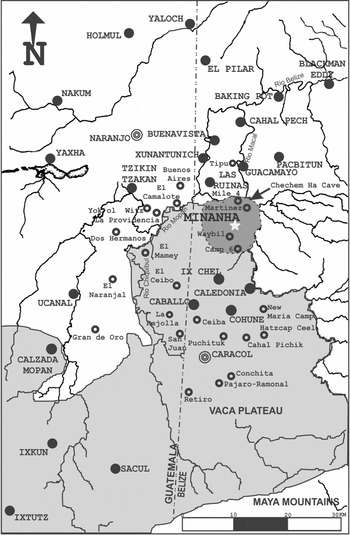
The ancient Maya center of Minanha, located in the north Vaca Plateau of west-central Belize, was the setting for a small city-state in the eighth century A.D. (Figure 1; Iannone Reference Iannone, Iannone, Seibert and Gray1999, Reference Iannone2005). The remains of the ancient community are located 520 m above sea level, on top of one of the highest hills in the north Vaca Plateau. Minanha is situated at the nexus of three different ecozones: the Belize River valley to the north, the Mountain Pine Ridge and Macal River to the east, and the Petén Department of Guatemala to the west.
Map of the Vaca Plateau (dark gray) and surrounding areas showing the location of Minanha and other key ancient Maya sites in the area. (Map provided by Social Archaeology Research Program.)

Archaeological research at Minanha was conducted annually from 1998 to 2013 by the Social Archaeology Research Program, directed by Gyles Iannone (Iannone, Chase, et al. Reference Iannone, Chase, Chase, Awe, Moyes, Brook, Polk, Webster, Conolly and Iannone2014:283). This extensive research program has produced a detailed cultural sequence from 500 B.C. to A.D. 1200 (Iannone, Chase, et al. Reference Iannone, Chase, Chase, Awe, Moyes, Brook, Polk, Webster, Conolly and Iannone2014; Schwake and Iannone Reference Schwake and Iannone2010). The Vaca Plateau is home to numerous important Maya centers, including Caracol, Camp 6, Ixchel, Caledonia, and Caballo. Minanha occupies a strategically important position on the border of the political territories of two large Maya polities—Naranjo to the northwest and Caracol to the south—so its history was strongly shaped by the conflict and interaction of these two polities (Iannone, Chase, et al. Reference Iannone, Chase, Chase, Awe, Moyes, Brook, Polk, Webster, Conolly and Iannone2014; Schwake and Iannone Reference Schwake, Iannone, Iannone, Houk and Schwake2016). The Minanha royal court was established in the Late Classic period (A.D. 675–810) and possessed several attributes suggesting that the ruling elite modeled their architecture and practices on the nearby center of Caracol. This and the speed of building suggest nonlocal participation in its construction (Iannone Reference Iannone2005:31–32).
The presence of individuals who consumed a distinct, nonlocal diet could confound our investigation of chronological trends. Sutinen (Reference Sutinen2014) conducted a strontium isotope analysis of 20 individuals from Minanha in order to identify such foreigners. Five had strontium isotope ratios outside the local range and were identified as nonlocal. All nonlocal individuals have similar strontium isotope ratios consistent with sites in the Belize River valley, elsewhere in the Vaca Plateau, or northern Yucatán (Sutinen Reference Sutinen2014:95). Nonlocals were identified in most time periods and in all grave types. Ritual burials (i.e., caches) as well as burials with multiple individuals contained local and nonlocal individuals. Of the 20 individuals sampled by Sutinen (Reference Sutinen2014), five were also included in Stronge's (Reference Stronge2012) analysis of stable carbon and nitrogen isotope ratios. Of these five overlapping individuals, four are classified as local and one as nonlocal based on strontium isotope ratios. The isotope data for the four locals show substantial variability: δ 13Ccol values vary from −13.5 to −9.8‰ (mean = −11.3 ± 1.6‰) and δ 15Ncol varies from +8.0 to +10.7‰ (mean = +9.1 ± 1.1‰). The one nonlocal individual falls within these ranges: −12.6‰ (δ 13Ccol) and +9.5‰ (δ 15Ncol). Freiwald's (Reference Freiwald2011:307–309) research demonstrates that for the Belize River valley, long-distance migration was rare and most mobility was on a regional level. It is unlikely that sites separated by short distances within the same region are in vastly different ecozones with distinct, non-overlapping carbon and nitrogen isotope ratios. For this reason, the presence of nonlocal individuals is an unlikely explanation for the dietary diversity observed at Minanha.
The Vaca Plateau is characterized by subtropical to tropical rainforest and a rugged topography of dry karst valleys and residual limestone hills. The dry valleys have deep soil deposits and dense vegetation, while the hills have shallower soils and sparser vegetation (Iannone et al. Reference Iannone, Awe, Bevan, Brook, Conolly, Downey, Longstaffe, Moyes, Polk, Reeder, Van Beynen, Webster, Williams, Iannone, Awe, Lamoureux-St-Hilaire and Longstaffe2010; Reeder et al. Reference Reeder, Brinkmann and Alt1996). The climate is somewhat unpredictable, with irregular recurring cycles of normal rainfall and dry periods. Highly fertile Rendoll soils are irregularly distributed across the landscape. Because of the karstic landscape and the depth of the water table, meteoric rainfall was the primary source of water for the inhabitants of Minanha (Reeder et al. Reference Reeder, Brinkmann and Alt1996). This is supported by the archaeological evidence of a complex system of water management that included a large and small reservoir and natural springs and basins (Macrae and Iannone Reference Macrae and Iannone2011; Primrose Reference Primrose2003). The land around Minanha was intensively cultivated using agricultural terraces (McCane et al. Reference McCane, Macrae and Iannone2010; Macrae and Iannone Reference Macrae and Iannone2011). There is evidence that the water management system and agricultural terraces were expanded in response to dry periods during the occupation of Minanha (Iannone, Chase, et al. Reference Iannone, Chase, Chase, Awe, Moyes, Brook, Polk, Webster, Conolly and Iannone2014:291).
Sample
The ancient Maya were a highly stratified society and although there is debate around the number, type, and relationships among social strata (Chase Reference Chase, Chase and Chase1992), researchers agree that it is often possible to identify social status using archaeological data. Schwake (Reference Schwake2008:303) identified three social strata at Minanha using settlement location, degree of architectural elaboration, and associated portable material items. Generally, the apical elite at Minanha were interred in the site epicenter (i.e., the main agglomeration of monumental architecture that served as the ritual, economic, political, and royal-residential hub of the polity), the lesser elites in the site core (i.e., the settlement zone immediately surrounding the epicentral royal court complex), and the commoners in the periphery. Nonetheless, it is possible that some burials are exceptions to this pattern.
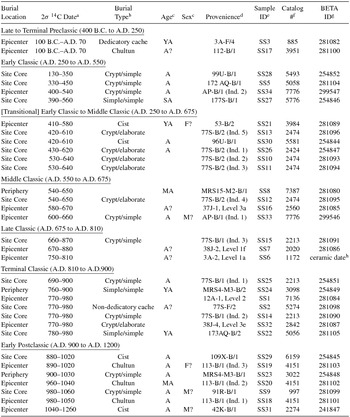
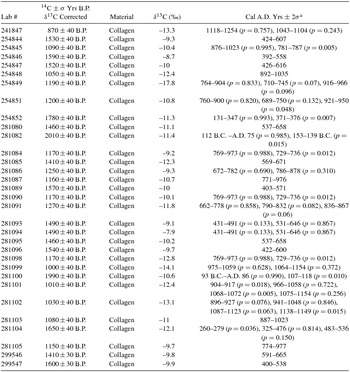
Thirty-three individuals from the Minanha epicenter (n = 14), site core (n = 16), and periphery (n = 3) were sampled for stable carbon and nitrogen isotope analysis (Stronge Reference Stronge2012:22–25; summarized in Table 1). The age at death has been determined for 25 individuals, and the sex of five is known (Schwake Reference Schwake2008; Snetsinger Reference Snetsinger2013). Radiocarbon dates were determined for 32 of the 33 individuals (Table 2); the date of the remaining individual is based on ceramic associations. These data confirm that the sample spans all periods of occupation (specifically, cal 100 B.C. to A.D. 1260). The Minanha sample size is similar to other single-site isotope studies throughout Mesoamerica (e.g., Coyston et al. Reference Coyston, White, Schwarcz and White1999; Freiwald Reference Freiwald2011; Rand et al. Reference Rand, Healy and Awe2015; Somerville et al. Reference Somerville, Schoeninger and Braswell2016; White and Schwarcz Reference White and Schwarcz1989; White et al. Reference White, Pendergast, Longstaffe and Law2001; Williams et al. Reference Williams, White and Longstaffe2009), although it is important to recognize that small samples may not always be representative of the larger population.
Minanha Master Sample Chart.

Note: Blank cells indicate there is no data for this variable.
a All radiocarbon dates are calibrated using Calib 7.1 and written as cal A.D. unless specified.
b Burial types assigned by Social Archaeology Research Program (SARP), following Welsh (Reference Welsh1988) typology.
c Age and sex estimations assigned by Schwake (Reference Schwake2008) and Snetsinger (Reference Snetsinger2013). A = adult; A? = possible adult; YA = young adult (20–35 years); MA = middle adult (35–50 years); F? = probable female; M? = probable male.
d Provenience refers to burial number (e.g., xxx-B/#), feature number (e.g., xxx-F/#), or specific unit/level information where a unique burial number was not assigned.
e Sample ID assigned by Stronge Reference Stronge2012.
f Refers to master catalog number assigned to samples by the SARP. All individual numbers preceded by 27/187-002: #.
g Laboratory ID number assigned by Beta Analytic for radiocarbon data.
h Radiocarbon dating was unsuccessful; the date for this individual is based on associated ceramics.
Radiocarbon Data for All Minanha Isotope Samples.

a Calibrated using Calib 7.1.
Methods
All isotopic results are reported in δ−notation, relative to international standards: VPDB for carbon and AIR for nitrogen. Bone collagen was isolated using the whole bone method (Sealy et al. Reference Sealy, Johnson, Richards and Nehlich2014) followed by a 20-hour soak in 1 percent NaOH (Ambrose Reference Ambrose1990; see also Stronge Reference Stronge2012:72–74). Bone collagen samples were analyzed using the continuous flow mode of the Thermo Fisher Deltaplus XL isotope ratio mass spectrometer (IRMS) interfaced with a Costech Elemental Analyzer (ECS 4010). A two-point calibration curve based on NBS-22 and IAEA-CH-6 was used to calibrate δ 13Ccol to VPDB. Two-point calibration of δ 15Ncol to AIR was accomplished using USGS-40 and USGS-41. Precision and accuracy of the calibration curves were evaluated using the laboratory keratin standard (MP Biomedicals Inc., Cat. No. 90211, Lot No. 9966H). The preservation of bone collagen was assessed using collagen yield, C/N ratio, and carbon and nitrogen concentrations following standard criteria (Ambrose Reference Ambrose1990; Van Klinken Reference Van Klinken1999).
Bone bioapatite was isolated using a four-hour treatment in 0.1M acetic acid (Garvie-Lok et al. Reference Garvie-Lok, Varney and Katzenberg2004:774; Stronge Reference Stronge2012:74–75). The δ 13Csc of bone bioapatite samples was analyzed by reaction with orthophosphoric acid at 90°C using a Micromass Multiprep autosampling device configured for sealed vessel reaction conditions coupled with a VG Optima IRMS operated in dual-inlet mode (Metcalfe et al. Reference Metcalfe, White, Longstaffe, Wrobel, Collins Cook and Anne Pyburn2009). Two-point calibration of δ 13Csc to VPDB was accomplished using NBS-19 and the laboratory standard calcite Suprapur. Precision and accuracy of this calibration curve was evaluated using NBS-18 and the laboratory standard calcite WS-1. The preservation of bone bioapatite was assessed using the crystallinity index (Garvie-Lok et al. Reference Garvie-Lok, Varney and Katzenberg2004:768).
Individuals sampled for this research were placed into different temporal categories that form the basis of the chronological comparisons (Table 1). Chronology was determined using three criteria: (1) evaluation of radiocarbon data including the intercept, 2-sigma dates, and probabilities associated with multiple dates (using Calib 7.1); (2) stratigraphy; and (3) ceramic seriation. Most individuals were assigned to nonoverlapping temporal categories, but data for six individuals overlapped two time periods: the end of the Early Classic (A.D. 250–550) and beginning of the Middle Classic (A.D. 550–675). These individuals were placed into a temporal category identified as transitional Early Classic to Middle Classic (Table 1).
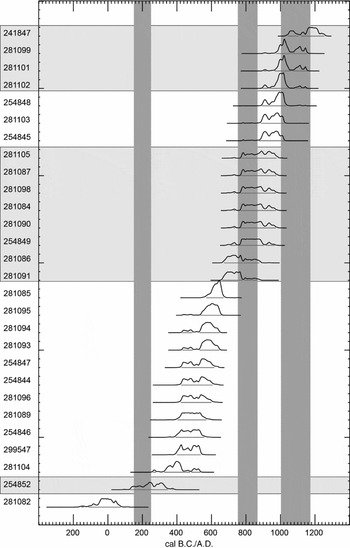
The climatic reconstruction for the north Vaca Plateau is based on a new multiproxy analysis of the Macal Chasm speleothem, collected approximately 10 km southwest of Minanha (Akers et al. Reference Akers, Brook, Railsback, Liang, Iannone, Webster, Reeder, Cheng and Lawrence Edwards2016; an earlier and much less detailed analysis was reported in Webster et al. Reference Webster, Brook, Bruce Railsback, Cheng, Lawrence Edwards, Alexander and Reeder2007). The reanalysis of this speleothem yields a chronology of environmental fluctuations from 5250 cal B.P. to the current day (Akers et al. Reference Akers, Brook, Railsback, Liang, Iannone, Webster, Reeder, Cheng and Lawrence Edwards2016:275). This spans the entire ancient occupation of Minanha. The environmental record was based on the following sources of data: 11 new U-Th dates, 660 isotope (δ18O and δ13C) samples (with intervals ranging from 0.25 mm to 5 mm), ultraviolet-stimulated luminescence (UVL) intensity, and petrographic examination (Akers et al. Reference Akers, Brook, Railsback, Liang, Iannone, Webster, Reeder, Cheng and Lawrence Edwards2016:274). Akers and colleagues (Reference Akers, Brook, Railsback, Liang, Iannone, Webster, Reeder, Cheng and Lawrence Edwards2016:280–281) compared the Macal Chasm data to other local paleoclimate records from southern Belize (Kennett et al. Reference Kennett, Breitenbach, Aquino, Asmerom, Awe, Baldini, Bartlein, Culleton, Ebert and Jazwa2012) and Mexico (Hodell et al. Reference Hodell, Brenner and Curtis2005; Medina-Elizalde et al. Reference Medina-Elizalde, Burns, Lea, Asmerom, von Gunten, Polyak, Vuille and Karmalkar2010; Medina-Elizalde et al. Reference Medina-Elizalde, Burns, Polanco-Martínez, Beach, Lases-Hernández, Shen and Wang2016). They also compared the Macal Chasm data to other long-term regional climate records from the Galápagos Islands (Conroy et al. Reference Conroy, Overpeck, Cole, Shanahan and Steinitz-Kannan2008), Petén, Guatemala (Wahl et al. Reference Wahl, Byrne and Anderson2014), and Venezuela (Akers et al. Reference Akers, Brook, Railsback, Liang, Iannone, Webster, Reeder, Cheng and Lawrence Edwards2016:281–282; Haug et al. Reference Haug, Hughen, Sigman, Peterson and Röhl2001). The regional comparisons corroborate the presence and dates of the major dry events (MDEs) identified in the Macal Chasm speleothem, and long-term comparisons suggest that the dry events recorded on the Vaca Plateau may be part of broader global trends (Akers et al. Reference Akers, Brook, Railsback, Liang, Iannone, Webster, Reeder, Cheng and Lawrence Edwards2016:281). Akers and colleagues (Reference Akers, Brook, Railsback, Liang, Iannone, Webster, Reeder, Cheng and Lawrence Edwards2016:276) identified eight MDEs that were recorded as distinct periods of high δ13C and δ18O values, low UVL values, and the presence of Type L boundaries. Three MDEs date to periods of significant Maya occupation on the Vaca Plateau: cal A.D. 150–250, A.D. 750–875, and A.D. 1000–1175. We date an individual to an MDE if most of the 2-sigma deviation for its radiocarbon date falls within one of these three time periods (Figure 2 and Table 2). To test whether MDEs affected subsistence, the isotope ratios for individuals dated to an MDE were compared with individuals dating to non-MDE times. Additionally, the isotope ratios of individuals dating to the Late to Terminal Classic MDE were compared to the isotope ratios of individuals dating to the Early Postclassic MDE (Figure 2). The radiocarbon dates for individuals and MDEs lack precision, so we did not attempt fine-grained comparisons of climate or isotope data using the temporal categories of the other analyses.
Probability distribution of the 2-sigma radiocarbon dates for Minanha. The vertical gray columns coincide with the major dry events identified by Akers et al. (Reference Akers, Brook, Railsback, Liang, Iannone, Webster, Reeder, Cheng and Lawrence Edwards2016) in the Late Preclassic to Early Classic (A.D. 150–250), Late to Terminal Classic (A.D. 750–875), and Early Postclassic (A.D. 1000–1175). The horizontal light gray columns identify samples for which most of the 2-sigma radiocarbon dates fall within a MDE. This figure excludes four samples whose isotope ratios were altered by diagenesis (281100, 299546, 254851, 281080) and one sample (SS6) whose date was based on ceramics and not radiocarbon data.

The construction sequence of Minanha is related to a variety of events that have been identified from archaeological data collected at Minanha and other sites within the region (Iannone et al. Reference Iannone, Awe, Bevan, Brook, Conolly, Downey, Longstaffe, Moyes, Polk, Reeder, Van Beynen, Webster, Williams, Iannone, Awe, Lamoureux-St-Hilaire and Longstaffe2010; Iannone, Chase, et al. Reference Iannone, Chase, Chase, Awe, Moyes, Brook, Polk, Webster, Conolly and Iannone2014). The Early and Middle Classic are characterized by a gradual intensification of processes, including agricultural intensification, population growth, and increased social stratification, rather than a stark contrast of events, such as abandonment, war, the destruction of monuments, or the creation of a new royal center (Iannone et al. Reference Iannone, Awe, Bevan, Brook, Conolly, Downey, Longstaffe, Moyes, Polk, Reeder, Van Beynen, Webster, Williams, Iannone, Awe, Lamoureux-St-Hilaire and Longstaffe2010; Longstaffe and Iannone Reference Longstaffe and Iannone2011; Macrae and Iannone Reference Macrae and Iannone2011). For this reason, our comparison of isotope data considers the isotope data from the Early Classic, transitional Early to Middle Classic, and Middle Classic periods together.
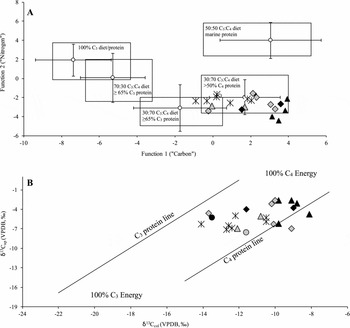
Because the sample sizes are small and unequal, we analyzed the data using nonparametric statistics. Groups with only a single individual were excluded from these analyses. The accepted p value for statistical significance was ≤0.05; nonetheless, when multiple pairwise comparisons were made, the p value was adjusted using the Bonferroni correction (e.g., 0.05/number of comparisons). We used the regression-based model for dietary reconstruction developed by Kellner and Schoeninger (Reference Kellner and Schoeninger2007) to infer the sources of dietary protein and the ratio of C3 to C4 foods in the whole diet. To better understand the protein sources in the Minanha diet (in particular, to differentiate between marine and C4 protein), we employed Froehle and colleagues' (Reference Froehle, Kellner and Schoeninger2012) multivariate diet reconstruction model. Froehle and colleagues (Reference Froehle, Kellner and Schoeninger2012:357) identified five clusters associated with specific diets and then used linear discriminant function analysis to generate two discriminant functions (F1 and F2) that can be used to assign individuals to a cluster based on δ 13Ccol, δ 13Csc, and δ 15Ncol. The first function (Carbon: F1 = 0.322* δ 13Csc + 0.727 * δ 13Ccol + 0.219 * δ 15Ncol + 9.354) is most influenced by the carbon-isotope variables; as carbon isotope ratios decrease, F1 decreases. In contrast, the nitrogen variable exerts its strongest effect on the second function (Nitrogen: F2 = −0.393* δ 13Csc + 0.133 * δ 13Ccol + 0.622 * δ 15Ncol − 8.703); as nitrogen isotope ratios decrease, F2 decreases. We calculated Minanha-specific F1 and F2 values and used them to assign individuals to the five dietary clusters identified by Froehle and colleagues (Reference Froehle, Kellner and Schoeninger2012:357). We also used Minanha-specific F1 and F2 values to better understand dietary patterns over time (e.g., increased maize consumption over time is evident as an increase in F1 over time).
Results
Sample Integrity, Accuracy, and Precision
Thirty-three samples were prepared for stable isotope analysis. During collagen isolation, nine samples dissolved; the remaining 24 samples did not show evidence of contamination or alteration (Supplemental Table 1; Stronge Reference Stronge2012:81–82). All 33 samples survived bioapatite preparation. The preservation of bioapatite was assessed for a subset of 10 individuals, four of whom had an FTIR crystallinity index outside the acceptable range and were removed from further consideration (shown in bold in Supplemental Table 1; Stronge Reference Stronge2012:82–85). The final bone collagen and bone bioapatite datasets included 24 and 29 individuals, respectively. Twenty-three individuals yielded both collagen and bioapatite data (i.e., Δ 13Csc-col; Supplemental Table 1). Reproducibility based on three duplicate analyses of samples was ±0.04‰ for δ 13Ccol and ±0.08‰ for δ 15Ncol. Reproducibility based on three duplicate analyses of bone bioapatite was ±0.03‰ for δ 13Csc. Accuracy of the isotopic data was better than 0.2‰ for δ 13C (n = 5) and 0.4‰ for δ 15N (n = 4), based on standards not included in the calibration curves.
Isotope Data Summary
The mean δ 13Ccol for the sample population was −10.9 ± 1.7‰ (n = 24) with a range of −14.1 to −8.2‰. The mean δ 15Ncol was +9.0 ± 0.8‰ (n = 24) with a range of +7.2 to +10.7‰. The mean δ 13Csc was −5.0 ± 1.6‰ (n = 29) with a range of −7.6 to −2.4‰. The mean Δ 13Csc-col was 5.8 ±1.7‰ (n = 23) with a range of 2.1 to 9.0‰. There were no statistically significant differences between individuals buried in the epicenter versus the site core, except for δ13Csc (Supplemental Table 2). This means that individuals buried in the epicenter were significantly depleted of 13C relative to individuals buried in the site core. Ideally, in subsequent tests, δ 13Csc would have been compared separately for the epicenter and site core, but the sample sizes were too small to permit such statistical analysis of the data. Sex and age data were available for some individuals but not others, prohibiting a comparison of isotope ratios across these categories.
A total of six burial types, signifying different degrees of complexity and labor investment, were identified at Minanha (Snetsinger Reference Snetsinger2013). There are statistically significant differences in δ 13Csc, Δ 13Csc-col, and F2 among burial types (Supplemental Table 3). Post hoc comparisons using Dunn's test demonstrate that the δ 13Csc of chultun burials (bodies placed in excavated cisterns) was depleted of 13C and F2 was lower relative to all other burials, with the difference in δ 13Csc and F2 between chultun and crypt or elaborate burials being statistically significant (respectively, z = 2.982, p = 0.003, Bonferroni corrected p = 0.003; and z = 3.113, p = 0.002, Bonferroni corrected p = 0.005). Post hoc comparisons using Dunn's test demonstrate that Δ 13Csc-col for human remains in cache contexts is much larger relative to other burials, with the difference in Δ 13Csc-col between cist and cache offerings being statistically significant (z = 2.823; p = 0.005; Bonferroni corrected p = 0.005).
There are statistically significant differences in δ 13Ccol and F1 over time (Supplemental Table 4). Post hoc comparisons using Dunn's test demonstrate that δ 13Ccol and F1 in the transitional Early to Middle Classic sample is enriched in 13C and has a higher F1 value relative to all other time periods. The difference in δ 13Ccol and F1 between the transitional Early to Middle Classic and the Early Postclassic is statistically significant (respectively, z = 3.468, p = 0.001, Bonferroni p = 0.005; and z = 3.193, p = 0.001, Bonferroni p = 0.005). With respect to climate (e.g., MDEs vs. normal climate), when individuals are grouped and compared there are no statistically significant differences in isotope ratios or discriminant functions (Supplemental Table 5). Interestingly, when the isotope data for the Terminal Classic MDE is compared to the Early Postclassic MDE, there are statistically significant differences in δ 13Ccol and F1 (Supplemental Table 5).
When the pooled Early/transitional/Middle Classic isotope data are compared to the other temporal categories, there is a statistically significant difference in δ 13Ccol (Supplemental Table 6). Post hoc comparisons using Dunn's test demonstrate that δ 13Ccol in the pooled Early/transitional/Middle Classic is enriched in 13C relative to all other time periods. The difference in δ 13Ccol between the pooled Early/transitional/Middle Classic and the Early Postclassic is statistically significant (z = 2.742; p = 0.006; Bonferroni corrected p = 0.008).
Discussion
Population-Level Diet at Minanha
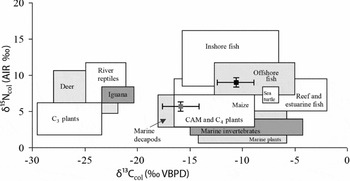
Figure 3 shows the δ 13Ccol and δ 15Ncol values of a variety of plants and animals that characterize the food web in Belize. The δ 13Ccol from Minanha are consistent with a mixed diet including both C3 and C4 plants and lower-level terrestrial herbivores or omnivores (such as deer, rabbit, agouti, peccary, and paca) that consume these plants. The statistical analyses of the isotope data similarly indicate a mixed diet, with the majority derived from C4 energy sources (Figure 4a, b); the multivariate model indicates that the population at Minanha was consuming a 3:7 C3:C4 diet, with most of the diet coming from C4 plant proteins or animals that consume such plants (Figure 4a). It should be stressed that the dietary clusters of the multivariate model are not exact representations of dietary input and should be viewed as general dietary types. Moreover, because there is considerable variation within each cluster, not all individuals in a given cluster will have precisely the same diet. Marine protein was not a component of the Minanha diet (Figure 4a). The Early Classic to Terminal Classic diet at Minanha, particularly maize consumption and reliance on terrestrial proteins, is consistent with the diet of many other Maya sites (e.g., Chase et al. Reference Chase, Chase and White2001 [Caracol]; Gerry and Krueger Reference Gerry, Krueger, Whittington and Reed1997 [Baking Pot, Barton Ramie, Holmul, Uaxactun]; Scherer et al. Reference Scherer, Wright and Yoder2007 [Piedras Negras]; Whittington and Reed Reference Whittington, Reed, Whittington and Reed1997 [Copan]; Wright Reference Wright1994 [Altar de Sacrificios, Seibal, Dos Pilas, Aguateca, Itzan]; Wright Reference Wright, Ciudad Ruiz, Ruz Soza and Iglesias Ponce de Leon2003 [Tikal]).
Maya subarea isotope food web (adapted from Williams et al. Reference Williams, White and Longstaffe2009). The black square represents mean collagen isotope data from Minanha. The gray square represents diet (i.e., bone collagen δ 13C and δ 13N are adjusted by −5‰ and −3‰ respectively to account for fractionation [reviewed in Katzenberg Reference Katzenberg, Anne Katzenberg and Saunders2008]). Isotope data for both collagen and diet are provided in recognition of the fact that there is some uncertainty about the actual fractionation between diet and tissue (e.g., Vanderklift and Ponsard Reference Vanderklift and Ponsard2003).

Individual Minanha isotope data by time period. Black circle = Early Classic; Gray circle = Late to Terminal Preclassic; Black triangle = Transitional Early to Middle Classic; Gray triangle = Middle Classic; Black diamond = Late Classic; Gray diamond = Terminal Classic; Black X = Early Postclassic. A) Multivariate plot with clusters indicating five different diets (after Froehle et al. Reference Froehle, Kellner and Schoeninger2012:357). The limits of the boxes represent the extreme minimum and maximum individual case scores for each function within each cluster. Error bars extend to 2-sigma of the means of both sets of function scores within each cluster. B) Bivariate plot with two regression lines demonstrating different protein sources (C3 protein: y = 1.74x + 21.4, r 2 = 0.95, P<0.001, df = 11; C4 protein: y = 1.71x + 10.6, r 2 = 0.80, P = 0.04, df = 4) (after Kellner and Schoeninger Reference Kellner and Schoeninger2007:1122).

The fact that isotope ratios vary among burial locations and burial types (Supplemental Tables 2 and 3) is intriguing, but the small size of the commoner sample does not permit it to be compared with the elite sample. Furthermore, there are insufficient data to determine if gender played a role in dietary choice or access. Given that the isotopic data that show significant differences across burial type and location (δ 13Csc, Δ 13Csc-col, and F2) are not the same as those that show significant chronological differences (δ 13Ccol and F1), it is unlikely that variability among burial types and locations are due to chronological changes in diet. Put another way, maize was the dietary staple regardless of status or period. Nonetheless, the isotope ratios of the apical elite at Minanha are consistent with a diet containing relatively more C3 plants, protein, and animals from higher trophic levels than is suggested for the diet of the lesser elites (Supplemental Tables 2 and 3). Preliminary faunal analysis at Minanha suggests that elite feasts were composed of a variety of animal resources (Stanchly et al. Reference Stanchly, Solis, Iannone, Iannone and Macrae2008) and were likely complemented by a variety of plant resources (e.g., maize, beans, squash, tubers). Similar differences in isotope ratios have been documented among social strata at other Maya sites from various time periods (Chase et al. Reference Chase, Chase and White2001; Coyston et al. Reference Coyston, White, Schwarcz and White1999; Emery Reference Emery2002; Scherer et al. Reference Scherer, Wright and Yoder2007; Somerville et al. Reference Somerville, Fauvelle and Froehle2013; Somerville et al. Reference Somerville, Schoeninger and Braswell2016; White et al. Reference White, Healey and Schwarcz1993; White et al. Reference White, Pendergast, Longstaffe and Law2001; Whittington and Reed Reference Whittington, Reed, Whittington and Reed1997). In particular, elite individuals generally had access to a more varied diet containing more rare foods than nonelites (e.g., Sharpe and Emery Reference Sharpe and Emery2015).
Temporal Changes in Diet
Recent research in the southern Maya lowlands demonstrates that while elite diet decreased in maize consumption and increased in animal protein over the Classic period, commoner diet was relatively constant (Somerville et al. Reference Somerville, Fauvelle and Froehle2013). Commoners had access to local-level resources (e.g., forests, house gardens, milpas), so they were buffered from larger economic, political, and environmental factors that influenced the subsistence strategies used by the elite. As for other sites in the Maya lowlands (Somerville et al. Reference Somerville, Fauvelle and Froehle2013), the isotope ratios of Minanha elites suggest a similar change over time, but the sample size for Minanha is small. The significant decrease in δ 13Ccol and F1 over time is consistent with decreasing consumption of C4 resources (e.g., maize or C4-fed animals). Although the overall diet (δ 13Csc), amount of animal protein (F2, Δ 13Csc-col), and trophic position (δ 15Ncol) did fluctuate over time, there is no evidence for a dramatic shift or alteration in diet that can be tied to famine or a failure of the agricultural system.
The period of highest maize consumption (transitional Early to Middle Classic) predates the rise of the Minanha kingdom but corresponds with significant growth of the local population and concomitant expansion of agricultural terrace construction (Supplemental Table 6; Iannone, Chase, et al. Reference Iannone, Chase, Chase, Awe, Moyes, Brook, Polk, Webster, Conolly and Iannone2014). Similarly, the nearby site of Caracol reached its apogee of power during this time, and Calakmul expanded its hegemony through warfare, conquest, and alliances (Dahlin and Chase Reference Dahlin, Chase and Iannone2014:153). In contrast, the agricultural productivity at nearby Ixchel decreased, the ritual activity at the Chechem Ha Cave (a site of ritual activity near Minanha) increased (Iannone, Chase, et al. Reference Iannone, Chase, Chase, Awe, Moyes, Brook, Polk, Webster, Conolly and Iannone2014), and Tikal was reduced to a client state (Dahlin and Chase Reference Dahlin, Chase and Iannone2014:152). Although maize consumption at Minanha declined after the transitional Early to Middle Classic, coinciding with the emergence of the royal court, it remained relatively high in the Late and Terminal Classic but dropped during the Postclassic period (Figure 4; Supplemental Table 4).
The major dry event of the Late to Terminal Classic (cal A.D. 750–875) was associated with a serious decline at Ixchel, the practice of a drought cult at Chechem Ha Cave, and changes to the sociopolitical landscape of the Vaca Plateau, such as power sharing (Iannone, Chase, et al. Reference Iannone, Chase, Chase, Awe, Moyes, Brook, Polk, Webster, Conolly and Iannone2014:291–292). In contrast, there are examples from other regions of success in the face of drought (e.g., northeastern Yucatán [Hodell et al. Reference Hodell, Brenner and Curtis2007:234–235] and the site of Cantona, Mexico [Bhattacharya et al. Reference Bhattacharya, Byrne, Böhnel, Wogau, Kienel, Lynn Ingram and Zimmerman2015:1695]). There is evidence for unrest at Minanha and Caracol toward the end of the Late Classic. The royal residential courtyard at Minanha was burned ca. A.D. 775 and Caracol went to war against Ucanal and B'ital in A.D. 800 (Iannone, Chase, et al. Reference Iannone, Chase, Chase, Awe, Moyes, Brook, Polk, Webster, Conolly and Iannone2014:291–292). These events culminated in the abandonment of the royal court at Minanha during the Terminal Classic.
The Early Postclassic follows the fall of the Minanha kingdom; it is marked by a decrease in agricultural productivity and diminished agricultural centralization (Iannone, Prufer, and Chase Reference Iannone, Prufer and Chase2014; Macrae and Iannone Reference Macrae and Iannone2011). The Early Postclassic also coincides with an MDE (cal A.D. 1000–1175). The changes in agricultural practices appear to have influenced diet; the Postclassic isotope ratios are indicative of the lowest maize consumption (aside from the Preclassic, see below) in the history of the site. The decrease in maize consumption between the Terminal Classic and Postclassic periods is documented at various sites throughout the Maya subarea (e.g., Coyston et al. Reference Coyston, White, Schwarcz and White1999; Emery and Thornton Reference Emery and Kennedy Thornton2008; Gerry Reference Gerry1997; Powis et al. Reference Powis, Stanchly, White, Healy, Awe and Longstaffe1999; Scherer et al. Reference Scherer, Wright and Yoder2007; Somerville et al. Reference Somerville, Fauvelle and Froehle2013; Tykot Reference Tykot and Jakes2002; Tykot et al. Reference Tykot, van der Merwe, Hammond, Mark Pollard and Heron1996; White et al. Reference White, Healey and Schwarcz1993; Whittington and Reed Reference Whittington, Reed, Whittington and Reed1997), although this phenomenon has not been universally observed (e.g., Coyston et al. Reference Coyston, White, Schwarcz and White1999; Emery et al. Reference Emery, Wright and Schwarcz2000; Scherer et al. Reference Scherer, Wright and Yoder2007; White and Schwarcz Reference White and Schwarcz1989; White et al. Reference White, Pendergast, Longstaffe and Law2001; Wright Reference Wright2006).
The Terminal Classic fall of the Minanha kingdom primarily affected the two extremes of society: the relatively new and presumably nonlocal ruling elites of the eighth-century Minanha kingdom, and the lower-status commoners who did not control land and either abandoned the community or were forced out (Iannone, Chase, et al. Reference Iannone, Chase, Chase, Awe, Moyes, Brook, Polk, Webster, Conolly and Iannone2014; Lamoureux-St-Hilaire and Iannone Reference Lamoureux-St-Hilaire and Iannone2012; Lamoureux-St-Hilaire et al. Reference Lamoureux-St-Hilaire, Macrae, McCane, Parker and Iannone2015). In contrast, the long-standing, highly resilient, founding lineages reasserted their control of the agricultural lands and perennial water sources, fostering this control using their traditional kin-based power structures (Iannone, Chase, et al. Reference Iannone, Chase, Chase, Awe, Moyes, Brook, Polk, Webster, Conolly and Iannone2014; Longstaffe and Iannone Reference Longstaffe and Iannone2011). The courtyards associated with founding lineages demonstrate continued use from the Preclassic into the Postclassic (Schwake and Iannone Reference Schwake, Iannone, Iannone, Houk and Schwake2016). The Postclassic populations left an archaeological “footprint not that dissimilar to their Preclassic and early Classic ancestors” (Iannone, Prufer, and Chase Reference Iannone, Prufer and Chase2014:163). The Minanha Late to Terminal Preclassic sample includes isotope data for just one individual; however, his or her δ 13Ccol is very close to the Early Postclassic average (Supplemental Table 4). The Postclassic F1 and F2 averages are most similar to those for the Late to Terminal Preclassic individual (and also the Early Classic mean; see Supplemental Table 4).
In the Terminal Classic, the Minanha kingdom collapsed and the royal court complex was abandoned. Several long-standing family groups remained and even flourished in the region into the Early Postclassic period, only to abandon the site slowly over time (Lamoureux-St-Hilaire et al. Reference Lamoureux-St-Hilaire, Macrae, McCane, Parker and Iannone2015). The lack of immediate, total site abandonment after a series of dry periods in the region implies that the collapse of Minanha was fueled by political events, the effects of which were felt most strongly by the apical elite (Iannone Reference Iannone2005). This implies that the cyclical dry periods at Minanha, although undoubtedly a difficult environmental problem to mitigate, did not impede the inhabitants to the point of total site abandonment.
The isotope data align well with this assertion. When isotope data for all MDEs combined are compared to isotope data for all normal climate periods, there are no significant differences in diet. Nonetheless, when the isotope data for the two MDEs with more than one individual are compared (i.e., Late to Terminal Classic MDE vs. Early Postclassic MDE), it becomes apparent that maize consumption was lower in the early Postclassic MDE than in the Late to Terminal Classic MDE. This could indicate a shift in agriculture to a drought-resistant crop such as manioc (Sheets et al. Reference Sheets, Dixon, Guerre and Blanford2011), but it also could be due to decreased maize availability due to the collapse of local markets. Although maize consumption during the most severe dry event recorded during the habitation of Minanha (cal A.D. 1000–1175) was lower relative to earlier periods, maize remained the dietary staple and comprised approximately 70 percent of the overall diet (Figure 4). Given the long history of occupation at Minanha and the ritual evidence that has been identified at the site for long-term cultural memory spanning between 425 and 750 years (Schwake and Iannone Reference Schwake and Iannone2010), it stands to reason that the population would have developed the adaptive capacity (e.g., agricultural terraces, water management, crop diversification, etc.) to mitigate the cyclical dry periods that characterize the Vaca Plateau. Therefore, it is overly simplistic to suggest that the decrease in maize consumption was exclusively due to a decline in agricultural productivity due to drought.
Although drought is often thought to be a causative agent in the process of collapse and sociocultural decline among ancient Maya communities (e.g., Gill Reference Gill2000), there is an increasing awareness that the relationship between drought and collapse is not straightforward (Iannone, Yaeger, and Hodell Reference Iannone, Yaeger, Hodell and Iannone2014:61–62), and the evidence that drought or climate change caused collapse is limited (Yaeger and Hodell Reference Yaeger, Hodell, Sandweiss and Quilter2008). A drought may be detectable in the paleoclimate records, but it may not negatively impact agriculture or natural resources. Various researchers have proposed a series of drought definitions with the aim of quantifying the effect of droughts on the natural environment and populations (e.g., Iannone, Yaeger, and Hodell Reference Iannone, Yaeger, Hodell and Iannone2014:65–66; Me-Bar and Valdez Reference Me-Bar and Valdez2003; Wilhite and Glanz Reference Wilhite and Glantz1985). One way to understand the localized effect of droughts is by evaluating their impact on natural resources (Emery and Thornton Reference Emery, Kennedy Thornton and Iannone2014:318). Studies of faunal remains from Mexico, Guatemala, Belize, and Honduras suggest that the Late to Terminal Classic drought was present but not sufficient to negatively impact natural resources (Emery and Thornton Reference Emery, Kennedy Thornton and Iannone2014:319–320; Repussard et al. Reference Repussard, Schwarcz, Emery, Kennedy Thornton and Iannone2014:243). Although the magnitude, effect, and timing of droughts can vary across locales within and between regions (Webster Reference Webster and Iannone2014:336–337), there is widespread evidence for a progressive drying trend over the period of Maya cultural development (Emery and Thornton Reference Emery, Kennedy Thornton and Iannone2014:305). There is also growing evidence that the climatic oscillations that impacted Maya cultural development became more pronounced and unpredictable from the Late Classic onward (Akers et al. Reference Akers, Brook, Railsback, Liang, Iannone, Webster, Reeder, Cheng and Lawrence Edwards2016:285).
Conclusion
The isotope data from Minanha are consistent with a mixed diet incorporating a variety of C3 and C4 resources. The large ranges of δ 13Ccol, δ 13Csc, and Δ 13Csc-col values suggest that the diet at Minanha was diverse. Social status likely accounts for some of this diversity. Apical elites buried in the epicenter enjoyed more varied diets than lesser elites buried in the surrounding site core. Significant differences in Δ 13Csc-col and F2 observed among different burial types further suggest that the amount and type of animal protein consumed was related to factors such as social position, lineage, and perhaps occupation (e.g., administrators, agriculturalists, or merchants; Sharpe and Emery Reference Sharpe and Emery2015). Consumption of certain foods, such as puma, jaguar, crocodile, and marine resources, is known to have often been restricted to elite contexts among the ancient Maya (Emery Reference Emery2002; Pohl Reference Pohl and Pohl1985; Sharpe and Emery Reference Sharpe and Emery2015). Although our conclusions are based on a small subset of the Minanha population, the results are consistent with the widespread evidence for social differences in diet (e.g., Chase et al. Reference Chase, Chase and White2001; Coyston et al. Reference Coyston, White, Schwarcz and White1999; Emery Reference Emery2002; Sharpe and Emery Reference Sharpe and Emery2015; Somerville et al. Reference Somerville, Fauvelle and Froehle2013; Somerville et al. Reference Somerville, Schoeninger and Braswell2016; White et al. Reference White, Healey and Schwarcz1993; White et al. Reference White, Pendergast, Longstaffe and Law2001; Whittington and Reed Reference Whittington, Reed, Whittington and Reed1997).
Comparisons of isotope ratios over time suggest that the diet at Minanha was relatively constant. Nevertheless, we acknowledge that our temporally stratified samples are very small and not well suited to rigorously testing whether environmental or social factors influenced changes in diet. Although the amount of maize in the diet varied over time, it remained a staple throughout the history of Minanha, even during the MDEs. Maize consumption was at its highest during the transitional Early to Middle Classic, an important period that saw the expansion of the community, increasing social stratification, growth of the periphery, and expansion of the agricultural terrace system. The expansion of the terraces may have been a response to cyclical dry periods, especially the one postulated to have occurred at the end of the Preclassic (cal. A.D. 150–250; Akers et al. Reference Akers, Brook, Railsback, Liang, Iannone, Webster, Reeder, Cheng and Lawrence Edwards2016:281). Such terraces increase water retention and soil fertility (Beach et al. Reference Beach, Luzzadder-Beach, Dunning, Hagerman and Lohse2002:373–374). The continued expansion of agricultural terraces and the growth of water management systems in the Late Classic may have been stimulated by cyclical dry periods, but also likely were responses to the population growth and increased social stratification that characterized the florescence of Minanha during the Late Classic. The timing of this florescence and the isotope data suggesting that maize consumption reached its peak when other sites (e.g., Ixchel) were experiencing agricultural downturns, demonstrate the effectiveness of the adaptive strategies and the success of the leaders of Minanha at this time.
Maize consumption returned to a lower level during the Early Postclassic period. This is consistent with archaeological evidence for a shift in the organization of food procurement from the Terminal Classic to the Postclassic (Macrae Reference Macrae2010:163–164) and broader regional dietary trends (Somerville et al. Reference Somerville, Fauvelle and Froehle2013). Macrae (Reference Macrae2010:163–164) suggests that terrace construction and food production were decentralized (i.e., characterized by nonhierarchical, household-level control over production) prior to the Late Classic, heterarchical (i.e., a combination of hierarchical and nonhierarchical control over production) during the Late Classic period, and decentralized again during the Terminal Classic and Postclassic periods. This idea is supported by archaeological research at the site core, which suggests that after the collapse of the royal court the Minanha Maya shifted back to a more traditional rural lifeway. Specifically, long-standing family groups with ties to the best agricultural lands and perennial water sources reasserted their authority over the community (Longstaffe and Iannone Reference Longstaffe and Iannone2011:54). Given the archaeological similarities between Preclassic and Postclassic assemblages, gradual site abandonment, the resilience of the subsistence economy, and the dismantling of the market economy at nearby Caracol, the decrease in maize consumption associated with the Early Postclassic at Minanha probably was more closely related to political factors than to environmental factors. There is good evidence that Minanha was resilient to environmental perturbations for much of its existence. Rather than simply adapting to their environment, the Minanha Maya built into their lifeway an adaptive capacity that allowed them to exhibit high levels of resilience to climate change, shifting land-use strategies, and demographic fluctuations.
Acknowledgments
This research was funded by multiple grants from the Social Sciences and Humanities Research Council of Canada (Iannone) and additional funds awarded by the Alphawood Foundation (Iannone and Williams). The archaeological and environmental data were generated by the various members of the Social Archaeology Research Program (directed by Iannone). Three anonymous reviewers provided extensive and helpful comments that have improved the final manuscript. Permits for this research, and overall project support, were provided by Belize's Institute of Archaeology. All isotope data were generated by the Laboratory for Stable Isotope Science (LSIS), Western University. This is LSIS Contribution #341.
Data Availability Statement
A complete digital copy of the data presented in this article is available upon request to the author: jocelynwilliams@trentu.ca.
Supplemental Materials
Supplemental materials are linked to the online version of this article, which is accessible via the SAA member login at https://doi.org/10.1017/laq.2017.13.
Supplemental Table 1. Minanha Stable Isotope Results and Preservation Indices.
Supplemental Table 2. Mean Isotope Data by Burial Location.
Supplemental Table 3. Mean Isotope Data by Burial Type.
Supplemental Table 4. Mean Isotope Data by Time Period.
Supplemental Table 5. Mean Isotope Data by Climate Pattern.
Supplemental Table 6. Mean Isotope Data by Periods of Site Development.