Whether and how early developmental experiences and environmental exposures influence human development are issues of great interest to developmental scholars. Although the previous approach of examining cumulative risk exposure has proved fruitful and effective in forecasting child functioning (e.g., see review Evans et al., Reference Evans, Li and Whipple2013), recent theoretical advances have called for greater specificity in understanding adverse developmental experiences (e.g., Ellis et al., Reference Ellis, Figueredo, Brumbach and Schlomer2009; McLaughlin et al., Reference McLaughlin, Sheridan and Lambert2014). Given this, the present work is guided by Ellis and associates (Reference Ellis, Figueredo, Brumbach and Schlomer2009) evolutionary analysis of fundamental factors shaping life history strategy in humans and animals. Thus, we examine the role of environmental harshness and unpredictability, both operationalized using the same repeatedly measured indicator – family income relative to family size (i.e., income-to-needs ratio) – in association with child socioemotional functioning. In addition to evaluating the main effects of income-related factors, we consider the interaction of harshness and unpredictability. Notably, appreciating that distal contextual influences may operate via more proximal mechanisms, including family dynamics (Belsky, Reference Belsky1984; Conger et al., Reference Conger, Ge, Elder, Lorenz and Simons1994), we also examine whether and how parental negative parenting psychology and harsh-inconsistent parenting links family income-related factors with children’s socioemotional development, extending prior work which adopted a similar approach that examined different dimensions of environmental risks (i.e., harshness and unpredictability, Li et al., Reference Li, Liu, Hartman and Belsky2018).
Life history theory
Life history theory seeks to explain why and how organisms allocate time and energy to distinct and competing life tasks over the life cycle, specifically, body maintenance (e.g., immune function), growth (acquisition of physical, social, and cognitive competencies), and reproduction (e.g., mating and parenting) (e.g., Belsky et al., Reference Belsky, Steinberg and Draper1991; Ellis et al, Reference Ellis, Figueredo, Brumbach and Schlomer2009; Del Giudice et al., Reference Del Giudice, Gangestad, Kaplan and Buss2015; Stearns, Reference Stearns1992). Given the limited resources available to each individual, investment in all life tasks cannot be maximized simultaneously, as devoting greater resources in one domain (e.g., growth) necessarily comes at the expense of other domains. In consequence, life history theory asserts that individuals trade-off when, where, and how to expend resources among competing life tasks. One critical phenotype that is regulated by these trade-off decisions is the rate of development. According to evolutionary-developmental theory (Belsky et al., Reference Belsky, Steinberg and Draper1991; Ellis, Reference Ellis2004) exposure to environmental adversity will accelerate development. Individuals “adopting” faster life history usually exhibit accelerated growth and earlier reproduction and engage in more opportunistic and risk-taking behavior, much of which is regarded by mainstream developmental thinking as “problematic”. But, evolutionary analysis does not conceptualize developing faster, taking advantage of others and assuming more risks as evidence of dysregulation, dysfunction or disorder. And this is because both faster and slower, context-regulated life histories are presumed to reflect natural selection’s means of enhancing the fit of the individuals to the context they are developing in and likely to encounter later in life, all in the service of dispersing their genes into future generations. Neverthless, for purposes of convenient communication, “problematic” terminology will often be used herein, though always in quotes to distinguish the evolutionary conception of such behavior being referred to from the more traditional understanding of such wording.
Beyond cumulative risk
Developmental scholars who study environmental effects on children often rely on the cumulative-contextual-risk approach when it comes to characterizing children’s contextual conditions, broadly conceived (for review, see Evans et al., Reference Evans, Li and Whipple2013). More specifically, this measurement strategy sums the number of risks to which a child is exposed (e.g., poverty, single parent, maternal depression), assuming that the greater the risk exposure, the more compromised will be the child’s health and development. In essence, then, cumulative-risk thinking reflects a rather undifferentiated theory of the developmental environment. Recently, more theory-guided efforts have been made to identify and distinguish distinctively influential dimensions of the developmental context that underly many distinct conditions of adversity (Ellis et al., Reference Ellis, Figueredo, Brumbach and Schlomer2009; McLaughlin et al., Reference McLaughlin, Sheridan and Lambert2014). Here we draw on Ellis and associates’ (Reference Ellis, Figueredo, Brumbach and Schlomer2009) cross-species analysis of contextual regulators of life-history strategy which highlighted several fundamental dimensions of the environment, two of which are the focus of this report: harshness and unpredictability.
Environmental harshness
Harshness refers to the rate of uncontrollable and unavoidable (i.e., extrinsic) morbidity and mortality in a population. In modern societies, this is often indexed via family income, as will be relied upon herein, or composite measures of socioeconomic status (e.g., Adler et al., Reference Adler, Boyce, Chesney, Folkman and Syme1993; Chen et al., Reference Chen, Matthews and Boyce2002). And this is because of extensive evidence that lower levels of income – and SES more generally – are related to poorer health and short lifespans (Brooks-Gunn & Duncan, Reference Brooks-Gunn and Duncan1997; Melchior et al., Reference Melchior, Moffitt, Milne, Poulton and Caspi2007). Exposure to environmental harshness early on, indexed by limited family income or low SES, has been found to bias life history towards a faster strategy (see Ellis et al., Reference Ellis, Figueredo, Brumbach and Schlomer2009 for a review). In the present study, we operationalized harshness in terms of level of the ratio of family income to needs across four measurement occasions prior to enrollment in kindergarten.
Environmental unpredictability
Environmental unpredictability refers to stochastic variation in life-history-related contextual conditions that cannot be predicted or anticipated by the developing person. Prior research has operationalized unpredictability in various ways. Notably, Young et al. (Reference Young, Frankenhuis and Ellis2020) recent synthesis of research on environmental unpredictability distinguished two sources of unpredictability signals. First, the ancestral-cue approach to environmental unpredictability posited that our ancestral environment provided critical fitness-relevant information (i.e., unpredictability) which individuals, via processes of natural selection, even now use as privileged data to guide development. Several examples of environmental features considered as reflecting environmental unpredictability according to the ancestral-cue approach are geographic relocations of the family, a parental occupational or partner transition, and a chaotic home environment.
The second source of unpredictability signals according to Young et al. (Reference Young, Frankenhuis and Ellis2020) is highlighted by the statistical-learning approach. This approach stipulates that individuals actively collect and track their lived experience repeatedly and use the collected information to estimate the statistical structure of the environment (e.g., variability and autocorrelation in the environmental condition). Unpredictability is thus perceived as the inconsistencies in the living experiences that resulted in a “prediction error”. Notably, then, there is no presumption in this second way of thinking about the influence of the environment on development that unpredictability is monitored because it is informative regarding chances of passing on genes to future generations, as is the case with the ancestral-cue approach.
Despite distinctions between the two approaches, most existing research has been guided by the ancestral- cue approach. This has led to the measurement of changes or disruptions within the family (e.g., changes in parental employment, residences, and paternal presence) in research documenting anticipated associations linking greater unpredictability with (less) supportive parenting and (more) “problematic” child development (e.g., Belsky et al., Reference Belsky, Schlomer and Ellis2012; Ellis et al., Reference Ellis, Figueredo, Brumbach and Schlomer2009; Simpson et al., Reference Simpson, Griskevicius, Kuo, Sung and Collins2012; Zachrisson & Dearing, Reference Zachrisson and Dearing2015; Li et al., Reference Li, Sturge-Apple, Martin and Davies2019). There is one study, to our knowledge, that measured unpredictability in a way that is more consistent with the statistical-learning approach (Li et al., Reference Li, Liu, Hartman and Belsky2018). Li and associates (Reference Li, Liu, Hartman and Belsky2018) operationalized unpredictability as the random variation in family income to needs repeatedly measured over time – after accounting for systematic linear trends. As delineated in Hoffman (Reference Hoffman2007) and Li et al. (Reference Li, Liu, Hartman and Belsky2018), this approach is better than simply calculating the mean and variation (i.e., standard deviation) of repeated measures in that it distinguishes systematic and thus predictable change (e.g., linear increase/decrease) from random change. The Li et al. (Reference Li, Liu, Hartman and Belsky2018) approach, as discussed in Young et al. (Reference Young, Frankenhuis and Ellis2020), offers unique insights into statistical-learning processes in which individuals use their repeatedly sampled experiences over time to guide their adaptation to the environment. In the present work, we followed Li et al. (Reference Li, Liu, Hartman and Belsky2018) by operationalizing unpredictability via the statistical-learning approach: estimating the variability in repeatedly measured family income-to-needs over time. Notably, reliance on income-to-needs ratio to operationalize unpredictability was due to (a) it also being the basis of our central indicator for environmental harshness and (b) the fact that is can be relatively objectively assessed over time.
Ellis et al. (Reference Ellis, Figueredo, Brumbach and Schlomer2009) assert that harshness and unpredictability are conceptually distinct environmental dimensions and therefore should shape life history strategies uniquely and additively. Results of several studies provide empiricial support for such theoretical claims (e.g., Belsky et al., Reference Belsky, Schlomer and Ellis2012; Brumbach et al., Reference Brumbach, Figueredo and Ellis2009; Doom et al., Reference Doom, Vanzomeren-Dohm and Simpson2016; Simpson et al., Reference Simpson, Griskevicius, Kuo, Sung and Collins2012; Szepsenwol et al., Reference Szepsenwol, Simpson, Griskevicius and Raby2015). Specifically, this body of work has uniquely linked early unpredictability – above and beyond the effect of harshness – with more sexual behavior and risk-taking activity (Belsky et al., Reference Belsky, Schlomer and Ellis2012; Simpson et al., Reference Simpson, Griskevicius, Kuo, Sung and Collins2012), more externalizing behavior and substance use (i.e., alcohol and marijuana; Doom et al., Reference Doom, Vanzomeren-Dohm and Simpson2016), poorer health (Brumbach et al., Reference Brumbach, Figueredo and Ellis2009), and more negative orientation towards the parental role, as well as less supportive parenting behavior (Szepsenwol et al., Reference Szepsenwol, Simpson, Griskevicius and Raby2015). For example, drawing data from the NICHD Study of Early Child Care and Youth Development (NICHD Early Child Care Research Network, 2005), Belsky et al. (Reference Belsky, Schlomer and Ellis2012) evaluated whether and how early-life harshness and unpredictability (i.e., before age five) may shape adolescent sexual behavior. Results indicated that greater unpredictability, but not harshness, directly predicted more adolescent sexual behavior, which is regarded as a marker of a faster life history strategy.
Income instability and child functioning
Research guided by life-history thinking that operationalizes harshness by SES-related indicators (e.g., income) perfectly aligns with extensive developmental and economic research on the effects of family income on children. After all, extensive work shows that multiple aspects of child development are “compromised” – according to traditional developmental thinking – when children grow up in economically disadvantaged families (e.g., Brooks-Gunn & Duncan, Reference Brooks-Gunn and Duncan1997; Duncan et al., Reference Duncan, Yeung, Brooks-Gunn and Smith1998; Gennetian et al., Reference Gennetian, Castells and Morris2010). Notably, some income-related work also underscores the adverse effect of income volatility in addition to limited family income (e.g., Dearing et al., Reference Dearing, McCartney and Taylor2006; Gennetian et al., Reference Gennetian, Wolf, Hill and Morris2015; Yeung et al., Reference Yeung, Linver and Brooks–Gunn2002; Zachrisson & Dearing, Reference Zachrisson and Dearing2015). This latter research has operationalized income volatility as, for example, variability around the mean family income across time (Moffitt & Gottschalk, Reference Moffitt and Gottschalk2002) or in terms of the coefficient of variation (i.e., ratio of the standard deviation of the repeatedly measured income divided by the mean income, Newman, Reference Newman2006; Nichols & Zimmerman, Reference Nichols and Zimmerman2008).
Thus, heightened income instability has been linked to greater externalizing (Dearing et al., Reference Dearing, McCartney and Taylor2006; Yeung et al., Reference Yeung, Linver and Brooks–Gunn2002; Zachrisson & Dearing, Reference Zachrisson and Dearing2015) and internalizing behavior during early childhood (Zachrisson & Dearing, Reference Zachrisson and Dearing2015), and less positive social behavior during childhood and adolescence (Hill, Reference Hill2016). Yeung et al. (Reference Yeung, Linver and Brooks–Gunn2002) found, for example, that income instability experienced in the first 3–5 years of life – operationalized in terms of proportion of years the family experienced at least a 30% reduction in the family income compared with the prior year – directly contributed to children’s externalizing behavior during early childhood. This association was partly mediated by maternal psychological well-being and parenting behavior, consistent with developmental models highlighting the role of proximate family processes in linking more distal forces of influence with children’s development (Belsky, Reference Belsky1984; Bronfenbrenner, Reference Bronfenbrenner1979; Bronfenbrenner & Morris, Reference Bronfenbrenner, Morris, Lerner and Damon2006; Conger et al., Reference Conger, Ge, Elder, Lorenz and Simons1994; Elder, Reference Elder1998; McLoyd, Reference McLoyd1990).
Clearly, what the preceding summaries of research reveals is that both evolutionary developmental (evo-devo) thinking about harshness and unpredictability and more traditional developmental approaches to family income have in common is the view that limited and/or volatile family income may promote the formation of a developmental trajectory that increases the risk of so-called “problematic” functioning, as well as increased morbidity and earlier mortality. In the work reported herein, we treat child socioemotional functioning (e.g., externalizing behavior) as the outcome to be explained – because both investigatory traditions already highlighted – traditional developmental inquiry and evo-devo research – have done so, the former because of its links to problems in school and society and the latter because opportunistic-advantage taking is regarding as indicative of a fast life history strategy (Belsky et al., Reference Belsky, Steinberg and Draper1991).
Income harshness-x-unpredictability interaction
In addition to focusing on (main) effects of contextual harshness and unpredictability on child development, we also consider how these two evo-devo environmental dimensions might interact to influence child development. Conceptually, there are multiple ways that one can imagine how contextual harshness or unpredictability moderate the effects of the other factor in shaping development. Consider the following possibilties: (a) a dual-risk pattern in which high harshness and high unpredictability amplify the negative impact of each other, resulting in especially “problematic” development for children exposed to both conditions of adversity; (b) a dual-benefit pattern in which the positive impact of low harshness and low unpredictability amplify each other, such that children growing up experiencing these supportive contextual conditions function especially “competently”; and, as a final example, (c) a buffering pattern whereby the adverse impact of high harshness or high unpredictability is attenuated due to the absence of risk in the other environmental condition (i.e., high unpredictability/low harshness, high harshness/low unpredictability). Thus, children exposed to a single risk condition would be expected to develop tolerably “well” and prove indistinguishable from those exposed to none. Intriguingly, all three of these forms of interaction have been reported in previous research not informed by life-history thinking (e.g., dual-risk: Ge et al., Reference Ge, Conger and Elder2001; dual-benefit: Ditzen et al., Reference Ditzen, Schmidt, Strauss, Nater, Ehlert and Heinrichs2008; buffering: Cohen and Wills Reference Cohen and Wills1985).
Importantly, one can also imagine a fourth possible pattern of the harshness -x-unpredictability interaction: the combination of high harshness and low unpredictability (i.e., predictably low income) that could lead to especially “problematic” child functioning. In contrast, the reverse combination of low harshness and low unpredictability could prove most “supportive” of developmental well-being. Notably, this is just what Li and associates (Reference Li, Liu, Hartman and Belsky2018) found when they addressed the same harshness-X-unpredictability interaction using data from the NICHD Study of Early Child Care and Youth Development (NICHD Early Child Care Research Network, 2005). To some extent, these findings are also consistent with the environmental-cue-reliability perspective advanced by Frankenhuis and Panchanathan, (Reference Frankenhuis and Panchanathan2011a, Reference Frankenhuis and Panchanathan2011b; Panchanathan & Frankenhuis, Reference Panchanathan and Frankenhuis2016). These theorists posit that environmental unpredictability operates as an unreliable cue, reducing the likelihood that an individual will use (randomly variable) incoming contextual information as a guide to life history strategy. Whereas children raised under conditions of predictably low income should develop faster life-history strategies, those growing up under low, but unpredictable income conditions should defer their commitment to certain strategies in order to reduce the chance of developmental miscalibration when it comes to matching developmental trajectory to the current and anticipated future developmental context.
Despite the findings emerging from Li et al.’s (Reference Li, Liu, Hartman and Belsky2018) prior work, we do not advance a specific hypothesis regarding the nature of any detected harshness-x-unpredictability interaction in the current inquiry; and this is because of the inconsistency in findings from previous empirical work guided by Ellis et al.’s (Reference Ellis, Figueredo, Brumbach and Schlomer2009) evolutionary thinking that focused on life-history related outcomes. Consider in this regard the fact that whereas Brumbach et al. (Reference Brumbach, Figueredo and Ellis2009) did not detect any significant interaction between harshness and unpredictability, Simpson et al. (Reference Simpson, Griskevicius, Kuo, Sung and Collins2012) reported a dual-benefit pattern, such that the combination of low harshness and low unpredictability was linked to the least risky functioning (i.e., later sexual debut). In contrast, Doom et al. (Reference Doom, Vanzomeren-Dohm and Simpson2016) documented a dual-risk pattern whereby the combination of high harshness and high unpredictability forecasted the most adolescent substance use.
Parental mediation of income harshness and unpredictability
In addition to focusing on the interaction of harshness and unpredictability in predicting children’s “problematic” development, we sought to extend prior evo-devo work by considering proximate family processes that might mediate any such “distal” harshness and unpredictability effects. Toward this end, we drew on Belsky et al.’s (Reference Belsky, Steinberg and Draper1991; Belsky, Reference Belsky2012) evolutionary theory of socialization and particularly the claim that children’s life-history strategies are shaped by developmental experiences during the first 5–7 years of life, as these provide a “weather forecast” (Geronimus, Reference Geronimus1992) for the probable environment that the child will encounter in the future. Such a “predictive adaptive response” theory (Bateson et al., Reference Bateson, Gluckman and Hanson2014) presumes that it is through proximate family process that the nature and quality of the extra-familial world is transmitted to the child. Indeed, it stipulates that parents will limit their investment in children when the environment is unavoidably harsh and unpredictable, because any parental efforts to mitigate risks are not likely to pay off and benefit their children. Such parental signals then become the cues by which children calibrate their development in order to enhance−or at least once did−their reproductive strategy to increase their chances of passing on their genes to future generations. Consistent with such claims is evidence that environmental unpredictability and harshness early in life forecast less maternal sensitivity, and thereby, greater sexual risk taking in adolescence (Belsky et al., Reference Belsky, Schlomer and Ellis2012) and negative orientation toward fathering (Szepsenwol et al., Reference Szepsenwol, Simpson, Griskevicius and Raby2015); also noteworthy is evidence from the former investigation that environmental harshness undermines maternal sensitivity by promoting maternal depression.
The emphasis in life-history-informed developmental research on indirect effects involving family dynamics is very much consistent with more traditional developmental inquiry (e.g., Belsky, Reference Belsky1984; Conger et al., Reference Conger, Ge, Elder, Lorenz and Simons1994; Elder, Reference Elder1998; McLoyd, Reference McLoyd1990). Consider in this regard the family stress model (Conger et al., Reference Conger, Ge, Elder, Lorenz and Simons1994), which stipulates that economic strains affect children indirectly through family processes, including parental psychological well-being and, thereby, parenting. Thus, economic stress is presumed – and found – to take a toll on the emotional well-being of parents, which in turn diminishes their ability to provide warm, supportive and consistent parenting, while increasing their punitive and inconsistent parenting, which ultimately promotes “problematic” development (Conger et al., Reference Conger, Ge, Elder, Lorenz and Simons1994; Conger et al., Reference Conger, Rueter, Conger, Crockett and Silbereisen2000; McLoyd, Reference McLoyd1990; McLoyd et al., Reference McLoyd, Jayaratne, Ceballo and Borquez1994; Yeung et al., Reference Yeung, Linver and Brooks–Gunn2002). What still remains unclear is whether and how harshness and unpredictability interact to affect these proximal processes. Thus, in this inquiry, we examine whether environmental harshness, unpredictability – and their interaction – predict “problematic” child functioning in kindergarten via parental psychology and parenting. We examine parental psychology and parenting behavior as serial processes linking income predictors and child functioning in line with the family stress model (Conger et al., Reference Conger, Ge, Elder, Lorenz and Simons1994).
Method
Participants
This paper draws on data from the Early Childhood Longitudinal Study, Birth Cohort(ECLS-B), which followed a nationally representative cohort of children born in 2001 from birth through first grade. (All sample sizes in the current paper are rounded to the nearest 50 in accordance with ECLS-B data-security regulations.) Parents of 10,700 children born in 2001 participated in the first wave of the study when children were approximately nine months of age. The second wave of data collection occurred when children were about 2 years old, during which parents of approximately 9,850 children were interviewed again. Families were revisited for the third wave of data collecting during year 2005–2006 when the children were approximately 4 years old (i.e., preschool age). Two subsequent waves of data collection occurred, with approximately 75% of children seen at kindergarten age during 2006–2007, the fourth wave, and another 25% seen in kindergarten in 2007–2008, the fifth wave. Notably, this latter data collection only included the children who were not old enough to be in kindergarten during the fourth wave in 2006–2007 or who were expected to repeat kindergarten for a second time in 2007–2008.
Starting from the second wave, an early-care/early-education component was added which included caregiver/teacher evaluations of the child in addition to the home visit for collecting data on the family. Because all analyses to be presented are based on full information maximum likelihood (Enders & Bandalos, Reference Enders and Bandalos2001), with missing data missing at random (MAR), all 10,700 comprise the analysis sample.
Measures
Three sets of measures are described in turn, predictor variables based on income measurements obtained across the first four waves of data collection; child-outcome measures reflecting functioning in kindergarten; and parental mediator variables measured in kindergarten year 2006–2007.
Income predictor variables
Total household income was obtained by means of a computer-assisted interview with the parents at 9 months, 2 years, 4 years and 2006–2007 (when some children were not yet in kindergarten). The respondents were primarily the child’s biological mother, unless unavailable, in which case alternative informants provided information. Multiple sources of household income were used to classify families into one of 13 income categories at each measurement occasion, ranging from “5,000 or less” to “200, 001 or more”. (See Table S.1 in supplemental materials for detailed information of the number of families falling in each category at each wave.) The midpoint of each income range (e.g., $22,500 for category $20, 001-$25,000) was used to calculate the income-to-needs ratio at each wave.
The income-to-needs ratio is an index of family economic resources, with higher scores indicating greater financial resources per person in the household. It was computed by dividing the family income by the 2001 census-determined poverty threshold, which itself is based on total family size. (The poverty threshold for a household of four members in 2001 was $18,104.) Thus, an income-to-needs ratio of 1.0 indicates that the household income equals the federal poverty threshold for a family of that size. A higher income-to-needs ratio indicates greater financial resources per person relative to family size. Table 1 shows the family income-to-needs ratio for the corresponding poverty threshold at each wave.
Descriptive analyses for the total family income after adjusting for poverty threshold of the corresponding family sizes at each wave

Note. Sample sizes are rounded to the nearest 50 in accordance with ECLS-B data-security regulations.
Only the first four waves of income-to-needs ratio (i.e., 9 months to Kindergarten 2006–07) were used to derive the indicators of income harshness and unpredictability.
With these age-specific measurements, we created longitudinal indices of income harshness and unpredictability, with income harshness conceptualized as the typical income-to-needs ratio (after reverse scoring) across four measurement occasions, and income unpredictability as the degree of random variability in the ratio across the same period, after partialling (any) systematic linear change in the income-to-needs ratio over time(See supplemental material for more details). We adopted Hoffman’s (Reference Hoffman2007) model fitting procedures to obtain the individual-specific estimates of income-to-needs’ harshness and unpredictability. Notably, this approach has also been widely used to assess differences in intraindividual variation over time when investigating other repeatedly measured constructs (e.g., cortisol: Almeida et al., Reference Almeida, Piazza and Stawski2009; social functioning: Liu et al., Reference Liu, Choi, Reddy and Spaulding2011; pain/fatigue: Schneider et al., Reference Schneider, Junghaenel, Keefe, Schwartz, Stone and Broderick2012).
We first fitted a series of multilevel growth-curve models to determine whether there was a systematic linear trend in the income-to-needs ratio over time. More specifically, we tested an intercept-only model, a fixed effect model (i.e., fixed + random intercept and fixed slope), and a linear-growth model (i.e., fixed + random intercept and linear slope). More specifically, we used a data-driven approach to determine the growth trajectory that best reflected our income data, considering the significance of parameter estimates (e.g., random slope), and model-fit indices. As shown in the supplemental material (Table S2), the random-slope model fitted the data the best (βtime = 0.01, p < .01), reflecting the systematic linear increase in the family income-to-needs ratio over time. Given the finding from the growth-curve model, we subsequently fitted a linear regression model to the repeatedly measured income-to-needs ratio data for each child – with (individual-centered) child age as the predictor – in order to discount the person-specific linear trend in the growth-curves. Notably, this individual-regression strategy does not impose constraints on homoscedasticity in income-to-needs variability over time, allowing income variability to be freely estimated for each family. The estimated intercept of the income-to-needs ratio at each person’s mean age during the study period was used as an indicator of typical income-to-needs, as this index reflected the averaged family income over time. We then reverse-scored income-to-needs ratio intercept so that higher values reflected greater harshness (i.e., low income-to-needs), an approach consistent with prior research to capture environmental harshness (e.g., Belsky et al., Reference Belsky, Schlomer and Ellis2012; Li et al., Reference Li, Liu, Hartman and Belsky2018). An indicator of residual variance from the model was used as the index of income unpredictability for each child’s family: root-mean square error saved from the individual regression, which is the square root of the residual variance.
Furthermore, we centered the predictor variables of income-to-needs harshness and unpredictability, thereafter creating the income-harshness-X-unpredictability interaction term. Calculation of the correlation between the two main-effect predictors following these steps yielded a moderate negative association of income harshness with unpredictability (r = −0.46, p < .01). See Table S.3 in supplemental materials for the detailed descriptive information of the predictors.
Child outcome variables
Kindergarten teachers appraised children’s socioemotional development by means of a 22-item questionnaire adapted from the Preschool and Kindergarten Behavior Scales, second edition (PKBS-2; (Merrell, Reference Merrell1994), and the Social Skills Rating System (SSRS, Gresham & Elliott, Reference Gresham and Elliott1990). Items were rated on a 5-point scale (1 = never”, “5 = very often”), tapping prosocial skills, approach toward learning, problem behavior, emotion knowledge, temperament, and friendships (e.g., “child makes friends easily”, “child shares with others”, “child is physically aggressive”, “child has difficulty concentrating”). To create a limited number of child outcome variables, first- and second-order exploratory factor analyses were carried out on teacher ratings for the children in kindergarten in 2006–2007. In the first analysis, four rather clear factors emerged (see Table 2), which were used to create measures reflecting “Externalizing behavior”, “Social skills”, “Focused attention”, and “Internalizing behavior” at kindergarten year 2006–2007 and 2007–2008.
Rotated factor pattern for the exploratory factor analyses on the kindergarten teacher-report child socio-emotional development during kindergarten years 2006–2007

Note. Rotation method: promax (power = 4). Factor analyses were based on 3,500 cases with complete data for all the items.
Because of the intercorrelation of factor scores derived by summing the highly-weighted items (bolded in Table 2), we conducted a second-order factor analyses using these four composite measures in hopes of further reducing the number of outcomes to be analyzed (see Table 3). Results led to the creation of a grand Externalizing Problems composite operationalized as externalizing behavior minus the sum of social skills and focused attention. Because internalizing problems loaded only weakly on the second-order factor, it was retained as a separate outcome.
Factor pattern for the second-order exploratory factor analyses on the Kindergarten socioemotional functioning

Parental mediator variables
Answers to select questions drawn from a lengthy interview administered to parents at kindergarten 2006–2007 measurement occasion and related to the experience of being a parent were composited to create two parenting measures, parent negative psychology and harsh-inconsistent parenting behavior.
Parent negative psychology was measured using five questions about whether being a parent (1) proved harder than expected and (2) was experienced as being more work than pleasure; and whether it (3) left the parent feeling trapped in their parenting responsibilities, (4) feeling tired, worn out or exhausted from raising a family, and (5) giving up more of life to the child’s needs than ever expected. Respondents rated each question on a 4-point (reverse-coded) Likert scale ranging from strongly agree (“3”) to strongly disagree (“0”), with higher scores reflecting greater stress/difficulty. Answers to the questions were summed to create an internally consistent index of parent negative psychology (Cronbach alpha = 0.79).
Harsh-inconsistent parenting was measured using four questions from the parent interview that were composited on an a-priori basis. The first two questions asked parents (1) whether there were times when they did not have the energy to make their children behave as they should and (2) whether they had little or no difficulty sticking with their rules for children. These two questions were rated on a 5-point Likert scale ranging from “1 = exactly like me” to “5 = not at all like me”. A third question asked parents to specify their frequency of spanking their child in the past week. Answers were recoded never, once, twice and three or more times. The fourth question, answered with a “yes” or “no” response, queried parents as to whether, when the child got angry and/or threw a tantrum, they would yell at the child or threaten him/her. All four items were standardized and summed following the conceptually appropriate reverse coding (of questions 1 and 4) so that higher scores reflected greater harsh-inconsistent parenting behavior. (Despite the lower magnitude of correlation [rs range among individual items after appropriate reverse-scoring was 0.03–0.14], all items were significantly correlated in the expected direction: ps < .05).
Data analysis plan
Data analyses involved testing indirect pathways linking the three income-related predictor variables (i.e., harshness, unpredictability, harshness-X-unpredictability) to the two parent-mediator variables (i.e., parent negative psychology, harsh-inconsistent parenting) and, thereby, to the two kindergarten-outcome variables (i.e., externalizing problems, internalizing problems). Notably, we specified a serial-mediation model with parent negative psychology as a precursor of harsh-inconsistent parenting. This decision was informed by the family stress model (Conger et al., Reference Conger, Ge, Elder, Lorenz and Simons1994; Masarik & Conger, Reference Masarik and Conger2017), which stipulates that income-related stressors may increase parents’ psychological distress and then elevated harsh and insensitive parenting behavior towards children (see Figure 1). In addition, direct effects of the three income-related predictor variables to kindergarten-outcome variables were also included in serial-mediation model, resulting in a fully saturated model with a perfect model fit. Pathway analyses were performed in Mplus 7.3 (Muthén & Muthén, Reference Muthén and Muthén1998–2011) using the maximum likelihood estimation with robust standard errors (MLR).
The pathway model forecasting kindergarten socioemotional functioning (n = 10,700).
Note. ** p < .01, *p < .05. All pathway coefficients are standardized coefficients.
Significant paths are demonstrated by black lines, insignificant paths are shown in gray-shaded lines.

Little’s Missing completely at random(MCAR) test indicated that our data were not missing completely at random (X 2 [73] = 277.82, p < .01). Yet, we used the Full Information Maximum Likelihood (FIML) procedure with auxiliary variables (i.e., variables not included in the model but used to address missing data; e.g., mother and father education, child birth weight, number of siblings) to address missing data. One advantage of FIML is that it does not assume MCAR, but rather missing at random (i.e., MAR), allowing missingness to be accounted by data that are present. Finally, to obtain unbiased estimates of indirect effects, we used Mplus bootstrapping with bias-corrected confidence intervals via 1,000 bootstrapped samples. Notably, Mplus does not allow including auxiliary variables when bootstrapping; therefore our bootstrapped indirect effects were calculated without auxiliary variables that yielded a slight reduction in sample size (n = 10,600).
Correlation matrix of income harshness, unpredictability, the harshness-X-unpredictability interaction and the Kindergarten child functioning on the incomplete data

Note. *p < .05, **p < .01.
Results
Pathway estimates
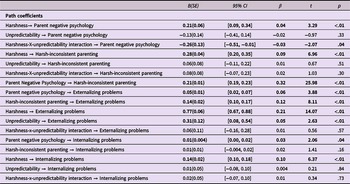
We fitted the model described above to examine the role of income-related environmental predictors on child socioemotional functioning via parental factors (See correlation matrix of study variables in Table 4). As shown in Figure 1 (and Table 5 for pathway coefficient estimates), greater income harshness predicted more negative parent psychology and more harsh-inconsistent parenting; more negative parent psychology also significantly predicted more harsh-inconsistent parenting; and both more negative parent psychology and more harsh-inconsistent parenting predicted greater externalizing problems. Furthermore, only more negative parent psychology was associated with more internalizing problems.
Path coefficient estimates predicting Kindergarteners’ socioemotional functioning (N = 10,700)

Path Coefficient Estimates Predicting Kindergarteners’ Socioemotional Functioning (N = 10,700).
Note. The model is fully saturated with perfect model fit.
Additionally, the income harshness-X-unpredictability interaction also significantly predicted negative parent psychology. To illuminate nature of this latter prediction, simple slope analyses were conducted with low and high income-unpredictability operationalized as −1 and +1 SD, respectively. Results indicated that under conditions of low income unpredictability, greater income harshness predicted significantly more negative parent psychology (see Figure 2; B = 0.33, p < .01), but that this same association was not significant under conditions of high income unpredictability (B = 0.09, p = .29). In other words, it was the combination of high income harshness and low-income unpredictability that was associated with high negative parent psychology.
Income harshness-x-unpredictability interaction for parent negative psychology.

Indirect effects
As shown in Table 6, all indirect paths already mentioned linking income harshness and externalizing problems proved significant. Although none of the indirect pathways involving income unpredictability achieved significance, two of the three paths involving the harshness-X-unpredictability interaction did (i.e., bootstrapped 95% CI did not contain zero): predictable harshness → (a) more negative parent psychology → more externalizing problems (conditional indirect pathway being significant under low income-unpredictability [B = 0.02, p < .01] but not high income-unpredictability [B = 0.004, p = .30]); and (b) more negative parent psychology → more harsh-inconsistent parenting → more externalizing problems (conditional indirect pathway being significant under low income-unpredictability [B = 0.01, p < .01] but not high income unpredictability [B = 0.003, p = .29]).
Indirect effects predicting children’s socioemotional functioning (N = 10,700)

Note. Interaction: Harshness-x-unpredictability interaction. Boostrapped 95% CI without auxiliary variables: auxiliary variables are not allowed in Mplus bootstrapping, resulted in a slightly lower sample size (N = 10,600).
When it came to predicting internalizing problems, none of the indirect paths linking income-related environmental predictors and internalizing problems achieved conventional leels of statistical significance (i.e., bootstrapped 95% CI did not contain zero).
Discussion
The goal of the research reported herein was to evaluate whether income harshness, unpredictability−and their interaction−predict children’s socioemotional functioning in kindergarten via two parent-related proximate processes, one involving negative parent psychology and the other harsh-inconsistent parenting. As such, our work built on prior developmental theory and research highlighting (a) adverse effects of low income and income volatility on child development (e.g., Brooks-Gunn & Duncan, Reference Brooks-Gunn and Duncan1997; Yeung et al., Reference Yeung, Linver and Brooks–Gunn2002), (b) proximate-processes linking distal influences with children’s functioning (e.g., Belsky, Reference Belsky1984; Belsky et al., Reference Belsky, Steinberg and Draper1991; Conger et al., Reference Conger, Ge, Elder, Lorenz and Simons1994), and (c) Ellis et al.’s (Reference Ellis, Figueredo, Brumbach and Schlomer2009) analysis of fundamental environmental forces regulating fast vs. slow life-history strategies (i.e., harshness, unpredictability). We extended prior work by evaluating the interactive effects of harshness and unpredictability and by considering the proximal processes of income-related effects. In addition, harshness and unpredictability were both derived from the same repeated measurement of family income to needs, with the latter being innovatively operationalized as the random variations in family income after partialling out the systematic trend.
Consistent with prior research, findings indicated unique effects of income harshness and unpredictability in promoting the development of greater externalizing problems for children (e.g., Doom et al., Reference Doom, Vanzomeren-Dohm and Simpson2016; Simpson et al., Reference Simpson, Griskevicius, Kuo, Sung and Collins2012). More importantly, findings pertaining to indirect pathways revealed not only greater (typical) income harshness (i.e., less income to needs) to be associated with more “problematic” child development – via elevated parent psychological stress and harsh-inconsistent parenting – but also that the interaction of income harness and unpredictability played a role in this developmental process. Recall that the combination of high-income harshness and low unpredictability – predictable low income – forecast more negative parent psychology, which in turn was associated with more harsh-inconsistent parenting, with both linked to more externalizing problems in kindergarten. Perhaps notable as well was that no significant indirect pathways emerged linking income unpredictability, as a main effect, with children’s socioemotional functioning in kindergarten. These differential effects of environmental harshness, unpredictability, and their interaction (on parenting) seem notable because all these predictors were derived from the same repeated measurement of family income-to-needs ratio. This precluded the possibility that any differential effects of these environmental predictors could be an artifact of different measurements being used to operationalize environmental harshness and unpredictability, as has been routine in prior research informed by Ellis et al.’s (Reference Ellis, Figueredo, Brumbach and Schlomer2009) theorizing about fundamental dimensions of the environment regulating life-history development.
More importantly, as highlighted in Young et al. (Reference Young, Frankenhuis and Ellis2020), our operationalization – and thus conceptionalization – of unpredictability aligns more with the statistical-learning approach to environmental unpredictability, thus reflecting the statistical structure of the developmental exposures under investigation herein. In fact, this might account for why we did not detect any indirect effects involving environmental unpredictability, and/or why results revealed a somewhat different income harshness-x-unpredictability interaction pattern than did prior research that operationalized unpredictability in line with the ancestral-cue approach (e.g., Belsky et al., Reference Belsky, Schlomer and Ellis2012; Doom et al., Reference Doom, Vanzomeren-Dohm and Simpson2016; Simpson et al., Reference Simpson, Griskevicius, Kuo, Sung and Collins2012). Recall that Brumbach et al. (Reference Brumbach, Figueredo and Ellis2009) failed to discern a significant interaction, whereas others reported either dual-benefit (Simpson et al., Reference Simpson, Griskevicius, Kuo, Sung and Collins2012) or dual-risk patterns (Doom et al., Reference Doom, Vanzomeren-Dohm and Simpson2016). In contrast, here we observed that it was the combination of high harshness and low unpredictability (i.e., predictably low income) that proved predictive of more “problematic” functioning via parental processes. Thus, the combination of high harshness and low unpredictability forecast more negative parent psychology (i.e., psychological stress), which itself predicted more harsh-inconsistent parenting and, thereby, more externalizing problems in children. Notably, this apparent influence of predictably low income emerged even in the face of typically low income. Clearly, these findings suggest that the two income-related parameters are not redundant despite their moderate positive correlation.
To some extent, these results are consistent with those of Li and associates (Reference Li, Liu, Hartman and Belsky2018), who also found that high, but predictable income harshness undermined well-being. Here we extended that work with a much larger and more representative sample, while illuminating plausible mediating parent-related mechanisms. One thing we find especially interesting is how, once again, these new results accord with the environmental-cue-reliability theorizing of Frankenhuis and Panchanathan (Reference Frankenhuis and Panchanathan2011a, Reference Frankenhuis and Panchanathan2011b, Panchanathan & Frankenhuis, Reference Panchanathan and Frankenhuis2016). Consistent with their thinking, a consistent environmental signal of harsh conditions led to a pattern of functioning in line with it, something less evident when the same signal – of low family income – was less consistent. With regard to family and developmental processes, it would appear that parents’ experience more emotional and psychological stress, at least when it comes to their experience of parenting, when income is not only typically low (i.e., high harshness), but predictably so (i.e., high harshness + low unpredictability). Perhaps this results from the fact that an unpredictably low income, even if typically low, affords hope that a family’s financial conditions may improve. Such a belief could potentially facilitate coping, resulting in a less negative parenting experience, more supportive parenting and, thereby, reduced chance of children developing “problematic” behavior. This speculative interpretation could be evaluated in future work.
On another note, despite the two unpredictability signals distinguished by Young et al. (Reference Young, Frankenhuis and Ellis2020), and the distinct mechanisms hypothesized for detecting and responding to those signals, here we only considered the statistical-learning approach with respect to environmental unpredictability. Thus, one important future direction is to contrast the effects of the two unpredictability approaches – statistical learning and ancestral cue – and empirically examine the different mechanisms (e.g., signal detection, learning mechanisms) hypothesized to link each type of unpredictability with child development. Finally, despite the direct link between greater unpredictability and elevated child externalizing problems, we did not find significant indirect pathways linking income-unpredictability and child functioning. Thus, it is possible that these latter null findings could be due to proximate processes that went unmeasured in the current inquiry. To cite but one of many possible omitted pathways, income unpredictability could influence child development via parental investment in children’s learning resources, in line with Becker’s family- investment model (Becker & Tomes, Reference Becker and Tomes1986; Haveman & Wolfe, Reference Haveman and Wolfe1994; Mayer, Reference Mayer1997).
Limitations
The contributions of the present study (e.g., large, nationally representative sample) needs to be considered in light of several limitation. To begin with, even though we have interpreted our results in terms of indirect effects whereby the income-related factors predicted child functioning via parent-related processes, it must be acknowledged that the latter two sets of measurements were not temporally ordered. Because the proximate-process and outcome measurements were both obtained when children were in kindergarten, we cannot rule out the possibility that risky child functioning evoked parents’ negative feelings and harsh-inconsistent parenting. Guided as we were by the evolutionary theory of socialization (Belsky et al., Reference Belsky, Steinberg and Draper1991) and more traditional developmental frameworks (e.g., Conger et al., Reference Conger, Ge, Elder, Lorenz and Simons1994; Elder, Reference Elder1998; McLoyd, Reference McLoyd1990), we believe our approach was reasonable.
Second, no matter how one views this matter, it must be appreciated that this is an observational study. So even if we relied on causal language at times to interpret our findings, the effects discerned could not document causation; and this would be so even if the temporal-ordering problem just highlighted did not exist. In fact, we would be remiss if we did not acknowledge that the detected indirect pathways linking income-related predictors with child functioning via parental factors might reflect passive gene-environment correlation. Genes that parents and children share could influence all measured constructs and thus account for their documented interrelation (Scarr & McCartney, Reference Scarr and McCartney1983).
The final limitation to highlight pertains to the statistical approach we used to derive income unpredictability as the residual variance in repeatedly measured family income relative to family size after partialling the systematic linear trend. After all, there could be other non-linear trends in the income data that go uncontrolled in the approach adopted herein. In addition, our approach of treating residual variance in repeatedly measured family income as environmental unpredictability does not capture the autocorrelation in the context over time. The latter, according to Young et al. (Reference Young, Frankenhuis and Ellis2020), characterizes another critical dimension for one to perceive unpredictability within their environment (i.e., lower autocorrelation in the context over time refers to more volatile and unpredictable environment).
Furthermore, although unpredictability in family income might be one important source of unpredictability, there are no doubt influential changes in other family conditions (e.g., maternal sensitivity) that convey developmentally significant information of the current and, probabilistically, future environment. This is consistent with the modest effect sizes of income-related predictors detected in this study. Thus, we urge future investigators to examine different unpredictability signals than those focused no herein. Third, reliance on the same repeatedly measured income-to-needs ratio resulted in non-independent constructs. Recall, though, that despite this, key unpredictability-related findings emerged even income harshness was controlled. Finally, our income-unpredictability index captured the total amount of variability but did not provide information on the direction and nature of each income fluctuation (i.e., increase, decrease). Indeed, this is one reason why our unpredictability measurement aligns more with Young et al.’s (Reference Young, Frankenhuis and Ellis2020) statistical-learning proposition regarding “prediction error” (i.e., inconsistency in the environmental condition over time) than with Ellis et al.’s (Reference Ellis, Figueredo, Brumbach and Schlomer2009) ancestral-cue thinking.
Conclusion
Despite these limitations, it should be evident that the present work was guided by a modern evolutionary perspective on development which enabled illumination of effects of different dimensions of early experiences, as well as their interaction, on child development, via parent-related processes. In so doing, we have integrated more traditional approaches to studying how ecological conditions can shape children’s development with more recent evolutionary ones.
Supplementary material
For supplementary material accompanying this paper visit https://doi.org/10.1017/S095457942100136X
Acknowledgments
Zhi Li, School of Psychological and Cognitive Sciences and Beijing Key Laboratory of Behavior and Mental Health, Peking University, Beijing, China; Jay Belsky, Department of Human Ecology, University of California, Davis.
Funding statement
The author(s) received no financial support for the research, authorship, and/or publication of this article.
Conflict of interest
The authors declare that they have no conflict of interest.
Ethical standards
The original data collector of ECLS-B obtained written consent from parent participants. The restricted-use dataset was anonymized, and our use of the de-identified dataset was approved by the National Center for Education Statistics.