Introduction
Compensation of Emergency Medical Services (EMS) professionals has been a common topic in EMS literature for a number of years.Reference Studnek 1 - Reference Williams 5 Compensation in EMS has been difficult to quantify, in part, due to the large number of volunteers, who provide EMS services on a reduced or no cost basis. Popular opinion within the EMS community has indicated that compensation may be linked with the ability (or inability) to recruit and retain employees. Additionally, compensation has been linked with ongoing employee satisfaction and retention. 6
While EMS professionals have consistently reported a high level of overall job satisfaction, prior research indicates that EMS professionals are least satisfied with their pay and benefits.Reference Studnek 1 Brown et alReference Studnek 1 found that 94% of EMS professionals believe they are paid less than they deserve for their work efforts. While compensation may have rated low in satisfaction relative to their jobs, a majority of EMS professionals still indicated that they were satisfied or very satisfied with their compensation.Reference Herzberg and Hamlin 7 A large proportion of individuals in this study (74.6%) also report that one of the main reasons they entered the EMS profession was because they wanted a job with good pay and benefits.Reference Herzberg and Hamlin 7
It has been posited that compensation is part of the foundation for an individual’s overall job satisfaction.Reference Brown, Dickison, Misselbeck and Levine 8 Absent appropriate compensation, an individual is unlikely to experience job satisfaction; conversely continuous increases in compensation are unlikely to result in unlimited increases in employee satisfaction. Attempting to causally link compensation with sustaining levels of satisfaction and employee retention may result in spurious conclusions. 6 Hence, for the present analysis, compensation is used as a measure of equality among other professionals and within the EMS profession. It is a popular industry belief that in EMS, its professionals are underpaid. This inequality may stem from the workload and job hazards experienced by EMS professionals. As the US population continues to grow and age, this sense of inequality will likely grow since EMS professionals will respond to an increasing number of emergency calls.Reference Williams 5 Current findings also suggest that EMS professionals are at high risk of occupational illness and injury, which leads some experts to question the disparity between pay and risk in the EMS workforce.Reference Herzberg 9 - Reference Maguire, Hunting, Guidotti and Smith 15
Before comparing itself to other professions, EMS should have a solid understanding of compensation within its own ranks. Drawing upon 10 years of Longitudinal Emergency Medical Technician (EMT) Attributes and Demographic Study (LEADS) data, this report provides an estimate of the compensation for nationally certified EMS professionals. Additionally, this section seeks to describe volunteers in EMS within the context of compensation.
Data and Methods
To aid in obtaining accurate measures of compensation, only individuals reporting that they were “currently practicing” at the EMT-Basic or EMT-Paramedic level were included in these analyses. It is important to note that currently practicing is not synonymous with practicing full time. Where possible, efforts have been made to separate and illustrate the compensation status of part-time and volunteer EMS professionals. While incorporating individuals who do not work full time into this analysis may add a level of complexity to this paper, these individuals are a reality of the workforce.
Variable Description: Core LEADS Survey
Compensation was defined as the amount of money earned from EMS-related jobs in the prior 12 months, presented as a categorical variable in $9,999 increments starting at $0. In 2004, the range of values (response categories) for compensation changed; the number of options that an individual could choose was expanded from eight to 11. The ceiling category was raised to ≥$100,000 and participants were able to additionally indicate if they made between $1-$999 and $75,000-$99,999. Otherwise, salary ranges remained the same between the two time periods.
While initially collected as a categorical variable, for the present analysis, compensation was analyzed as a continuous variable by utilizing the midpoints taken from each salary range response category. For those categories at the top range of the compensation scale the mid-point was derived by using the ceiling and $9,999 in excess of that value.
To better describe the complex reality of EMS compensation several independent variables were included in this analysis. These variables were divided into individual and work-related characteristics. The variables describing individual characteristics were as follows: educational level, gender, and race. The work-related variables were as follows: level of certification, service type, community size, hours worked, and volunteer status.
Educational Level, Gender, and Race
Educational level is the highest level of education an individual had completed when taking the LEADS survey. This variable was changed in 2004 from five options (didn’t complete high school, high school graduate, Associate’s degree, Bachelor’s degree, and Graduate degree) to six categories, with the addition of an intermediary category (some college). Due to small cell counts, individuals indicating that they did not complete high school were dropped from analysis. A respondent’s gender was based on self-report. Data regarding gender from the 1999 survey will not be reported due to data coding and collection issues during this year for this variable. Race was recorded as minority or white (nonminority). An individual’s race is based on their self-report on the survey. If an individual elected not to report their race on the survey, their sampling strata, based on information provided during the National Registry of EMTs’ (NREMT; Columbus, Ohio USA) registration process, was used to classify race in order to decrease item nonresponse.
Work Variables: Level of Certification Service Type, Community Size, and Volunteer Status
Only individuals registered as EMT-Basics and Paramedics were included in these analyses. While an important part of the workforce, first responders and intermediate-level EMS professionals were not analyzed because they were not part of the sampling frame.
Four EMS service types were analyzed: (1) fire-based, (2) private, (3) municipal, and (4) other, which includes hospital-based, US government (nonmilitary), and military. Community size was categorized as rural (<25,000 people) or urban (≥25,000 people).
During the first five years of LEADS, there was no single item that independently asked about volunteer status. Beginning in 2004, individuals were asked to indicate if they were a volunteer. Using this item, respondents were placed into three categories of compensation status: uncompensated volunteer, compensated volunteer, and career individuals. Respondents were considered uncompensated volunteers if they reported being a volunteer with an income of $0-$999 from EMS during the last 12 months. Compensated volunteers were respondents that reported EMS earnings equal to or in excess of $1,000 during the last 12 months. Finally, career individuals were respondents who indicated that they were not volunteers and who reported EMS earnings.
Analysis
Data analysis for this section focused on changes in groups over time. All individuals were grouped based on their reported certification level, and separate analyses were conducted for each certification level. All data analysis was performed as a discrete cross-sectional analysis of individuals responding in a given year.
Individuals were classified as volunteer or career professionals for the 2004-2008 time frames. Uncompensated and compensated volunteers were excluded from the analysis of average compensation by individual and work-life characteristics for the years 2004-2008. Population proportions for each individual work-life characteristic were also calculated. For the first five years of data (1999-2003), compensation patterns for all EMT-Basics and Paramedics (including volunteers) were analyzed. For the next five years (2004-2008), volunteer EMT-Basics and Paramedics were excluded from analysis. This approach, in addition to informing about compensation, also proved informative about the composition and compensation of the volunteer EMS workforce.
An overall mean salary was estimated for the certification levels for each year of the survey. Compensation was then analyzed by all independent variables. Percent change in compensation by independent variable was also estimated by calculating the percent change of salary in the first year (1999) compared with the fifth year (2003), and the sixth year (2004) compared with the tenth year (2008). Finally, all variables reported were adjusted for the complex survey design of the LEADS, as described in the Data and Methods section. Means and resultant 95% confidence intervals (CIs) were reported with statistical significance assessed by evaluating for the absence of overlap in CI between two compared groups.
Results
There were 15,231 LEADS questionnaires eligible for analysis. It is important to remember that when studying the demographic tables in this section, the years 1999-2003 contain all LEADS respondents and the years 2004-2008 included only respondents that were career EMS professionals. This side-by-side comparison of the two different sample populations displayed the differences among career and volunteer EMS professionals, between the 5-year periods. It also demonstrated the stability of demographic characteristics within the separate 5-year time periods.
Volunteerism
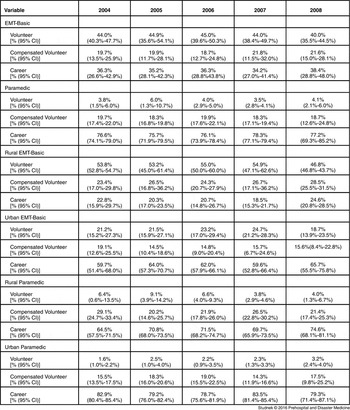
Table 1 displays the frequency of volunteerism among EMS professionals during 2004-2008. It shows that over 60% of EMT-Basics reported being either compensated or noncompensated volunteers, while >75% of EMT-Paramedics indicated that they were career EMS professionals. The proportion of career and volunteer EMS professionals also appears to be relatively stable over this 5-year time period. While more than one-half of the EMT-Basics working in rural communities report being volunteers, 60% of EMT-Basics in urban areas classify themselves as career EMS professionals. When comparing EMT-Basics to EMT-Paramedics across all years EMT-Basics were significantly more likely to be classified as a volunteer where EMT-Paramedics were significantly more likely to be classified as career. This association holds true even when assessing volunteerism by community size. Regardless of community size EMT-Basics were significantly more likely to be volunteers than EMT-Paramedics.
Volunteer Status by Certification Level and Community Type

Abbreviation: EMT, Emergency Medical Technician.
EMT-Basic Compensation Analysis
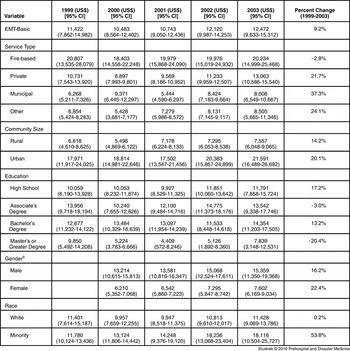
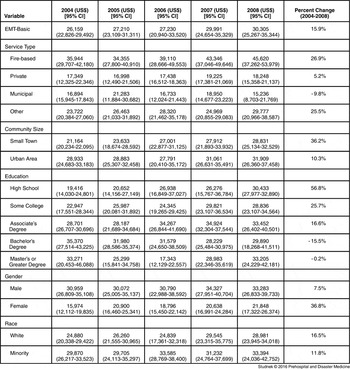
Table 2 presents the combined compensation status of career and volunteer EMT-Basics from 1999 to 2003. When compared with Table 3, the effects of including volunteers in compensation analyses are dramatic. With the elimination of volunteers from the data, EMT-Basic compensation increased. The following discussion is restricted to Table 3. There was a 15.8% increase in EMT-Basic compensation with an average salary of $30,305 in 2008. Several demographic variables indicated potential salary disparities including service type, community size, and gender. The EMT-Basics working in fire-based systems had the highest average salary increase (26.9%), while those working for municipalities had the lowest salary (and an apparent decrease in pay over five years). Those EMT-Basics working in a fire-based service reported making significantly more money than any other reported service type, and this was consistent over all years. Nearly one-quarter of EMT-Basics worked for private EMS agencies, making on average $21,000 less per year than those working in the fire service. Pay increases between fire-based and individuals working in “other” EMS agencies were similar.
EMT-Basic CompensationFootnote a from 1999 to 2003

Abbreviation: EMT, Emergency Medical Technician.
a This table includes compensation data from individuals who were compensated or noncompensated volunteers during this time period.
b Gender data for 1999 were unavailable due to coding and data processing errors.
EMT-Basic Compensation from 2004 to 2008

Abbreviation: EMT, Emergency Medical Technician.
Urban EMT-Basics were consistently compensated at higher levels than their rural counterparts. However, this difference was only statistically significant in 2004. Rural EMT-Basics’ salary increased significantly from 2004 to 2008. There was marked gender disparity in EMT-Basic salary levels with female EMT-Basics making significantly less money in four out of five years. Female EMT-Basics made nearly $15,000 per year less than males in 2004. While seeing a significant increase of 36.8%, over the intervening years, compensation for females was still $11,000 less than males in 2008. For nearly every demographic variable, average compensation of EMT-Basics appeared to steadily increase. However, only those EMT-Basics who were female or had only a high school education saw a statistically significant increase in compensation from 2004 to 2008.
EMT-Paramedic Compensation Analysis
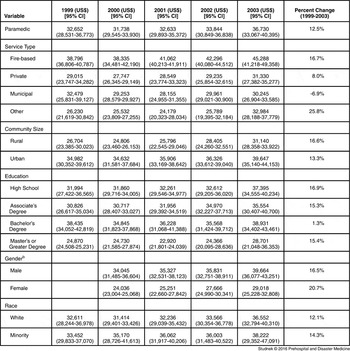
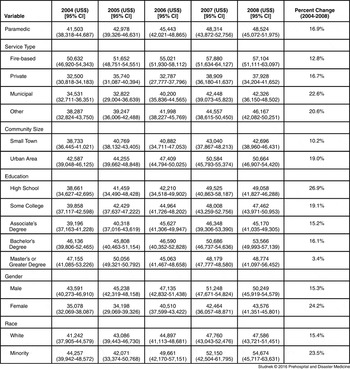
Tables 4 and 5 present EMT-Paramedic salary data for 1999-2003 and 2004-2008, respectively. In 2004, the average EMT-Paramedic salary was $41,502—nearly a $5,000 increase from 2003. While compensation grew 12.5% during 1999-2003 there was never an annual increase >$3,000 and compensation in 1999 was not significantly different than that in 2003. While the differences in EMT-Paramedic compensation between the years 1999-2003 and 2004-2008 were less drastic than for EMT-Basics, the inclusion of volunteers may have had the effect of deflating salaries as reported here. Data from 2004 to 2008 appear to be the best source for estimates of compensation among EMT-Paramedics by demographic variables.
Paramedic CompensationFootnote a from 1999 to 2003

a This table includes compensation data from individuals who were compensated or noncompensated volunteers during this time period.
b Gender data for 1999 were unavailable due to coding and data processing errors.
Paramedic Compensation from 2004 to 2008

While the compensation of EMT-Paramedics was significantly higher than that of EMT-Basics across all years, several results identified in the EMT-Basic analysis were also found among EMT-Paramedic respondents; that is, there were differences in compensation based on service type, community size, and gender.
The EMT-Paramedics working for fire-based EMS services made >$50,000 per year from 2004 to 2008 with a 12.8% increase in salary in those five years, which is at least $10,000 more than any other service type. Those individuals employed with a fire-based EMS service had significantly higher income than any other service type. The EMT-Paramedics working for fire-based EMS, on average, made nearly $19,000 more per year than those working for private services. Those individuals working for private EMS organizations had the lowest level of compensation. All service types experienced comparable salary growth over this interval.
As with EMT-Basics, female EMT-Paramedics and EMT-Paramedics who worked in rural areas made less. While average compensation of female paramedics increased by nearly 25%, during 2004-2008, salaries for females, generally, remained $7,000 less than that for males and were significantly lower than males in 2004, 2005, and 2008. Small town EMT-Paramedics had one of the smallest changes in salary over this time period (10.2%). They consistently received $7,000 a year less than individuals who worked in urban areas but were only significantly different in 2008. On average, individuals working in rural areas had among the lowest levels of compensation when compared with other demographic categories.
Among EMT-Paramedics, average compensation increased over the latter study years. Data including volunteers from 1999 to 2003 demonstrated continued salary increases for EMT-Paramedics in most demographic categories. The EMT-Paramedic salary changes between both (5-year) time periods were not as dramatic as for EMT-Basics, though a clear increase in salaries could be seen when volunteers were removed from analysis with a significant difference in compensation when comparing 2004-2008.
Discussion
The present analysis examined EMS compensation by employment and demographic characteristics. The analysis points to several within-profession salary disparities. Among these disparities, some of the largest differences were between EMT-Basics and Paramedics, within differing EMS organizations, and between genders. It appeared that volunteerism had a substantial impact on reported EMS compensation. Finally, this analysis was limited to describing EMS salaries to provide a baseline assessment of salary differences. It is likely that there are numerous other unexplored variables that may affect EMS compensation.
There was approximately an $11,000-$18,000 salary difference between EMT-Basics and Paramedics over the course of the study. This difference is expected given that certification as an EMT-Basic has typically served as the entry point for the EMS profession, and based upon their increased level of medical training and their ability to provide advanced level care, EMT-Paramedics tend to receive higher compensation. While the difference in salaries may be justified, both certification levels had similar salary growth over the study period.
The largest disparity found in this analysis was in compensation by organization. For both certification levels, respondents working for fire-based EMS agencies reported higher levels of compensation. In 2008, average salary differences by service type for EMT-Basics exceeded $30,000. Among EMT-Paramedics, the largest difference was nearly $20,000. This finding begs the question: “Why is there such a large disparity in salaries between organizations?” Unfortunately, LEADS was a project directed at providers not organizations. While comparing EMS compensation with other professions is important, this disparity highlights the need to further explore the existing compensation structure within EMS.
The final variable that demonstrated a perceived salary discrepancy was gender. Within EMS, gender inequality has rarely been studied.Reference Friedman 17 , Reference Dickison, Hostler, Platt and Wang 18 However, a clear difference in compensation was noted throughout the entire LEADS time frame, with males reporting annual salaries of $7,000-$15,000 more per year than females. One might hypothesize that this disparity is due to men receiving a higher proportion of available promotions simply because the proportion of men in EMS is so much greater, but the LEADS project did not capture these data. This unexplained disparity within EMS also warrants further investigation.
While this analysis was able to identify some of the factors of salary variability in EMS compensation, the present analysis also identified volunteers, EMS professionals that provide patient care with little or no compensation. The present analysis also indicates that a majority of EMT-Basics identified themselves as either a compensated or uncompensated volunteer. The opposite is true for EMT-Paramedics; more than three-quarters of the EMT-Paramedic respondents indicated they were career EMS professionals. In addition to the changes described in the demographic tables after volunteers were removed, there are certainly a number of other differences between volunteer and career EMS professionals that merit future research.
Limitations
While a baseline assessment of EMS compensation was performed, a number of other important questions are raised regarding EMS compensation. Limitations to this data analysis included the utilization of a categorical variable—compensation status—as a continuous variable, which may have led to some misclassification bias while providing the ability to look at EMS financial compensation in monetary form (as opposed to frequencies for distinct categories).
It is important to note that the analyses conducted in this section did not adjust for inflation, though each 5-year period does provide a measure of salary change. When examining EMT-Basics and Paramedics, average salaries increased by more than 15%. When using an inflation calculator both EMT-Basic and Paramedic salaries seem to have increased at a rate slightly higher than that of inflation. While compensation among EMT-Basics and Paramedics was not shown to be rapidly changing there was evidence to suggest that salaries were trending higher than what one might expect if inflation were factored in.Reference Maguire, Hunting, Smith and Levick 16
Conclusion
This section of the LEADS 10-year analysis provides an objective estimate of the compensation of nationally certified EMS professionals in the context of demographic and work-life characteristics. In the context of compensation, a description of volunteerism in EMS was also provided. The present analysis highlighted a number of disparities in compensation within the EMS profession, specifically among differing EMS service types and EMS provider gender. It is hoped, that as a profession, EMS will further analyze the source of these disparities and develop equitable policies and practices as needed.