

Introduction
Small and medium enterprises (SMEs) are a fundamental part of the economic fabric of transition economies and play a crucial role in the growth and prosperity of nations. Resource acquisition is vital to the survival and growth of these firms.Footnote 1 In unfavourable institutional environments, however, it is difficult for SMEs to access critical resources.Footnote 2 This is especially the case in economies such as China, Russia, and Vietnam, given the existence of a substantial and privileged state capitalist sector in which the government gives priority in resource acquisition to the large, state-owned enterprises.Footnote 3 In such environments, SMEs can find themselves in a power-imbalanced dependency in which one party controls the resources—financial, legal, administrative, political, or production—that another party values but does not have. The latter party is unilaterally dependent on the former for access to those valued resources.Footnote 4
Researchers have extensively studied how large firms and SMEs use business and political ties to obtain tangible and intangible resources in transition economies that are experiencing significant institutional changes from central planning to market competition.Footnote 5 However, how SMEs establish these ties in a power-imbalanced dependency by using unethical and illegal “strategic practice” such as bribery, with the possibility of considerable financial loss and legal penalty if such action is uncovered, remains underexplored. Furthermore, how SMEs deploy strategies to mitigate such risky actions in the process of resource acquisition is also given limited attention in the literature. Lack of exploration of these issues leaves significant gaps in our understanding of how SMEs are able to initiate and operate their ties for survival and growth despite enormous institutional constraints.
To address these gaps, we analyse how SMEs in transition economies “cultivate” network environments characterized by political and business ties to facilitate resource acquisition in the face of institutional uncertainty and political discrimination. Specifically, we develop a conceptual framework and empirically determine (1) the extent to which the power-imbalanced dependence (PID) of SMEs leads to a strategy of induced bribery in exchange for political ties; (2) how this induced bribery is associated with an acquisition of business resources; and (3) the extent to which dependence on induced bribery for resource acquisition is mitigated by SMEs’ power-mutual dependence (PMD) on business ties.
We analyse the negative and positive effects of PID on business resource acquisition via regression analysis, using data from 232 Chinese SMEs. The results suggest that SMEs’ PID on governments is positively associated with the use of induced bribery to establish political ties with officials for access to resources in a transition economy, and that SMEs’ PMD through business ties minimizes this relationship.
Our study contributes insights into SME resource acquisition in transition economies by addressing two research aspects in the literature on SMEs. First, we seek to extend resource dependence theory (RDT), which offers a comprehensive account of how organizations seek to manage their reliance on external environments,Footnote 6 to understanding of SMEs’ business operations in transition economies by identifying the institutional prerequisites for their engagement in power balancing for firm survival and growth. Disadvantages of PID can drive SMEs to engage in the unethical bribery of officials. Previous research explaining induced bribery in the context of inadequate formal institutions has not accounted for the deliberate agency of actors.Footnote 7 We depart from the narrow focus of this literature by considering how SME entrepreneurs in transition economies use unethical means to acquire critical business resources.
Second, we address underexplored aspects of how SMEs in transition economies act to mitigate power dependence on political ties in an effort to acquire resources. In doing so, we explore the moderating effects of PMD in business ties. As one of the few studies that explicitly examine the consequences of SMEs using bribery in such a context, our research provides additional insights into the issue of power balance in the SME literature of transition economies.
The remainder of this article is structured as follows. First, we elaborate on the theoretical arguments and develop testable hypotheses. We then provide descriptions of the data, variables, methods, and findings. Finally, we conclude with a discussion of the implications for firms.
Dependence, power imbalance, and exchange
Power-imbalanced dependence and resource acquisition
According to RTD, organizations must manage their dependencies on external entities and limit these external dependencies when resources are considered critical. The practical reason is that they need to control critical resources either to create value for competitive advantage in hyper-adversarial environments or to survive in disadvantageous environments.Footnote 8 RTD applies a dyadic approach to resource dependence, defining two distinct but related aspects of power in a dyad: power imbalance and mutual dependency.Footnote 9 Power is an essential property of social relations and is seen as a result of the simultaneous interaction of the power capability of one party with that of another in RDT.Footnote 10 Power imbalance is defined as the difference between the two parties' dependencies or as the ratio of the power of the more powerful party to that of the less powerful party.Footnote 11 The mutual dependence aspect of dyadic power captures the existence of bilateral dependencies in the dyadFootnote 12 and is the sum of the equal power of a party's dependence on another in the long term.
Resource acquisition for SMEs in transition economies is constrained by two types of firm dependence: First, where there is one party that depends on a dominant party for resources important to its survival, there will be a PID. Such imbalance can result when an external authority, such as government, has extensive political control over the supply of critical resources. Second, where there are bilateral dependencies between business parties with equal status in resource exchange in the long term, there will be PMD.Footnote 13
Most resource-dependency research has been conducted in developed countries where the external authority of government power is relatively transparent and well defined through formal institutions of regulation, taxation, and so on. In these contexts, political ties may be considered to be countervailing risks leading to resource exclusion in democratic politics,Footnote 14 while in transition economies such as China, Russia, and Vietnam, political ties are essential for a firm's performance in uncertain and dangerous political environments, as previous studies suggest. Political ties are firms’ informal social connections with government officials at various levels of administration, including central and local governments, and in regulatory agencies such as tax or stock market administrative bureaus.Footnote 15 SMEs use networking and personal interactions to build purposeful political and business ties with business players and government officials to minimize imbalance dependency and resource exclusionFootnote 16 and thereby create a favorable, highly specific institutional environment. However, these political ties are built upon firms’ unilateral dependencies on the political actors who confer benefits on the firms.Footnote 17
The institutional environment comprises a set of fundamental political, social, and legal ground rules that significantly shape a firm's economic dependencies on other entities.Footnote 18 Institutional environments of transition economies are characterized not only by a lack of formal institutions but also by the administration of officials who control key resources and thus become politically as well as economically important.Footnote 19 Economic power is largely a matter of regulation rather than competitive markets, and officials have considerable discretionary power over SMEs’ access to vital resources. In China, for example, government policies toward private SMEs have evolved through a number of stages of strict prohibition, tolerance, accommodation, and limited encouragement.Footnote 20 However, in terms of access to critical resources and legal protection, there are still significant controls and limitations on the operation of SMEs. Political discrimination still persists in favour of large, state-owned enterprises.Footnote 21 Such institutional environments afford opportunities for substantial power imbalances to develop between officials and SME entrepreneurs. These power imbalances can create high dependencies for SMEs on external environments as they have only a limited capability to obtain critical resources. Firms that seek to acquire essential resources find that the most efficient way to gain these resources is by entering into power-imbalanced and dependent relationships with officials.Footnote 22
RDT posits that in a relationship characterized by power imbalance, the dependent party will be expected to provide unilateral and valuable commitments before tangible benefits can flow from the dominant side.Footnote 23 In such a relationship, rational SMEs need to proactively influence their environment to minimize or neutralize imbalance dependence for the acquisition of critical resources.Footnote 24 One mechanism is to develop a “bridge” between businesses and external parties to facilitate beneficial exchanges and establish political ties. Martin et al. (Reference Martin, Cullen, Johnson and Parboteeah2007), de Jong et al. (Reference de Jong, Tu and van. Ees2012), and Meznar and Nigh (Reference Meznar and Nigh1995) observe that firms that are heavily dependent on the government are more favourably disposed to engage in political activity.
Faced with corruptible officials controlling obligatory passage pointsFootnote 25 through which desired resources flow,Footnote 26 many SMEs have to make a choice: Either they take unethical actions to secure resource support from officials for the firm's survival or they assume no proactive action on obtaining needed resources and risk going out of business. The firm's need for survival frames their motivation for dealing unethically with officials by bribing them. Bribery occurs when serving officials seek to obtain personal economic benefits by manipulating the institutional environment in favor of a client organization. The most commonly used definition of bribery, offered by the Organization for Economic Co-operation and Development in 2000, is “offering, promising, or giving something in order to influence a public official in the execution of his/her official duties.” Previous research on bribery has focused on the behavior of individual firms in the context of developed economies.Footnote 27 However, in the weak institutional environments of transition economies, bribery is much more characteristic of a collective behavior.Footnote 28 With an economic-social-behavioral model, Ryvkin and Serra (Reference Ryvkin and Serra2012) demonstrate that in emerging economies, the greater the proportion of people who are corrupt, the less likely it is that specific corrupt or bribed individuals will be detected and receive sanction.
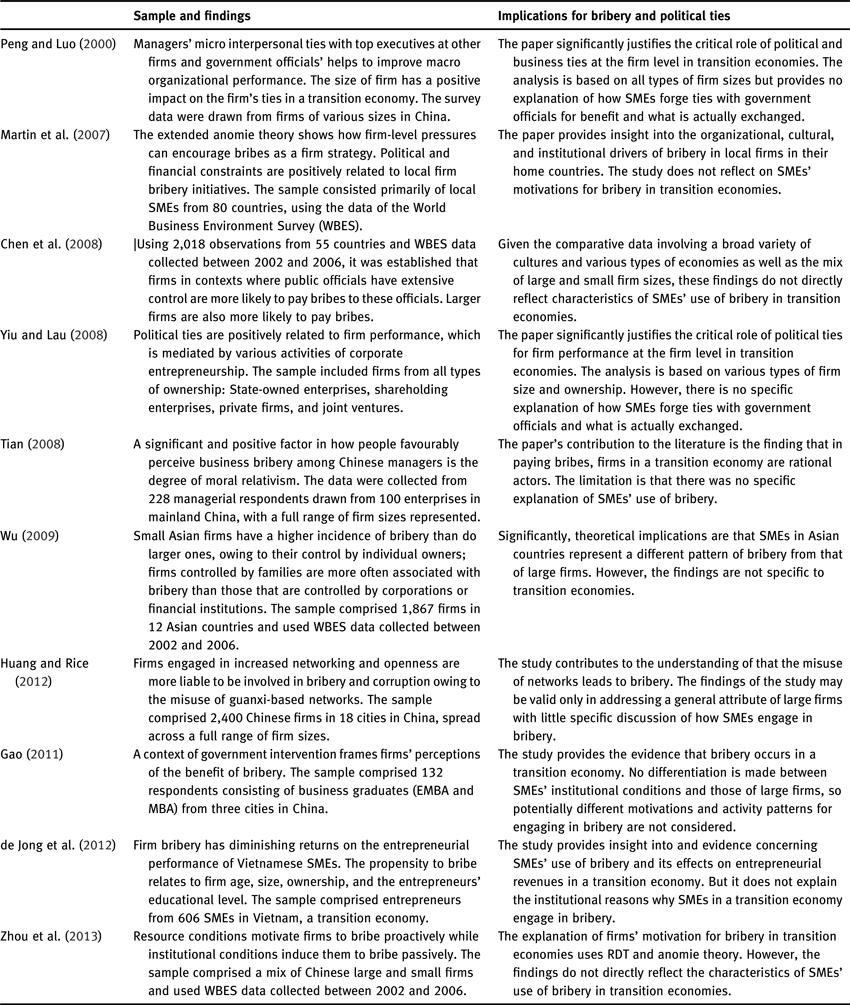
Although there are findings of firm bribery and political ties in many previous studies, earlier research has typically been based on a mix of large and small firms or of various types of economies, as in the data of the World Business Environment Survey (WBES).Footnote 29 Some data come only from large firms.Footnote 30 Therefore, they do not accurately reflect the institutional conditions facing transition SMEs that enter into dependent relationships with officials in pursuit of resource acquisition through bribery. A brief summary of previous studies of firm bribery and political ties is presented in table 1.
Previous studies of firm bribery and political ties

Multiple political factors induce SMEs in transition economies to use bribery to establish political ties for access to essential resources. First, unlike large firms that governments require officials to support politically and institutionally, SMEs are often subject to open as well as more subtle political discrimination by officials.Footnote 31 Second, unlike large firms, which government policies prioritize in terms of critical resources, SMEs are placed significantly lower on the priority spectrum.Footnote 32 Third, unlike large firms, whose attributes of high social and political status allow them to easily attract official support,Footnote 33 which can become a source of particular officials’ personal political gain, SMEs do not ordinarily attract much attention from government disciplinary agencies and law enforcement authorities.Footnote 34 They also have lower credibility in the market. Fourth, large firms usually have robust financial resources or multidimensional business ventures that allow for long-term survival even if their operations are disrupted by the shortage of certain critical resources and weaker bargaining power with officials.Footnote 35 Because SMEs’ survival in the market is much more precarious, they are likely to have higher propensity and motivation to bribe officials for access to resources for survival and growth in such an environment—not because they are more corrupt so much as because they are more vulnerable to external exigencies.Footnote 36 Socially and psychologically, SMEs use bribery of public officials as a way to diminish power imbalances and build political ties in their quest for resource acquisition. We thus hypothesize the following:
Hypothesis 1: In transition economies where governments control critical resources, SMEs’ PID is positively related to the firms’ use of bribery to induce officials’ support.
Induced bribery as an instrumental choice for resource acquisition
In transition economies, firms’ use of political ties to access financial, reputational, and legal resources is well established in the literature,Footnote 37 but the question of how it is practiced by SMEs in the context of power imbalance has been given scant attention.Footnote 38
Theoretically, RDT suggests that resource power disequilibria can easily lead to incommensurate, inadequate, and unfair exchanges for the disadvantaged side; that a relationally less powerful actor is less likely to achieve reciprocity with the dominant side;Footnote 39 and that organizations characterized by a high degree of dependence on others are more likely to be proactive in seeking to absorb the sources of their dependence.Footnote 40 To reduce PID in securing the flow of valued resources, dependant organizations tend to restructure their dependencies through various tactics. Casciaro and Piskorski (Reference Casciaro and Piskorski2005) suggest that these tactics can include socializing with members of the constraining organization or exchanging valuable goods, such as status, friendship, or information.
Given economies in which the government plays a central and pervasive role, cultivating ties with officials can be instrumental in overcoming institutional barriers to resource acquisition.Footnote 41 Specifically, when officials control key conduits for access to business resources, they can offer firms a variety of privileges, such as highly profitable projects, tax waiver approvals, exclusive licensing, access to advanced technologies, and the allocation of scarce resources such as bank loans.Footnote 42 Following the logic of RDT, it can be further reasoned that in transition economies, in the context of a high degree of power imbalance and no market-based exchange of resources, SMEs tend to adopt proactive tactics for gaining the flow of valued resources, but the tactics of exchanging friendship or status to restructure a power balance may not be sufficient for SMEs to gain critical resources from governments. Choices of their tactics have to be open to influence by corrupt officials who are able to abuse their authority unilaterally. Their observation of officials’ support preference leads them to believe that meeting officials’ personal need is a sufficient tactic for this purpose.
During the process of establishing political ties, SMEs as resource seekers and donors base their exchanges on the expectation that, in return for inducements, officials will be willing to help overcome structural constraints to make decisions that favour SMEs.Footnote 43 Ties based on PID typically operate under the expectation of immediate reciprocal returns to the bribing party.Footnote 44 Officials in transition economies, as rent seekers, are open to inducement from a plurality of firms.Footnote 45 In reality, however, they can only provide exclusive resources to a small number of firms. In this context, they will be reluctant to commit to any particular relationship if opportunities exist for more lucrative returns.Footnote 46 Corrupt officials will select those exchanges that they perceive will deliver the greatest personal benefits.
Larger corporations in either the state or private sector are more likely to enjoy formal political favor and have a PMD on government control. SMEs with much weaker political status are often unable to establish political ties for access to essential resources unless they choose to bribe officials as power restructuring tactics to increase opportunities.Footnote 47 For these SMEs, being unethical with respect to officials is a choice involving the calculation of future costs and benefits.Footnote 48 We thus hypothesize as follows:
Hypothesis 2: Induced bribery that meets the personal needs of officials with whom political ties are established is positively associated with resource acquisition by SMEs in transition economies.
Moderating effect of power-mutual dependence
Winning business opportunities by meeting the personal needs of corrupt officials to forge political ties is a double-edged sword for SMEs as it channels entrepreneurship into unhealthy dependent relations. For SMEs, not only is it potentially destructive to entrepreneurial creativity and animal spirits,Footnote 49 but also it leads to the risk of being charged with criminal conduct and associated with substantial financial loss and personal psychological suffering. To minimize political risk and potential loss, SMEs need to decrease their PID.Footnote 50 We next examine the strategies that SMEs take to mitigate risk when dealing with imbalanced dependency for resource acquisition. They resort to business ties to create PMD and lower PID on officials. Business ties refer to informal social connections with buyers, suppliers, other market collaborators, influential people and top managers from various industries, as well as acquaintances and friends.Footnote 51 These social connections are embedded in networks that are possible conduits for accessing various resources such as knowledge, resources, and complementary capabilities.Footnote 52
While exploring the role of both political ties and business ties in firm performance, previous research has underplayed the interactive effect between two types of ties that firms use on powerful governments in emerging economies,Footnote 53 RDT suggests that an organization's critical ability to reduce imbalanced dependence is related to its capacity to create mutually beneficial exchanges. Mutual dependence captures the existence of bilateral dependence in a dyad.Footnote 54 PMD refers to a situation where the average level of dependence of both parties is relatively equal and bilateral.Footnote 55
Power imbalance and mutual dependence need to be considered simultaneously in the power-dependence structure by organizations when trying to control their external dependency. A PID can be varied by levels of mutual dependence within its own dyad from time to time with a dynamic interaction for any value.Footnote 56 Building on Casciaro and Piskorski's (Reference Casciaro and Piskorski2005) findings, we argue that the extent that external dependency varies corresponds to the degree of mutual dependency embedded in coalition relations. On the basis of a survey of 241 Chinese firms, Sheng et al. (Reference Sheng, Zhou and Li2013) found that business ties are more beneficial when legal enforcement is inefficient and technology is changing rapidly, whereas political ties lead to increased performance when general government support is weak and technological turbulence is low.
One strategy of PMD to alleviate firm imbalanced dependence involves forming coalitions with other differently resourced agents seeking various resources through business ties. Coalitions provide SMEs with opportunities to generate bridging ties and cultivate mutual exchanges with diverse resource suppliers.Footnote 57 Social capital theory suggests that the sets of dyadic ties that make up business networks are characterized by reciprocity, trustworthiness, and shared vision among the parties.Footnote 58 Such interlocking directorates provide firms with credible business information for strategic actions as well as interfirm resource exchange,Footnote 59 particularly when other sources of information and resources are not available.Footnote 60 The accessible resources are embedded in these business networks through reciprocity.Footnote 61
In power-mutual business networks, when the parties feel a sense of obligation toward one another and demonstrate active engagement through various cross-industry links, reciprocal behavior with a long-term perspective on relationships is likely to occur.Footnote 62 Reciprocity is manifest in exchanges that share technologies, innovative applications, and common production resources; in sharing distributive channels; and by making both short-term and longer-term opportunities to collaborate on significant projects that require contributions across various industries.
Coalitions embedded in networks allow firms to procure assets, competencies, or capabilities that are not readily available in competitive factor markets, as well as to tap into history-dependent competencies and resources that are difficult to trade in strategic factor markets.Footnote 63 Characterized by the reliability of assets and a history of exchange that enables identification of trustworthy partners, power-mutual relationships reduce uncertainty regarding the flow of necessary resources, neutralizing dependence by relying on social norms of cooperation and reciprocity.Footnote 64 Structurally, business ties embedded in networks are grounded in social attachments;Footnote 65 they expedite firm resource acquisition because the network relationship is based on mutual dependence, providing firms with opportunities to invoke the norm of reciprocity among supplies within coalitions.Footnote 66
A number of studies relate advantages derived from power-mutual-based business ties to resource acquisition and growth generally. Chisholm and Nelson (Reference Chisholm and Nielsen2009), for example, find that relationships with customers, suppliers, and external organizations such as universities, banks, and venture capitalists facilitate the achievement of ends that would otherwise not be attainable at lower cost. Successful entrepreneurs use social contacts to obtain resources for start-ups. Venture capital organizations help entrepreneurs by using their contacts and networks to provide access to important sources.Footnote 67 The quality of the relationship between a small business and its bank influences the costs of borrowing.Footnote 68 Building upon family embeddedness, Arregle et al. (Reference Arregle, Batjargal, Hitt, Webb, Miller and Tsui2015) tested the curvilinear relationship between the proportion of family ties in entrepreneurs' networks and venture growth on entrepreneurs from China, France, Russia, and the United States and found a U-shape for the business resource network in this relationship.
Compared with bribery, the reciprocity of PMD embedded in networks is less immediate but more oriented toward mutual commitment. The risk of opportunism on the part of corrupt officials is reduced. Seeking to develop mutually reciprocal obligations to gain resources from diverse sources and reduce reliance on political ties is a preferred strategy under systems based on strongly institutionalized legitimacy. In institutional environments characterized by less government control and in which firms can effectively search for, access, and acquire desired resources via power-balanced reciprocity, however, firms rely less on officials to acquire external resources. Accordingly, the following hypothesis is proposed:
Hypothesis 3: SMEs’ PMD negatively moderates the relationship between induced bribery and resource acquisition. Specifically, for SMEs, the more a firm resorts to PMD, the less it will turn to bribery to gain resources.
Methods
Sampling and procedure
We selected China, the largest transition economy, as the location for this study. Peng et al. (Reference Peng, Wang and Jiang2008) argue that in transition economies, as state control morphs into market-based economies, a degree of institutional convergence occurs. Hence, China, while certainly an outlier in terms of state control and the size of its economy, reflects wider trends in transition.
Our sample comprised entrepreneurs who operated businesses and were responsible for the strategic and administrative activities of their firms. As such, they would have oversight over any activities related to the firm's political and business ties. The sample was drawn from the population of local company registration databases in the city administrations of industry and commerce in cities in Sichuan province. To ensure sampling representativeness, we constructed a representative random selection.Footnote 69 De Jong et al.'s (Reference de Jong, Tu and van. Ees2012) study suggests that particular entrepreneurial firm and industry-specific characteristics affect the likelihood of bribes. We randomly selected firms drawn from the lists of industry sectors dependent on specific resources, such as licensing and land, or that encountered a high demand for competitive resources. The selected industry sectors were retail, real estate, travel, telecommunication services, and manufacturing—sectors officially identified as having high rates of bribery and corruption.Footnote 70 The average firm size was 160 employees, which fits a definition of SMEs in China according to Cunningham's (Reference Cunningham2011) study, and the average firm age was 8.4 years. The average entrepreneur tenure at the firm was approximately ten years.
Research assistants, being hired to distribute and collect 280 questionnaires, visited entrepreneurs in person to ensure that the questionnaires were completed. The investigation yielded a sample of useful questionnaires from 232 respondents (191 men and 41 women). The remaining forty-eight questionnaires were either incomplete or completed with the similar scale choices on most items throughout the questionnaire. The response rate of 83 percent was high, reflecting the efficacy of the face-to-face method of data collection.
Analysis and validity
We performed four steps to ensure the validity of the investigation and statistical analysis. First, we developed the survey instrument on the basis of published empirical and conceptual studies. Since all questionnaire items were derived from English-language studies, we translated them into Chinese. The Mandarin and English versions were verified for equivalency in meaning and refined through backward-forward translation to ensure face and content validity. Second, we conducted a pilot study consisting of a questionnaire and subsequent interviews with seven participants. The questionnaire was then modified accordingly. Third, to avoid the effect of social desirability bias and fears, especially with respect to measures in relation to bribery, we took critical steps to guarantee (1) anonymity in completing the questionnaires, ensuring neutrality and limiting the respondents’ personal involvement in the answers; (2) the neutral phrasing of the sensitive questions—for example, use of the phrase “a firm” instead of “our firm” to avoid concern in admitting misconduct; and (3) the focus of sensitive questions on the respondents’ firms rather than on the respondents themselves.Footnote 71
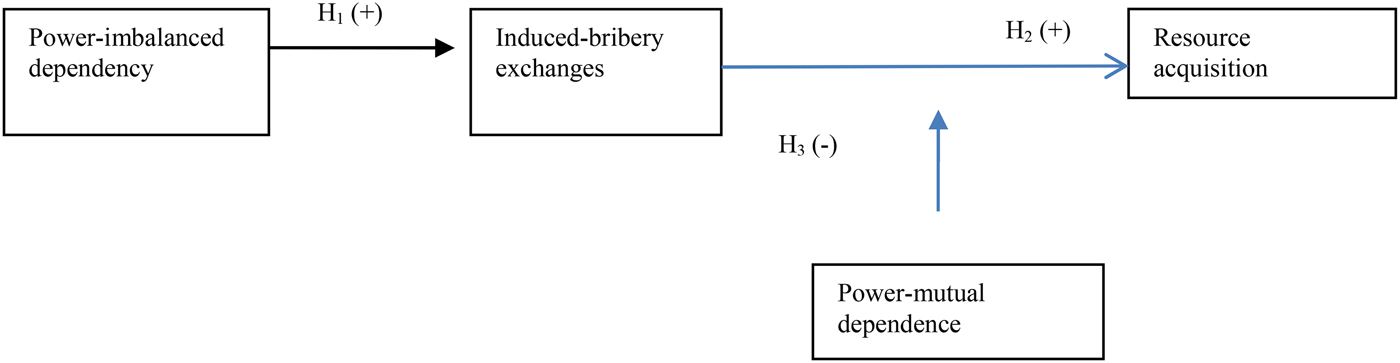
Finally, before testing the hypothesized paths in the theoretical model (see figure 1) using SPSS version 23, we employed exploratory factor analysis (EFA) and confirmatory factor analysis (CFA) to ensure both internal convergent validity within each construct and concurrent validity and discriminant validity between constructs. Specifically, we examined nineteen survey items using an unrotated principal components factor analytic procedure. No single predominant factor emerged. Instead, the analysis generated five factors with eigenvalues larger than 1. The maximum variance was 23.75 percent, and the cumulative variance explained by these five extracted factors was 62.05 percent. Results of the EFA analysis show that no dominant single factor accounted for the majority of covariance in the variables. Then, to obtain a more precise assessment of common method variance in the data, we used a CFA approach to test for such bias. The model proved a better fit (with chi-square to degrees of freedom ratio of 2.725, GFI = 0.911, RMSEA = .06, and CFI = 0.918) after four items were removed. These items were “a firm had to make extra payment to officials connected with awarding of benefits”; “a firm had to pay a facilitating fee to officials for favourable judicial decisions”; “our firm's operation relies on support by officials who influence critical decisions on resources allocation”; and “our firm has obtained legal help and regulatory information in the past three years.”
The framework for power dependence, induced bribery, and resource acquisition for SMEs in transitional economies

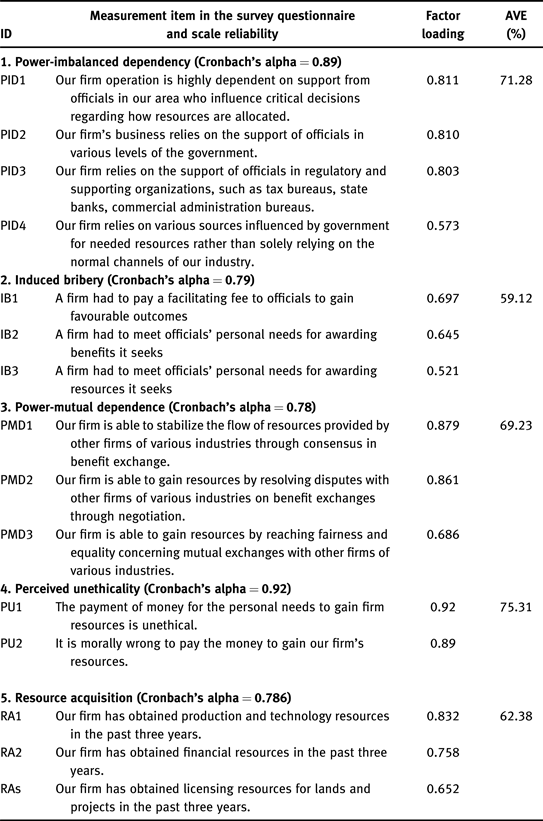
Factor loadings with fifteen items in the survey questionnaire and scale reliabilities for these variables confirmed measurement validity as reported in table 2. The alpha values of the scales were more than 0.70. Collectively, these results show that common-method bias was not an issue in the study. We also assessed convergent validity by examining the average variance extracted (AVE) values. Table 2 also shows that all the AVE values are well above the recommended threshold level of 50 percent.
Operational measures, reliability, factor loadings and AVE

Measures
All measures were assessed by asking the subjects to rate their level of agreement with a given statement on a five-point Likert scale ranging from 1 for “strongly disagree” to 5 for “strongly agree.” The operational measures of variables, reliability of each scale (Cronbach's alpha), and factor loadings are reported in table 1.
Independent variables
Power-imbalanced dependence (PID) is measured by a four-item scale and developed from both the literature of RDT, especially Casciaro and Piskorski (Reference Casciaro and Piskorski2005), and the instrument of political ties (Peng and Luo Reference Peng and Luo2000) to measure the extent to which a firm's operations depend on the officials who control or influence resource allocation.
Induced bribery measures the extent to which a firm believes it has to deal with corrupt officials using three items adapted and modified from the Corruption Perception Index (CPI 2005), one of the most visible and systematic measures of perceived bribe taking in the world.
Power-mutual dependence (PMD), developed from Casciaro and Piskorski's (Reference Casciaro and Piskorski2005) theoretical analysis, uses a three-item scale to measure the extent to which a firm's resource acquisition depends on fair exchanges of resources with other firms from various industries.
Dependent variable
Resource acquisition measures the extent to which a firm obtained business resources. This three-item scale was based on Mahoney's (Reference Mahoney1995) analysis of resource learning theory, which defines resources in an inclusive manner and classifies them in terms of tangible, intangible, and useful types.
Control variables
In the analysis, we controlled for firm size, as previous research has suggested that a firm's size is negatively related to the firm's need for social ties to ensure survival and prosperity.Footnote 72 When predatory officials demand personal inducements to provide services to small firms, the firms are in a weaker position to resist than are larger firms.Footnote 73 We also controlled for firm age and respondents’ number of years of employment at the firmFootnote 74 and industry because it often takes time for SMEs to observe the effect of networking and bribery on their businesses within the context of the industry.
Additionally, we controlled for entrepreneurs’ perceptions of the unethical nature of bribery. Perceived unethicality was adopted and modified from Powpaka's (Reference Powpaka2002) study and used a two-item scale to measure the extent to which managers perceive paying a facilitating fee to be unethical. In most countries, bribery is against the law, even if widely practiced and reinforced by gift-appreciative cultural and historical factors, as is the case in many transition economies such as China, the Czech Republic, Indonesia, Poland, and Russia.Footnote 75 The degree to which it is regarded as unethical varies.Footnote 76 The theory of planned behavior suggests that perceived behavioral control directly influences behavioral intentions and that such perceived behavioral control, together with behavioral intention, can be used directly to predict behavioral achievement of individuals.Footnote 77 According to this theory, an entrepreneur's intention to use bribes for business survival will be influenced by that person's attitude toward bribery. In considering whether to engage in certain behavior, people have to deal with the social pressures they experience. In this case, an SME entrepreneur's belief that significant others think that bribery is wrong may also be influential.
Results
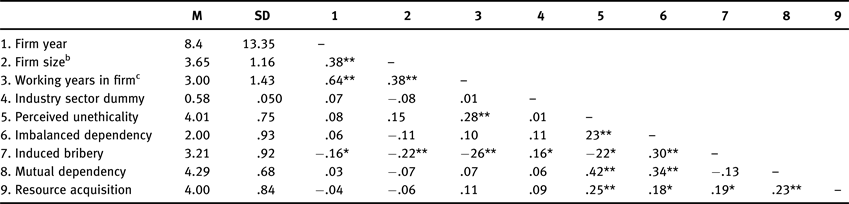
The means, standard deviations, and Pearson correlations for all variables are reported in table 3. The zero-order correlations indicate significant correlations between the variables.
Means, standard deviations, and Pearson Correlationsa for variables (N = 232)

a * p < .05, ** p < .01, *** p < 0.01 (2-tailed). b Firm size was coded as 1 = 1–10; 2 = 11–30; 3 = 31–100; 4 = 101–200; 5 = more than 200; 6 = more than 1,000; cWorking years in firm was coded as 1 = less than 2 years; 2 = 2–5 years; 3 = 6–10 years; 4 = 11–20 years, and 5 = more than 20 years.
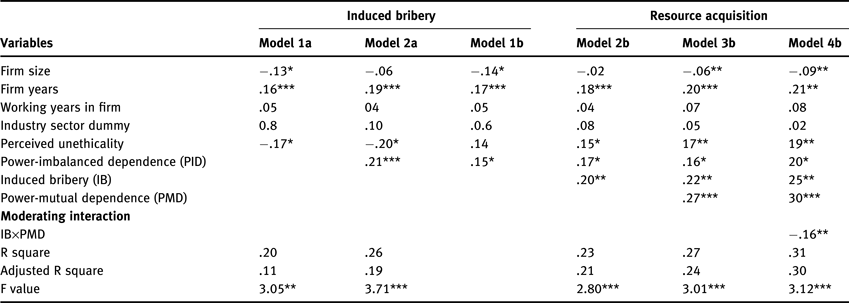
To examine the effect of PID on induced bribery and the effect of induced bribery on firm resource acquisition, we conducted a regression analysis (table 4). On the basis of our examination of the effects of the control variables on these variables (model 1), we regressed PID on induced bribery (Step 1). Results in model 2a show that PID is positively related to induced bribery. We then regressed the variable of induced bribery on resource acquisition (Step 2). Results in model 2b suggest that induced bribery has a significant positive effect on resource acquisition. Our data support hypothesis 1, stating that in transition economies where governments control critical resources, SMEs’ PID is positively related to bribery to induce officials’ support, and hypothesis 2, stating that induced bribery that meets the personal needs of officials with whom political ties are established is associated with resource acquisition by SMEs in transition economies.
Regression for power-imbalanced dependence, induced bribery, and resource acquisition of SMEs in transition economies

N = 223; + p < .1; * p < .05; ** p < .01; *** p < .001.
To test the hypotheses of the interaction terms composed of PMD, we employed a moderated hierarchical regression analysis (Step 3). To minimize the potential threat of multicollinearity, we mean-centred all independent variables constituting interaction terms and then created the interaction terms by multiplying the relevant mean-centred variables. Model 3b indicates that PMD of business ties is positively and significantly related to resource acquisition. In model 4b, the interaction between induced bribery and power-balanced reciprocity produces a negative relationship with resource acquisition. These findings reflect the significant moderating effect of PMD of business ties on the bribery-resource acquisition relationship. Thus, hypothesis 3, stating that SMEs’ PMD negatively moderates the relationship between induced bribery and resource acquisition, is supported.
Discussion
Although academic interest in bribery and managerial ties in transition economies has been evident for more than a decade,Footnote 78 the issue of how these factors are actually developed in relation to SMEs’ resource acquisition in transformational economies has not been adequately investigated and explained. Our study examines the influence of resource dependency on bribery and PMD in transition economies and contributes to the literature and practice in several ways.
Theoretical implications
The result of the ongoing debate regarding the relationships among poor governance, managerial ties, and firm bribery is inconclusive.Footnote 79 Prior studies have generally captured the positive value of political ties on firm performance rather than the negative effects of PID caused by institutional constraints in transition economies.Footnote 80 They either avoid or ignore the negative effects of bribery associated with political ties on SMEs’ constructive entrepreneurship—as well as on society—in the process of establishing political ties.
First, our study contributes to the literature on SMEs by incorporating RDT to address fundamental issues of resource acquisition. Our results suggest a propensity for SMEs in transition economies to engage in bribery to establish political ties in conditions of considerable power imbalance. Conceptually and empirically, we find that SMEs use bribery to proactively create a relatively “favorable” external environment to ensure resources for survival when their level of PID on government control is high.
Second, our findings challenge the conventional tendency in transition economy studies to simply attribute bribery to the immoral behavior of individual entrepreneurs or to a passive response to extortion by individual public officials.Footnote 81 Instead, we contend that induced bribery by SMEs is a collectively unethical response to economic and political constraints occurring in institutionalized environments where resource imbalances are significant and legitimate ethics are weakly framed. Our study makes a significant contribution to an understanding of the causes of unethical behavior by using the RDT perspective to analyse root causes of SMEs’ involvement in bribery in transition economies.
Third, our study extends previous studies of managerial ties in transition economies by differentiating between power-imbalanced dependency of political ties and mutual-balance dependency of business ties in relation to resource acquisition of SMEs. Our findings indicate that when SMEs proactively endeavour to increase PMD in unfavourable institutional environments, there will be less resource acquisition through PID on officials. We contend that the two types of power dependence are not mutually exclusive in terms of overcoming constraints on resource acquisition. SMEs should seek to develop mutually reciprocal obligations to gain resources from diverse business sources and reduce reliance on political ties.
Practice implications
Puffer et al. (Reference Puffer, McCarthy and Boisot2009) observe that in Russia, SMEs’ attempts to use official channels and procedures to obtain resources often result in frustration and failure. The situation seems similar in China. In practice, bribery is destructive for entrepreneurship because it solidifies power imbalances. Characterized by diminishing returns in relation to entrepreneurial performance as a whole,Footnote 82 bribery ultimately results in a profoundly dysfunctional and demoralizing experience for many firms. As SMEs’ behaviour in relation to bribery reflects their current political status in institutional environments, our analysis suggests that there is an urgent need to improve the institutional environment in these economies. Although bribery may be perceived as a rational choice by SMEs intent on firm survival, it is only a temporary means to cope with institutional constraints.
Perceived power disequilibria in exchanges with corrupted officials can be offset by SMEs exploring diverse resources via business ties embedded in heterogeneous networks. Such business ties have a much lower risk of criminality, cost less, and, most importantly, offer the prospect of long-term returns. The statistically significant link between business ties and SMEs’ acquisition of business resources in our analysis demonstrates the effectiveness of this approach. However, our study also suggests that to minimise bribery among SMEs in transition economies, a critical step would involve reducing governments’ power to control resources. When mechanisms exist for establishing, maintaining, and (in cases of breaches) reproducing high institutional trust, bribery can be partially contained through improved corporate governance.Footnote 83 Our findings imply that SMEs’ institutional dependence on bribery will decrease in transition economies through the emergence of what Weber (Reference Weber1978) defines as a rational state staffed by officers with a professional ethos operating in a formal legal-rational institutional environment.
Limitations and future research
Our research represents one of the few empirical studies that explore and test the linkages among key variables of firm resource dependency, bribery, and power-balanced reciprocity of managerial ties. Nonetheless, the limitations of this study provide opportunities for further research. First, we did not include contextual factors of firm dependence and political ties, such as trustworthiness and deception, although previous studies have recognized these factors as affecting exchange relations.Footnote 84 Future research would benefit from an examination of these relationships to provide a more comprehensive understanding.
Second, the specific characteristics of SME management could affect the outcomes of relationships of organizational power balance with the external environments, as suggested by RDT.Footnote 85 Accordingly, it would be especially interesting for future research to investigate the influence of network density on firms’ adoption of bribery and power-balanced reciprocity in heterogeneous networks.
Third, the issue of whether bribery benefits firms’ long-term growth has been a topic of research attention for decades, not only from the perspective of international business and business ethics but also from that of sociology and economics; nonetheless, the evidence remains inconclusive. From an economic perspective, for example, Olken and Panda (Reference Olken and Pande2012) use the data from Indonesia and India, and Svensson (Reference Svensson2005) uses data from Uganda, to propose that bribery has a negative correlation with a firm's long-term growth in developing countries. Svensson (Reference Svensson2005, 40), however, has asked if “China has been able to grow fast while being ranked among the most corrupt countries. Is corruption less harmful in China? Or would China have grown even faster if corruption was lower?” Meanwhile, scholars of a social capital orientation conclude that, in general, political ties do facilitate firms’ performance in transition economies in distinctly different ways from those in other developing countries in terms of institutions, cultures, and political systems. While our study takes an important step in contributing to the literature through its findings of a positive relationship between bribery and resource acquisition in transition economies, future research may explore this issue further by investigating whether in these economies bribery is linked with SMEs’ long-term growth via the mediation of resources acquisition.
Fourth, our study used heretical regression analysis as a method to analyse the data, a form of analysis that is used for prediction and forecasting which independent variables are related to the dependent variable but not for testing a linear cause-effect relationship. The findings of our study, therefore, cannot be inferred as causal relationships. Generalization of its conclusion should be subject to this caution. Future research may expand the analysis to linear cause-effect relationships to increase generalization.
Conclusion
Our study offers a better understanding of survival and growth behaviors among SMEs in transition economies in the context of their increasingly significant role in global business. Despite its unethical nature, bribery is an approach that SMEs use to cope with institutional constraints on obtaining resources. The study contributes to the literature on SME development by analysing the critical phenomena of resource acquisition from the perspective of power balances within weak institutional environments. To prevent bribery by SMEs, legitimate networking should be encouraged and the void created by insufficient formal legal-rational institutions minimised. Given that this situation is effectively a case of “physician, heal thyself,” we recognize a degree of irony. Only in situations with competitive and countervailing plural political elites would one expect reform to occur; otherwise, oligopoly tends to reproduce the conditions under which unethical behaviour occurs.