Introduction
According to the United Nations Department of Economic and Social Affairs (UNDESA 2014), 2007 marked the first time a global majority lived in urban areas. Greater economic opportunities, infrastructure and modern amenities (e.g., formal education and Western healthcare) are major drivers for continued rural migration into urban centres (Zhang & Song Reference Zhang and Song2003, Brandt et al. Reference Brandt, Mathez-Stiefel, Lachmuth, Hensen and Rist2013). By UN projections, net global population growth in 2014–2050 will be urban, as city-dwellers reach two-thirds of the global population (UNDESA 2015). Consequently, the socioeconomic, political and environmental implications of increased urbanization are studied across academic disciplines. Though rural-to-urban migration may relieve overburdened rural ecosystems by “decreasing extractive dependence on native species for survival,” this can also negatively affect cultural resilience by decreasing “long established links with nature, both materially and cognitively” (Voeks & Leony Reference Voeks and Leony2004).
The rapid urbanization and unique orchid biocultural richness in southwest China’s Sichuan Province provide ideal conditions to test how urbanization affects the distribution of local orchid knowledge. The Chinese people (particularly the Han majority ethnicity) attribute great cultural significance to orchids within the genus Cymbidium (兰花, lánhuā). Globally, the greatest Cymbidium diversity is found from the eastern Himalayas into China, and though Cymbidium has a large range across southern China, the focus of many distributions lies in southwest China, including Sichuan (Du Puy & Cribb Reference Du Puy and Cribb2007, Zhou et al. Reference Zhou, Cheng, Liu, Zhang, Hu and Huang2016). Following economic reforms beginning in 1978, China experienced world history’s largest rural-to-urban migration (Zhang & Song Reference Zhang and Song2003), with an unprecedented domestic migration of >440 million people (Heikkila & Xu Reference Heikkila and Xu2014, Zhao et al. Reference Zhao, Zhou, Zhu, Sun, Wu and Liu2015). Urbanization and changing market dynamics have fuelled price speculation and rapid overcollection of many Chinese orchids (including Cymbidium), resulting in population collapse and local extinctions of many species (Du Puy & Cribb Reference Du Puy and Cribb2007, Zhang et al. Reference Zhang, Yan, Tian, Li, He and Tang2015).
Confucius’ unparalleled influence and many sayings historically associated with Cymbidium greatly contributed to what became known as ‘orchid culture’ (兰花文化, lánhuā wénhuà) in Chinese. This refers to veneration of Cymbidium in all Chinese art forms, including classical paintings, calligraphy, pottery, architecture, musical compositions and poetry (Teoh Reference Teoh2005, Du Puy & Cribb Reference Du Puy and Cribb2007). Multiple orchids, including several Cymbidium species, have long been used in traditional Chinese medicine (Du Puy & Cribb Reference Du Puy and Cribb2007, Liu et al. Reference Liu, Luo and Liu2010). Cymbidium are also referenced in the Book of Songs (诗经, Shījīng) and Book of Rites (礼记, Lǐjì), two of the ‘Five Classics’ of ancient Chinese scholarly literature. Cymbidium cultivation (horticulture) became a popular pastime for Song Dynasty (960–1279 CE) scholars, and Cymbidium came to allegorize the gentry scholar – “unassuming, enduring, chaste, and ascetic” – as well as the ideals of love and beauty, standing for “grace, refinement, fragrance and all things considered noble and elegant in a woman” (Teoh Reference Teoh2005).
Consequently, the diverse uses, material culture, oral and literary traditions and medicinal applications of Cymbidium, collectively known as ‘orchid culture’, are sources of great pride and cultural identity for many Chinese (Hew Reference Hew2001, Teoh Reference Teoh2005). Overcollection resulting from their pharmaceutical potential, rarity, fragrance and beauty, as well as habitat loss, continue to risk the extinction of Chinese Cymbidium species (Du Puy & Cribb Reference Du Puy and Cribb2007, Zhang et al. Reference Zhang, Yan, Tian, Li, He and Tang2015). This pressure became so severe that newly discovered populations of southwest China’s Cymbidium wenshanense and Cymbidium nanulum were nearly extirpated shortly after first being described (Du Puy & Cribb Reference Du Puy and Cribb2007). Though southwest China’s rapidly declining Cymbidium populations are widely recognized, the cultural implications, particularly on orchid knowledge as the nation becomes increasingly urbanized and detached from its traditional way of life, have not been well studied.
Considering Cymbidium’s importance to Chinese traditional culture and the high level of species richness in Sichuan, we sought to test how urbanization influences the distribution of traditional knowledge about orchids and, in light of declining wild populations, how this distribution may be mediated/exacerbated by differing knowledge domains. From preliminary field research (summer 2013), we identified four domains associated with Cymbidium in Sichuan: (1) ability to correctly identify taxa (plant ID); (2) local ecological knowledge (LEK), such as how to locate, harvest, grow and propagate orchids; (3) business/market knowledge (BMK), such as where to buy/sell and who pays the most/sells the best quality; and (4) traditional orchid culture knowledge (OCK), such as awareness of orchid literary classics and associated scholars, orchid material culture and the symbolism of the Chinese orchid aesthetic. We hypothesized that urbanization’s effect on orchid knowledge would differ by knowledge domain (Reyes-García et al. Reference Reyes-García, Martí, McDade, Tanner and Vadez2007a, Reference Reyes-García, Vadez, Huanca, Leonard and McDade2007b, Gaoue et al. Reference Gaoue, Coe, Bond, Hart, Seyler and McMillen2017). We anticipated that LEK would be negatively affected by urbanization, since rural people live closer to species’ natural habitats (Reyes-García et al. Reference Reyes-García, Vadez, Huanca, Leonard and McDade2007b, Reference Reyes-García, Guèze, Luz, Paneque-Gálvez, Macía and Orta-Martínez2013). Conversely, we expected that OCK would be positively impacted by urbanization since its acquisition is closely associated with formal schooling (Hew Reference Hew2001). Unless otherwise specified, use of the word ‘orchid’ refers exclusively to Cymbidium (following the Chinese cultural tradition).
Methods
Study area
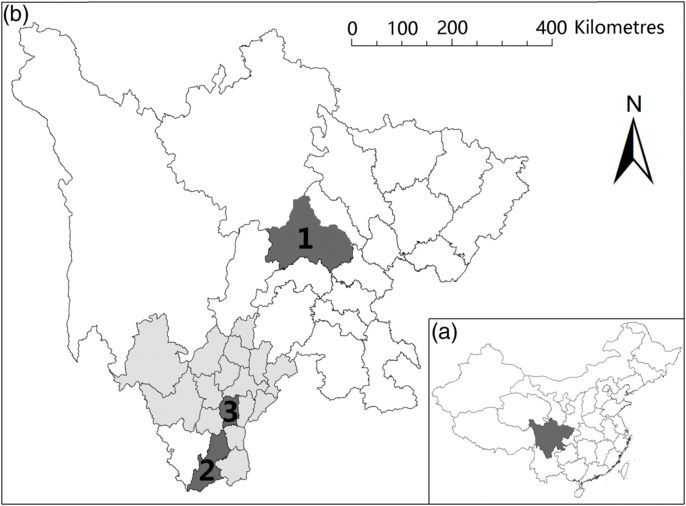
This study was conducted at three distinct urbanization-level locales in central and southwest Sichuan (China, 92°21′∼108°12′E and 26°03′∼34°19′N; Fig. 1), each with ongoing cultural and economic connections to the orchid trade. Chengdu (102°54′∼104°53′E and 30°05′∼31°26′N), the highly urbanized capital, is the province’s most urban and wealthiest locale. The largest sub-provincial city in west China, Chengdu’s total area is 14 605 km2 (population c. 15.7 million) encompassing 20 county-level jurisdictions. The city’s highly developed urban core comprises 1007 km2 (population c. 8 million). With all ethnic groups represented, Chengdu is the historic locus for Sichuan’s major cultural institutions, including universities, museums, herbaria and libraries. The breadth of orchid society members, collectors, vendors and growers is extensive. Transportation routes and government offices are based in and radiate out from Chengdu.
(a) Location of Sichuan Province (dark grey) within China. (b) Research site locations (dark grey): (1) high urbanization (Chengdu City) in central Sichuan; (2) medium urbanization (Huili County); and (3) low urbanization (Puge County), located within Liangshan Yi Autonomous Prefecture (light grey) in southwest Sichuan Province.

The other two locations are in southwest Sichuan’s Liangshan Yi Autonomous Prefecture. Moderately urban Huili County (101°52′∼102°38′E and 26°5′∼27°12′N) comprises 4528 km2 at Sichuan’s southernmost tip, bordering Yunnan Province to the south. With 439 100 residents (as of 2012), Huili is the second most populous of Liangshan’s 17 county-level jurisdictions, and its population (and urbanization level) has been relatively stable for two decades. The county’s two primary ethnic groups are Han (c. 83.2%) and Yi (c. 15.9%). With a peri-urban population of c. 48 000, the county seat of Chengguan Town lies 180 km south of Liangshan’s capital (Xichang City). Huili, historically esteemed for its beautiful Cymbidium, has an active orchid society. In 2011, Chengguan Town was named the 118th ‘National Historical and Cultural City’ by the State Council, partially due to its orchid trade history and influence on traditional orchid culture.
Rural Puge County (102°26′∼102°46′E and 27°13 ′∼27°30′N) comprises 1918 km2. With 155 740 residents (as of the 2010 census), it is Liangshan’s second least populous county-level jurisdiction. Puge’s primary ethnic groups are Yi (c. 74.8%) and Han (c. 24.0%). The county seat, Puji Town (population c. 19 000), lies approximately 74 km southeast of Xichang. Many of Puge’s rural villages have been actively involved with the wild collection and sale of Cymbidium from surrounding mountains, and many individuals continue to maintain household orchid collections. The three levels of urbanization, therefore, are high (Chengdu), moderate (Huili) and low (Puge).
Participant selection
Studies investigating specialized local knowledge dynamics should first identify and select local experts of that knowledge (Davis & Wagner Reference Davis and Wagner2003, Turvey et al. Reference Turvey, Barrett, Hao, Zhang, Zhang and Wang2010). Thus, in order to better isolate urbanization’s effects on the various orchid knowledge domains, we sought to select stakeholders in the orchid trade (i.e., those actively collecting, cultivating or trading Cymbidium) at each urbanization level, rather than the general public. To exclude confounding effects of ethnic culture, only ethnic Han individuals were selected. Due to each jurisdiction’s extremely different size scales, interview participant selection occurred in two ways.
In Chengdu and Huili, since orchid stakeholders were a relatively elite group scattered over a large area, snowball sampling was utilized (Bernard Reference Bernard2011). Initially pinpointed stakeholders were interviewed and asked to identify other stakeholders within their social networks. Following the referrals, the stakeholder networks expanded widely throughout each municipality. In Chengdu, orchid nursery owners were interviewed from the Orchid Exhibition Centre of China and Gaodianzi Flower Market, as were academics, orchid collectors and members of the Chinese Orchid Society, the Orchid Society of Sichuan and the Shuangliu County Orchid Society. In Huili, members of the Huili County Orchid Society, as well as orchid merchants and hobbyists, were interviewed.
To capture knowledge held on the rural scale, farthest away from urban influences, two Han-majority sub-village jurisdictions were selected in Puge County. We chose one from Chechejie Village and one from Gengdi Village due to their long-term involvement in the orchid trade and significant ongoing orchid activity (≥30% of the population currently collecting, cultivating or trading Cymbidium). Interview participants were selected by creating name lists of eligible villagers and randomly selecting within each (Bernard Reference Bernard2011). Children and youths younger than 18 years of age as well as the blind, mentally disabled and elderly with dementia were excluded as ineligible. In total, 91 individuals were interviewed: 31 from Chengdu, 30 from Huili and 30 from Puge (15 per village).
Interview process
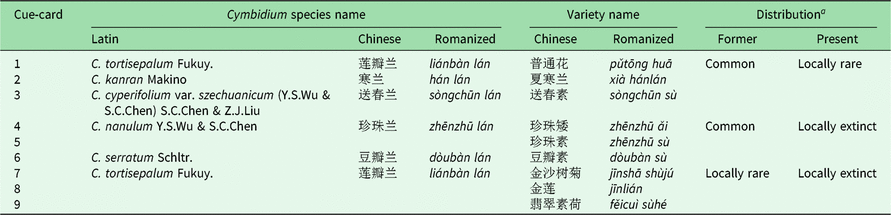
For this knowledge survey, we identified nine Cymbidium taxa native to central and southwest Sichuan, spanning three distinct rarity/local extinction levels, choosing three of each rarity status so that uneven distributions would not bias one locale over another. These were naturally occurring species, subspecies and/or natural varieties, recognized as different taxa in the local Chinese terminology (Table 1). Photographs of each were printed in colour and laminated. These photographic cue-cards (Turvey et al. Reference Turvey, Barrett, Hao, Zhang, Zhang and Wang2010, Bernard Reference Bernard2011) were used between July and December 2015 for all 91 in-person interviews, conducted by the first author and aided by a local speaker.
Identification of nine Cymbidium taxa used for photographic cue-cards. Native to central and southwest Sichuan Province, these were species, subspecies and/or naturally occurring varieties recognized as distinct strains in the local Chinese vernacular.

a Former distributions refer to each taxon’s local distribution before the price speculation-driven overharvest began (late 1980s).
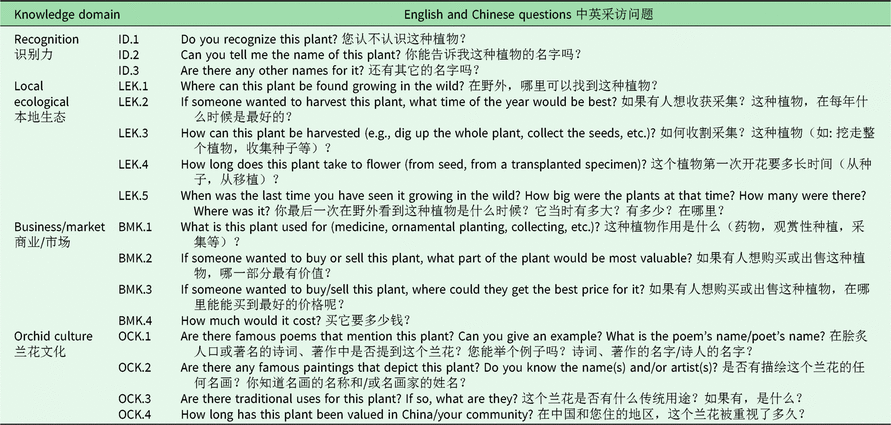
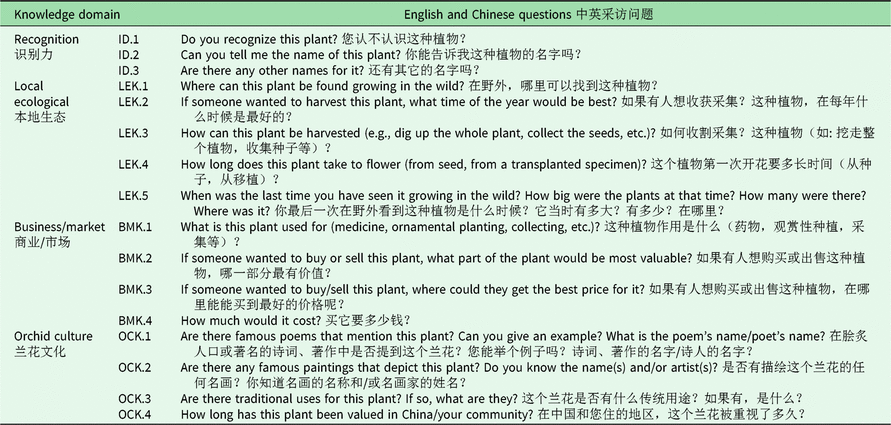
Participants were given a cue-card, asked to identify the plant with a name and then asked for additional names of the same plant. Based on these responses, participants were assigned a ‘plant ID’ knowledge score, ranging from 0 (incorrect) to 4 (most detailed, accurate answer). Then, for the same cue-card, questions were asked for each specific knowledge type in consecutive order (Table 2). Questions were developed from semi-structured interviews that the first author conducted with orchid stakeholders across Sichuan in 2013. This process was repeated for all nine taxa, with the photographic cue-card order randomized for each interview. Since harvesting wild orchids is illegal in China, interviewing those possibly engaged in illicit behaviour raised special research ethics concerns (Gavin et al. Reference Gavin, Solomon and Blank2010). To minimize risk, participants were never asked if they had harvested wild orchids. All interview questions, methods and confidentiality procedures were approved prior to use by the University of Hawai`i Institutional Review Board. Interviews were digitally recorded, transcribed and translated, with coding and qualitative analysis aided by NVivo 11 Plus for Windows (QSR International).
Interview questions used to gauge local knowledge of each orchid taxon.
Response verification
We used ‘agreement with experts’ techniques to verify response accuracy and to more objectively assign knowledge scores (Davis & Wagner Reference Davis and Wagner2003, Reyes-García et al. Reference Reyes-García, Vadez, Tanner, McDade, Huanca and Leonard2006, Kightley et al. Reference Kightley, Reyes-García, Demps, Magtanong, Ramonez, Thampy and Stepp2016). Only two participants correctly identified all nine specimens, so participants scoring ≥3.5 for plant ID averaged across all nine orchid taxa were treated as experts (14 in total). For correctly identified taxa, their answers were used as the baseline for other questions, comparing it to the entirety of responses at each location to ensure the ‘expert baseline’ was appropriate for each. Many participants answered ‘same’ for multiple interview questions. These were scored as 0. Though some may have intended more detailed answers previously given for different taxa, this was not universal. Multiple participants used ‘same’ to refer to previous ‘I don’t know’ statements. Since cue-card order was randomized in each interview, scoring all ‘same’ responses as 0 did not introduce bias. The negative impact on knowledgeable, less verbose individuals was balanced by avoiding score inflation for those intending ‘same’ as ‘I don’t know.’
Data analysis
We assembled four knowledge score matrices: (1) aggregate (with all knowledge scores, including one for plant ID; fourteen total); (2) LEK (five); (3) BMK (four); and (d) OCK (four). We averaged knowledge scores by rarity status, so each participant had three knowledge scores per question for further analysis. For each matrix, we calculated Cronbach’s α (Romney et al. Reference Romney, Weller and Batchelder1986, Reyes-García et al. Reference Reyes-García, Vadez, Tanner, McDade, Huanca and Leonard2006) in order to verify that each represented distinct knowledge types. The Cronbach’s α values for the aggregate, LEK and BMK matrices were all >0.8, suggesting that they represented meaningful contrasts as distinct knowledge domains. However, for OCK, the Cronbach’s α was 0.67, which was slightly below the 0.7 cut-off. Due to the cultural importance of this type of knowledge, we continued to use OCK as a construct for each additional analysis, taking care to interpret the results cautiously.
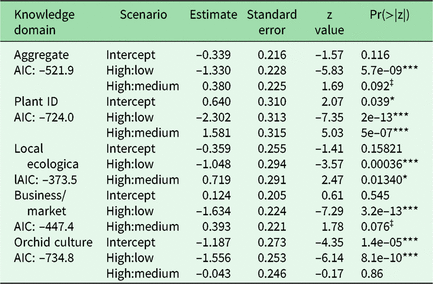
We summed individual scores within each matrix, converting to proportion data by dividing by the maximum possible score. All knowledge types were strongly correlated (Supplementary Fig. S1, available online), indicating that each domain could act as an appropriate proxy for an individual’s overall orchid knowledge. To test how urbanization impacts the distribution of aggregate orchid knowledge, we utilized a generalized linear mixed effect model (GLMM) through the glmmADMB package in R (version 3.3.2), with β error distribution (Ferrari & Cribari-Neto Reference Ferrari and Cribari-Neto2004), urbanization as the fixed effect and participant and rarity status as random effects. We chose the GLMM due to its ability to control for multiple random effects (Bolker et al. Reference Bolker, Skaug, Magnusson and Nielsen2012). We compared the effect sizes and their significance for two urbanization scenarios: high urbanization (Chengdu) versus low urbanization (Puge), and high urbanization (Chengdu) versus moderate urbanization (Huili). We developed separate GLMMs using the same urbanization scenarios for each orchid knowledge domain (Table 3).
Generalized linear mixed effect model coefficients for effect of urbanization on each orchid knowledge domain.
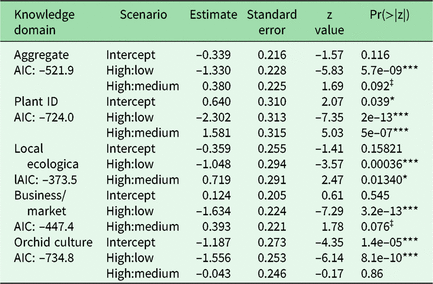
Significance codes: ***<0.001, **<0.01, *<0.05, ‡<0.1.
AIC = Akaike information criterion.
Results
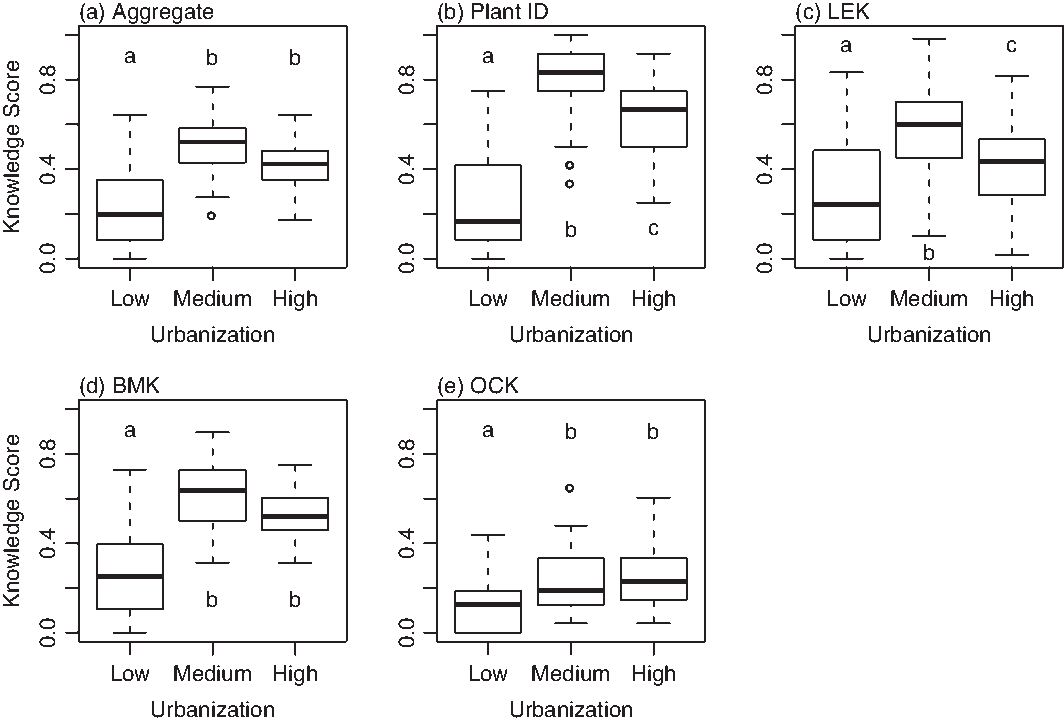
Urbanization was positively related to aggregate orchid knowledge (Fig. 2, Table 3); people had significantly higher aggregate orchid knowledge in urban Chengdu than rural Puge (effect size β = –1.330 ± 0.228, p < 0.001). However, there was no significant difference between the two highest urbanization levels (Chengdu and Huili) for aggregate knowledge (β = 0.380 ± 0.225, p = 0.092), and the relationship between urbanization and knowledge distribution differed in magnitude for each specific domain (Fig. 2, Table 3). People in urban Chengdu were more likely to correctly identify taxa (plant ID, β = –2.302 ± 0.313, p < 0.001) and had significantly more LEK (β = –1.048 ± 0.294, p < 0.001), BMK (β = –1.634 ± 0.224, p < 0.001) and OCK (β = –1.556 ± 0.253, p < 0.001) than people in the rural villages (Puge). Like the distribution of aggregate orchid knowledge, there was no significant difference in BMK (β = 0.393 ± 0.221, p = 0.08) or OCK (β = –0.043 ± 0.246, p = 0.90) between the two higher urbanization levels (Chengdu and Huili). However, people in Huili (moderate urbanization) had significantly higher scores for plant ID (β = 1.581 ± 0.315, p < 0.001) and LEK (β = 0.719 ± 0.291, p < 0.05) than those in Chengdu (high urbanization).
Effect of urbanization on type of knowledge. Significance levels: (a) (b) (d), and (e): p < 0.001; (c) ‘a’ p < 0.001, ‘b’ p < 0.05. BMK = business/market knowledge; LEK = local ecological knowledge; OCK = orchid culture knowledge.

LEK was present at every urbanization level, but qualitatively manifested differently. For example, in urban Chengdu, participants provided more general information to delineate orchid native ranges (e.g., naming provinces and altitudes). In contrast, in rural Puge, participants named specific mountains and valleys where the orchids had previously grown, rarely mentioning localities beyond Yunnan or Guizhou (neighbouring provinces). Yet in moderately urbanized Huili, participants tended to employ both methods to denote species nativity, describing exact locations (mountains/valleys) where the taxon once grew, while also providing their geographic extent by naming provinces and altitudes. This scale difference did not affect participant knowledge scores, however, since higher scores were based on specificity within a scale without favouring one scale over another.
Plant ID followed a similar pattern; participants from moderately urbanized Huili scored significantly higher than both extremes (average of >80% correctly identified versus <70% for highly urbanized Chengdu and <20% for rural Puge) (Fig. 2). Plant ID in Chengdu (high urbanization), though significantly lower than Huili, was still significantly higher than Puge (low urbanization). While identifying taxa, Puge participants who recognized an orchid tended to provide unique morphological characteristics as common names (e.g., ‘common flower’, ‘large-petalled’ or ‘unspotted’) rather than technical names. In Chengdu, participants usually provided technical names without elaborating. In contrast, Huili participants tended to do both, providing both technical names and differentiating features. For this study, participants were scored based on accuracy, regardless of which method they employed, but participants in Huili seemed to make fewer mistakes in identifying technical names by relying also on differentiating morphological characteristics.
Qualitatively, interviews revealed several trends concerning orchid market dynamics, continued overharvest and how orchid rarity/extinction affects the perceived utility and resultant spatial distribution of orchid knowledge across the rural–urban gradient. Though increasing urbanization could decrease rural orchid harvest pressure, one Chengdu participant, a Shuangliu County Orchid Society officer, explained that with c. 50 000 active orchid collectors throughout Chengdu, there remained a high level of pressure on wild populations to support this demand. At each urbanization level, participants described the high economic value of orchids. In 2006, 26 Huili families pooled resources to buy a wild-collected natural mutation of Cymbidium tortisepalum (taxon #7, Table 1) for >¥4.6 million Chinese Yuan (CNY) (US$1 = CN¥7.97, 2006 average; c. US$580 000). Each ‘shareholder’ became wealthy selling vegetatively propagated clones of this orchid and other valuable varieties. During the market peak, one Huili participant traded two orchids for a brand-new BMW from a car dealer in Yunnan. Several Chengdu and Huili participants explained that their orchid collections were once valued at tens of millions of US dollars. One Huili collector constructed greenhouses on top of his building to house his large collection, employing four people to care for them. He also hired armed guards (2005–2006) due to the risk of theft. On a much smaller scale, multiple Puge villagers had made tens of thousands of dollars selling locally collected orchids to ‘orchid speculators’ from big cities.
Many participants also lamented how severe orchid population decline meant that rural residents no longer benefit from wild access, possibly contributing to heightened knowledge loss there. For example, Huili participants noted varieties of C. nanulum (taxa #4 and #5, Table 1) used to be common, but they now “face extinction” and “are no longer on the mountains.” Chengdu participants similarly noted many Cymbidium taxa no longer persist in the wild, with all but the most common species being locally extinct. However, participants from both of the more urban areas could still access locally extinct species in private collections (including their own). In contrast, many rural Puge participants had never seen orchid flowers. Even Puge villagers who were actively maintaining orchid collections rarely saw their orchids flower before selling them to urban collectors. With continued overharvest, only small orchid root re-sprouts (seedling-like growths from the root fragments of formerly harvested orchids) remain in the wild. These also rarely grow large enough to flower before being collected and sold at market. With many species now locally extinct, several younger Puge participants only know of them from books.
Multiple Huili participants regretted that their orchid knowledge was not as extensive as before, since the noticeable downturn in the orchid market (particularly post-2008) made orchid knowledge acquisition less worthwhile. Consequently, membership in Huili’s Orchid Society also declined. Before 2010, there were hundreds of members, but membership later declined to a few dozen enthusiasts. One participant explained, “The people are still here, but the value of orchids is not good anymore. Now many have transitioned into other businesses. They are not as free to attend orchid meetings anymore.” The most prominent orchid shop in Huili in 2013 had closed by 2015, being converted into an English education business. Nevertheless, even as orchid economic valuation declined, several participants remarked, orchids “remain priceless” and are “the most valuable thing there is.”
Distinct changes in Chengdu orchid markets also occurred. In 2013, many Gaodianzi Flower Market shops only sold Cymbidium (wild collected from rural areas), but five shops had begun selling Phalaenopsis and Dendrobium hybrids with larger/showier flowers. Tissue cultured and seen as catering to a ‘Western’ beauty aesthetic, these were increasingly popular with the growing urban, younger middle class. In 2013, one shop owner explained, “I previously only sold Cymbidium, but one day a man came and gave me his business card, explaining he sells tissue-cultured Phalaenopsis, Dendrobium, Oncidium and hybrid cultivars of Cymbidium grown in his greenhouses. He was a scientist with a business mind, so he offered to help me grow and sell them.” By 2015, nearly all shops had moved away from selling wild-collected Cymbidium (many older shops closed entirely); only a few exclusively sold Cymbidium. In 2013, orchid collectors throughout Sichuan adamantly insisted there was “no value” in artificially hybridized Cymbidium cultivars, believing that only wild-collected specimens had value. Although wild-collected/naturally occurring mutants are still the most valuable and desired, the increasing willingness of urban Chinese orchid collectors (and the broader public) to buy hybrids and tissue-cultured clones has strong implications for urbanization’s long-term effect on natural resource demand.
Discussion
We found significant effects of urbanization on the distribution of orchid knowledge. Unlike most studies that have found a negative relationship between increasing urbanization and ethnobotanical knowledge (Voeks & Leony Reference Voeks and Leony2004, Reyes-García et al. Reference Reyes-García, Vadez, Huanca, Leonard and McDade2007b, Reference Reyes-García, Guèze, Luz, Paneque-Gálvez, Macía and Orta-Martínez2013, Brandt et al. Reference Brandt, Mathez-Stiefel, Lachmuth, Hensen and Rist2013, Gandolfo & Hanazaki Reference Gandolfo and Hanazaki2014), we found a positive relationship similar to Vandebroek and Balick (Reference Vandebroek and Balick2012). One important caveat is that we did not sample the general public, but rather those actively collecting, cultivating or trading Cymbidium. Multiple studies of knowledge distribution dynamics routinely sample subpopulations like fishermen (Bender et al. Reference Bender, Floeter and Hanazaki2013, Davis & Wagner Reference Davis and Wagner2003, Hallwass et al. Reference Hallwass, Lopes, Juras and Silvano2013), medicinal plant merchants, practitioners or lay-users (McMillen Reference McMillen2012, Vandebroek & Balick Reference Vandebroek and Balick2012), herders (Gaoue & Ticktin Reference Gaoue and Ticktin2009) or other clearly defined subpopulations based on subject familiarity and relevance to specific research objectives.
Müller-Schwarze (Reference Müller-Schwarze2006) argued that since all community segments do not utilize plants in the same way, the knowledge they possess would differ; therefore, sampling specialist subsamples (healers, musicians, etc.) is appropriate when investigating specific knowledge. Turvey et al. (Reference Turvey, Barrett, Hao, Zhang, Zhang and Wang2010) similarly studied knowledge loss following Yangtse River megafaunal extinction by selecting people who were considered ‘knowledgeable’ about the relevant taxa. However, Reyes-García (Reference Reyes-García2010) argued that studies solely focusing on specialists (e.g., folk healers/shamans) fail to understand the full breadth of knowledge held within a wider community. The present study’s objectives, however, were not to document all knowledge held, nor explore every mechanism of knowledge acquisition/loss, but to understand more broadly how various knowledge domains might react differently to urbanization. Second, like Vandebroek and Balick (Reference Vandebroek and Balick2012), who selected ‘laypersons’ who used medicinal plants but were not ‘traditional healers’, we did not specifically select ‘specialists’, but rather selected those who were actively engaged in the orchid trade.
Because actively engaged individuals are more likely to possess orchid knowledge, sampling them better measures the dynamic effects of other variables (e.g., urbanization and knowledge domain). Their expertise is precisely due to their orchid appreciation and orchid trade involvement (mechanisms for orchid knowledge acquisition), but, with declining orchid populations threatening knowledge, the effect of urbanization is made clearer by this subset (i.e., if even they do not have certain knowledge, then this knowledge is at greater risk). We expected urbanization would positively affect some orchid knowledge domains and negatively affect others, but every measured domain had a positive relationship. Nevertheless, the extent of this positive relationship varied significantly by domain, supporting our main hypothesis that urbanization’s effect on orchid knowledge would differ by domain (Benz et al. Reference Benz, Cevallos, Santana, Rosales and Graf2000, Voeks & Leony Reference Voeks and Leony2004, Reyes-García et al. Reference Reyes-García, Martí, McDade, Tanner and Vadez2007a, Furusawa Reference Furusawa2009).
Despite expecting that urbanization would negatively impact LEK (Voeks & Leony Reference Voeks and Leony2004, Reyes-García et al. Reference Reyes-García, Guèze, Luz, Paneque-Gálvez, Macía and Orta-Martínez2013, Gandolfo & Hanazaki Reference Gandolfo and Hanazaki2014) due to a disconnect between urban environments and native orchid habitats, our data showed otherwise. LEK was significantly lower in Puge’s rural villages (low urbanization), than either Huili (moderate urbanization) or Chengdu (high urbanization), but this relationship was not linear (Fig. 2); moderately urbanized Huili had significantly higher LEK, with participants there benefitting from the worldviews/perspectives of both urbanization extremes (e.g., knowing the orchid distribution from both provincial/altitudinal and mountain/valley perspectives). This emphasizes the importance of considering the effects of both knowledge domain (Müller-Schwarze Reference Müller-Schwarze2006; Reyes-García et al. Reference Reyes-García, Vadez, Huanca, Leonard and McDade2007b; Souto & Ticktin Reference Souto and Ticktin2012) and geographic/cultural scale when studying urbanization’s effect on knowledge dynamics (Müller-Schwarze Reference Müller-Schwarze2006, Vandebroek & Balick Reference Vandebroek and Balick2012, Gaoue et al. Reference Gaoue, Coe, Bond, Hart, Seyler and McMillen2017).
Similarly, Huili participants (moderately urban) utilized the plant ID knowledge perspectives of both urbanization extremes (providing each taxon’s technical names and differentiating features). This further illustrates that one need not know a plant’s name to correctly recognize/distinguish it, drawing into question whether using one’s ability to correctly name a plant as many studies have done (Wang et al. Reference Wang, Liu, Hu and Gao2004, Zarger & Stepp Reference Zarger and Stepp2004, Shenton et al. Reference Shenton, Ross, Kohut and Waxman2011) is the best proxy for an individual’s overall ethnobotanical knowledge. In the present study’s context, the LEK and BMK domains represented better proxies of an individual’s overall (aggregate) orchid knowledge (Supplementary Fig. S1). Thus, investigators should assess the appropriateness of using various knowledge domains as proxies for overall knowledge within a local context before selecting which to use within a broader investigation of local knowledge dynamics.
One limitation in our plant ID knowledge assessment was that all three questions (Table 2) elicited similar responses, so we could only assign one plant ID knowledge score per individual. This knowledge domain was, therefore, not as robust as the other three. Furthermore, these three questions did not sufficiently differentiate participants who could correctly identify a taxon as Cymbidium but were unsure of which species it belonged to from participants who could not recognize orchids. Consequently, for future studies, a more robust plant ID measure should ask: (1) ‘What kind of plant is this?’ rather than ‘Do you recognize this plant?’; and (2) ‘What characteristics allow you to make this identification?’ Including a photographic cue-card of a ‘dummy’ plant superficially resembling an orchid (e.g., Iris spp., Chlorophytum spp., Liriope spp.) to see which respondents correctly differentiated them would also increase plant ID robustness.
As expected, OCK was the least abundant domain across all three urbanization levels, but urbanization also positively affected it (Fig. 2, Table 3). There was no significant difference between Chengdu (high urbanization) and Huili (moderate urbanization) for this domain, but both were significantly higher than Puge (low urbanization). This overall trend also existed for BMK. Since people abandon knowledge that is not perceived as valuable (Reyes-García et al. Reference Reyes-García, Guèze, Luz, Paneque-Gálvez, Macía and Orta-Martínez2013), these two knowledge domains apparently remain valuable in urban environments.
These results highlight the importance of investigating the distribution of knowledge in different local contexts and different geographical scales (Zarger & Stepp Reference Zarger and Stepp2004, Furusawa Reference Furusawa2009). Our study indicates that OCK increases with urbanization, but due to it being the rarest domain, it may be especially vulnerable to loss long term, even in urban areas, as wild species are driven to extinction. Multiple participants scoring highly in OCK (across urbanization levels) were first inspired to learn this knowledge domain as youths when older friends/family took them to mountains to see flowering orchids. They explained that viewing orchids growing in their native habitats is necessary to fully appreciate the traditional Chinese orchid aesthetic and to properly interpret the classics in Chinese material culture (paintings, pottery, etc.) and scholarly literature (poetry, pilgrimage accounts, pharmacopeias, etc.). The inability to view healthy wild orchid populations, they believed, was negatively affecting this highly refined aspect of Chinese culture, severing the ability to ‘inspire’ young minds to acquire OCK. Declining wild populations may also explain why, contrary to expectations, LEK was greater in urban areas. Since access helps drive knowledge acquisition, the maintenance of wild-extinct species in urban collections may delay knowledge decline in urban areas compared with more noticeable declines in rural areas.
Investigating the mechanisms of orchid knowledge transmission/acquisition was beyond this study’s scope, but is worth further study (Reyes-Garcia et al. Reference Reyes-García, Broesch, Calvet-Mir, Fuentes-Peláez, McDade and Parsa2009, McMillen Reference McMillen2012, Gaoue et al. Reference Gaoue, Coe, Bond, Hart, Seyler and McMillen2017), particularly in terms of how urbanization might influence these mechanisms. Though we found that all orchid knowledge domains positively correlated with increasing urbanization, follow-up studies are needed to test this relationship’s robustness over time (Zarger & Stepp Reference Zarger and Stepp2004, Reyes-García et al. Reference Reyes-García, Guèze, Luz, Paneque-Gálvez, Macía and Orta-Martínez2013). Particularly for public policy and biocultural diversity conservation efforts, as species further decline in the wild, rural people may be especially inhibited in acquiring plant-specific knowledge. Since wild-extinct orchids are no longer available locally, the only people who can view them are the wealthy with personal collections or those who have access to pubic repositories such as parks and botanical gardens.
Conclusion
By investigating the prevalence of four orchid knowledge domains in three Sichuan communities of distinct urbanization levels, this project tested how increasing urbanization affects knowledge distribution. Our findings support our main hypothesis that urbanization’s impact on cultural knowledge differs by knowledge domain. Orchid knowledge was significantly lower in rural Puge (low urbanization) than Chengdu (high urbanization) and Huili (moderate urbanization), indicating that urbanization may assist the ongoing maintenance of orchid knowledge. Though certain knowledge domains may benefit from rural proximity to species in their natural habitat, this benefit diminishes as wild populations decline. Urban communities also offer distinct advantages, including better infrastructure, greater education access and major cultural institutions such as museums, libraries, herbaria and botanical gardens. These benefits may help ‘professionalize’ knowledge as a trade becomes more lucrative and elite in urbanized communities. Nevertheless, since all orchid knowledge domains were significantly higher in moderately urbanized Huili, moderately urban jurisdictions may be best suited for local knowledge preservation and retention, aided by both modern urban amenities and proximity to natural habitats. With increasing global urbanization, environmental degradation and plant extinctions, these findings provide insights for biocultural diversity conservation efforts in China and beyond, suggesting moderately urban locations are ideally suited for biocultural diversity conservation.
Author ORCIDs
Barnabas C Seyler 0000-0002-4823-8793
Supplementary Material
For supplementary material accompanying this paper, visit multimediafluids.uam.elogim.com/core/journals/environmental-conservation.
Acknowledgements
We thank Shidu Liu, the Huili County Orchid Society’s president, who assisted with the selection and identification of orchid taxa. Thanks to Weihong Guo (Orchid Exhibition Centre of China, Chengdu), Tingfu Yang (Puge Forestry Bureau) and Zhengyang Su, who provided logistical assistance, as well as Song Zhang, who helped create Figure. 1.
Financial support
Funding for BCS was partially covered by the US National Science Foundation (Award #1514945), Ministry of Science and Technology of China, China Science and Technology Exchange Centre, Sichuan University and the East–West Center, as well as the Department of Botany, Graduate Student Organization, and Pacific Cooperative Studies Unit at the University of Hawai`i at Mānoa.
Conflict of interest
None.
Ethical standards
The authors assert that all procedures contributing to this work comply with applicable ethical standards of the relevant national and institutional committees on human experimentation and with the Helsinki Declaration of 1975, as revised in 2008.