Introduction: borders and borderlands theory
In 1948, an immigration inspector stationed in Arakan, the westernmost state in Burma, alerted his superior in Rangoon to a particularly alarming situation: a large number of immigrants were entering the state illegally, and Arakanese village headmen and locals were actively harbouring them. Indeed, they tutored the immigrants on how to answer police or immigration authorities’ questions about which village or hill tract they belonged to and, worse, actually helped them settle there. The inspector added that the influx was so extensive that many established East Pakistan villages had disappeared, replaced by the ones settled by the newly arrived immigrants around Kwazon township in Arakan. Detailing their routes, the officer observed that if the rate of their arrival continued, the size of the Muslim community would soon double—this activity, he concluded, clearly exposed Pakistan's designs on Burmese soil.Footnote 2
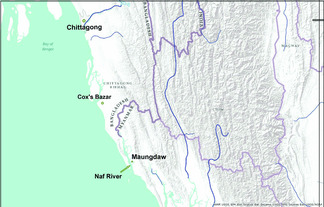
India-Bangladesh (East Pakistan)-Myanmar (Burma) borders.Footnote 1

This article offers a critical and engaging historical study of a border that is increasingly important, but poorly understood. It has been almost systematically neglected in the increasingly booming field of border studies in South and Southeast Asia.Footnote 3 While there has been significant attention paid in recent years to the India-Bangladesh border, there has been little study of the India-Burma border and almost no historical investigation of the Bangladesh-Burma border. This is surprising, given that today the border is in the international media spotlight because of the condition of Rohingya refugees faced with ‘army clearance operations’ who desperately try to cross the border into Bangladesh. This gap has impaired our ability to write and speak in grounded ways about the current crisis of migration, displacement, and statelessness facing (among other groups) the Rohingya. In tracing the longer trajectory of both attempts at state control and claims of belonging and citizenship in the borderlands, it brings to light a fascinating chapter in the history of this very recent border, thus historicizing recent events.
The limited historiography on immediate post-independence Burma (after 1948) depicts the Arakan borderland as plagued by communist and Muslim separatist movements actively abetted by neighbouring states and aimed at destabilizing the nascent Burmese nation. These groups were seen as responsible not only for bringing illegal immigrants into Arakan but also for trafficking pilfered rice across the border into Pakistan.Footnote 4 This state-centric scholarship depicts this difficult terrain degenerating over decades into semi-banditry, with the general population as the victims. Political instability, inter-ethnic conflict, and land-strapped peasants bred a permanent condition of ‘lawlessness’ and ‘disturbance’ on both sides of the border and in the whole India-Burma-Pakistan/Bangladesh borderland region.Footnote 5
Instead of accepting the established historiographical narrative of ‘illegal’ border crossers being sent across by neighbouring states (a rhetoric regularly used by the Myanmar government even today), we should first ask who these border crossers were, why they crossed the borders, and why people on the other side of the border so often aided them. Questioning the standard account thus focuses attention on the historic claims of different borderland ethnic groups and on their relationships with each other and the state. In doing so, this article attains a dual aim: first, it traces both the creation of a physical border and the political ideas that task required and, second, it shows how the state thereby defined citizens and foreigners (or infiltrators) who do not belong to the body of the nation. Very importantly, as we shall see, distinctions between citizen and non-citizen, and their consequent rights, would now be decided on the basis of belonging or not belonging to the state's majority ethnic groups and religion.
One of the imperatives for scholars studying borderlands has been to move beyond the area study paradigm that has dominated the academic landscape since the post-Second World War period. The powerful geographic imagery of area studies—South Asia, Southeast Asia, and so on—have suggested a certain homogeneity across each area that could be projected back in time. Even more problematic has been the dominance of certain heartland regions or zones within these meta geographical, symbolic, and institutional spaces, which has eclipsed our understanding of the ‘peripheries’ or ‘fringes’ of these entities. The Burma-Bangladesh-India borderland has been one such historic zone, unable to slot neatly into either modern South or Southeast Asia and hence relegated to the sidelines.Footnote 6 This article brings to light the ‘troubled’ history of the space, the close examination of which would allow us to critically rethink how the state functions in liminal zones, and how it articulates its sovereignty—both externally against neighbouring states and internally between groups. Thus, the manner in which the state interacts with these hybrid transnational zones—through bureaucratic paperwork and immigration control on a daily basis and large-scale militarization, transmigration programmes, and taxation on larger, more contentious levels—reflects how the state fashions an ‘affective’ border. This, in turn, helps it determine who may cross, on what terms, and how they are treated when they do.Footnote 7 Through this study, we move out of the meta categories of mainland South and Southeast Asia and rethink how these peripheries, in fact, shaped the histories of the heartland regions.
The state remains a constant player through whose eyes border crossers and their actions were, and are, deemed illegal and yet its actions still beg the question of why people continuously cross the borders. Current scholarly literature on refugee populations and the borderlands of India and East Pakistan has enriched our understanding of post-colonial state-making and its relationship with people who sought to traverse cross-constructed frontiers.Footnote 8 Preventing borderland people from crossing borders or persecuting them could certainly turn them into refugees.Footnote 9 But not all border crossers are asylum seekers. People living in the borderlands may have a long history of crossing a man-made or natural border daily, weekly, or monthly because of economic and social necessity. They include itinerant traders and day-labourers; peasants and others dependent on forest and land resources and on access to markets to sell their produce; and families visiting relatives across the border to mark festivals, marriages, births, or deaths. One therefore needs to understand this daily contest between the borderlanders and the state, and how each of them understood their rights to this portion of land and waters, and in turn, claims and challenges to citizenship.
This article therefore investigates the Burma-East Pakistan-India borderland beyond lines drawn in land and water by the state. The first section revisits the contentious history of this zone as the theatre of a power struggle between the Burmese and the British Indian empire in the eighteenth and nineteenth centuries. Demographic shifts from voluntary and forced migrations, political rebalancing between religious and ethnic groups due to outside interventions, and the imposition of new processes of border control mark this era. The conquest of Burma by the British East India Company and then by the British Crown in the nineteenth century and the desperate official attempts to create a ‘hard’ border between Burma, China, and Siam afford an illuminating example of the state's gradual construction of the categories of ‘citizen’ and ‘stranger’.
The second section investigates the Burma borderlands during and immediately after the Second World War and independence. The administrative split of Burma and the partition of the Indian subcontinent, which was meant to resolve ethnic disputes and save minorities’ rights actually invited fresh conflicts. People suddenly found themselves on a side of a border that made them minorities in a Muslim, Hindu, or Buddhist majority population. As a result, border crossings were often viciously penalized and even legitimate requests for passes into Pakistan, India, or Burma aroused suspicion in each country's intelligence departments. In part, the very newness of the bureaucracies baffled its administrators. At the same time, officials in one state seemed hesitant even to acknowledge their counterparts’ power in another state—one in which they would be the distrusted minority.
In the third section, the article analyses borderlanders making historical claims to this space in their quest for political representation and territorial control as well as the state's response or non-response to them. The militarization of the region in the wake of the Japanese invasion and Allied defence prepared the ground for recruitment into and organization of separatist fighting units. Following independence, then, the military forces of the government and local military entrepreneurs continued to struggle for control of the borderlands.
Bengal-Burma borderlands
Understanding the clash between state claims and those of border crossers necessitates exploring the history of sociocultural space in the borderland. The development of ancient and early modern Arakan exceeds the scope of this article. But the array of strategies improvised by colonial and post-colonial states to control the movement of people and commodities across rivers and land vividly illustrates flaws in their concepts and policies regarding the border. Indeed, the nineteenth- and twentieth-century history of this particular borderland epitomizes that of the British empire in South Asia more generally, its conflict with other empires, and newly independent states’ immigration rules as a discourse on sociopolitical nationality and nonentity.
In 1937, Burma was officially separated from the British Indian empire. With the conclusion of the Second World War and Japanese occupation in 1948, the country became independent, sharing borders with newly independent countries of India, East Pakistan, China, and Siam (Thailand). Thus, in the long saga of state intervention to control the movement of people, the birth of India, Pakistan, and Burma as nation-states created a new set of boundaries. Some crossers failed to appreciate the importance of these novel lines and continued to traverse them out of genuine ignorance or of a feeling that it did not concern them personally. At the same time, the cumbersome and expensive procedure of getting the papers required for crossing the border legally encouraged others to simply evade the process. In one 1949 example, the local immigration officer in Maungdaw wrote to the controller of immigration in Rangoon, Burma, to inform him of the number of cases in which Arakanese Buddhists from Maungdaw had crossed the river without permits to visit relatives, had been arrested by Pakistani authorities, and were sent to Cox's Bazar for further enquiries for fear that they might be communists.Footnote 10
Hence, the category of border crossers encompassed an impressive range of people. From 1951 to 1952 in Bengal borderlands, several thousand nomadic cultivators from Tripura (in India) crossed the borders to Chittagong Hill Tracts (Pakistan) and began cultivating plots there—hardly exceptional, as such cultivators had been migrating throughout these hills for generations. Now, however, the border police violently evicted them, as they were seen as interlopers in a reserved forested area. But the practice of crossing the border to farm would persist among shifting cultivators in the section of the borderland linking East Pakistan and Burma, with its vaguely demarcated border, difficult terrain, weak state presence, and multiplicity of ethnic groups. In brief, cross-border webs of kinship and sociability continued to support cross-border patterns of slash-and-burn cultivation.Footnote 11
Border crossers might also have included members of the border police themselves. In November 1949, the embassy of Pakistan in Burma wrote a strongly worded letter regarding the violation of their territorial waters and the harassment of Pakistani merchants carrying goods along the Naf River. On 17 November, a patrol party of four armed constables was attacked by no less than 40 armed soldiers soon after the party had passed Noya-para khal, which, the ambassador claimed, was within Pakistani waters.Footnote 12 There, where the river spanned about 180 metres, Burmese forces searched the sampans and seized their goods and money. The ambassador demanded a thorough investigation and punishment sufficient to prevent the recurrence of such incidents.Footnote 13
Rather than conveniently following a straight line, the Bengal-Burma border zigzags through the countryside.Footnote 14 More complicated yet, its rivers were considered as rigid borderlines and, worse yet, the border might be held to run through the river's precise middle, track an entirely arbitrary line through it, follow its deepest channel, or be fixed along one of its banks. And since none of the waterways had been demarcated before, it should be no surprise that many border disputes between India, Pakistan, and Burma focused on rivers.Footnote 15 Moreover, altercations between the border security parties of both countries reveal a number of uncharted bureaucratic situations emerging in the post-independence period, including an overwhelming increase in the appearance of the state apparatus. Although the Arakan borderland had seen its fair share of fighting during the Second World War, the state had been a fairly distant entity for most borderlanders. But after independence it was everywhere. The sheer number of state personnel shot up and they began to regulate aspects of life which, while crucial to borderlanders’ livelihoods, had never been of much concern to the state. Specifically, their customary rights to movement and to land and forested areas were curtailed, and border police and the army often subjected them to searches and harassment. Strategies employed by such groups on the borderland in the face of such upheaval varied from outright defiance to complex and innovative accommodation.
Recent work on the post-partition borderlands in South Asia, particularly on the Bengal border, provides us with insight into the experiences of people living in the borderlands and enclaves within these nation-states.Footnote 16 Through his interviews with residents of Dahagram on the India-Bangladesh border, Cons shows how questions of citizenship, displacement, security (both national and personal), and rights are all subsumed under a wide range of notions about belonging, possession, and dispossession. Freedom of movement and the ability to hold onto or release material goods—whether land, clothing, houses, crops, or livestock—link intimately to issues of community and identity.Footnote 17 This critical concept of ‘belonging’ often underlay major episodes of violence in the borderland as well as citizens’ daily humiliation and harassment by the border security force. Routinized brutality seemed to become an everyday occurrence on the borderlands. Thus, the attempt to regulate movement by the state only led to increased ‘illegal’ border crossings by often-desperate residents who, on being caught, were subjected to another round of violence, fines, and often longer-than-usual imprisonment.
Ignoring migration rules could turn into open defiance against state personnel. In official correspondence, the commissioner in Arakan detailed a spate of ‘disturbances’ perpetrated by local ‘bandits’ and ‘dacoits’ who had taken to collecting arms and threatening the local villagers near the mouth of the river. Going even further, they had begun attacking boats carrying rice across the river and although they had not yet ventured to target the Arakan Flotilla Company's weekly mail craft, service and travel between Kyaukpyu and the nearby harbour (now called Ann) involved considerable danger to life and property.Footnote 18 On many other occasions, though, large groups openly defied the border regulations and security forces. Between March and May of 1949, a series of official communications from the Indian to the Burmese government complained that villagers from the Burmese side had launched armed raids and destroyed five miles of telegraph lines in the state of Assam. The Indian government dispatched a unit of Assam Rifles to confront this brazen ‘banditry’ and remarked that stopping such incursions, often linked to time-honoured headhunting practices among certain ‘tribal’ communities, demanded joint military initiatives from both governments.Footnote 19
If demarcating the lengthy border was a challenging and delicate job in treacherous terrain, guarding and maintaining it on a day-to-day basis was often an even more difficult enterprise. Despite increased numbers of custom posts, border patrols, immigration offices, and toll stations, the borders remained a stubbornly evasive space. The more effort the state—both colonial and post-colonial—put into implementing immigration rules and asserting control over ‘primitive’ economies and peoples, the more complicated the relationship with these subject communities became. Despite all attempts, state presence here remained at best fragile, tenuous, and frequently challenged. In an interesting and exasperated letter from the local immigration officer in Chittagong to his superior in Rangoon, the official mentions
It is a fact well known to most people of Burma that most people of this area especially the Chittagong district can easily be compared with wild beasts and cattle that can only be controlled by shouts, weapons, firearms etc., and sometimes when they are rushing into the office like cattle, my staff and myself have to control such crowds by shouting and pushing to prevent them from being suffocated due to the heavy rush.Footnote 20
Over the decades, with the takeover by the military dictatorship in Burma in 1962 and upheavals leading to the establishment of Bangladesh in 1971, new kinds of political and bureaucratic fences arose against minority ethnic groups in the region. Today, the border between Myanmar and Bangladesh is dotted with refugee camps housing 28,000 registered ethnic minority Rohingya—remnants of the 250,000 ethnic, linguistic, and religious minority people who fled Myanmar's western Rakhine state in 1991—and the Bangladeshi qualification of these invisible refugees as ‘economic migrants’.Footnote 21
This article contributes to the field of borderland studies by illuminating everyday life in border zones through the prism of border crossing, borderlanders’ claims, and states’ attempts to control borders in the immediate post-independence period. This painful dance of policing and people's responses to it would refine the requirements, and the rights, of citizenship in each of the new nation-states. Its novel markers—documentation required for border crossing—were too costly for many borderlanders, and therefore engendered petitions and protests that challenged state encroachment on centuries-old rights to cross rivers that, suddenly, had become political boundaries. Studying how these borders were formed, resisted, and defended throughout the nineteenth to the mid-twentieth centuries gives us a historically informed insight into past and current ‘cross-border crime’ and ‘insurgencies’. We can then better understand the ongoing situation at the Myanmar-Bangladesh borders and, indeed, wherever the state pronounces on persons’ citizenship or foreignness.
Permeable borders and the colonial administration
The nineteenth century certainly saw diplomatic tension and intense commercial competition between France and Britain over regions in Southeast Asia and the security of Britain's flagship colony in India. Burma was carved up by the British in the course of the three Anglo-Burmese wars of 1824–1826, 1852–1853, and 1885, and for much of the century, two Burmas competed: a shrinking independent state in the north and an expanding colonial entity in the south. While a desperate Burmese court raced to establish administrative reforms and to modernize by introducing the latest Western technologies, court politics and a poorly developed economy ensured its ultimate defeat. A sense of the inevitability of imperial expansion resonates even in its official statements. One gets a sense of this ‘inevitability’ in the famous speech made by Lord Curzon at Oxford early in the twentieth century in which he declared the universal and beneficial tendency for weaker, nebulous entities to evolve into a harder shape:
Spheres of interest tend to become spheres of influence; temporary leases to become perpetual; spheres of influence to develop into protectorates; Protectorates to be the forerunners of complete incorporation. The process is not so immoral as it might appear; it is in reality an endeavor, sanctioned by general usage, to introduce formality and decorum into proceedings which, unless thus regulated and diffused, might endanger the peace of nations or too violently shock the conscience of the world.Footnote 22
Thus, implicit violence lay at the foundation of the logic of empire as well as the manner in which it was won.Footnote 23 And indeed, settling the turbulent frontier between the British Indian empire and Burma during the nineteenth century would be neither peaceful nor straightforward. For starters, government and mercantile interests clashed repeatedly. The first Anglo-Burmese war (1824–1826) won Arakan, Tenasserim, and Pegu for Britain as well as substantial financial reparations. Initially, these sparsely populated, poor annexations seemed to be political and financial white elephants and their future as part of the empire was in doubt. Some suggested that they be restored to the Burmese or even sold to Siam, and the Indian government was more inclined to cut its losses than to extend its liabilities.Footnote 24
By late 1830, however, the appointment of Lord Dalhousie as governor-general brought changes in administrative policy. Also, geopolitical strategy made Arakan, located in the Bay of Bengal region, essential to the British Indian empire. But the beginnings of British administration in the area remained a piecemeal effort, veering between transplanting Indian institutions into a foreign landscape or, more often, ruling indirectly through local circle (district) headmen as emissaries of the British government.
The chief of many obstacles to controlling nearly a thousand miles of frontier between the two empires proved to be its scanty population. At first hopes were entertained of a great influx from Pegu, especially of the indigenous Tailaings who had been forced out of their home in Burma to Siam. Officials thought perhaps they would come back home to enjoy the benefits of British rule, but the few who visited Tenasserim annually seemed to come as spies.Footnote 25 Attempts were made therefore to recruit foreigners such as Malays or Chinese. But nothing seemed to induce settlement until the successful ploy of encouraging Indians to cultivate rice in Burma. The migrations were mostly motivated by the promise of well-paid jobs; Arthur Phayre reported that during the 1830s wages in Arakan greatly exceeded those in Bengal. This rallied a large number of ‘coolies’ who came from the Chittagong district by land and sea. At first many came to Arakan as seasonal agricultural labourers and returned home after harvesting. Others ploughed, worked at the mills, and served in the carrying trades.Footnote 26
Chittagongian labour provided the main impetus to the economic growth of Arakan during the next few decades, along with the opening of regular commercial shipping lines between Chittagong and Akyab. Its arable land expanded four and a half times between 1830 and 1852, and Akyab became one of the major rice-exporting cities in the world. At least on the frontier farmlands, the population swelled and the ethnic landscape shiftedFootnote 27 from the Buddhist cultivator class of the middle and southern Arakan littoral, whom British colonial officials had come to see as indolent, opium-smoking troublemakers, to the Muslim cultivators from Chittagong, who seemed diligent and docile.
Just as the arable southern and eastern parts of Arakan were being settled by migrant labour, the new colonial state was desperately trying to rein in the hilly borderlands. In an exemplary 1910 case, correspondence between officials in the Northern Shan States in Burma and the Home Department debated jurisdiction in the murders of the Arakanese Indian trader Jaffar and his Burmese wife Ma Yuu in their home in Yingh Pan village on the Chinese side of the border.Footnote 28 It seemed that Jaffar and his wife did not have any passports or permission to cross into Chinese territory. A series of official communications and enquiries revealed further complications: over a year before, Jaffar had left the British side of the frontier to avoid judgments against him, but had paid a house tax while living there. In fact, he was one of the many itinerant traders regularly crossing the border, often without any paperwork.Footnote 29 Administrators in both countries were at a loss as to whether the case should be tried in the frontier courts, British Burma, or the imperial court in China. Did Jaffar and his wife still hold rights as British subjects? The bureaucrats argued that this case might provide a model for others involving jurisdiction on the frontier—that a man's nationality could be decided according to the country in which he was assessed for the payment of taxes. Further investigation revealed the family had actually crossed the border from British Burma to the other side a few years earlier and were in hiding there.Footnote 30 As the case progressed and the frontier police caught up with the culprits, the main assailant was killed trying to evade arrest and one of his assistants was arrested and tried.
Such administrative conundrums concerning itinerant traders and other border crossers repeatedly raised questions of where the exact borders were located or, at least, were operative. Were revenue payers to the British by definition in the ‘administered’ territory? Who decided which set of laws governed which groups of people? The lack of consensus on these issues permeated all correspondence between officials in these far-flung areas of the empire, and makes us question the ‘absoluteness’ with which contemporaries claimed that the entire territory was pacified, clearly demarcated, and controlled.
Indeed, as Eric Tagliacozzo argues, a living mosaic of peoples, territorial claims, and commodities animated the nineteenth-century borderlands.Footnote 31 Among such ‘commodities’ were human beings trafficked across the borders. Official correspondence between the Arakan Division and British commissioners in Chittagong repeatedly condemns slave raids, which occasioned bloody skirmishes between tribal communities. Ironically, such unrest actually intensified after the conquest of Burma in 1885, when the British Army acted directly to ‘pacify’ the ‘recalcitrant’ elements on these borderlands: people who had for generations lived outside both British and Burmese suzerainty.Footnote 32 In describing such expeditions British officials often mentioned inhabitants from villages located across administrative boundaries who were acting as spies. To match the boldness of the raids in such proximity to their own posts and to ‘secure’ the border, official reports recommended that extraordinary punishments be meted out to the parties.Footnote 33 In 1907, the Upper Burma and Arakan Hills Frontier Crossing and Disturbed Regulations conferred powers to prevent persons from entering, residing in, or travelling through troubled parts of those regions.Footnote 34 The attempt to stem such customary ‘slavery’ also ranked high on the agenda of borderland officials. A series of dispatches between 1911 and 1921 indicates the local government's active intervention in providing financial recompense for slaves—on condition that the slaves themselves paid half the amount.Footnote 35
Government agents posted to these remote parts—especially newcomers—often recorded the harsh, hostile conditions they encountered while trying to police the frontiers. The new deputy commissioner in the Hill District of Arakan wrote to the commissioner of the Arakan Division, Akyab, in 1929 about raids made by villagers from the Chin Hills side of the boundary on the village of Lintwi in his district. He described the extremely difficult terrain he had to traverse to reach the scene: ‘The footpaths are very bad and covered in jungle, especially from Lising to Kwisa. There is water to be obtained at each of the above camps. The camps are distant about 16 to 20 miles from each other, but owing to the bad condition of the paths it takes a whole day to get to a camp.’Footnote 36 He recorded further that the raid had been carried out not only to obtain captives for sale, but also in retaliation for a very similar raid that had taken place the year before.Footnote 37
The annual nature of the skirmishes seemed to be common bureaucratic knowledge. The senior official replied that the new subdivision assistant superintendent would in time acclimatize to the fact that during this season ‘there will be a number of raids and feuds to settle’.Footnote 38 It was recommended that the junior officer be given a small escort of village police consisting of one sub-inspector, two head constables, and ten constables. The senior official did not anticipate active resistance, but knew orders would be met with plenty of passive resistance and enforcement would require making arrests and having an escort to guard his prisoners. The more experienced officer gave further guidelines: first, compensation should be paid for each life or capture according to the Chin custom; second, captives should be released; third, raid ringleaders must surrender; and, finally, villagers implicated in the raid were to be punished by small rather than huge fines, given their poverty. The report strongly recommended that the ringleaders be held for a short period at headquarters as ‘this would not only act as a corrective but had a wonderful civilizing influence on these wild people’.Footnote 39
Administrative letters also suggest that despite the desire to control the borderlands, officials knew they had to make concessions regarding on-the-ground conditions and their own limitations when curbing traditional routes of movement over the border, especially when different ethnic groups were on either side of it. For example, in 1936 a proposed amendment tightening up the 1907 Disturbed District Regulations for entry into Tibet from Burma, even by European British subjects, was rejected as foolish because was impracticable. The proposal cited the case of Siam, where all British subjects had to have passports, and suggested establishing a system of passes that would be signed by the district commissioner and be valid for a limited period (for example, six months) lest the bearer reuse the pass in perpetuity. In response to the proposal, however, a number of officials pointed out that any such provision would have to make exceptions for permanent residents of the Putao Hills Subdivision. They argued further that it would be neither feasible nor advisable to prevent those people from crossing: ‘There are Tibetan villages all the way up in the north-east corner of the Putao subdivision and they have regular relations with the villages on this side of the frontier, and it would be stupid to insist on passes for them.’Footnote 40 Colonial reality, then, curtailed colonialist ideals.
Thus, the complex process of controlling the borderlands involving both state and non-state actors often left the administration in a quandary about the accuracy of the border, the proper set of laws to apply, and, more importantly, how to apply them in the face of local resistance. Rather than recount the advance of the official policy of expansion and management, then, this section highlights the incongruity between the British colonial state's ideal of a controlled border and the reality of the borderlands. These disturbed districts in the borderlands underwent a turbulent phase during the Second World War and Japanese occupation. For a whole generation of Burmese of all classes, races, and political beliefs, the Second World War was without doubt a major formative political experience. Burma was devastated as the armies of two colonial powers trampled its soil. Few areas escaped unscathed. What the invading Japanese Army did not destroy, retreating British soldiers burned down in a calculated ‘scorched earth’ policy. With independence and partition, the nation-states of India, Burma, and Pakistan inherited a new set of borders and a highly militarized borderland that had been economically and socially crippled by the war. Since little about the creation or acceptance of the border resembled democracy, frustration and outrage ran high. People found their social world truncated, their relatives and neighbours turned into foreigners, and their livelihoods threatened by unwelcome new arrangements. The next section explores how borderlanders coped with this social, political, and economic catastrophe, and how they developed strategies that often brought them into conflict with the state.
Post-independence nation-states, ‘illegal’ immigrants, and troubled borderlands
In 1947, the Bengal Arakanese Buddhist Association, headquartered in Cox Bazar (Chittagong, East Pakistan), made a passionate appeal to the prime ministers of Burma and Pakistan and other dignitaries. Created in 1935 to promote the well-being of a ‘minority community’ in an East Pakistan Muslim-majority region, the Association's main grievance against both governments centred on the new immigration and border control rules. They explained that the community survived as merchants, traders, agriculturalists, and fishermen, and depended on free entry into Arakan from the Pakistan side of the border:
there has been a daily movement of Burmese from one border to the other (across the river Naf) for sale of commodities, matrimonial alliances, religious ceremonies etc. since centuries but the introduction of the passport or identity certificate system by the Union government for Burmese nationals when entering Burma would cause immense hardship and difficulty for the community.Footnote 41
In recent years, not only had their people lost land to refugees from post-partition India, but their handloom industry had withered since the introduction of the Burmese government's prohibitions against importing yarn from India and crossing the border to sell the finished clothes: ‘Fifty percent of the population are barely fed with one meal per day, twenty five percent with a scanty meal in two days or three and the remaining twenty five percent hardly with one meal in more than that.’Footnote 42 Along with such economic distress and natural calamities, the community faced political and educational backwardness. With Bengali now the only accepted language of instruction, Burmese Buddhist boys had to learn both that foreign tongue and English, and still found themselves at the lowest rung of the academic ladder. Further, the community was not represented in parliament, district councils, or any other government department, and as a minority group they enjoyed no civil privileges.Footnote 43
The Burmese government, though sympathetic to the Buddhist Arakanese who now found themselves in foreign territory, was cautious in encouraging their mass repatriation to Burma. In an ambassadorial communiqué from the first secretary of the Burmese embassy, Karachi, the government clearly stated it would allow their return to Burma, but could not specify a timeline, found no governmental action feasible, and consequently could divert no money to the endeavour until a comprehensive official resettlement plan was drawn up. Moreover, given the delicate state of relations with Pakistan, who regarded them as its nationals,
without being able to ascertain whether they are Burmese nationals as defined by our Constitution (despite the community's claims) there is little that the Government of Burma can do without appearing to make unwarranted interference in the affairs of another country. Further, the ambassador was satisfied during his recent visit to East Bengal that there was no discrimination directed against the Arakanese minority.Footnote 44
Anxious to avoid the obvious expenditure and complicated logistics of moving more than 30,000 people across the border, government officials stalled by first insisting on setting criteria for ‘how to establish Burmese nationality’—that is, how to justify the Burmese citizenship of groups who had ‘left Burma’ and crossed what had been the border in the eighteenth century or earlier.Footnote 45 Of course, the conversation on nationality and domicile between pre-partition Indian and Burmese governments had been going on even prior to independence, when the Burmese population had been part of undivided India and hence under British India's jurisdiction. The state's current lack of initiative further delayed a process that could have resolved such matters long before. This section focuses on how borderlanders, sometimes aggressively and sometimes subtly, navigated the new rules on a daily basis. The administrative split of Burma and the partition of the Indian subcontinent which was meant to resolve ethnic disputes and save minorities’ rights had actually invited fresh conflicts. People suddenly found themselves on a side of a border that made them minorities in a Muslim-, Hindu-, or Buddhist-majority population. And despite the lofty promises of Indian, Pakistani, and Burmese leaders, each state perceived these newly minted minorities as internal enemies. Thus, Muslims on the Indian side of the border, Hindus and Buddhists on the Pakistan side, and Chittagonian Muslims in the Arakan state of Burma were widely assumed to be disloyal to the new state and potential agents of the neighbouring one. As a result, border crossings were often viciously penalized and even legitimate requests for passes into Pakistan, India, or Burma aroused suspicion in each country's intelligence departments.
Thus, a 1946 letter from the additional government secretary in India to the controller of immigration in Rangoon, Burma, sidestepped the question of repatriating Arakanese-Burmese settlers now living in Bengal states. The Saw-Bajpai agreement had defined an ‘Indian’ as a British subject domiciled in India or the subject of the Indian state. U Aung Kyaw Zan, the representative of the Arakanese and Burmese settlers in Bengal, had pressed for exempting this settler group from the category ‘Indian’ in any Burmese immigration laws. In his letter to the Indian government he requested that, although by force of law they had acquired Indian domicile, this group be recognized as Arakanese and Burmese rather than as Indians, for two reasons: first, they had never severed ties with Burma and, second, growing tensions with local Muslims in the wake of riots made their repatriation to Burma even more desirable. In their response, Indian officials lectured him on their larger governmental policy: ‘Racial origin and nationality are two different things. While a person cannot change his race, he can change his nationality. But a person can have only one nationality at a time. The Burmese and Arakanese settlers in Bengal are to all intents and purposes, statutory Indians, and as such must follow any immigration laws applying to Indians.’Footnote 46
The government representative expressed his exasperation at the ‘childlike demands of the people who could not be made to understand why a one-hundred-per-cent Burman cannot come to his own country—Burma as freely and often as he likes’. At the same time, the official conceded the problems of being a minority community surrounded by ‘potential enemies’ around the Naf estuary. In 1942 widespread clashes between Buddhists and Muslims in Arakan had killed or injured many, including the deputy commissioner of the district. Rumours had exaggerated Arakanese Buddhist cruelties against Muslims who had to evacuate Arakan and now planned to attack the Arakanese Buddhist colony. The official could not guarantee that a similar situation would not arise again since relations between the two countries were still strained and the transfer of power to Indians—which in Eastern India meant Muslims, before the creation of Pakistan—was impending. Buddhists who had lived in the region for generations now had no choice but to leave.Footnote 47
The Burmese government, having long contemplated the logistics of such a huge exodus, hesitated. They wondered if the Government of India would agree and how the Indian and Burmese public would react. They also feared that the repatriated people might become economic and social liabilities. Still, a census had counted at least 60,000 Buddhist-Arakanese (in the Cox Bazar subdivision, Pataukule subdivision, and the Sundarban area), the majority of whom worked productively in rural or urban areas. Thus cultivators, artisans, fishermen, ‘coolies’, and traders would find employment in rural settings, while merchants, teachers, doctors, and lawyers would be resettled in urban milieus. They tallied the monies needed and surveyed possible locales for their resettlement. However, despite the promising initial paperwork, the Rehabilitation Department was not enthusiastic. Its focus was on repatriating evacuees displaced by the war rather than Arakanese and Burmese Buddhists settled for generations in Chittagong and Barisal districts: ‘It was not understood how advisable it was to permit and assist the descendants of Arakanese and Burmese settlers to immigrate into and settle in Burma. Burma's war wounds had not yet healed up and it would take time for the country and the economy to recover.’Footnote 48
The new laws defined citizenship in the Union of Burma as membership of the Kachin, Kayah, Karen, Chin, Burman, Mon, Rakhine, or Shan ethnic groups who were permanently settled in any of the territories within the state before 1185 bce and 1823 ce.Footnote 49 Several drafts later, the law took into account naturalized citizenship. Yet its categories of ‘national’ versus ‘foreigner’ remained problematic as many border crossers did not belong to the ethnicities listed, and government officials struggled to distinguish Burmese nationals from foreigners. In a communiqué to their superiors in the Foreign Office in Burma, immigration officials mention the difficulty they had differentiating between Arakanese Muslims in Arakan and those entering from Pakistan. In response, the controller proposed that Arakanese Muslims be issued with identity cards and that borderlanders on the Burma side be made to take out certificates of citizenship under Section 6 of the 1948 Union Citizenship Act.
An analogous problem emerged regarding Shan Tayokes in the Kachin and Northern Shan States, who were equally difficult to differentiate from the Shan Tayokes entering Burma from the Yunnan (China) side.Footnote 50 The special commissioner stated that the foreigners were clever enough to twist the law and to procure evidence of their status as residents and that, even worse, locals would vouch for them. Hence, he recommended insisting that non-citizens who wished to cross the border acquire a certificate (much like an identity card) under the Registration of Foreigners Act, and that only those who could prove they had lived in Burma for three or four generations would be exempt from this requirement. At the same time, he acknowledged the difficulty faced by those who had not yet obtained such a certificate because they could not afford the trip to Lashio (in the case of ethnic Chinese) or Chittagong (in the case of Arakanese). Still, he opined that their failure to do so could stem from political resistance as well as poverty. In fact, local insurrections in 1949 forced the withdrawal of registration officers from those places, leaving insufficient staff to manage the post-war volume of work.Footnote 51
Such official foot-dragging on frontier passes united organizations such as the Eastern Bengal Burmese-Arakanese National Congress, the Bengal Arakanese Buddhist Association, the Bengal Arakanese Buddhist Congress, and the Anti-Fascist People's Freedom League (AFPFL), Akyab, and they composed another petition on behalf of the stranded, ‘dying’ Arakanese Buddhist community in Pakistan. Because of the delay in repatriation, the representative requested first that there be no restrictions on the immigration of these people into Burma via the Arakan borderlands—especially since several border crossers had been placed in custody for lacking the appropriate papers.Footnote 52
The question of documentation, particularly in relation to citizenship, arose continuously. The Burmese vice consul in Chittagong informed the first secretary of the Burmese embassy in Karachi that the East Pakistan Arakanese Buddhist Association had sent him a representation dated 25 January 1951 requesting the release of Arakanese settlers of East Bengal said to have been arrested by Akyab immigration authorities and to ensure their passage into Arakan without identification documents. The official wondered if he should take action, since that would interfere with Pakistan's jurisdiction. He further offered his opinion that for diplomatic reasons they should not even enquire into the incident and should instead inform the Association they were not in a position to help them in such cases. Further, in connection with frontier crossing, he would refer the Association to Amendment 13 of the Burma Passport Regulations requiring citizens of the Union of Burma entering the country to obtain Union of Burma passports or certificates of identity. He admitted its inconvenience for the poor, particularly settlers in the Cox Bazar subdivision, to travel to do so each time they wished to cross into Arakan, but they could not be exempted from the formalities of the Union government. Perhaps, he offered, the frontier post at Maungdaw might be authorized to grant such documents to those arriving there.Footnote 53
All parties acknowledged the imprudence of relaxing the rules, as it would be too difficult to distinguish those who had settled in East Bengal from those settled elsewhere. In addition, how else could an immigration inspector differentiate between people wanting to move permanently into Burma and those seeking temporary entry for trading? Besides, the matter involved more than the Union of Burma. Under existing rules, Pakistani citizens had to hold national passports or other travel documents to return to their country from a foreign state, and this necessitated their travel to Chittagong. Thus, granting this concession to border crossers, especially itinerant traders, would have no practical value and therefore could not be recommended.Footnote 54
The matter was taken up again in 1949 when the Burmese controller of immigration wrote to the Burmese embassy in Karachi to request ‘frontier passes’ from the Pakistani government to facilitate frequent crossing and recrossing of the border for trade and other legitimate purposes. The Foreign Office had received several representations from Arakanese Buddhists residing on the other side of the Pakistan-Burma border wishing to visit ill relatives or conduct trade. Also, as noted, the Pakistan authorities had arrested many border crossers, fearing they were communists. As a token of diplomatic goodwill, the immigration authorities in Burma offered to issue frontier passes to Pakistan nationals—at least, those with documentation to prove it—to cross over to Union territories within the 10-mile limit, and they expected a reciprocal gesture from the Pakistani government.Footnote 55 Their hopes were however, disappointed. The government of Pakistan claimed that a major portion of the territory under question was ‘disturbed’, controlled by ‘Mujahids’, ‘Communists’, and other troublemakers who might cross over in the guise of Arakanese Buddhists. Such insurgents would not be likely to obtain any passes issued by the Union government and the very object of issuing them would be frustrated. Further, Pakistani government officials complained that its investigation had revealed that only a very limited number of passes had been issued by the Burmese government to Pakistani citizens. Thus, scant respect had been paid to them and heavy dues levied on boatmen in possession of those passes added insult to injury. Naturally, the Burmese government countered these charges, citing the number of passes that had been issued that year and insisting they had gone out of their way to facilitate the application process.Footnote 56
Beyond the bureaucratic processes, both countries frequently assumed the moral high ground regarding minority rights. However, years after independence, minority communities were still protesting against states’ intrusion into their centuries-old economic privileges and their very existence as independent cultures. In 1950, the Rangoon newspaper The Nation reported a rally against East Pakistani oppression of Arakanese nationalism conducted by Arakanese students and Buddhist sanghas (monastic orders) in front of the Pakistan ambassador's house. The protestors noted that the Arakanese minority had lived for generations as Indian nationals before the Union of Burma won independence. But now that they had become a minority, the Pakistani government was not treating them as citizens: they were harassed when they tilled the land, their land itself was forcibly occupied or destroyed, their houses were searched by military police, they were arrested without justification, their visas were demanded when they were out shopping, they were taxed heavily, they were so threatened they dared not stay in their villages, their holy places were treated with contempt, they were not free to sell or buy cultivable lands, they were not allowed to return to Burma, and if a family escaped, the remaining villagers were punished.Footnote 57 The Buddhist sanghas’ spokesman claimed that East Pakistan oppression had become so unbearable that some 1,000 Arakanese had staged an exodus by sea on 17 February and settled in Ganda, Myapyu, Hpelanlonnya, Mawtoke, Hngetchay, and other small villages along the Arakan coast in Akyab district (on the Burma side of the border). Others waited to follow.Footnote 58
In addition, the Bengal Arakanese Buddhist Association submitted numerous petitions reminding both governments of their separate cultural entity and complaining that by lumping them in with another Buddhist group, the Pakistani decennial census had negated their very existence. According to the petition, Arakanese Buddhists living in Bansal, Chittagong and Chittagong Hill Tracts, and other parts of East Pakistan were purely Burmese, having migrated from Burma after the Second Burmese War. After settling in Bengal, they had been designated as Bengal Arakanese Buddhists. But Burmese Buddhist law governed the Arakanese Buddhists, and their culture, manners, and customs differed notably from those of Bengali Buddhists who were known as Barua in Bengal and adhered to Hindu laws.
The government of Pakistan retorted that it had launched a full-fledged investigation into the charges and had found them entirely false. To begin with, the ambassador referred to the ‘alleged’ maltreatment and clarified right at the beginning that the persons of Arakanese origin in the reports were in fact full citizens of Pakistan, referred to as ‘persons of Arakanese origin’ only for convenience sake.Footnote 59 Then, he denied any instance in which Pakistanis interfered with persons of Arakanese origin cultivating their own lands. Indeed, persons of Arakanese origin not only farmed but could dispose of their lands ‘freely’. (If by ‘freely’ he meant ‘rent-free’, that is untrue, since reports from the resident magistrate of Khepupara specified that many migrants to Arakan had left without paying their rent or other government and private dues.) Enquiries also revealed that persons of Arakanese origin habitually disposed of their property by irregular devices. The administration thus faced a dilemma: if permission to sell land was refused, they would cry that they would starve, but if permission were given, they would squander the profits and grow poorer. The ambassador also challenged as wholly unsubstantiated the allegations that persons of Arakanese origin selling agricultural land were paid only a third of the stipulated price, and that the purchasers threatened them if they demanded the balance—indeed, not even one such case had ever been reported to local officers or to the government.Footnote 60
Next, the official rebutted complaints about identification cards required to cross the borders. No such system pertained, he said, since persons of Arakanese origin were Pakistani citizens and demands to produce permits whenever they took boats across to earn their livelihood did not arise. The Forest Department did issue permits which were required for collecting fuel and catching fish from the Reserve Forest area, but all persons, of both Pakistani and Arakanese origin, had to obtain these. Therefore, there was no discrimination against persons of Arakanese origin.Footnote 61
Regarding taxes, he said that Union councils levied taxes under the Basic Democracies Order. Although taxes under the Union councils were higher than those imposed by the Union boards, the ambassador claimed that there was no bias involved.Footnote 62 In fact, at least one chairman of the Union councils had to be of Arakanese origin and many councillors originally hailed from Arakan. If taxes were excessive or discriminatory, councillors of Arakanese origin could have exercised their influence to reduce them. Thus, this accusation was as untenable as the rest. But despite this fact, the government of Pakistan deputed special officials to visit the area and assure the persons of Arakanese origin of their full protection and assistance. Addressing the final complaint, the ambassador asserted that all along the East Pakistani government had taken special measures to provide education to people of Arakanese origin in their own language and environments.Footnote 63
In sum, the treatment of minority groups in the borderlands remained a difficult topic throughout this period and centred on the documentation they needed to cross the border for everyday employment, trade, or visits to relatives. Conversely, denial of such documentation generally revealed the state's reluctance to bestow movement rights on people it did not acknowledge as citizens. As Zamindar notes, ‘the passport . . . shifted from being a travel document, a means to control movement, to also becoming a certificate of citizenship, a means to establish state-bound national identity, and this shift needs to be located rather than presumed’.Footnote 64 Although the British Indian passport had extremely limited utility, it did mark its bearer as a subject of the colonial state. The India-Pakistan passport emerged as a new kind of a document, probably the first that was widely used in the region. Its appearance on the coat-tails of its predecessor, the permit, suggests the increasing alliance in the post-partition order between the goals of controlling movement and determining citizenship. This twinning required declaring the territory of the ‘other’ state as ‘foreign’ and differentiating ‘citizens’ from ‘aliens’.Footnote 65
That alien, though, was a citizen of a foreign state or a member of a minority group in the borderland that the state refused to acknowledge. The next section details some of those ethnic minorities who violently claimed portions of the Burma borderlands based on their origins there. In addition, it traces how, over decades, the denial of membership by the Union of Burma rendered them stateless and has forced them to become refugees in neighbouring countries.
How borderland ‘rebels’ and ‘bandits’ shaped the state
In 1948, an urgent message from the deputy inspector general of police requested that the Immigration Department withdraw the passports of five Burmese Muslim boys suspected to be on their way to Dacca, Pakistan, for military training. The suspicion had even been published in the New Times of Burma, which provoked the rapid response. But further enquiry revealed that the boys were Burmese nationals, students at the Yindaw Madantua-Uloom Arabic College, and were peaceably proceeding to ‘Madrassa Aliah’ in Dacca for further education so that they could preach in a Muslim institution or become moulvi in a mosque. After being detained and deprived of their passports, they were eventually released. But a secret report further noted that the college principal, U Aung Sein, and his followers wanted to form a United Burmese Muslim Block in the Union of Burma, and hoped to send batch after batch of boys to Eastern Pakistan for further study.Footnote 66 This incident illustrates the government's preoccupation with border crossers’ potential links to anti-state groups on either side of the border.
A similar instance riled the intelligence circles of India and Burma in 1949. The Indian government apprehended a certain U Winayayasa for failing to comply with its law that compelled foreigners to register. They described him as a ‘monk communist’ whose group was aided and abetted by Muslim Leaguers in East Pakistan. To emphasize the gravity of the situation, an analogy was drawn to troubles in the western province of post-partition India: ‘Even before the British left Burma, the leaguers tried hard to make parts of this province (Buthidaung and Maungdaw) a separate province of Pakistan and murdered and looted many local Arakanese Buddhists as was done by the Leaguers of western Punjab. Their aims had not been fulfilled and now they had made alliances with local Arakanese communists and “looters”.’ Thus, they painted U Winayayasa as a dangerous leader of the present insurrection in western Arakan who moved between there and India on the pretext of religious works but whose true aim was to connect Indian and Arakanese communists and spread turbulence in the province.Footnote 67
As the Burmese national movement gained momentum in the 1920s, various ethnic minorities felt sidelined and began to organize for their own rights. The outbreak of war gave young leaders of many such minorities in the borderlands experience not only in governing a group but in violently opposing an invading government. Moreover, the British and Japanese armies were not the only foreign forces fighting inside Burma; nationalist Chinese armies and American units continued operations across much of the northeast throughout the war.
The hostilities unified nationalist groups such as the Anti-Fascist People's Freedom League (AFPFL), the Communist Party of Burma (CPB), and the Burma National Army (BNA) as well as various ethnic minorities. At the same time, it set worrisome precedents. With the British continuing to recruit Kachin, Karen, and Chin battalions, while the Japanese-trained BNA remained predominantly Burman, the war was fought largely along racial lines. Such schooling coloured the emerging political movements and the growing belief of young nationalists of all persuasions in the superiority of armed struggle over negotiated cooperation. Many of the battles that have raged across Burma since independence echo the campaigns of war.Footnote 68
Thus, the Second World War proved a watershed in many communities’ nationalist aspirations. Later, when new boundaries—made by post-war South Asia polities and erstwhile British Burma—upended borderlanders’ economic and social lives and cast them willy-nilly as citizens (or not), and brutally punished resistance, they would soon apply the lessons of war against the post-war Burmese central state. Of the disparate groups (and their factions) who felt their claims to the borderlands had been neglected, the Arakan Leftist Unity Front in particular led a campaign encouraging the non-payment of rent, loans, and taxes. Within weeks the ‘no-tax’ drive swept through rural Arakan from Akyab to Sandoway. Soon an embattled Burmese military faced insurgencies from two separate communist uprisings (Red Flag and White Flag) in addition to resistance from varied groups fighting for autonomy such as the Mujahidin and Arakan nationalist groups and the (Marxist) Arakan People's Liberation Party. In the south, government forces controlled little except Sittwe. Thus, locals grew increasingly distant from the AFPL (the emerging Burmese government at the centre), whom they accused of calling in the troops.Footnote 69
In a 1947 press release, the government sought to clarify the many ‘misleading statements’ appearing in some newspapers regarding the ‘disturbing’ conditions in Arakan, particularly following the arrest of rebel leader U Seinda. The spokesperson emphatically denied any widespread unrest and claimed that unsavoury elements in the Arakan borderland area needed to be brought under control:
Bad hats made a house to house visit in the villages and exacted a basket-full of rice and a rupee from each individual household. In addition to this they ill-treated the villagers, insulted the women folks in various ways and indulged in other forms of lawless activities, even to the extent of killing them. In certain localities, parallel courts were set up and sentences of whipping or death were passed. Those given the extreme penalty were shot dead.Footnote 70
The statement further averred that the sub-divisional officer of Kyaukpyu (a frontier town) had conducted a search in a village near RamreeFootnote 71 and that in one house, inspectors had discovered 12 followers of the rebel leader with firearms and full programme for an uprising. They were brought to the police station where, at U Seinda's instigation, some 3,000 people surrounded the police court to demand their release. The sub-divisional officer tried to placate the crowd, which remained in situ for two days. U Seinda then forced the sub-inspector to sign the release forms, took his firearms, and even hijacked the police steamer in a daring escape. The military was at last called in and, following a massive manhunt, apprehended the rebel.Footnote 72
In discussing the roles of bandits, rebels, and other military entrepreneurs in state formation, Gallant speaks of the ‘border effect’.Footnote 73 By defying state power, he argues, these figures contribute to a continual reproduction of the border, since states react with aggressive territoriality in the borderland to assert their control of the border itself. Military, administrative, and symbolic mastery of the boundary—with anti-personnel mines, fences, outposts, roads, armed patrols, the army, and an army of bureaucrats—became essential whenever individuals questioned state sovereignty and tried the state's monopoly on force. The state's attempt to abolish borderlands has a dual effect. First, it introduces and strengthens the centralized state apparatus, consolidating a new balance of power between the military, bureaucracy, and politicians, to incorporate border regions more firmly and to demarcate its territorial hegemony more explicitly. Then, according to the relative success (or failure) of military versus political campaigns in the borderland, which determine the balance between these two branches of state power, the state pursues wider policy options either to accommodate, or to repress, other forms of opposition.Footnote 74
At the core of these various claims was, very often, the newness of the borders compared with the antiquity of these groups’ presence in the region. For example, in 1947 the president of the Jamiatul-ulama, North Arakan (with a head office in Maungdaw) wrote a passionately worded letter to the under-secretary of the British government for dominions describing his people's history as Muslim settlers in Arakan from about the year 788 and how they had advanced its civilization. Many Arakanese kings, he offered, were so influenced by Islamic culture that they had adopted Muslim names and used Persian as the court language. He also claimed that Muslims and Arakanese Buddhists had lived together peacefully for centuries—a cordial relationship marred by British expansionism in 1710 and again in 1825. In 1942, the growing distance between the two communities exploded into riots which spread into Akyab district and killed nearly 40,000 people.Footnote 75 The Second World War, he continued, proved a blessing in disguise. The community's administrative body had taken leadership and set up an autonomous Muslim state in northern Burma. When the Burma campaign was launched in the Northern Arakan Front and the advancing Allied force entered the area, he claimed that the Jamiatul-ulama had fought alongside the Allies and had sacrificed lives and property for Burma's freedom. As Burma progressed towards complete independence, different ethnic groups on the frontier were invited to a conference regarding their future in the Union. The representatives of Jamiatul-ulama complained that the Shan States and the Kachin and Chin Hills were given a far wider political and economic stake in the newly forming Burmese Union, and that their own wartime sacrifices and suffering, and their legitimate claims to an independent state of North Arakan, were completely ignored.Footnote 76
The proposal to redress these grievances, however, received scant consideration from the outgoing British colonial government. The government asserted that this idea had been implanted by the recent claim of Mr Jinnah in India for a Muslim state and could not be endorsed in the ‘homogenous’ province of Burma. The response even went on to say that the group's non-representation at the conference was due to its refusal to acknowledge their region as part of the ‘Frontier Areas’.Footnote 77 The controller of immigration in Burma further stated officially that the Muslim organizations in this region were collaborating with the government of Pakistan to include these dissident areas in East Pakistan. Negating their claims of a long history, the government made it clear that more recent migrants and border crossers were squatting on foreign land and thereby revealing their designs on Burmese territory.
Indeed, the immigration authorities placed restrictions on the movement of Muslims from northern Arakan to Sittwe. Some 13,000 Muslims who had fled during the war to refugee camps in India and Pakistan were not permitted to return, and any who did were considered illegal Pakistani immigrants. The growing hostility between the government and the community became glaringly obvious in 1954, when representatives of the Mujahid-i-Arakan claimed that their community had been subjected to the worst possible abuse by the Burmese military, including rapes, confiscation of livestock and produce, burning of homes, and brutal killing of the menfolk. In addition, their demand for an independent state and the same rights as citizens of Burma had been pushed aside, and they had been labelled a band of robbers without any legitimate cause.Footnote 78
The government of the Union of Burma rejected this report, published in the newspapers in Pakistan, and claimed that it aimed to tarnish the image of the fledging state. It insisted that it included representatives from all regions and religions, and perpetrated no discrimination against any group. If incidents of such a nature had in fact taken place, it asserted, the Muslim representatives of the Maungdaw-Buthidaung area in parliament and, moreover, Relief and Resettlement officials would certainly have conveyed the information to the prime minister.
As this example illustrates, tension between the Burmese and Pakistan governments and concern for long-lost ‘citizens’ across the border erupted in often-acerbic diplomatic wars. The widespread disturbance in this region prompted governments’ ever-closer scrutiny of people from certain ethnic and religious groups crossing the border, even for legitimate reasons.
Conclusion
Burma has long been surrounded by powerful empires in India, China, and Southeast Asia as well as interconnected commercial networks. In the nineteenth century, it was the site of bitter imperial rivalries. When the British administration finally achieved apparent regional hegemony at the end of the Third Anglo-Burmese War (1885–1886), it grew increasing preoccupied with determining and securing its boundaries. Establishing this ‘scientific frontier’ was certainly prompted by economic and military necessities. But it simultaneously functioned to police and to control—though imperfectly and at a great human cost—the movement of people with completely different conceptions of boundaries and their rights to traverse them.
If the borders of British Burma can be described as an incongruent and contentious space, roughly hemmed in by the colonial state's limited powers, then post-independent Burma added new demarcations and another set of ‘unruly’ citizens who refused to comply with identification and passport regulations. The fundamental issue in defining who would be allowed in or barred from crossing the borders depended on state documentation or lack of it. A new set of documents would challenge people living in the borderlands who may have had a long history of crossing a man-made or natural border daily, weekly, or monthly because of economic and social necessity. They include itinerant traders and day-labourers; peasants and others dependent on forest and land resources and on access to markets to sell their produce; and families visiting relatives across the border to mark festivals, marriages, births, or deaths. Borders also became the site of struggle against the increasingly militarized border police. Such resistance often created diplomatic crises in the corridors of the foreign offices of India, Burma, and East Pakistan. Borders, then, along with the categories of ‘nationals’ and ‘aliens’, were continuously constructed, evaded, and contested. Linking the colonial state and the newly independent ones, this article reasserts the importance of studying their political history from the standpoint of borderlands as the edges increasingly defined empires, nations, and persons.
The new documentation regime was further used by state authorities to segregate and discriminate against ethno-religious groups on the borderlands. The question of citizenship would now be decided on the basis of the majority religion of the land on the understanding that minority religious groups could not possibly trace their history and ancestry nor would they be able to prove their ‘descent’ and ‘claim’ to the land. Rather, they could be branded as illegal immigrants or potential insurgents sent over by the neighbouring state as squatters or to create trouble. In such a scheme, groups like the Rohingya have become a target for persecution and have been displaced from the borderlands. The study of Burma borderlands, wedged between the area studies of South and Southeast Asia, has remained hidden in academic discussion. This article seeks to bridge this gap by providing a context for the contemporary crisis of migration, exile, and statelessness facing the Rohingya through a historical study of these borderlands.
Afterword
In this chaotic context, Buddhist–Muslim relations have frayed further. The Mujahidin rebellion was eventually defeated, leaving only pockets of small-scale resistance. Partly in response to Mujahidin demands and partly for electoral advantage, in 1961 the government established a Frontier Administration in northern Arakan (Rakhine state), administered by army officers rather than local representatives. The frontier populations increasingly characterized themselves as ‘Rohingya’, which functioned as both an ethnic descriptor and a political identity. Today, this name has become politically charged. Two strong blocs in Myanmar have emerged: pro- and anti-Rohingya. The pro bloc takes the view that the Rohingyas settled in Burma in the ninth century and, through the ages, mixed with Bengalis, Persians, Mughals, Turks, and Pathans, in line with the historically pluralistic population of Arakan state. The anti group views the Rohingyas as a modern construct, comprising, principally, illegal Chittagonian Bengalis who arrived as a by-product of British colonial rule.Footnote 79
The 1962 military coup in Burma banned Muslim political activity and other forms of political organization and inaugurated a tougher stance towards minorities. New policies effectively denied citizenship to the majority of Rakhine Muslims and dissolved the short-lived Frontier Administration. With the country now a one-party state, an authoritarian government scrutinized electorally irrelevant Muslim communities’ origins and loyalties with renewed intensity.Footnote 80 Rohingya were not included among the 135 ethnic groups in Myanmar recognized by the government.
In 1977, the military government initiated a nationwide operation to tackle illegal immigration, particularly to stop the flow of refugees from the East Pakistani war that led to the creation of Bangladesh. Many Muslims’ lack of immigration status, combined with the abusive implementation of the operation in Rakhine, ignited serious intercommunal violence and drove some 200,000 Rakhine Muslims into Bangladesh. Most of them returned within a year under intense pressure from the Bangladeshi authorities, but no real efforts at reintegration were made and the majority still had no citizenship papers. A new citizenship law in 1982 further eroded Rakhine Muslims’ legal rights.Footnote 81 According to this law, there are three categories of citizenship in Myanmar: citizen, associate citizen, and naturalized citizen. Citizens are descendants of residents who lived in Burma prior to 1823 or were born to parents both of whom are citizens. Associate citizens are those who acquired citizenship through the 1948 Union Citizenship Act. Naturalized citizens are those who lived in Burma before 4 January 1948 and applied for citizenship after 1982. Although most Rohingyas would be able to trace their ancestry to at least the colonial period, their lack of adequate documentation means that the vast majority have not been recognized as citizens.Footnote 82
The fundamental issue of the Rohingya conundrum, therefore, is how official documentation (or the lack of it) has been used by state authorities to segregate and discriminate against ethno-religious groups on the borderland. The present violence in Rakhine state is a direct offshoot of the unsettled questions of the origin and identity of the Rohingya. While Bangladesh condemned the Burmese government for using excessive force to drive the borderlanders into Bangladesh territory, the Burmese government claimed that they were illegal settlers intruding into its territory.
The 1988 coup ensconced a new military regime in Myanmar. It promised a swift transition to democracy and held multi-party elections in 1990, but their results were never implemented and military rule continued. This additional nullification of their electoral value exposed the Rohingya to further political threat. In 1991, the regime commenced a significant armed deployment to northern Rakhine state. Troops confiscated Muslim land, levied arbitrary taxes, and imposed forced labour on the villagers. By early 1992 more than 250,000 Muslims had fled to Bangladesh, where they were crowded into refugee camps. In 2001, riots between Rakhine Buddhists and Muslims broke out in the state capital, Sittwe. For months, a curfew darkened the city. Mayhem spread to Maungdaw township and several mosques and madrasas were destroyed. That same year, Muslim communities elsewhere in Myanmar became targets. The 2010 multi-party elections again stirred up tensions in Rakhine state. Many Rakhine Buddhists fumed at pre-election pledges by the regime-established Union Solidarity and Development Party (USDP) to grant Rohingya people citizenship—part of an effort to secure the Muslim vote and thereby limit the electoral success of the Rakhine party. This exacerbated intercommunal resentment and contributed to the 2012 outbreak of anti-Muslim violence.Footnote 83
The Myanmar government has rejected accusations that the authority abused its power and used excessive force in dealing with the violence. The government also rejected attempts by some organizations and groups to politicize and internationalize the conflict as a religious issue. However, in its 27 October 2012 report, Human Rights Watch claims extensive destruction of homes and damage to other property in the predominantly Muslim-populated coastal area of the Rakhine state. Further, the rights body documented targeted killings, rape, and mass arrest of Rohingyas by the Myanmar security forces. The report condemned the authority for imposing restrictions on humanitarian access to the Rohingya community where as many as 104,000 displaced people were in dire need of food, shelter, and medical care. To an accusation of ‘genocide’ levelled by the international media, the minister for border affairs, Lieutenant General Thein Htay said in an interview, ‘In Rakhine, there were only 250,000 Rohingya in 1980 and now there are one million. Think for yourselves. Is this genocide?’Footnote 84
The situation has only deteriorated further since 2012. Desperate to seek safety and security, the displaced groups try to cross the borders or take the water route to neighbouring countries: Bangladesh, Thailand, and Malaysia. En route, not only do they face exploitation at the hands of human traffickers because of their vulnerable condition, but also, because of their religion, once they reach these countries, they are deemed likely to join the ranks of local insurgent groups. For example, in the past few decades, Thailand's military has been waging a heightened war against a Malay-Muslim insurgency in far southern Thailand, the very area through which Rohingyas need to transit to reach Malaysia. Given the insurgency, it has not been difficult to extend that paranoia to the Rohingyas, whom Thai soldiers fear might join the revolt. Thus, Thai army and navy patrols routinely detain Rohingyas and deport them back to Myanmar.Footnote 85