INTRODUCTION
The padded dancer, or komast, has persisted as a perplexing iconographic representation in Archaic Corinthian art. Often associated with Dionysos, theatre, or ritual practices, the exact meaning of these figures remains unsettled among scholars. Nonetheless, these rotund dancers offer commentary on artistic trends, cult practice, cultural identity, and historical and political activity in Archaic Corinth. The deformed feet found on a number of padded dancers raise even more questions about their unusual cultic, mythic and political connections. The emblematic meaning of these lame figures may be intricately linked with Dionysos, Hephaistos, and even the Corinthian aristocracy. Cultic and political subtexts permeate the meaning of the padded dancer and his occasionally deformed foot. His iconography is not only multi-layered but also deeply embedded in constructs of local identity.
Although there are a handful of padded dancer images that pre-date Corinthian examples, the rotund figure primarily spread from, and was made well known by, the city of Corinth (Seeberg Reference Seeberg1971, 2–3; Smith Reference Smith2010, 14–17). The production of vases depicting these unusual characters at Corinth was limited to a sixty-year period, c.630–570 bc. The number of vases portraying padded dancers rose soon after the usurpation of power by the tyrannical family of the Kypselids, who controlled Corinth from the middle of the seventh century until the first quarter of the sixth century bc. More importantly, a segment of these padded dancer images depicts a lame-footed figure and there is literary evidence tying the Kypselid family to a legend of lameness. It is unlikely that the chronological and thematic correlation of padded dancer production and the Kypselids is a coincidence. Thus far, no adequate explanation has been proposed for the chronological production period and abrupt discontinuation of padded dancers at Corinth, lame or otherwise. The Kypselid family, which ruled Corinth from approximately 657 bc to 584 bc, offers a chronological explanation for this termination in production.Footnote 1 The 15-year lag in which padded dancer vases were produced after the tyranny fell can be best explained by the gradual dying out of a generation of potters who were still aware of the padded dancers' connection to the family and its legendary lameness.
THE PADDED DANCER
Although Greifenhagen was the first to assemble material on Attic padded dancers, it was Seeberg's seminal work that compiled the essential catalogue of padded dancers known in Corinthian vase painting (Greifenhagen Reference Greifenhagen1929; Seeberg Reference Seeberg1971). He described this dancing man as ‘a male profile figure of squat proportions dressed in a belted sleeveless chiton, more or less tight-fitting, reaching a little way down his thighs. A big swelling fold of stuff overhangs the belt in front. He moves briskly and rhythmically with arms swinging, between a few well-defined stances. This dance … is almost his only occupation’ (Seeberg Reference Seeberg1971, 1). Padded dancers are found in scenes of all sorts though they most often are drinking or dancing; they dance alone, with each other, and with dancing women in scenes known as the ‘Frauenfest’ (Jucker Reference Jucker1963).Footnote 2 In addition to making up the central focus of a vase, they also are found in animal friezes, mythical scenes, and other unusual contexts, such the pottery workshop illustrated on the well-known Dümmler Krater (Csapo and Miller Reference Csapo and Miller2007, 214–15, figs. 84, 85).
Padded dancers appear on Corinthian pottery as early as the Transitional period (630–615 bc) and as late as Late Corinthian I (570–550 bc).Footnote 3 But it is during the Early Corinthian (615–590 bc) and Middle Corinthian (590–570 bc) phases that their production intensifies (Amyx Reference Amyx1988, 651; Seeberg Reference Seeberg1971, 10). In his catalogue of over three hundred vases, Seeberg only dated about twenty examples of padded dancers to the Transitional and Late Corinthian phases; the remainder was produced between the last quarter of the seventh century and the first quarter of the sixth (Seeberg Reference Seeberg1971, 69).Footnote 4 Few satisfactory explanations have been proposed for this short-lived production period.Footnote 5 The types of vase on which padded dancer imagery is found and the archaeological contexts for their deposition fail to provide meaningful explanations for their production. Images of padded dancers appear most frequently on round aryballoi, kraters and alabastra, in addition to cups and kotylai. Although their presence on kraters, cups and kotylai ties the motif to symposion scenes, the prevalence of their depiction on aryballoi and alabastra offers little connection between the shapes and iconography. A correlation with athletics, and consequently the aristocracy, may provide one possible explanation for the great number of examples on small aryballoi. Alternatively, the general popularity of aryballoi in Corinthian pottery production could be reason in and of itself for the frequency of padded dancers on this shape. The personal preferences of a handful of specialist painters who created many of these pieces may supply another explanation for the use of unexpected shapes. Padded dancers were the frequent subject of the Wellcome Painter, the Falstaff Painter, and the La Trobe Painter, among others (Seeberg Reference Seeberg1971, 59–62; Amyx Reference Amyx1988, 101–18). The archaeological contexts for the excavation of padded dancer vessels are also diverse and provide little information for understanding these scenes. In Corinth one finds padded dancer vases in graves, pottery production areas, wells, along roads, and in sanctuaries.Footnote 6 There seem to be few well-defined contexts in which they appear. One exception to this pattern, that will be explored below, is the deposition of several vases depicting padded dancers in the North Cemetery at Corinth. Nor was the general distribution of these vases limited to the city of Corinth, as they were exported all over the Mediterranean, especially to Italy. In essence, there are few patterns in the archaeological evidence to explain the production, consumption and distribution of vases bearing representations of padded dancers.
Although the padded dancer motif spread from Corinth, there is some evidence that earlier manifestations of the theme appeared elsewhere in Aegina, Cyprus, Crete and some East Greek contexts (Seeberg Reference Seeberg1971, 2–5; Smith Reference Smith2010, 14–17). Influence from these regions could very well have had an impact on early Corinthian styles and iconographic themes. Despite these isolated examples, Seeberg justly emphasises that the motif sprang up suddenly in Corinth with little evolution behind it (Seeberg Reference Seeberg1971, 2). The padded dancer, in its most typical form, is a Corinthian invention.
ICONOGRAPHY OF THE DANCERS
The iconography of this figure and the history of its scholarship are complex. The focus of this investigation is on the Corinthia during the Archaic period. By assessing the production and role of padded dancer vases in a political and historical context, one may hope to offer new explanations for the production period of these images and for the presence of the unusual lame-footed examples. It is necessary to engage in such an enquiry by first reviewing aspects of previous scholarship on these images and how they have been connected to theatre, Dionysos, the symposion and ritual practice.
Even the appropriate term for the padded dancer has created some degree of debate. The term komast has been used just as frequently as ‘padded dancer’ when referring to the squat, plump figure. Isler-Kerényi (Reference Isler-Kerényi and Csapo2007a, 82–3) remarks that the term komast has obvious associations with drama and the komos. On the other hand, Carpenter, and more recently Smith, have rightly pointed out that later padded dancers not only lose their padded clothing, but also become thinner, thus challenging the use of the term ‘padded dancer’ (Carpenter Reference Carpenter, Csapo and Miller2007, 109–10; Smith Reference Smith2010, 6). A distinction between Corinthian and Attic padded dancers remains necessary because the Corinthian examples undergo fewer of the later changes in appearance. Since Corinthian dancers are typically padded and the link between the figures and theatre is still disputed, the term ‘padded dancer’ seems less contentious here. It refers only to a visual interpretation of the figure's appearance, rather than describing a specific event in which the padded dancer may or may not be participating. For Corinthian scholarship, the term is relatively standard since Payne, Seeberg and Amyx used it in their publications dealing with the figures (Payne Reference Payne1931; Seeberg Reference Seeberg1971; Amyx Reference Amyx1988).
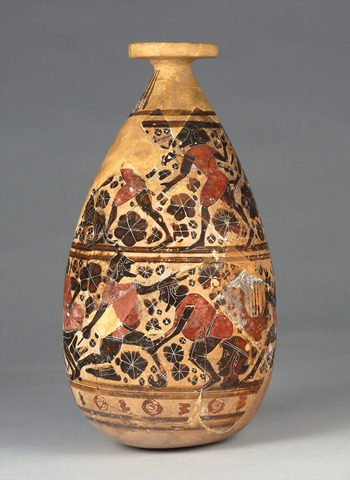
Scholars have tried to connect the padded dancer to various aspects of early theatre, such as the komos dance, the satyr play and the first dithyramb. The temptation to attach padded dancers to early manifestations of drama is especially strong at Corinth, where the dithyramb is said to have been invented by Arion, who, Herodotus (1.23) claims, was a contemporary of Periander (Pickard-Cambridge Reference Pickard-Cambridge1962, 19–25, 131–5).Footnote 7 It may be that ritual, theatrical and political overtones are not mutually exclusive in the iconography of the padded dancer. This article attempts to examine representations of the figure in their earliest manifestations at Corinth, separate from their later theatrical connections. Smith has recently emphasised that it is impossible to connect all padded dancers to theatre or Dionysiac cult since the first examples were produced at a ‘pre-dramatic’ stage in history (Smith Reference Smith2009, 71–5). Yet the costume of the padded dancer, the act of dancing, their similarity to the satyr, and their presence in scenes which include Dionysos or the symposion represent some of the major features which link them to drama. The padded costume and the act of dancing have both been presumed to be elements of performance.Footnote 8 Hedreen has even proposed that the lame feet of some padded dancers, such as that seen in Fig. 1, may have been attached as additional costume pieces.Footnote 9 How such performative aspects have been interpreted varies. Authors like Steinhart believe the padded dancers are acting out mimetic dance to perform the myths and events into which their images are incorporated.Footnote 10 For instance, a vase bearing images of both padded dancers and Herakles fighting the Hydra attempts to portray a performance of this myth. Others see the padded dancer as a performer associated with the symposion since he dances, drinks and is occasionally placed in a symposion setting (Fehr Reference Fehr and Murray1990; Rusten Reference Rusten2006, 41–2). Finally, some believe that such dancing and costume are associated with ritual rather than with dramatic performance (Isler-Kerényi Reference Isler-Kerényi and Csapo2007a, 85–92; Green Reference Green and Csapo2007). Of course, these hypotheses overlap in many ways as the distinctions between performance, drama and ritual become especially blurred with the incorporation of Dionysos and his entourage of silens and satyrs into the discussion of such iconography. Moreover, it is likely that the padded dancers produced in Corinth at the end of the seventh century were not visually or emblematically identical to those produced in Athens or Boeotia in the middle of the sixth century.
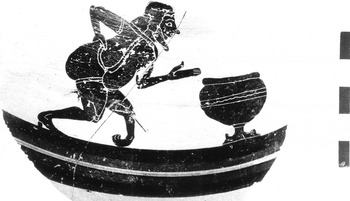
Padded dancer with crisscrossing lines on lame foot being pulled by second padded dancer who stands over a bearded (statue?) head resting on the ground (Paris, Musée de Louvre S1104; reproduced courtesy of Réunion des Musées Nationaux).

The similarity between padded dancers and satyrs remains one of the more compelling reasons why dramatic connotations have been attached to the dancers. Padded dancers visually differ from satyrs as they are not depicted with tails, horns, animal-like ears or masks, and only rarely are they endowed with erect phalloi. It is relatively certain that padded dancers and satyrs are not the same creatures since they appear together on some vases (Isler-Kerényi Reference Isler-Kerényi2007b, 29). Whether or not padded dancers are proto-satyrs or portraying the actions of satyrs is one of the issues still unresolved in recent scholarship.Footnote 11 If one builds upon Isler-Kerényi's hypothesis that the padded dancer expresses the ritualistic transformation of the satyr into the civilised, it seems reasonable to suggest that the padded dancer represented a human worshipper of Dionysos during his fertility rites, while the satyr was tied to the fantastical mythologies of the god and his entourage (Smith Reference Smith2010, 8). However, it is important to acknowledge that this distinction between cult and myth may not have been explicitly recognised by vase-painters or their customers.
The line between performance and Dionysiac ritual is hard to draw. Hedreen emphasises this fact in his article on visual narrative in scenes of the Return of Hephaistos. He contends that vase-painters drew upon Dionysiac festivals for the imagery that they incorporated into the famous scenes of Dionysos returning the lame Hephaistos to Olympos (Hedreen Reference Hedreen2004). Religious ritual that is associated with Dionysos and his many characteristics may offer a good explanation for the range of similarities padded dancers share with aspects of later theatre. Previous scholarship makes it evident that it is impossible, and unnecessary, to separate the role of Dionysos, his mythology and cultic rites from the production of padded dancers and the ruling aristocracy of Corinth.
DIONYSOS, HEPHAISTOS, AND LAMENESS
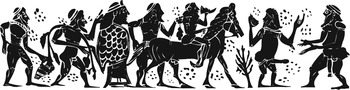
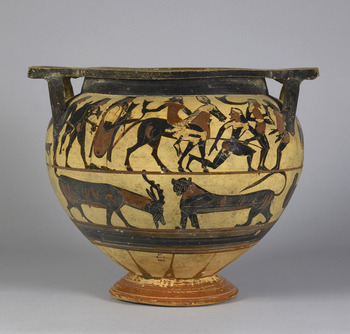
Dionysos, his fertility rites, and his role in the myth of the Return of Hephaistos play an important part in interpreting and understanding the padded dancer imagery in its historical context. A Middle Corinthian amphoriskos bears the first known vase painting of the mythological scene depicting the Return of Hephaistos (Fig. 2). Although this vase dates to the Middle Corinthian period, or the last phase of padded dancer vase production, it is highly likely that both the myth and visual representations of it existed well before this date. Myths and images of Hephaistos and Dionysos could have easily been associated with padded dancers even if the earliest example of the Return found on a Corinthian vase is later in date than the first appearance of padded dancers. On this vase a lame-footed man rides a donkey and drinks from a rhyton. Behind the donkey follows a bearded figure holding a bunch of grapes in his hand. A figure walks behind them wrapped in a cloak covered in scales or feathers. At least two padded dancers surround these figures. Scholars have argued whether or not the cloaked figure is a representation of Dionysos.Footnote 12 Isler-Kerényi believes that the bearded man holding the grapes is the wine god (Isler-Kerényi Reference Isler-Kerényi2007b, 24). Whether cloaked or holding grapes, Dionysos is expected to be found in this image, given that this is the scene of the lame Hephaistos being led by Dionysos back to Mount Olympos, as described in Pausanias (1.20.3) and other sources.Footnote 13 Supporting this is the fact that Dionysos is identified by inscribed labels on later, yet similar, versions of this same scene, such as that on the François vase. In addition to the Return scene on this amphoriskos, at least one other Corinthian vessel, a Middle Corinthian krater, is confidently identified as a Return of Hephaistos (Fig. 3). There are also two other uncertain examples of this scene on Corinthian wares (Seeberg Reference Seeberg1965, 103–4).Footnote 14 The amphoriskos, however, is the first to combine in one scene the clubfooted Hephaistos, Dionysos and padded dancers.
Return of Hephaistos to Olympos on a Middle Corinthian amphoriskos (Athens, National Museum 664; drawing by Daniel Lamp).

Return of Hephaistos to Olympos on a Middle Corinthian krater (London 67.8–5.860; reproduced courtesy of the Trustees of the British Museum).

The depiction of the Return of Hephaistos with padded dancers is particularly important for two reasons. First, padded dancers may be connected to fertility rites associated with Dionysiac worship and festivals. The depiction of the dancers in scenes with Dionysos himself, in symposia scenes, in scenes of dancing and drinking, and their similarity to satyrs suggest that they were in some way linked to the worship of the god. The connection with fertility rites specifically is discussed below as the implications and connotations of lameness are explored. Second, the Return of Hephaistos myth introduces a lame figure who was rejected and welcomed back into the community. Hephaistos is thrown from Olympos by Hera because of his limp but has his revenge when he is welcomed back as the only one who can free her from the trap he had set for her. As will be demonstrated, the story of Kypselos shares elements of lameness, rejection and reintegration.
Evidence for Hephaistos at Corinth bolsters an argument that he was not only associated with padded dancers and Dionysos, but may also have been the figure on which the lore of the Kypselids was modelled. Although the lame god was not traditionally associated with Corinth, there is some evidence for his presence in Archaic Corinth. His rare appearance on Corinthian vessels may be due in part to the fact that Corinthian vase painting infrequently includes representations of specific Olympian deities, especially in proportion to the number of such examples from Attic iconography. But there is some evidence in support of his existence at the site. First, the description by Pausanias (5.19.8) of the famous chest of Kypselos identifies and describes Hephaistos as ‘not strong on his feet’. A reference in Dio Chrysostom's oration on the Corinthians (37.43) also makes mention of a statue of Hephaistos, albeit with ‘good’ feet, by Euphranor, a fourth century bc Corinthian sculptor. Although it is not certain, it is possible that this statue was erected in the city of Corinth.
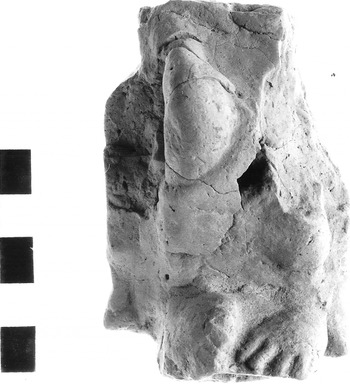
Two figurines at Corinth have been identified as representing the deity. The first is identified as Hephaistos because he is seated on a throne, has a beard and wears a pilos (Stillwell Reference Stillwell1952, 138–9 no. 8 [KT23-1], pl. 26). Found at the Potters' Quarter, Stillwell remarked that a Hephaistos figurine would be an appropriate offering for a shrine at an industrial site (Stillwell Reference Stillwell1952, 138–9). The existence of this piece makes the identification of another unusual figurine as Hephaistos more plausible. The fragment of the lower half of a figure seated on a throne, with a visibly deformed foot, was found in the Early Classical levels of the Sanctuary of Demeter and Kore (Fig. 4).Footnote 15 Although there are no other distinguishable attributes, the intentionally turned-in foot and the resemblance of this figure to the seated Hephaistos discussed above strongly support the identification of this fragment as Hephaistos. As patron of the crafts he may have played a larger role than previously realised at Archaic Corinth, an industrial city known throughout the Greek world for its quality goods.
Terracotta figurine with a deformed foot representing Hephaistos (Corinth Museum, MF-73-113; reproduced courtesy of the American School of Classical Studies, Corinth Excavations, I. Ioannidou and L. Bartzio).

The fact that there are many examples of padded dancers with deformed feet seems to reaffirm the assertion that the attendants in the Return scene discussed above are, in fact, padded dancers. Webster has suggested that the Return of Hephaistos could be included in a number of ‘Release’ stories, such as that of Persephone, in which an earth goddess must be released in order to bring the onset of spring (Webster Reference Webster1958, 43–8). Thus Hephaistos must return to Olympos in order to release Hera from her bonds. If one accepts this interpretation, then this scene would represent a fertility rite with which the image of the padded dancer might be associated.
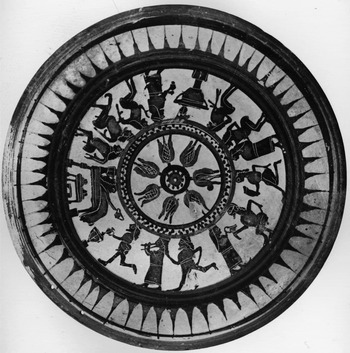
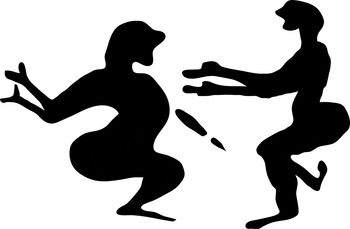
There are a surprising number of padded dancer depictions that include a lame figure among them.Footnote 16 Seeberg lists 38 examples which he considers to be a ‘twisted or misshapen foot’; he concludes that these represent lameness (Seeberg Reference Seeberg1971, 74).Footnote 17 At least one additional example exists on a Middle Corinthian oinochoe fragment from the Corinth Museum (Fig. 5); Amyx cites another that was never catalogued by Seeberg (Fig. 6),Footnote 18 and McPhee also publishes one,Footnote 19 bringing the total to at least 41 known Corinthian examples. As noted, the existence of lame padded dancers is as yet almost entirely limited to the Early and Middle Corinthian periods. Most of the examples of clubfooted padded dancers cannot be placed in a specific mythological scene or context; one can only establish that they are dancing and that they are lame (Fig. 7). An unusual example includes a clubfooted dancer whose deformed foot seems to be pulled out from under him (Fig. 1). Behind the dancer who grabs the foot of the limping man rests a large head on the ground which has been interpreted by Walsh as part of an anodos scene.Footnote 20 If this scene is, in fact, an anodos, representing ritual rebirth in chthonic cult, the connection between Dionysos, lame padded dancers, and symbolic rejection and reintegration into society would grow stronger still. Aside from an unusual example such as this, clubfooted padded dancers are rarely found in contexts other than dancing. Thus it has remained difficult to determine what exactly the lame foot meant to both the vase painter and the consumer.
A clubfooted padded dancer (Corinth Museum, C-73-73a; reproduced courtesy of the American School of Classical Studies, Corinth Excavations, I. Ioannidou and L. Bartzio).

A padded dancer symposion scene with a single clubfooted example on a Middle Corinthian plate (Athens, National Museum 951; reproduced courtesy of the National Archaeological Museum, Athens).

Two padded dancers face each other; right figure has significantly deformed foot (London, B.M. 65.7–20.14; drawing by Daniel Lamp).

The artistic representation of deformities or physical oddities in antiquity was not extremely common but authors such as Dasen, Garland, and Walsh have attempted to examine their presentation and treatment.Footnote 21 Ancient sources also discuss the occurrence of infants with clubfeet. Plutarch's description of how the Spartans coped with such an infirmity reflects one of the most extreme. He states: ‘… the eldest of the tribesmen would scrutinise the baby, and if it was well-made and strong, they would bid him (the father) rear it, allotting to it a plot from the 9000. But if it was feeble and misshapen, they would send it away to the so-called “Putting-asides”, a crevasse-like place beside Taygetus, on the ground that it was better neither for itself nor the city that a child not soundly born for health and strength should live’.Footnote 22 Both Plato (Republic 5.460c) and Aristotle (Politica 1335b) make similar remarks concerning the exposure of deformed infants, reiterating that such a child should not be reared.
These texts and others confirm that exposing a baby was an acceptable practice if it was deformed and had little hope of becoming an able-bodied member of society.Footnote 23 Garland points out that the disabled would have been limited to sedentary tasks, among whose practitioners are leather-makers, blacksmiths, and pot makers (Garland Reference Garland1995, 29–35). Could Hephaistos have been depicted as deformed because he was a blacksmith or was he a blacksmith because he was deformed?Footnote 24 It is possible that disabled members of society, surviving to adulthood, sought out the career of a craftsman and identified with Hephaistos.
The Greeks in particular associated these deformities with the divine wrath of the gods. Delcourt has argued that this manifestation of the gods' scourge may have been considered a reflection of human culpability (Delcourt Reference Delcourt1986). She contends that the Greeks believed war, plague, and famine to be punishments from the gods. Through these misfortunes, the infertility of humans, plants and animals ravished the earth. Vernant argues that lameness can be a symbolic construct for what is not right, or straight (Reference Vernant1982, 20–21). The most evident symbol of this to the Greeks is the abnormal infant, a sign of the gods' displeasure. Callimachus describes what happens to unjust men: ‘On their cattle plague feeds, on their tilth feeds frost … and their wives either are smitten and die in childbirth, or if they escape, bear births whereof none stands on upright ankle …’Footnote 25 The exposure of infants was not only a practical consideration for the well-being of the community, but also an offering of a scapegoat to placate the anger of the gods. For this reason it is noteworthy to have depictions of such individuals present on Corinthian vases. The significance of their presence is twofold. First, those with clubfeet normally should not have lived to maturity to be depicted as dancing adults. Second, lame individuals may have been living proof of the earth's infertility; like Hephaistos, they could have been excluded or rejected as an ominous warning of the gods' anger.
Along this line, Isler-Kerényi describes the padded dancer as the opposite of the Greek ideal; he is the antithesis of aristocracy and heroism (Isler-Kerényi Reference Isler-Kerényi and Csapo2007a, 84–6). Padded dancers are clothed and unathletic; they are not heroically naked. They dance despite the fact that they are lame. They move in anonymous groups. They act out uncivilised and hedonistic behaviour, possibly in ritual imitation of a mythical story or deity. Building on this notion, Seaford believes that the padded dancers, through their connections to Dionysos, represented the embodiment of exclusion (and eventual reintegration) into the community and the polis (Seaford Reference Seaford2007, 382–94). Seaford ties this ‘sequence of exclusion expressed in lameness’ to the contemporaneous dynasty of Corinthian tyrants, whose family history, as will be shown below, included lame members (Seaford Reference Seaford2007, 394). However, his analysis neither explores the dichotomies of the representations of Hephaistos and Dionysos in relation to the Corinthian aristocracy nor does it adequately provide an explanation for the particular production period of padded dancer vases, especially those with lame examples.
EXPLANATIONS FOR CLUBFOOTED DANCERS
Various interpretations have been presented to explain the noteworthy presence of clubfooted participants in padded dancer scenes. Fehr argues that padded dancers represent the akletoi mentioned in Homer and other sources (Fehr Reference Fehr and Murray1990; Homer, Iliad 1.597). We see the akletoi performing at the home of Odysseus (Homer, Odyssey 14.462–6; 17.374–92; 18.1–5; Xenophon, Symposion 3.2). They are entertainers hired off the streets who perform at symposia for food or because they are forced to do so. Fehr explains that their weaknesses, ugliness and inferiority are put on display for the dinner guests' entertainment, much as Hephaistos mocked his own limp in order to evoke laughter from the Olympians (Fehr Reference Fehr and Murray1990). The deformed padded dancers could be such entertainers hired to amuse the symposion diners with their ‘humorous’ clubfeet and limps. Fehr tries to explain that the short boom in popularity of these images was because the symposion became less aristocratic, no longer requiring lewd entertainment (Fehr Reference Fehr and Murray1990, 192). He explains that aristocratic guests of the sixth century symposion became more unruly, imitating the akletoi themselves, until there was little differentiation between the entertainers and the entertained (Fehr Reference Fehr and Murray1990, 192–3). However, not all padded dancer scenes, even those with a clubfooted participant, take place in a symposion setting. Such an explanation about the changing nature of the aristocracy also fails to explain why padded dancers were no longer produced by c.570 bc.
An alternative interpretation was previously mentioned: the limping padded dancers were performers, acting out Hephaistos' Return myth. This reading falls short of explaining the presence of clubfooted padded dancers in scenes which do not relate to the Return story in any way. It also fails to account for the short phase of production of these figures and their disappearance during the Late Corinthian period.
In a recent article, Smith (Reference Smith2009) argued that the lame-footed figures were imitating Hephaistos, but in a form of parody of the gods. She contends that the images of lame dancers are situated in the mortal world of performance, though not necessarily in a dramatic, theatrical context (Smith Reference Smith2009, 87).Footnote 26 In this setting, the ‘most vital visual elements’ of lameness and wine have been extracted to convey or mock the story of the clubfooted god (Smith Reference Smith2009, 85–6). Although her interpretation is one of the most compelling presented, it too fails to offer an explanation for the discontinuation of the figures. A final alternative may offer a solution for the important chronological and thematic connections between the lame padded dancers and the Corinthian ruling families.
It seems more plausible that a folklore tradition of lameness, and the symbolic negativity associated with it, permeated Archaic Corinthian culture and that it was closely tied to the reign of the Kypselids. Clubfooted dancers were not just mimetic performers or mocked entertainers at the symposion. The story of Hephaistos connected lameness to Dionysos and fertility rites, but the mythic connotation was soon borrowed to comment on other crooked individuals. Evidence points to a historical tradition of lame personalities coming from Corinth. This ailment was associated, either physically or symbolically, with the Bacchiadai, from whom the Kypselids and the first tyrant of Corinth descended.
Although seemingly removed from Corinth, the Theban family of Oedipus, who himself was lame, is connected in a number of ways to the Bacchiadai and Corinthian history. Oedipus was raised in Corinth and believed his parents to be Corinthians until he learnt otherwise (Sophocles, Oedipus Tyrannus 771–95). In addition, members of both Oedipus' and Kypselos' families had names which were believed to mean ‘lame’ (Herodotus 5.92). The name of Oedipus' grandfather was Labdakus, and the name of Kypselos' mother was Labda, suggesting that the stories of these two figures, one mythological and the other historical, were intertwined.Footnote 27
Jameson argues that the names Labda and Labdakus both stem from the early name of the letter lambda (Jameson Reference Jameson and Del Chiaro1986). He points out that the Archaic version of the lambda used in local Corinthian script was one on which the second stroke was shorter than the first, thus depicting something that looked like crooked legs. This form of the letter is used throughout the Archaic period and at least until the fifth century bc (Jeffery Reference Jeffery1961, 115).
The name of Kypselos' mother stems from her rejected place among the Bacchiadai. Herodotus (5.92) informs us that the lame Labda was excluded from being a full member of the community because of her infirmity and was forced to marry a non-Bacchiad, Eetion. Because of this unsuitable marriage, an oracle prophesied that she would give birth to a son who would take over and bring down the rulers of Corinth. One can immediately see the parallels of rejection and reintegration into the polis as also played out in the Return of Hephaistos. Lameness may have been a symbolic construct associated with infertility and that which falls outside social norms.
Kypselos, the son of Labda, himself was not reported to have been lame but his story bears many similarities to that of Oedipus, who was lame and whose grandfather bore a related ‘lame’ name, Labdakus. Like the clubfooted Oedipus, Kypselos, starting out as an infant rejected by the ruling aristocracy, was prophesied to bring downfall to his people (Vernant Reference Vernant1982, 28).Footnote 28 His mother hid him in a chest, leaving him to fend for himself, much as Oedipus was exposed to die. The name Kypselos, derived from kypsele, has often been suggested to mean beehive (that in which his mother hid him), but it may have its own connotation of lameness. Aristotle records that there was a bird, a type of sandpiper, called ‘kypselos’, which was also known as ‘apous’, or footless.Footnote 29 The tradition of Kypselos bears many similarities to the Cadmean story of Oedipus, another man who was deformed, rejected and eventually reintegrated into his community.
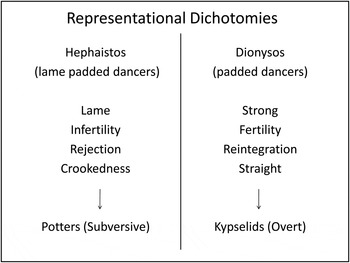
A fragment of Aristotle informs us that Bacchis, the man after whom the Bacchiadai family was named, was also lame.Footnote 30 This was also an attested epithet of Dionysos at Corinth, since Pausanias claims to have seen an early statue dedicated to Dionysos Bakkheios in the Corinthian forum (Pausanias 2.2.6–7). The report of a lame ancestor named Bacchis not only connects the clan to a Dionysiac epithet, but also projects the family ‘history’ of lameness back to the early oligarchy of Corinth in the eighth century. Oost argues that a clubfooted ancestor may have been a fictitious person created to tie Kypselos and the lame tradition of his family to his Bacchiad heritage in order to legitimise his rule (Oost Reference Oost1972, 23). This point is immaterial. The invention of a fictional deformed ancestor actually serves to reaffirm that a tradition of lameness in the Bacchiad/Kypselid family existed. This infirmity may have been a real one but more likely it was highly symbolic of infertility, rejection and crookedness. Because the lame man represents the outcome of an infertile scourge of the gods, he is the one who drives affairs from the ‘straight’ path.Footnote 31 The theme of exclusion from the polis may have been modelled on Hephaistos' rejection from Olympos. If the Bacchiads tried rather overtly to align themselves with the fertility of Dionysos, Corinthian vase-painters turned this mythic connection around and associated the ruling family with Hephaistos and notions of lameness. The contrasts of infertility/fertility and rejection/reintegration played out visibly in the myth of the Return, the representation of healthy and lame padded dancers, and in the political lives of the Bacchiads and Kypselids (Fig. 8).
Chart of the representational dichotomies in padded dancer imagery.

Corinthian mythology may have fixated on lame figures besides Hephaistos, especially if this infirmity was associated with the ruling aristocracy. One must question if the crippling fall of the Corinthian hero, Bellerophon, reflects this thematic thread running through early Corinthian history. The fragmentary play of Euripides, Bellerophon, reports that this hero, a popular figure in Corinthian myth, was crippled on his fall from Pegasos (Collard and Cropp Reference Collard and Cropp2008, 289–317).Footnote 32 His attempt to ride to Olympos was considered a hubristic one for which he was punished. The bridling of Pegasos at Peirene was a well-known and important myth to the Corinthians, who portrayed it on their coinage for hundreds of years.Footnote 33 Were Euripides' play and the version of the story he presented known to most Corinthians? If so, this story would represent yet another prominent lame leader for the city.Footnote 34
POLITICS AND THE PRODUCTION OF PADDED DANCERS
Steinhart and Seaford, with different agendas, touch on the chronological associations between the padded dancers and the reigning tyrants at Corinth, though neither explicitly tackles the precise production period of vases depicting the figures (Steinhart Reference Steinhart2004, 57–64; Seaford Reference Seaford2007, 388–94). Steinhart charts out the upper and lower chronologies of the Kypselids alongside the chronology of Corinthian pottery to associate the dithyramb and mimetic performance to the appearance of the padded dancer (Steinhart Reference Steinhart2004, 57). Seaford, on the other hand, focuses on the thematic presence of lameness across performance, myth and history in his attempt to emphasise the connection between these scenes and early drama (Seaford Reference Seaford2007, 393–4). Despite the pointed observations made in both of these works, an emphasis on the production period and termination of padded dancer vases at Corinth, especially lame examples, has not been fully explored.
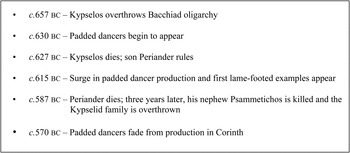
Vessels with padded dancers first start to appear in the Transitional period, around 630 bc, well after the Kypselids came to power. A surge in their popularity begins in the Early Corinthian period, around 615 bc. Most importantly, the lame examples are limited to the Early and Middle Corinthian periods of pottery production. Kypselos, the first tyrant of Corinth, overthrew the Bacchiad oligarchy c.657 bc, ruled for approximately thirty years, and was succeeded by his son, Periander. After Periander's death, his nephew, Psammetichos, was in power for three years until he was killed c.584 bc, bringing to an end the seventy-year tyranny at Corinth. It is possible that the depictions of lame-footed padded dancers are a delayed reaction to the rule of the Kypselid family. The tyranny's approximate seventy years in power could explain the discontinuation of these scenes, which fade out of existence by 570 bc (Fig. 9). The final 15 years of their production could easily be reconciled with a generation of potters dying out who were still keenly aware of the tyrannical rule and the family's legendary lameness. Moreover, if one chooses to adopt the ‘lower’ Herodotean chronology of the Kypselids, which would down-date the family's rule by approximately thirty years, the tyranny and the production of padded dancers overlap almost perfectly. One also cannot neglect to observe that, though it is Kypselos who has the most references tying him to lameness, the dates of the brutal rule of his son, Periander (627–587 bc), align almost perfectly with the extant examples of lame padded dancer vases. Few other explanations adequately account for the chronologically limited phase of production for these figures, which are so popular on Corinthian vases in the Early and Middle Corinthian periods.
Timeline of the production of padded dancer vessels and the Kypselid dynasty.

Funerary evidence from the North Cemetery of Corinth may also support the chronological and thematic connection of padded dancers and the aristocracy. The excavators of the cemetery determined that a cluster of six contemporaneous graves was a family group due to their proximity to each other, similarities among their offerings, the placement of those offerings and the use of fine white stucco on the sarcophagi (Blegen Reference Blegen, Palmer and Young1964, 178).Footnote 35 At least four of these graves are unusually wealthy for the North Cemetery and all have offerings of exceptionally high quality. The average number of vessels in an undisturbed sixth century grave at the North Cemetery is 3.6, while, in this cluster of graves, grave 155 had 8 vessels, grave 156 had 9, grave 157 had 25 and grave 172 had 14 (Blegen Reference Blegen, Palmer and Young1964, 178–92). Grave 158 had no offerings but it probably was robbed since its sarcophagus lid was broken (Blegen Reference Blegen, Palmer and Young1964, 185). Although grave 173 only had 4 vessels, it was the largest sarcophagus in the cemetery (Blegen Reference Blegen, Palmer and Young1964, 191–2). Multiple factors suggest that these graves were associated with each other and that those individuals interred within them were some of the wealthiest buried at the North Cemetery. Worthy of note is that only four padded dancer vessels were found within the entire North Cemetery; all four were found in this cluster of graves.Footnote 36 Of course, it is impossible to determine exactly who was buried in these graves. The placement of these vessels depicting padded dancers, found nowhere else but in the richest graves of the cemetery, permits the suggestion that their healthy, Dionysiac imagery was associated with the wealthy families of Corinthian aristocracy.
POTTERY AND LOCAL IDENTITY
The lore of lameness in Corinthian material culture and literary evidence raises larger questions of identity and relationships within the Archaic Corinthian polis. If local potters were depicting lame figures in padded dancer scenes, what kind of commentary were they trying to make about the ruling political entity? It was probably one of hostility, if the symbolism of lameness is indeed associated with infertility, rejection and exile. The reintegration of the Kypselid family back into the polis may have come with a great deal of reluctance from most of the community. Yet reintegration is a prominent part of the stories of Hephaistos, Oedipus and Kypselos. Much like the disparate themes of rejection and reintegration, historical traditions about Kypselos were conflicting. Although he overthrew the Bacchiads and governed as tyrant, sources report that he ruled undisturbed for thirty years and died a natural death (Herodotus 5.92). Nonetheless, antagonism may have been directed at his family, since Periander was considered a far more brutal tyrant than his father (Herodotus 5.92).
Arafat and Morgan have argued that, in Archaic society, pottery and iconography were not instruments of factional propaganda (Arafat and Morgan Reference Arafat and Morgan1989, 312, 332). This interpretation of the manufacture of padded dancer vases disputes this theory. Even if the Kypselids had no institutionalised involvement with the production of pottery and its iconography, it is difficult to say that these images may not have been political propaganda, albeit negative commentary on the ruling elite. If this view is accepted, then it may be necessary to reconsider the role of iconography in Archaic society and polis development.Footnote 37 The average Corinthian potter had the opportunity to convey his attitudes through his art, and the occasional limping padded dancer may have been a subtle way to suggest that the tyrants were ill-fated and corrupt.
Padded dancers may have come to be associated with the aristocracy because they were worshippers in the fertility rites of Dionysos, from whom the oligarchic family could have taken their name. By incorporating lame figures into these scenes, the potters communicated a code, already associated with Hephaistos, which stood for the infertile and rejected. In other words, the lame foot stood for that which was not right in the polis. The tyrant, born of an unsuitable union between Bacchiad and outsider, seized power illegitimately. He was the clubfoot and the scourge of the gods in the eyes of the Corinthians. After the tyranny was overthrown in the 580s, it is possible the generation of potters who produced these images died off and the symbolic connections between the padded dancer, particularly the lame examples, and the deposed tyranny were not passed on as their significance grew obsolete in a new political environment.
The illustration of lame feet on padded dancer vases is not exclusive to Corinthian iconography, though it is far commoner among Corinthian wares (Smith Reference Smith2009, 81–7; Smith Reference Smith2010, 172–3). Smith cites examples from Attica, Boeotia, Lakonia and Chios, though she acknowledges that the evidence is far less outside of Corinthian production and ‘may be more indicative of the spread of the black-figure technique than of the occurrence of any accompanying dance, cult, or myth’ (Smith Reference Smith2009, 81). The padded dancer, both intact and deformed, was likely to have been a strongly contextualised symbol within Archaic Corinthian society. If few lame padded dancers were produced outside of Corinth, the meaning of those figures must have been established within Corinth, and it was complex. First tied to fertility rites, Dionysos and Hephaistos, the padded dancer was then associated with the aristocratic Bacchiad/Kypselid clans. The clubfoot, with its Dionysiac ties to (in)fertility and its role in the Return of Hephaistos, became attached to lore of lameness associated with the family. It became a symbol of exclusion and rejection from proper civic behaviour. Lameness was visually codified to remark on the aristocratic Bacchiads and Kypselids.
If few lame padded dancers were depicted outside of the Corinthia, it would suggest that their symbolic meaning was poorly transferred, or that it was meaningless outside of the region (Smith Reference Smith1995, 314).Footnote 38 Pemberton calls padded dancers ‘emblematic’, much like the representation of a Gorgon (Pemberton Reference Pemberton2000, 86–7). The images became standardised and the Corinthians, entrenched in their own local culture, cultic practices and political identity, were aware of what was associated with them. The padded dancer and its deformed counterpart were local phenomena bearing ingrained social information that may have been meaningless beyond the borders of the region.
The study of these uniquely Corinthian figures does more than inform about the local aristocracy and cultic mythology of the city. The Greek city of Corinth is well known for its dearth of literary and epigraphic evidence. Here an example exists which demonstrates that the evidence from non-Corinthian textual sources coincides well with material culture and iconography produced by local, Corinthian potters. It also confirms the chronological veracity of both Archaic Corinthian pottery phases and the established dates for the reigns of the local tyranny. If non-Corinthian authors such as Herodotus and Aristotle are reporting a history of deformity in Corinthian history and Corinthian potters and painters are constructing scenes with lame-footed dancers in them, then we see an agreement, chronologically and thematically, in the evidence available for the site. It would appear that Corinthians and non-Corinthians were depicting the city's past, whether mythological or historical, in a similar fashion. Could this correlation make us less hesitant to use non-Corinthian sources to analyse early Corinthian history, which remains regrettably devoid of its own textual evidence?