According to the biblical book of Daniel chapter 3, King Nebuchadnezzar, who ruled the Babylonian Empire where the Jews lived in exile, commissioned the building of a ninety-foot golden image and commanded the people to worship it. Refusal to comply meant one's death in a fiery furnace. While most obeyed the king's dictate, the story recounts how Shadrach, Meschach, and Abednego, Jews who worked for the king, refused to worship the image and remained loyal to their God. In response, the king bade his men to stoke the furnace and burn the defiant rebels. To the king's amazement, the trio appeared unscathed amid the red-hot flames, and he glimpsed a mysterious fourth figure with them. Seeing this, the king called the men to come out of the furnace and they emerged unharmed, protected, according to the text, by the fourth figure, an angel. The story depicts Shadrach, Meschach, and Abednego as heroes who withstood the forces of evil and witnessed the power of their God. It speaks to the fidelity of these men and to the intolerant nature of Nebuchadnezzar's faith. While this passage and its lessons may be familiar to many, in the 1920s they gained additional meanings that provide us with important insights into the workings of religious intolerance in the United States.
In Branford Clarke's “The Men Who are Refusing to Bow to the Great Image” (figure 1) from Alma White's 1925 book The Ku Klux Klan in Prophecy, we see, in graphic detail, the story of Shadrach, Meschach, and Abednego overlaid with the mission of the second Ku Klux Klan. Under the arched and star-spangled banner decorated with the fiery cross and the Constitution, representing the Christian Klan and the democratic United States, respectively, the scene unfolds. The small pathway in the center of the foreground draws the viewer's eye to the “golden image” that dominates the horizon line. However, in this case, the “golden image” being worshiped by the large population is not the false God of Nebuchadnezzar, but rather the false God of Catholicism—the pope—indicated by the word “Rome” on the statue's base, as well as by the figure's accoutrements, the large cross held in his hand and the triregno on his head. A fiery furnace labeled “temporal power” and situated adjacent to the papal idol suggests not only the pope's desire for and attainment of political power, but also that his power rests on both the idolatry of Catholics and the persecution of Protestants.
Branford Clarke, “The Men Who are Refusing to Bow to the Great Image,” from Alma White, The Ku Klux Klan in Prophecy (Zarephath, N.J.: The Good Citizen, 1925), 74.

The foreground of the image depicts the heroes as well as the other villains of the story. On the right, the artist names those forces whose loyalty to the pope threatens the very foundations of orthodox Christianity and the American nation. First in line and most visible is a man on bended knee. The hand on his jaw signals his reflective and attentive attitude toward the idol while the letters “K of C” appear prominently on his back and reveal his identity to the viewer. He represents the Knights of Columbus—a group Klan members deemed subversive because they believed it to be the pope's army operating in the United States. Next to the Knight of Columbus is a kneeling figure with arms outstretched labeled “Tammany,” most likely a representation of New York Governor Al Smith, a Catholic presidential candidate in the 1920s whom the Klan opposed. The figure's presence evokes the corruption of the Tammany Hall political machine that dominated New York City politics in the late nineteenth century, a ring that some feared was run by and for Irish Catholics.Footnote 1 The inclusion of this reference suggests that the Klan believed political machines and Catholic corruption continued to operate and threaten American democracy.
If one looks carefully, two additional yet unnamed foes appear on the far right. Like the other villainous figures, the man directly to the right of “Tammany” kneels but, unlike with his counterparts, the viewer can discern his facial features, namely his stereotypical, caricatured profile. His large hooked nose identifies him as a Jewish man. He is, it seems, in the Klan's eyes, disloyal to his Jewish past and to his jealous God, and, even more troubling, he has joined forces with Catholics.Footnote 2 Farthest to the right, another foe is shown—a flapper. She has bobbed hair and a low-cut bodice, both features connoting the corruption of her morality and modesty. She, like the others, this Klan image asserts, has been seduced by Catholicism and the corrupt forces it has unleashed on American society. To the far left of the center path, one last ally of Catholicism lurks on bended knee: “Booze.” As debates about Prohibition raged in the 1910s and 1920s, the Klan upheld the “dry” position and often recruited its members through local temperance movements. They impugned Catholicism for its “wet” stance, stating that it violated biblical teaching and harmed innocent women (who were the victims of drinking men).
Taken all together, the image presents an overwhelmingly corrupt and powerful Catholicism, one that has assembled a vast array of allies and recruited legions of loyal nameless and literally faceless followers to accomplish its mission of “temporal power.” However, despite these numerous foes, the image also reminds the viewer of how this biblical story ends. It is a story of perseverance, of remaining faithful even when confronted by the powerful and overwhelming forces of evil. To recall this message of hope, the artist placed three Klansmen, representing the faithful trio of Daniel, prominently in the left foreground of the image. Like Shadrach, Meschach, and Abednego, they refuse to bow to the papal idol and appear to be moving away from its corrupting presence. The artist reinforced this sense of their faithfulness to Christianity and the United States by including potent symbols of each entity, the clearly labeled “Holy Bible” and the highly visible flag. The three appear wary, yet protective of these symbols, as they remove themselves from “Rome's” evil. In the accompanying text, Alma White exclaimed: “These men will burn rather than bow to the Romish gods and their triple-crowned head in the Vatican.”Footnote 3
In its fusing of biblical myth, American identity, and Klan ideology, this image raises important questions about the history of religious intolerance in the United States. These questions are not new, and many scholars have provided valuable insights into the Ku Klux Klan and the religious dimensions of nativism as part of their more comprehensive accounts, from John Higham's Strangers in the Land to Lynn Dumenil's The Modern Temper to David Chalmers's Hooded Americanism. For example, Higham emphasizes anti-Catholicism as one prominent strand in nativist rhetoric, Dumenil explores how “the Klan's promise to promote Protestant religion and moral ideas had a far-flung appeal” in her study of the 1920s, and Chalmers records the Klan's popularity among Protestant denominations—Baptist, Presbyterian, Dutch Reformed, and Methodist—as part of his state-by-state history of the movement.Footnote 4 This scholarship provides a firm basis for and broad introduction to the topic; however, it does not offer a more specific examination of religious intolerance, incorporate visual culture as a source, or include detailed analyses of how people constructed and persuaded many of their position's validity, if not of its religiously justified character.
In response, this case study seeks to enhance our understanding of these less investigated issues by examining the illustrations of Branford Clarke, as published in Alma White's three pro-Klan books—The Ku Klux Klan in Prophecy (1925), Klansmen: Guardians of Liberty (1926), and Heroes of the Fiery Cross (1928). This focus demonstrates the significance of visual imagery as a type of primary source “that illuminate[s] the past in ways speeches, sermons, letters, and laws may not.”Footnote 5 In addition, foregrounding visual culture provides a way to look more specifically at the machinations of religious intolerance (defined as “prejudice against individuals or groups based on religious convictions, affiliations or practices, which can manifest as violent action and/or intimidation, with the intent to deny the right to practice religion freely”).Footnote 6 It affords us a glimpse into how religious individuals use visual culture to “configure [intolerant] social worlds” and create negative “ways of seeing.”Footnote 7 Specifically, this article explores how Clarke's illustrations, in conjunction with White's words, Christianized the Ku Klux Klan and demonized Catholicism. It analyzes how this imagery became a weapon to delineate boundaries between orthodoxy and heresy, good and evil, insiders and outsiders, and thus helps discern the art of religious intolerance in America, the ways religious intolerance is disseminated and replicated.
This analysis, I suggest, not only contributes to our understanding of how the second Ku Klux Klan articulated its Protestant American identity, it also reveals two patterns that deepen our understanding of how religious intolerance functions and could thus provide a basis for future comparative work. First, the Bible emerges as a vital element in the dissemination of the Klan's intolerant Protestant vision. While White repeatedly referenced the Bible to buttress her views, Clarke used it to create a set of images that “proved” the Klan's virtue and Catholicism's vice. Given the power of the Bible in American culture in the 1920s, the selective artistic inclusion of its contents and the text itself provided Clarke with an effective way to establish the Klan's religious status and persuade others of the rightness of his vision. Second, the employment of visibility and invisibility constitutes a central component in the promulgation of their message.Footnote 8 For example, Alma White's writings highlighted the Klan's biblical heritage while downplaying its violent character; however, Clarke's artistic rendering of this interpretation (and others) constructed a particular way of seeing the world. His imagery functioned as a visual shorthand, an artistic stereotype that helped readers quickly and easily differentiate hero from villain, religious insider from religious other. Through their combined efforts, they sought to maintain the “social and symbolic order”—Protestant dominance of the American landscape.Footnote 9 This case study, then, challenges us to reflect on the art of religious intolerance in the United States. By doing so, we can better understand how religious intolerance functions and make visible its pervasiveness in American Christianity and in American history.
I. The Progressive Era and the Pillar of Fire
As seen in figure 1, in the eyes of writer Alma White and artist Branford Clarke, more than “gaiety” and “prosperity” characterized the roaring twenties.Footnote 10 The “Progressive Era” represented anything but progress to these seminal members of the Pillar of Fire Church. Established by Alma White in 1901, the denomination split from Methodism and adhered to the Holiness doctrines of its fiery female leader.Footnote 11 These perfectionist principles led Alma White to challenge the status quo throughout her life (1862–1946). Upset with the “corruption” of Methodism and its constraints on women as preachers and leaders, she founded her own denomination. Not content to simply preach on Sunday mornings, she took her message across the country and across the Atlantic. Along the way she founded colleges, operated radio stations, wrote books, and published newspapers.Footnote 12 She was, quite simply, a powerful force in the early twentieth-century Holiness movement and in conservative Protestantism more broadly. William Seymour of Azusa Street fame, like many others in the early twentieth century, visited her Denver mission. However, much to Seymour's dismay, she eventually became the “earliest and bitterest critic” of pentecostalism, and she was also known for her opposition to that “necromancer” Aimee Semple McPherson.Footnote 13 In their vocal criticisms, Alma White and her Pillar of Fire denomination sought to protect their vision of “pure” Christianity from the corrosive forces that existed within and without—pentecostals and modernists, Catholics and Jews (to name only a few).
In many ways, then, the Pillar of Fire denomination belongs squarely in the emerging fundamentalist camp of the early 1900s, defined by historian George Marsden as “militantly anti-modernist Protestant evangelicalism.” He writes that “fundamentalists shared with the discontented intellectuals of the 1920s, if little else, a sense of the profound spiritual and cultural crisis of the twentieth century.”Footnote 14 This attitude of militancy and perception of crisis characterized Alma White and her Pillar of Fire Church, evidence of which can be seen in figure 1. In response to the changing social and religious mores of the time, they upheld conservative Protestant morality with their “dry” stance and anti-flapper attitudes.Footnote 15 The Pillar of Fire Church also endorsed the authority of the Bible, and White's sermons and publications document her veneration of the Bible even as they preserve her attacks on modernists' sins, including movies, cards, and dancing.Footnote 16 However, while White's teachings reflected central dimensions of fundamentalism, her biographer Stanley notes that she also differed from it in important ways. Unlike many in the movement, Alma White upheld women's right to preach and vote, endorsed premillennialism yet rejected dispensationalism, and continued her attempts to transform society while other fundamentalists retreated from the public stage.Footnote 17 She did not back down or shy away from perceived threats or challenges; rather, she met them publicly with her vast arsenal of books, newspapers, radio sermons, and extensive travels.
Notably, for Alma White and the Pillar of Fire, modernism was not the only threat that needed to be met. Between 1820 and 1920, 33.6 million immigrants to the United States had brought with them “foreign” loyalties and “foreign” religions.Footnote 18 Catholicism was the most religiously and politically dangerous of these “foreign” entities. Like other anti-Catholics before and after, White condemned Catholicism for its “rejection” of the Bible, its hierarchical structure, and its valorization of the papacy. She feared the “temporal power” that “Rome” supposedly sought and wielded—the use of its loyal followers to erase the separation of church and state in a quest for national and world domination. Her accusations echoed historic anti-Catholic charges, and at the time she was far from alone or unique in her intolerant views.Footnote 19 The 1910s saw the passage of the Espionage and Sedition Acts, which granted the U.S. government increased power to identify and punish “disloyal” residents, and this decade also witnessed the emergence of successful immigration restriction legislation, which culminated in the passage of the Johnson-Reed Act in 1924.Footnote 20 Historian Paul Murphy writes of the 1920s: “That decade, despite its surface prosperity and supposed gaiety and exuberance, was characterized by waves of public intolerance seldom felt in the American experience.”Footnote 21 The rise of the second Ku Klux Klan, reorganized by William J. Simmons in 1915, speaks to the accuracy of Murphy's claim. By the 1920s, estimates put Klan membership between four million and six million.Footnote 22 Mainstream white Protestant men and women populated the organization, and its scope was national.
The reincarnated Klan's appeal, as seen in figure 1, rested in large part on its identity as the defender of Protestantism and America. Klan chronicler Wyn Craig Wade writes, “While fundamentalism would make a controversial, often divisive contribution to religion in twentieth century America, its most critical impact on our social and political history was that, without it, the Ku Klux Klan could never have enrolled the fantastic numbers nor have gained the remarkable power it wielded between 1922 and 1925.”Footnote 23 Historian Lynn Dumenil also acknowledges this intimate connection between Protestantism and the Klan. She states: “Although not all Klansmen or Klanswomen were fundamentalists, they shared with fundamentalists a concern over ‘the weakened influence of Protestantism.’ Throughout the country the Klan played upon this theme, describing the order in religious terms with revivalistic fervor.”Footnote 24 As seen here, scholars have acknowledged the pivotal role of religion in the Klan, but the depth and dimensions of this link often remain unexplored. Rather than assuming the perspicuity of this relationship or writing off the Klan's Protestantism as a guise for its hatred, I focus on this issue by examining how White and Clarke defined the Klan in Christian terms and worked to persuade others to see it in the same way.
For Alma White and many other conservative Protestants, the Ku Klux Klan represented God's response to the various problems confronting Christianity in the 1910s and 1920s. The divine had “raised up” the Klan to combat the enemies threatening Christian civilization (the United States).Footnote 25 In the Klan, White and Clarke saw a Christian organization through which society could be transformed. People needed to act, and Alma White urged them to do so as she spread her intolerant views through sermons, The Good Citizen, and her books endorsing the Klan.Footnote 26 She wrote: “The creation of sentiment must precede a victory, and somebody must begin it.”Footnote 27 Create sentiment she did. Invective and inflammatory accusations permeate her written legacy; however, Clarke's illustrations made visible her written and spoken desires. More than her writings, his art Christianized the Klan and disseminated a negative vision of the Catholic other.
II. Alma White's Words and Branford Clarke's Imagery
While Alma White left a voluminous body of written work by which we can document her life and legacy, much less is known of the Reverend Branford Clarke, who illustrated her many publications. Most often referred to (if at all) as the “Pillar of Fire Artist,” he emigrated from England in 1913 and was likely converted during one of White's many trips to London. He became minister of the denomination's Brooklyn Church in 1921, but little else has been found or written about Branford Clarke.Footnote 28 What we do have, as seen in figure 1 and the other illustrations cited throughout this article, is his artistic legacy as preserved in White's texts.
Alma White does not tell us exactly how she viewed Clarke's work or recount the details of how they worked together. She neither writes about the images nor does she directly call the reader's attention to them. Other than his credit on the title page and his signature in the drawings, Branford Clarke's name is never mentioned, but that does not mean that his images were an obscure or unimportant component. Given what we know of White's autocratic leadership style, it is doubtful that any of Clarke's artwork was published without her request and imprimatur. Indeed, White's stern portrait, labeled “Bishop Alma White, A.M.,” along with letters of endorsement by prominent Klansmen prominently placed at the start of all three pro-Klan books, imbues their written and artistic contents with a sense of authority.Footnote 29
In addition, White's inclusion of Clarke's illustrations seems to indicate that, like other Protestants of her time, she “accept[ed] the power of artistic imagery to influence thought and behavior.”Footnote 30 Sheer numbers alone provide ample evidence of this view. For example, of the 174 pages in her 1926 volume, Klansmen: Guardians of Liberty, thirty-eight of those feature full or half-page illustrations by Branford Clarke. The similarly sized Heroes of the Fiery Cross and The Ku Klux Klan in Prophecy both contain at least twenty. Furthermore, in all three of White's pro-Klan books, chapter titles often echo and draw attention to the primary illustration included within each. For example, only a few pages of the chapter “Bow or Burn” deal explicitly with the story of Shadrach, Meschach, and Abednego, but this is the element of the chapter illustrated and reinforced by the title, as seen in figure 1. Other chapters evince a similar alignment of title and illustration—“Jonah—the Jew—A Fugitive from God,” “A New Star Baffles Rome,” and “The Hebrew Rock.”Footnote 31 The evidence suggests that Clarke's artwork mattered.
It added “something more, something not in the text”: a visualization of the Klan as the defender of Protestant America and the religious other as dangerous, foreign, and un-Christian.Footnote 32 To accomplish this, Clarke built on and utilized the conventions established by the work of political cartoonists and novel artists in the “Golden Age of American Illustration,” 1880–1914.Footnote 33 Unlike political cartoons that often function independently of the text in a magazine or newspaper, Clarke's work illustrates the points made in White's texts.Footnote 34 However, while Clarke's art shares this commonality with novel illustration, his drawings utilize the conventions of the cartoon genre. For efficacy, cartoons rely on “instant recognition.” They therefore use “the familiar,” whether “stock situations,” negative stereotypes, or popular symbols.Footnote 35 As seen in figure 1, Clarke's illustrations employ popular symbols and stereotypes—the flag, the Bible, the “Jewish” nose, the pope's “triple crown”—to make their point. Like political and humorous cartoons, Clarke's work “conveys its message quickly and pungently.”Footnote 36 These characteristics of the cartoon genre make it, according to historian Thomas Milton Kemnitz, a medium that “can match any other media for invective and is an excellent method for disseminating highly emotional attitudes.” He adds, “the cartoon is also an ideal medium for suggesting what cannot be said by the printed word.”Footnote 37 Clarke's images, then, made visible what White may have deemed too dangerous or inflammatory to vocalize. Indeed, they often embellished her writings and at times included additional scenes and interpretations.
This is not to say that White and Clarke worked at cross-purposes, but rather to suggest the power of Clarke's drawings to shape their pro-Klan message and influence readers. “People,” as art historian David Morgan writes, “tend to believe what they see.”Footnote 38 Clarke's illustrations provided a visual accompaniment that seems to overpower White's words. Not bound by prolonged theological invective or detailed biblical exegesis, Clarke reduced the complexity of White's compositions to easily discernible, yet powerful, symbols filled with religious meaning. Using elements from the Bible, as well as the strategy of visibility and invisibility, Clarke's artistic endeavors “ma[d]e their claims more fetching, authoritative, or trustworthy.”Footnote 39 He created a body of work that functioned as immediate “proof” of the Klan's divine sanction and Catholicism's evil intent.
III. The Bible and the American Religious Landscape
As mentioned previously and seen in figure 1, the Bible played a central role in White and Clarke's Christianization of the Klan. Scholars have long recognized the intimate and intense relationship between the Bible and the American people. “For almost all varieties of Americans, the Jewish-Christian Scriptures have provided a vast reservoir of themes, phrases, meanings, and habits of thinking”—“Scripture,” according to Mark Noll and Nathan Hatch, “has been nearly omnipresent in the nation's past.”Footnote 40 Puritans and enslaved Africans invoked it, Elizabeth Cady Stanton revised it, and Isaiah Thomas illustrated it. Whether in nineteenth-century literature, twentieth-century Christian romances, or contemporary Jesus films, the Bible constitutes a visible and vital part of American life.Footnote 41
Its interpretations and uses are vast, varied, and powerful. “The Bible is an engine of civilization, an inspiration to nation building, a treasure of literary allusion, a cudgel for ideological bludgeoning, a source of private consolation, a staple of public ceremony, and much more.”Footnote 42 For our consideration, it functions as a vehicle for claiming and establishing religious legitimacy. For example, new religions and religious organizations, from the Klan to Christian Identity, from Oneida Perfectionists to Mormons, “affirm[ed] the Bible as Scripture,” even as they developed new interpretations and at times “additional scriptures.”Footnote 43 Historically, the appeal to biblical authority has been a powerful force in American culture. For Mormons and Oneida Perfectionists it provided a familiar foundation from which to assert authority and build their alternative religious visions.Footnote 44 For others, the Bible has served as evidence to buttress their bigoted causes. For example, the “curse of Ham” was a “stock weapon” used to defend slaveholding Christianity in the nineteenth century, while Christian Identity's “two-seed theory” interpretation of Genesis is currently used to demonize Jews.Footnote 45 Similarly, defenders of the second Ku Klux Klan used the Bible to secure the Klan's status as both American and Christian and thus proclaim the righteousness of its cause.
This tactic proved especially powerful as the Bible's authority took on added significance in the 1910s and 1920s. During this time the fundamentalist/modernist controversy raged, and the Pillar of Fire denomination reached its peak. As debates swirled about the nature of the Bible and the status of miracles, Alma White and her Pillar of Fire Church, like other fundamentalists, held fast to the centrality of the Bible. “The Bible,” White stated, “was written for all ages, and is not a difficult book to understand.” A few pages later, she added, “The Scriptures are our only infallible authority for faith and conduct.”Footnote 46 In a world questioning the Bible's veracity and status, she styled herself, her denomination, and the Klan as the defenders of the biblical text.
The Bible, White insisted, provided a clear and necessary guide for individual and national life. It contained answers to problems, patterns to discern, and prophecies to be fulfilled. She read the Bible as an archetypal historical-prophetic text that revealed God's manner of working in the world—past and present. Her repeated use of the phrase “in all ages,” and her claim “that the principles for which the Ku Klux Klan is contending are not new, that the powers of evil have long fought against these principles all down the ages” reveal this typological hermeneutic.Footnote 47 According to Alma White, the patterns seen in biblical history repeated themselves in American and world history. Just as God called prophets in the Bible to gather his people, he summoned Luther to lead the Reformation and “raised up” the Klan to save America.Footnote 48 Through this hermeneutic, White combined the ideology of the Klan with American identity and biblical history. Her interpretive task, then, was to make readers aware of the many correspondences between the biblical text and their contemporary context.Footnote 49
However, it was Branford Clarke who brought this biblical vision to life. In White's three pro-Klan books, fourteen of Clarke's illustrations explicitly invoke the Bible—eight depict scenes from the Old Testament, while six portray facets of the New. Those representing the Old Testament focus on prophets and heroes—Shadrach, Meschach, and Abednego (as seen in figure 1) as well as Elijah, Elisha, Jonah, Samson, and Gideon. Two feature Jericho's walls being toppled. With the exception of Jonah (a figure White interpreted as symbolic of the Jews), Clarke portrayed these biblical heroes as Klansmen leading the “white-robed army” to victory over the forces of evil, Catholicism. Half of the New Testament illustrations feature familiar scenes—Jesus feeding the multitudes, the parable of the Good Samaritan, and the Scarlet Woman of Revelation 17—while the other three are more obscure representations. Like their Old Testament counterparts, these illustrations blend the world of the Bible with the empire of the Klan.
In recent years, art historians, including David Morgan and Sally Promey, have provided valuable insights into the power of visual culture in American religious history, while scholars of the Bible and art have examined prominent Bible illustrators such as Gustav Doré, Bernard Plockhorst, and Johann Heinrich Hofmann, along with analyzing biblical themes in the work of famous artists. Yet, the intersection of the Bible and intolerance in visual culture, particularly in the work of less prominent artists, remains understudied.Footnote 50 Nevertheless, Clarke's work seems to function in ways similar to those explored by previous scholars. For example, historically, Bible illustrations emphasized the importance of research and accuracy so as to “underline the trustworthiness of the biblical message and promised interpretive insights.”Footnote 51 Clarke's drawings featuring biblical subjects connote a similar sense of historicity and dependability. They are clearly set in Palestine, and the landscape, with its hills, lakes, and pathways, is portrayed as real and tangible as if to affirm the Bible's truth and reliability. While not overly detailed, his work still denotes the land's significance and reality. They seem to “suspend time” and present an “eternal moment” as if they were documentary evidence of the Bible's historical truth and the Klan's Christian lineage.Footnote 52 Clarke's illustrations enhance the credibility and accessibility of White's work by literally showing the connections between the Bible and the Klan.
IV. The Bible in Pictures for Klan EyesFootnote 53
By depicting Klansmen and Catholics within the landscape and stories of the Bible, Branford Clarke merged the past and present in a way that emphasized the Bible's authority, the Klan's legitimacy, and Catholicism's deviancy. Through his appropriation of the Bible and manipulation of visibility, he portrayed Klansmen as the defenders and inheritors of the biblical text while Catholics appear vague and threatening, unbiblical and idolatrous. Through the symbols and stories of the biblical text, and the Bible itself, Clarke strengthened White's intolerant message. Moreover, he shaped that message by providing readers with a visual shorthand of her words. “Pictures,” David Morgan writes, “are not merely illustrations of nonvisual events, such as ideas, personalities, or nations, but one powerful way in which ideas, personalities, and nations happen.”Footnote 54 Clarke's visual imagery helped religious intolerance happen. It reduced White's writing to evocative and familiar symbols set within known biblical frames. In doing this, he both simplified and expanded on her message—he reduced it to its core and infused it with religious meaning. He helped foster religious intolerance by envisioning a world that valorized Protestant power, demonized Catholic faith and, ultimately, justified religious violence.
Two illustrations from The Ku Klux Klan in Prophecy, one from the Old Testament and one from the New, demonstrate these patterns and reveal the importance of Clarke's imagery as a source of study. Chapter 7, titled “Gideon's Army of 100 Percenters,” begins with a description of Gideon's accomplishments in the biblical book of Judges. He was, White declared, “raised up to save the Hebrew nation from being completely swallowed up in Baal worship.” White praised Gideon's razing of the altars of Baal and his building of an altar to Jehovah. She then mentioned how Gideon, like Moses and the Klan, “had to work under cover of night” to accomplish his goals, and proceeded to establish more parallels between the biblical text and the contemporary Klan. Gideon's army (represented by the barley cake), she asserted, is the “white-robed army” of the Klan. They will “roll into the camp, knock down the tents and put the enemy to flight.” She then concluded the chapter with a prayer-like sentiment—that the Klan, like Gideon, will “destroy the altars of un-Americanism” and “build up the places of true worship.”Footnote 55 For White, the Klan's purposes and activities duplicated those of a biblical hero. By establishing this correspondence, she hoped to persuade readers that the Klan, like Gideon, was justified in its actions and should be emulated.
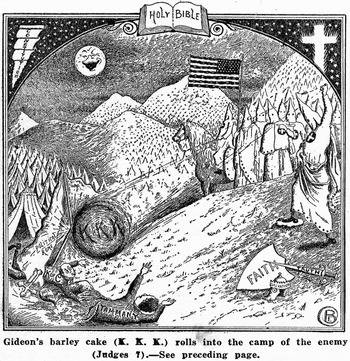
Branford Clarke's illustration “Gideon's Barley Cake” (figure 2) appears on the fourth page of this five-page chapter, and in many ways it “presents” the picture that White's words “evoke.”Footnote 56 The caption under the image—“Gideon's barley cake (K.K.K.) rolls into the camp of the enemy (Judges 7).—See preceding page”—alerts readers to the importance of the text in its decoding. It explicitly refers them not only to White's words but also to the biblical passage—book and chapter. The caption cements her interpretation and Clarke's in the Bible. Not only does this authorize Clarke's art, it attempts to rein in any unwarranted interpretations of his work and deter those who may be tempted to look at the pictures and skim the text.Footnote 57 However, vastly deviant interpretations seem unlikely, as Clarke's illustration remains faithful to White's words in a number of ways. The laughing moon indicates, like White's text, that this confrontation occurs under the protection of night. The barley cake is clearly labeled “K.K.K.,” and Gideon's army is indeed dressed in the white robes of the Klan. Lastly, Clarke's inclusion of the American flag makes explicit White's prayer-like words about America at the end of the chapter. Together White's words and Clarke's art purposefully re-imagine a biblical passage to create a way of seeing the Klan as a divinely justified fighting force.
Branford Clarke, “Gideon's Barley Cake,” from Alma White, The Ku Klux Klan in Prophecy (Zarephath, N.J.: The Good Citizen, 1925), 58.

However, while Clarke's art does not subvert White's words, his illustration includes details not mentioned in the surrounding pages that enhance the intolerant vision being disseminated. For example, White never directly described Gideon as a Klansman, but Clarke depicted him as one. Also, White only mentioned “Rome” and its nefarious schemes twice in this chapter, and she did not situate “Rome” in direct relationship to the Gideon story. Obviously, if one reads the entirety of White's work, “Rome's” enemy status is clear; however, at the same time, lest the reader forget, Clarke's art makes this enemy real in his artwork in a way that White's chapter does not. The tent being crushed by the K.K.K. barley cake is identified as “Political Rome,” and spilling out of it are its minions—the Knights of Columbus and Tammany (as in figure 1). These elements identify Catholicism as a threat that must be defeated, and Clarke's portrayal of the religious other attempts to ease any discomfort with this violent notion. He refused to feature ordinary Catholics who may have elicited reader sympathy but instead highlighted the supposed powerful Catholic forces in a stereotypical fashion. They appear as hapless caricatures who command great numbers—simultaneously bumbling and dangerous. By doing so, Clarke's illustration incites fear and denies Catholicism a human face (even the immense Catholic crowd in figure 1 appears indistinct yet mob-like). In this way, Clarke provided readers with a visual shorthand to the conflict, one that revealed the Catholic threat and justified, if not divinized, action against it.
The image reinforces this sense of divine sanction as the Klan appears powerful, organized, and biblical. In the right foreground Gideon possesses biblical weapons not mentioned in White's text—the shield of faith, the helmet of salvation, and the sword of truth of Ephesians 6:16–17. Noticeably, these biblical weapons appear opposite the “superstitious” trappings of Catholicism—Holy Water and a cross. The size of the sword, helmet, and shield dwarf that of the Holy Water and cross, connoting the former's power and virtue. And their position on the right only reinforces this interpretation. As in figure 1, “Gideon's Barley Cake” employs the visual idiom of idolatry to signal Catholicism's religious outsider status.Footnote 58 In both of these illustrations, Clarke used familiar and evocative symbols, as well as biblical elements, to disseminate his pro-Klan message in a quick and effective manner. Unlike White's words, he literally showed readers. In his visual imagery, the biblical and therefore Christian character of the Klan is clear while Catholic reliance on people and things other than the Bible denotes their idolatrous and un-Christian character.
Clarke's illustrations made visible the religious and political threat posed by Catholicism while simultaneously showcasing the patriotism and Protestantism of the Klan. His art visually demarcated the difference between insider and outsider, Christian and non-Christian. He used American and biblical symbols to create a simplistic and stereotypical vision of the religious other. “This is the most important function of the stereotype: to maintain sharp boundary definitions, to define clearly where the pale ends and thus who is clearly within and who clearly beyond it.”Footnote 59 This boundary creation recast the victims of religious intolerance as villains. In these scenes, the religious outsiders were depicted as power-hungry threats to the American (and Christian) way of life, a force that must be stopped. Given the way humans “create their worlds by visual means,” Clarke's rendering of a visual stereotype of both Catholic and Klansman through the Bible was a powerful tool with which to advance his cause.Footnote 60 By providing readers with a visualized biblical framework, his artistic additions constructed a way of seeing the world that justified religious intolerance.
Similar patterns emerge in the next chapter, titled “Feeding the Multitudes.” In these pages White discussed the “miraculous growth of the Invisible Empire.” People, she proclaimed, are being “enlightened” by the Klan while Catholicism seeks to keep them in “ignorance, superstition, and tyranny.” However, she insisted, despite “Pagan Rome's” best efforts, “our great army of patriots”—the Klan—will vanquish Catholicism and transform the country. “The multitudes,” she wrote, “are everywhere falling in line” with the Klan.Footnote 61 In White's view, Catholicism appeared ignorant and idolatrous in contrast to the Klan's intelligence and faithfulness. Clarke's illustration, figure 3, comes on the third page of this five-page chapter. Nowhere in the chapter, except in this image and its caption, is the feeding of the five thousand mentioned and only White's last sentence, which references the word “multitudes,” remotely recalls this gospel account.
Branford Clarke, “Then He Took…,” from Alma White, The Ku Klux Klan in Prophecy (Zarephath, N.J.: The Good Citizen, 1925), 63.

As with figure 2, Clarke's illustration exceeds the words written in White's text. He developed White's nascent idea of the Klan's dissemination of truth through this biblical passage. The image works visually in vertical thirds, and its composition leads the viewer's eyes immediately to Jesus and the disciples in the dominant middle third. White does not refer to Jesus at all in her chapter, but Clarke's illustration prominently features him wearing robes with a halo around his head. As in the biblical account, Jesus has five loaves of bread, but in this instance they bear the label “Tenets of the K.K.K.,” and he distributes them to his Klansmen disciples, who then feed the multitude. In case the viewer fails to discern Clarke's meaning, the caption explains. Parts of Luke 9:16 are quoted—“Then he took the five loaves and two fishes . . . and blessed them . . . and gave to the disciples to set before the multitude”—followed by the statement: “In like manner is the truth being carried to the people by the Ku Klux Klan.” As with figures 1 and 2, White's text and Clarke's image worked together and used the Bible to sanctify the Klan's cause, but in this case, White's words seem muted when compared with Clarke's more strident and explicitly biblical tones. Clarke's illustration seems to overshadow White's text and, to some extent, speak independently of it. By invoking a familiar biblical passage and placing Jesus amid Klansman disciples, Clarke's work translated White's writing into “a potent weapon” that spoke loudly about the legitimacy and sanctity of their message.Footnote 62
Similar to his other works, he constructed this religiously intolerant way of seeing, in part, through the use of visibility and invisibility. For example, Catholicism is absent from figure 3, but presumably it remains a threat in viewers' minds from reading White's words and seeing Clarke's other illustrations. Indeed Catholicism's invisibility seems to reinforce the sense of threat and need for vigilance. In the 1920s, one could not readily identify the Catholic other—Catholics did not bear distinguishing features and therefore could remain an undetected and subversive power. In response, Clarke's illustrations sought to help people see the threat they posed. However, at the same time, the other's absence allowed the viewer to imagine and endow it with threatening qualities. Thus Catholicism's simultaneous visibility and invisibility made it a canvas onto which viewers could cast their fears. Even when Catholicism appears, in figures 1 and 2, it remains a vague yet threatening force. Ordinary Catholics remain indistinct or even invisible and their visualized beliefs menacing. For example, Clarke included very specific symbols and labels—the pope, Holy Water, and the Knights of Columbus—to highlight Catholicism's supposed idolatry and desire for power, but nothing in them explains Catholic doctrines or proves the threat that these symbols suggest. Historical data and detailed explanations about Catholicism are noticeably absent. Yet Clarke employed these visual cues, this artistic shorthand, as a type of evidence to persuade viewers of an alleged historical truth—that Catholics were unbiblical and posed a threat to Protestant America. In the context of White's texts, this visual imagery, like photographs, hoped to function as “the quintessential objective document” and persuade readers (in a way that words could not) to believe in this simultaneously biblical and American world.Footnote 63
Clarke's portrayal of the Klan used these same techniques. In many of his drawings, including figure 3, the Klan dominates the image, a visibility that emphasizes its power and might, while Protestant symbols reveal its alleged virtues. However, except for their wearing of hoods and working at night, the Klan's tactics and tenets are concealed. In this way, Clarke masked the intolerance of the Klan; its hatred and violence remained invisible. Similarly, in figure 3, Jesus distributes the “Tenets of the K.K.K.,” but they are not defined. Neither is the nature of Protestantism. Clarke used Jesus and the “Holy Bible” to denote the Klan's Christian faith, but the character of this Jesus and the content of this Bible, as well as the Klan's tenets, are left un-illustrated. This tactic simultaneously sanctified the Klan's mission yet allowed viewers to ascribe their own religious particularities and presumably virtues to Jesus, the Bible, and the Klan. Clarke's disclosure and concealment, as well as his simultaneous reduction and expansion of White's message, provided readers with a biblically justified intolerant way of seeing the world.
The art of religious intolerance as promulgated by Clarke and White rested on this ability to reframe reality—to construct a different vision of the world. This vision claimed historical and religious veracity but relied on suggestive and vague argumentation. It invoked the Bible as authoritative but excluded the Exodus story and the Golden Rule. It relied on the appropriation, representation, and re-contextualization of supposed evidence. Clarke's illustrations played a central role in this process. His visual shorthand simplified the complexities involved, making the Klan-Catholic conflict easy for readers to decode.Footnote 64 He employed powerful symbols to make the alleged threat of the Catholic other visible and tangible while concealing the Klan's intolerance. Indeed, he re-envisioned it as benevolence and faith, which he accomplished, in part, through his appropriation of biblical elements. Juxtaposing Klansmen and Bible heroes, the hills of Palestine and the flag of America, demonstrated for readers steeped in Christianity the righteousness of his cause. Clarke's visual culture appealed to emotions of patriotism and fear, but more than that, it drew on the Bible. Protestant Christianity's association with this sacred text became the religious norm to which all others were compared and, not surprisingly, these others fell short.Footnote 65 In the end, he constructed an imagery of desire, one that not only included the Bible, but also the United States.Footnote 66
V. Bible History Is American History Is Klan HistoryFootnote 67
White and Clarke's appropriation of the Bible was not restricted to the bravery of prophets or the landscape of Palestine. The prominence of the flag in figures 1, 2, and 3 demands a closer look at how they envisioned the United States in relation to the Bible and the Klan. In both her words and his images, America is portrayed as an entity to be protected and defended given its embodiment of the Christian principles of liberty and democracy. White rooted these claims in her interpretation of the American past. She stated that these “heroes and heroines of the Cross,” the Puritans, “did not come to America as mere sightseers or adventurers; they came to establish principles that would liberate the human race from the tyranny of the Old World.”Footnote 68 Similarly, in another passage, White wrote, “The United States was founded upon the principles of the Protestant faith.”Footnote 69 George Washington provided additional “proof” of this as White recounted how he “stooped and kissed the Bible” upon taking his presidential oath. In the 1920s, for White and Clarke, this heritage—an America based on biblical Christianity—appeared to be in jeopardy as “Rome,” “the arch foe of liberty,” sought “to take the Bible, not only out of our public schools, but from our homes and churches” and “to wrench the government from the hands of Protestants and make it subserve the purposes of the Vatican.”Footnote 70 White's words and Clarke's art sought to persuade others that, if Catholicism were not stopped, Christian America would be lost.
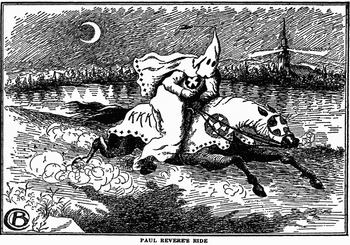
America and her history, then, emerged as a dominant refrain in White's writings and Clarke's illustrations. For them, the nation's past, as with the Bible, became a kind of sacred text from which they could glean historical patterns and heroic examples. Just as Klansmen peopled the landscape of ancient Palestine, they also appeared in the annals of American history. Samuel Adams, Paul Revere, and George Washington joined ranks with Gideon, Samson, and Jesus—they all belonged to the Klan. By merging the American past and the Klan's present, White and Clarke attempted to convince readers of the Klan's legitimacy through its historicity and sanctity. It also served as a call to action. “We need more than a display of national colors,” White insisted; what was needed was “a real infusion of patriotic blood in to the veins of our people.”Footnote 71 The Klan already had it. Others were clearly anemic.
To help infuse readers with this patriotic fervor and intolerant Protestant vision, White added to The Ku Klux Klan in Prophecy with Klansmen: Guardians of Liberty and Heroes of the Fiery Cross. Throughout these works, White emphasized the Klansman's willingness to sacrifice himself for the principles of the American nation, democracy and liberty. Features of Clarke's art highlighted this as well. In Klan iconography, the hood concealed members' individual identity and symbolized their supposed selflessness, and the fiery cross represented their apparent willingness to sacrifice themselves for the greater good—both common elements in Clarke's illustrations.Footnote 72 His work suggested that, like Shadrach, Meschach, and Abednego, and like Jesus, Klansmen were willing to die. “Sacrifice,” White wrote, “is the most priceless of all the jewels of liberty.”Footnote 73 In addition to these biblical comparisons, White emphasized the connection between sacrifice and liberty embodied in those responsible for the country's founding: Revolutionary War heroes. Chapter titles, including “The Price of Liberty,” “Klansmen of the Revolution,” “Faith of our Fathers,” and “True Heroism,” reveal the importance she placed on this national event.Footnote 74 White also highlighted this connection between the country's past and the Klan's present by describing their shared genealogy. “Many people today,” she explained, “are unable to trace the origin of the Knights of the Ku Klux Klan back to the early settlers of our country, whose spirit and principles have been brought down from the Revolutionary times to the present day. Since the first efforts were made by the colonists to throw off the yoke of tyranny placed upon their necks by George III, 100 percent Americans have been the most conspicuous characters in our history.”Footnote 75 In other words, White re-narrated history. She constructed a world in which American heroes and heroines were members of the Klan. She claimed that American history is Klan history. Clarke's work made this history come alive and provided visual evidence that it was “true.”
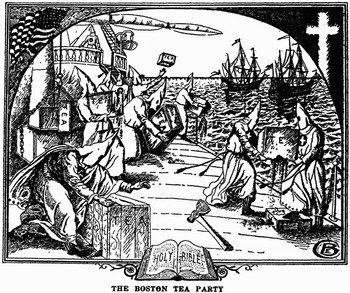
The creation and dissemination of this re-envisioned history can be seen most forcefully in figure 4, “The Boston Tea Party.” In this image, the wooden dock focuses one's attention on the Klansmen's defiant activity—dumping the Brits' heavily taxed tea into the waters below. The figures work furiously and fearlessly to accomplish their goal. White's accompanying text describes the scene: “The Klansmen, under the leadership of Samuel Adams, made up their minds to do the unloading in their own way. A great Klavern was held in the Old South Meeting House to determine what could be done. That night a band of citizens in full regalia rushed down to the wharf and emptied every chest of tea, nearly $100,000 worth, into the harbor.”Footnote 76 There is no question about their identity and their relationship to the Klan. White's words harmonize perfectly with Clarke's depiction. They leave little room for confusion or misinterpretation: in this re-imagined history, members of the Boston Tea Party were Klansmen. So, too, was Paul Revere (see figure 5).Footnote 77 Together White and Clarke constructed a vision of the Klan as an inheritor of this patriotic legacy, that the Klan, like these Revolutionary heroes, was defending the nation's liberty. For White the equation was simple: “The parallel between the Klansmen of the Revolution and those of today is obvious to anyone who has eyes to see.”Footnote 78 With Clarke's artwork it would indeed be difficult, if not impossible, for those with eyes to miss it.
Branford Clarke, “The Boston Tea Party,” from Alma White's Klansmen: Guardians of Liberty (Zarephath, N.J.: The Good Citizen, 1926), 54.

Branford Clarke, “Paul Revere's Ride,” from Alma White's Klansmen: Guardians of Liberty (Zarephath, N.J.: The Good Citizen, 1926), 57.

However, equally if not more important when analyzing figure 4 is the illustration's border. Here we again see Clarke's use of symbolic shorthand, especially the Bible. He situated the Klan's fiery cross opposite the American flag, suggesting their equal status and mutual goals. He often placed the fiery cross of the Klan opposite and equal to icons of the United States, including the Constitution, the Liberty Bell, the flag, the American Eagle, and the Capitol Building (figures 1 and 2). The symbols of each entity usually fill the top two corners while the symbol of Protestant Christianity, an open Bible, often occupies the top or bottom center (figures 2 and 3). In “The Boston Tea Party,” the “Holy Bible” in the border's center anchors the picture, invites viewers in, and upholds its centrality. Its positioning also highlights the Bible's relevance to history and frames the Klan's Christian character. Even more, the Bible provides the scene's foundation and authorizes the illustration's contents. The Bible literally opens up a pathway into American history as if to say biblical history is American history is Klan history. Through these historical and symbolic combinations, Clarke provided the actions of the Klan, past and present, with a blessing both patriotic and divine. He produced visual documentation of a history that never happened. Given the power of the Bible and “the capacity of images to influence” one's perspective, Clarke's illustrations constituted an influential weapon with which to attack Catholicism and defend the Klan.Footnote 79
By placing the Bible alongside symbols of the United States and the Klan, Clarke reinforced their alignment with one another—their common cause, the sense that one necessarily implied the others.Footnote 80 The positioning of these three icons on or near the border suggests that one should view the enclosed scene in light of their intermingled and seemingly interchangeable meanings. For example, figure 6 depicts a Klan initiation ceremony. The diagonal block of unoccupied space in the foreground combined with the oval-shaped ring of cars in the crowd of Klansmen immediately draws the eye to their fiery cross. However, the points of this cross direct one's attention to the icons in the banner that frames the scene. To the right and the left of the cross Clarke placed men emblematic of American freedom: George Washington and Abraham Lincoln. These men are connected by another American symbol, the flag, which is, in turn, held together through the power of the Bible. The Bible's location in the middle seems to suggest its ability to unify, to hold things together, and its placement directly above the fiery cross connotes its blessing upon the Klan's endeavors. These symbols combine to create a framework that signals that the scene within—a Klan initiation—is both biblical and American. The banner acts as a blanket that encompasses the event within its protective patriotic and divine folds. White's words only reinforce this interpretation. In the paragraph surrounding this illustration, she wrote: “A few faithful followers of the lowly Nazarene have been contending for the faith once delivered to the saints, against papal mobs who have torn down gospel tabernacles, wrecked buildings and imprisoned Protestant worshipers. There are times when, overwhelmed with gratitude to God, I wonder if it is an illusion of the mind or actually true that the rescuers of the Constitution and the faith of the Revolutionary fathers are at hand.”Footnote 81 This quote and Clarke's image re-envisioned the past to sanctify the Klan's actions in the present.
Branford Clarke, “Open-air Initiation of K.K.K. under the Light of the Fiery Cross,” from Alma White, The Ku Klux Klan in Prophecy (Zarephath, N.J.: The Good Citizen, 1925), 24.

Together White's words and Clarke's art combined the Bible with American history to redeem their cause and disseminate religious intolerance. They re-imagined historical events and appropriated biblical elements to “prove” that the Klan was patriotic and Protestant. Their work offered an intimate and visible connection—a historical link—between the Bible, America, and the Klan. Clothing Gideon in Klan robes, giving Jesus Klan disciples, and re-narrating the Boston Tea Party removed the distance between past and present, between the Bible and America. It helped make the Klan a plausible choice. Knowing that some doubted the Klan's fidelity to Christianity and the nation, Clarke and White created a written and visual culture that challenged these uncertainties.Footnote 82 In this vision, Clarke's artwork satisfied readers' “demand[s] for documentation, the[ir] hunger for authenticity.”Footnote 83 His illustrations showed in a powerful way that the Catholic other was idolatrous, un-Christian, and foreign while the Klan was seemingly unassailable—it was biblical, it was Christian, it was American. The efficacy of White and Clarke's message rested, in part, on their ability to claim interpretive power over the past, both biblical and American. By asserting authority over Bible stories and patriotic symbols, they not only delineated the parameters of Christianity, but they also defined America and what it meant to be American. In turn, this vision allowed them to label Catholics as religious and political threats, and justified violent action against them. They created a religiously intolerant way of seeing the world.
VI. Conclusion
These examples reveal the importance of images as sources for the study of religious intolerance; however, they also demonstrate how White's words and Clarke's imagery combined in various ways to create a persuasive and powerful message of religious intolerance. Sometimes Clarke's work harmonizes perfectly with White's words while at other times Clarke's artistic melody seems to dominate.Footnote 84 While neither duplicates the other, their different melodies show some of the complicated arrangements and compositions that disseminated Protestant religious intolerance in the 1920s. For White and Clarke, religious belief, fervent nationalism, and the Klan creed went together—and they were by no means alone in this stance, given the Klan's immense popularity among Protestants. As an advertisement for The Ku Klux Klan in Prophecy in White's periodical The Good Citizen boasted: “First edition of 11,000 exhausted in three weeks, second edition now ready.” Another stated, “We have never put out a book that has had such a sale. Six hundred and fifty copies were sold at a Klan gathering in a few hours. Others have sold 150 to 200 in a single evening. It sells itself.”Footnote 85 There was, it seems, a ready audience for White and Clarke's carefully crafted message.
The Klan's popularity rested, in large part, on its ability to invoke and promote a variety of causes. Historian Alan Goldberg states, “The Klan offered a program of Americanism, militant Protestantism, fraternity, order, religious intolerance, and racial purity—a plethora of causes from which to choose.”Footnote 86 White's typological hermeneutic and Clarke's artistic interpretations functioned similarly. They disseminated a multifaceted message that addressed religion and politics, America and the Bible, Jesus and the Klan, good and evil. However, even as one could read about this fusion of causes in White's writings, Clarke's illustrations offered something more. Through his use of the Bible and the technique of visibility/invisibility, he created a visual shorthand that offered ease of access and clarity of vision. People did not have to wonder. They could clearly distinguish the heroes from the villains, the insiders from the outsiders. They were provided with a way of seeing that divinized the Klan's mission, sacralized the American nation, and demonized the Catholic Church. In this way, he helped make the Klan an attractive religio-political option and contributed to the religious intolerance that characterized much of the 1920s.
While White, Clarke, and the second Ku Klux Klan faded from the American scene in the 1930s, their work illuminates how some Protestants wielded the art of religious intolerance in the 1920s and raises areas for future research. It demonstrates the power of visual culture in creating religiously intolerant ways of seeing the world. In addition, their efforts suggest that religious intolerance functions, in part, through strategies of disclosure and concealment, visibility and invisibility, demarcating boundaries and blurring distinctions. It tries to quell any questions that may arise. It aims to play on one's emotions and simply “presents” the supposed truth.Footnote 87 It also highlights the centrality of sacred texts, in this case the Bible, in disseminating religiously intolerant visions. Biblical passages, symbols, and figures provided Clarke and White with potent ways to claim legitimacy (religious and political) and thereby further their cause. They prompt us to question whether and how others in American history have promulgated religious intolerance in similar ways.
We may be tempted, as John Higham writes, to dismiss this vision as the work of “crackpots.” However, he reminds us that “nativism as a habit of mind illuminates darkly some of the large contours of the American past; it has mirrored our national anxieties and marked out the bounds of our tolerance.”Footnote 88 We cannot shy away from or write off the work of men and women like Branford Clarke and Alma White. Examining their way of seeing reveals aspects of how people create and replicate religious intolerance, then and now. They provide us with a glimpse into those contours and teach us how religion often functions as a way for people to exorcise their fears and exercise their power. Scholar Deborah Lipstadt writes that “the historian's role has been compared to that of the canary in the coal mine whose death warned the miners that dangerous fumes were in the air.”Footnote 89 Perhaps White and Clarke represent our canaries. They remind us of the persistence of religious intolerance in the United States and the need to study it.