1 Introduction
1.1 Why the theremin?
Lev Sergeyevich Termen, better known as Leon Theremin, spent most of 1927 touring through Europe, playing at concerts and demonstrations in Frankfurt, Berlin, Paris and London. He finally arrived in New York City on 20 December and stayed for approximately ten years.Footnote 1 The purpose of this tour was to introduce his new instrument, the etherphone, or thereminvox, or simply the theremin,Footnote 2 which intruded in the musical world causing a global commotion, provoking passionate reactions and attracting the attention of the scientific and cultural elite (Scotsman Correspondent 1927b: 13), and, as the following quote reveals, of the public at large (Birkhead Reference Birkhead1927: N16; Huddleston Reference Huddleston1927: 3):
Police were called to keep order among the crowds which thronged to the [Paris] Opera [house] tonight to hear his concert and many hundreds were turned away. For the first time in the history of the Opera standing room was sold in boxes … German musical centers hailed him as the inventor of a new form of music. (New York Times 1927b: 3)
Theremin became a media phenomenon, and the world’s reaction to the instrument, the myth that grew around it, and the speculations about the new music it heralded, were thoroughly documented in the press. As a reporter for the Irish Times put it: ‘The imagination is intoxicated by the musical possibilities latent in the invention. It is the greatest wonder of our time’ (Irish Times 1927a: 7). Late nineteenth- and early twentieth-century coverage of inventions were ‘hardly neutral or objective [and] favored a very particular, narrow, and romantic style of technical journalism’ (Douglas Reference Douglas1989: xvii) that often contributed to the success or failure of an invention. However, even if the product of an ‘intoxicated imagination’, the representation of the theremin in the press rendered it a site that allows us to understand how broad views about music technology, and electric musical instruments in particular, were culturally constructed in the development of modern music and modernity at large. These early reactions to the theremin resonate with general reactions to electric musical instruments thereafter and remain central threads in a larger system of beliefs about the roles of electric technologies in music.
In Albert Einstein’s view, the theremin put the world’s ‘musical development where our Stone Age ancestors were when they first discovered that they could produce sounds by striking implements together’ (Irish Times 1927b: 4). Soon the public and the press were defining this ‘music of the future’ by its medium: electricity. ‘Electric’Footnote 3 music was thus defined by its first widely popular exponent, the theremin, and in contraposition to the traditional, mechanical instruments of the past.Footnote 4 This sense of a new era in music, as a result of the introduction of a new medium, was particularly important given that the introduction of new media (such as photography or cinema) with respect to other art forms (painting or theatre) had already been perceived, at least initially, as a process of replacement. Indeed, assertions about the theremin replacing traditional instruments abounded and were central to the public’s understanding of the new device. The theremin’s techno-cultural life thus marks an important inflection point in the history of musical media and can provide us with insight into the dynamics of musical instruments at large.
1.2 Musical instruments as new media
Marshall McLuhan (Reference McLuhan1964) creates a distinction between the content of a medium and its message, arguing that ‘the content of any medium is always another medium’ (8). Thus ‘the content of writing is speech, just as the written word is the content of print, and print is the content of the telegraph [… while] the “message” of any medium or technology is the change of scale or pace or pattern that it introduces into human affairs’ (McLuhan Reference McLuhan1964: 8). For McLuhan, the content of a medium is what attracts people to it. The public becomes hypnotised and numbed by the content, thereby allowing the medium to effect changes in ‘human affairs’.
Building upon McLuhan’s ideas on the content of media, Bolter and Grusin propose the term ‘remediation’ to name ‘the representation of one medium on another’ (Bolter and Grusin Reference Bolter and Grusin2000: 45). In this logic, electric musical instruments have traditional instruments as their content, that is, electric instruments remediate traditional ones by repurposing aspects of traditional instruments in new electric devices. However, paraphrasing media theorist Steven Holtzman’s view of digital media, borrowing properties from existing instruments is problematic as these properties, not being designed with electric media in mind, do not take advantage of the specific qualities of electric ‘worlds’ (Holtzman 1997). Remediation and repurposing then are ‘transitional steps’ in the development of electric instruments, which ultimately give way to distinct and new forms of expression.
The main argument of this article is that the theremin follows similar patterns to those developed in new media theory. That is, as a new instrument designed with the aim of improving musical instruments at large, the theremin remediated older traditional musical instruments that relied on mechanical transfer of energy, and repurposed their musical properties in the electric domain. And although it aspired to the status and musical values of traditional musical instruments, this status was ultimately unattainable, thus eroding the values it aspired to uphold, gradually revealing the new and unique affordances of electric media. These new affordances uncovered a dramatically expanded flexibility in designing the relationship between sound and action through the dissociation of power, effort, sound, interface, and gesture, all of which could be easily scaled and combined modularly into new configurations. These new designs were formalised into circuits and these were encoded in a symbolic, graphical representation called a schematic. The schematic inaugurated a practice of transduction where an electric instrument changes state from symbolic representation to material device and back. Ultimately, it is the theremin’s practice of transduction through electronic schematics that allowed for changes in Western musical practice, blurring the boundaries between composer, performer, instrument, score, audience, as well as luthier and engineer. This transduction process is, however, only possible because of the instrument’s remediating behavior.
It is impossible to cover, in the short span of a article, the rich techno-cultural life of the theremin and thus I have focused on its early reception in newspapersFootnote 5 and on its technical life in amateur electronics publications thereafter. A richer view of the theremin that is beyond the scope of this article must include a study of the role of the theremin in the construction of musical modernism and its relation to the notion of modernity itself, an analysis of the role gender plays into the physical and cultural construction of the theremin and of electric sound at large, and an account of the role of the theremin and electric sound in movie thrillers (as the sonic expression of aliens, extreme psychological states, and so forth), and then in the sonic character of musical ‘exotica’ and psychedelia.Footnote 6 While in this article I place attention on the reception of the theremin as a device and indirectly on its inventor, it is impossible not to stress the fundamental role that theremin virtuosi Clara Rockmore and Lucie Bigelow Rosen played in making the theremin a musical instrument.
2 Electric Instruments and the Ether: Situating the Theremin
The application of science must lead to progress in music. (Theremin quoted in the Times of London 1927a: 9)
First demonstrated in Russia in 1920, the theremin captivated massive audiences largely because it was performed unlike any other instrument: without touching it. While it used electricity, it was not performed with keys, buttons, knobs or switches, and although it was a musical instrument, it looked like a wooden box (Figure 1).
A display ad in the New York Times advertising a live demonstration by Leon Theremin at the Gimbel Brothers store highlighting the human tones and immaterial interface (New York Times 1932c: 9).

The theremin consists of two antennae that propagate electromagnetic fields that vary with the human body’s capacitance, that is, with the body’s ability to store an electric charge. This phenomenon is largely – yet wrongly – understood as a measurement of the distance between the hands and the antennae, but capacitance varies with the movement of the entire body. One antenna controls the amplitude of the sound and the other one, its pitch. The sound was originally created with the heterodyning technique which used the difference between two inaudible high frequency oscillators to obtain a lower, audible third frequency as a result. The ranges of the antennae could be adjusted with variable resistors controlled by knobs to adjust the fields to the performers’ bodies.
Theremin initially named the device etherphone and the music it produced ether music or ether wave music ‘to distinguish it from the product of the contact or keyboard method’ (New York Times 1928b: 24). In ancient and medieval science ‘aether’ was believed to be the medium that filled the space between the planets. In early modern physics, and into the nineteenth century, it was believed to be the medium in which electromagnetic waves propagated (Whittaker Reference Whittaker1910). The term became a popular concept to explain the wireless transmission of sounds in the ‘radio boom’ of the 1920s. Indeed, the theremin was considered a ‘radio instrument’ (Associated Press 1927: 1; Altoona Mirror 1927: 2; Popular Mechanics 1934: 320; Parton Reference Parton1928: 2) and people talked about ether music, ethereal music, ether-wave music, musique des ondes ethérées and so on in reference to the sounds that the theremin produced (Lyrica 1927: 12; Christian Science Monitor 1928: 14; Dermée Reference Dermée1928: 12; New York Times 1928c: 31; New York Times 1928d: 25). These terms were gradually replaced with electric or electrical music. Several expressions of wonder about the instrument alluded to religious, and magical experiences, while the ether references also recalled the ancient ideal of the music of the spheres:
If Leo Theremin had lived 500 years ago he would probably have been burnt as a sorcerer … his magic held enchanted the thousands of people who filled the Albert Hall. (Times of India 1928: 13)
When Theremin arrived in New York in 1927, there was a large telephone network, a growing phonograph and record industry, and several radio stations broadcasting live. Commodified by corporations, sound technologies were continually being shaped into mass media and a sense of progress through technological development dominated public opinion. As Susan Douglas points out, this era of transformation, was ‘characterized by its cultural and commercial fixation on inventors and the cult of invention’ (Sterne Reference Sterne2003: 188–9). Theremin was no exception, claiming that the objective of his demonstrations was ‘to prove that science can render to music as much service as it is giving to industry’ (Manchester Guardian 1927: 16).
The first public presentations of the theremin were both technological demonstrations and musical concerts with Theremin at his instrument. While he had taken cello lessons as a child, Theremin considered himself a physicist and scientist rather than a musician and saw his work as a step ‘toward [the] electrification of musical acoustics’ (New York Times 1928b: 24) which he understood as progress. The Russian press described the instrument as ‘a musical tractor coming to replace the wooden plough’, saying that ‘Termen’s invention has done [for music] almost what the automobile has done for transportation’, and reported people in the audience saying ‘we might as well throw our violins aside’ (Glinsky Reference Glinsky2000: 52). In a 1921 lecture, Theremin actually defined the ‘goal’ of his work as the creation of a ‘solo instrument’ that could ‘perform the same functions as, for example, the violin, the viola, the violoncello, or corresponding wind instruments such as the clarinet’, except with one improvement: ‘If the instrument were able to produce sounds by responding readily to the free movement of the hands in space, it would have an advantage over traditional instruments’ (Theremin and Petrishev Reference Theremin and Petrishev1996: 50).
Theremin and many electric instrument makers of the time were not trying to transform the way music was practised. Instead, their inventions were an attempt at better instruments assessed in terms of traditional ones. That is, new electric instruments were evaluated under the then dominant (and reductive) concept of instrument as a stable timbre over which pitch and amplitude were articulated. In this sense, while electric instruments were taken as cases where new media would replace older media,Footnote 7 Western music’s nineteenth-century division of labor and the roles music media and technology played in music making, all remained intact: composer → score → performer → instrument → listener.
Indeed, in 1940, Curt Sachs added the category ‘electrophones’ to the already existing idiophones, membranophones, chordophones and aerophones, originally proposed by Mahillon in 1893. Thus the theremin and several contemporaneous electric instruments seemed to fit nicely into the existing organological classifications of the time which divided instruments according to the ‘nature of the vibrating, sound-producing body’ (Kartomi Reference Kartomi1990: 163) in the case of Mahillon, and ‘the physical properties of sound production’ (Kartomi Reference Kartomi1990: 173) in the case of Hornbostel and Sachs, both of which suggested the existence of a material sound-producing source. However, it was impossible to determine the locus of ‘sound’ in a device such as the theremin, since the only ‘vibrating body’ was the loudspeaker, and the signal it decoded was the result of a complex network of circuitry, magnetic fields and the bodies of performers.
3 Remediating traditional instruments
The first theremin recitals featured the new instrument performed as a soloist with piano accompaniment. Concert programmes consisted of nineteenth-century adaptations of solo pieces for voice or violin prompting associations and comparisons to those instruments: ‘a curious cross between a violin note and a human voice’ (Jones Reference Jones1927: 4). Portamento and vibrato were salient features associated with expressivity that the theremin shared with the singing voice and with bowed strings. Indeed, portamento became a strong marker of expressivity in violin performance in the early twentieth century (Katz Reference Katz2010) and many understood vibrato as a way to put a ‘soul’ or to give ‘life’ to an otherwise ‘mechanical’ or ‘cold’ sound (New York Times 1928a: 1; Vuillermoz Reference Vuillermoz1928: 10). While some saw these issues as unique features of the instrument, many others saw in them the instrument’s limits for performing discrete pitch steps and for playing notes in tune without vibrato.
Associations with the voice revived long-standing ideals about musical sound in the West. Vocal music was preferred to instrumental music since ‘the times of Plato’ (Kartomi Reference Kartomi1990: 135–40) until the eighteenth century, when composers began to pay more attention to instruments and instrumental music. The voice was considered to be the most expressive musical means and therefore instruments were measured against a ‘vocal standard’ according to their ability to imitate ‘the one thing that was worth imitating: the human voice’ (Dolan Reference Dolan2013: 60–6). The nineteenth century saw the culmination of a shift to instrumental music which granted real musical value to instruments. Seen in this light, the perception of the theremin’s sound as a hybrid of the singing voice and bowed strings construed this modern electric instrument as an ideal instrument capturing the best of the vocal and instrumental worlds.
In addition to this association, the press often referred to the theremin’s sound as ‘pure’ or ‘perfect’. The absence of material objects and of the mechanical energy needed to make these objects sound, translated into the absence of the ancillary noises of air blowing, bow friction and the mechanisms of keys and hammers that accompanied musical sounds in traditional instruments. Vocal technique in the Western world had aspired throughout its history to a pure, noiseless sound that the theremin had also achieved. The actions of the theremin performer accounted for both pitch and amplitude, but not fully for timbre. In contrast, the immateriality of the interface did partially account for the theremin’s unusually ‘clean’ or ‘pure’ sound. Thus the theremin provided a concrete material instance of the notion that instruments were fixed timbres over which pitch and amplitude were articulated.
Theremin designed a fingerboard model of the instrument in 1922. In 1929, he developed a new version of that fingerboard model commissioned by the conductor Leopold Stokowski for the Philadelphia Orchestra. The ‘fingerboard model’, in contrast to the ‘space-control’ model – with which we have been dealing so far – alluded directly to the cello, not only through its sound, but also through the shape of its interface, required performance posture and fingering technique. Stokowski thought of the ‘fingerboard’ model as ‘a cello, but without strings’ and the composer Joseph Schillinger described it as having an ‘idealized cello tone’ (Glinsky Reference Glinsky2000: 110). The absence of strings effected the transition from mechanical forms of sound production to electric ones, from cordophone to electrophone. However, the sound of the bowed string and all the noises that result from this mechanical friction are in fact an integral part of the sound of the cello, not the ‘idealized cello tone’ of the fingerboard-theremin. Schillinger’s allusion to an ‘ideal tone’ reflected the Western world’s division between musical sound and noise and its readiness to get rid of undesired artefacts of sound production.Footnote 8
The theories of H. von Helmholtz published in the late nineteenth century contributed to a new understanding of sound. For Helmholtz, ‘any given regular periodic form of vibration [could be] produced by the addition of simple vibrations’ (Von Helmholtz Reference Von Helmholtz1895) thereby determining its ‘quality’ or timbre. For Sterne (Reference Sterne2003), this view inaugurated a tympanic model of sound, where instead of modelling the source of a sound, sound was modelled in terms of the waveform that impacted the ear. Organological models based on sound sources such as strings (such as chordophones) assumed a direct and stable relationship between material source and resulting waveform that was simply not present in electrophones.
The ideal timbre of the theremin was produced by a circuit, and was therefore designed. The theremin did not have a timbre, but rather one was authored for it with ‘a pleasing combination of overtones’ (Glinsky Reference Glinsky2000: 104). Instead of adding sine waves as Helmholtz did, Theremin modified the parameters of his circuit to synthesise different waveforms. At the same time that the theremin’s timbre was identified with voices and bowed strings, the theremin was being portrayed as an instrument capable of all timbres. Theremin often claimed that his instrument could imitate ‘all known instruments’ and demonstrated this in his lectures. Both Theremin and the press often went further and claimed that the sounds of the theremin were even ‘better than that of the [imitated] instruments themselves’ (Glinsky Reference Glinsky2000: 68). However contradictory, Theremin stated that it was ‘not his wish in any way to imitate the tone of any particular instrument with his invention’ (Times of London 1927b: 13) but instead to add ‘an entirely new range of tone colors. Hitherto the composer has had only about twenty tone colors, represented by as many types of orchestral instruments. I give him literally thousands of tone colors’ (Kaempffert Reference Kaempffert1927: E1).Footnote 9 Paradoxically all these ‘tone colors’ came from one single source: the theremin.
Since the work of Grey (Reference Grey1975) and Wessel (Reference Wessel1979) we do not think of timbre in terms of an ‘instantaneous spectrum’, but as the complex interaction of time-varying phenomena such as the nature of the attack and evolution of the sound. In other words, if we understand timbre to be the way in which we recognise a sound to belong to the same instrument, then the timbre of the theremin is determined and recognised both by its articulation and performance technique and by the waveform generated by its circuitry.
Theremin declared that his instrument was loud enough ‘for 150,000 people to hear’ (Glinsky Reference Glinsky2000: 63). He presented it in ‘several large local auditoriums’ and even played it for an audience ‘of 12,000 in Lewisohn Stadium’ (New York Times, 1928e: 31). For some, the instrument had unlimited volume and others measured its power with acoustic instruments as the unit, ‘the equivalent of thirty instruments’ (Powell Harriss Reference Powell Harriss1928: TM4); ‘a tone which rivals that of a bank of stringed instruments’ (Knickerbocker Reference Knickerbocker1927: 5). First Airphonic Suite by Joseph Schillinger was the first theremin concerto. It was premiered in 1929 by the Cleveland Orchestra conducted by Nikolai Sokoloff with Theremin as the soloist. Both in the premiere of First Airphonic Suite and in the Lewisohn Stadium concert, critics were baffled mainly by the loudness of the instrument relative to the orchestra. The symphonic orchestra – the Western world’s largest musical organisation and symbol of musical evolution – had gradually developed over centuries towards the ideals of maximal register, timbral diversity and dynamic range. Suddenly, the orchestra was overbalanced by Theremin, ‘a grave and slender figure in evening clothes’ who ‘made the slightest motions in front of two bars’ (Glinsky Reference Glinsky2000: 108).
In sum, the theremin – and with it, electric music – revealed an instrument in which sound intensity was not directly proportional to the energy or force applied to it. ‘The slightest motions’ could indeed create a sound as loud as the amplification system would allow it. Violinist Joseph Szigeti noted that ‘the performer on this instrument can hold a note forever, or at least, as long as his hands could hold up … a singer is limited by his lung capacity, and a violinist by the length of his bow, but there is no limitation of on this instrument’ (New York Times 1928a: 1). In this way, electric sound seemed to shed away the limits and noises of materiality to achieve the long-held ideals of ‘purity’ of musical sound and magnified dynamic range through its immateriality. The new electric sound contributed to the constitution of modern sound as noiseless and powerful, but also as one where the relationships between space, energy and sound were reconfigured independently of the laws of physical objects and mechanical transfer of energy.
Borrowing from McLuhan, Bolter and Grusin, the theremin medium has traditional musical instruments as its content. The theremin remediates traditional instruments by borrowing their timbre, their repertoire, their vibrato. However, as a new medium the theremin aspired to be better than – or minimally as good as – traditional instruments at their job and thus it was evaluated in terms of these instruments (register, dynamics, timbre). It is in these efforts to improve upon the older media of traditional instruments that the theremin revealed an ambivalence between having a timbre and having many timbres, between being a completely new instrument and imitating existing instruments, between providing new materials to music and celebrating many long- held ideals of Western music. The theremin thus simultaneously affirmed traditional Western musical values and subverted them.
4 The theremin as a universal instrument or as a non-instrument
4.1 Immediacy
Now the theremin is peculiarly true in the sense that it reflects accurately the whole nervous and emotional system behind the hands that play on it, more sensitive to the musician’s hand than any other instrument. (Bigelow Rosen Reference Bigelow Rosen1934: X6)
Perceived to be an immaterial, interfaceless instrument, the performer on the theremin did not manipulate a material object, but rather ‘the ether itself’, a fact that rendered the instrument both spectacular and ‘magical’, as well as extremely hard to play (New York Times 1928a: 1). More precisely, the performer interacted with electromagnetic fields that transduced complex bodily gestures into two voltages that controlled the pitch and amplitude of the instrument. The sound thus became an index of the performer’s body and actions. The correspondence between the ‘free movement of the hand in space’ (Theremin and Petrishev Reference Theremin and Petrishev1996: 50) and the sounds produced by the instrument created the feeling that every detail of the performer’s movements was translated into sound and therefore nothing could be concealed from the audience. In this way, the theremin entered the debate about technological fidelity that abounded in the phonograph industry, where the discussion focused on the accuracy with which original live performances were recorded. The theremin was therefore a high fidelity instrument as its sound was perceived to be an exact translation of the performer’s gestures.
The invisibility of the interface with which the performer interacted contributed to the perception that the theremin’s mediation was so perfect that performances seemed not mediated at all. In words of the New York Times ‘there is nothing between the human being and the music itself’ (New York Times 1928a: 1). The press talked about performers expressing themselves directly to the audience, making the musician’s ‘personality’ or ‘individuality’ audible and allowing for an intimate connection to the music (New York Times 1929b: 37). It is important to note that the two most famous thereministes of the twentieth century as well as many theremin performers were women, and thus the bodies that the theremin was believed to transparently encode in sound were mostly female.
In this way, the theremin provides an early example of what Bolter and Grusin identified as the logic of transparent immediacy in digital technology. In this logic, a transparent interface is ‘one that erases itself so that the user is no longer aware of the medium, but instead stands in an immediate relationship to the contents of that medium’ (Bolter and Grusin Reference Bolter and Grusin2000: 23). Indeed, the circuitry of the instrument, and evidence of its mediation, was concealed from the view of the public inside a wooden box – and a metaphorical ‘black box’. Under this logic, performers did not play the theremin, they played music:
The musician ought never to be conscious of his instrument or of his technic when he plays as an artist. But the keyboard, the bow and the catgut constantly interpose and prevent him from obtaining true freedom … What can be freer than the movement of hands in empty space to produce beautiful sounds? (Kaempffert Reference Kaempffert1928: 128)
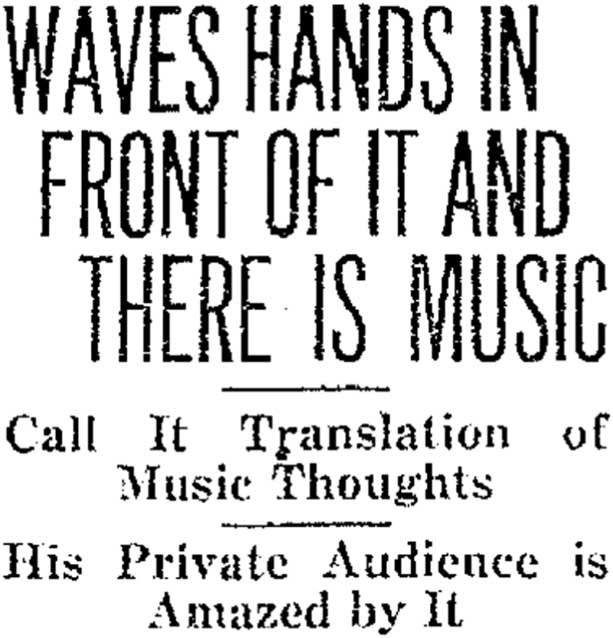
The idea was carried on to the extreme as the press and the inventor began claiming that the theremin was the ‘most perfect medium existing for translating the musician’s thoughts into music’ (Christian Science Monitor 1927: 1). The theremin thus enacted the centuries old debate about the mind–body split and about the nature of embodiment: while the sound was an index of the body, the body was an index of the mind and secondary to it, ignoring the intensity of the bodily engagement needed to play the instrument (Figure 2).
The theremin was often portrayed as capable of the ultimate mediation, from musical thought to sound, even while performers’ bodies were at the centre of each performance (Zanesville Signal 1928: 5).

Contrary to the beliefs of the press, because the instrument worked by sensing capacitance, any movement the performer made affected the sound and thus playing music on the theremin proved extremely hard. Rockmore told Theremin that she could ‘hardly breathe on that instrument without affecting something [… and could not] register any of [her] internal emotion at all. You cannot shake your head, for instance, or sway back and forth on your feet. That would change your tone’ (Glinsky Reference Glinsky2000: 156). Indeed, thereministes stood extremely still while performing. In the theremin all the tactile feedback of working directly with a vibrating material or interface disappeared thus forcing performers to develop their own technique and to adjust their performance by auditory feedback alone.
Nevertheless, while it was exceptionally difficult to play something well, it was very easy to play anything poorly because the theremin’s timbre was independent from the gestural input. The problem of producing a ‘good’ sound, which violin students had to face since their first lessons, seemed to be solved. Timbre was an automation, while pitch and amplitude were human-controlled. In fact, Theremin’s Euro-American tour resulted from a demonstration he gave to Vladimir Lenin in 1921 (Gordon Reference Gordon1992: 235), who was able to play it in his first attempt. The theremin was – misleadingly – portrayed as an instrument which was easy to play (Sutton Reference Sutton1933: I15) and in which ‘anyone who can hum or whistle a tune is able to produce whatever music he wishes … Little technical knowledge, practice or study is necessary’ (The Gleaner 1930: 22). In some cases, writers went as far as to say that music played almost automatically from the theremin without any effort.
4.2 A universal musical instrument or the non-instrument
With its aid anyone can produce every conceivable sound, familiar and unfamiliar. (Van Dieren Reference Van Dieren1928: 10)
In the mid-1920s the Russian press wrote in reaction to a theremin demonstration that ‘the problem of producing the ideal instrument is solved’ (Glinsky Reference Glinsky2000: 33). The Radio Corporation of America (RCA) advertising brochure predicted that the instrument was ‘destined to be the universal musical instrument; people will play it as easily, and naturally, as they now write or walk […] A child … an elderly lady … a skilled musician … a blind man … all can learn to play this incredible instrument with exactly the same facility!’ (RCA Reference RCA1929a). For RCA, the theremin was the instrument everyone could play and since the theremin was perceived as capable of imitating the timbre of any instrument, all acoustic instruments could be replaced with this single device.
Music unions feared the possibility of electric orchestras proposed by Theremin and Stokowski, because electric instruments were portrayed as so easy to play and so timbrally and dynamically powerful that they would reduce the number of instruments and jobs:
The power of the instruments will make it possible to reduce materially the number of players. (Prunieres Reference Prunieres1927: X8)
Because a variety of timbres can be obtained at the will of the performer, only sixteen instruments are needed for a full orchestra (New York Times 1932a: X7).
Theremin had an even more radical vision for an electric orchestra: ‘The time is coming when an entire orchestra will play without instruments. Then, before each musician there will stand only a music stand with music and on it two antennae, and through waves of the air an entire orchestral work will be played – strings, winds, drums – all’ (Glinsky Reference Glinsky2000: 115). The press accompanied theremin’s vision with inspired imagination and announced ‘the orchestra without instruments has come into being’ (New York Times 1927c: 16). Two of the New York Times’s most renowned critics of the time wrote:
At this future – and futuristic – concert no instrument will be seen, unless loudspeakers, music stands with antennae, and electrical apparatus concealed about the premises be reckoned as such. Wild-eyed musicians will sit at the music racks and flourish their paws in the air. Their movements will be even more eccentric and incomprehensible than they are now. They will stir restlessly in their chairs, describing strange angles and ellipses by their gestures. As the climax gathers to break in a gigantic crashing wave of tone these musicians will leap in the air, reaching for an imaginary mark suspended in the atmosphere above them. (Downes Reference Downes1928: 128)
Imagine, then, the Theremin electrical symphonic orchestra of the future! A hundred men stand before sheets of music. No horns, no violins, no clarinets – nothing in sight but the players and the music. The conductor raises his baton. The massive chords that open Beethoven’s Fifth Symphony are heard – that soul-stirring knocking of Fate at the portal of life. The players simply wave their arms. They seem to grasp the music out of the air. (Kaempffert Reference Kaempffert1928: 128)
The ideal or universal instrument was therefore an immaterial, invisible instrument or, metaphorically, a non-instrument. The theremin was construed as an instrument that disappeared in performance to present us directly with the music (even if the press and the public were obsessed with the device itself rather than with the music made with it). In other words, the ideal medium was a non-medium and the ideal mediation, immediacy. In this way, the theremin instrument became a non-instrument that erased itself in performance thus affirming the aspiration to an unmediated musical experience. In trying to achieve the best instrument and mediation possible, it fundamentally subverted the concept of the musical instrument as a medium for musical expression. It is thus interesting to consider how the ideas of a music without instruments that circulated around the theremin finally led to a music without performers, laying the foundations for the Electroacoustic Studios of the 1950s.
So if the theremin’s content is traditional musical instruments and the musical values they materialise, and if this remediational logic both affirms and subverts these values, what is the theremin’s message? What changes does it bring to ‘human affairs’?
5 From commercial product to schematic circulation
For Thompson (Reference Thompson2004), sound was modern at the turn of the century for three reasons. The first reason was efficiency, as sounds were ‘stripped of all elements now deemed unnecessary’ resulting in a ‘signal-like clarity’ (3). The theremin’s pure synthetic waveforms thus ‘minimized noise and maximized productivity’ by eliminating the noises of mechanical sound production, maximising signal loudness and imitating any timbre with a single device. The second of Thompson’s reasons was to ‘demonstrate man’s technical mastery over his physical environment’ (4) which the theremin embodied in its invisible, body-controlled electromagnetic field interface. The dissociation between effort and sound, and the physical distances that separated the loudspeaker from the performer and from the instrument, reconfigured space–time relations; the actions in one point in space resulted in an instantaneous response in another point in space through electromagnetic sensing and electric transmission. The third reason, required the instrument to be a commercial product (Figure 3).
An ad from Wanamaker department store introducing the RCA theremin and highlighting its ease of performance and immaterial and electrical nature, distinguishing it from other sound media such as the radio and the phonograph. Quite notably, the theremin is shown performed by a woman, as the most notable thereministes were women (New York Times 1929c).

The press would often speculate about agreements or offers to massively produce theremins. The magical, quasi-hypnotic effect of the instrument, its ability to attract large crowds, its automatic ‘pleasing’ timbre and perceived ease of performance added to the prospect of low fabrication costs and entertained the idea of commercial success. Seizing on the opportunity, on 12 March 1929, Theremin signed an agreement with RCA to develop a commercial version, and on 23 September the RCA Theremin was announced and sales began shortly after. The New Yorker reported that RCA executives ‘chagrined that none of its engineers hit upon the idea’ and agreed to pay Theremin ‘royalties that should make him wealthy’ (New Yorker Magazine 1929a: 18).
The RCA Theremin became the first mass-produced, standardised version of the instrument. RCA expected to sell theremins for ‘every home’ (Figure 4). They produced a first set of 500 instruments to test the market and although all the units were sold, it generated a loss. Targeted to higher income families with a total cost of approximately $232 dollars (approximately $3,127 in today’s US dollars)Footnote 10 including all parts and loudspeakers, the RCA Theremin was introduced to the public less than a month before the ‘Black Thursday’ market crash that marked the beginning of the depression era. Royalties paid to Theremin, merchandising expenditures, problems springing from technical malfunctions, lawsuits for patent violations and the socioeconomic context prevented RCA from pursuing the instrument’s commercialisation any further.
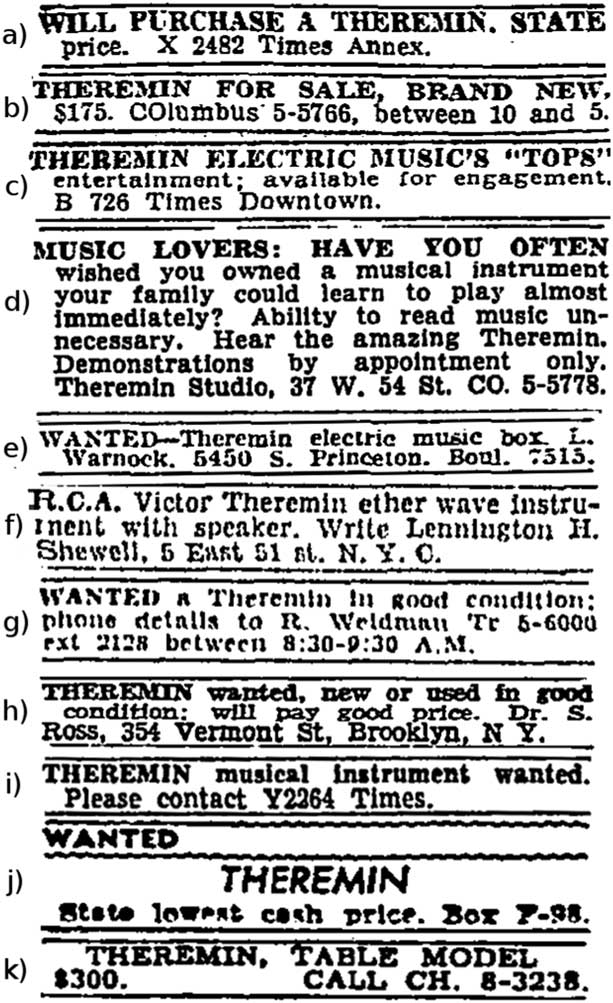
A selection of classified ads from the 1930s until the 1950s, a small and informal market for theremins and theremin entertainment subsisted in the absence of commercial models: (a) New York Times, 13 December 1934: 3; (b) New York Times, 19 January 1936: N2; (c) New York Times, 12 April 1936: N2; (d) New York Times, 19 February 1939: 40; (e) Chicago Daily Tribune, 10 May 1942: C13; (f) New York Herald Tribune, 8 November 1944: 18; (g) New York Herald Tribune, 21 June 1947: 25; (h) New York Times, 13 February 1949: R17; (i) New York Times, 29 December 1950: 33; (j) Los Angeles Times, 30 October 1954: A18; (k) Los Angeles Times, 22 September 1957: K36.

Still, by 1931 RCA had managed to create a small market of amateur and professional thereministes they could no longer attend. The New York Times’s Classified Ad and Public Notices sections featured announcements of people looking to buy and sell theremins, as well as thereministes offering their services as entertainment, generating a small-scale economy around the instrument. Moreover, its regular use in movies, radio, TV shows and records throughout the century allowed the theremin to retain a position in the imaginary of the public.
While engaged in its commercial venture, RCA realised that one of the pitfalls of the instrument was that it could malfunction. Facing the fact that they could not rely on salesman to repair their failing products, RCA released the ‘RCA-Theremin Service Notes’ which contained diagrams, parts lists and schematics of the instrument that allowed people to repair their own instruments (RCA Reference RCA1929b,).
The fact that the instrument boiled down to a schematic – a diagram that specifies the parts and connections that make up an electronic circuit – and in the absence of commercial manufacturers, amateurs were presented with the opportunity to not only repair existing instruments, but also to modify or start making their own. The theremin thus joined the fast growing world of ‘amateur electronics’, which had started with amateur or ‘ham’ radio building and listening and had grown dramatically in the 1920s to the point that it lead ‘radio industry giants RCA and General Electric [to pursue] a sideline in products for hobbyists’ (Haring Reference Haring2007: 55).
As early as 1928, theremin schematics were published in La France Radiophonique and in the theremin patent itself (Theremin Reference Theremin1928). In the Berlin Wireless Exhibition of 1932, an organisation called the Heinrich Hertz Institute exhibited an instrument ‘based largely on that of Theremin’ and taught ‘interested amateurs how they [could] build them for themselves’ (New York Times 1932b: X8). In the United States, schematics and tutorials were often published in electronics magazines (Figure 5),Footnote 11 including a 1949 article by Ernest J. Schultz used by Robert Moog to build his first theremin, and a 1954 article by Moog published in Radio and Television News with his own version of the instrument (Moog Reference Moog1954). At this time, Moog had become a small-scale theremin builder, hand-building each unit upon order and offering the first commercial model in almost two decades. Moog began to improve the theremin and offered a few different models, some of which included an ‘overtone selector’ and a ‘synthetic formant’ (Pinch and Trocco Reference Pinch and Trocco2004).
First page from Hansen’s tutorial on ‘how to build a theremin’ featuring schematics and step-by-step instructions. This was one of many tutorials that allowed for the instrument’s reproduction (Hansen Reference Hansen1953).

The fact that Moog was able to access information in the form of a schematic, transform it into a new design, produce information in the form of a new schematic and submit it to a larger community was not a minor achievement. In fact, this kind of code-instrument transduction was probably the most important – yet possibly involuntary – contribution Theremin made to electronic and computer music as practices. It marked the beginning of a new paradigm in the exchange of information and in the way we make music and sound, transforming musical instrument design and construction, and through it, music composition as we understand it today.
Moog’s access and appropriation of information was, however, not that different from Theremin’s access and appropriation of discoveries such as the Audion. A very important part of Theremin’s work consisted in combining or interconnecting already existing electric components, concepts and ideas, and experimenting; a sort of modular design process. When legal action was taken against RCA for the use of Lee De Forest’s audion, or vacuum tube, in its commercial theremin model, Theremin acknowledged he had used ‘pioneering inventions’ (New York Times 1928b: 24) in his design, but he saw in the interface and its control possibilities his real contribution to music.
Theremin’s various interfaces for the same sound production deviceFootnote 12 (the heterodyning oscillator) or his use of the same interface to control various devices for sound, or light, or color,Footnote 13 indicated not only an unprecedented flexibility in designing relationships between gesture, effort, power and sound, but prefigured the concept of modular design. While it was not actually modular in the sense that it was not ready for end-users to reconnect its parts in various ways, Theremin’s ability to rewire the different parts of his inventions revealed that any voltage could potentially control any other voltage; any device could control any other device.
Indeed, before modular synthesisers emerged as a dominant paradigm in the early 1960s, trombonist Paul Tanner created the ‘electro-theremin’ in the 1950s in collaboration with actor Bob Whitsell, who had built theremins as a teenager (www.electrotheremin.com). Using two ‘off-the-shelf components from Heathkit an oscillator and an amplifier’ which they hid inside a box, they created an interface where volume was controlled with a knob while pitch was controlled with a sliding handle attached ‘through a pulley-and-cable mechanism to the rotary dial of the oscillator’ (Holmes Reference Holmes2016: 471). The Electro-Theremin, famously featured in the Beach Boys’ hit song Good Vibrations, sounded like the theremin, but its handle would slide over a hand-drawn piano keyboard instead of the signature space-control interface of the theremin. Tanner and Whitsell’s Electro-Theremin thus re-fashioned the theremin out of three distinct modules: oscillator, amplifier and interface.
The degree to which the idea of modular design in music is indebted to the theremin is hard to assess. However, the fact that Moog, one of the main forces behind this design philosophy, began his career as a theremin builder is telling. Buchla, another driving force behind the idea of voltage controlled modular synthesisers, offered a Model 117 module called ‘Dual Proximity Sensor’ with ‘theremin-style antennas’ (Buchla Reference Buchla1966) that enabled the user to ‘patch’ a theremin by combining it with other modules. The original theremin was, after all, a hardwired voltage-controlled synthesiser.
Let us consider one more case of code-instrument transduction. In Czechoslovakia in the 1970s the rock band Plastic People of the Universe had been banned by the Soviet regime and forced to become an underground band. The band’s audio-engineer built a theremin based on a schematic ‘taken from an audio-engineering magazine’ (Hayward Reference Hayward1997: 43) with which they performed for several years. In code-instrument transduction, the theremin is converted into immaterial symbolic code and back again into material existence as a circuit; the schematic is a complete representation of the theremin, and is in a sense an immaterial theremin, and thus it contains the potential to be materialised into existence at a different time and place.
A global community of theremin makers has emerged over time offering new designs and adjusting to new parts and materials as technologies change. The nodes in this network of theremin-builders are separated by space and time and are connected by schematics, thus allowing for a trace to be made from every theremin to ever other theremin, by the schematic it is made of. Today’s theremin culture is, perhaps, more global than ever, and is articulated through a large and popular website called thereminworld.com, which includes a wide array of resources including theremin kits, tutorials, schematics, media and a very active discussion forum. Users in thereminworld.com often share schematics online, as well as their findings on the analysis of classic devices.
The schematic, a symbolic and graphical representation of an electric circuit, converted the instrument into a code for information exchange, just like today’s computer programmers, including computer musicians, share open source code. As such, it opened up the possibility of re-constructing the theremin, but more importantly, of modifying it and/or recombining it – fully or in parts – with other electric devices. In short, the schematic allowed for (1) the exact replication of the instrument, (2) its study, (3) its partial appropriation, using a part of the circuit with a different purpose or in a different context, (4) its complete appropriation, using the whole device as part of a larger context, and (5) to convert these processes into a schematic too, further advancing the exchange of knowledge and information.
6 Conclusions
The theremin attracted the attention of the world because of the ‘magical’ qualities of its invisible, intangible interface, qualities that situated it at the forefront of the wave of scientific and technological innovation that dominated the twentieth century, and which defined modernity. The theremin, and with it electrical instruments at large, remediated traditional musical instruments by adopting their sound, their repertoire, their venues, their status and their role in musical practice. This act of remediation legitimised the technological apparatus as a musical instrument. However, the theremin was not a traditional musical instrument, but an electrical musical instrument, and thus a new medium with distinct qualities. The theremin, and with it all remediating media deploy a double logic: because they behave like something they are not, they concurrently reinforce and subvert the values materialised in the media they remediate. They reinforce them because imitation is a way of affirm the values that traditional media materialise, and they subvert them because they can never really be what they imitate and as new media, they materialise something else that is yet to be defined. Over time, remediating instruments create change because they destabilise older media as they begin to find their own behaviour as new media.
By this logic, the theremin, and all remediating instruments, both reify and challenge conceptions of musical instrument and musical material. The theremin’s ‘pure’ timbre reinforced divisions between musical sound and (material) noise and validated vocal and instrumental sound by creating idealised versions of these sounds. However, instead of a fixed timbral identity, the theremin offered infinite timbres challenging the individual timbral identity that defines each traditional instrument. The ideal or universal musical instrument, capable of all timbres, with an infinite pitch range, and a sound purer and more powerful than that of any other instrument, was construed as a medium that overcame the limitations of the physical world and as a symbol of the human domination of nature through science. Furthermore, the theremin was imagined as a direct, transparent and immediate instrument, capable of faithfully translating the performer’s personality – and even her thoughts – into sound without getting in the way. In consequence, the theremin seemed to reach the ideal mediation where nothing mediated between the musician and the music, thereby becoming a non-medium – and to some extent, a non-instrument. In this way, the theremin effected the ultimate affirmation and subversion of the traditional concept of musical instrument.
In an attempt to create a better instrument, the theremin imitated traditional instruments, but it also revealed the unique qualities of new modern electric media. The dissociation of gestural energy from sound power, of the qualities of the timbre from the actions of the performer, of the sound production device from both the interface and the loudspeaker were all characteristics of electric media’s unprecedented flexibility in designing the relationship between sonic behaviour and human action, that is, musical instruments. The medium to notate and communicate these new design possibilities was the circuit schematic. In this way, the theremin, and with it electric media, was presented as a modular instrument opening new paths for musical exploration.
But I would argue that these new paths were only possible because of the ‘magical’ remediation of traditional instruments. The popularity of the instrument and of the inventor himself, as well as the rich cultural life that the theremin enjoyed throughout the century, became catalysts of the changes that the theremin announced. In other words, what attracted the large audiences of the 1930s was the lure of attaining the ideals of Western music: the pure tone of the voice, the loudness that the orchestra and organ did not achieve, the instrument everyone could play, the possibility of realising all timbres in one device, and a mass market. In short, the appearance of a new and modern medium or technology that would match and surpass what music media had allowed until then. What they actually got was a schematic, and through it, the emergence of a practice of code-instrument transduction.
It is clear today that, despite the efforts of Theremin, Rockmore, Bigelow Rosen and many others, the theremin did not become the general purpose, universal musical instrument the press thought it would. Rather than achieving the status of traditional instruments, the theremin devolved into a specialised tool, and a dated sonic marker of the alien and the weird. In contrast, the practice of building theremins and other musical devices according to a code has grown exponentially. The theremin inaugurated a practice where musical instruments are designed, circulated and transformed through code. This code, whether the theremin schematics and tutorials circulating since the 1930s, or today’s open source software, can be transduced into material devices and sounds and re-encoded again. Instrument-code transductions force us to question how aesthetic ideas are materialised into instruments and formalised into a code, rendering the bounds between instrument and music more permeable and dynamic.
Marshall McLuhan’s famous dictum, ‘the medium is the message’, is particularly apt here. The theremin’s remediation of mechanical instruments was ‘like the juicy piece of meat carried by the burglar to distract the watchdog of the mind’(McLuhan Reference McLuhan1964: 18), while the real ‘message’ of the theremin – the introduction of modularity as a design philosophy and of the schematic as an operable and transmittable code – sneaked in silently through the back door. That is, the content of the theremin medium was traditional musical instruments and the Western repertoire and musical values it brought forth in the public’s attention, but the message of the theremin consisted of the transformations in the way we design and exchange music and musical devices, and with them a change in how we make music. The theremin thus inaugurated the electric era and prefigured current dominant computer music practices of code exchange and musical instrument design.