INTRODUCTION
Acute care hospitals continue to be the predominant place of death for terminally ill patients in most Western countries (Jacobs et al., Reference Jacobs, Bonuck and Burton2002; Sorensen & Iedema, Reference Sorensen and Iedma2011), and nurses are key players in the provision of end-of-life (EOL) care. Considering their continued presence at the bedside, nurses are expected to care holistically for terminally ill patients/families while they adjust to and live through the trajectory of the terminal illness (Fitzgerald, Reference Fitzgerald2007). However, the high-tech acute care environment of hospitals has been recognized as suboptimal for EOL care (Jacobs et al., Reference Jacobs, Bonuck and Burton2002; Sorensen & Iedma, Reference Sorensen and Iedma2011), and in such a context a comprehensive approach to care can be very difficult for nurses to accomplish due to: (a) the very fast pace of the environment, (b) the biomedical culture focused on active treatment and cure (Summer & Townsend-Rocchiccioli, Reference Summer and Townsend-Rocchiccioli2003), and (c) the cultural reluctance to discuss sensitive issues surrounding dying and the death itself (Willard & Luker, Reference Willard and Luker2006; O'Gorman, Reference O'Gorman1998). In that regard, the perceived cultural norms in acute care settings can have a strong influence on staff behaviors, attitudes, and beliefs toward dying patients (Wilson & Kirshbaum, Reference Wilson and Kirshbaum2011), even more so when these norms ignore the consequences and suffering that caring for dying individuals can create in healthcare professionals (Willard & Luker, Reference Willard and Luker2006).
In a literature review focused on the effect of death on nursing staff, Wilson and Kirshbaum (Reference Wilson and Kirshbaum2011) noted that much of the knowledge development on EOL care reports on the experience of patients and their relatives. Furthermore, research on EOL has mostly explored the experience of nurses working on specialty units, such as oncology, palliative care, and critical care (Wilson & Kirshbaum, Reference Wilson and Kirshbaum2011). The medical-surgical nurses (or generalist nurses) represent an important group of nurses involved in the provision of EOL, yet no review to date has explored such specific experience in providing EOL care within an acute care environment. According to the Canadian Association of Medical Surgical Nursing, medical-surgical nurses are considered the largest group of practicing nurses and have been referred to as “the foundation of our healthcare system” (CAMSN, 2008). Considering the valuable role these nurses play in supporting many of the dying patients in our acute healthcare institutions, the aim of this literature review is to explore and gain an in-depth understanding of this experience, identify knowledge gaps, and recommend future research. We will attempt to answer the following questions: How is the experience of providing EOL care described by nurses? What are potential factors that influence nurses' responses and adjustment to provision of EOL care? What future research is needed in this area?
METHODS
Search Criteria
Inclusion Criteria
The sample inclusion criteria for the review were as follows. Published and peer-reviewed articles of empirical research reporting the experience and/or perceptions of acute care nurses regarding provision of EOL care in an acute care hospital, in a context other than critical intensive care units. Studies were limited to adult acute care where medical-surgical nurses were on staff. Studies including other areas of nursing practice or other healthcare professionals' perceptions and experiences were considered as long as the data attributed to the medical-surgical nurses were clearly identifiable. All study designs were included, based on the belief that combing through data from different types of research could potentially increase the depth and breadth of our conclusions (Whittemore, Reference Whittemore2005). Studies that reported exclusively on critical care and ICU nurses, oncology, or palliative care nurses were excluded.
Literature Search
The first author conducted the literature search during September 2012 using the CINAHL, MEDLINE, and PsyInfo databases, from 1992 to October 2012. The search criteria included the terms end-of-life, palliative care, terminal care, death and dying, nurs*, medical-surgical, acute care, hospita*, and tertiary care. Reference lists of key papers were reviewed to identify additional relevant references.
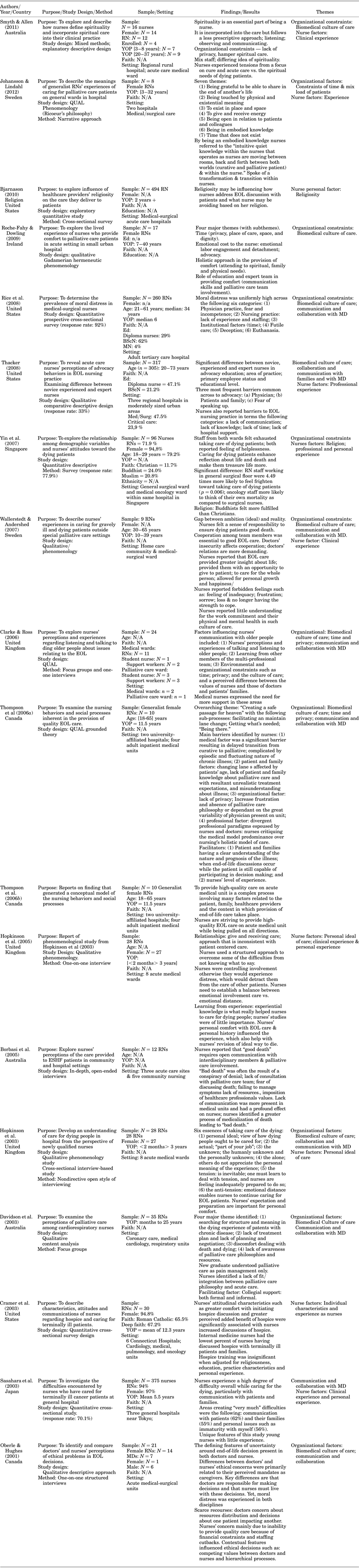
In all, 650 references were found and reviewed, considering the title and abstract first. A total of 16 studies met the inclusion criterion. Studies were from developed countries and included the United States (4), Canada (2), United Kingdom (2), Sweden (2), Ireland (1), Australia (3), Singapore (1), and Japan (1). In all but two studies (Davidson et al., Reference Davidson, Introna and Daly2003; Thacker, Reference Thacker2008), the authors specified that the majority of participants were female. The age of the nurses and years of experience varied across studies, but this information was not always available. The included studies employed qualitative designs (9), mixed methods (1), and quantitative designs (6) (see Table 1; also marked with an asterisk in the reference list below). Two separate publications reported findings from one original study (Hopkinson et al., Reference Hopkinson, Hallett and Luker2005; Thompson et al., Reference Thompson, McClement and Daeninck2006b). Most studies focused exclusively on registered nurses (RNs). Two quantitative studies also included nurse participants from other areas of practice: oncology, cardiology, pulmonary, and cardiac care (Cramer et al., Reference Cramer, McCorkle and Cherlin2003; Thacker, Reference Thacker2008). These were included since nurses' experience according to area of practice was identifiable. One study combined data from nurse participants working in the community, in home care, and on medical-surgical units in a hospital (Wallerstedt & Andershed, Reference Wallerstedt and Andershed2007). The specific experience of medical-surgical nurses was not singled out, but the authors suggested that their findings reflect a commonality across settings. One study also included nurse students and support workers who experienced EOL care on medical-surgical wards (Clarke & Ross, Reference Clarke and Ross2006), but, again, specific comments from those nurses were identifiable.
Summary of the studies included in the review

Notes: N/A = not available; YOP = years of practice; MD = medical doctor.
Analysis
This narrative review was conducted as per the following steps: (1) identification of the topic, (2) search of the literature, and (3) reading and critique of the sources, followed by (4) an in-depth analysis of the sources “to identify systematically the main recurrent and/or most important (based on the review questions) themes and/or concepts across multiple studies” (Pope et al., Reference Pope, Mays and Popay2007, p. 109). Data extracted from original studies were summarized with respect to sample characteristics, settings, methods, and key factors reported as influencing nurses' experience of EOL care within acute medical-surgical units (see Table 1).
RESULTS
Overall, the experience of acute care nurses providing EOL care within a hospital environment was challenging, but for some it was a time of personal satisfaction and growth. Several factors were identified as influencing the medical-surgical nurses' experience of caring for individuals at the end of life. These are detailed further below grouped as followed: 1) factors related to organizational constraints, 2) factors related to nursing and its professional ideal of a good death, 3) factors related to collegial collaboration and communication, and 4) factors related to nurses' personal experience and personal resources factors.
Organizational Factors
Culture of Care, Time and Privacy
The organizational factors were considered part of the working environment and not within nurses' control. Several studies addressed the difficulty associated with nurses caring simultaneously for both curative and palliative patients (Hopkinson et al., Reference Hopkinson, Hallett and Luker2003; Johansson & Lindahl, Reference Johansson and Lindahl2012; Smyth & Allen, Reference Smyth and Allen2011; Thompson et al., Reference Thompson, McClement and Daeninck2006a; Reference Thompson, McClement and Daeninck2006b; Wallerstedt & Andershed, Reference Wallerstedt and Andershed2007). Nurses were aware of the need to establish meaningful relationships with dying patients, but, given the task-oriented culture of medical units, they felt they had to give priority to meeting the physical needs of the acute patients (Clarke & Ross, Reference Clarke and Ross2006). As an example, nurses frequently reported that the spiritual needs of the dying were often given lesser attention than the more pressing and objective tasks to be accomplished for acute care patients (Roche-Fahy & Dowling, 2004). Furthermore, time taken to sit down and talk with patients was hard to justify as actual work (Davidson et al., Reference Davidson, Introna and Daly2003; Roche-Fahy & Dowling, 2004).
Even when time could be found, nurses identified important physical constraints from their working environment, such as the lack of privacy and lack of space, further limiting possibilities for spiritual and emotional care (Clarke & Ross, Reference Clarke and Ross2006; Sasahara et al., Reference Sasahara, Miyashita and Kawa2003; Smyth & Allen, Reference Smyth and Allen2011; Roche-Fahy & Dowling, 2004; Thompson et al., Reference Thompson, McClement and Daeninck2006a). However, nurses also recognized that a lack of time and practical tasks were at times helpful strategies employed to avoid talking with dying patients (Clarke & Ross, Reference Clarke and Ross2006). The difficulty involved in the emotional work of the dying was also contrasted with the ease and the comfort nurses felt toward providing physical care to active patients, which did not require as much emotional involvement (Roche-Fahy & Dowling, 2004). Caring for patients receiving active treatments offered nurses the chance to gather the strength and energy needed to care for dying patients (Johansson & Lindahl, Reference Johansson and Lindahl2012).
These cultural, physical, and time constraints were not without consequences for nurses who experienced tensions caused by their practice. They often described feelings that had negative connotations: feeling “physically and spiritually split between work with terminally ill patients and those suffering acute illness” (Johansson and Lindahl, Reference Johansson and Lindahl2012, p. 2038); feeling “helplessly torn between competing demands on their time” (Hopkinson et al., Reference Hopkinson, Hallett and Luker2003, p. 529); feeling inadequate from being unable to give dying patients and their loved ones what they needed (Johansson & Lindahl, Reference Johansson and Lindahl2012); and feeling hopelessness (Thompson et al., Reference Thompson, McClement and Daeninck2006a). Nurses often perceived that the acute care environment did not encourage sharing these feelings (Wallerstedt & Andershed, Reference Wallerstedt and Andershed2007) and that caring for dying people was something that nurses had to accept as “part of the job” or something “you get used to” (Hopkinson et al., Reference Hopkinson, Hallett and Luker2003, p. 528).
Having to learn to deal with it on their own, nurses perceived a risk attached to identifying and developing closeness with dying patients, mostly in terms of a difficulty in letting go at the end of their shift and taking work home with them (Wallerstedt & Andershed, Reference Wallerstedt and Andershed2007). To cope with the emotional demands EOL care placed on them, nurses in several studies spoke of the need to balance their engagement and detachment (Hopkinson et al., Reference Hopkinson, Hallett and Luker2005; Johansson & Lindahl, Reference Johansson and Lindahl2012; Roche-Fahy & Dowling, Reference Roche-Fahy and Dowling2009). This balancing act helped make it possible to care both in the present and on a long-term basis (Hopkinson et al., Reference Hopkinson, Hallett and Luker2005).
Lack of Recognition of the Emotional Dimension of EOL Care
As just described above, attending to the emotional needs of dying patients created dissonance within acute care nurses who felt constrained to do so within an acute care environment that did not recognize the emotional dimensions of care. Yet, despite being demanding work, when nurses were able to meet the emotional needs of dying patients, they described the caring experience as rewarding and gratifying (Johansson & Lindahl, Reference Johansson and Lindahl2012; Roche-Fahy & Dowling, Reference Roche-Fahy and Dowling2009). Nurses in several studies spoke of the work satisfaction they derived from being able to care for the whole person and also from their relationship with families (Johansson & Lindahl, Reference Johansson and Lindahl2012; Hopkinson et al., Reference Hopkinson, Hallett and Luker2005; Wallerstedt & Andershed, Reference Wallerstedt and Andershed2007). Johansson and Lindahl (Reference Johansson and Lindahl2012) reported that nurses were grateful for being able to share in the end of another's life. Nurses viewed “their caring practice as a privilege and felt compelled to give back by involving themselves deeply in their work, in a ‘totally comprehensive way’” (p. 2038). Nurses acknowledged the opportunity that this deep involvement provided for self-knowledge, which was conceptualized as “finding oneself, both as a person and as a professional nurse” (p. 2038).
Factors related to Professional Ideal of a “Good Death”
Nurses' dedication to patient care was motivated by a desire to bring the life of the patient to a good end (Wallerstedt & Andershed, Reference Wallerstedt and Andershed2007; Borbasi et al., Reference Borbasi, Wotton and Redden2005; Thompson et al., Reference Thompson, McClement and Daeninck2006a; Reference Thompson, McClement and Daeninck2006b). Nurses who were animated by this desire felt an inner reward that positively influenced their work (Wallerstedt & Andershed, Reference Wallerstedt and Andershed2007). A good death, for nurses, was possible when patients and families: (a) were included in decision making, (b) were kept informed, (c) accepted that death was imminent, and (d) were in an appropriate environment (Borbasi et al., Reference Borbasi, Wotton and Redden2005; Thompson et al., Reference Thompson, McClement and Daeninck2006a; Reference Thompson, McClement and Daeninck2006b). Nurses' ideals around a good death were described in terms of achieving a peaceful and pain-free death (Borbasi et al., Reference Borbasi, Wotton and Redden2005; Davidson et al., Reference Davidson, Introna and Daly2003; Hopkinson et al., Reference Hopkinson, Hallett and Luker2005). A good death also meant an opportunity for nurses to help prepare and be present with the patient's family members to say their goodbyes (Thompson et al., Reference Thompson, McClement and Daeninck2006a; Reference Thompson, McClement and Daeninck2006b; Hopkinson et al., Reference Hopkinson, Hallett and Luker2003). However, some nurses also recognized that death is not always a peaceful phenomenon (Davidson et al., Reference Davidson, Introna and Daly2003), that problems at the end of life are not always resolvable, and that suffering may very well be inevitable (Oberle & Hughes, Reference Oberle and Hughes2001; Hopkinson et al., Reference Hopkinson, Hallett and Luker2003). Nonetheless, despite this awareness, nurses experienced distress from not being able to act on some preventable issues, such as ensuring proper symptom management (Davidson et al., Reference Davidson, Introna and Daly2003; Thompson et al., Reference Thompson, McClement and Daeninck2006a; Rice et al., Reference Rice, Rady and Hamrick2008; Wallerstedt and Andershed, Reference Wallerstedt and Andershed2007).
Futile Care as a Source of Moral Distress
As discussed earlier, in several studies nurses described the biomedical approach to care (with its curative interventionist focus) as interfering with both their ability to provide high-quality care to the palliative care patients and the process of transitioning patients to palliative care (Davidson et al., Reference Davidson, Introna and Daly2003; Hopkinson et al., Reference Hopkinson, Hallett and Luker2003; Rice et al., Reference Rice, Rady and Hamrick2008; Thacker, Reference Thacker2008; Thompson et al., Reference Thompson, McClement and Daeninck2006a; Reference Thompson, McClement and Daeninck2006b). As a result, nurses spoke of the tension and moral distress they experienced when they provided futile care (treatment without benefit). Moral distress is defined as a painful psychological disequilibrium that results from recognizing ethically appropriate actions, yet not taking them because of obstacles (i.e., lack of time, supervisory reluctance, institutional policy, or legal considerations) (Rice et al., Reference Rice, Rady and Hamrick2008, p. 361). For nurses, the moral distress was related to their perception of providing futile care (Thompson et al., Reference Thompson, McClement and Daeninck2006a; Davidson et al., Reference Davidson, Introna and Daly2003), which has been associated with: (a) unnecessary treatment at the EOL, (b) initiation of extensive life-saving actions that only prolong death, (c) failure to ascertain family/patient wishes regarding these life-saving actions, and (d) communication deficiencies in discussing the implications of life-saving treatments to assure proper understanding on the part of patients and families (Rice et al., Reference Rice, Rady and Hamrick2008; Thompson et al., Reference Thompson, McClement and Daeninck2006a; Wallerstedt & Andershed, Reference Wallerstedt and Andershed2007).
Communication and Collaboration with Medical Colleagues
Poor collaboration and communication with medical colleagues emerged as a strong factor influencing nurses' perceptions of providing futile care (Clarke & Ross, Reference Clarke and Ross2006; Davidson et al., Reference Davidson, Introna and Daly2003; Rice et al., Reference Rice, Rady and Hamrick2008; Sasahara et al., Reference Sasahara, Miyashita and Kawa2003; Thacker, Reference Thacker2008; Thompson et al., Reference Thompson, McClement and Daeninck2006a; Reference Thompson, McClement and Daeninck2006b). Lack of collaboration was commonly discussed in terms of the personal attributes of physicians that impeded proper EOL care, such as lack of proper prognostication skills and lack of skills and knowledge of palliative care and symptom management (Davidson et al., Reference Davidson, Introna and Daly2003; Rice et al., Reference Rice, Rady and Hamrick2008; Thompson et al., Reference Thompson, McClement and Daeninck2006a; Wallerstedt & Andershed, Reference Wallerstedt and Andershed2007). Nurses' dissatisfaction and frustration were also considered a direct consequence of nurse–doctor relationships that failed to support and value nurses' caring beliefs and behaviors (Thompson et al., Reference Thompson, McClement and Daeninck2006a; Clarke & Ross, Reference Clarke and Ross2006). However, both nurses and doctors appeared to lack mutual appreciation of the moral burden carried by each profession in the care practice of the terminally ill patients (Oberle & Hughes, Reference Oberle and Hughes2001). Alternatively, nurses reported positive experiences in caring for persons at the EOL when collaboration and communication among colleagues was present (Johansson & Lindahl, Reference Johansson and Lindahl2012; Thompson et al., Reference Thompson, McClement and Daeninck2006a; Wallerstedt & Andershed, Reference Wallerstedt and Andershed2007). Collaborative approaches to care were perceived to improve clarity in treatment plans, allowing nurses the time needed to prepare for patient death and further contributed to nurses' positive experience (Thompson et al., Reference Thompson, McClement and Daeninck2006a; Clarke & Ross, Reference Clarke and Ross2006).
Communication and Collaboration with Patients/Families
Nurses also referred to patients/families “letting go” of curative treatments as another factor that further contributed to their perceptions of futile care (Borbasi et al., Reference Borbasi, Wotton and Redden2005; Thompson et al., Reference Thompson, McClement and Daeninck2006a). Nurses identified several barriers to patients' transitioning from curative to palliative care, including: (a) lack of patient/family knowledge about palliative care, (b) unrealistic treatment expectations, and (c) misunderstanding of the illness having progressed to a terminal state. Nurses believed that families' denial of death brought “false hope” and did not facilitate a “good death” (Borbasi et al., Reference Borbasi, Wotton and Redden2005; Thompson et al., Reference Thompson, McClement and Daeninck2006a). Nurses also perceived that both patients' and families' hopes were very much tied to patients continuing to receive active treatment aimed at a cure (Borbasi et al., Reference Borbasi, Wotton and Redden2005; Thompson et al., Reference Thompson, McClement and Daeninck2006a).
Individual Factors
End-of-Life Care Knowledge and the Clinical Experience
Although the need for additional palliative education was identified in several studies (Davidson et al., Reference Davidson, Introna and Daly2003; Sasahara et al., Reference Sasahara, Miyashita and Kawa2003; Yin et al., Reference Yin, Xia and Yi2007) mostly in terms of developing necessary knowledge and proper symptom management, it was mostly nurses' clinical experience that appeared to play a central role in influencing nurses' comfort around the provision of EOL care. To that effect, several studies highlighted the invaluable knowledge gained from years of practice (Clarke & Ross, Reference Clarke and Ross2006; Cramer et al., Reference Cramer, McCorkle and Cherlin2003; Hopkinson et al., Reference Hopkinson, Hallett and Luker2005; Johansson & Lindahl, Reference Johansson and Lindahl2012; Roche-Fahy & Dowling, Reference Roche-Fahy and Dowling2009; Smyth & Allen, Reference Smyth and Allen2011; Thacker, Reference Thacker2008). To that effect, a survey conducted in three general hospitals situated near Tokyo revealed lack of professional experience as an important factor linked to nurses experiencing a high degree of difficulty in terms of communicating with dying patients and families (Sasahara et al., Reference Sasahara, Miyashita and Kawa2003).
Nurses reported that their clinical experience provided them with valuable and useful knowledge about spiritual care, which came mainly from years of practice and learning from patients and families (Smyth & Allen, Reference Smyth and Allen2011). Experience appeared particularly relevant while caring concurrently for both curative and palliative care patients (mixed load, as described above), since it involved a necessary process of inner/psychological movement, whereby a deep knowledge of palliative care encounters and having good self-knowledge and knowledge of others were necessary (Johansson & Lindahl, Reference Johansson and Lindahl2012). Experienced nurses more readily identified other resources that could provide them with support, such as communication skills, relationships with patients, personal beliefs and compassion, and family support (Hopkinson et al., Reference Hopkinson, Hallett and Luker2005; Thacker, Reference Thacker2008). Experienced nurses were practicing “anti-tension” activities, such as: developing mutually supportive relationships with other nurses or relatives, using assumptions that provided them reasons for decisions and actions, and controlling their emotions so they could continue to care for both their dying patients and other patients (Hopkinson et al., Reference Hopkinson, Hallett and Luker2005).
End-of-Life Care Knowledge, Personal Experience and Resources
Nurses' professional experience was also influenced by personal resources such as religion (Bjarnason, Reference Bjarnason2010; Cramer et al., Reference Cramer, McCorkle and Cherlin2003; Yin et al., Reference Yin, Xia and Yi2007), although it is not exactly clear how religion might do so. For example, Bjarnason (Reference Bjarnason2010) pointed out the literature exploring the influence of healthcare providers' religiosity on the care they deliver to patients at the end of life. The author defined religiosity as “a set of beliefs regarding faith-based activities that are both visible (e.g., church-going) as well as discreet (silent prayer)” (p. 79). In another study, a positive correlation between nurses' religiosity and level of comfort in educating patients about aspects of EOL care was found. However, a negative correlation was found between nurses' religiosity and level of comfort with respect to withholding or withdrawing treatment. Cramer and colleagues (Reference Cramer, McCorkle and Cherlin2003), looking specifically at hospice discussions among nurses and terminally ill patients, found that greater religiousness was a factor that correlated with nurses being more likely to have discussed hospice with EOL patients/families. However, the authors pointed out other potential contributing variables since these “nurses were also more likely to have discussed hospice when factors such as caring for a greater number of terminally ill patients, having a close family member or friend who had used hospice, and being satisfied with hospice caregivers were present” (Cramer et al., Reference Cramer, McCorkle and Cherlin2003, p. 253). Thus, even though these are correlating variables, they nonetheless highlight the influence that nurses' personal and professional experience can have on the EOL care they provide.
DISCUSSION
This is the first published review of research studies focusing on factors influencing the experience of medical-surgical nurses in acute care providing end-of-life care. As such, it contributes to our understanding of this area. Our findings suggest that caring for dying individuals within acute care is complex, demanding, and challenging for nurses and that multiple factors influence nurses' experience.
The Value Placed on Emotional Labor
The organizational factors emerged strongly as factors constraining nurses' provision of good end-of-life care. The acute care environment was often described as unresponsive to nurses' professional assessments in terms of the identified needs of the patients/families, and to nurses' needs in relation to the emotional work they provided to dying patients and their loved ones. The lack of recognition of the emotional labor required in the care of dying patients and their loved ones has been critiqued elsewhere (Sorensen & Iedema, Reference Sorensen and Iedema2009). Emotional labor is defined “as a “deep acting,” where a personal exchange takes place and the healthcare professional connects with the patient to feel the emotion that they wish to display” (Sorensen & Iedema, Reference Sorensen and Iedema2009, p. 7). It also involves “managing feelings in both self and others” (Maunder, Reference Maunder2006, p. 28) and is known to exert considerable demands on nurses (Davenport & Hall, Reference Davenport and Hall2011; Stayt, Reference Stayt2009; Summer & Townsend-Rocchiccioli, Reference Summer and Townsend-Rocchiccioli2003).
In that respect, nurses frequently spoke of a need to balance their emotional involvement to protect themselves and to continue to care for other patients in the present and over the long term. In light of the multiple challenges and constraints to EOL care identified in this review, it is argued that emotional distancing may very well be an inevitable coping strategy nurses use to protect themselves form the suffering that results from by being emotionally involved with EOL care of patient/family may create (Davenport & Hall, Reference Davenport and Hall2011). However, despite these organizational constraints, nurses acknowledged gaining intense satisfaction from the relationships they were able to create with their patients.
Caring Ideal and Its Consequences
This satisfaction may be in part related to the professional ideals of nursing that are also influencing nurses' understanding of caring and how they can be fostered in their practice with dying patients and families. Caring in nursing is a core value of the profession around which nursing orients its occupational ideology (Maunder, Reference Maunder2006). In that respect, the caring experience cannot be expressed as an impersonal generalized stance of good will: “it must be lived, communicated intentionally, and in authentic presence” (Boykin & Schoenhofer, Reference Boykin and Schoenhofer2001, p. 54). Positive experiences of caring for patients at the end of life were described here in terms of contributing to personal growth, self-knowledge, and greater meaning in life. These findings echoed findings from a review that looked at factors that contributed to job satisfaction in nurses working in hospitals (Utriainen & Kyngas, Reference Utriainen and Kyngas2009), which showed that patient care was the major factor impacting on nurse job satisfaction.
Paradoxically, this ideal of caring has been critiqued as potentially contributing to nurses' general sense of inadequacy and to the tensions they have experienced in their practice (Ceci & McIntyre, Reference Ceci and McIntyre2001; Summer & Townsend-Rocchiccioli, Reference Summer and Townsend-Rocchiccioli2003). To that effect, Allen (Reference Allen2004) speaks of a “mismatch” between real-life nursing work and the profession's occupational orientation, mandating nurses to develop emotionally intimate therapeutic relationships with the patient. This is further supported by Summer and Townsend-Rocchiccioli (Reference Summer and Townsend-Rocchiccioli2003), who argued that, in acute clinical settings, “with acutely ill patients requiring an extraordinary level of factual and skill knowledge, the ability to turn on the caring emotion may be difficult if not impossible” (p. 165).
Hope and Need to Go Beyond Its Medicalization
This literature review clearly indicates that nurses experience a great deal of distress from the perceived futility of the care they provide to dying individuals. This is not unique to generalist nurses and has been abundantly acknowledged as a significant source of stress for critical care nurses (Badger, Reference Badger2005; Gélinas et al., Reference Gélinas, Filion and Robitaille2012). It has been argued that the need to intervene until the very end of life may be a response to the healthcare provider's view that this is important to maintain a patient's hope (Abu-Saad Huijer et al., Reference Abu-Saad Huijer, Abboud and Dimassi2009); however, this view has been critiqued as an incorrect conceptualization of terminally ill patients' hope (Duggleby et al., Reference Duggleby, Holtslander and Steeves2010; Eliott & Olver, Reference Eliott and Olver2002; MacLeod & Carter, Reference MacLeod and Carter1999).
Several studies of the experience of terminally ill patients focused on peace and comfort at the end of life and hope for the families, not on a cure (Duggleby et al., Reference Duggleby, Holtslander and Steeves2010; Eliott & Olver, Reference Eliott and Olver2002; MacLeod & Carter, Reference MacLeod and Carter1999). In relation to nurses striving toward providing dying patients and their families with a good death experience, it can be argued that by using a holistic approach to care nurses are implicitly addressing very important dimensions of hope (Duggleby & Wright, Reference Duggleby and Wright2005). However, nurses in this review mainly referred to hope in the context of curative intentions and in terms of professionals and patients'/families' “false hopes” and “death denial.” The argument developed here is that this discourse emphasizes the medicalization of hope; it is a discourse that is incomplete and insufficient (Eliott & Olver, Reference Eliott and Olver2002; Duggelby et al., Reference Duggleby, Holtslander and Steeves2010). As such, it may be necessary for nurses to expand their discourse of hope for patients at the end of life.
Nurses' Attitudinal Characteristics and Personal Resources
This review highlights the fact that, although formal education is necessary, it is insufficient to help nurses increase their level of satisfaction with the care they provide. In that regard, a nurses' personal attitudes toward death, personal experience as well as professional experience all play a significant role in increasing the level of comfort and satisfaction with EOL care. As such, it may be important in any palliative/EOL educational sessions to consider nurses' personal attitudes and beliefs in terms of the influence these might have on nurses' overall EOL care experience. In fact, training interventions that consider the personal attitudes and beliefs of healthcare providers may be more successful than those focused only on communication skills (Gysels et al., Reference Gysels, Richardson and Higginson2004). To that effect, Blomberg and Sahlberg-Blom (Reference Blomberg and Sahlberg-Blom2007) concluded that for healthcare professionals to be close and to share in the suffering of another human being, aspects of personal identity — such as self-knowledge, maturity, and security — must be considered in addition to experience and education (Blomberg & Sahlberg-Blom, Reference Blomberg and Sahlberg-Blom2007; Hopkinson et al., Reference Hopkinson, Hallett and Luker2003).
Collegial Collaboration and Communication
An important struggle faced by nurses was related to the process of transitioning patients/families to palliative care. This is particularly difficult when a collaborative relationship with physicians is lacking. In that regard, medical-surgical nurses are not the only ones; the need to fight to ensure decent conditions for the death of patients has been identified by critical care nurses as the most distressing issue encountered in EOL care (Gélinas et al., Reference Gélinas, Filion and Robitaille2012). It is argued here that this may be due to medical colleagues also experiencing discomfort and difficulty around timely and appropriate EOL care and decision making.
In fact, a discomfort around end-of-life care in acute care physicians has been well documented (Badger, Reference Badger2005; Sorensen & Iedema, Reference Sorensen and Iedema2009) along with the use of avoidance strategies to discuss sensitive issues, which are recognized in both doctors and nurses (Bloomer et al., Reference Bloomer, Moss and Cross2011). There is a potent cultural fear of death and a tendency toward denial of death that still prevail in Western societies (O'Gorman, Reference O'Gorman1998), and healthcare professionals are not immune to these phenomena. Yet, these must be acknowledged if we wish to diminish the suffering experienced by healthcare providers, patients, and families. As findings from this review suggest, when healthcare professionals ignore their own discomfort, when they think it is not appropriate to display emotions or share the emotions experienced, emotional detachment then develops. This emotional detachment, though at times healthy and necessary, can also result in failure to communicate effectively with patients, subsequently leaving healthcare providers feeling helpless and dissatisfied with the care they have provided (White & Coyne, Reference White and Coyne2011).
LIMITATIONS
This is a narrative review, and the analysis relies on the interpretation of reviewers (Pope et al., Reference Pope, Mays and Popay2007); as such, the two authors crosschecked each other's interpretations of the data from the studies reviewed. Although other interpretations are possible, the strength of this review lies in the commonalities highlighted across studies, which may signal a need to pay closer attention to particular aspects of acute medical-surgical nursing work. A few quantitative studies were cross-sectional survey designs from which correlations were not always easy to interpret. Finally, an additional limitation is a lack of an in-depth interpretation of cultural variation considering that studies came from many parts of the globe; this was beyond the scope of our paper and not one of this review's objectives.
FUTURE RESEARCH
This review identifies important gaps in the research. First, there is a lack of intervention studies specifically aimed at identifying ways to best support medical-surgical nurses in their provision of EOL care and which also consider the limits and particularities of the medical-surgical context of care. In particular, intervention studies considering practical ways to recognize and support nurses' emotional work in such a context are needed. Studies aimed at improving collaboration and communication among healthcare providers are also crucial in that regard. Finally, there is an absence of critical studies of nursing professional discourses, particularly with respect to medical-surgical nurses' practices of EOL care. For example, it may be relevant to conduct future research exploring nurses' discursive practices around the concept of “hope” or “good death” to help reveal dominant ideologies and assumptions influencing nurses' provision of end-of-life care.
CONCLUSION
This review has highlighted that despite the numerous challenges encountered within the hospital environment, generalist nurses want to and are dedicated to address the needs of patients at the end of life. This culture of care often hinders nurses' capacity to truly engage with patients and thereby threatens an important dimension of nurses' practice of EOL care: the patient–nurse relationship. This relationship is considered a necessary means for nurses to provide high-quality end-of-life care. Administrators and managers must acknowledge the emotional impact that providing EOL care has on healthcare providers and provide resources to support nurses' and other colleagues' emotional work. However, further research is required to develop necessary strategies for achieving meaningful outcomes in this regard.