1 Introduction
While it is relatively common for languages to contrast post-aspirated and unaspirated stops, or unaspirated and voiced stops, few languages contrast a set of phonemically pre-aspirated stops (Silverman Reference Silverman2003). Pre-aspiration as a phonemic feature can be found in languages such as Icelandic (Thráinsson Reference Thráinsson1978), Faroese (Helgason Reference Helgason2003), Eastern Ojibwa, a language of Canada (Bloomfield Reference Bloomfield1957), Goajiro, spoken in Colombia and Venezuela (Homlers Reference Holmer1949). For a complete list, see Clayton (Reference Clayton2010: 31–63). Pre-aspiration is also reported allophonically in such varieties as Middlesbrough English (Jones & Llamas Reference Jones and Llamas2003), Irish (Ní Chasaide Reference Ní Chasaide1985), Edinburgh English (Gordeeva & Scobbie Reference Gordeeva, Scobbie, Fuchs, Toda and Zygis2010), Newcastle English (Docherty & Foulkes Reference Docherty, Foulkes, Foulkes and Docherty1999: 66; Foulkes, Docherty & Watt Reference Foulkes, Docherty and Watt2005; Foulkes & Docherty Reference Foulkes and Docherty2006), Central Standard Swedish (Helgason & Ringen Reference Helgason and Ringen2008), Sienese Italian (Stevens & Hajek Reference Stevens and Hajek2007), Standard Italian (Stevens Reference Stevens and Alvord2011), and northern Welsh (Morris Reference Morris, Meyerhoff, Adachi, Daleszynska and Strycharz2010). This study is concerned with pre- and post-aspiration in a language where pre-aspiration has been described as a phonemic feature, Scottish Gaelic (Ladefoged et al. Reference Ladefoged, Ladefoged, Turk, Hind and Skilton1998, Clayton Reference Clayton2010). In the remainder of this paper, the language Scottish Gaelic is interchangeably referred to as ‘Gaelic’.
1.1 Pre- and post-aspiration
Pre-aspiration is referred to as the time period between the offset of normal voicing and the stop closure (Laver Reference Laver1994: 150). This definition conceptualises pre-aspirated stops in terms of the timing coordination of glottal abduction and supra-glottal closure for the stop. For example, in pre-aspirated /k/ in Gaelic boc ‘goat’ /pɔʰk/, the glottis is abducted before the stop closure for /k/, resulting in a period of aspiration preceding the stop. Laver refers to the offset of normal or modal voicing, highlighting the fact that the glottis abducts slowly, resulting in a period of breathy voice between the offset of normal voicing and onset of voiceless pre-aspiration. Breathy voice seems to be an important and integral part of pre-aspiration, since perceptual tests by Ní Chasaide (Reference Ní Chasaide1985: 373) indicated that breathy voicing alone was sufficient to cue pre-aspiration in Icelandic. In many pre-aspirating languages, and several dialects of Gaelic, though not the one under consideration here, pre-aspiration is produced with extensive supra-glottal constriction and frication, especially preceding velar stops (Ó Murchú Reference Ó Murchú1985).
Post-aspiration can similarly be thought of in terms of the timing coordination of glottal and supra-glottal closures. During the closure for a voiceless stop, the vocal folds are abducted. If the closure is released before the vocal folds move together for a following voiced segment, this results in an audible puff of turbulent, noisy air, or aspiration. The durational correlate of aspiration usually measured in phonetic studies of post-aspiration is Voice Onset Time (VOT) first defined by Lisker & Abramson (1964: 389) as ‘the interval between the release of the stop and the onset of glottal vibration, that is, voicing’.
1.2 Measures of pre-aspiration
The majority of phonetic studies of pre-aspiration measure durational properties of the pre-aspirated stop, for example Shuken (Reference Shuken1980), Ní Chasaide (Reference Ní Chasaide1985), Ladefoged et al. (Reference Ladefoged, Ladefoged, Turk, Hind and Skilton1998), Helgason (Reference Helgason2002), Helgason & Ringen (Reference Helgason and Ringen2008), Clayton (Reference Clayton2010). An exception is Jones & Llamas (Reference Jones and Llamas2003), who measured spectral peak. This is possibly because it has previously proved difficult to find a measure which can be applied to both the periodic sections of pre-aspiration (breathy voice) and aperiodic sections. Our study introduces a new analysis technique described in Gordeeva & Scobbie (Reference Gordeeva, Scobbie, Fuchs, Toda and Zygis2010) to the analysis of phonemic pre-aspiration. The measure, band-pass filtered zero crossing rate (BP ZCR), is a dynamic measure which aims to capture the noisiness of pre-aspiration in both the vowel preceding the pre-aspiration, and the pre-aspiration itself. The measure calculates the rate of zero crossings in a band-pass filtered signal, and performed better than other measures in tests designed by Gordeeva & Scobbie (Reference Gordeeva, Scobbie, Fuchs, Toda and Zygis2010) in its ability to distinguish stops identified as pre-aspirated. The measure is perceptually justified by results from Klatt & Klatt (Reference Klatt and Klatt1990) and Hillenbrand, Cleveland & Ericson (1994). These studies found that mid-frequency-range noise accounted for up to 80% of perception of breathiness. BP ZCR attempts to capture this perceptually important mid-range noise. The measure and its application are explained more fully in Section 3.5.3.
1.3 Aspiration in Scottish Gaelic
The focus of this paper is Scottish Gaelic, an endangered language with around 58,000 speakers according to the latest available data from the 2001 Census. The language is undergoing revitalisation with support from the Scottish Government. In this paper we report on Gaelic speakers from the Isle of Lewis, a large island off the north-west coast of Scotland, and the location of the densest concentration of Gaelic speakers (MacKinnon Reference MacKinnon, Ball and Müller2010).
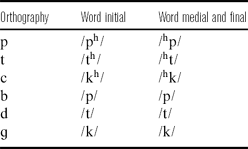
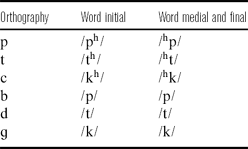
Studies of Scottish Gaelic report two stop series distinguished by aspiration, not voicing e.g. Oftedal (Reference Oftedal1956: 98), Borgstrøm (Reference Borgstrøm1940: 20). Word initially, stops are voiceless aspirated /pʰ tʰ kʰ/ vs. voiceless unaspirated /p tk/, e.g. /kʰa:ɫ/ càl ‘cabbage’, and /kaɫ/ gal ‘steam’. Word medially and word finally, stops are voiceless pre-aspirated /ʰp ʰt ʰk/ vs. voiceless unaspirated /p tk/, e.g. /pɔʰk/ boc ‘male goat’, and /pok/ bog ‘soft’. Although these distinctions are considered phonemic in every description of Scottish Gaelic, there are very few minimal pairs in the language (Shuken Reference Shuken1980: 22). In particular the pre-aspirated vs. unaspirated contrast is reported as bearing very little functional load, though there is no quantitative data available on exactly how large or small the load is compared to other contrasts in the language.
As well as the aspirated and unaspirated distinctions, Gaelic also distinguishes between palatalised and non-palatalised stops, similar to the system of Irish (Ní Chasaide Reference Ní Chasaide1999). Here we refer only to the non-palatalised stops. The phonetic realisation of pre-aspiration in Gaelic varies somewhat from dialect to dialect (Ó Murchú Reference Ó Murchú1985). The stop system of Lewis Gaelic from Ladefoged et al. (Reference Ladefoged, Ladefoged, Turk, Hind and Skilton1998) is summarised in Table 1. This study analysed data from speakers of Lewis Gaelic and measured duration of pre- and post-aspiration.
The stop consonant system of Scottish Gaelic.
Clayton (Reference Clayton2010) includes two production studies measuring duration of word medial and word final pre-aspiration in Gaelic, in both long and short vowel contexts. These studies found pre-aspiration was longest preceding velar stops, and shortest with bilabials. Also, pre-aspiration is longest after short vowels and shorter after long vowels. Clayton (Reference Clayton2010) compares Lewis, Harris, and Skye dialects, and while pre-aspiration is produced in all three dialects, it is shortest in Lewis Gaelic.
We expand on these previous durational studies of Gaelic (Ní Chasaide Reference Ní Chasaide1985, Ladefoged et al. Reference Ladefoged, Ladefoged, Turk, Hind and Skilton1998, Clayton Reference Clayton2010) by applying the band-pass filtered zero crossing rate measure to Gaelic stops to look at the quality of the aspiration, and also by considering the possibility of inter-generational production differences among speakers.
1.4 Variation among Gaelic speakers
Scottish Gaelic is in a complex situation of decline and revitalisation. In many areas of the Gaelic-speaking heartlands, such as the Isle of Lewis, where our participants are from, language shift is rapidly taking place and communities which were once entirely Gaelic-speaking are now bilingual, or becoming English-dominant (see for example Macleod Reference Macleod2006, MacKinnon Reference MacKinnon, Ball and Müller2010). Due to these large social changes which have taken place in Gaelic-speaking communities, we hypothesised that some differences in production may be apparent between generations. As such we felt it important to include representatives of an older generation who grew up in Gaelic-speaking communities, and also representatives of the younger generation who have grown up in much more mixed communities. Our small-scale study considers data from speakers split into two age groups: older speakers, aged 45–55, and younger speakers, aged 20–24. We first examined the patterning of the data according to the individual speakers and then assessed whether any comparison of the two age groups was appropriate.
1.5 Research questions
This paper presents results from an acoustic phonetic study of aspiration in the Gaelic of six speakers from Lewis. We address the following three research questions:
1. What are the durational characteristics of pre- and post-aspiration in Scottish Gaelic?
2. Is band-pass filtered zero crossing rate a useful measure for studying the acoustic characteristics of phonemic (pre-)aspiration?
3. Are there differences between the speakers in the realisation of pre- and post-aspiration? Do these pattern with generational age groups?
2 Methodology
2.1 Materials
The data referred to in this paper are taken from a set of word list recordings made by the first author between December 2009 and January 2010. The word list was designed to elicit minimal pairs for every contrast reported in Gaelic in previous phonemic analyses such as Ternes (Reference Ternes2006), and also to include at least one example per context from the Ladefoged et al. (Reference Ladefoged, Ladefoged, Turk, Hind and Skilton1998) paper for comparison. As noted above (Shuken Reference Shuken1980: 22), it is extremely difficult to find minimal pairs for pre-aspiration in Gaelic. Where this was not possible, we used near-minimal pairs e.g. bata ‘stick’ /paʰtə/ and bodach ‘old man’ /pɔtɔx/. Each word was included in the carrier phrase below and elicited three times.
Chuala e ____ aig Ailean
/xuəɫə e ____ ɛk alən/
‘He heard ____ from Alan’
The carrier phrase was presented to the participant at the top of the computer screen, and an English translation of the target word in Gaelic was provided below in order to contextualise the word.
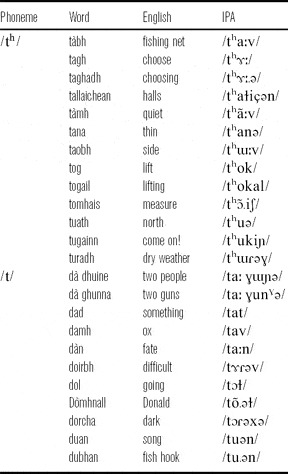
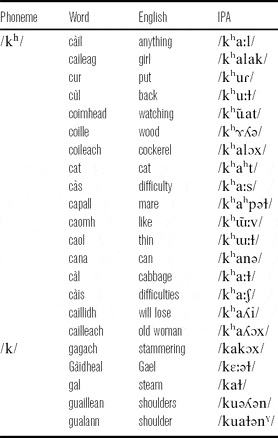
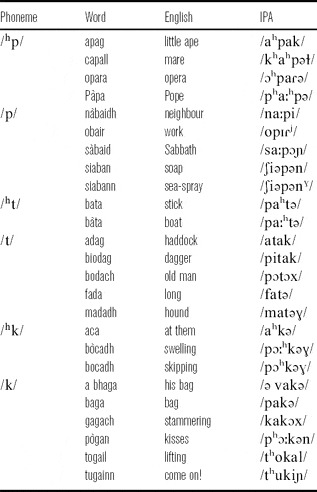
The words were grouped into seven semantic sets such as ‘nature’ or ‘home and family’ in order to distract participants’ attention from the minimal pairs on the list. Repetitions were ordered randomly within these groups. The resulting recordings contained examples of all stops at all places of articulation and word position. In all, 1285 word initial and 453 word medial stop tokens (1738 total) were extracted from the list for analysis. The number of tokens in each vocalic context was not entirely constant across different places and word positions. We therefore coded the vowels in the following manner and included this in statistical analysis: /i e/ = high front; /ɛ a ɔ/ = low; /o u ɯ ɤ/ = high back. Vowel length is phonemic in Gaelic and the word list included short and long vowels. This was included as a factor in the analysis. Lists of the word initial stops can be found in the Appendix, in Tables A1, A2, and A3; the word medial stops are in the Appendix, in Table A4.
2.2 Participants
This paper analyses data from six native speakers of Lewis Gaelic. All of the participants were raised in Gaelic-speaking households on the Isle of Lewis, and were living in Glasgow at the time of the recordings for work or study. The sample covered two generations: three of the participants were aged 45–55 years and three were aged 20–24 years. The older speakers grew up with Gaelic as the language of their community as well as their home, and at the time of data collection worked as professionals using Gaelic as part of their jobs. The younger group grew up in a situation of increasing community language shift to English, but went through Gaelic-medium primary education, and two of them were studying Gaelic at university. This age difference between speakers allowed us to gain a first indication of possible inter-generational differences. Given the pool of suitable Gaelic native speakers available, we were not able to stratify for gender: all bar one of the sample are female, one older speaker was male.
2.3 Recording conditions
The recordings were made directly onto a desktop computer, with a sampling rate of 44,100 kHz and 16-bit quantisation. The data were collected in the noise-attenuated sound studio at the Glasgow University Laboratory of Phonetics. The recording setup consisted of a Sennheiser MKH 40-P48 microphone connected to a PC using a Symetrix pre-amplifier and an Edirol AD/DA converter.
2.4 Data preparation
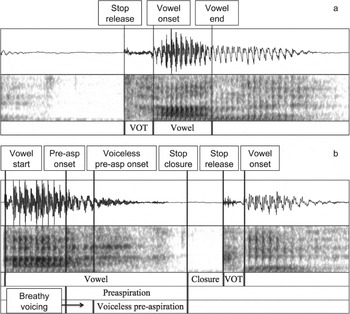
Prior to analysis, the sound files were filtered and labelled. We low-pass filtered the sound files at 8,000 Hz following Jones & Llamas (Reference Jones and Llamas2003) in order to remove any spectral information irrelevant to the current investigation. Labelling was carried out in Praat (Boersma & Weenik Reference Boersma and Weenik2012). Word initial stops were labelled for stop release, vowel onset, and vowel offset. Word medial stops were labelled for vowel onset, breathy voice onset (if any), voiceless pre-aspiration onset (if any), stop closure, stop release, following vowel onset. Figure 1 shows examples of the segmentation of post-aspirated stops (Panel a) and pre-aspirated stops (Panel b).
Examples of durational segmentation for post-aspirated stops (Panel a) and pre-aspirated stops (Panel b).

Durational measures were taken off the waveform (Ladefoged Reference Ladefoged2003: 96), and were taken at the nearest zero crossing, as in Foulkes, Docherty & Jones (Reference Foulkes, Docherty, Jones, Paolo and Yaeger-Dror2010). In the case of multiple bursts we followed Ladefoged et al. (Reference Ladefoged, Ladefoged, Turk, Hind and Skilton1998: 5) in taking the first indication of a stop burst in order to make our results more comparable to their previous work on Gaelic. Where the stop burst was unclear, the token was discarded. This was rare, but happened most commonly in word initial /pʰ/. We defined the start of the vowel following initial stops e.g. tana /tʰanə/ ‘thin’ using Lisker & Abramson's (1964: 389) definition of VOT as ‘the interval between the release of the stop and the onset of glottal vibration’; we measured the start of voicing as the start of the vowel.
Breathy voice can result in either a visibly jagged waveform (Gordon & Ladefoged Reference Gordon and Ladefoged2001) or a more sinusoidal waveform (Ladefoged Reference Ladefoged2003: 172). To determine the onset of breathy voice we therefore looked for a qualitative change in the waveform coupled with a decrease in amplitude of F4 and F5 visible on the spectrogram (Jones & Llamas Reference Jones and Llamas2006). This was the most challenging division to segment, but by zooming in to individual wave periods we were able to label consistently. The onset of voiceless pre-aspiration was determined by complete lack of periodicity in the waveform. Voicing in word medial stops was measured automatically (removing the need for manual segmentation) using a Praat script provided by Olga Gordeeva, which, as in Gordeeva & Scobbie (Reference Gordeeva, Scobbie, Fuchs, Toda and Zygis2010), included a cross-correlation algorithm to measure the offset of f0. For the male data, the minimum was 75 Hz and the maximum 350 Hz, and for the female data 75 Hz and 400 Hz, respectively.
2.5 Measurements
2.5.1 Durational measurements
In word initial stops we measured the duration of Voice Onset Time and the duration of the following vowel. In word medial stops we measured the duration of modal voicing in the vowel, breathy voicing, voiceless pre-aspiration, stop closure, and VOT following the stop release. By adding together the duration of breathy voicing and voiceless pre-aspiration, this gives the total duration of pre-aspiration. In the interest of space, this study presents the durational measurements of VOT, total pre-aspiration, breathy voice, and voiceless pre-aspiration only, as these measures yielded the most interesting results.
Our impression from listening to the data was that older speakers spoke more slowly. In order to normalise for speech rate, we used a ratio: in word initial position we took VOT and vowel as 100% and worked out proportional durations accordingly, and in word medial and word final position we took vowel and pre-aspiration as 100% and calculated proportional durations from this. These ratios proved ineffective at maintaining distinctions between phonemically long and phonemically short vowels. The results using these ratios were only reliable when comparing older and younger speaker groups, so we refer to them only when comparing the different age groups against one another.
2.5.2 Analysis of voicing
Closure voicing in word medial stops was investigated following Dorian's (Reference Dorian1978) claim that for East Sutherland Gaelic the stop system was /p tk/ and /b d ɡ/. She suggests that in East Sutherland the Gaelic was so influenced by contact with English that the (pre-)aspiration contrast had been replaced by a voicing contrast. We wanted to ascertain whether there was any evidence to suggest this replacement of the (pre-)aspiration contrast with a voicing contrast in word medial position.
The measure used to investigate closure voicing is voicing offset ratio, as developed by Gordeeva & Scobbie (Reference Gordeeva, Scobbie, Fuchs, Toda and Zygis2010). The offset of voicing was measured relative to where the stop closure occurred. If voicing stopped during the stop closure, this represented a voiced stop. If voicing stopped before the stop closure, this was a pre-aspirated stop. In order to time normalise the measurements, offset of voicing was calculated as a proportion of the stop closure. For example, if voicing stopped halfway through the stop closure, this stop would be 50% voiced. Only tokens of the unaspirated stop series were analysed in this way, as there was little or no voicing in the vast majority of the tokens from the aspirated series of stops.
2.5.3 Band-pass filtered zero crossing rate
In order to investigate the quality of pre-aspiration, we used a measure developed by Gordeeva & Scobbie (Reference Gordeeva, Scobbie, Fuchs, Toda and Zygis2010): band-pass filtered zero crossing rate (BP ZCR). Pre-aspiration refers to both periodic (breathy voice) and aperiodic sections of the waveform, so a measure was needed which was applicable to both; BP ZCR provides this. Previously, studies such as Bombien (Reference Bombien2006) have used standard zero crossing rate to quantify voiceless sections of the wave, but standard zero crossing rate is not applicable to breathy voiced sections, such as those found in pre-aspirated segments because breathy voiced sections contain a large amount of energy in the first harmonic, H1, and this disproportionally lowers the number of zero crossings in those sections. For this reason, Gordeeva & Scobbie's (Reference Gordeeva, Scobbie, Fuchs, Toda and Zygis2010) BP ZCR measure aims to remove the influence of H1. This is achieved by band-pass filtering with a flexible lower limit for the band at 1.5 × f0. Any rigid setting of, for example, 200 Hz, might miss H1 for speakers with higher f0, but a higher setting might remove too much spectral information for those with lower-pitched voices. For this reason a flexible lower limit is set, with a cut-off to avoid formant-tracking errors: 200 Hz for males and 250 Hz for females. The higher limit of the band-pass filter was set at 5512 Hz. This is because Gordeeva & Scobbie (Reference Gordeeva, Scobbie, Fuchs, Toda and Zygis2010) were interested in noise from the glottis, and filtering at 5512 Hz greatly reduces the contribution of any supra-glottal constriction to the noise in the signal. Gordeeva & Scobbie (Reference Gordeeva, Scobbie, Fuchs, Toda and Zygis2010) tested several measures against stops which were coded in a binary fashion as pre-aspirated or not. BP ZCR performed best in these tests, providing quantitative data, which most closely matched the stops coded as pre-aspirated. The examination of this particular frequency range with regard to pre-aspiration is also justified by perceptual data. Klatt & Klatt (Reference Klatt and Klatt1990) and Hillenbrand et al. (Reference Hillenbrand, Cleveland and Ericson1994) found mid-frequency-range noise accounted for up to 80% of perception of breathiness in sections of speech. BP ZCR aims to capture exactly this perceptually salient mid-range noise.
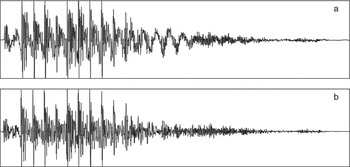
The effects of the band-pass filter on a waveform are shown in Figure 2. The differences are most apparent in the middle section, where breathy voicing occurs and the filtering increases the number of zero crossings.
Panel a shows the unfiltered vowel and pre-aspiration in aca ‘at them’; and Panel b shows band-pass filtering on the same token.

Using a Praat script kindly provided by Olga Gordeeva, we applied the BP ZCR measure to vowel+pre-aspiration in Gaelic, and also extended it to VOT+vowel in word initial position since many stops, particularly aspirated velars, had breathy voiced onsets which would not be accounted for in traditional definitions of Voice Onset Time, such as by Lisker & Abramson (Reference Lisker and Abramson1964). Some definitions, however, such as Helgason & Ringen (Reference Helgason and Ringen2008) do include breathy voice as part of initial VOT. Another advantage to BP ZCR is that it can provide a dynamic measure of the vowel+pre-aspiration, and VOT+vowel portions together. This is preferable to considering just VOT or just pre-aspiration in isolation, since Gobl & Ní Chasaide (Reference Gobl, Chasaide, Hardcastle and Hewlett1999) found carryover effects in the voice source signal of a vowel following a stop, and similarly, anticipatory effects in the voice signal of a vowel preceding a stop. The BP ZCR measure can capture some of such long-range effects.
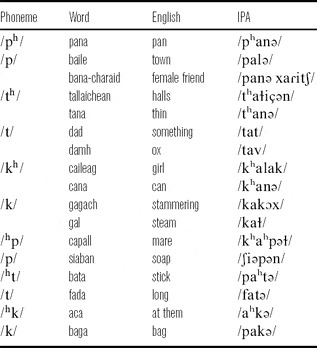
Zero crossings were measured in five temporally equal sections of VOT+vowel or vowel+pre-aspiration as in Gordeeva & Scobbie (Reference Gordeeva, Scobbie, Fuchs, Toda and Zygis2010). A greater number of zero crossings equates to noisier (pre-)aspiration. Analyses were conducted on the average zero crossing rate from each of the five sections to look at differences between aspirated and unaspirated stops, differences according to place of articulation, and also the possibility of inter-generational differences. Vocalic context can substantially change the number of zero crossings in a particular segment due to the differing shape of different vocalic waveforms. For this reason we only conducted zero crossing measures on one vowel context: short /a/. The words selected for BP ZCR analysis are included in the Appendix, in Table A5. A method for normalising for vowel context is, however, suggested in Gordeeva & Scobbie (Reference Gordeeva, Scobbie, Fuchs, Toda and Zygis2010).
2.6 Statistical analysis
Due to the unbalanced nature of the word list, and the lack of normal distributions or heterogenous variance, we applied a non-parametric statistical test, the Kruskal-Wallis test, on the durational data. Each durational measure (word initial VOT, word medial pre-aspiration, breathy voice, voiceless pre-aspiration, and VOT) was tested according to the following factors: Place of Articulation, Stop Series, phonemic Vowel Length, Vowel Context, and Age Group. Kruskal-Wallis is the non-parametric equivalent of the ANOVA. Post-hoc tests after the Kruskal-Wallis test were conducted using the Mann-Whitney U test. This test requires a manual application of a correction to avoid family-wise errors in calculating significance levels. We applied the Bonferroni correction here, calculated by dividing our significance cut-off, p < .05, by the number of post-hoc tests conducted. For example, in word initial position, Kruskal-Wallis demonstrated a main-effect of Stop Series. In order to discern whether Stop Series differences were present at every place of articulation, we conducted a Mann-Whitney test on the data split for each of the three Places of Articulation. Significance was therefore set at .05 / 3 = .0167. Results from the Mann-Whitney test are therefore reported as significant at the equivalent of where p < .05, with this correction applied.
The measures from BP ZCR analysis were, on the other hand, analysed using repeated measure ANOVAs. BP ZCR analysis was only carried out on one vocalic context, as discussed above, which led to a balanced dataset. The data were normally distributed with homogenous variance and therefore suitable for analysis using parametric repeated measure ANOVAs.
3 Results
The results for durational measures on word initial and word medial stops are presented first, in Section 3.1. We then present the results for the BP ZCR analysis of word initial and word medial stops in Section 3.2. Finally, we consider the differences between speakers in our dataset in both the durational and BP ZCR measures (Section 3.3), in order to assess whether inter-generational production differences exist.
3.1 Durational results
3.1.1 Word initial stops
3.1.1.1 VOT
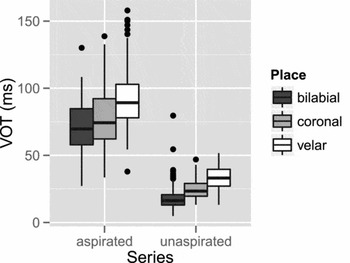
The duration of word initial voice onset time can be found in Figure 3. Results are split according to stop series (aspirated vs. unaspirated) and place of articulation. The duration of Voice Onset Time (VOT) was longer in the aspirated series of stops (H(1) = 955.3, p < .001), and this was true at every place of articulation: bilabial (U = 85.5, r = −.64), coronal (U = 39, r = −.85), and velar (U = 27, r = −.72). Bilabial stops have shorter VOT than coronal stops (U = 35781.5, r = −.55), and coronal stops have shorter VOT than velar stops (U = 52131, r = −.37). Velars therefore have longest VOT, and bilabials the shortest. Both the aspirated series of stops and the unaspirated series differed significantly according to Place of Articulation (aspirated U = 5091, r = −.35; and unaspirated U = 2201.5, r = −.60).
Durations of voice onset time in word initial stops (ms).

Vocalic Context did have an effect on VOT durations. In this case there were no high front vowels, so we were only comparing two contexts. Stops before high back vowels had a longer VOT (H(1) = 68.28, p < .001) than before low vowels.
Gaelic has phonemically short and long vowels and both of these were represented on the word list. There were no significant differences in word initial VOT duration according to phonemic Vowel Length.
3.1.2 Word medial stops
3.1.2.1 Word medial pre-aspiration and Voice Onset Time
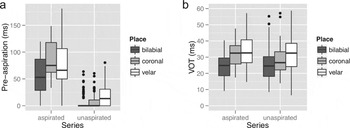
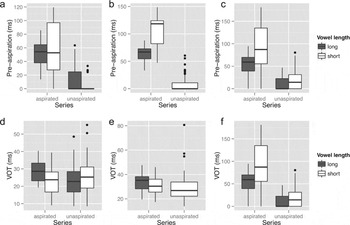
Results for total pre-aspiration duration (breathy voice and voiceless pre-aspiration together) are shown in Figure 4 (Panel a). The aspirated series of stops have a longer duration of pre-aspiration (H(1) = 233.79, p < .001) and this is the case at every place of articulation (bilabial U = 2252.5, r = −.21; coronal U = 829.5, r = −.35; velar U = 1776, r = −.27). Velar stops have the longest pre-aspiration, but not significantly so, possibly because of the very large range of values in the velar stops in particular. A pattern emerges from the mean values towards velar and coronal stops having the longest pre-aspiration (velar mean = 80.2 ms, sd = 47.6; coronal mean = 83.3 ms, sd = 32.8), and bilabials having the shortest pre-aspiration (mean = 58.0 ms, sd = 34.8). The duration of pre-aspiration split according to vowel length, place of articulation, and stop series is at the top of Figure 5. Pre-aspiration is shortest following long vowels (for phonemically pre-aspirated stops only) (U = 1988.5, r = −.21). Vowel Context significantly affects pre-aspiration duration (H(2) = 57.6, p < .001). There are no differences between stops after high front and high back vowels, but both show significantly shorter pre-aspiration than after low vowels (U = 967.0, r = −.19).
Duration of word medial pre-aspiration (Panel a) and VOT (Panel b) (ms).

Duration of pre-aspiration (Panels a–c) and VOT (ms) (Panels d–f) split according to vowel length, place of articulation and stop series. Bilabial stops are in Panels a and d, coronals in Panels b and e, and velars Panels c and f.

The duration of word medial VOT is shown in Figure 4 (Panel b). VOT durations following the release of the word medial stops were not different in the aspirated and unaspirated stop series. There was however a main effect of Place (H(2) = 55.19, p < .001), where bilabials had shorter VOT than coronals (U = 6425.5, r = −.26), which in turn had shorter VOT than velars (U = 8361.0, r = −.18). Vowel Length and Vowel Context did not pattern with VOT duration.
3.1.2.2 Breathy voice and voiceless pre-aspiration
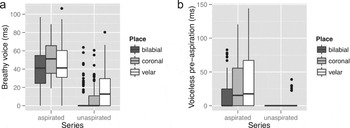
In addition to measuring total pre-aspiration duration, we also considered pre-aspiration split into breathy voice and voiceless pre-aspiration components. The durations of word medial breathy voice and voiceless pre-aspiration are shown in Figure 6. There was more breathy voicing in the aspirated series of stops, at every place of articulation (bilabial U = 607.5, r = −.72; coronals U = 139.0, r = −.77; velars U = 1024.0, r = −.55). However there was no difference according to Place of Articulation, or phonemic Vowel Length. Vowel Context affects breathy voice durations (H(2) = 56.4, p < .001); again stops after high front and high back vowels have the same duration of breathy voice, but both are significantly shorter than breathy voice found in stops after low vowels (U = 967.0, r = −.19).
Duration of word medial breathy voice (Panel a), and voiceless pre-aspiration in ms (Panel b).

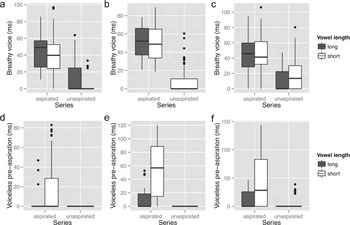
The duration of word medial voiceless pre-aspiration is shown in Figure 6 (Panel b). It seemed illogical to include the unaspirated stops in the analysis; they displayed so little voiceless pre-aspiration that including them produced misleading results. The statistical analyses were therefore only conducted on the phonemically pre-aspirated stops. Velar stops have the longest voiceless pre-aspiration but not significantly so (velar mean = 34.4 ms, sd = 43.6; coronal mean = 32.3, sd = 38.3; bilabial mean = 16.4, sd = 24.9). Stops after short vowels have longer voiceless pre-aspiration than after long vowels (H(1) = 12.64, p < .001), see Figure 7. There was a main effect of Vowel Context (H(2) = 17.49, p < .001) where stops after high vowels have shorter voiceless pre-aspiration than after low vowels (U = 7852.0, r = −.18).
Duration of breathy voice (Panels a–c) and voiceless pre-aspiration (Panels d–f) split according to vowel length, stop series, and place of articulation. Bilabial stops are in Panels a and d, coronals in Panels b and e, and velars Panels c and f.

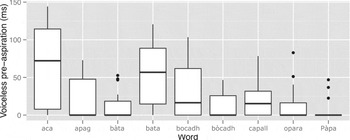
Among the individual words on the word list, there was considerable variation in the duration of voiceless pre-aspiration in particular, shown in Figure 8. The word aca ‘at them’ (common prepositional pronoun) showed most voiceless pre-aspiration, whereas the word for ‘Pope’, Pàpa, showed least.
Duration of voiceless pre-aspiration in individual words (ms).

3.1.3 Analysis of voicing
The proportion of closure voicing in the unaspirated series of stops was measured, and some voicing was present in 331 out of 435 tokens (76%), though this was weak in amplitude. The voicing lasted for approximately 30% of the stop closure duration at all places of articulation (bilabials mean = 30.5% (sd = 19.2); coronals mean = 30.3% (sd = 18.0); velars mean = 31.0% (sd = 20.3)). We argue that although there was a very small amount of voicing present in some tokens, there are no phonetic grounds for calling these stops ‘voiced’.
3.2 Band-pass filtered zero crossing rate
BP ZCR measures the amount of zero crossings in a given section of speech. A greater zero crossing rate equates to noisier (pre-)aspiration.
3.2.1 Word initial stops
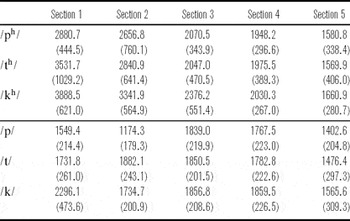
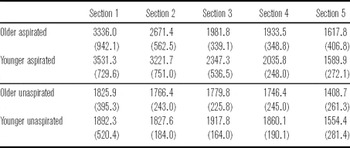
The BP ZCR measure was conducted on the entire VOT+vowel period, which was then divided into five time-normalised sections (Sections 1–5 in Table 2). Numerical results are shown in Table 2. A repeated measure ANOVA was fitted to the data with Time and Stop Series (aspirated vs. unaspirated) as within-subjects factors. ‘Time’ was a 1–5 scale corresponding to whether the measure was taken in Section 1, Section 2, etc.
Zero crossings per second in the five sections of VOT+Vowel (mean to one decimal place, standard deviations in parentheses). For the results per phoneme, n = 72.

Zero crossings decreased over time across the VOT+vowel period (F(4,136) = 118.435, p < .001, r = .68) and this was true for each place of articulation (bilabials F(4,40) = 32.328, p < .001, r = .67; coronals F(4,40) = 41.925, p < .001, r = .72; velars F(4,40) = 160.008, p < .001, r = .89). The aspirated stop series was noisier than the unaspirated series (F(1,34) = 157.946, p < .001, r = .91), and this was the case at each place of articulation (bilabials F(1,10) = 118.143, p < .001, r = .96; coronals F(1,10) = 25.851, p < .001, r = .85; velars F(1,10) = 120.762, p < .001, r = .96).
3.2.2 Word medial stops
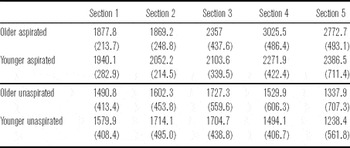
In word medial stops we considered the noise component of the vowel preceding the stop and the pre-aspiration. Therefore, the results here therefore refer to the vowel+pre-aspiration period, divided into five equal sections following Gordeeva & Scobbie (Reference Gordeeva, Scobbie, Fuchs, Toda and Zygis2010). The values are shown in Table 3. A repeated measure ANOVA was fitted to the data with Time and Place of Articulation as within-subjects factors, similar to the word initial stops.
Zero crossings per second in the five sections of vowel+pre-aspiration (mean to one decimal place, standard deviations in parentheses). For the results per phoneme, n = 36.

Overall, the number of zero crossings increased over time reflecting a shift from less to more noise as the time point got closer to the stop closure (F(4,64) = 10.122, p < .001, r = .37). This was the case at every place of articulation (bilabials F(4,16) = 6.709, p = .002, r = .54; coronals F(4,16) = 6.126, p = .003, r = .53; velars F(4,16) = 4.966, p = .009, r = .47). The phonemically pre-aspirated stops were noisier (F(1,16) = 75.010, p < .001, r = .91) at every place of articulation (bilabials F(1,4) = 63.777, p = .001, r = .97; coronals F(1,4) = 96.994, p = .001, r = .98; velars F(1,4) = 13.484, p = .021, r = .89).
3.3 Variation among the speakers
3.3.1 Word initial durational measures
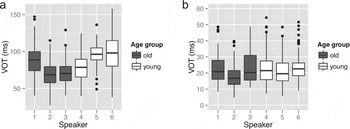
The greatest inter-speaker variation emerged in the aspirated stop series. Individual values are shown in Figure 9. From looking at the plots, younger speakers appeared to be behaving differently to older speakers. For this reason we included Age Group as a factor in the analysis, with the following significant results: young people had longer VOT in word initial aspirated stops (U = 30248.5, r = −.36). VOT was significantly longer for young people in the bilabial aspirated stops (U = 334.5, r = −.47), coronal aspirated (U = 1645, r = −.44) and velar aspirated stops (U = 4640.5, r = −.34). Proportional results were extremely similar so are not repeated here.
Duration of VOT (ms) for individual speakers in word initial aspirated stops (Panel a) and unaspirated stops (Panel b).

3.3.2 Word medial durational measures
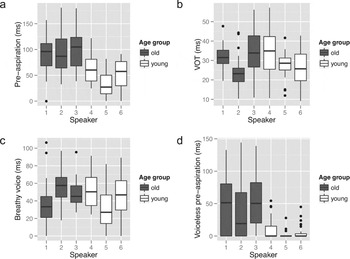
The greatest differences between the speakers again emerged in the production of phonemically aspirated stops. The durations for each measure for each individual speaker in the phonemically pre-aspirated stops are shown in Figure 10. Pre-aspiration is in Panel a, VOT in Panel b, breathy voice in Panel c, and voiceless pre-aspiration in Panel d. These figures indicate that younger and older speakers may be patterning differently, particularly with respect to overall pre-aspiration and voiceless pre-aspiration. For this reason, Age Group was included as a factor in the analysis.
Durational measures for individual speakers (ms). Aspirated stops only. Panel a shows total pre-aspiration duration, Panel b shows VOT, Panel c shows breathy voice duration, and Panel d shows voiceless pre-aspiration duration.

Younger speakers had significantly shorter pre-aspiration in aspirated stops (U = 1049.5, r = −.57). This was also the same pattern in the proportional measures normalising for speech rate. There were no differences in word medial VOT durations between the two age groups, nor in word medial breathy voice durations for aspirated stops. Younger speakers had significantly shorter voiceless pre-aspiration (H(1) = 54.27, p < .001) at every place of articulation (bilabial U = 2209.5, r = −.35; coronal U = 1471.5, r = −.21; velar U = 3295, r = −.20). Measures normalised for speech rate gave the same results so are not repeated. There were no differences between the age groups for the percentage of voicing during the closure of word medial phonemically unaspirated stops.
3.3.3 Word initial BP ZCR
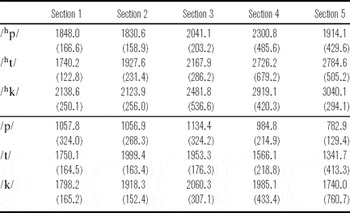
Again, from observing the data it appeared that younger speakers were patterning differently from older speakers. In the interest of space, individual results are not reported here, but the mean values and standard deviations for each age group are in Table 4. Age Group was included as a between-subjects factor in the repeated measure ANOVA. Young people had a higher zero crossing rate than old people in both Stop Series (F(1,34) = 5.374, p = .027, r = .37). This was the case in the bilabials (F(1,10) = 5.380, p = .043, r = .59) and the velars (F(1,10) = 15.617, p = .003, r = .78) but there were no significant differences for Age Group in the coronal stops.
BP ZCR results for word initial stops according to age group (mean to one decimal place, standard deviations in parentheses). In each cell, n = 216.

3.3.4 Word medial BP ZCR
The mean results for each age group of speakers are presented in Table 5. The data indicate that younger speakers start off noisier, and then finish less noisy than older speakers, cancelling out any significant overall difference between the age groups. For this reason, we tested the last three sections of the vowel+pre-aspiration period on their own, by including Age Group as a between-subjects factor in the repeated measure ANOVA. Here, younger speakers were less noisy than older speakers in the phonemically pre-aspirated stops (F(1,16) = 4.885, p = .042, r = .48).
BP ZCR results for word medial stops according to age group (mean to one decimal place, standard deviations in parentheses). In each cell, n = 108.

4 Discussion
This paper investigates the acoustic properties of pre- and post-aspiration in two generations of Gaelic speakers. We discuss the durational results first, followed by an assessment of the usefulness of the BP ZCR measure, and then discuss possible explanations for the production differences between our participants.
4.1 Durational measures
Results from all three analyses: durational, closure voicing and zero crossing rate support the view that Gaelic stops are contrasted by the presence or absence of aspiration. Similar to many other languages, Gaelic bilabial stops show the shortest VOT, velars the longest, and coronals in the middle (Cho & Ladefoged Reference Cho and Ladefoged1999). Cho & Ladefoged (Reference Cho and Ladefoged1999) suggest some aerodynamic reasons for this, such as the larger cavity behind a bilabial stop closure leads to a quick equalisation of air pressure on stop release, whereas a smaller air cavity behind a velar stop closure leads to higher air pressure buildup and a longer equalisation.
Significant differences according to Place of Articulation were not found in pre-aspiration duration, though this may be due to the wide range of values in our data. Despite a non-significant result, the durational measurements showed a pattern of velar stops having longest pre-aspiration, coronal medium and bilabial the least. A similar pattern for Gaelic pre-aspiration is reported in Ní Chasaide (Reference Ní Chasaide1985: 128) and Clayton (Reference Clayton2010: 165). Helgason & Ringen (Reference Helgason and Ringen2008) found a consistent pattern in Central Standard Swedish pre-aspiration duration according to place of articulation following the bilabial < coronal < velar hierarchy. They suggest that the explanation may lie in the speed of closure in the articulators involved in stop production. Hardcastle (Reference Hardcastle1973) suggests that the tongue dorsum moves more slowly to form a velar closure than the tongue tip or the lips move to form a coronal or bilabial closure respectively. This argument is supported by articulatory evidence from Kuehn & Moll (Reference Kuehn and Moll1976), who demonstrate that the tongue dorsum moves relatively more slowly than the tongue tip and lips. Since a closure further back takes longer to implement, this may explain why velar pre-aspiration is longer than bilabial and coronal pre-aspiration in these data. This explanation is also put forward in Ní Chasaide (Reference Ní Chasaide1985: 126).
The results in this study indicate significant differences according to Vowel Length in duration of word medial pre-aspiration: longer pre-aspiration follows short vowels. Longer pre-aspiration following short vowels is reported in previous studies of Gaelic (Ní Chasaide Reference Ní Chasaide1985: 108; Clayton Reference Clayton2010: 166), and is also reported for dialects of Scandinavian languages including Swedish, Faroese, and Norwegian (Helgason Reference Helgason2002, Reference Helgason2003; Helgason & Ringen Reference Helgason and Ringen2008). In Icelandic, where pre-aspiration is phonemic, pre-aspiration does not occur following long vowels (Thráinsson Reference Thráinsson1978). All of these results suggest that ‘vowel length’ is not just about the vowel being phonetically long or short, but the surrounding phonetic context is also adjusted to provide additional information about the vowel's phonemic length. A future perceptual study would provide evidence to support this hypothesis.
4.2 Band-pass filtered zero crossing rate
An innovative aspect to this study is the application of band-pass filtered zero crossing rate (BP ZCR) to phonemic pre-aspiration and word initial aspiration. Here, we assess the utility of this measure along three criteria: ability to distinguish stop categories found in the durational measures, ability to distinguish differences among the speakers found in the durational data (discussed in the next section), and also benefits of using this measure in addition to, or instead of durational data.
In the durational data we found differences according to Stop Series (aspirated vs. unaspirated) and Place of Articulation (though non-significant in the case of pre-aspiration). These differences are also captured in the BP ZCR measure, both in word initial position and in word medial position. In addition, the BP ZCR measure found significantly different pre-aspiration in the case of phonemically pre-aspirated velar stops, a bonus on top of the durational measures, although we conducted the BP ZCR analysis on a very controlled subset of the data so this may explain the discrepancy. The BP ZCR also distinguished the two age groups of speakers similar to the durational measures (discussed in Section 4.3 below). This indicates that the measure is reliable for distinguishing both large linguistic category differences in word initial and word medial stops, and also more subtle sociolinguistic differences in our dataset.
The BP ZCR measure offers some benefits in addition to purely durational measurements. Firstly, the measure is able to compare periodic and aperiodic sections of pre- and post-aspiration. Secondly, BP ZCR is dynamic and characterises aspiration preceding/following the stop in its vocalic context. Studies such as Gobl & Ní Chasaide (Reference Ní Chasaide1999) have found that the phonetic effects of a stop extend into the vowel preceding and the vowel following the stop, and BP ZCR offers a new way of capturing some of those effects. In other words, BP ZCR can contribute to parametric analyses of sounds in context such as Plug & Ogden (Reference Plug and Ogden2003) and Carter & Local (Reference Carter and Local2007). Indeed the measure could be run on entire sections of speech, provided the phonetic contexts were comparable, removing the need for much manual segmentation. Thirdly, BP ZCR is another way of describing stops in addition to durational properties, but also an alternative to other acoustic measures such as spectral moment analysis (e.g. Forrest et al. Reference Forrest, Weismer, Milenkovic and Dougall1988).
A possible drawback of this measure is that we were only able to consider one vocalic context in our dataset. This was because the spectral properties of different vowels made for incomparable results when different vowels were pooled. Although we used the raw BP ZCR results, leading to the issue with vocalic context, Gordeeva & Scobbie (Reference Gordeeva, Scobbie, Fuchs, Toda and Zygis2010) do suggest some methods for normalising the values from different vowels and speakers, which could be further explored in future applications of the measure.
4.3 Production differences among the speakers
Some of the measures did pattern with the two generational groups in our sample (albeit with only three speakers in each age group). In word initial position, younger speakers had longer VOT in aspirated stops, and also more zero crossings in their aspirated productions. In word medial position on the other hand, the younger speakers had shorter pre-aspiration and fewer zero crossings in the final portion of pre-aspiration. In summary: younger speakers produce longer and noisier aspiration in word initial stops, but shorter and less noisy pre-aspiration in word medial stops.
Younger speakers’ longer, noisier VOT in word initial position may be explained by physiological differences among the speakers. Authors such as Morris & Brown (Reference Morris and Brown1987) and Docherty et al. (Reference Docherty, Watt, Llamas, Hall and Nycz2011) note shorter VOT durations in older speakers, presumably due to the effects of aging on the larynx. However, the striking differences between individuals’ duration and noisiness of pre-aspiration cannot be explained by physiological factors. The differences between speakers are most striking for duration of voiceless pre-aspiration (see Figure 10, Panel d). so we focus our discussion on this measure. Studies such as Helgason & Ringen (Reference Helgason and Ringen2008) indicate that voiceless pre-aspiration durations are subject to individual variation, but our results show such a clear pattern between the two generations that we argue that they are instead indicative of apparent-time change in progress from more to less and quieter pre-aspiration. While the younger speakers still produce pre-aspirated stops, their pre-aspiration is durationally and qualitatively different. It does not seem to be the case that a pre-aspiration contrast is being replaced by a contrast along other parameters: there were no differences between the groups of speakers according to word medial VOT, or voicing during the word medial stop closure. In other words, younger speakers maintain the pre-aspiration contrast in word medial position, but their stop series are less distinct compared to the older speakers. Comparison with the results from Ladefoged et al. (Reference Ladefoged, Ladefoged, Turk, Hind and Skilton1998) suggests that this pattern may have been ongoing for some time. Ladefoged et al.'s (Reference Ladefoged, Ladefoged, Turk, Hind and Skilton1998) speakers produce substantially longer voiceless pre-aspiration than even the older speakers in the current study. However, Ladefoged et al. (Reference Ladefoged, Ladefoged, Turk, Hind and Skilton1998) recorded using different materials and there may be some differences in segmentation criteria.
It is possible that younger speakers produce less and less noisy pre-aspiration due to the influence of their dominant language, English. Pre-aspiration appears susceptible to contact-induced change, for example Ringen & Suomi (Reference Ringen and Suomi2012) find no pre-aspiration in Fenno-Swedish and suggest that this is due to high levels of contact with Finnish. However, a language contact explanation of these Gaelic data is not straightforward: English on the Isle of Lewis is reported as having extensive pre-aspiration in word medial and final voiceless stops due to the influence of Gaelic (Shuken Reference Shuken and Trudgill1984). Instead, any contact influence from English would have to come from an English external to the Isle of Lewis, such as Scottish Standard English or English English. These varieties have stop systems which do not contrast phonemic pre-aspiration in word medial position (e.g. Docherty Reference Docherty1992). As noted by Gordeeva & Scobbie (Reference Gordeeva, Scobbie, Fuchs, Toda and Zygis2010), however, some allophonic pre-aspiration does occur in Scottish Standard English, and these authors argue that it may help distinguish fricative and stop series. It is possible, then, that younger speakers from Lewis may be influenced by Scottish Standard English, where stop series are partially distinguished by allophonic pre-aspiration. A second potential explanation of the source of this sound change is the lack of minimal pairs for this particular contrast in Gaelic. This gives speakers little structural motivation to maintain very distinct phonemic categories, as there is little or no possibility of confusion arising.
Individual words behaved very differently with regard to duration of pre-aspiration. One word in particular, Pàpa ‘Pope’, showed little or no voiceless pre-aspiration, while aca ‘at them’ showed most (see Figure 8). The word for ‘Pope’ was included on the word list for comparability with Ladefoged et al. (Reference Ladefoged, Ladefoged, Turk, Hind and Skilton1998), but as Lewis is a very Protestant community, ‘Pope’ is a word that the participants in this experiment use extremely infrequently, or avoid using. Aca, on the other hand, is an extremely frequent word as this preposition must be used as part of expressing ‘to have’ in Gaelic. Although there is some confound with vowel length, the long vowel in Pàpa disfavouring pre-aspiration, differences between Pàpa and aca indicate that the change from more to less/no pre-aspiration may be taking place in less frequent words first (e.g. Phillips Reference Phillips1984). However, these results need to be replicated on a larger dataset.
5 Conclusion
Similar to previous studies of Scottish Gaelic (Ní Chasaide Reference Ní Chasaide1985, Ladefoged et al. Reference Ladefoged, Ladefoged, Turk, Hind and Skilton1998, Clayton Reference Clayton2010), we have found durational differences in pre- and post-aspiration according to phonemic Stop Series, Place of Articulation and Vowel Length. These results also support findings from cross-linguistic studies of VOT duration such as Cho & Ladefoged (Reference Cho and Ladefoged1999). We have extended previous analyses by including breathy voicing in our measurements, and considering voicing during word medial stop closure. The evidence points to maintenance of typologically rare pre-aspiration, and no reason to suggest that voicing plays any role in word medial stop contrasts.
We have applied a new measure – band-pass filtered zero crossing rate (BP ZCR, Gordeeva & Scobbie Reference Gordeeva, Scobbie, Fuchs, Toda and Zygis2010) – to phonemic pre-aspiration and post-aspiration. BP ZCR quantifies mid-frequency noise in periodic and aperiodic stretches of aspiration. The measurement of this frequency range is justified by previous research on the perception of breathiness (Klatt & Klatt Reference Klatt and Klatt1990, Hillenbrand et al. Reference Hillenbrand, Cleveland and Ericson1994). The measure proved efficient in distinguishing differences in stop production according to Stop Series and Place of Articulation, and also efficient in distinguishing more subtle sociolinguistic differences between the speakers. In addition, the measure brings benefits over a purely durational analysis by its ability to capture dynamic information and removes some of the need for manual segmentation. It provides a useful new tool for the analysis of pre-aspiration in particular in its ability to compare voiced and voiceless elements of pre-aspiration. We argue in favour of using BP ZCR instead of, or alongside, other measures of the spectral properties of stops.
Our study also considers production patterns among the speakers. The most striking of these was the much shorter duration of voiceless pre-aspiration in the three younger speakers compared to the three older speakers in the sample. This was supported by the BP ZCR results, which indicated that younger speakers also produced less noisy pre-aspiration. Although our study is small-scale and the results must therefore be treated with caution, we suggest that sound change may be taking place from more to less pre-aspiration. There is no evidence to suggest replacement of the pre-aspiration contrast with another parameter, such as longer word medial VOT in the aspirated series of stops, or an increase in voicing during stop closure in the unaspirated series. Instead we argue that the stop series are becoming phonetically less distinct for younger speakers, possibly due to the lack of minimal pairs in Gaelic for this contrast.
Future work will expand this study to a larger sample and also consider data from elderly Gaelic speakers who grew up in entirely Gaelic-speaking communities and can be considered Gaelic-dominant. It would also be of interest to examine data from spontaneous speech rather than word lists. This would shed light on exactly how functional the contrast between stop series is. The results from this study indicate a potential language change and future investigation will examine whether or not change is indeed taking place and if so what is its extent.
Acknowledgements
This research was funded by a Lord Kelvin and Adam Smith Ph.D. Scholarship, University of Glasgow. Many thanks to Olga Gordeeva for help with implementing the BP ZCR methodology, comments on earlier versions of this paper, and for generously giving us her Praat script. We are grateful to Sam Kirkham, Roibeard Ó Maolalaigh, Adrian Simpson, and to the anonymous reviewers for their helpful comments on earlier versions of this paper.
Appendix
Word initial bilabial stops.

Word initial coronal stops.

Word initial velar stops.

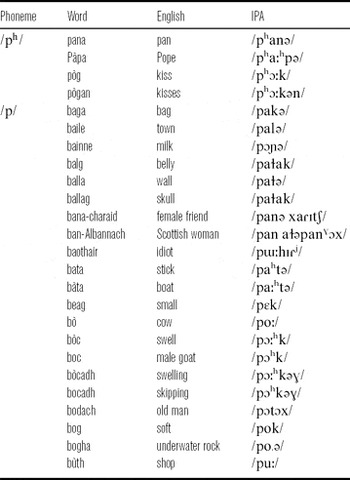
Word medial stops.

Words used in the BP ZCR analysis.