Introduction
A considerable body of research indicates that multiple cognitive abilities decline in parallel with advancing age (Dixon et al., Reference Dixon, Bäckman and Nilsson2004), especially in individuals presenting concomitant disorders such as depression. Depression is clearly associated with significant morbidity, as well as with functional and cognitive impairment of a range of functions (Vinkers et al., Reference Vinkers, Gussekloo, Stek, Westendorp and van der Mast2004), even in patients with less severe symptoms (Blazer, Reference Blazer2003). The cognitive alterations most frequently reported are deficits of executive function (Baudic et al., Reference Baudic, Tzortzis, Barba and Traykov2004; Elderkin-Thompson et al., Reference Elderkin-Thompson, Mintz, Haroon, Lavretsky and Kumar2006), episodic memory (Baudic et al., Reference Baudic, Tzortzis, Barba and Traykov2004; Elderkin-Thompson et al., Reference Elderkin-Thompson, Mintz, Haroon, Lavretsky and Kumar2006) and processing speed (Christensen et al., Reference Christensen, Griffiths, Mackinnon and Jacomb1997; Sheline et al., Reference Sheline2006). In addition, residual memory deficits can be observed even after patients have achieved depression remission and have increased their scores on processing speed and executive function tests (Butters et al., Reference Butters2004).
The neuropsychology of depression in the elderly is not completely understood. Although numerous studies have described cognitive functioning in depressed elderly individuals, only a few have employed a comprehensive assessment of the cognitive domains. One factor that is known to account for some of the variance in cognitive ability among older adults, and which might also account for the variability in brain activity, is level of education. Some authors report that having had fewer years of schooling correlates with more rapid age-related declines in memory (Evans et al., Reference Evans1993), mental status (Lyketsos et al., Reference Lyketsos, Chen and Anthony1999) and verbal ability (Arbuckle et al., Reference Arbuckle, Maag, Pushkar and Chaikelson1998). A number of studies have addressed cognitive function in depressed elderly individuals, and it is clear that level of education has to be taken into consideration when assessing the performance of the elderly depressed patient. Nevertheless, there have been no studies evaluating depressed patients with minimal formal education. Nor have there been any studies aimed at determining the influence that the number of years of schooling has on cognitive performance in this specific population.
The mechanism by which higher education retards cognitive decline in elderly individuals remains unknown. Some authors have suggested that differences in level of education influence the choice of strategies employed to perform a given task, and that there are different brain regions underlying the behavior (Springer et al., Reference Springer, McIntosh, Winocur and Grady2005).
Wight et al. (Reference Wight, Aneshensel and Seeman2002) studied elderly men and found a positive correlation between formal education and cognitive function. However, this correlation was dependent upon the following factors: post-educational training experience, ethnicity and depressive symptoms. In that study sample, the mean level of education ranged from 6 to 15 years of schooling. However, other authors have obtained different results. Bhalla et al. (Reference Bhalla2005) investigated the influence that level of education has on the severity of depression-related neuropsychological impairment in a sample of 115 patients aged 59 or older and diagnosed with early or late-onset major depression, compared with a control group of elderly individuals of similar age and education. The authors divided the subjects into two groups based on level of education: high (>12 years of schooling) and low (≤12 years of schooling). They found that depression resulted in alterations in all cognitive domains, and that level of education influenced performance only on the Boston Naming Test, and that the interaction of depression and education had no influence on any of the variables studied. The authors concluded that a higher level of education does not minimize the cognitive deficits associated with depression. Nevertheless, other studies involving various populations have shown that level of education has a significant impact on cognitive function (Stern, Reference Stern2002; Bennett et al., Reference Bennett2003; Dufouil et al., Reference Dufouil, Alpérovitch and Tzourio2003).
Recognizing the principal differences among individuals of various educational backgrounds in terms of the cognitive alterations that depression causes is quite important in making the differential diagnosis, planning the treatment and establishing parameters regarding the prognosis of such patients.
The objective of the present study was to investigate the influence that education and depression have on cognitive performance in the elderly. Our hypothesis was that depressed patients who had had less education would perform more poorly than would those who had had more education or healthy subjects with a similar level of education.
Methods
Subjects
This study was conducted at the Institute of Psychiatry, under the auspices of the University of São Paulo School of Medicine, Hospital das Clínicas. A total of 110 elderly individuals (aged 60 or older) participated in this study: 59 depressed outpatients with dysthymic disorder or major depressive disorder, including unipolar early- or late-onset depression, diagnosed according to the DSM-IV criteria; and 51 healthy controls. All depressed subjects were outpatients from the Old Age Research Group, Institute of Psychiatry, Hospital das Clinicas, University of São Paulo; and comparison subjects were recruited from the geriatric service of the same hospital. Clinical exclusion criteria for patients were diagnoses of organic mental disorders (according to DSM-IV criteria), and diagnoses of other psychiatric disease (other than anxiety disorders comorbid to depression). Clinical exclusion criteria for controls were organic mental disorders, according to DSM-IV, and previous history of depression.
Depressed patients and controls were allocated to one of two groups: the low-education group, consisting of those with one to four years of schooling; and the high-education group, consisting of those with five or more years of schooling.
The evaluation procedure consisted of a detailed medical history, psychiatric evaluation, cognitive assessment, laboratory tests and cerebral magnetic resonance imaging. The psychiatric evaluation included a clinical interview and administration of the following tests and scales: the Mini-mental State Examination (Folstein et al., Reference Folstein, Folstein and McHugh1975), the Cambridge Mental Disorders of the Elderly Examination (Roth et al., Reference Roth1986), the Cambridge Cognitive Examination (Bottino et al., Reference Bottino, Almeida, Tamai, Forlenza, Scalco and Carvalho1999), the Montgomery-Asberg Depression Rating Scale (MADRS; Montgomery and Åsberg, Reference Montgomery and Åsberg1979), the Hamilton Depression Rating Scale (HAM-D; Hamilton, Reference Hamilton1960), the Cumulative Illness Rating Scale (Linn et al., Reference Linn, Linn and Gurell1968) and the Bayer Activities of Daily Living Scale (B-ADL) (Lehfeld et al., Reference Lehfeld1997; Folquitto et al., Reference Folquitto2007), the last administered only to the relatives of the patients. We administered all of these tests and scales in Portuguese, using translations validated for use in Brazil. Trained psychiatrists conducted all evaluations.
We classified depressive symptoms as mild, moderate or severe according to the system of HAM-D cut-off points devised by Del Porto (Reference Del Porto1989) and generally accepted in clinical practice. According to that system, scores higher than 25 indicate severe depression, scores from 18 to 24 indicate moderate depression, and scores between 7 and 17 indicate mild depression.
After undergoing psychiatric examination by a trained neuropsychologist, all participants were submitted to the neuropsychological battery of tests, which covered cognitive domains relevant to depression among the elderly (memory, attention, executive function and processing speed). The battery included the following tests: the vocabulary and matrix reasoning subsets of the Wechsler Abbreviated Scale of Intelligence (Wechsler, Reference Wechsler1999); the Fuld Object Memory Evaluation (Fuld, Reference Fuld1980); the Wechsler Memory Scale-revised (WMS-R) Logical Memory I and II subtests (Wechsler, Reference Wechsler1987); the WMS-R Visual Reproduction I and II subtests (Wechsler, Reference Wechsler1987); the WMS-R Digit Span Forward and Digit Span Backward subtests (Wechsler, Reference Wechsler1987); the Trail Making Test, parts A and B (Lezak et al., Reference Lezak, Howieson and Loring2004); the Stroop Test (Lezak et al., Reference Lezak, Howieson and Loring2004); the categorical verbal fluency (animal naming) test (Spreen and Strauss; Reference Spreen and Strauss1998); the phonemic verbal fluency test (Spreen and Benton, Reference Spreen and Benton1996); and the Cancellation Test (Mesulam, Reference Mesulam1985). All of the neuropsychological tests employed were also Portuguese-language translations validated for use in Brazil.
All subjects gave written informed consent to participate in this study, and the Ethics Committee of the University of São Paulo Faculty of Medicine, Hospital das Clínicas, approved the study protocol.
Statistical analysis
In the data analysis, we used the Statistical Package for the Social Sciences, version 14 for Windows (SPSS, Inc., Chicago, IL, USA). First, we performed descriptive analyses of sociodemographic and clinical characteristics as categorical variables (frequency and percentage). We employed the χ2 test for the comparison of categorical data and for continuous data (mean and standard deviation), we applied the Student's t-test for variables with normal distribution, and the Mann-Whitney test for variables without normal distribution (see Table 1).
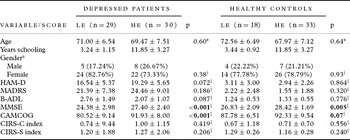
Characteristics of the depressed and healthy individuals evaluated

LE = low education; HE = high education; n = number of patients; HAM-D = Hamilton Depression Rating Scale; MADRS = Montgomery-Åsberg Depression Rating Scale; B-ADL = Bayer Activities of Daily Living Scale; MMSE = Mini-mental State Examination; CAMCOG = Cambridge Cognitive Examination; CIRS-C = Cumulative Illness Rating Scale-Comorbidity; CIRS-S = Cumulative Illness Rating Scale-Severity.
a All data except those related to gender (number and percentage) are mean ± standard deviation.
* Student's t-test; †chi-square test; ‡Mann-Whitney test.
To investigate the effect of depression and level of education, and their possible interactions, we conducted two-way ANCOVAs with gender and age as covariates on neuropsychological test performance (see Table 2). The level of statistical significance was set at α = 0.05.
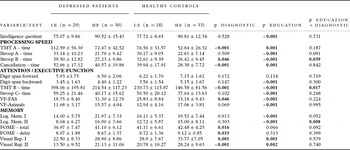
Cognitive performance of depressed patients and healthy compartion subjects

LE = low education; HE = high education; TMT A = Trail Making Test, part A; TMT B = Trail Making test, part B; Stroop A = Stroop Test, part A; Stroop B = Stroop Test, part B; Stroop C = Stroop Test, part C; VF-FAS = phonemic verbal fluency test; VF-animals = categorical verbal fluency (animal naming) test; Log. Mem. I = Logical Memory – immediate; Log. Mem. II = Logical Memory – delayed; FOME = Fuld Object Memory Evaluation; Visual Rep. I = Visual Reproduction – immediate; Visual Rep. II = Visual Reproduction – delayed.
Results
In Table 1, the clinical and sociodemographic characteristics of our sample are presented. The sociodemographic characteristics reveal that the groups with different years of education and same diagnostic are not statiscally different in terms of the following variables: age, gender, clinical comorbidity and severity. In both groups, women predominated. However, due to the age difference between the groups, and due to the higher incidence of women, these two variables were considered as co-variables in the analysis performed. As expected, there were significant differences between the two groups in terms of the mean scores on the B-ADL, MADRS and HAM-D. Based on the MADRS and HAM-D scores, depressive disorders were mostly mild (50.85%) or moderate (40.68%).
Table 2 shows the raw cognitive test results for the four groups, the influence that depression and years of schooling, as well as the interaction between the two factors, had on subject performance on neuropsychological tests that assess the intellectual quotient (including the vocabulary and matrix reasoning subsets), as well as on those that assess processing speed, attention, executive function and memory.
We found that depression significantly influenced the results of the following tests regardless of their level of education: Trail Making Test, parts A [F(1) − 13.027, p = 0.001], and B [F(1) − 23.243, p < 0.001], Stroop B [F(1) − 4.066, p = 0.046], Cancellation Test [F(1) − 15.809, p < 0.001], phonemic verbal fluency [F(1) − 4.067, p = 0.046], the WMS-R Visual Reproduction I [F(1) − 11.838, p = 0.001] and II [F(1) − 13.993, p < 0.001] subtests and Fuld Object Memory Evaluation – total [F(1) − 5.985, p = 0.016] and delayed [F(1) − 4.666, p = 0.033].
Level of education had a significant influence on the results of the tests that assess the following variables: intelligence quotient [F(1) − 34.480, p < 0.001], processing speed – Stroop Test, parts A [F(1) − 24.885, p < 0.001], and B [F(1) −15.806, p < 0.001], Trail Making Test part A [F(1) − 10.971, p = 0.001], Cancellation Test [F(1) − 11.127, p = 0.001]; executive function – WMS-R Digit Span Backward subtest [F(1) − 14.582, p < 0.001]; Trail Making Test, part B [F(1) − 17.060, p < 0.001], inhibitory control – Stroop Test, part C [F(1) − 18.006, p < 0.001]; verbal fluency phonemic [F(1) − 17.3200, p <0.001] and semantic [F(1) − 25.273, p < 0.001]; memory – immediate [F(1) − 14.688, p < 0.001] and delayed memory [F(1) − 11.444, p < 0.001] (WMS-R Logical Memory I and II subtests); immediate [F(1) − 10.756, p < 0.001] and delayed visual memory [F(1) − 10.384, p < 0.001] (WMS-R Visual Reproduction I and II subtests). Individuals having had more years of schooling, independent of their mental status, performed better than those who had had fewer years of schooling in terms of processing speed, attention, executive function, memory and intelligence quotient. The only two tests that showed no influence of education were Digit Span Forward and Fuld Object Memory Evaluation (immediate and delayed recall).
We found that the combination of a lower level of education and depression had a significant negative influence on the performance of the Stroop B [F(1)−4.364, p = 0.039], Trail Making Test, part B [F(1)−5.898, p = 0.017], WMS-R Logical Memory II subtest [F(1)−7.288, p = 0.008], which assesses delayed verbal memory. However, we did not find any other significant effects of the interaction between level of education and depression.
Discussion
In the present study into the assessment of depressed elderly, we found that level of education had a significant impact on cognitive functions, such as intellectual efficiency, processing speed, attention, executive function and memory, and that this impact was more pronounced than the impact, albeit also significant, that depressive symptoms had on the same cognitive variables. In addition, we found that the interaction between level of education and depression had a significant impact on the results of only one memory test.
We can raise a number of hypotheses to explain the results we obtained in the present study. One is that depressive symptoms had less impact on cognitive performance because the majority of the patients in our sample presented only mild or moderate depressive symptoms. Some authors have suggested that the level of cognitive impairment increases in parallel with increases in the severity of depressive symptoms (Dixon et al., Reference Dixon, Bäckman and Nilsson2004; Baudic et al., Reference Baudic, Tzortzis, Barba and Traykov2004). Another hypothesis involves the idea that cerebrovascular injuries cause more significant cognitive deficits. The subjects in our sample presented low clinical comorbidity indices, which might translate to minimal changes in cerebral white and gray matter (Kramer-Ginsberg et al., Reference Kramer-Ginsberg1999). Consequently, as suggested in other studies (Alexopoulos et al., Reference Alexopoulos, Meyers, Young, Kakuma, Sibereweig and Charlson1997; Thomas et al., Reference Thomas, Kalarina and O'Brien2004), less cognitive impairment would be expected, especially in terms of executive function and processing speed.
Our results also suggest that psychiatrists should give special attention to the level of education when assessing the cognitive performance of elderly subjects. One hypothesis that might explain why individuals who have had more years of schooling apparently present fewer cognitive changes over the years, or when they suffer from a psychiatric or neurological disease, is the cognitive reserve hypothesis proposed by Stern (Reference Stern2002). In this cognitive reserve model, the brain actively searches for compensation mechanisms to deal with the difficulties of an impaired brain, and this mechanism is dependent upon intellectual capacity, which is in turn directly reliant upon, among other factors, level of education.
Our findings are in agreement with those of other studies assessing the influence of education on other conditions such as Alzheimer's disease, AIDS and cerebral white matter hyperintensities (Stern, Reference Stern2002; Bennett et al., Reference Bennett2003; Dufouil et al., Reference Dufouil, Alpérovitch and Tzourio2003), as well as with the cognitive reserve hypothesis (Stern, Reference Stern2003), which states that less significant cognitive changes occur in subjects with higher cognitive reserve because they utilize old and new neural networks in a more efficient manner in order to solve problems. However, in the study conducted by Bhalla et al. (Reference Bhalla2005), who investigated the influence of education on elderly individuals with and without depression, the authors found that depression caused alterations in all domains, and level of education had no impact. Level of education only correlated significantly with performance on the Boston Naming Test. Such divergent results might be attributable in part to the fact that, in the study by Bhalla et al., the subjects in the low-education group had had an average of 11 years of schooling, and those in the high-education group had had an average of 15 years of schooling. The fact that level of education had a less significant impact in the Bhalla et al. study than in our study might be due to fact that all of the subjects in that study were well educated in comparison with those included in our sample. The authors (Bhalla et al.) considered the lack of poorly educated subjects a limitation of their study and stated that the influence of level of education and neuropathological alterations on cognition is greater among poorly educated individuals. We can suppose that, after some years of formal education, the brain becomes more flexible and more resistant in order to deal with the effects of diseases or with the natural changes caused by the aging process.
Bhalla et al. (Reference Bhalla2005) also observed a minimal effect of the interaction between depression and level of education, which mirrors our findings on this point. However, our data can stimulate discussion regarding the importance of depression and level of education as risk factors for dementia and Alzheimer's disease. In our sample, we observed an effect of such interaction only on the speed processing test – Stroop B; divided attention, Trail Making part B, and delayed verbal memory test results were one of the neuropsychological variables with the largest effect sizes to identify patients with preclinical Alzheimer's disease (Bäckman et al., Reference Bäckman2005). Since the authors evaluated elderly patients with late-life depression and recurrent geriatric depression, the interaction effect that they observed for the verbal memory test might be primarily attributable to the inclusion of the patients with recurrent geriatric depression, since, as stated by Rapp et al. (Reference Rapp, Dahlman, Sano, Grossman, Haroutunian and Gorman2005), elderly patients with recurrent major depression can exhibit deficits in episodic memory. The follow-up assessment of the subjects evaluated in the present study might shed some light on this topic. The interaction observed in processing speed and divided attention tests in our study suggest that these might be sensitive instruments to address the influence of the educational level as well as the influence of less severe depressive symptoms. Another interesting finding was the interaction of the Fuld Object Memory Evaluation with depressive symptoms, but not with education, suggesting that this test can be useful to evaluate depressed patients with low schooling.
The data presented here might be relevant for clinical practice and certainly indicate the importance of designing cognitive function tests in which level of education has less effect on the results. For instance, Nitrini et al. (Reference Nitrini2004) presented the results of a study that compared the performance of literate and illiterate individuals without dementia on two tests designed to assess delayed memory, delayed recall of a word list from the Consortium to Establish a Registry for Alzheimer's disease (CERAD) and delayed recall of common objects presented as simple drawings from the Brief Cognitive Screening Battery (BCSB). The comparison between the two groups revealed differences on the CERAD memory test but not on the BCSB memory test, indicating that the latter is more suitable for the assessment of long-term memory in a population with a high rate of illiteracy and in subjects with little education.
One of the limitations of our study was that we assessed only the number of years of formal education, excluding previous and current intellectual, social and leisure activities, which seem to have an influence on the cognitive function of healthy elderly people and of elderly people presenting pathologies. Another limitation is that our study did not include severely depressed patients, which prevented us from investigating whether the severity of depression has a significant impact on cognitive performance or interacts with the level of education. In addition, due to the small size of our sample, we did not evaluate patients with late-life depression separately from those suffering from recurrent geriatric depression, and our sample was therefore heterogeneous.
Conclusion
Our findings suggest that level of education has an influence on the performance of elderly individuals on cognitive tests, as does the presence of depressive symptoms. However, we found that low level of education has a greater impact on cognition, affecting a wider range of cognitive functions, than does the presence of mild to moderate depressive symptoms. The interaction between these two factors, level of education and depression, had a significant impact only on the results of three tests that assessed processing speed, divided attention and delayed verbal memory.
These findings underscore the importance of considering level of education when interpreting the performance of elderly individuals on cognitive tests. Moreover, it is important to stress the necessity of applying tests that can measure cognitive alterations associated with depressive disorders, but are less influenced by the educational level, as was observed with the visual-verbal Fuld Object Memory Evaluation test. There is a danger that, due to their low performance on some cognitive tests caused by their low level of education, such individuals might receive a misdiagnosis of dementia. In addition, depression in the elderly merits more attention, since it can result in a future decline in cognitive functioning and in the ability to perform activities of daily living. Further, longitudinal studies should address the relevance of the interaction between depression and level of education on delayed verbal memory tests, especially for elderly subjects with low educational levels.
Conflict of interest
None.
Description of authors' roles
C.M.C. Bottino designed the study, supervised the data collection and wrote the paper. R. Avila collected the neuropsychological data and wrote the paper. S. Ribeiz and M.A.P. Moscoso collected the clinical data. O. Jaluul was responsible for the health controls. J. Arrais was responsible for the statistical design of the study and for carrying out the statistical analysis.
Acknowledgments
This study received financial support from Conselho Nacional de Desenvolvimento Científico e Tecnológico (CNPq), National Council for Scientific and Technological Development); Fundação de Amparo à Pesquisa do Estado de Sao Paulo (FAPESP, Foundation for the Support of Research in the State of São Paulo; grant no. 04/09586-9.