INTRODUCTION
Radiocarbon (14C) dating is a method widely used to estimate age of various carbon bearing materials (Arnold and Libby Reference Arnold and Libby1949), with applications in archaeology, geosciences, or forensics (Hajdas Reference Hajdas2009; Jull Reference Jull2013). Moreover, for historical monuments, the method has been used for dating of buildings or their remains, even in the absence of organic parts such as timbers, since absorption of atmospheric carbon dioxide (CO2) is crucially involved in hardening and maturing of lime-based mortars within weeks, months or years following the building phase (Labeyrie and Delibrias Reference Labeyrie and Delibrias1964; Hale et al. Reference Hale, Heinemeier, Lancaster, Lindroos and Ringborn2003; Nawrocka et al. Reference Nawrocka, Goslar, Pazur, Dan, Přikryl and Török2010; Daugbjerg et al. Reference Daugbjerg, Lindroos, Heinemeier, Ringborn, Barrett, Michalska, Hajdas, Raja and Olsen2021). By absorbing carbon dioxide, the calcite (CaCO3) from the original limestone is restored. As an alternative or in addition to analyses of 14C in CaCO3 in mortars, small organic inclusions such as wood fragments, seeds, grains, or charcoals, the latter most often found in mortars, can be dated (Van Strydonck et al. Reference Van Strydonck, van der Borg, de Jong and Keppens1992; Hajdas et al. Reference Hajdas, Lindroos, Heinemeier and Ringbom2017; Michalska and Mrozek-Wysocka Reference Michalska and Mrozek-Wysocka2020; Daugbjerg et al. Reference Daugbjerg, Lindroos, Heinemeier, Ringborn, Barrett, Michalska, Hajdas, Raja and Olsen2021, Reference Daugbjerg, Lichtenberger, Lindroos, Michalska, Raja and Olsen2022). Charcoals in mortars are believed to originate mainly from fuel used in lime burning or from sand or other material aggregates used in mortar preparation. Inevitably, this may include very old organic materials, e.g., from fluvial sediments or from using older fuel sources, such as peat (Tubbs and Kinder Reference Tubbs and Kinder1990). Recently, we have reported the inclusion of several palaeolithic charcoals in mortar of Pyšolec, a medieval Czech castle, independently dated to 1300–1340 AD (Pachnerová Brabcová et al. Reference Pachnerová Brabcová, Krofta, Valášek, Suchý, Kundrát, Šimek, Kozlovec, Kotková, Fialová, Povinec, Válek and Světlík2022). Even if the charcoals originate from wood used in lime burning, the so-called “old wood problem” can occur (Schiffer Reference Schiffer1986; Michalska Nawrocka et al. Reference Michalska Nawrocka, Michczyńska, Pazdur and Czernik2007). Although it seems unlikely to some investigators (Rutgers et al. Reference Rutgers, de Jong and van der Borg2002), in addition to young wood such as branches or small trees, a considerably older wood from large trunks might have been used as a fuel, with ages potentially exceeding 100 years (Pachnerová Brabcová et al. Reference Pachnerová Brabcová, Krofta, Valášek, Suchý, Kundrát, Šimek, Kozlovec, Kotková, Fialová, Povinec, Válek and Světlík2022). On the other hand, charcoals may be younger than the building itself if sampled from sites that underwent later repairs or reconstructions or may appear younger if they were contaminated by mould or lichen (Van Strydonck et al. Reference Van Strydonck, van der Borg, de Jong and Keppens1992; Mathews Reference Mathews2001). Despite these issues, charcoals are useful alternative or complementary samples for dating historic buildings. Very low current weight requirements of elemental carbon measurable with accelerator mass spectrometry (AMS) (Linick et al. Reference Linick, Damon, Donahue and Jull1989), together with gentle sampling makes the method minimally invasive.
The present study reports on radiocarbon dating of charcoals found in mortars of Rýzmburk castle (Riesenburg, Osek) in Teplice region, northwestern Bohemia with location coordinates 50.432808 N, 16.045609 E. This study represents the first step in our longer-term effort to date local medieval castles; including ongoing development of direct mortar dating.
With the building area of approx. 200 m × 70 m, Rýzmburk castle belongs to the largest medieval castles in the Czech Republic. It represents a cornerstone of studies on the relations of the Bohemian king and aristocracy in the 13th century (Klápště and Ricketts Reference Klápště and Ricketts2012). The first written report mentions the castle in 1250 AD, as being held by Boreš II of Rýzmburk. The castle was owned by the House of Rýzmburk till 1398, then belonged to margraves of Meissen (later Electors of Saxony) and to Bohemian kings. At the end of 15th century, the castle was abandoned and started to fall into ruins (Lehký Reference Lehký2012). Impressive 3D visualizations of the castle and its building phases are available online (Lehký Reference Lehký2018).
From a geological point of view, the hilly landscape on which the castle stands is formed of the Krušné hory (Erzgebirge) Unit (Mísař et al. Reference Mísař, Dudek, Havlena and Weiss1983). This is a complex melange of crystalline rocks forming a part of an extensive Variscan Saxo-Thuringian orogenic belt stretched along the northwestern rim of the Bohemian Massif (e.g., Saxothuringicum, Dallmeyer et al. Reference Dallmeyer, Franke and Weber1995). The rocks, predominantly mica schists, red and grey gneisses, biotite-rich granodiorite gneisses, porfyric granites, and migmatites of unsure original age experienced two-phase regional metamorphisms during Cadomian and Variscan orogenic phases and a poly-phase tectonic deformations resulting in its complex nappe-like structural arrangement (Cháb et al. Reference Cháb, Fatka, Hladil, Kalvoda, Šimůnek, Štorch, Vašíček, Zajíc and Zapletal2010). Younger Carboniferous–Permian granite plutons and dacite and rhyolite intrusions also penetrate these crystalline units at several places near the castle. To the southeast of the castle, Upper Cretaceous and Tertiary limy and fluvial clastic sediments belonging to the platform cover of the Bohemian Massif blanket these crystalline rocks, covering the slopes and foothills of the Erzgebirge Mountains.
The building stones which were used to construct medieval walls and buildings of the castle were predominantly gneisses, with subordinate granite and rhyolite blocks also embedded. These rocks apparently offered the most easily accessible building materials in the immediate vicinity of the castle. The nearest sources of limestone suitable for lime production was located about 10 km to the southeast of the castle in the Cretaceous basin (Válek et al. Reference Válek, Stuchlíková, Maříková-Kubková and Ebel2015). The binder of castle mortars was a lime, most probably made from local Cretaceous marls. The aggregate was a gneiss sand and fine-grained gravel of local origin that commonly occurs in the alluvial deposits of nearby Osek Brook, immediately below the castle. The mortar contains charcoal fragments and unmixed lime lumps as accessories.
Charcoal samples analyzed in the present work were gathered from the northern Rýzmburk tower. While a nearby round tower belongs to the oldest Rýzmburk parts, with wooden parts originating from an oak tree cut down in winter 1248/1249 according to dendrochronological dating, the northern tower is believed to be built somewhat later, in the timeframe of 1260–1278 (Lehký Reference Lehký2012) or before 1300 (Razím Reference Razím2019). The charcoal dating reported in this work provides age estimates that are consistent with these dates from historical sources, considering that several decades old wood might have been used for lime burning when building the castle.
MATERIALS AND METHODS
Sampling
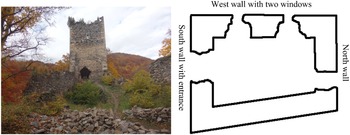
The roofless North tower is the current height dominant of the preserved part of the Rýzmburk castle (Figure 1). The tower is of a quadrangular floor plan, with internal dimensions of approx. 5.5 m × 8 m. Above the ground floor there are three additional floors up to a height of 15 m (Lehký Reference Lehký2012), but these are not easily reachable. There are no records or visible signs of repair or restoration works. For collecting samples, accessible inner walls as well as the wall profiles (1.7 m in thickness) in the large entrance opening of the south wall were explored. The walls were visually inspected up to the height of 2 m. The north wall, partially destructed and bearing security risks, as well as two unusually large windows in the west wall were excluded. On the total inspected area of about 40 m2, 10 samples resembling charcoals were identified by eye in the surface layer of the mortar and sampled. To avoid damaging the tower walls, deeper layers of the mortar were not sampled.
North tower of Rýzmburk castle: a photograph of the steep rocky access path and the entrance (left, taken in 2021) and a ground floor plan according to Lehký (Reference Lehký2012) (right).

Sample Treatment
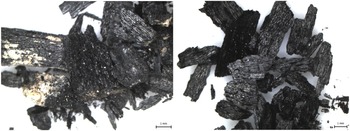
The subsequent sample treatment was performed in the Czech Radiocarbon Laboratory (CRL) of the Nuclear Physics Institute of the CAS. First, all samples were carefully inspected and mechanically cleaned. No traces were found of biological contamination, such as lichen or fungi, though the charcoals were exposed to moisture. The cleaned samples were pretreated with the acid-base-acid (ABA) protocol (Svetlik et al. Reference Svetlik, Jull, Molnár, Povinec, Kolář, Demján, Pachnerova Brabcova, Brychova, Dreslerova, Rybnicek and Simek2019). For large samples, the treatment was performed on a computer-controlled apparatus with a continuous flow of HCl to remove carbonates, NaOH to remove humic acid contaminants, and again HCl to release atmospheric CO2 absorbed in the previous step, washing the samples in-between these steps (Šimek et al. Reference Šimek, Megisová and Bemš2019). Two samples weighing less than 10 mg required a gentle pretreatment routine, including centrifugation, to minimize losses of the sample material. One of these samples dissolved during alkaline leaching and no residue was yielded through a silver membrane filter (0.2 µm pore size). For the successfully pretreated samples, the weight loses due to ABA ranged from 10% to 54% (Table 1). Illustrative photographs showing a sample before and after the pretreatment are presented in Figure 2.
Radiocarbon dating of charcoal samples from the North tower of Rýzmburk Castle.

1 Index A/M stands for automatic/manual procedure.
2 Calibrated calendar date intervals corresponding to about 95% confidence interval.
3 Sample 21132 was completely dissolved during the twice-repeated ABA pretreatment.
Sample 21139 before (left) and after (right) chemical ABA pretreatment. The scales indicate 1 mm.

The pretreated samples were dried at 60°C, under normal pressure and combusted with CuO as an oxidant and then graphitized with Zn as a reductant (Orsovszki and Rinyu Reference Orsovszki and Rinyu2015). Carbon content of the sample was derived by measuring the pressure of its combustion product CO2 in an apparatus of known volume.
As controls, graphite samples were prepared from the radiocarbon reference material (Oxalic Acid II, NIST SRM 4990C) and a blank (radiocarbon-free phthalic acid anhydride) using the same treatment (Cercatillo et al. Reference Cercatillo, Friedrich, Kromer, Paleček and Talamo2021). The combustion and graphitization blank measured along with the samples resulted in blank levels of 51,000–54,000 BP which is at regular level of processed blanks in our laboratory.
Radiocarbon Analysis and Dating
The graphite targets were analyzed with MILEA AMS system (CRL) at the Nuclear Physics Institute of the CAS or with MICADAS AMS in the Hertelendi Laboratory of Environmental Studies (DeA, Hungary). The measured radiocarbon activities were reported as conventional radiocarbon ages in years BP. For their conversion to intervals of calibrated age, the program OxCal, version 4.4, was applied (Bronk Ramsey Reference Bronk Ramsey2009), using the IntCal20 calibration curve as relevant for terrestrial samples from the Northern Hemisphere (Reimer et al. Reference Reimer, Austin, Bard, Bayliss, Blackwell and Bronk Ramsey2020).
RESULTS AND DISCUSSION
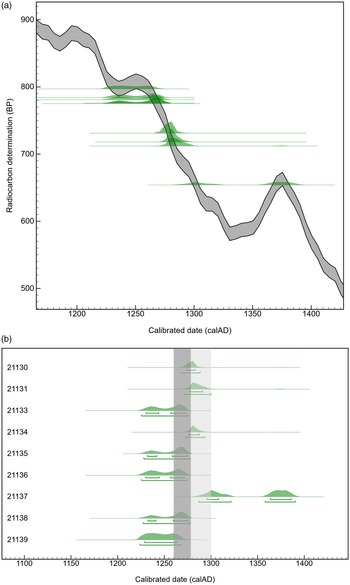
Results on charcoal samples, extracted from the North tower of Rýzmburk Castle, are listed in Table 1. Graphically, the resulting conventional radiocarbon ages and their calibration to intervals of calendar dates using the IntCal20 calibration curve are presented in Figure 3A. In a detailed view (Figure 3B), the calendar dates of the individual samples are presented as probability distributions, with the narrower and wider brackets denoting 68.3% (1σ) and 95.4% (2σ) confidence intervals, respectively, and compared with the existing historical estimates of the tower building dates, 1260–1278 or 1260–1300 AD (Lehký Reference Lehký2012; Razím Reference Razím2019).
Conventional radiocarbon ages (in BP) of the charcoals from the North tower of Rýzmburk calibrated to calendar age (in AD) using the IntCal20 calibration curve and the OxCal calibration tool. A: Calibration curve overlaid with the sample dates. B: Detail comparison of sample dates with two existing age estimates of the building (grey vertical bands—the dark band represent the narrower estimate 1260–1278 AD; together with the light band it represents the wider estimate 1260–1300 AD).

As can be seen from Figure 3 and Table 1, the majority of analyzed samples (8 out of 9) are consistent with the older estimate of the historic age of the tower, 1260–1278 (Lehký Reference Lehký2012). However, the sample 21137 indicates a post 1279 origin of the building, at 99.7% (3σ) confidence level, post 1287 at 95% (2σ) and post 1296 at 68% (1σ) levels, respectively. There are no records of repairs or restoration works, and no signs thereof were found when inspecting and sampling the tower walls. Obviously, the possibility cannot be completely excluded that the single sample 21137 might have originated from undocumented and unrecognizable early repairs in late 13th or 14th century. Likewise, later contamination with lichen or mould might have increased its 14C content, producing thus younger age. However, when inspecting and cleaning the found charcoal, there were no signs of such contamination whatsoever. This particular sample was not found in a special location where it would be exposed to weathering effects more than the other samples, either. In the absence of any evidence for such potential effects, we consider them unlikely, and we expect that the dating of this particular sample was as robust as that of the other ones. The dating subinterval of 1358–1390 AD is interpreted as due to the local shape of the calibration curve. Taken together, the present results in conjunction with the previous estimates thus suggest dates 1287–1300 AD as the most likely building period of the North Rýzmburk tower.
While the charcoal 21137 is to be interpreted then as originating from rather young wood such as branches, bush or small trees, the other samples point to wood most likely 20–70 years old. However, this interpretation is based only on the radiocarbon dating results relative to the historical estimation. The use of similarly old wood for lime burning has been reported frequently (Povinec et al. Reference Povinec, Cherkinsky, Dorica, Hajdas, Jull, Kontul, Molnár, Světlík and Wild2021), and our previously published results for other Czech medieval castles even provided some indication for the use of wood potentially as old as 300–400 years (Pachnerová Brabcová et al. Reference Pachnerová Brabcová, Krofta, Valášek, Suchý, Kundrát, Šimek, Kozlovec, Kotková, Fialová, Povinec, Válek and Světlík2022).
For the majority of the present samples, the conventional radiocarbon age was determined with the uncertainty interval of 12–13 years BP, which is at the limit of present AMS techniques. Nevertheless, the dating uncertainty is notably larger due to the local pattern of the calibration curve during a given period (Svetlik et a. 2019). The calibration curve (Figure 3A) shows a local minimum at approx. 1235 AD followed by a local maximum at approx. 1250 AD, so that the conventional radiocarbon age translates to calendar ages with 95% confidence intervals that are often as wide as 50 years, and 68% intervals that break into two calendar intervals (samples 21133, 21135, 21136, 21138, 21139). Similarly, due to a local 1330 AD minimum followed by a 1375 AD maximum, the calendar age of sample 21137 splits into two intervals, even at the 95% confidence level. The underlying profile of the IntCal20 calibration curve, derived from analyses of numerous dated samples in the Northern Hemisphere (Reimer et al. Reference Reimer, Austin, Bard, Bayliss, Blackwell and Bronk Ramsey2020), can presumably be pinpointed to temporary variations of 14C production rate. Indeed, even heavily pronounced dips and peaks on the calibration curve, such as the Miyake event in 774–775 AD, when the 14C content in the atmosphere expressed as Δ14C increased by as much as 20‰ (Miyake et al. Reference Miyake, Nagaya, Masuda and Nakamura2012), corresponding to a sudden drop of the conventional radiocarbon age of about 130 years BP (Reimer et al. Reference Reimer, Austin, Bard, Bayliss, Blackwell and Bronk Ramsey2020), could be explained by an about seven-fold increase of the 14C production rate over a year, presumably due to variations in Solar activity (John et al. Reference John, Kundrát, Pachnerová Brabcová, Molnár and Světlík2022). In the context of the present work, simulations using a global carbon cycle model (John et al. Reference John, Kundrát, Pachnerová Brabcová, Molnár and Světlík2022) approximately reproduced the 1230 AD local minimum on the calibration curve when a 25% increased 14C production rate for 12 years was assumed.
Direct radiocarbon dating of mortar CaCO3 functions as terminus ante quem criteria, which may be insufficiently restrictive if the mortar hardening process had taken up to hundreds of years, as might be the case in very massive walls of medieval castles. On the contrary, dating of charcoal fragments as reported here provides terminus post quem criteria (Thacker Reference Thacker2020). With samples of larger size and better quality than in the present study, one could potentially even identify species and relative position on the trunk and infer on the sample age when cut down, making the dating results more informative. When using timber from secular trees, cross dating of mortars and charcoals can narrow the most likely interval of rising the construction.
CONCLUSIONS
The beginning of Rýzmburk castle located in northwestern Bohemia is relatively well known from written sources and analyses of architectural remains. However, exact dating of various construction phases is still subject to discussions. Understanding and dating the construction of Rýzmburk castle is important for understanding of social system, distribution of power and forms of rule in medieval states in central Europe. Radiocarbon dating of 10 charcoal samples, found in surface mortar layers of the Northern tower of the Rýzmburk castle, provided new, independent data, where other methods used so far had reached their limits. The charcoals were analyzed by AMS, providing a virtually non-invasive method of radiocarbon dating of the building. The previous estimates of the tower building dates were refined to 1287–1300 AD. The charcoals likely originated from wood used for lime burning, with young wood such as branches, as well as 20-to-70 year-old wood being utilized. The dating precision is limited mostly by the intrinsic properties of the radiocarbon calibration curve around 1250 AD, which presumably can be traced to slight temporal variations of 14C production in those times, and only to a small extent by measurement uncertainties of cutting-edge AMS techniques.
ACKNOWLEDGMENTS
This work was supported by OP RDE, MEYS, under the project “Ultra-trace isotope research in social and environmental studies using accelerator mass spectrometry”, Reg. No. CZ.02.1.01/0.0/0.0/16_019/0000728, and by Czech Ministry of Culture, under the project “Possibilities of radiocarbon dating of historic mortars”, No. DG20P02OVV028.