




No CrossRef data available.
Article contents
Long-term investigation of the composition and richness of intestinal helminth communities in the stocked population of eel, Anguilla anguilla, in Neusiedler See, Austria
Published online by Cambridge University Press: 12 November 2004
Abstract
Data from a long-term study of the intestinal helminth parasite community of eels, Anguilla anguilla, stocked into the shallow eutrophic Neusiedler See, Austria, were collected over an 8 year period (1994–2001). In total, 720 eels from 2 sampling sites were examined. The parasite community showed characteristics similar to those in the natural eel populations in rivers of the UK and mainland Europe: it was species poor, with only 5 species (Acanthocephalus lucii, Acanthocephalus anguillae, Raphidascaris acus, Proteocephalus macrocephalus, Bothriocephalus claviceps) comprising the component community and a maximum infracommunity richness of 4 species. Over the period, the intestinal parasite community of the sampling site in Illmitz, which was originally dominated by A. lucii, changed. As levels of A. anguillae increased to a point at which it dominated the community, diversity increased whilst dominance of a single species decreased. By contrast the community in the southern sampling site remained rather constant with a continuous high infection level of A. anguillae and low abundance of A. lucii. Both acanthocephalan species exhibited higher infection levels in larger eels and in different seasons of the year and the infection parameters were significantly different between the years of study. The significant differences in the infection levels of the 2 acanthocephalan species at the 2 sampling sites were surprising as both acanthocephalan species use the same intermediate host, Asellus aquaticus, and the sampling sites were in close proximity and were similar in terms of water quality, host size and invertebrate abundance. Differences in the fish communities of the 2 sampling sites and eel movements rather than interspecific competition are discussed as possible explanations for the differences in the parasite communities of the 2 sampling sites.
Information
- Type
- Research Article
- Information
- Copyright
- © 2005 Cambridge University Press
INTRODUCTION
Long-term studies on host–parasite systems are generally rare in parasitology though of crucial importance to better understanding of many aspects of parasite ecology (Kennedy, 1993). This is also the case in fish parasite systems and most of the published data on the intestinal helminth communities in European eels, Anguilla anguilla, have been obtained from short-term investigations that have extended over 3 years or less (Kennedy et al. 1997; Schabuss et al. 1997; Sures et al. 1999; Kennedy, 2001; Sures & Streit, 2001; Norton, Lewis & Rollinson, 2003). In general, these studies have shown that intestinal helminth communities of eels in the UK and mainland Europe are isolationist in character, exhibiting low densities, low species diversity, with low richness and high dominance, usually by a single acanthocephalan or nematode species. Only a few publications (Kennedy, 1993, 1997; Kennedy et al. 1998; Kennedy & Moriarty, 2002) describe long-term changes in composition and richness of eel parasites.
Most of the investigations were carried out in small (Kennedy, 1993, 1997) or large rivers (Kennedy et al. 1998; Sures et al. 1999; Sures & Streit, 2001; Kennedy & Moriarty, 2002; Norton et al. 2003) and data about parasite communities in eels from lakes are very rare (Moravec, 1985; Køie, 1988a,b). Such data as do exist were obtained from naturally occurring eel populations. The data presented here are the results of an 8-year investigation into the composition and structure of intestinal helminth communities in eels from 2 sites in Neusiedler See, Austria.
The eel stock in Neusiedler See, like in many other lakes of Central and Eastern Europe, is based on allochtonous populations and has been maintained by regular massive stocking since 1958 (Herzig et al. 1994). This therefore represents the first study of the intestinal parasite community of a stocked, unnatural eel population and the Neusiedler See could be used as a model for other water bodies in Europe where eel is not naturally occurring, for instance Lake Balaton, Hungary (Herzig et al. 1994).
Furthermore, since the establishment of the transboundary national park Neusiedler See-Seewinkel between Austria and Hungary in 1993, stocking of eels has been prohibited. The eel population was therefore predicted to decline and was expected to become extinct within 10 years due to the ongoing fishery (Herzig et al. 1994). As the samples were taken from 1994 to 2001 this appeared to provide a unique opportunity to compare the dynamics of the intestinal parasite community of the declining, stocked host population in Neusiedler See with stable, natural eel populations as in Lough Derg, Ireland (Kennedy & Moriarty, 2002) and the river Tiber, Italy (Kennedy et al. 1998).
MATERIALS AND METHODS
Study areas and organism collection
The Neusiedler See (47°45′N 16°48′E) is the largest, westernmost steppe lake in Europe. The basin of this shallow, eutrophic lake covers an area of 321 km2 across the Austrian-Hungarian border. The mean depth of the lake is 1·2 m and the water temperatures can reach more than 30 °C during summer. A dense reed belt (Phragmites communis) encircles the lake and covers more than 50% of the lake area (180 km2). The average conductivity in the reed belt lies between 2000 and 4000 μS and the salinity can reach 2 g/l (Wolfram et al. 2001; Herzig, Kubecka & Wolfram, 2002). Eels were collected by electrofishing in the course of an ecological investigation of the fishery of the reed belt (Wolfram et al. 2001) at 2 different sampling areas, located about 5 km apart from each other: in the bay of Illmitz and in the southern part of the lake (Fig. 1). Wherever possible samples were taken at least once a year at both localities, but as sampling had to fit into the fishery ecological investigation it was more frequent in some years at one sampling area (1995 and 1996 in Illmitz and 1997 and 1998 in the southern area) whereas no samples were taken in others (1999 and 2000). Sampling spanned a period of 8 years from 1994 to 2001 and a total of 19 samples were taken. Details of sample times and sample sizes are given in Table 1. Sampling was normally restricted to spring (March to May), summer (June to August) and autumn (September to November) as the freezing of the lake rendered electrofishing impossible in winter. The number of eels per sample ranged from 5 to 68 (mean 37·9±14·4 S.D.).

Fig. 1. Eel sampling areas in the bay of Illmitz and in the southern part of Neusiedler See (after Wolfram et al. 2001). A, Austria; H, Hungary.

A total of 424 eels were caught in the bay of Illmitz (mean size: 39·8±10·5 cm, mean weight: 119±107 g, sex ratio male to female 1[ratio ]5) and 296 specimens in the southern area of the lake (mean size: 43·2±9·3 cm, mean weight: 141±105 g, sex ratio male to female 1[ratio ]11). The fish were transported to the laboratory alive and their weight (±0·1 g) and length (±0·1 cm) were recorded. The eels were killed by decapitation, the abdomens were opened, the fish were sexed according to the appearance of the gonads (Tesch, 1977) and the swimbladders and intestines were removed and examined for helminth parasites by standard methods (for details see Schabuss et al. (1997)). The detailed data and results concerning the swimbladder nematode Anguillicola crassus will be presented in a separate paper. All endo-helminths in each eel were identified to species and counted.
Determination of helminth community structure and statistical treatment
In order to describe the parasite population structure, the terms prevalence (P%), mean intensity (MI) and abundance (AB) were used according to Bush et al. (1997). The measures of community structure and similarity for the endoparasitic helminths detected were those employed in previous investigations (Kennedy, 1993, 1997; Sures et al. 1999; Kennedy & Moriarty, 2002; Norton et al. 2003). The measures of component community structure were Simpson's index (1/D), the Shannon Wiener index (H′log2), Evenness [H′/log2(S)], and the Berger Parker dominance index (BP). Infracommunity parameters were Brillouin's index and the mean number of species and individuals of the helminths per eel. All indices were calculated according to Magurran (1988). The ratio of variance to mean abundance was used as an index of dispersion. The effects of year, season and host length on prevalence, mean intensity and abundance of A. lucii and A. anguillae and on the number of species and number of helminth parasites per eel were explored with an Analysis of Variance (ANOVA, General Linear Model Procedure available in SPSS 10.0). Year (1994, 1995, 1996, 1997, 1998 and 2001), season (spring, summer, autumn) and size class (<30, <40, <50 and >50 cm) were entered as categorical predictors and individual host length (L) as a covariate. Significance was accepted for P[les ]0·05.
RESULTS
Composition of the parasite community
During the 8-year study, a total of 720 eels was examined with overall 6014 helminth specimens found in the intestines. The intestinal helminth community of eels in Neusiedler See was composed of 5 species (Table 2): 2 acanthocephalan species, 2 cestode species and 1 nematode. As the prevalence, mean intensity and abundance of the parasite species A. lucii, A. anguillae and P. macrocephalus were significantly different (P<0·001) between the 2 sampling sites and the acanthocephalans represented the vast majority of the parasite community, the 2 locations were analysed separately. In Illmitz, the highest values of prevalence, mean intensity, mean and relative abundance from 1994 to 1998 were recorded for A. lucii in each year. The relative abundance of A. lucii as a proportion of the total number of all helminth species decreased from 0·95 in 1995 to 0·3 in 1998 and stayed at this low level until 2001. The relative abundance of A. anguillae, which exhibited the second highest infection levels until 1998, increased from 0·01 in 1995 to 0·57 in 2001 and became the most prevalent and abundant intestinal helminth species in Illmitz in 2001. The 2 cestode and especially the nematode species occurred at low levels of infection throughout the study period. In the southern sampling site A. anguillae exhibited the highest levels of infection from 1996 to 2001, whereas A. lucii constantly occurred at rather low values of prevalence, mean intensity and abundance. The 2 cestode and the nematode species occurred at even lower levels than in Illmitz.
Table 2. Prevalence (P%), mean intensity (MI)±standard deviation (S.D.), mean abundance (±S.D.) and relative abundance of each helminth species as a proportion (pi) of the total number of all helminth species in the intestines of eels from 2 sites in Neusiedler See (s2/x, variance over mean ratio; *, numbers too small for calculation of S.D. to be meaningful.)

The effects of host size, season of sampling and year of study on helminth communities
As the 2 acanthocephalan species dominated the parasite community, the influence of host length, season of sampling (spring, summer, autumn) and year of study on the prevalence, mean intensity and abundance of A. lucii and A. anguillae from the 2 sampling sites was tested for statistical significance. The results of the general linear model are presented in Table 3. All 3 parameters had a significant influence on the infection levels of A. lucii and A. anguillae. Concerning the year of study A. lucii was significantly more prevalent (P[les ]0·05) and abundant (P[les ]0·05) in 1996 in Illmitz, whereas there was no significant difference in the infection levels of A. lucii in the southern part of the lake. In Illmitz, A. anguillae was significantly more abundant (P[les ]0·001) and prevalent (P[les ]0·001) and showed higher mean intensities (P[les ]0·05) in 2001 than in all other years. In the southern sampling area A. anguillae showed significantly higher values of abundance (P[les ]0·01) and mean intensity (P[les ]0·001) in 1998.

The prevalence (P[les ]0·001), mean intensity (P[les ]0·01) and abundance (P[les ]0·001) of A. lucii in Illmitz were significantly higher in autumn than in spring or summer, whereas in the southern sampling site A. lucii showed higher values of abundance (P[les ]0·05) and prevalence (P[les ]0·05) in spring than in summer and autumn. A. anguillae exhibited significant higher abundance (P[les ]0·01) and mean intensity (P[les ]0·01) in spring than in summer and autumn in both sampling sites.
There was no significant difference in the length frequency of eels from the 2 sampling areas, but significant differences (P[les ]0·001) in length were found between the years of the study. The average length of eels increased slightly from 1994 to 2001. In Illmitz, A. lucii recorded significant higher mean intensity (P[les ]0·05) in eels from 40–49·9 cm than eels smaller 30 cm and in the southern sampling site, eels larger 50 cm showed significantly higher prevalence (P[les ]0·01), mean intensity (P[les ]0·05) and abundance (P[les ]0·01) than all other size classes. A. anguillae exhibited in Illmitz higher abundance (P[les ]0·01) and prevalence (P[les ]0·01) in eels larger than 50 cm than in fish smaller 30 cm. In the southern area A. anguillae showed higher abundance (P[les ]0·01) and mean intensity (P[les ]0·01) in eels larger than 50 cm than hosts in the size classes of <30 and <40 cm and the prevalence was significantly lower (P[les ]0·01) in eels smaller than 30 cm than in all other size classes. Overall, the average size of eels increased slightly throughout the study period, both acanthocephalan species exhibited higher infection levels in larger eels and in a certain season and the infection parameters were significantly different between the years of study.
Component community profiles
Summarized data on the helminth component community structure of the 2 sampling areas for each year are shown in Table 4. Except in 1994 in Illmitz and 1996 in the southern area where the number of eels examined was very low, all 5 species were present at both sites in each year of the study. The Simpson's index, Shannon-Wiener index and Evenness varied in Illmitz from the lowest values in 1995 to maximum values in 1998. The diversity parameters were lower and varied to a smaller extent from 1996 to 2001 in the southern sampling site. The Berger Parker dominance index in Illmitz showed, after a high dominance of A. lucii from 1994 to 1996, a decrease from 1997 to 1998 and in 2001 A. anguillae dominated the component community. In the southern area A. anguillae remained the dominant species at a rather constant high level throughout the investigation. The small sample of 1996 when B. claviceps was the dominant species may be atypical. The species ratio between A. lucii and A. anguillae in the intestinal parasite community in Illmitz decreased drastically from a maximum value of 76[ratio ]1 in 1995 to a value of 0·7[ratio ]1 in 2001, whereas the ratio in the southern area remained rather constant from 1997 to 2001. The 2 acanthocephalan species represented the vast majority (in average >80%) of the helminths found in the intestines of eels throughout the study.
Table 4. Diversity characteristics of the intestinal component communities of helminths of eels from 2 sites in Neusiedler See (Data for whole year combined. A. l., Acanthocephalus lucii; A. a., A. anguillae; B. c., Bothriocephalus claviceps.)

Infracommunity profiles
The composition of the helminth infracommunity of the eels from the 2 sampling sites for each year is presented in Table 5. The mean number of helminths species and specimens per eel (all eels) and the Brillouin's index increased in Illmitz from a minimum value in 1994 to a maximum in 2001. In the southern sampling site a similar trend was obvious, but the values of the diversity parameters were lower compared to Illmitz. The prevalences (%) of coexisting helminth species in the intestine of eels are shown in Table 6. The percentage of uninfected eels decreased in Illmitz from 74% in 1994 to 5% in 2001 and in the southern area from 60% in 1996 to 12% in 2001. Throughout the 8 years of study the individual eel harboured an increasing number of helminth species in each year and in Illmitz in 2001 more fish were infected with 2, 3 or 4 species than with 0 or 1 species. The percentage of eels infected with both acanthocephalan species increased with each year in both sampling sites (Table 6). The number of species and the number of helminth parasites per eel were significantly correlated with the year of study, season of sampling and host length. In Illmitz, the number of species was significantly higher (P[les ]0·001) in each year than in the previous year, significantly more species (P[les ]0·05) were recorded in autumn than in spring or summer and eels larger than 50 cm harboured significantly more species (P[les ]0·05) than the smaller size classes. In the southern sampling site significantly more species (P[les ]0·05) were found in 2001 than in all other years, the number of species was higher (P[les ]0·001) in spring than in summer or autumn and eels larger than 50 cm harboured more (P[les ]0·05) and eels smaller 30 cm significantly less (P[les ]0·001) species than all other size classes.
Table 5. Diversity characteristics of the intestinal infracommunities of helminths of eels from 2 sites in Neusiedler See (Data for whole year combined. x, mean; Max, maximum; *, numbers too small for calculation of S.D. to be meaningful.)

Table 6. Prevalence (%) of coexisting helminth species in the intestine of eels from 2 sampling sites in Neusiedler See (Data for whole year combined. A. l., Acanthocephalus lucii; A. a., A. anguillae.)

The number of intestinal helminth specimens per eel in Illmitz was significantly higher (P[les ]0·01) in 2001 than in all other years except 1996, more parasites (P[les ]0·01) were found in autumn than in spring or summer and eels in the size class from 40 to 49·9 cm and larger than 50 cm harboured significantly more (P[les ]0·01) parasites than eels smaller than 30 cm. In the southern sampling site significantly more (P[les ]0·05) parasites were found in 1998 than in all other years, the number of helminths was higher (P[les ]0·001) in spring than in summer or autumn and eels larger than 50 cm harboured more parasite specimens (P[les ]0·01) than all other size classes.
DISCUSSION
The intestinal helminth parasite community of the stocked eel population in Neusiedler See showed characteristics similar to those in natural eel populations in rivers of the UK and mainland Europe (Kennedy, 1993; Kennedy et al. 1997, 1998; Sures et al. 1999; Sures & Streit, 2001; Kennedy & Moriarty, 2002). The component community consisted of 5 helminth species, all of these species have previously been reported from eels in Europe. This number of species is comparable with data on the intestinal parasite fauna reported for eels from rivers in Belgium (Schabuss et al. 1997), Germany (Sures et al. 1999; Sures & Streit, 2001), Ireland (Kennedy & Moriarty, 2002), Italy (Kennedy et al. 1997), Portugal (Saraiva & Eiras, 1996) and the Netherlands (Borgsteede et al. 1999). Higher component community richness (9, 11, 8 and 8 species) was reported from England (Kennedy, 1993, 1997; Norton et al. 2003) and Italy (Kennedy et al. 1998), respectively.
The intestinal parasite community in both sampling sites in Neusiedler See was heavily dominated by acanthocephalans. Such domination of a community by an acanthocephalan is a common characteristic of intestinal helminth communities in eels and has been reported from the UK and mainland Europe (Kennedy, 1990; Schabuss et al. 1997; Kennedy et al. 1998; Sures et al. 1999; Kennedy & Hartvigsen, 2000; Sures & Streit, 2001; Kennedy & Moriarty, 2002).
Within the 8 years of study significant changes in the structure and diversity of the parasite community in Neusiedler See were observed. The parasite community in Illmitz was heavily dominated by A. lucii from 1994 until 1998 but in 2001 A. anguillae dominated the parasite community, after increasing continuously from 1995 onwards. The diversity indices increased and more eels were infected with more parasite species with each year of the study. In the southern sampling site, the community structure remained rather constant with a continuous domination of A. anguillae and a very low proportion of A. lucii-infected eels. The diversity characteristics increased with each year but to a lower extent than in Illmitz. Comparing the component community of eels in Neusiedler See with the investigation in Lough Derg, Ireland (Kennedy & Moriarty, 2002), it is obvious that the Shannon-Wiener index and Simpson's index in Neusiedler See exhibited higher values (maximum 2·07 and 4·02 respectively) and varied over a higher range than in Lough Derg (maximum values 0·30 and 1·15). The Berger Parker dominance index in Illmitz decreased from a maximum value of 0·95 to a minimum of 0·3 and the dominating species changed within the study period, whereas in Lough Derg the high domination of A. lucii ranging from 0·93 to 1·0 remained constant throughout the 18 years of study. Thus the diversity in Neusiedler See was higher and varied to a higher extent between years than in Lough Dergh, while the dominance of a single species was lower and decreased throughout the study. The diversity in Neusiedler See was more similar to diversity characteristics reported from component communities of the 13-year study on the river Clyst (Kennedy, 1993) and short-term studies from coastal lagoons in Italy (Kennedy et al. 1997), the river Rhine (Sures et al. 1999; Sures & Streit, 2001) and the rivers Thames and Test (Norton et al. 2003).
On the intestinal helminth infra-community level, a higher maximum number of species per eel (4 species), similar mean number of species and mean Brillouin's index values, and lower mean number of parasites per eel were recorded in Neusiedler See compared to results from Lough Derg. The number of eels infected with 0 or 1 parasite species decreased and the percentage of eels infected with 2 or more species increased in both sampling sites in Neusiedler See throughout the 8 years of study, whereas the number of eels uninfected or with a single-species infection remained at a rather constant high level in Lough Derg. Results of the investigations on the eel parasite community of the River Tiber (Kennedy et al. 1998) showed lower diversity characteristics of the infracommunity than in Neusiedler See.
This increase in richness and diversity is very surprising as the eel population was predicted to decline and become extinct within 10 years after the prohibition of eel stocking in 1993 (Herzig et al. 1994). The infection levels and the diversity of the parasite community did not decline as a reaction to the predicted changes in the host population. So the question arose whether the eel population was in decline at all. Recent results from fish ecological investigations of the reed belt showed that despite a slight decrease in the eel population between 1994 and 1997, the eel stock in 2002 was at a similar level as in the early 1990s (Wolfram et al. 2001; Wolfram & Mikschi, 2003). In contrast to the findings of this study, the results of the fish ecological investigations showed that the length frequency distribution of eel did not change from 1988 to 2002 and the average size of eels did not increase (Wolfram et al. 2001; Wolfram & Mikschi, 2003). There was no decrease of specimens in the smaller size classes and small eels (<15 cm) were caught regularly until 2002, indicating constant illegal stocking.
Corresponding to such ongoing illegal stocking measures probably by local fishermen, the host population did not decrease after 1993. Thus, the characteristics of the intestinal parasite community reflected the unchanged eel population and moreover we observed an increase in helminth parasite diversity over the last decade.
The most important factors associated with the infection parameters of the dominating acanthocephalans in the 2 sampling sites in Neusiedler See were the year of study, season of sampling and length of eels.
In this study, we found a clear relationship between the parasite infection parameters and host size on both a total length and size-class basis. The influence of host length on parasite infection levels has been reported from various studies where larger eels harboured more parasites than smaller ones (Dogiel, Petrushevski & Polyanski, 1958; Moravec, 1985; Conneely & McCarthy, 1986; Molnar, Szekely & Perenyi, 1994; Schabuss et al. 1997; Poulin, 2000; Lefebvre et al. 2002; Audenaert et al. 2003), but various factors like sample size and size range of hosts are also of major importance and not all parasite species exhibit a correlation between intensity of infection and host size (see Poulin (2000) for a critical review). This accumulation of parasites in larger specimens is explained by a longer exposure time of older (=larger) eels to the parasite, a larger host area (intestine size) for parasite establishment, a higher degree of consumption of infected prey with increasing host size and a differential efficiency of the parasite transmission between intermediate and paratenic hosts (Poulin, 2000; Lefebvre et al. 2002). Moravec (1985) assumed that the intermediate host Asellus aquaticus is the main source of A. lucii infection for smaller eels, but their proportion in the food of large eels gradually decreases with increasing proportion of forage fish. Gut analyses showed that eels in Neusiedler See mainly feed on aquatic insects (Odonata, Coleoptera, Ephemeroptera and Trichoptera representing more than 50% of the food items throughout the year) and on Asellus aquaticus especially in spring, whereas planktonic animals and fish are of minor importance (Herzig et al. 1994; Wolfram et al. 2001). Eels in Neusiedler See become piscivorous at a size larger than 50 cm. As there are few eels in Neusiedler See with a body length exceeding 60 cm due to high population density and intensive fishing (Herzig et al. 1994; Wolfram et al. 2001; Wolfram & Mikschi, 2003), Asellus aquaticus seems to be the main source of infection with A. lucii and A. anguillae in this lake and eels larger than 50 cm seem to continue to feed intensively on this isopod. In this study the host length also had significant influence on the mean number of parasites and mean number of parasite species per eel. Norton et al. (2003) and Conneely & McCarthy (1986) reported a significant influence of eel length on the number of parasite species per eel, but no correlation between eel size and number of parasites per eel has been found in their study. The higher number of helminth species and specimens in larger eels in Neusiedler See may indicate a consumption of an increasing amount and variety of intermediate hosts with increasing host size.
Within this study, significant differences in the infection levels of both acanthocephalan species between the seasons of sampling were observed. A. anguillae exhibited significantly higher abundance and mean intensity in spring in both sampling sites. A. lucii recorded in Illmitz showed significantly higher abundance and mean intensity in autumn, whereas in the southern sampling site this parasite species displayed the highest values of abundance and prevalence in spring. Moravec (1985), Conneely & McCarthy (1986) and Kennedy et al. (1998) reported seasonality of parasite infections in eels, but not for acanthocephalans. Kennedy & Moriarty (2002) reported higher abundance of A. lucii in May, July and August, but noted that the increase in abundance is very dependent upon the values found in a single month and alternative samples in the same month can produce very different patterns of dispersion. Kennedy & Moriarty (1987) recorded lowest levels of abundance and prevalence of A. lucii and A. anguillae in March and April with an increase to a peak in mid-summer, a decrease in July and an increase again in autumn. A variety of ecological factors seem to account for the seasonal patterns and between-site variations in eel parasite infections (Conneely & McCarthy, 1986). Eels exhibit marked seasonality in their activity patterns and feeding intensity and temperature-related changes in feeding habits rather than physiological synchronization of parasite and host life-cycles are more likely to be responsible for the increased parasitizing of eels in certain seasons (Conneely & McCarthy, 1986). The gut analyses of the eel in Neusiedler See showed that eels were feeding more intensively in April and June while the feeding intensity decreased in summer and autumn and Asellus aquaticus was consumed intensively especially in spring (Herzig et al. 1994). This feeding behaviour of eel in Neusiedler See could explain the higher infection rate for acanthocephalans and the higher number of helminth species and specimens in spring in the southern sampling area. In Illmitz, however, the maximum infection level of A. lucii was recorded in autumn and it seemed that this parasite utilized eel at a different time of the year than in the southern sampling site. Other ecological factors, like a different population cycle of A. aquaticus or different cycles in recruitment and reproduction of the parasite may influence the transmission of A. lucii in Illmitz.
The significant differences between the 2 sampling sites concerning the infection levels of A. lucii and the increasing infection of eel with A. anguillae in Illmitz are surprising. Both species use Asellus aquaticus as their intermediate host and the 2 sampling sites were in close proximity and were similar in terms of water quality, host size and invertebrate abundance (Wolfram et al. 2001). Neither acanthocephalan species are eel specialists: the preferred final host of A. lucii is the perch (Perca fluviatilis) and that of A. anguillae is the chub (Leuciscus cephalus). As the chub is absent in the Neusiedler See (Herzig et al. 1994; Wolfram et al. 2001), eel might be the preferred definitive host of A. anguillae as in Lough Derg (Kennedy & Moriarty, 1987, 2002).
Results of the fish ecological investigation of the reed belt showed that the fish community of the 2 sampling sites is different. Perch were more abundant in Illmitz than in the southern sampling area (Wolfram et al. 2001). Thus, the higher prevalence, mean intensity and abundance of A. lucii in Illmitz compared to the southern sampling site could be explained by the higher number of A. lucii introduced to the community by perch. Kennedy & Moriarty (2002) observed changes in the relative abundance of A. lucii and A. anguillae in Lough Derg and attributed these changes to differences in infection levels in different parts of the lake and to changes in the movement patterns of eels in the Lough. An increased movement of eels from areas with high abundance of A. anguillae, like in the southern sampling site, into the bay of Illmitz might be a cause for the increasing infection of eels with A. anguillae in this area.
Kennedy (1992) reported competition between A. lucii and A. anguillae in eels such that A. anguillae populations are depressed by its congener, whereas Kennedy & Moriarty (1987) could not detect competitive displacement or resource partitioning in space or time between these two acanthocephalans, but still considered that exploitation competition might occur. In this study it seems that in the southern sampling site, the proportions of the 2 species remained fairly constant over the period and both congeneric species of acanthocephalans co-exist in apparently stable equilibrium in eels. In Illmitz, however, the observed changing proportions and species ratios of A. lucii and A. anguillae and the increasing number of eels infected with both species, seem to reflect the differences in the fish community and eel movements into this sampling site rather than competition as A. lucii is reported to be the stronger competitor (Kennedy, 1992). However, resource partitioning in time might be possible in this sampling site, as indicated by the maximum infection levels of A. lucii in autumn and A. anguilla in spring.
References
REFERENCES
AUDENAERT, V.,
HUYSE, T.,
GOEMANS, G.,
BELPAIRE, C. &
VOLCKAERT, F. A. M. (
2003).
Spatio-temporal dynamics of the parasitic nematode Anguillicola crassus in Flanders, Belgium.
Diseases of Aquatic Organisms
56,
223–233.CrossRefGoogle Scholar
BORGSTEEDE, F. H. M.,
HAENEN, O. L. M.,
DE BREE, J. &
LISITSINA, O. I. (
1999).
Parasite infections of European eel (Anguilla anguilla L.) in the Netherlands.
Helminthologia
34,
251–260.Google Scholar
BUSH, A. O.,
LAFFERTY, K. D.,
LOTZ, J. M. &
SHOSTAK, A. W. (
1997).
Parasitology meets ecology on its own terms: Margolis et al. revisited.
Journal of Parasitology
83,
575–583.CrossRefGoogle Scholar
CONNEELY, J. J. &
McCARTHY, T. K. (
1986).
Ecological factors influencing the composition of the parasite fauna on the European eel, Anguilla anguilla (L.), in Ireland.
Journal of Fish Biology
28,
207–219.CrossRefGoogle Scholar
DOGIEL, V. A.,
PETRUSHEVSKI, G. K. &
POLYANSKI, Y. I. (
1958).
Parasitology of Fishes.
Oliver and Boyd,
London.
HERZIG, A.,
MIKSCHI, E.,
AUER, B.,
HAIN, A.,
WAIS, A. &
WOLFRAM, G. (
1994).
Fischbiologische Untersuchung des Neusiedler Sees.
Biologisches Forschungsinstitut für Burgenland, Bericht 81,
1–125.Google Scholar
HERZIG, A.,
KUBECKA, J. &
WOLFRAM, G. (
2002).
Fish distribution in the open water and littoral of Neusiedler See (Austria): a matter of habitat structure and abiotic factors.
International Conference on Limnology of Shallow Lakes.
Balatonfüred,
Hungary
25–30 May 2002, p. 79.
KENNEDY, C. R. (
1990).
Helminth communities in fresh-water fish: structured communities or stochastic assemblages? In
Parasite Communities: Patterns and Processes
(ed. Esch, G. W., Bush, A. O. & Aho, J. M.) pp.
131–156.
Chapman and Hall,
London.
KENNEDY, C. R. (
1992).
Field evidence for interactions between the acanthocephalans Acanthocephalus anguillae and A. lucii in eels, Anguilla anguilla.
Ecological Parasitology
1,
122–134.Google Scholar
KENNEDY, C. R. (
1993).
The dynamics of intestinal helminth communities in eels Anguilla anguilla in a small stream: long-term changes in richness and structure.
Parasitology
107,
71–78.CrossRefGoogle Scholar
KENNEDY, C. R. (
1997).
Long-term and seasonal changes in composition and richness of intestinal helminth communities in eels Anguilla anguilla of an isolated English river.
Folia Parasitologica
44,
267–273.Google Scholar
KENNEDY, C. R. (
2001).
Metapopulation and community dynamics of helminth parasites of eels Anguilla anguilla in the River Exe system.
Parasitology
122,
689–698.CrossRefGoogle Scholar
KENNEDY, C. R.,
BERRILLI, F.,
DI CAVE, D.,
DE LIBERATO, C. &
ORECCHIA, P. (
1998).
Composition and diversity of helminth communities in eels Anguilla anguilla in the River Tiber: long-term changes and comparison with insular Europe.
Journal of Helminthology
72,
301–306.CrossRefGoogle Scholar
KENNEDY, C. R.,
DI CAVE, D.,
BERRILLI, F. &
ORECCHIA, P. (
1997).
Composition and structure of helminth communities in eels Anguilla anguilla from Italian coastal lagoons.
Journal of Helminthology
71,
35–40.CrossRefGoogle Scholar
KENNEDY, C. R. &
HARTVIGSEN, R. A. (
2000).
Richness and diversity of intestinal metazoan communities in brown trout Salmo trutta compared to those of Anguilla anguilla in their European heartlands.
Parasitology
121,
55–64.CrossRefGoogle Scholar
KENNEDY, C. R. &
MORIARTY, C. (
1987).
Co-existence of congeneric species of Acanthocephala: Acanthocephalus lucii and A. anguillae in eels Anguilla anguilla in Ireland.
Parasitology
95,
301–310.Google Scholar
KENNEDY, C. R. &
MORIARTY, C. (
2002).
Long-term stability in the richness and structure of helminth communities in eels, Anguilla anguilla, in Lough Derg, River Shannon, Ireland.
Journal of Helminthology
76,
315–322.CrossRefGoogle Scholar
KØIE, M. (
1988 a).
Parasite in eels Anguilla anguilla (L.) from eutrophic Lake Esrum (Denmark).
Acta Parasitologica Polonica
33,
89–100.Google Scholar
KØIE, M. (
1988 b).
Parasite in European eel Anguilla anguilla (L.) from Danish freshwater, brackish and marine localities.
Ophelia
29,
93–118.Google Scholar
LEFEBVRE, F.,
CONTOURNET, P.,
PRIOUR, F.,
SOULAS, O. &
CRIVELLI, A. J. (
2002).
Spatial and temporal variation in Anguillicola crassus counts: results of a 4 year survey of eels in Mediterranean lagoons.
Diseases of Aquatic Organisms
50,
181–188.CrossRefGoogle Scholar
MOLNAR, K.,
SZEKELY, C. &
PERENYI, M. (
1994).
Dynamics of Anguillicola crassus (Nematoda, Dracunculoidea) infection in eels of Lake Balaton.
Folia Parasitologica
41,
193–202.Google Scholar
MORAVEC, F. (
1985).
Occurrence of endoparasitic helminthes in eels (Anguilla anguilla (L.)) from the Macha lake fishpond system, Czechoslovakia.
Folia Parasitologica
32,
113–125.Google Scholar
NORTON, J.,
LEWIS, J. W. &
ROLLINSON, D. (
2003).
Parasite infracommunity diversity in eels: a reflection of local component community diversity.
Parasitology
127,
475–482.CrossRefGoogle Scholar
POULIN, R. (
2000).
Variation in the intraspecific relationship between fish length and intensity of parasitic infection: biological and statistical causes.
Journal of Fish Biology
56,
123–137.CrossRefGoogle Scholar
SARAIVA, A. &
EIRAS, J. C. (
1996).
Parasite community of European eel, Anguilla anguilla (L.), in the River Este, northern Portugal.
Research and Reviews in Parasitology
56,
179–183.Google Scholar
SCHABUSS, M.,
KONECNY, R.,
BELPAIRE, C. &
SCHIEMER, F. (
1997).
Endoparasitic helminths of the European eel, Anguilla anguilla, from four disconnected meanders from the rivers Leie and Scheldt in western Flanders, Belgium.
Folia Parasitologica
44,
12–18.Google Scholar
SURES, B.,
KNOPF, K.,
WÜRTZ, J. &
HIRT, J. (
1999).
Richness and diversity of parasite communities in European eels Anguilla anguilla of River Rhine, Germany, with special reference to helminth parasites.
Parasitology
119,
323–330.CrossRefGoogle Scholar
SURES, B. &
STREIT, B. (
2001).
Eel parasite diversity and intermediate host abundance in the River Rhine, Germany.
Parasitology
123,
185–191.CrossRefGoogle Scholar
TESCH, F. W. (
1977).
The Eel. Biology and Management of Anguillid Eels.
London,
Chapman and Hall.CrossRef
WOLFRAM, G.,
MIKSCHI, E.,
WOLFRAM-WAIS, A. &
HAIN, A. (
2001).
Fischökologische Untersuchung des Schilfgürtels des Neusiedler Sees.
Biologische Station Neusiedler See Biologisches Forschungsinstitut für Burgenland,
Bericht,
141 pp.
WOLFRAM, G. &
MIKSCHI, E. (
2003).
Fischökologisches Monitoring Neusiedler See 1998–2002.
Biologische Station Neusiedler See Biologisches Forschungsinstitut für Burgenland,
Bericht,
46 pp.

Fig. 1. Eel sampling areas in the bay of Illmitz and in the southern part of Neusiedler See (after Wolfram et al. 2001). A, Austria; H, Hungary.

Table 1. Dates of fishing, sample sites, season and number of eels examined (n)
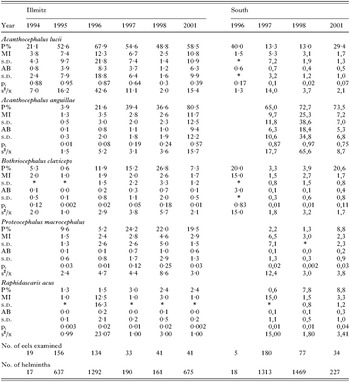
Table 2. Prevalence (P%), mean intensity (MI)±standard deviation (S.D.), mean abundance (±S.D.) and relative abundance of each helminth species as a proportion (pi) of the total number of all helminth species in the intestines of eels from 2 sites in Neusiedler See
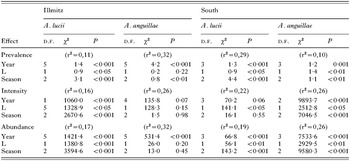
Table 3. Results of the general linear model examining effects of year, season and host length (L) on prevalence, intensity and abundance of A. lucii and A. anguillae in eel from 2 sampling sites in Neusiedler See (ANOVA tests)
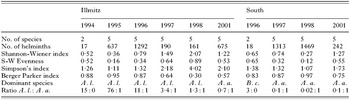
Table 4. Diversity characteristics of the intestinal component communities of helminths of eels from 2 sites in Neusiedler See
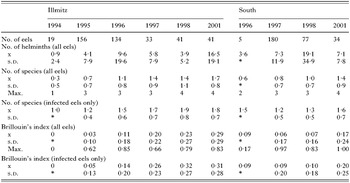
Table 5. Diversity characteristics of the intestinal infracommunities of helminths of eels from 2 sites in Neusiedler See

Table 6. Prevalence (%) of coexisting helminth species in the intestine of eels from 2 sampling sites in Neusiedler See
 You have
Access
- 22
- Cited by