Introduction
Traumatic laryngeal injuries are uncommon, representing less than 1 per cent of blunt external trauma cases treated in major trauma centres.Reference Gussack, Jurkovich and Luterman 1 Since the introduction of protective gear and rule modifications for participant protection, the incidence of cervical injury in contact sports such as American football, ice hockey and soccer has remained stable.Reference Delaney and Al-Kashmiri 2 , Reference Lawrence, Svider, Raza, Zuliani, Carron and Folbe 3 However, the larynx remains vulnerable, particularly after contact with another athlete or sports equipment (e.g. puck or stick), a field hazard, or a fixed object such as a goal post. Injuries can be quite heterogeneous, and vary from minor soft tissue oedema to significant endolaryngeal soft tissue disruption, with or without a fracture of the laryngeal skeleton.Reference Paluska and Lansford 4 Initial goals of management include stabilisation and protection of the airway and cervical spine, as per the Advanced Trauma Life Support guidance, 5 which will not be detailed in this report.
Clinical evaluation
Early diagnosis is crucial for the best clinical outcomes following blunt laryngeal trauma. Evaluation includes physical examination, with an emphasis on airway, vascular structures and cranial nerve assessment. Airway compromise is common, and ranges from minor (e.g. short duration stridor often resolved before presentation) to dramatic (with increased respiratory rate and oxygen desaturation). Airway obstruction must be managed definitively with tracheostomy or endotracheal intubation.
Common symptoms associated with laryngeal injury include neck pain, haemoptysis, dysphonia, dyspnoea, odynophagia and dysphagia. Clinical signs include neck and laryngeal tenderness, ecchymosis, oedema, loss of laryngeal prominence, and subcutaneous emphysema. The laryngeal framework and neck should be carefully evaluated; laryngeal asymmetry on inspection and/or palpation, with point tenderness, crepitus or a step deformity are highly suspicious of a fracture.Reference Paluska and Lansford 4
Unless there is airway instability, flexible laryngoscopy is essential in the assessment of airway patency and endolaryngeal injuries. Important endoscopic findings include the presence of haematoma, oedema, mucosal disruption, exposed cartilage and impaired vocal fold mobility.
Computed tomography (CT) is extremely valuable for evaluation of the laryngeal framework and soft tissues, and for identifying potential injuries to the carotid sheath or cervical spine, which should not be overlooked in any neck trauma. Further investigation should be case-specific (e.g. CT angiography for suspected vascular injuries and magnetic resonance imaging (MRI) for potential cervical spine injuries).
High- and low-velocity blunt trauma can lead to significant permanent voice, swallowing or respiratory difficulties. The clinician must maintain a high degree of suspicion in order to expeditiously diagnose and manage these patients by adopting a systematic approach in their evaluation.
This paper presents a case series of patients who sustained blunt laryngeal trauma during sports activity and contextualises their specific management in relation to the published literature.
Materials and methods
Patients who presented to the tertiary laryngology clinic at St Michael's Hospital, Toronto, Canada, with external laryngeal trauma, from 2009 to 2015, were identified from the clinic database. The key words ‘laryngeal trauma’ and ‘laryngeal fracture’ were used to identify a cohort of 28 patients, of which 13 (46 per cent) had a history of sports-related blunt trauma.
A case-based retrospective analysis was undertaken using the hospital electronic medical records and the departmental clinic database. The following patient data were collected: (1) demographics (age and gender); (2) mode of injury; (3) symptoms; (4) physical signs; (5) Schaefer-Fuhrman grade; (6) presence and type of fracture; (7) CT findings; (8) indirect laryngoscopy findings; (9) time to surgery; (10) surgical treatment; (11) follow-up duration; and (12) Voice Handicap Index 10 scores.Reference Rosen, Lee, Osborne, Zullo and Murry 6
Laryngeal function was evaluated by indirect laryngoscopy and, when feasible, with videostroboscopy. The degree of subjective vocal function disability following injury was reported using a validated questionnaire (Voice Handicap Index 10).Reference Rosen, Lee, Osborne, Zullo and Murry 6 In this report, vocal function that had recovered to the same pre-morbid state was classified as a ‘good’ outcome; vocal function that had recovered to a level of social functioning was considered a ‘fair’ outcome, and aphonia, with a voice that was just audible or unintelligible, was classified as a ‘poor’ outcome.Reference Butler, Wood, O'Rourke and Porubsky 7
The most recent videostroboscopic examination for each patient was subjected to a consensus evaluation, using a standardised rating form,Reference Poburka 8 conducted by three experienced clinicians (one laryngologist and two speech language pathologists), in order to judge structural integrity and vibratory characteristics.
Results
In this case series, sports-related blunt laryngeal trauma occurred primarily amongst young men (12 out of 13), with a mean age of 34 years (range, 17–58 years). Ice hockey was the most common sport implicated (six patients: five puck-related and one elbow strike); the remaining cases sustained trauma during baseball, jiu-jitsu, soccer, dune buggy racing, lacrosse, skiing and cycling.
Clinical presentation
Common symptoms included: dysphonia or aphonia (n = 13), neck or throat pain (n = 13), shortness of breath with or without stridor (n = 8), haemoptysis (n = 4), dysphagia (n = 4), odynophagia (n = 3), cough (n = 1), and referred pain (otalgia) (n = 1). Clinical signs observed included: abnormal laryngoscopy (n = 12), neck tenderness (n = 5), oedema (n = 4), ecchymosis (n = 2), palpable laryngeal step deformity (n = 3) and crepitus (n = 2).
Flexible laryngoscopy was performed acutely (within less than 48 hours) in 10 out of 13 patients, and was delayed in 3 out of 13 (3 patients presented between 20 and 100 days post-injury). Endoscopic findings included true and/or false vocal fold haematoma (n = 9), oedema (n = 6), piriform fossae haematoma (n = 2), vocal fold avulsion (n = 2), and vocal fold paresis (n = 1); laryngoscopy findings were normal in one patient. One female patient, who presented with aphonia four months after an injury sustained whilst abroad, was found to have bilateral vocal granulomas and an extensive anterior glottic web.
The Schaefer-Fuhrman classification was used to categorise the severity of laryngeal injury (Table I).Reference Schaefer and Close 9 The majority of patients were in group III (eight patients), with five patients in groups I or II. None of the patients met the criteria for groups IV or V, or sustained cervical spine, vascular or oesophageal injuries as a result of their trauma.
Severity of laryngeal injury in case series of sports-related injuries*

* Graded according to the Schaefer-Fuhrman classification.Reference Schaefer and Close 9 †Total n = 13
Twelve of 13 patients underwent CT imaging at the time of injury. Seven laryngeal fractures were diagnosed radiologically with two additional fractures diagnosed by the supervising surgeon based on clinical findings. The thyroid alar cartilage was the most prevalent fracture site (eight cases); two patients had a concomitant hyoid or cricoid fracture. One patient had a cricoid and upper tracheal ring fracture. Three patients had soft tissue injuries without an associated fracture.
Treatment
In our series, four patients (31 per cent) were orotracheally intubated for acute airway obstruction at a peripheral hospital prior to transfer to our institution. Two were converted to tracheostomy at surgery. The remaining 10 patients (77 per cent) had a stable airway. In total, four patients (31 per cent) required a tracheostomy, which was performed in the operating theatre. Medical management for two patients (with Schaefer-Fuhrman classification group II injuries), which included serial flexible laryngoscopies, humidified oxygen, intravenous steroids, antibiotics and anti-reflux treatment, necessitated admission to hospital for observation. Both patients were discharged within 48 hours. The patients who underwent surgery were orotracheally intubated using either a Mackintosh size 3 blade, Miller laryngoscope or a GlideScope® video-guided laryngoscope blade, within the operating theatre.
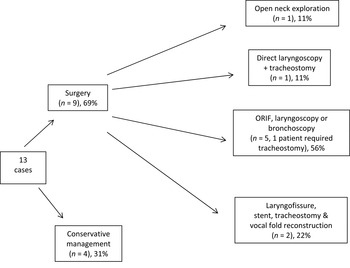
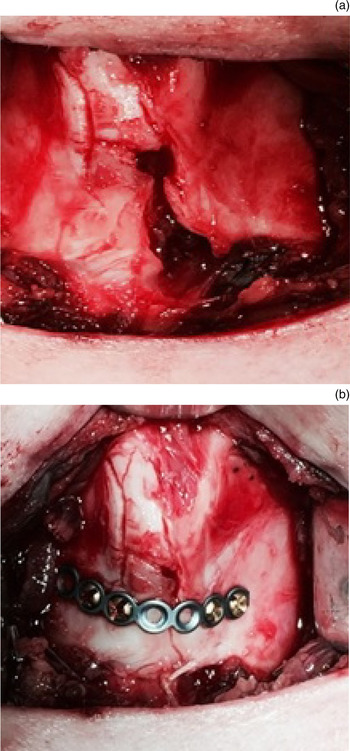
Nine patients (69 per cent) underwent a surgical procedure (Figure 1). Open reduction internal fixation, with mini-plating (Figure 2) or suture repair, was required in five patients with a displaced fracture.
Management outcomes of our series of blunt laryngeal trauma patients (n = 13). ORIF = open reduction internal fixation

(a) & (b) Mini-plate fixation (open reduction internal fixation) of comminuted bilateral paramedian thyroid lamina fracture.

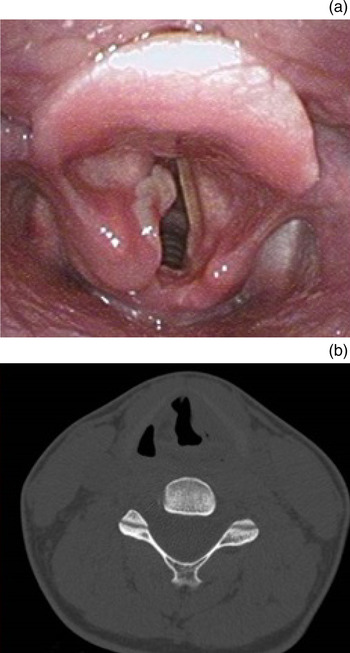
Two patients without any laryngeal fracture on CT, who sustained similar injuries from a lateral blow to the neck (an elbow in soccer and a lacrosse stick), presented with ipsilateral vocal fold avulsion and contralateral haematoma (Figure 3). Flexible laryngoscopy was instrumental in the diagnosis of the avulsion injury, with unilateral haemorrhage, torn mucosa, and a shortened true or false vocal fold. At surgery, the cover of the vocal fold, and most of the thyroarytenoid and lateral cricoarytenoid muscle, were found to be avulsed from the body or vocal process of the arytenoid, with the laceration extending into the ventricle. After careful intubation (using a size 6 endotracheal tube) with GlideScope visualisation, tracheostomy was conducted through a separate incision, and then laryngofissure was performed. Primary multi-layered suture repair was carried out to reconstruct the arytenoid body and repair the vocal fold mucosa (Figure 3).
Left vocal fold avulsion 7 days post-injury: (a) rigid laryngoscopy view and (b) axial computed tomography scan through glottis.

One patient required tracheostomy for a large haematoma and one underwent neck exploration. The average time from trauma to surgery was 7 days (range of 1–23 days, excluding 1 patient who presented 4 months after the injury). The majority of the patients who required surgery were classified as having group III severity of laryngeal injury (n = 7; 54 per cent), with one each from groups I and II. The one group I patient who underwent neck exploration did so as their original CT scan suggested a higher grade of injury (group II).
The arytenoid joint was found to be intact in all patients. In light of concerns that the thyroarytenoid or lateral cricoarytenoid would pull away from the arytenoid post-operatively, a solid Montgomery stent (Boston Medical, Westborough, Massachusetts, USA) was placed and secured with suture and Silastic® buttons in the usual fashion to the anterior of the neck. Prior to closure, botulinum toxin A (Allergan, Markham, Ontario, Canada) was injected (8 IU) into the avulsed thyroarytenoid and lateral cricoarytenoid muscles to induce a chemical myotomy. The stents were removed under general anaesthetic at week three, with decannulation at week five post-operatively.
The one female patient in the series, with delayed presentation and aphonia, required two microlaryngoscopy procedures; the first was required to remove large granulomas, and the second was needed for division and recontouring of an extensive anterior glottis web.
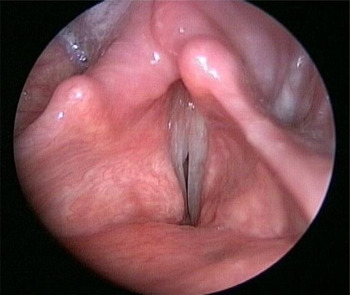
Overall, the voice results in this cohort of sports-related laryngeal trauma cases, managed medically or surgically, were good (with a return to a pre-morbid state), based on a combination of indirect laryngoscopy findings, reported symptoms and Voice Handicap Index 10 scores. The length of time from injury to the reported Voice Handicap Index 10 score ranged from 5 months to 6.5 years (mean, 33 months). One patient did not have a Voice Handicap Index 10 score recorded and was lost to follow up. Eighty-three per cent of patients reported their Voice Handicap Index 10 score as 10 or lower (range of 0–9, median = 6) indicating that their voice was perceived as normal. Only two patients had a Voice Handicap Index 10 score of 20 or higher (in the moderate to severe disability range). Both patients sustained a vocal fold avulsion injury and had the most abnormalities on videostroboscopy (Figure 4) at one-year post-injury (reduced mucosal wave, mid vocal fold gap and a defect in the upper free edge contour).
Videostroboscopic view during adduction, 12 months following repair of right vocal fold avulsion injury, demonstrating mid-membranous vocal fold gap and edge defect.

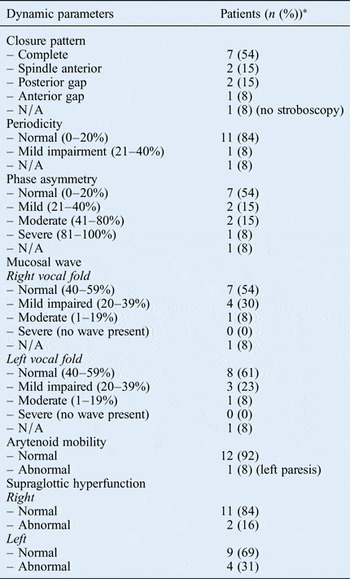
Videostroboscopy was carried out at each post-operative visit. The most recent examination was evaluated by consensus rating using a standardised form, the results of which are summarised in Table II.Reference Poburka 8 No patients had any airway or swallowing complaints at their last follow-up visit; at their initial presentation, 62 per cent of patients (n = 8) complained of airway symptoms, and 31 per cent (n = 4) complained of temporary dysphagia that did not necessitate nasogastric feeding.
Consensus rating of videostroboscopy following sports-related laryngeal trauma

* Total n = 13. N/A = not applicable
Discussion
Laryngeal trauma is rare, but potentially life threatening. Blunt trauma to the larynx can present with subtle and variable clinical signs, which can manifest up to 48 hours post-injury.Reference Paluska and Lansford 4 No single symptom correlates well with injury grade. An asymptomatic patient may actually have an underlying significant laryngeal injury, which, if missed, could ultimately have serious life-threatening consequences, such as airway obstruction and death.Reference Omakobia and Micallef 10 The early identification and treatment of laryngotracheal injuries has been associated with improved outcomes in voice and airway for all injury types.Reference Butler, Wood, O'Rourke and Porubsky 7 , Reference Juutilainen, Vintturi, Robinson, Bäck, Lehtonen and Mäkitie 11
The literature indicates that the proportion of penetrating trauma cases are increasing secondary to assault, which was not found in our patient population.Reference Omakobia and Micallef 10 , Reference Kim, Cho, Son, Park and Woo 12 Of 28 laryngeal trauma cases in the St Michael's Hospital (regional trauma centre) database, almost half were blunt trauma from sports injuries and only 11 per cent were the result of assault (none were penetrating injuries with a weapon).
A reduction in blunt laryngeal trauma has occurred because of safety regulations introduced in the past 30 years (e.g. seatbelts, speed limits, air bags) and protective gear in sports. The mechanisms of injury in sports may be complex, including possible rotation of the laryngeal framework on ligamentous attachments, and the transfer of energy after a lateral blow with compression against the spine resulting in contralateral injury. This was evident in our two vocal fold avulsion patients, who were struck laterally and presented with an ipsilateral avulsion and contralateral haematoma (Figure 3).Reference Sidle and Altman 13
Airway management is the main priority in laryngeal trauma patients, and the severity of symptoms and physical findings should be assessed carefully. Open tracheostomy has been considered the safest option for acute airway obstruction, with concerns that intubation may cause further obstruction or aggravate the injury.Reference Schaefer and Close 9 , Reference Gussack and Jurkovich 14 However, airway management remains controversial, depending in part on the personnel and equipment available.Reference Cheong and Yau 15 With advances in endoscopic imaging and video-assisted equipment, certain cases may be safely managed with awake fibre-optic or GlideScope assisted orotracheal intubation.Reference Cheong and Yau 15 Gussack et al. (1986) published a management protocol on laryngeal trauma, which recommends open tracheostomy for obvious severe airway disruption (or failed intubation) and a trial of intubation in all other cases.Reference Gussack, Jurkovich and Luterman 1 Surgical or needle cricothyroidotomy is not recommended.Reference Gussack, Jurkovich and Luterman 1 , Reference Gussack and Jurkovich 14 , Reference Atkins, Abbate, Fisher and Vaslef 16 , Reference Waldron and Young 17 Cricoid pressure during intubation is also contraindicated, as it may cause further airway compromise.Reference Cicala, Kudsk, Butts, Nguyen and Fabian 18 , Reference Gold, Gerber, Shott and Myer 19 Once the airway and cervical spine is found to be stable, flexible laryngoscopy and CT imaging are the ‘gold standard’ for initial laryngeal assessment.Reference Schaefer 20
The mortality rate associated with blunt laryngeal trauma has been reported to be as high as 40 per cent, influenced largely by early airway management and the severity of related injuries.Reference Minard, Kudsk, Croce, Butts, Cicala and Fabian 21 Our series of sports-related laryngeal trauma had no mortality and low morbidity rates (no airway limitations and good voice outcomes). This is in contrast to the literature on blunt laryngeal trauma resulting from combined causes (e.g. motor vehicle accident, assault).Reference Schaefer 22
Compared to other published series,Reference Omakobia and Micallef 10 our study of sports-related trauma patients has shown that, although most patients required surgical management (69 per cent), the degree of injury was lower according to the Schaefer-Fuhrman classification (groups II and III as opposed to groups III and IV). Furthermore, the trauma generally affected a single system (rather than multiple systems), and occurred in young and healthy individuals.
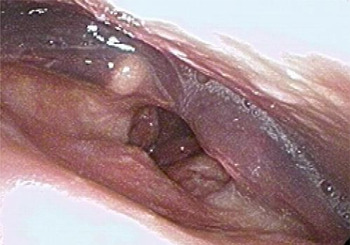
The possibility of concomitant injuries to associated structures such as the oesophagus and cervical spine must be considered. In our series, 2 of the 12 patients sustained other injuries (multiple facial fractures in 1 polytrauma patient and an ankle fracture in another patient). No oesophageal injuries occurred in our series. In addition, acute odynophagia or dysphagia symptoms were prominent in those with localised oedema and haemorrhage in the piriform fossae and post-cricoid region, but none persisted long-term (Figure 5).
Acute laryngeal trauma to piriform fossae and vocal fold ecchymosis.

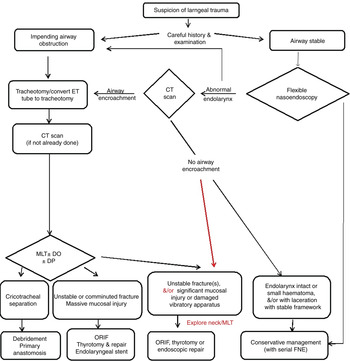
After securing the airway, restoring vocal function is a priority in these cases. Minor injuries (mainly group I injuries), such as small laryngeal haematoma, may be managed conservatively with hospitalisation, medical treatment (steroids and antibiotics), and observation including serial fibre-optic examination. Surgical treatment should be undertaken early in unstable injuries (group II injuries and above) to restore structural integrity and optimise vocal fold reconstruction.Reference Butler, Wood, O'Rourke and Porubsky 7 Sandhu and Nouraei (2014) have published an algorithm for management decisions when treating laryngeal trauma.Reference Sandhu, Nouraei, Kirtane and de Souza 23 We have proposed a minor modification to this to account for the management of a significant soft tissue injury to the vibratory structures without associated airway compromise or fracture (Figure 6).
Modified management protocol for managing laryngeal trauma. ET = endotracheal; CT = computed tomography; MLT = microlaryngoscopy and tracheoscopy; DO = direct oesophagoscopy; DP = direct pharyngoscopy; ORIF = open reduction internal fixation; FNE = flexible naso-endoscopy. Reproduced with permission (modifications are shown in red).Reference Sandhu, Nouraei, Kirtane and de Souza 23

The primary imaging modality to evaluate the laryngeal framework and soft tissues is CT. Ossification of the laryngeal framework is variable given that the hyaline cartilage ossifies as part of a normal ageing process. The cuneiform complex and vocal process are fibro-elastic cartilage which does not ossify. The thyroid ala starts to ossify from the posterior-inferior border, starting around age 20 years; by age 65 years, the cartilage may be completely ossified, which predisposes this population to comminuted fractures.Reference Beckera, Leuchterb, Platona, Beckera, Dulguerovb and Varoquauxa 24 The central area of the thyroid ala frequently remains non-ossified and radiolucent, with soft tissue density, on CT. Inconsistent ossification or no ossification of the laryngeal ala in young patients can make the diagnosis of fracture difficult. Greenstick (perichondrium preserved) or complete fractures when identified by CT are classified as displaced or non-displaced.Reference Beckera, Leuchterb, Platona, Beckera, Dulguerovb and Varoquauxa 24
Experimental studies show that whilst non-ossified cartilage may spring back after an anterior blow, ossified cartilage can shatter, resulting in haematoma and massive soft tissue oedema with potential airway compromise. In low-velocity trauma cases, fractures of the hyoid bone and soft tissue injury can be observed. In high-velocity trauma cases, thyroid and cricoid fractures with major soft tissue lacerations are observed.Reference Beckera, Leuchterb, Platona, Beckera, Dulguerovb and Varoquauxa 24 In this series, the sports-related injuries tended to be low velocity and resulted primarily in thyroid cartilage fractures. High-resolution CT, with rapid acquisition and a high degree of anatomical detail with multiplanar reconstruction, is an invaluable tool in the evaluation of laryngeal trauma. In contrast, MRI is a less common modality, indicated in patients with poorly ossified cartilages where a fracture is suspected clinically and CT findings are equivocal. In these cases, the MRI slice thickness should not exceed 2–3 mm. For CT images, 1–1.2 mm reconstructed slices should be used, with 50 per cent overlap.Reference Beckera, Leuchterb, Platona, Beckera, Dulguerovb and Varoquauxa 24
Surgical treatment may include initial airway management, direct laryngoscopy, neck exploration, open reduction internal fixation of displaced fracture(s), and soft tissue repair with laryngofissure (as needed). Stenting may be necessary to support an unstable framework and/or soft tissue reconstruction. Tracheostomy could be performed as part of initial airway management, or during surgical exploration when oedema or haematoma are likely to cause further airway obstruction or a stent is placed. In this series, titanium microplates or sutures were used for the fixation of alar fractures. Chemical myotomy (with an onabotulinum toxin A injection) was used to facilitate the repair of vocal fold avulsion.
Amongst our cases series, prompt treatment and meticulous reconstruction of laryngeal injuries led to good voice outcomes in the majority of patients, with no airway or swallowing problems.
-
• Blunt laryngeal traumas range from minor soft tissue oedema, to life-threatening haematoma and airway obstruction, with or without a laryngeal fracture
-
• Clinical signs may be subtle; a high degree of suspicion is required for optimal airway and voice outcomes
-
• Despite a low injury classification, nearly 70 per cent of our laryngeal sporting injury patients required surgical management
This study concentrates specifically on sports-related blunt laryngeal trauma, its weakness being that it represents a small series. However, it does highlight the aetiology of laryngeal trauma within a tertiary Canadian Voice centre as being almost exclusively due to sports-related blunt trauma as opposed to penetrating injuries with a weapon. This may reflect the social policy of gun control within Canada as opposed to the rest of North America.
Conclusion
Blunt laryngeal trauma is rare and sports-related causes are uncommon. Prompt diagnosis and management are crucial. Careful attention should be paid to the cumulative information available from clinical, endoscopic and CT scan findings. A high index of suspicion is warranted, along with the adoption of a systemic and timely approach. Early surgical repair may be necessary to reduce or stabilise fractures and restore anatomy, and to reconstruct the glottis soft tissues, to achieve the optimal laryngeal functional outcome (in terms of airway, voice and swallowing) after these injuries.
Acknowledgements
The authors would like to acknowledge the valued contribution from our dedicated departmental speech and language pathology therapists, Gwen Merrick and Marta De Luca, and departmental research assistant William To.