Implications
On 19 dairy farms across southern England, 7.9% of male and female calves were born dead or died within 24 h of birth, and on average, 15% of female calves born alive died or were culled between 1 day of age and first calving. Dairy heifers are a critical component of the dairy industry; they are potential milking cow replacements and are needed to maintain herd size. Such high losses decrease farm profitability, and could be reduced by implementation of better management practices for youngstock.
Introduction
The successful rearing of the required numbers of heifer replacements annually is a key factor in profitable dairy enterprises. However, a significant number of calves are either born dead (8%) (Esslemont and Kossaibati, Reference Esslemont and Kossaibati1996), or die during the calf-rearing period (13%) (Esslemont and Kossaibati, Reference Esslemont and Kossaibati1997), and thus, many potential replacement dairy heifers fail to reach their first lactation. Calf survival is influenced by many factors, including genetic, management and environmental variables (Meyer et al., Reference Meyer, Berger, Koehler, Thompson and Sattler2001). There is a strong association between stillbirths and calving difficulty (Berglund et al., Reference Berglund, Steinbock and Elvander2003), although it is often difficult to determine the exact timing of calf death. Risk factors for calving difficulty include breed, sire, parity, gestation length, calf sex, twinning, season of birth, herd size and calving supervision (Svensson et al., Reference Svensson, Linder and Olsson2006). The incidence of stillbirths and calves dying shortly after birth is difficult to monitor because calves dying within 36 h of birth may not be ear-tagged (EU and UK legislation). Furthermore, in many dairy software packages, heifers are not recorded as herd members until after first calving, thus, mortality and losses during the rearing period are poorly documented.
During the rearing period, calf birth weight, person caring for calves, colostrum intake, milk feeding practices, housing, age at weaning and exposure to infectious disease are all recognised risk factors for calf mortality (Speicher and Hepp, Reference Speicher and Hepp1973; Sivula et al., Reference Sivula, Ames and Marsh1996). However, the impact of these risk factors on mortality is not always consistent between studies. These risk factors may also be difficult to assess accurately on commercial farms as the agreed procedures, for example, with regard to colostrum supplementation or milk volume, may not be applied uniformly to every animal born.
The somatotrophic axis (growth hormone (GH), insulin and the insulin-like growth factors (IGFs)) in the dairy heifer is involved in many biological processes, including postnatal growth, reproduction, lactation and immune function (McGuire et al., Reference McGuire, Vicini, Bauman and Veenhuizen1992). The liver is a major site for the production of circulating IGF-I in response to GH receptor binding and nutritional status. The timing and amount of colostrum intake at birth influences plasma IGF-I concentrations in the neonatal calf (Blum and Hammon, Reference Blum and Hammon1999). Feeding calves high protein and energy diets (milk replacer 30% crude protein (CP), 4.4 kcal metabolisable energy (ME)/g; calf starter 21% CP, 3.7 kcal ME/g) during the first 3 months of life increases IGF-I concentrations (Brown et al., Reference Brown, Vandehaar, Daniels, Liesman, Chapin, Keisler and Nielsen2005). Alterations in energy and protein intake, associated with metabolic and endocrine changes, are primarily responsible for alterations in growth rate (Blum et al., Reference Blum, Schnyder, Kunz, Blom, Bickel and Schurch1985). IGF-I concentration is a good indicator of growth; high growth rates are associated with elevated concentrations in heifer calves (Kerr et al., Reference Kerr, Laarveld, Fehr and Manns1991; Radcliff et al., Reference Radcliff, VandeHaar, Kobayashi, Sharma, Tucker and Lucy2004; Brickell et al., Reference Brickell, McGowan and Wathes2009). IGF-I concentration can be altered by disease; sick or immune-challenged calves undergoing an immune response, with the production of cytokines, may have a decreased food intake, which subsequently reduces growth rate and circulating concentrations of IGF-I (Quigley et al., Reference Quigley, Wolfe and Elsasser2006).
In the UK, there is limited information available regarding the incidence of calf and heifer mortality on commercial farms (Esslemont and Kossaibati, Reference Esslemont and Kossaibati1996 and Reference Esslemont and Kossaibati1997). Therefore, the primary objective of this study was to determine the incidence of calf and heifer losses (death or culling) from birth through first calving in Holstein-Friesian cattle on commercial dairy farms in England. Secondly, the study aimed to identify potential risk factors at the heifer-level for the loss of these animals during the rearing period. A better understanding of these risk factors could potentially increase the number of heifers reaching their first lactation, through the introduction of improved management techniques.
Material and methods
Animals and farms
All procedures were performed under the UK Animals (Scientific Procedures) Act, 1986. The study was conducted on 18 commercial dairy farms and one university farm across southern England (median herd size 228, range 105 to 540 Holstein-Friesian cows). The criteria for farm selection included the number of Holstein-Friesian cows calving, the maintenance of accurate records and a willingness to commit to the trial. Veterinary practitioners recommended dairy farms that fulfilled the selection criteria, and farmers were approached by one of the research teams. No aspect of herd management was changed for the purpose of the study. Herd recruitment occurred between August 2003 and October 2004. The recruitment period for each farm coincided with the main calving block (all-year-round herds, n = 12; seasonal herds, n = 7), and generally lasted from 1 to 4 months. Cohorts of consecutively born live heifer calves per farm were recruited (mean cohort size 24, range 15 to 30); the university farm provided three groups of calves, giving a total of 21 cohorts recruited.
The three groups of calves on the university farm were each on a different milk-feeding regime; milk replacer (reconstituted at 10%, containing 16% oil and 26% CP) fed warm (35°C) ad libitum (mean daily intake 14 l), cold ad libitum (mean daily intake 11 l) or restricted feeding (warm 2 l fed twice daily). The 18 commercial farms offered calves either milk replacer (n = 5) or whole milk (n = 8), with the remainder using a combination of the two (n = 5). Most farms (n = 16) used a conventional restricted feeding regime, either offering calves ⩽5 l/day (n = 13) or >5 l/day (n = 3); the remainder offered calves milk ad libitum (n = 2). Concentrates (CP range 14% to 22%) were offered to calves within the first week of birth on most farms (n = 17 cohorts); the remainder made concentrates available from day 7 to 21 (n = 4 cohorts).
Farms were visited at least monthly, and calving records for all male and female Holstein-Friesian calves, born dead and alive (n = 1097), were collected during the recruitment period from on-farm paper records. The remaining live heifer calves at 1 month (n = 506) were then monitored till the first calving. For heifers failing to reach their first lactation, farmers were asked to record the reason and age at removal (death, cull or sale). Losses on each farm were calculated for five lifetime phases as follows:
(1) Perinatal: stillbirths and mortality within the first 24 h of birth of male and female calves. This was calculated by dividing the number of dead calves (born full term; ⩾272 days gestation) at 24 h after birth by the total number of calves born on the farm during the recruitment period.
(2) Neonatal: the number of female calves that died or were euthanised between 24 h and 28 days of age divided by the number of females born on the farm that were alive at 24 h.
(3) Calf: the number of female calves that died, or were euthanised or culled, between 1 and 6 months of age divided by the number of females alive at 1 month.
(4) Heifer1: the number of heifers that died or were culled between 6 months and the commencement of breeding, divided by the number of heifers alive at 6 months. These animals were never inseminated or run with the bull.
(5) Heifer2: the number of heifers that died or were culled between the commencement of breeding and first calving (including those failing to conceive) divided by the number of heifers served.
Heifer-level risk factors
During the recruitment period, information recorded included date of calving, dam parity at calving, calving ease (unassisted or assisted), calf sex (male or female) and calf number (twin or singleton). Date of calving was subsequently used to assign a season of calving; winter (December through February), spring (March through May), summer (June through August) and autumn (September through November).
All live heifer calves were assessed at approximately 1 month of age (26 ± 0.7 days) to measure size parameters and plasma concentrations of IGF-I. BW was measured using a portable weigh platform with Tru-Test loadbars connected to an Eziweigh 2 indicator (Ritchey Tagg, Ripon, North Yorkshire, UK). Heart girth (GIRTH) and crown–rump length (CRL) were measured using a tape measure and height at withers (HT) was measured using a height stick. All size parameters were measured by the same person to avoid inter-operator variability.
With an on-farm study, it was not possible to collect blood samples at a precise time relative to milk feeding, but IGF-I was considered a suitable index of metabolic status as there is no circadian variation and the concentration does not change in relation to time of feeding (Taylor et al., Reference Taylor, Beever, Bryant and Wathes2004; Vicari et al., Reference Vicari, van den Borne, Gerrits, Zbinden and Blum2008). Blood samples were collected from the jugular vein into 10 ml heparinised tubes (BD Vacutainer systems, Plymouth, Devon, UK) and transported to the laboratory on ice, where they were centrifuged at 1500 × g at 4°C for 15 min, and aliquots of the plasma stored at −20°C. IGF-I concentration was measured by human OCTEIA IGF-I plate kits (Immunodiagnostic Systems Ltd, Boldon, Tyne and Wear, UK), which are two-site immunoenzymometric assays, as described earlier (Swali and Wathes, Reference Swali and Wathes2007). The amino-acid sequences of human and bovine IGF-I are the same. The method incorporates a sample pre-treatment to remove interference from binding proteins and measures the total IGF-I content. Serial dilution of calf plasma with buffer paralleled the standard curve. Limit of detection was 1.9 ng/ml. Inter- and intra-assay coefficients of variation were 4.1% and 1.7%, respectively.
Breeding information
Mean age at first breeding was 16.4 ± 0.2 months, ranging from 12.6 ± 0.1 to 26.4 ± 0.1 months across farms. For heifers with breeding information available, the method of insemination (artificial insemination (AI) (n = 210), natural service (n = 130), embryo transfer (n = 8) or a combination (n = 36)), and the total number of inseminations given to each heifer was recorded. For those heifers that were naturally mated by running with a bull, the duration of the breeding period before either a subsequent calving, or a cull before first calving, was recorded.
Statistical analysis
Associations between the heifer-level risk factors and (a) perinatal mortality, (b) neonatal mortality and (c) calf mortality, were determined using clustered binary logistic regression in Stata 9.2 (StataCorp, Texas, USA) (see Table 1). The model used was a two-level binary logistic random effects model that included farm as a random effect, with the outcome coded as 1 (calf death) or 0 (no calf death). The two-level structure of the model was such that the heifers (level 1 units) were nested within farms (level 2 units). The random effects were represented by two sources of variation in the data: (i) the variation between the heifers within each farm and (ii) the variation between farms. Each heifer-level variable of interest (the explanatory variable) was first included one at a time as a fixed effect. Because of the variability in the exact age of sample collection at 1 month, actual age of the heifer at sample/measurement collection was initially included in each model as a fixed effect, but was dropped if P > 0.1. The final multivariate model for each mortality period included all explanatory variables significant at P < 0.1. All two-way interactions of significant variables were considered, but did not improve the fit of the model and will not be discussed further. The exponential of each logistic coefficient in the model was the odds ratio (OR), approximated by the estimated relative risk of calf death for a unit increase in the explanatory variable, after adjusting for other variables in the equation. The final P-values and confidence intervals reported for the estimated OR were based on Wald’s test.
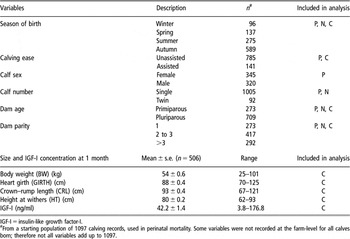
Heifer-level variables considered as risk factors associated with perinatal (P), neonatal (N) and calf (C) mortality

IGF-I = insulin-like growth factor-I.
#From a starting population of 1097 calving records, used in perinatal mortality. Some variables were not recorded at the farm-level for all calves born; therefore not all variables add up to 1097.
Results
Summary of heifer-level risk factors
Information used to assess the heifer-level risk factors is summarised in Table 1. The dataset of 1097 records was edited to include only farms for which complete information on the particular risk factor were recorded. Most calvings (85%) required no assistance, with only 15% of calvings requiring some assistance. Only 11 farms routinely recorded the sex of all calves born dead and alive; 345 were female and 320 male. Of the 1097 calves born, 8% were twins (twinning rate 4.4%). Of 982 calving records with parity details available, 273 (28%) calves were born to a primiparous dam and 709 (72%) to a pluriparous dam, of which 417 (59%) were in lactations 2 to 3 and 292 (41%) were entering lactations 4 to 11.
Data on the mean size and plasma IGF-I concentration of the calves at 1 month are also summarised in Table 1. Mean BW and plasma IGF-I concentration at approximately 1 month were 54 ± 0.6 kg and 42 ± 1.4 ng/ml, respectively.
Perinatal mortality
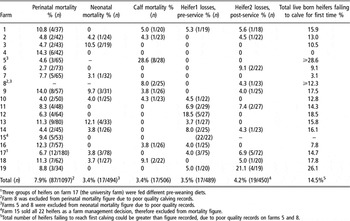
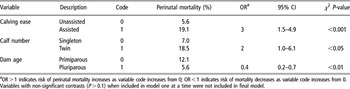
Mean perinatal mortality of male and female calves was 7.9%, and ranged from 2.7% to 14.3% across farms (Table 2). For female calves only, mean perinatal mortality was 6.4% (n = 22/345). Perinatal mortality of male and female calves was influenced by calving ease, birth number and dam parity (Table 3). Calves requiring assistance at birth were three times more likely to be born dead, or die within 24 h, than calves born unassisted (19.1% and 5.6%, respectively, P < 0.001). Of the calves born dead, or that died within 24 h, 62% (n = 44/71) were recorded as an unassisted calving. Calves born as twins were two times more likely to suffer perinatal mortality than singleton calves (twins 18.5%, singletons 7.0%, P < 0.05). Calves born to pluriparous dams were 60% less likely (OR = 0.4, P < 0.01) to suffer perinatal mortality compared to calves from primiparous dams; perinatal mortality decreased significantly as parity increased from lactation 1 (12.1%) to lactation 2 to 3 (5.8%), but it then remained similar for lactations 4+ (5.5%). A numerically greater proportion of male calves were born dead or died within 24 h, however, this difference was not significant (males 8.8%, females 6.4%, P = 0.3). Season of calving (winter 11.5%, spring 9.5%, summer 8.4% and autumn 6.8%, P = 0.4) was not associated with perinatal mortality.
Summary of number and percentage of replacement dairy heifers that failed to reach first calving

1Three groups of heifers on farm 17 (the university farm) were fed different pre-weaning diets.
2Farm 8 was excluded from perinatal mortality figure due to poor quality calving records.
3Farms 5 and 8 were excluded from neonatal mortality figure due to poor quality records.
4Farm 15 sold all 22 heifers as a farm management decision, therefore excluded from mortality figure.
5Total number of heifers failing to reach first calving could be greater than figure recorded, due to poor quality records on farms 5 and 8.
Odds ratios (OR) and 95% confidence intervals (CI) for heifer-level variables included in final model associated with perinatal mortality

#OR > 1 indicates risk of perinatal mortality increases as variable code increases from 0; OR < 1 indicates risk of mortality decreases as variable code increases from 0.
Variables with non-significant contrasts (P > 0.1) when included in model one at a time were not included in final model.
Neonatal mortality
Neonatal mortality of female calves averaged 3.4%, ranging from 0% to 12% on individual farms (Table 2). A further eight calves born alive (2% of total, not included in the neonatal mortality figure) were removed from farms at birth because they were born with a male twin and were presumed to be a freemartin. Reasons for heifer mortality during the first month of life were poorly recorded at the farm level; 67% (n = 11/17) calves died of an unknown cause. Reasons recorded for the remainder (often diagnosed by farm personnel), included death as a result of a difficult calving, navel infection, rotavirus and trauma. No significant associations were found between neonatal mortality and any of the heifer-level variables (P > 0.05, data not shown).
Calf mortality
Of the 506 calves that were alive at 1 month, 17 died (n = 14) or were euthanised (n = 3) between 1 and 6 months of age. The mean calf mortality rate was 3.4%; this was, however, skewed by one farm which had a much higher rate of 29% (8 died of 28 calves born) (Table 2). The majority of calves (n = 10, 59%) died of an unknown cause; reasons recorded included trauma, coccidiosis and pneumonia. Season of birth, dam parity and calving ease were not significant risk factors for calf mortality (P > 0.05, data not shown).
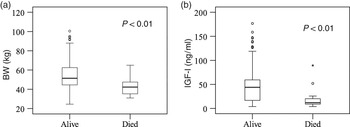
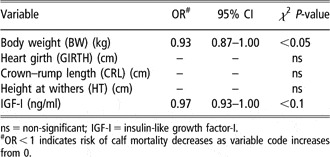
When considered individually in the model, a low BW (P < 0.05) and IGF-I concentration (P < 0.1) at 1 month tended to be associated with an increased risk of mortality between 1 and 6 months (Table 4). The mean BW and IGF-I concentration of calves at approximately 1 month that survived to 6 months of age (n = 489) was 54 ± 0.6 kg and 43 ± 1.4 ng/ml, respectively, compared to 43 ± 3 kg and 20 ± 6.2 ng/ml, respectively, for calves that died during the first 6 months of life (n = 14) (Figure 1). Including both BW and IGF-I concentration in the final model resulted in collinearity due to the positive correlation between these two variables (r = 0.49, n = 506, P < 0.001). Therefore, based on the actual weights recorded at 1 month, calves were divided into those with a low (<60 kg) or high (>60 kg) BW, and associations between IGF-I and mortality for each group were determined. For calves with a low BW, an increased IGF-I concentration reduced the risk of mortality between 1 and 6 months (OR = 0.9, P < 0.05). However, no association between IGF-I concentration and the risk of mortality was found for calves with a high BW (P > 0.1).
Box and whisker plots showing (a) BW and (b) insulin-like growth factor-I (IGF-I) concentration at 1 month for calves alive at 6 months (n = 489), and calves that died between 1 and 6 months of age (n = 14). Each plot summarises the median, the 25th and 75th percentiles, the minimum and maximum observed values, and the outliers (○) and extreme values (*). P-values: one-way ANOVA.

Odds ratios (OR) and 95% confidence intervals (CI) for heifer-level variables at one month of age, included in model one at a time, associated with calf mortality

ns = non-significant; IGF-I = insulin-like growth factor-I.
#OR < 1 indicates risk of calf mortality decreases as variable code increases from 0.
Associations between the heifer-level risk factors and calf mortality were determined for the farm with the exceptionally high calf mortality rate of 29% (Table 2). IGF-I was significantly associated with mortality between 1 and 6 months; for every 1 ng/ml increase in IGF-I concentration at 1 month, there was a reduced mortality risk (OR = 0.8, P < 0.01). Size parameters at 1 month were not significant risk factors for calf mortality on this farm (P > 0.1, data not shown).
Heifer losses
Of the 489 heifers reaching 6 months of age, 17 (3.5%) died (n = 13) or were culled (n = 3), and one heifer went missing, between 6 months and the start of the breeding period, ranging from 0% to 18.5% on individual farms (Table 2). Of the 450 heifers that were served (one cohort of 22 heifers was sold prior to breeding as a farm management decision, and was excluded from the mortality figure), 19 heifers (4.2%) subsequently died (n = 1) or were culled (n = 18), resulting in a loss rate ranging between 0% and 21.1% across farms. The main reasons for death of heifers before breeding were various accidents (n = 7), including ad libitum barley intake, lead poisoning and head entrapment. After the commencement of breeding, the primary reason for culling was infertility (n = 16/18). Ten of these animals received a mean of 3 ± 0.7 services (range 1 to 9) over a period of up to 427 days. Six animals were run with a bull for about 4 months but failed to conceive, whilst two were mated to a bull following failure to conceive to AI, and again failed to conceive. A further three heifers were culled at this stage (one before breeding and two after) after being diagnosed as freemartins, and one heifer died of pneumonia.
Survival
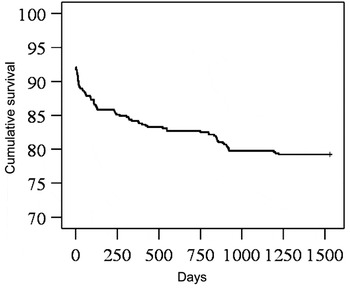
A survival plot for all heifers, to show the timing of the losses from birth to first calving, is given in Figure 2. A total of 431 heifers from the starting population of 506 at 1 month calved for the first time. The mean age at first calving for these heifers was 26.5 ± 0.2 months (n = 409) (median 25.4 months) ranging from 22.9 ± 0.2 to 36.5 ± 0.1 months across farms. Poor fertility of some heifers resulted in animals being kept in the herd for up to 46 months of age before they were culled.
Kaplan-Meier curve showing the cumulative proportion of animals surviving from birth through first calving; 92% were born alive (7.9% mortality at birth of male and female calves), and 78% calved for the first time (14.5% mortality from birth through first calving of heifers only).

Discussion
Perinatal and neonatal mortality (birth to 1 month)
In this study, 7.9% of calves born suffered perinatal mortality, a rate almost identical to that of 8% previously estimated for commercial dairy herds in the UK (Esslemont and Kossaibati, Reference Esslemont and Kossaibati1996). Several US studies have reported similar figures of 6.3% to 8.2% (Speicher and Hepp, Reference Speicher and Hepp1973; Johanson and Berger, Reference Johanson and Berger2003; Lombard et al., Reference Lombard, Garry, Tomlinson and Garber2007). Under good management conditions, it should be possible to maintain perinatal mortality at 1% to 3% (Heinrichs and Radostits, Reference Heinrichs and Radostits2001), whilst Roy (Reference Roy1990) considered that values of 3.5% to 5% were acceptable. In this study, all farms except one had a perinatal mortality rate of >5%.
The main risk factors for perinatal mortality identified in this study were calving assistance, twinning and maternal age. There is a higher risk of foeto-pelvic disproportion in calves born to primiparous dams (Meyer et al., Reference Meyer, Berger, Koehler, Thompson and Sattler2001); increased perinatal mortality for calves born to heifers has been reported earlier (Johanson and Berger, Reference Johanson and Berger2003; Lombard et al., Reference Lombard, Garry, Tomlinson and Garber2007). The finding that 62% of stillborn calves were born unassisted suggests that management policy regarding the timing of intervention or observation of the calving pen may be inadequate on farms. Improved observation of the calving pen could help to ensure that animals requiring assistance, particularly primiparous dams, get adequate help with the aim of reducing losses around birth. Calves born as twins may experience a prolonged or more difficult calving, or twin calves may be born weaker due to placental insufficiency. The twinning rate in Holstein-Friesians has increased from 3.4% in 1996 to 4.8% in 2004 (Silva del Rio et al., Reference Silva del Rio, Stewart, Rapnicki, Chang and Fricke2007), partly associated with increased milk production. Although a twin calving results in an extra calf, the financial loss associated with twins estimated at £110 (Kossaibati and Esslemont, Reference Kossaibati and Esslemont1997), together with the increased risk of perinatal mortality reported here, demonstrates that twinning is unfavourable. In addition, it increases the number of heifer calves that must be culled as freemartins.
Under good management conditions, neonatal mortality can be maintained at 3% (Heinrichs and Radostits, Reference Heinrichs and Radostits2001), which is close to the figure we recorded with half of the farms experiencing no neonatal mortality. Few commercial farmers determine the cause of death within the first month, making it difficult to identify risk factors for neonatal mortality.
Calf mortality (1 to 6 months)
On average, 6.8% of heifer calves born alive died or were culled during the first 6 months, similar to the figure of 6% from another recent UK study (Ortiz-Pelaez et al., Reference Ortiz-Pelaez, Pritchard, Pfeiffer, Jones, Honeyman and Mawdsley2008). Calves that died between 1 and 6 months of age had a lower BW at 1 month, supporting earlier suggestions that heavier calves tend to survive better (Waltner-Toews et al., Reference Waltner-Toews, Martin and Meek1986). Similarly, Swali and Wathes (Reference Swali and Wathes2007) reported that calves dying before 9 months of age weighed less at birth (mean 31 kg) compared to those that survived (mean 36 kg). Low birth-weight animals show retarded behavioural development, taking longer to stand and suck from the dam (Lawrence et al., Reference Lawrence, Dwyer, Jarvis and Roberts2005), which may in turn reduce colostrum intake. It was not possible to measure calves at birth in this study due to the scattered nature of the farms. BW at 1 month, as measured here, was therefore a combination of birth weight coupled with growth rate in the first few weeks of life. Small calves born to primiparous dams may show some catch up growth over this period (Swali and Wathes, Reference Swali and Wathes2007). On the other hand, poor nutritional management or ill health would be expected to reduce growth rates.
Plasma IGF-I concentration is an excellent indicator of nutritional status; energy intake is important in the regulation of IGF-I (Thissen et al., Reference Thissen, Ketelslegers and Underwood1994). For example, lambs fed ad libitum had greater plasma concentrations of IGF-I compared to those fed restricted diets (Greenwood et al., Reference Greenwood, Hunt, Slepetis, Finnerty, Alston, Beermann and Bell2002), and feeding bull calves a 30% CP, 20% fat milk replacer at increasing levels to achieve target rates of gain of 0.50, 0.95 or 1.40 kg/day elevated IGF-I concentrations (Smith et al., Reference Smith, Van Amburgh, Diaz, Lucy and Bauman2002). Similarly, feeding heifer calves high protein and energy diets (milk replacer 30% CP, 4.4 kcal ME/g; calf starter 21% CP, 3.7 kcal ME/g) from 2 to 14 weeks of age increased IGF-I concentrations compared to calves fed either moderate protein and energy, or low protein and energy diets (Brown et al., Reference Brown, Vandehaar, Daniels, Liesman, Chapin, Keisler and Nielsen2005). IGF-I concentration is considered a particularly useful index of metabolic status for on-farm measurement because concentrations do not change in relation to time of feeding, and remain stable through the day (Taylor et al., Reference Taylor, Beever, Bryant and Wathes2004; Vicari et al., Reference Vicari, van den Borne, Gerrits, Zbinden and Blum2008). In this study, we have shown that small calves with a low IGF-I concentration at 1 month were at an increased risk of mortality before 6 months, whereas IGF-I concentration was less important for heavier calves. During this period, the principal causes of death in both our study and previous ones (Svensson et al., Reference Svensson, Linder and Olsson2006) were infectious diseases. Mounting an immune response presents a considerable bioenergetic challenge (Fox et al., Reference Fox, Hammerman and Thompson2005). Animals with an adequate energy intake resulting in higher circulating IGF-I may thus mount a better immune response. Conversely, small calves with a low IGF-I concentration, indicative of low energy intake, were perhaps more susceptible to infections and thus at an increased risk of dying. The effect of increased protein and energy on the antigen-specific, cell-mediated immune response of the neonatal calf has previously been examined (Foote et al., Reference Foote, Nonnecke, Waters, Palmer, Beitz, Fowler, Miller, Johnson and Perry2005). Increased dietary protein and energy had subtle effects on the composition and functional capacities of peripheral blood mononuclear cell populations; further research is needed to determine if these minimal effects influence the calf’s susceptibility to infectious disease, as speculated in our study.
Mortality of recruited heifers (6 months to first calving)
Some heifers died or were euthanised or culled during the rearing period on all but one farm, with a mean mortality rate of 14.5%. This incidence was the same as reported earlier across English herds by Esslemont and Kossaibati (Reference Esslemont and Kossaibati1997) but was higher than the rate of 6.2% reported in Swedish heifers (Svensson et al., Reference Svensson, Linder and Olsson2006). Svensson et al. (Reference Svensson, Linder and Olsson2006) reported that in heifers aged 211 to 450 days, the most common cause of death was miscellaneous accidents, similar to the findings in the present study. Together, these studies highlight the importance of identifying problems on individual farms with the aim of minimising deaths from accidents for heifers in this age group.
After the commencement of breeding, the main reason for culling heifers was infertility, with heifers on two farms served several times before being identified by the veterinarian as a freemartin. Previous studies have reported the mean number of services per conception for Holstein-Friesian heifers at spontaneous oestrus as 1.5 (Abeni et al., Reference Abeni, Calamari, Stefanini and Pirlo2000; Taylor et al., Reference Taylor, Beever, Bryant and Wathes2003), and at synchronised oestrus as 2.1 (Carson et al., Reference Carson, Dawson, McCoy, Kilpatrick and Gordon2002). In the present study, the mean number of three services given to heifers that failed to conceive before the decision was made to cull them was similar to previous findings for infertile heifers (Taylor et al., Reference Taylor, Beever, Bryant and Wathes2003; Wathes et al., Reference Wathes, Bourne, Cheng, Mann, Taylor and Coffey2007). Serving a heifer several times that subsequently never starts a lactation is a considerable economic cost.
Conclusions
On average, 8% of Holstein-Friesian calves on a selection of dairy farms in England were born dead, and approximately 15% of heifer calves born alive failed to reach first calving. Heifers are a critical component of a dairy herd but the numbers available are limited by herd reproductive performance and perinatal and postnatal losses that, overall, often severely restrict selection strategies. Small size at 1 month of age was associated with higher rates of mortality up to 6 months, whereas later losses were primarily attributable to accidents (6 to 15 months) and poor fertility (15 months onwards). These results must however be interpreted with caution due to the limited number of farms involved in this study. Although a selection of farms across southern England were sampled to include a variety of management practices, a larger sample size from a wider geographical area may help to verify and/or identify additional risk factors for mortality.
Acknowledgements
We thank both the farm staff and the veterinarians who contributed to this study. Ms A Petrie provided advice for the data analysis. We would also like to thank Dr E Bleach for her contribution on the university farm. The study was funded by DairyCo (Cirencester, Gloucestershire, UK) and Defra (London, UK).