I. INTRODUCTION
Magnesium matrix composites (MMCs) have a great potential for aerospace, automotive, and industrial applications due to their superior mechanical properties, such as high specific strength, specific stiffness, creep resistance, and wear resistance.Reference Esmaily, Mortazavi, Svensson, Halvarsson, Wessén, Johansson and Jarfors1–Reference Chen, Chen, Han, Xia and Wu3 Therefore, the MMCs, especially particle-reinforced ones, have been subjected to great attention in last two decades.Reference Mallick, Tun and Gupta4–Reference Wang, Xu and Wu7 Normally, microsized SiC particles are used to reinforce MMCs to improve their yield strength, ultimate tensile strength, wear resistance, and modulus by sacrificing the ductility of the MMCs.Reference Jarry, Laurent and Regazzoni8,Reference Huang, Jeng, Semenov and Dai9 Moreover, many studies have shown that n-SiCp can improve the yield strength and ultimate tensile strength of materials, and without sacrificing ductility.Reference Wang, Li, Wang, Zhu, Wu and Jiang10,Reference Luo, Pei, Rong, Wang, Li and Jiang11 Previous reportsReference Shen, Wang, Zhang, Hu, Zheng and Wu12,Reference Nie, Wang, Hu, Xu, Wu and Zheng13 indicated that the addition of n-SiCp could effectively refine grain size by pinning effect. Therefore, the strength and facture elongation of MMCs are enhanced simultaneously. Thus, as a reinforcement material, ceramic nanoparticles have more advantages than microscale ceramic particles. In addition, mechanical properties of Mg composites are also influenced by the volume fraction of ceramic particles. Yao et al.Reference Yao, Zhang and Zheng14 found that the yield strength and ultimate tensile strength of AA6063-SiCnp nanocomposites increased from 296 and 343 MPa to 545 and 603 MPa, respectively, and the elongation to fracture decreased from 10.0 to 2.3% when the n-SiCp content increased from 1 to 10 vol%. Kang et al.Reference Kang and Chan15 found that the hardness and tensile behaviors of aluminum matrix composites reinforced with nanometric Al2O3 particulates increased with the increase of volume fraction of the reinforcement. However, the strengthening effect was weakened owing to the clustering of Al2O3 when nanoparticle content exceeded 4%. It is well known that n-SiCp is agglomerated easily due to its large specific surface area.Reference Luo, Pei, Rong, Wang, Li and Jiang11 Consequently, uniform distribution of n-SiCp in the matrix alloy is a key to increase the properties of the composite.
Currently, conventional fabrication methods for MMCs include mechanically stirring casting,Reference Shen, Wang, Ying, Wu and Song16,Reference Zhou, Deng, Li, Shang, Liang and Fan17 powder metallurgy,Reference Xiong, Nie, Ji, Li, Li, Li, Zhu, Luo and Wan18–Reference Hou, Wu, Wang, Zhang, Zhang, Dong and Sun20 and squeeze casting.Reference Wang and Hu21,Reference Wu, Zheng and Yao22 Among those, stirring casting methods have limitations for the volume fraction of the added particles. The optimum is only 1 vol% to obtain the composites with good mechanical property.Reference Nie, Wang, Hu, Xu, Wu and Zheng13 Furthermore, although powder metallurgy together with ball milling can realize the preparation of the composite with high volume fraction of ceramic particles, however, the agglomeration of nanoparticles is still not well resolved. Very recently, Deng, Nie, and ChenReference Nie, Wang, Hu, Xu, Wu and Zheng13,Reference Deng, Wang, Wang, Shi, Hu and Wu23–Reference Chen, Chen, Han, Hu, Han, Zhao, Xia and Wan25 found that dispersed distribution of submicron and n-SiCp could be easily achieved in the matrix under the semisolid state. It is expected that the semisolid state is favorable for the preparation of excellent MMCs.
In the present study, Mg–9Al–xSiC (x = 2.5, 5, 7.5, 10 wt%) composites were successfully fabricated by a novel method, combined with mechanical blend and ultrasound, the so-called ultrasonic-assisted hot pressing of powder. This method has the advantages of easy molding and low energy consumption. Besides, there is also the potential to distribute and disperse the high content of n-SiCp uniformly in the magnesium matrix. The purpose of this work is to establish the dependence of microstructure characteristics and mechanical properties based on n-SiCp contents in the Mg–9Al matrix. Additionally, the strengthening mechanism was also discussed.
II. MATERIALS AND METHODS
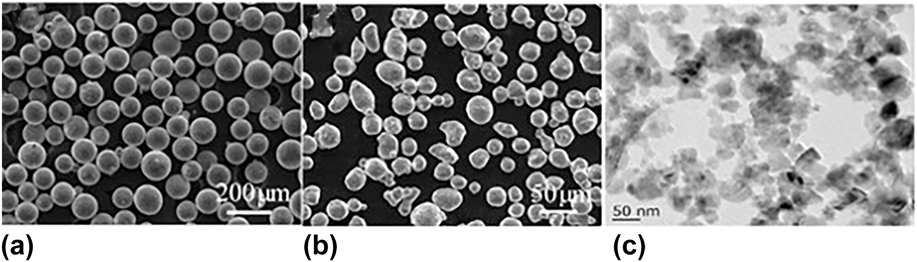
In this experiment, spherical magnesium (Mg) powders (99.9% purity) with an average particle size of ∼100 μm and aluminum powders (99.9% purity) with a particle size of ∼25 μm were used as matrix materials. SiC nanoparticles (99% purity, Hefei Kaier nanometer energy, Polytron Technologies Inc., Putian, China) with an average particle size of ∼60 nm were used as reinforcements. The weight fraction of n-SiCp was in the range of 2.5–7.5 wt%. The micrograph of the magnesium particles, aluminum particles, and n-SiCp are shown in Fig. 1.
Micrographs of the (a) magnesium particles, (b) aluminum particles, and (c) SiC nanoparticles.

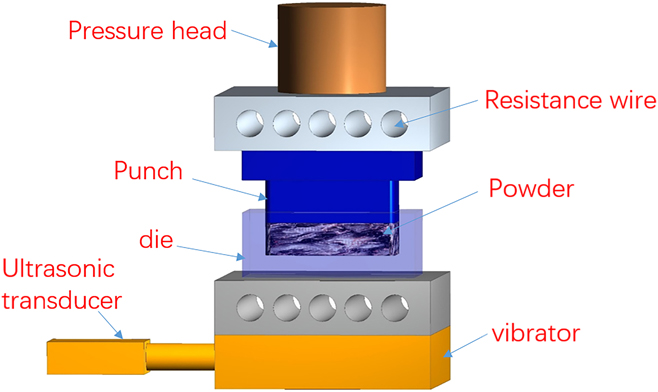
The schematic diagram of the experimental setup of hot pressing for this study is shown in Fig. 2. In a previous work,Reference Li, Wang and Nie26 suitable hot pressing temperatures for Mg–9Al alloys were set at 783 K. First, Mg, Al powder, and n-SiCp were mechanically blended and the blends were cold-pressed with a pressure of 10 MPa in the self-made cuboid compacts. After that, the cuboid compacts were heated to 783 K and kept for 20 min. To strengthen the fluidity of semisolid slurry, a pressure of 15 MPa is applied continuously for 30 min. The slurry was ultrasonicated from the bottom-up at the same time during the pressing process. The transducer with a maximum power of 1 kW and a frequency of about 20 kHz is used in the ultrasonic vibration device. Subsequently, the specimen was cooled in the furnace. For comparison, the Mg–9Al alloys were also fabricated following the above method adopted by the fabrication of Mg–9Al–xSiC (x = 2.5, 5, 7.5, 10 wt%) composites.
Schematic diagram of experimental setup.

Phase constituents of the obtained composites were analyzed by X-ray diffraction (XRD) with Cu-Ka radiation at a scan rate of 0.05°/s in a range of 20–80°. Optical microscopy (OM; Leica Microsystems, Heidelberg, Germany) and scanning electron microscopy (SEM; TESCAN, Brno, Czech Republic) equipped with energy dispersive X-ray spectroscopy (EDS) were used to study the microstructure evolution of the matrix and reinforcement distribution in the Mg–9Al–xSiC (x = 2.5, 5, 7.5, 10 wt%) composites. The samples for microstructure analysis were carried out in the central part of the specimens parallel to the pressing direction and prepared by the conventional mechanical polishing. The interface bonding situation between the n-SiCp and matrix alloy was studied using a transmission electron microscope (TEM; JEOL Ltd., Tokyo, Japan).
Tensile tests were performed on a universal tensile machine at room temperature with the speed of 0.5 mm/min. Four samples for repetitive tensile tests were cut from each specimen and the tensile strength reported in the present work was averaged from the values of four tensile tests.
III. RESULTS AND DISCUSSION
A. Densification behavior
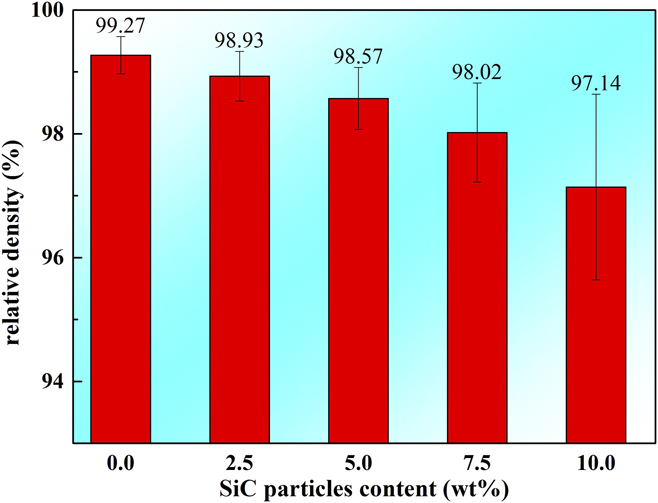
Figure 3 shows the relative density of the Mg–9Al alloy and Mg–9Al–xSiC composites, which is measured by the Archimedes drainage method. It can be found that the relative density of the Mg–9Al alloy is up to 99.27%, which may be attributed to the liquid phase formation, flow, and filling the clearance between the solid grains during the semisolid powder hot-pressing process.Reference Zhou, Deng, Li, Shang, Liang and Fan17 In this study, hot-pressing was performed at 783 K (higher than the liquidus temperature of Mg–9Al, 763 K) so that a large number of liquid phases were present in the material system. Under the role of capillary forces, ultrasonic vibration, and loads, the liquid phase flow accelerated and filled the pores, making the material denser.Reference Chen, Guo and Luo27 In addition, the relative density of Mg–9Al–xSiC composites decreased from 98.93 to 97.14% as the increase of n-SiCp contents. This result can be explained as follows: (i) there was a large amount of gas adsorbed at the surface of powder, so the pore could nucleate around n-SiCp and the contact surface area increased with the increase of n-SiCp contentsReference Chen, Wang and Li28; (ii) the fluidity of the matrix alloy was decreased with the increasing content of n-SiCp, resulting in that the matrix alloy flowed into the n-SiCp clusters difficultly. Therefore, the relative density of the composites is reduced slightly. However, relative densities of all the materials are over 97%, which indicates that the semisolid hot pressing is an effective method to produce near-dense Mg–9Al–xSiC composites.
Relative density of the Mg–9Al alloy and Mg–9Al–xSiC (x = 2.5, 5, 7.5, 10 wt%) composites.

B. XRD analysis
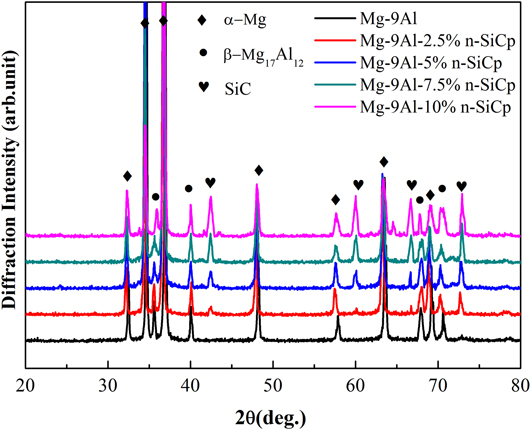
Figure 4 depicts the XRD patterns of the Mg–9Al and Mg–9Al–xSiC alloys. It can be clearly seen that the Mg–9Al–xSiC composites mainly consist of α-Mg, Mg17Al12, and SiC phases, and the diffraction peak intensity of n-SiCp increases with the increase of n-SiCp contents. While the Mg–9Al alloy only consisted of both α-Mg and Mg17Al12 phases. No other phases were detected in all the Mg–9Al–xSiC composites, indicating that the n-SiCp did not react with α-Mg or Al.
XRD patterns of the Mg–9Al alloy and Mg–9Al–xSiC (x = 2.5, 5, 7.5, 10 wt%) composites.

C. Microstructures
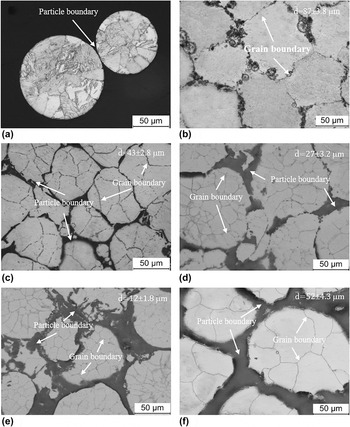
The OM micrographs of Mg–9Al–xSiC composites are presented in Fig. 5. As shown in Fig. 5(a), the initial particle boundaries were observed between Mg particles. In Fig. 5(b), the Mg–9Al alloy was well bonded without micropores. Moreover, the initial boundary of Mg particles almost disappears, and the similar results were reported in previous studies.Reference Mondet, Barraud and Lemonnier29 It is clearly seen that the grain size of Mg–9Al–xSiC composites is greatly dependent on the n-SiCp contents. The grain size of the composites decreases dramatically with the increase of n-SiCp contents. As the n-SiCp contents increase from 0 to 7.5 wt%, the average grain size of the composites is decreased obviously from 87 to 12 mm, indicating an ability of the n-SiCp to serve either as nucleation sites or obstacles to grain growth during the cooling of the sample in the furnace. Besides, the fine Mg17Al12 precipitation at the grain boundaries can also effectively pin grain boundaries, resulting in grain refinement.Reference Luo, Wang and Zhang30 Therefore, the grains of the nanocomposites are refined dramatically with the increase of n-SiCp contents.
OM micrographs of Mg–9Al–xSiC composites: (a) initial magnesium particle; (b) Mg–9Al alloy; (c) 2.5 wt%-SiCp; (d) 5 wt%-SiCp; (e) 7.5 wt%-SiCp; (f) 10 wt%-SiCp.

Note that grain size coarsening of the matrix can be observed due to the hindered diffusion of Al elements into the Mg matrix as the n-SiCp contents increase to 10 wt%, which results in the failure of the matrix to achieve an ideal semisolid state with the same condition. Consequently, the aggregation of n-SiCp is prone to occur due to the high viscosity and the grains grow obviously, as shown in Fig. 5(d).
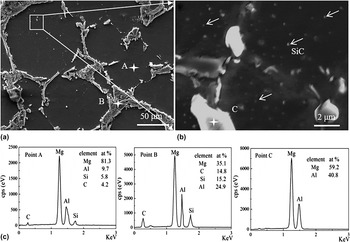
Figure 6 shows the SEM images and EDS analysis of the n-SiCp/Mg–9Al composite. Most of the second phase can be observed along the Mg particle boundaries and a few within the Mg matrix, as indicated in Fig. 6(a). Figure 6(b) is a local magnification of Fig. 6(a). And EDS results of the positions A, B, and C in Fig. 6 are shown in Fig. 6(c). It can be concluded that the secondary phase is identified as Mg17Al12 combining the above XRD analysis. The at.% of Si and C corresponds to the composition of the n-SiCp; The EDS results from A and B points reveal that n-SiCp was mainly distributed at the Mg particles’ boundary and mixed with the Mg17Al12 phase. The reason is that Mg particles are surrounded by the liquid phase, thereby pushed together via liquid flowing under the role of pressure. The flow of liquid incorporating particles results in coexistence of n-SiCp and Mg17Al12 along particle boundaries.Reference Jiang and Wang31 In addition, C point [see Fig. 6(b)] is a fine β-Mg17Al12 phase, which is mainly distributed at the grain boundary. This can be ascribed to the diffusion of Al solute within Mg particles. Details about the diffusion of Al elements will be described later.
(a) SEM micrograph of the n-SiCp/Mg–9Al composite; (b) high magnification of (a); (c) EDS results of A and B points in (a) and C point in (b).

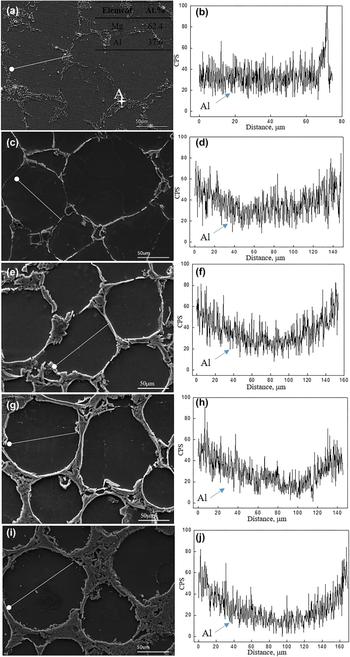
Figure 7 shows the SEM micrographs and EDS line scan result of Mg–9Al–xSiC composites. The second phase was labeled with symbol “A” in Fig. 7(a). Combined with the above XRD analysis and EDS point scanning results [see the inset table of Fig. 7(a)], it can be determined that point A is β-Mg17Al12, which was mainly distributed in the grain boundary. It can be clearly observed that a great number of n-SiCp segregated to the phase β-Mg17Al12 distributed along the Mg particle boundaries, which indicate that the n-SiCp were largely distributed in the front of the liquid–solid interface during solidification. It could be attributed to the “push” effect of the solidification front on nanoparticles. On the one hand, the temperature gradient ahead of the solidification front is influenced by the n-SiCp with lower thermal conductivity. On the other hand, the solid particle acts as a barrier to prevent solute diffusion, thereby changing the concentration gradient and restricting growth. Thus, the uniform distribution of n-SiCp along Mg particle boundaries is observed in the nanocomposites.
SEM micrographs and EDS line scan result of Mg–9Al–xSiC composites: (a) Mg–9Al; (b) EDS line scan along line in (a); (c) 2.5 wt%-SiC; (d) EDS line scan along line in (c); (e) 5 wt%-SiC; (f) EDS line scan along line in (e); (g) 7.5 wt%-SiC; (h) EDS line scan along line in (g); (i) 10 wt%-SiC; (j) EDS line scan along line in (i).

It is obvious that Al content in the inner side of Mg particles is less than that in the boundaries of Mg particles with the addition of n-SiCp, as shown in Fig. 7. It can be explained that the ceramic phase n-SiCp, with strong thermal stability, formed a natural diffusion barrier between the Mg particles, hindering the diffusion of Al elements in the nanocomposites. Sun et al.Reference Guan, Sun and Sun32 proposed a metal-oxide diffusion barrier method. In this paper, n-SiCp has no hindrance to the short-circuit diffusion of the Al element under high temperature conditions; however, the diffusion cross section of the Al element is reduced, leading to its diffusion path being extended. Combining with Fick’s first law, assume that D 1 and D 2 did not change with the concentration of the Al solute in the ideal condition. The modified formula was introduced to illustrate the diffusion of Al elements in the nanocomposite.
 $${{\partial C} \over {\partial t}} = \left( {{f \over \tau }{D_1} + {{{S_1}} \over S}{D_2}} \right){{{\partial ^2}C} \over {\partial {x^2}}}\quad ,$$
where D 1 is the bulk diffusion coefficient; D 2 is the short-circuit diffusion coefficient; S 1 and S are the bulk diffusion cross section, the short-circuit diffusion cross section and the total diffusion cross section respectively; f is the volume fraction of the magnesium particles; τ is the factor of the path growth of the Al element diffusion caused by n-SiCp, and its value increases with the increase of the content of n-SiCp.
The short-circuit diffusion coefficient is very small due to the dominant role of bulk diffusion at the high temperature. It can be seen from formula (1) that the volume fraction f of the magnesium particles decreases and the factor τ of the path increase of the Al elements diffusion caused by n-SiCp content increases. The hindrance to the diffusion of Al increased with the increase of the n-SiCp content, which is consistent with the results shown in Fig. 5.
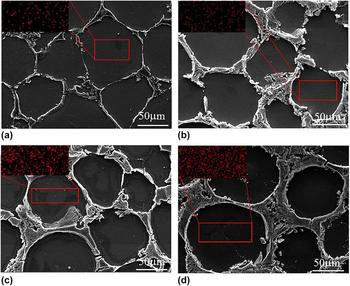
Figure 8 shows SEM micrographs and corresponding regional distribution of Si elements (see the inset) in Mg–9Al–xSiC composites. It can be seen that the n-SiCp content within the Mg matrix increases as the n-SiCp content increasing and finally tends to be distributed uniformly. The reason is that the absence of chemical reactions between the n-SiCp and the matrix in the composites, and therefore the semisolid alloy slurry with good flowability can enter the n-SiCp aggregated regions successfully. In addition, the uniform distribution of n-SiCp in semisolid slurry could be obtained under the dual role of ultrasound and pressure. It is clearly seen that n-SiCp were homogeneously embedded in the matrix from the inset of Fig. 8. It is beneficial to improve the strength of the material.
SEM micrographs and corresponding regional distribution of Si elements in Mg–9Al–xSiC composites: (a) 2.5 wt% n-SiCp; (b) 5 wt% n-SiCp; (c) 7.5 wt% n-SiCp; (d) 10 wt% n-SiCp (The inset is the EDS map result of the composites).

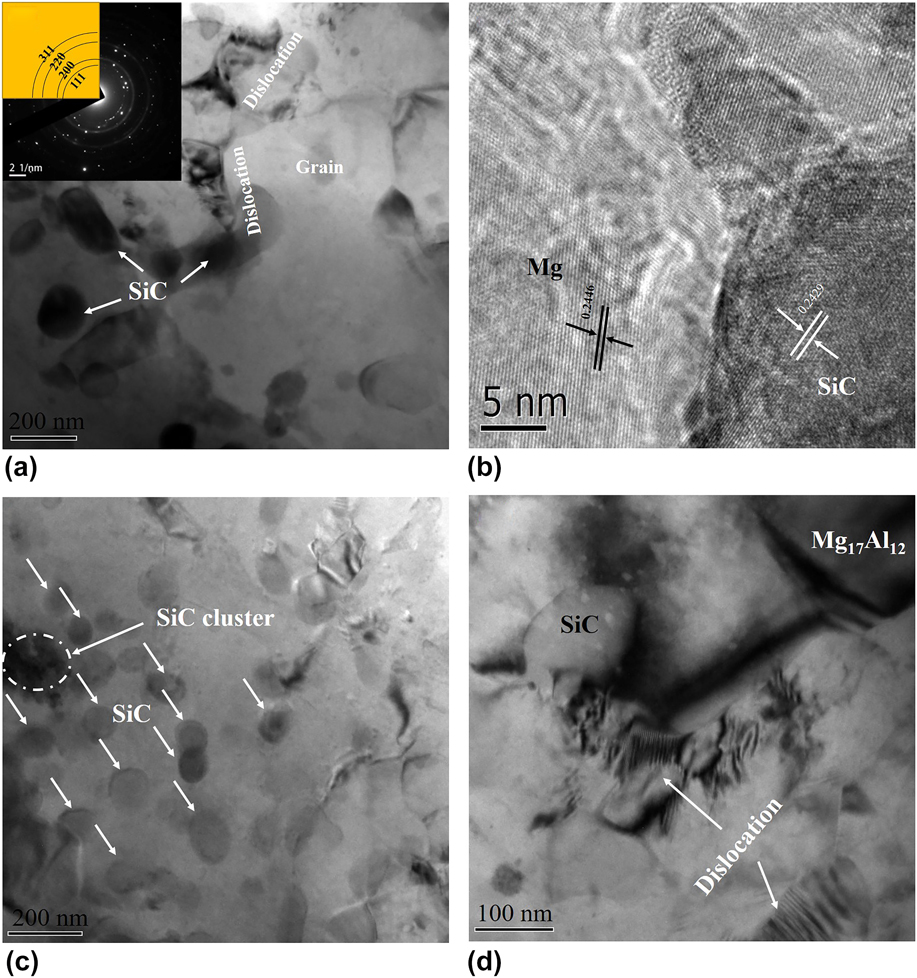
TEM images of the Mg–9Al–7.5 wt% n-SiCp composite and the high resolution TEM image of the interface between the n-SiCp and the matrix are shown in Fig. 9. As indicated in Fig. 9(a), it could be found that nanosized particles were distributed along grain boundaries and within the grains, which were confirmed as n-SiCp with the face-centered cubic structure by the selected area electron diffraction pattern inserted in Fig. 9(a). Figure 9(b) shows a high resolution TEM image of the interface between the n-SiCp and the matrix in the nanocomposites. It can be seen that the interface between the SiC and Mg matrix is clean, with no obvious interfacial product being found. This is consistent with previous reports.Reference Wang, Li, Wang, Zhu, Wu and Jiang10,Reference Nie, Wang, Hu, Xu, Wu and Zheng13 It is illustrated that good interfacial bonding between the matrix and the n-SiCp is achieved in the Mg–9Al–xSiC composites. The cluster of n-SiCp can be observed when the weight fraction of n-SiCp is 7.5 wt%; however, most of them are still distributed homogeneously on the surface of the Mg particle, as shown in Fig. 9(c). A higher magnification TEM image is shown in Fig. 9(d) where a large number of dislocations are stacked at the grain boundary. It can be explained that the n-SiCp pinning at the grain boundary, hindering the movement of dislocations. It will be piled up at the grain boundary around the n-SiCp when the dislocation moved from the crystal to the grain boundary. In addition, n-SiCp can hinder the dislocation glide according to the Orowan mechanism, thereby increasing the strength of the composite.Reference Kang and Chan15
TEM micrographs of the Mg–9Al–7.5 wt% SiCP composite: (a) electron diffraction pattern of n-SiCp; (b) HRTEM image of the interface between the n-SiCp and Mg matrix; (c) distribution of n-SiCp particles; (d) TEM microstructure near n-SiCp in the Mg–9Al–7.5 wt% SiCp composite.

D. Mechanical properties
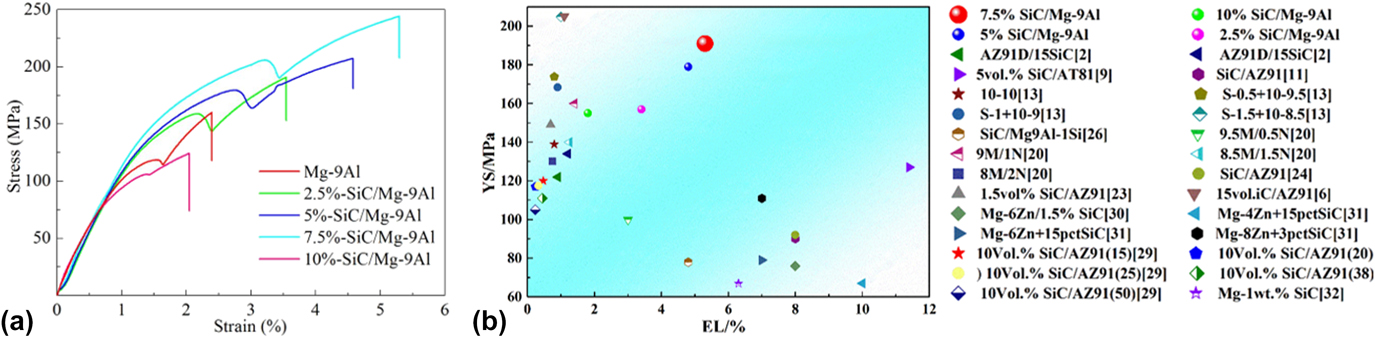
The yield strength (σYS, 0.2% proof stress), ultimate tensile strength (σUTS, the ultimate tensile strength), and fracture elongation of the Mg composites are shown in Fig. 10(a), which are increased first and then decreased with the increasing n-SiCp contents. As n-SiCp contents increase to 7.5 wt%, best tensile properties are obtained with the values of 191 MPa, 248 MPa, and 5.3%, respectively.
(a) Tensile strength of the Mg–9Al alloy and Mg–9Al–xSiC (x = 2.5, 5, 7.5, 10 wt%) composites; (b) Comparison of mechanical properties among present Mg–9Al–xSiC composites and other MMCs.

Figure 10(b) shows a summary of tensile strength of the composites prepared and Mg-based composites reported in this paper. As presented, the YS of present Mg–9Al–xSiC composites fabricated by ultrasonic-assisted hot pressing of powder is superior than that in most of the Mg-based composites previously reported.Reference Poddar, Srivastava, De and Sahoo2,Reference Luo, Pei, Rong, Wang, Li and Jiang11–Reference Nie, Wang, Hu, Xu, Wu and Zheng13,Reference Zhou, Deng, Li, Shang, Liang and Fan17,Reference Deng, Wang, Wang, Shi, Hu and Wu23,Reference Shen, Ying, Chen and Hou33–Reference Erman, Groza, Li, Choi and Cao37 In addition, it can be seen that the Mg–9Al–7.5 wt% n-SiCp composites exhibit almost same strength, but larger ductility compared to the high strength AZ91 matrix with high volume fraction SiCp (15%),Reference Huang, Jeng, Semenov and Dai9 and bimodal size (submicron: micron = 1.5:8.5) n-SiCp reinforced AZ91 MMCs.Reference Shen, Wang, Ying, Wu and Song16 Therefore, ultrasonic-assisted hot pressing of powderReference Lee, Suh, Kim, Lee and Lee38 would be an effective process for fabricating Mg-based and Mg alloy-based composites with n-SiCp reinforcement. The enhanced mechanical properties of Mg–9Al–xSiC composites are accompanying with basic strengthening mechanisms including grain boundary strengthening, Orowan strengthening, and load transfer strengthening.
According to the Hall–Petch equation,Reference Chen, Xu, Choi, Pozuelo, Ma, Bhowmick, Yang, Mathaudhu and Li39 σy of a given alloy is proportional to d −1/2.
 $${\sigma _{\rm{y}}} = {\sigma _0} + k{d^{ - {1 \over 2}}}\quad ,$$
where d is the mean grain size and σ0 is the material constants; k is the Hall–Petch coefficient taking the value of 130 MPa μm1/2. In this work, the increase of the YS caused by grain refinement in Mg–9Al–xSiC composites can be estimated as follows:
 $$\Delta {\sigma _{{\rm{Hall}} - {\rm{Petch}}}} = K\left( {{d_{{\rm{nc}}}}^{ - {1 \over 2}} - {d_{\rm{m}}}^{ - {1 \over 2}}} \right)\quad ,$$
where d nc and d m are the average grain size of the composites and the Mg–9Al alloy, respectively. The grain size of the composite reaches the minimum, that is, 12 mm [see Fig. 5(e)] when the n-SiCp contents is 7.5 wt%, which can contribute to the maximum increase of the yield strength. The increased YS was 24 MPa by calculation for Mg–9Al–7.5 wt% n-SiCp composites.
Additionally, the contribution of the Orowan strengthening (ΔσOrowan) mechanism included by well-dispersed nanoparticles, as shown in Fig. 9, can be calculated by the following equationReference Zhang and Chen40:
 $$\Delta {\sigma _{{\rm{Orowan}}}} = {{\varphi {G_{\rm{m}}}b} \over {{d_{\rm{p}}}}}\left( {{{6{V_{\rm{p}}}} \over \pi }} \right)\quad ,$$
where G m, b, V p, and d p are the shear modulus of the matrix, the Burgers vector, the volume fraction, and the size of the nanoparticles uniformly dispersed in the composites, respectively. φ is a constant equal to 2. In this work, G m = 1.66 × 10⁴ MPa, b = 3.21 × 10⁻¹⁰ m, V p = 0.05 for Mg–9Al–7.5 wt% n-SiCp composites, and d p = 60 nm. The calculated ΔσOrowan is 81.19 MPa. Dislocation migration is hindered by uniformly dispersed nanoparticles, resulting in the formation of dislocation pile-up around the n-SiCp during the tensile process at room temperature, which also enhances the strength of the composites.Reference Hou, Cheng, Wu, Cui, Ji, Long, Zhang, Li, Dong and Sun41 It is indicated that the Orowan strengthening mechanism exists in the composite owing to the interaction dislocations and n-SiCp.Reference Chen, Chen, Han, Hu, Han, Zhao, Xia and Wan25
Moreover, the n-SiCp bond well with the matrix in the Mg–9Al–xSiC composite, as shown in Fig. 9(b). The n-SiCp may withstand much higher extend load comparing with the Mg matrix so that the efficient load can be transferred from the soft Mg matrix to the hard n-SiCp during the tensile process, which can result in the increment of σYS. The load transfer effect can be calculated by the following equationReference Chen, Xu, Choi, Pozuelo, Ma, Bhowmick, Yang, Mathaudhu and Li39,Reference Wu, Wu, Hou, Zhang, Sun and Zhang42 :
 $$\Delta {\sigma _{{\rm{load}}}} = 1.5{V_{\rm{P}}}{\sigma _{\rm{i}}}\quad ,$$
where V P is the volume fraction of n-SiCp uniformly dispersed in the composites and σi is the interfacial bonding strength. Hence, the n-SiCp shares a percentage of load for the matrix during the nanocomposites under extend load.
In general, the Mg–9Al–7.5 wt% n-SiCp nanoparticles fabricated by semisolid powder hot pressing-assisted ultrasonic vibration shown the optimal tensile properties, including hardness, tensile strength, and fracture elongation. The results of this study clearly illustrated that the advantage of increasing n-SiCp content to the strength of MMCs is not just limited to a stronger nanoparticle strengthening effect through load transfer. Higher n-SiCp content induces other beneficial effects to the increases of the yield strength.
IV. CONCLUSION
(1) With the addition of n-SiCp, grains of the matrix in the Mg–9Al–xSiC composites exhibit obvious refinement compared with the Mg–9Al alloy. As the n-SiCp contents increase from 0 to 10 wt%, the density of the nanocomposites gradually decreases. However, the average grain size of the composites decreases first and then increases.
(2) Most of the n-SiCp were uniformly distributed along the matrix particle boundaries and the good bonding between the n-SiCp and matrix were obtained in the Mg–9Al–xSiC composites.
(3) Compared with the Mg–9Al alloy, the yield strength, ultimate tensile strength, and elongation to fracture of the Mg–9Al–7.5 wt% n-SiCp composites are improved by 67.5%, 45.9%, and 112%, respectively.
(4) The improved tensile strength of Mg–9Al–xSiC composites can be attributed to obvious grain boundary strengthening, Orowan strengthening, and load transfer strengthening. However, as the n-SiCp content is higher than 7.5 wt%, tensile strength decreased, which is ascribed to agglomeration of n-SiCp at higher n-SiCp content.
ACKNOWLEDGMENTS
The authors gratefully acknowledge the financial support obtained from Natural Science Foundation of Shanxi Province (201701D121045), National Natural Science Foundation of China (51301118 and 51404166), and Shanxi Key Laboratory of Advanced Magnesium-based Material Taiyuan University of Technology (AMM-2017-12).