It was already getting warm, pretty hot I think, I was just a little bit sun bathing so I felt the sun on my skin and you could hear the ocean waves coming in and yeah the saltwater maybe, you could smell the salt and the sea, also you can feel it on your skin. That was rich in terms of impressions actually. (Ben, a German WWOOFer, Interview)
‘Learning’ about the environment takes place in many different ways, and it literally takes place. This opening quote helps us affectively feel Ben's ‘rich impressions’ that took place sensorially in his bodily ‘doing’ on the beach. We feel the sun's warmth, the rhythmical sound of waves, and the moist saltiness of cool spray. This sensory ‘doing’ in the environment contributed to Ben's significant experience of surfing at a Victorian National Park on an excursion trip during his WWOOF (an abbreviation for Willing Workers On Organic Farm) participation. This article suggests that it is likely that it contributed to his environmental ‘learning’.
WWOOF is an international movement consisting of 61 national organisations (as of March 2016) to promote opportunities to ‘live and learn on organic farms’ (WWOOF International, 2016). Learning is a crucial part of the WWOOF policy. Indeed, WWOOF Australia introduced WWOOF as a ‘great way to learn . . . about Australia culturally’ by ‘leav[ing] the tourist trail’, as well as about organic farming (WWOOF Australia, 2016). WWOOFing has been increasingly popular for young adult international tourists in Australia in recent years. Typically, a WWOOFer (i.e., participant) stays at a host's farm and works for four to six hours a day in exchange for meals and accommodation. Usually, no monetary transaction occurs. Daily work may include tasks such as weeding, harvesting, tending farm animals, and construction. The duration of each stay varies from a few days to up to about six months.
Emplaced meaning-making through various ‘doing’, as indicated in the above, precedes conceptual ‘learning’. If so, the physical space of ‘doing’ and its environmental design may provide a unique means and medium through which ‘learning’ might take place. Following this ecopedagogical proposition (Payne, Reference Payne2014), with a more experiential view on ‘informal’ and/or ‘hybrid’ environmental education (Wals, Stevenson, Brody, & Dillon, Reference Wals, Stevenson, Brody, Dillon, Stevenson, Brody, Dillon and Wals2013, p. 544), this article assertively suggests the importance of incorporating environmental ‘doing’ into accounts of environmental ‘learning’.
Our context and circumstance now shifts from the surfing beach to rural WWOOF organic farms in Victoria, Australia. This article is based on an ethnographic study of 10 international young adult WWOOFers in five rural Victorian sites and their nature experience. Here, I selectively report on the ecopedagogy at those WWOOF sites, focusing on the potential linking of spatio-sensory ‘doing’ in the environment and conceptual ‘learning’ about the environment. The WWOOF environment is designed physically, materially, and naturally. For an interpretive purpose, as one approach among many, these dimensions are separated in overlapping spatial levels of micro/object, meso/setting, and macro/scape. Each spatial level partially correlates with the dominant bodily senses (i.e., micro/object-touch/taste; meso/setting-smell/sound; and macro/scape-vision). By analysing the WWOOFers’ reflexive accounts of their nature experience, this article suggests that their spatio-sensory ‘doing’ contributed to their conceptual ‘learning’ about the environment. This conceptual ‘learning’ is categorised into three types: symbolic, transpositional, and transformative. These conceptual ‘learning’ types had been identified and named with a ‘conjunctural analysis’ (James, Reference James2006, pp. 74–76) in my original ethnographic study prior to this article. The possible linking of ‘doing’ and ‘learning’ is referred to as ‘ecopedagogy’ in this article.
The suggested ecopedagogy in WWOOF, or WWOOF ecopedagogy, aims to advance the preliminary work on environmental learning experiences undertaken by Rickinson, Lundholm, and Hopwood (Reference Rickinson, Lundholm and Hopwood2009). A modest point of departure from that contribution is an emphasis on the material or ontological dimensions (or ‘doing’) in environmental learning experience, which is limitedly located within the participants’ reflexive accounts — or textualism (Payne, Reference Payne2005). However, this will enhance and extend the theory and practice of curriculum design and pedagogical development in environmental education, because the material ontology in environmental education is currently under-researched and under-theorised, yet of potentially great importance (Payne, Reference Payne2014).
Ecopedagogy
The term ‘ecopedagogy’ in this article is inspired by Payne's (Reference Payne2014) conceptualisation. My use of ecopedagogy is selective and limited to the educational context of WWOOFing, as outlined in the introduction (i.e., the linking of ‘doing’ to ‘learning’). At this point, it is crucial to note that there is no such thing as the ecopedagogy but ecopedagogies. Ecopedagogies are plural, leading to possible confusion about their definitions and associated practices.
The term has been used occasionally as a synonym for education for sustainable development (McNaughton, Reference McNaughton2010). At other times, its origin has been linked with the legacy of Paulo Freire's critical pedagogy. As ‘a relatively new sub-field of critical pedagogy’ (McLaren & Jandrić, Reference McLaren and Jandrić2014, p. 813), Freirian ecopedagogy ‘starts from a planetary consciousness’ or ‘planetary citizenship’ that recognises ‘the earth as a single community’ (Gadotti, Reference Gadotti2011, pp. 20–21), including non-humans. However, some authors (e.g., Bowers, Reference Bowers2004; Hung, Reference Hung2014) expressed their concerns with the globally and perhaps anthropocentrically centralised singularity over the plurality of local authenticity. In that context, Kahn (Reference Kahn2010) attempted to synthesise the global/singular and the local/plural in his ecopoliticised version of ecopedagogy. Ecopedagogy, in Kahn's version, is ‘holistic’ and ‘comprehensive’ (Davis, Reference Davis2013), yet potentially problematic due to geographically and historically situated learners’ multiple subjectivities with multiple intensions to make meaning out of the global-local synthesis (Nakagawa & Payne, Reference Nakagawa and Payne2015).
Payne's (Reference Payne2014) ecopedagogy is different. His version of ecopedagogy and related research is oriented to an understanding of ‘body~time~space’ experiences as a form of movement in various environments. Movement in the world is constituted with both humans and more/other-than-humans. Payne's ecopedagogy understands that movement phenomenologically enacts less anthropocentric thus more environmental somaethetic/ethical/political relationality, possibly in appreciation of the interconnectedness with nature (Jardine, Reference Jardine2000). Payne called this complex yet educative process ‘ecobecoming’ (Payne, Reference Payne, Stevenson, Brody, Dillon and Wals2013). Ecobecoming via ecopedagogy is a needed attempt to ‘throw aspects of biocentrism and ecocentrism’ into current environmental education with ‘the dominance of anthropocentrism’ (Fawcett, Reference Fawcett, Stevenson, Brody, Dillon and Wals2013, p. 414).
Importantly, therefore, Payne (Reference Payne2014) problematised any pedagogically ‘simplistic notions of learning and teaching (epistemologies, or so-called theories of learning) that exclude or ignore ontological matters and normative politics in education’ (p. 62). Learning is not only a ‘specification’ of curriculum developed by a policy maker, or an ‘enactment’ of curriculum by an educator. Learning, if not primarily, takes place and is ‘experienced’ by individual learners (Rickinson, Lundholm, & Hopwood, Reference Rickinson, Lundholm and Hopwood2009, p. 4). In particular, Payne's emphasis in his ecopedagogy is the material affects in ecobecoming. For that purpose, Payne highlighted the notion of ‘environmental design’ (Huebner, Reference Huebner1987) in curriculum theory and design, and their practices and applications in experiential environmental education. Educators have ‘the responsibility for providing an environment’ (Dewey, Reference Dewey1997, p. 45) for learners to enhance their educative experience.
An attempt to link ‘doing’ in the designed environment for WWOOFing and ‘learning’ about the WWOOF environment in this article is a response to Payne's ecopedagogical call for sustaining the ontological context of human and non-human (or society/culture and nature) relations within experiential environmental education. Ecopedagogical environmental designs can be found in other geographical contexts such as schools, playgrounds, botanical gardens, zoos, and even in ‘wilderness’ areas. As an example, WWOOF ecopedagogy in this article aims to establish a conceptual and practical basis of a potentially transferable (though not generalisable) model of the linking of ‘doing’ and ‘learning’ for other similar educational settings, whether formal or informal.
Context and Methodology
The ethnographic data were collected at five rural Victorian WWOOF sites within a two-hour drive distance from Melbourne. The five sites included two business farms, two domestic farms, and one spiritual organisation farm. The fieldwork was conducted from August to November in 2014, from the end of winter to the end of spring in Victoria. The 10 international WWOOFers were opportunistically recruited at the five cooperating hosts’ premises using an emergent sampling strategy (Patton, Reference Patton2002, p. 240). The nationalities of the participants were: British (one male and two females); German (two males and one female), Italian (two females), South Korean (one male), and Taiwanese (one female). Their ages ranged from 19 to 31 at the time of the data collection.
The main data sources for this ethnographic study were prolonged participation and observation (i.e., I was both a WWOOFer and a researcher at the researched sites) for up to two weeks with each participant (recorded textually and audio-visually), accompanied with two 60- to 90-minute semi-structured individual interviews conducted in English. The majority of the participants possessed high competency in English for describing their experiences in detail. This (auto)ethnographic process of WWOOFing and researching at the same time was crucial for an intersubjective understanding of the participants’ sensory engagement with(in) the environment (Pink, Reference Pink2009, p. 64). Getting to know the participants by spending time together was also beneficial for establishing empathetic rapport with them (Payne, Reference Payne2005, p. 429). By emplacing myself in a participant's lifeworld by doing the same activities, I was able to gain insights into what it was like to be a WWOOFer in the particular environment in his or her shoes (or gumboots!), some of which the participant did not reflexively report in his or her interviews. Those background insights definitely enhanced my textual understanding of the selected WWOOFers’ sensorially reflexive accounts in their interviews this article analyses.
The interviews were conducted with an interview guide approach (Patton, Reference Patton2002, p. 349), with prepared questions for specific topics. They included: nature experience background, motivations and expectations for WWOOFing, nature experience during WWOOFing, interactions with the hosts, and environmental learning. However, in order to generate more empathetic interview data that were personally meaningful for each participant (Fontana & Frey, Reference Fontana, Frey, Denzin and Lincoln2005, p. 696), I also encouraged them to talk freely and extensively about what they thought was particularly important in their WWOOF (nature) experience. Two interviews were conducted with a one- to two-week interval: the first interview at a participant's or my arrival (whichever occurred later) at a WWOOF site; and the second interview prior to the participant's or my departure (whichever occurred earlier). I planned, conducted, digitally recorded, and transcribed all the interviews.
As explored and discovered in this study, the WWOOF environmental design covers spatial levels of micro, meso, and macro. Micro refers to objects (e.g., weeds and vegetables), meso to settings (e.g., pigsty and silence), and macro to scapes (e.g., landscape and culturescape). This ‘levels approach’ for social sciences (e.g., James, Reference James2006) is for an analytical purpose only and not practically clearcut. In order to analyse the participants’ sensorially interactive ‘doing’ in the designed WWOOF environment more materially (Zeisel, Reference Zeisel1984 p. 130), each spatial level was analytically associated with the dominant sensory categories (Pink, Reference Pink2009, p. 126). That is: micro to touch and taste, requiring direct contact with objects; meso to smell and sound, mediating settings over a shorter distance; and macro to vision, mediating scapes over a longer (and perhaps imaginary) distance. In doing so, three dominant modes of spatio-sensory ‘doing’ in the WWOOF environment are heuristically generated: micro/object-touch/taste; meso/setting-smell/sound; and macro/scape-vision.
Again, this distinction of spatio-sensory modes is indicative yet not practically clearcut. This is because humans usually do not separate their senses in their experience. As Ingold (Reference Ingold2011) wrote, it is likely that ‘the environment that we experience, know, and move around in is not sliced up along the lines of the sensory pathways by which we enter it’ (p. 136). Nonetheless, it is possible to emphasise a certain sense in an experience. For example, to eat an object, one usually ‘sees’ it first, and then ‘smells’ and ‘hears’ it as he or she ‘crunches’ between their teeth, and finally ‘tastes’ it. But then, it is unlikely that one touches or tastes a setting or a scape, as once he or she does, it becomes an object. One can only smell, hear, and see settings and scapes. Touch and taste are exclusive to an experience with an object.
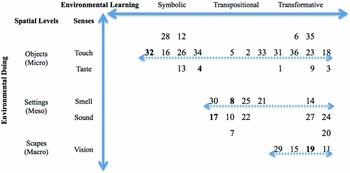
The data analysis in this article was conducted with the following process. First, from the entire interview transcripts, the participants’ accounts that indicate both spatio-sensory ‘doing’ and conceptual ‘learning’ were selected. There were 36 in total. Second, those accounts were interpretively categorised into the three spatio-sensory ‘doing’ modes. Third, the same accounts were interpretively categorised into the three conceptual ‘learning’ types. Lastly, spatio-sensory ‘doing’ and conceptual ‘learning’ were cross-analysed to reveal a potential pattern (Figure 1). This analytically identified pattern is what I call an ecopedagogical relation, and this paper seeks to explore this relation in order to provide a methodological model of linking ‘doing’ and ‘learning’ in experiential environmental education.
Ecopedagogical linking of ‘doing’ and ‘learning’ in WWOOFing.

Importantly, such a methodological model needs to be located at the intersection of various levels of epistemological abstraction, including the ethnographic and the theoretical (James, Reference James2006). Thus, to (re)present and elaborate the model in the later section, I will employ different modes of analysis as a way of performing the constitutive complexity for research congruence, a principle recommended in environmental education research (Reid & Payne, Reference Reid, Payne, Stevenson, Brody, Dillon and Wals2013).
In summary, this article analyses the WWOOFers’ reflexive accounts of their spatio-sensory learning experiences collected from their interviews. These discursive accounts of the WWOOFing experience indicate what the WWOOFers thought they had learnt in their WWOOFing through their bodily participation. This probably does not equate to what they actually had experienced, both quantitatively and qualitatively (Payne, Reference Payne2005). Thus, a major limitation of the analytical method employed in this article is that it is impossible to know what their experience really was. Their discursively reflexive learning is only a part of their educative experience, which also incorporates what Giddens (Reference Giddens1984) called ‘practical consciousness’. Giddens argued that revealing this practical consciousness in human action and interaction was a priority in social science. Therefore, it needs to be cautioned that the ecopedagogical linking of ‘doing’ and ‘learning’ that I aim to show in this article is fundamentally limited and analysed within the discursive ‘said’. ‘Learning’ is already a reduction of the totality of experience.
However, at the same time, it is questionable if there is a way to approach the totality of experience and to re-present it to the reader. Poststructurally, I understand representation as a constructed ‘partial truth’ rather than transparently mirroring the reality (Clifford, Reference Clifford, Clifford and Marcus1986). Acknowledging this limitation of representation, my strategy in this research was to facilitate the participants’ own representations of their spatio-sensory ‘doing’ in order to bring the ontological into their reflexive speech of ‘learning’, even if a little bit. On the other hand, an advantage of my ‘double hermeneutic’ method is that I can better acknowledge the participants’ agentic voices to represent their own ‘doing’ and ‘learning’ that are ‘already constituted as meaningful’ (Giddens, Reference Giddens1984, p. 284). However, at the same time, I am aware of the possibility that what is represented by the participants may not correspond with the objective reality of their experience (Bryant, Reference Bryant2011).
Ecopedagogical Linking of ‘Doing’ and ‘Learning’
Figure 1 shows the result of the cross-analysis of the potential ecopedagogical linking of ‘doing’ and ‘learning’ in WWOOFing. Each number in Figure 1 represents a participant's reflexive account collected from his or her interview (see Appendix for their summaries). In their accounts, the participants indicated their spatio-sensory ‘doing’ in the environment and conceptual ‘learning’ about the environment, either voluntarily or in response to my relevant interview questions. The bolded numbers (4, 8, 17, 19, and 32) in Figure 1 are quoted in this section for an interpretation of how their spatio-sensory ‘doing’ may be associated with three types of conceptual ‘learning’. In choosing these five quotes, I represented as many individual voices as possible, even within this limited space.
Symbolic Learning
The term ‘symbolic learning’ in this article refers to a process where the semiotic distinction between a human subject and a natural object became blurry through a course of sensory experience in the environment, especially involving touch and taste.
Symbolic learning is a form of environmental learning because it provides a learner with ‘fictional’ yet ‘creative’ imagination (Leggo & Sameshima, Reference Leggo, Sameshima, Reid, Hart and Peters2014) that may experimentally facilitate a more environmentally aesthetic, ethical, and political nature-human relation. This is inspired by what Bonnett (Reference Bonnett, Stevenson, Brody, Dillon and Wals2013) called ‘holistic learning’ in the context of environmental education. According to Bonnett, ‘dereification of the self’ is a crucial element for holistic learning. Here, the self is ‘understood as not simply contingently in some greater whole but ontologically an individual in indissoluble relationship with it’ (p. 91). This means that the self, an ontological unit, is both open and closed. With this enigmatic way of being, holistic learning ‘invite[s] a different way of being in the world to that which currently holds sway’ (p. 91).
In the deconstructive moment of symbolic learning that swings toward being open to ‘some greater whole’, nature temporarily ceased to be the Other (Cronon, Reference Cronon and Cronon1996). At the same time, the human Same, the mirror image of the natural Other, is fictionalised (Baudrillard, Reference Baudrillard1993, p. 133) to be yielded with a symbolic capacity to become creatively into something other than one currently is (Nakagawa & Payne, Reference Nakagawa and Payne2016). Symbolic learning in this instance is experimental rather than teleological.
Spatially, symbolic learning takes place in the environment as an interface where human and nature are mutually emplaced into the one body or unit. In this section, symbolic learning is interpreted in two WWOOFers’ reflexive accounts. One is Frank's tactile experience of weeding, and the other is Clare's experience of organic vegetables dominantly mediated by taste.
Frank's account of his tactile weeding is an appropriate example to illustrate the enigmatic invitation to a different way of being in the world:
Once you actually get into the soil, you realise quite quickly that you pull and snap. You have to dig, so finding and walking around and learning the behaviour of the weed, and discovering its own nature. And then adapting to it. That's a very pleasurable experience, you know, you feel you are accomplished, sense of accomplishment, you learnt something, if you like . . . You know, pull out the whole network of grass by following it and by being patient. (Frank, a British WWOOFer, Interview, 32 )
At a quick glance, it may read like Frank was talking about a subtle manual technique for weeding that requires tactile sensibility. However, I believe that he was saying something much more interesting than that. Forcefully pulling the weed did not work, because it would ‘snap’ and leave its roots in the ground. In order to do weeding well, Frank needed to learn ‘the behaviour of the weed’ and ‘discover its own nature’ by digging the soil with his hands and fingers. Importantly, Frank emphasised the need of ‘adapting’ himself to ‘the whole network of grass’, which happened as he touched the weed and was touched by the weed. In other words, Frank became (like) the weed to do weeding well. Did the weed also become like Frank in order to be weeded well? A little bit absurd, but perhaps.
If not, dereification of the self for Frank still took place in the environmental interface of the fingers/weed, or touching/touched, where Frank's being and the weed's being became temporarily reversible (to him). It is an enigmatically intertwining ontology. There, the distinction between human Frank and the natural weed was tactilely minimised within the chiasm of the environment. Or ‘flesh’, as Merleau-Ponty (Reference Merleau-Ponty1968) wrote: ‘The thickness of the body, far from rivalling that of the world, is on the contrary the sole means I have to go unto the heart of the things, by making myself a world and by making them flesh’ (p. 135). In this context, Franks used his tactility as a means to create a field where the two beings met and collided into one another. For Frank, that was an ‘accomplishment’, probably in the sense that he learnt a potentially different way of being in the world other than he usually was.
Clare's account of tasting organic vegetables is perhaps less strange than Frank's inspiration. Yet, it reveals another interesting (and perhaps more scientific) case of symbolic learning.
I think I like fresh food more after doing WWOOFing here, definitely. Because the fresh food, they are tasty, they are fresh, and you can feel the original taste from the vegetable, and you can feel that they are sweet or spicy or something else. For example, pumpkin. Pumpkin is sweet. And parsnip is sweet. Fennel, the flavour of fennel is special. I had never eaten fresh fennel in Taiwan because we just use the dried ones. So, it's very special. (Clare, a Taiwanese WWOOFer, Interview, 4 )
In her interviews, Clare highlighted the significance of the activities related to food during her WWOOFing at a small-scale business organic vegetable farm. Clare explained that the freshness of the organic vegetables was important because it revealed its ‘original taste’ to her. Whether ‘sweet’ or ‘spicy’, their tastes were strong, vital, and ‘special’.
Consumption, Bennett (Reference Bennett2010) wrote, is ‘a two-way street, an encounter between bodies human and non-human’ (p. 47). It is not just that Clare ate those organic vegetables to appreciate their tastes. By being consumed, the vital vegetables also affected Clare's body. ‘Food, as a self-altering, dissipative materiality . . . enters into what we become. It is one of the main agencies operative in the moods, cognitive dispositions, and moral sensibilities that we bring to bear’ (p. 51). The organic vegetables are ‘actants’ with vitalistic agency. Actant-vegetables ‘do something, and don't just sit there’ [original emphasis] (Latour, Reference Latour2005, p. 128) in the stomach. In this instance, symbolic learning for Clare is interpreted by her acknowledgement of the vitality of the organic vegetables via taste, and how that modified her body and taste. When Clare said ‘I think I like fresh food more after doing WWOOFing here’, she indicated her reinforced preference for fresh organic vegetables and interest in becoming healthier. Was that Clare talking, or the vegetables talking? As her qualifying addition of ‘I think’ to the first sentence may curiously imply the uncertainty of her agentic autonomy, Clare and the fresh organic vegetables were ontologically inseparable from a vital materialistic point of view.
Transpositional Learning
Transpositional learning is more ethically explicit and less ontologically experimental than symbolic learning. It is more ethically explicit, because intimate interconnectedness with nature is a major objective for the learning experience. It is less ontologically experimental, because although nature's Otherness appears in a physically and morally proximal distance, nature and human are understood as fundamentally separate entities no matter how they are interconnected within the environment. Using Bonnett's expression in the previous section, the human self is ‘an individual’ and has ‘an indissoluble relationship’ with nature.
The term ‘transpositional’ is adopted from one of Payne's (Reference Payne2014) thematic categories to describe his students’ experience in an outdoor environmental education unit. By transpositional, Payne meant the generatively ‘heteronomous’ (p. 58) quality of the subject that is (eco)becoming with the Other in his or her movement in the environment. The subject's identity changes as they move and is transpositioned in another body~time~space. In other words, Payne emphasised the ontologically flexible and reconstructive quality of the subject for transpositional learning. Transpositional learning is ‘an embodied and emplaced process — slowly, experientially, co-constructively, and democratically . . . [with] the partial reconfiguration and reconciliation of inner, social, and outer natures’ (p. 58). The reconfiguration and reconciliation are facilitated when the learners experience their material embeddedness in the environment. That is possible because the environment is inclusively ‘feral’ (Fawcett, Reference Fawcett, McKenzie, Hart, Bai and Jickling2009) and its system is made of the ‘interconnectivity of all life’ (Peters, Reference Peters, Stevenson, Brody, Dillon and Wals2013, p. 503) in or of nature. Pedagogically, transpositional learning may be implemented as an educational facilitation of ‘ethics of care’ or ‘field philosophy’ for the Other(s), based on ‘dialogue enacted with nonhuman or distant cared-fors’ [original emphasis] (Goralnik, Dobson, & Nelson, Reference Goralnik, Dobson and Nelson2014, p. 188).
In WWOOFing, transpositional learning took two steps. First, the WWOOFers were emplaced in the spatio-sensorial proximity (particularly via smell and sound) to the natural Other. Second, they became part of the environment by recognising the interconnectivity with the natural Other and ethically appreciating its significance. In this quote, Tea reflected on her sensory experience with a farm pig residing on the edge of the organic vegetable field:
The smell, I mean it smells like the mix of soil and water and pig. I like it. I don't care . . . Here, I stay in touch with an animal. I love that. I think it's the thing that makes me feel more relaxed and good. I always feel good with animals. I mean, it happens sometimes that you feel maybe scared, or not scared but nervous or something, but most of the times I feel really good with them, even if it's a pig, or a dog, or a cat. (Tea, an Italian WWOOFer, Interview, 8 )
Every morning, Tea would bring scrap vegetables kept in a kitchen bucket to the pig named Penny. As Tea approached the electric fence, Penny oinked and came close to her. The smell of ‘the mix of soil and water and pig’ close up was quite penetrating. When Tea said she ‘liked’ the smell, it is obvious that what she liked was what the smell signified — that is, the presence of Penny near her. Being ‘in touch with’ Penny made Tea ‘feel more relaxed and good’ despite the smell.
The proximity with another being mediated by smell is not only spatial (i.e., physical closeness) but also bio-socio-cultural. Pink (Reference Pink2004, p. 1) suggested that ‘fresh’ smell was often an index of ‘cleanliness’ of the home environment and brings family members and their guests together. A good smell is used as a means of association. On the other hand, Simmel (Reference Simmel, Frisby and Featherstone1997) suggested that ‘crude’ (p. 155) smell (such as ‘the mix of soil and water and pig’) is ‘dissociating’ (p. 156) for individuals, often used to mark the socio-culturally categorical Other (such as ethnicity or ‘race’ — see Law, Reference Law2001; Walmsley, Reference Walmsley2005). This latter dissociating function of a crude smell was important for Tea's transpositional learning. It was through dissociating that the being of Penny sensorially appeared to Tea as the Other, but nonetheless closely, both physically and morally, co-existing within the same environment. ‘[I]n smelling/perceiving the other's odour, an individual defines the self through a difference in smell, and also negates the other as the not-I based on a difference in odours’ (Low, Reference Low2005, p. 405). Penny as the Other was marked with a ‘crude’ smell, which bio-socio-culturally disassociated Penny from Tea. However, Penny was immediately re-placed within the moral proximity, despite the smell. Tea's ethical acceptance of Penny as the Other that nonetheless coexisted in the sensorial proximity is indicative of her transpositional learning.
The second quote is about the sound of geese Andreas experienced at the family bird farm where he WWOOFed:
Before, I thought when geese or other animals made a really loud sound to me, they wanted to attack me. What I learnt here was like, ‘ok yeah, she is not attacking me’, and this was a surprise. . .. So, it's not always that bad when they are making a huge sound. They are not trying to get you out or something. It's more like you are part of nature and they understand. I think they do. I see them as part of nature. (Andreas, a German WWOOFer, Interview, 17 )
Part of Andreas's morning routine was feeding the birds (emus, geese, ducks, and chickens) and collecting their eggs. Thus, Andreas had regular interactions with those birds, and sometimes he was indeed ‘attacked’. However, by closely being with them and observing their nature, Andreas ‘learnt’ that ‘a huge sound’ those birds sometimes made did not necessarily mean to ‘get him out’. Sometimes, the birds simply meant to acknowledge that he was there, as ‘part of nature’. Feeling an intimate connection with the birds, Andreas sometimes did not collect their eggs on purpose, particularly when the mother birds were still holding them under their stomach. ‘I'm not a guy who steals an egg from the mother’, Andreas explained to me after I watched the scene.
When Bauman (Reference Bauman1993) wrote that ‘[t]he same soil [of proximity] breeds love and hatred’ (p. 89), he meant that morally being close to or with the Other means nothing other than the actual fact of being close. Love or hatred, they contingently happen due to the proximity. Whether it is one or the other is random. Proximity is indeed a meaningless ‘aporia’ (p. 88). But it is this meaninglessness, or ‘feral’ semiotics, that indicates the irresolvable Otherness of the Other in the proximity. The Other is — or should be — independent and beyond the signification by the Same. ‘Being for’ (see also Payne, Reference Payne, McKenzie, Hart, Bai and Jickling2009, for his adoption of Bauman's ‘being for’ in intergenerational environmental education in the household) the Other is to recognise its absolute Otherness as the ethical priority beyond its meaning (Levinas, Reference Levinas1985, p. 77). In this quote, Andreas experienced the semiotically unmediated Otherness of the birds through their loud sounds. It was both a threat and a welcoming, not either/or. Hence it was semiotically meaningless, but according to Bauman, it was this meaninglessness that emplaced both Andreas and the birds in the moral proximity.
Transformative Learning
Transformative learning in this article is defined as ‘a process that helps each individual to understand the world in a way that may challenge their experiences, change their behaviours and influence their values, ultimately leading to individual and social transformation through the changed perspective’ (Nowaczek, Reference Nowaczek and Reisinger2013, p. 169). Social transformation, however, may occur sometime in the future as a result of individual transformation that has occurred through a learning experience. This means that what may be interpreted as ‘transformative learning’ in the WWOOFers’ reflexive accounts in their interviews is limited to signs of potential individual transformation, not actual ‘behavioural change’ (Ballantyne, Packer, & Sutherland, Reference Ballantyne, Packer and Sutherland2011) that is only observable after a while. Whether behavioural change leads to social change also requires some extra time to judge. Also, it is quite possible that, as indicated in James's case, ‘transformation’ may be framed within the logics of dominant ideologies, such as consumerism. Thus, a caution is required for whether or not transformative learning really took place among the WWOOFers. A longitudinal study is needed to answer such a temporal question, and that is obviously beyond the scope of this article.
Deville and Wearing (Reference Deville, Wearing and Reisinger2013) suggested that transformative learning is a prominent type of experiential learning in WWOOFing. They wrote that WWOOFing can induce life changes through authentic engagement with hosts and the environment based on ‘reciprocal exchange’ (p. 163). My study confirmed the ‘alternative’ (McIntosh & Bonnemann, Reference McIntosh and Bonnemann2006) value of reciprocal exchange in the WWOOFers’ ‘decommodified’ nature experience (Deville, Wearing, & McDonald, Reference Deville, Wearing and McDonald2016; Miller & Mair, Reference Miller and Mair2015) that educationally facilitated their environmental awareness. Environmentally significant life experience, such as (re-)connecting with fresh food sources to (re-)humanise herself (Steph, a British WWOOFer, Interview, 1), isolating herself in nature and learning the benefit of solitude in silence for her self-growth (Margherita, an Italian WWOOFer, Interview, 24), and realising herself through physically demanding labour to alter the landscape (Moon, a British WWOOFer, Interview, 36) did take place in WWOOFing as a non-formal educational setting (Chawla, Reference Chawla2001).
However, in the following, with James's reflexive account on his gaze on the WWOOF culturescape, I will suggest that the WWOOFers’ ‘transformation’ may be less ‘alternative’ due to its implication of consumerism:
I wanted to start something new, and I wanted to speak English more and learn new culture. I wanted to meet foreign people, so yeah I decided to move to another place and that's why I came here. I thought if I WWOOFed, I would be able to feel Australian culture, and to have Australian food, and to make foreign friends. (James, a South Korean WWOOFer, Interview, 19 )
While James's account does incorporate a series of multisensory engagements in the environment (e.g., ‘to speak English’, ‘to meet foreign people’, and ‘to have Australian food’), their sensory significance seems overpowered by the abstract differences that were socio-semiotically generated. ‘New’, ‘English’, ‘culture’, ‘foreign’, ‘another’, and ‘Australian’ — the WWOOF environment was represented as a set of differences or signs. The differences were important for James, because he wished to broaden his personal horizon through his experience. In this instance, the WWOOF environment for James was primarily a culturescape that gathered those signs of difference.
While James's account seems to correspond thematically to a humanistic understanding of travel as a process of self-discovery (MacCannell, Reference MacCannell1999, p. 5), it also implies some level of consumerism because he seemed to accept the touristic signs rather uncritically. According to Urry (Reference Urry2002), in tourism, vision is socio-culturally and commercially organised by the tourism industry and its professionals into a ‘gaze’. A gaze is embodied within tourists to determine what is worthwhile to look at and what is not. Particularly, ‘[t]he tourist gaze is directed to features of landscape and townscape which separate them off from everyday experience’ (p. 3). Those features appear extraordinary because they are advertised to be different from the ordinary everyday scapes.
The tourist gaze is not limited to tourism. In environmental education, particularly for pedagogies that prioritise eco-social justice such as land-based education, a concern was expressed that potentially ‘the nuances of place become reduced to objects of experiential or visual consumption’ (McKenzie & Bieler, Reference McKenzie and Bieler2016, p. 77). A similar concern has been expressed for international Study Abroad students who studied in a tertiary outdoor environmental education unit in Australia (Nakagawa & Payne, Reference Nakagawa and Payne2011). In order to lessen the ‘gaze’ effect and related consumerism, ‘locally’ contextualised knowledge and perspectives must be ‘critically’ inserted into the learners’ experience (Gruenewald, Reference Gruenewald, Stevenson, Brody, Dillon and Wals2013). In other words, the learner's subjective ‘awareness of one's position and the ever-shifting gaze’ that frames a ‘landscape’ (c.f. ‘land’, or ‘place’) requires a continuous reflexive critique (Brandt, Reference Brandt, Stevenson, Brody, Dillon and Wals2013, p. 276). A ‘critical discourse analytic’ approach (Gilbert, Reference Gilbert2003) to examine how power (re)produces (eco)tourism commodities through signs (such as ‘nature’, ‘the local’, ‘authenticity’, and so on) may be pedagogically useful in order to facilitate transformative learning.
Conclusion
The aim of this article was to examine WWOOFing as an example of ‘informal’ experiential environment education, with a particular focus on its participants’ experience as it was lived spatially and sensorially in a particular environment. In regard to ‘environmental learning’, the potential ecopedagogical linking of spatio-sensory ‘doing’ in the environment and conceptual ‘learning’ about the environment was analytically elaborated across various levels of epistemological abstraction, with a sampling of the WWOOFers’ reflexive accounts. This analysis provided insights into the processes of the WWOOFers’ educative experience and their meaning making. Importantly, the ecopedagogical model suggested in this article is not of a definitive and generalisable ‘conclusion’, but rather a heuristic tool to advance (Payne's) ecopedagogy in other similar educational contexts, whether ‘formal’ or ‘informal’. To iterate Figure 1:
-
• When the spatio-sensory mode of the micro/object-touch/taste was predominantly engaged, symbolic learning, transpositional learning, and transformative learning tended to take place.
-
• When the spatio-sensory mode of meso/setting-smell/sound was predominantly engaged, transposition learning and transformative learning tended to take place.
-
• When the spatio-sensory mode of macro/scape-vision was predominant engaged, transformative learning tended (or seemed) to take place.
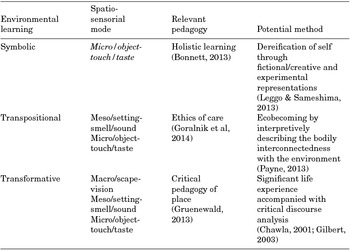
Table 1 more generally summarises the types of environmental learning, their dominantly corresponding spatio-sensory modes, relevant pedagogies, and their potential methods revealed in this article.
WWOOF Ecopedagogy

Despite various limitations, by empirically and theoretically attending to the processes of the 10 international WWOOFers’ nature experience, this article indicated a possible linking of their spatio-sensory doing’ in the environment and their conceptual ‘learning’ about the environment, and a heuristic model to explain the link. More importantly, by suggesting the tentative methodological and conceptual approach, this article contributed to the advancement of Payne's ontologically oriented ecopedagogy, even if indirectly, which is a much needed approach in experiential environmental education for the environment.
Acknowledgments
I would like to thank Dr Phillip Payne for his constructive feedback and suggestions for this article.
Financial Support
This research received no specific grant from any funding agency, commercial, or not-for-profit sectors.
Conflicts of Interest
None.
Appendix
Summary of the WWOOFers’ Reflexive Accounts

Author Biography
Yoshifumi Nakagawa is a PhD candidate in the Faculty of Education, Monash University. Yoshi is currently researching WWOOF with a sociological focus on its participants’ nature experience. Yoshi's research interests include human-nature relations in ecotourism and environmental education, post-critical research methodology, and Jean Baudrillard's social theory.