1 Introduction
Over 25 years ago, I made the claim that Gokana, a Cross-River Niger-Congo language of the Ogoni (or Kegboid) subgroup spoken in Nigeria, does not organise its consonants and vowels into syllables (Hyman Reference Hyman, Kaye, Koopman, Sportiche and Dugas1983, Reference Hyman1985). This was a radical and in principle unwelcome position, given the centrality of the syllable in almost all phonological work at the time. Still, as Hayward (Reference Hayward1997: 78) pointed out several years later, the extensive treatment of Gokana largely went unnoticed:Footnote 1
Hyman's account of the Nigerian language Gokana and in particular his well-argued claim that Gokana represents a case where invocation of the syllable buys nothing insightful for explaining the phonology of the language should have disturbed profoundly the settled orthodoxy surrounding the universality of the syllable. That a vowel (the quintessential syllable nucleus) is not guaranteed syllable membership is a very strong proposal, but one has little sense that it has attracted overmuch comment. … In my view it would be unfortunate if Gokana were to be regarded simply as an interesting oddity, rather than as the limiting case in a clinal situation in which many languages may participate to some degree in the course of their phonologies.
Although there was almost no response to the claim of no syllables in Gokana, the proposal of Hyman (Reference Hyman1985) to establish moras as a central building block in phonology did gain currency, and was particularly welcome to specialists of Japanese, long viewed as exclusively moraic in its prosodic structure. Since that time work on the syllable has gone in opposite directions: while Kubozono (Reference Kubozono and Tsujimura1999, Reference Kubozono and van de Vijver2003) presents mostly metrical evidence that the syllable may in fact play a role in Japanese, Steriade (Reference Steriade, Fujimura, Joseph and Palek1999) and Blevins (Reference Blevins and van de Vijver2003) argue against syllable accounts of phonotactic constraints, and Steriade (Reference Steriade2009) argues against syllable accounts of certain rhythmic effects. Instead, they show either that the generalisations are wrong, i.e. the constraints hold even across syllables, or that a string-based account without reference to the syllable is equally if not more revealing. It thus seems that the exact role of the syllable in phonology is once again up for grabs, as has been the case in its rocky ‘on-again, off-again’ past.
In this paper I have two goals. The first is to take a new (and more extensive) look at Gokana with respect to the original claim of no syllables. The Gokana situation would seem to be important to resolve, given that most researchers still assume the syllable to be a building block in all languages, a psycholinguistic reality which is phonetically grounded in articulation and/or perception and supported by experimental evidence, language acquisition and orthographies (see, for example, the collection of papers in Cairns & Raimy Reference Cairns and Raimy2011). While in my earlier work I was unable to find any evidence for the syllable, below I present an overlooked argument which, although ambiguous, can at least be shown to have advantages over the no-syllables account. The fact that the syllable plays at best a minor role in the prosodic organisation of Gokana has broader implications for both phonological typology and the quest for phonological universals. Thus, a second goal of the paper is to demonstrate that universal claims of the sort ‘all languages have syllables’ are necessarily theory-dependent and hence less testable than often assumed. This not only explains the numerous metamorphoses and instability of the syllable concept throughout the history of phonology, but also suggests that questions of (absolute) universality should not dominate the agenda. A more productive strategy is to ‘normalise’ the differences based on theoretical assumptions and focus on the ways in which diverse sound systems ‘activate’ structures and features in the sense of Clements (Reference Clements and Hall2001: 72): ‘features are specified in a given language only to the extent that they are needed in order to express generalizations about the phonological system’. The syllable has of course been very useful in expressing generalisations in a number of languages, e.g. concerning onset–coda asymmetries or closed-syllable vowel shortening. Perhaps this is what Hayward meant by ‘cline’: in some languages the syllable is activated to express multiple generalisations, in others only a few and in still others perhaps none at all, as in the case of Gokana.
The paper is organised as follows. In §2 I present general claims that have been made concerning the syllable, distinguish between analytic and descriptive claims, and show how one of them (‘syllabification is always predictable’) is highly theory-dependent. §3 then recapitulates the case for the descriptive claim of no syllables in Gokana, based on Hyman (Reference Hyman, Kaye, Koopman, Sportiche and Dugas1983, Reference Hyman1985). Potential new evidence for the syllable in Gokana is then presented in §4, followed by discussion in §5. Finally, §6 expands on the application of Clements' (Reference Clements and Hall2001) notion of phonological activation to the study of phonological universals and variation. The paper ends by situating the Gokana case within the ongoing debate initiated by Evans & Levinson (Reference Evans and Levinson2009) concerning linguistic universals vs. diversity, which has only partially concerned phonology up to this point.
2 Theory, interpretation and the syllable
The purpose of this section is to demonstrate that universal claims about the syllable are highly theory-dependent. One indication of this is the wide range of positions which have been taken on the syllable over the past 100 years or so, including those in (1).
(1)


While other linguistic constructs, such as the morpheme, word or sentence have had their own definitional and analytical problems, none has had such a ‘chequered’ past: at one end of the spectrum, various universal claims have been made for the syllable, such as those in (2), which also lists some of the few alleged counterexamples.
(2)
At the other end of the spectrum, in the early generative phonology era the syllable was claimed either not to exist or to be totally redundant and not necessary (Kohler Reference Kohler1966). How can it be that some scholars assume that syllables are universal and restricted to CV in all languages (Lowenstamm Reference Lowenstamm, Durand and Laks1996), or are subject to a maximal CVX syllable structure (Duanmu Reference Duanmu2009), while still others deny the syllable's appropriateness in some or all phonological analysis?
The problem is that the above claims are necessarily theory-dependent. As an illustration, consider the claim in (2d) that syllabification is always predictable:
One argument which has been raised against phonological syllables is that, unlike segments, the location of a syllable boundary within a morpheme can never be phonemic. That is, two morphemes such as /a$pla/ and /ap$la/ cannot differ only in their syllable structure. (Hyman Reference Hyman1975: 192)
Although oft repeated (Clements Reference Clements, Bogers, van der Hulst and Mous1986: 318, Hayes Reference Hayes1989: 260, Steriade Reference Steriade, Fujimura, Joseph and Palek1999: 224, McCarthy Reference McCarthy2003: 10, Blevins Reference Blevins2004: 232, etc.), care must be taken to interpret exactly what the nature of the claim is: is (2d) a descriptive claim stating that an underlying (surface?) contrast between monomorphemic a.pla and ap.la is not possible, or is it an analytic claim stating that any such contrast, if attested, would have to be formalised other than by contrastive syllable structure? In the first case, one is making the empirical claim that an identical intervocalic /pl/ sequence could not have two sets of properties within different morphemes. In the second case, one is making the formal claim that if two such sets of properties did exist, they could not be analysed as a difference in syllabification. Rather, some other representation or device would necessarily be appealed to.
Assuming this latter response raises the question of which devices one would be willing to invoke to ‘explain away’ apparent counterexamples to (2d). Marking one of the syllabifications as exceptional, e.g. /apla/ vs. /ap.la/, would clearly violate (2d). One might therefore instead set up an abstract contrast between geminate and single consonants, i.e. /apla/ (→ a.pla) vs. /appla/, which first syllabifies as ap.pla and then undergoes degemination to become ap.la. A variant of this analysis could be an empty C slot, i.e. /apla/ vs. /apCla/. Alternatively, one might posit a ghost V slot whereby /apla/→a.pla vs. /apVla/, which would first become a.p V.la, then ap.la. The question is not only whether such analytic moves are motivated, but whether one or another of them violates the spirit of (2d). Does the extraneous C or V slot effectively undermine the basic point, that we should be able to predict syllabification within morphemes?
Steriade (Reference Steriade, Fujimura, Joseph and Palek1999: 224) proposes that the absence of such syllabification contrasts may have a functional basis. Citing the absence of a contrast between monomorphemic as.ka and a.ska, Steriade suggests that there would be insufficient perceptual cues to signal such a contrast. Note, first, that such contrasts are possible across morphemes and words, e.g. my space vs. mice pace, where timing and aspiration differences at least potentially disambiguate the two. Returning to /apla/, if a language were to combine English aspiration with Icelandic open syllable lengthening (Vennemann Reference Vennemann1972), the surface contrast would be between [aː.pʰla] and [ap.la], which we can assume to be quite sufficiently distinct.
If we turn to other phenomena, we see that the issue is not so much one of perceptibility, or even CC syllabification, but rather whether specific theories allow underlying syllabification or not. The contrasts in (3), all of which are attested, would be as much a problem for such theories as a contrast between /a.pla/ and /ap.la/.
(3)
Again we must ask whether the proposed ‘solutions’ are in the spirit of (2d). The case of (3c) is particularly pertinent. If one assumes that stress is a property of syllables, and if unpredictable stress must be indicated lexically, diacritic accents and other such indications necessarily mark syllable properties (Inkelas Reference Inkelas1995: 295) and are hence not in the spirit of (2d).Footnote 2 Citing the near-minimal pair Ida [ˈaj.dʌ] vs. Aïda [a.ˈij.dʌ], Blevins (Reference Blevins and Goldsmith1995: 221) writes:
in the general case, syllable structure is not present in underlying representations. … For exceptional forms like [ʔa.íy.da] we can assume that minimal structure is specified in the lexicon.
However, in a later work, she writes: ‘syllabifications within a given language are never contrastive’ (Blevins Reference Blevins2004: 232). While not specifically talking about syllables, Bloomfield (Reference Bloomfield1933: 121) assumes representations that make the syllabicity of sonorants unpredictable:
Whether a sonant in any word is syllabic or non-syllabic, is determined in different ways in different languages. If the syllabic or non-syllabic character of a sonant depends entirely upon the surrounding phonemes (as in bird versus red), then the difference is not distinctive … In many cases, however, the syllabic or non-syllabic character of the sonant is determined arbitrarily, and constitutes a phonemic difference. Thus, in stirring [ˈst iŋ] the [r] is syllabic, but in string [striŋ] it is non-syllabic; in the second syllable of pattern [ˈpεtn] the [r] is syllabic and the [n] is non-syllabic, but in the second syllable of patron [ˈpejtr
 ] the [r] is non-syllabic and the [n] is syllabic.
Here we directly observe the theory-dependence issue and the importance of agreeing on the analysis. We can ignore Bloomfield's first pair of examples, since stirring is bimorphemic, but the fact that he represents pattern vs. patron with phonemic syllabic sonorants, rather than with schwas, i.e. /pætərn/ vs. /petrən/, in more modern terms would require lexical indications of syllabification.
Given the above issues, the ultimate status of (2d) is not entirely clear. The possibilities seem to be those in (4).
(4)
What I hope to have shown is how difficult it is to maintain a coherent position across platforms: to evaluate any of the claims in (2) one must also know what the theoretical assumptions are, as well as what one would be willing to consider as a counterexample. A related metatheoretical question one should ask is how good a universal is if it is so easy to ‘accommodate’ it with representations such as in (3). In this study I attempt to ‘normalise’ the discussion of the syllable by focusing on the descriptive properties which claims such as (2d) are intended to account for rather than on the analytic models, which can be quite removed from the observed facts. With this distinction in mind, let us now turn to the putative universal in (2a) and the more radical claim of no syllables in Gokana.
3 No syllables in Gokana
In §2 we went through a number of universal claims that have been made about syllables in (2) and considered (2d) in some detail. In this section we are concerned with the universal claim in (2a): ‘all languages have syllables’. In the following paragraphs I recapitulate the case for no syllables in Gokana.Footnote 3 The metatheoretical question we face in this context is: what would it take to convince us that a language does not have syllables? Hyman (Reference Hyman, Kaye, Koopman, Sportiche and Dugas1983, Reference Hyman1985) argued that such a case is to be found in Gokana, which organises its phonology exclusively around moras (‘weight units’). As an introduction to the problem, consider the sentence in (5a).
(5)
As seen, the utterance ends in six lengths of [ ]. (5b) shows that that the six surface lengths derive from eight underlying vocalic moras: both /ÈÈ/ (logophoric) and /´EE/ (3sg obj) undergo a rule which shortens a geminate vowel after another vowel (see (14b) below).Footnote 4 The question is: how many syllables are there in the form in (5b)? How can one determine? Assign a syllable to each vocalic mora, giving six syllables? Or to each pair of moras, giving three syllables? One indirect argument against syllable structure in Gokana was that it was virtually impossible to answer this question. However, I did recognise the following problem:
It is of course logically impossible to prove that a language does not have syllables, since it may be the case that it has them but does not show obvious evidence of it – it may also be the case that some future linguist might discover evidence for the syllable in Gokana which I have simply overlooked. (Hyman Reference Hyman1985: 27)
Although one cannot definitively ‘prove’ the absence of syllables, I appealed to two kinds of indirect arguments to support my original position: (i) a good-faith, but unsuccessful, effort was conducted to find the presence of syllables, based on the usual evidence and criteria; (ii) the system can be insightfully analysed without syllables.
In order to conduct such a ‘good-faith, but unsuccessful effort’, one has to know where to look for evidence that the syllable has been phonologically activated (§1). In (6) I list the properties which have provided the usual arguments for syllables and syllable structure in other languages:
(6)
I consider (6a–d) in the following four subsections; (6e) will be treated in §4.
3.1 Distributional constraints
The most revealing constituent affecting distributional constraints in Gokana is what I shall refer to as the ‘prosodic stem’ (PrStem), consisting of an obligatory root plus possible suffixes. Its phonological properties are summarised in (7).
(7)
In (7a), I use the symbol V to indicate a mora. Unless subscripted as ViVi or ViVj, VV represents either a long vowel or a sequence of (like or unlike) vowels. As seen, the PrStem may consist of one to four moras. It must begin with a consonant (C1), and may have a second consonant (C2) or not. Examples of each of the above structures are given in (8).
(8)
Where possible, I have provided both a noun and a verb to exemplify. However, as the glosses indicate, the shapes CVVV and CVVVV are restricted to verbs, which, unlike nouns, are capable of taking suffixes (see §4). Note that nasalisation or ‘nasal harmony’ is a prosody in Gokana, affecting vowels and converting /B v l z/ to [m ɱ n ɲ].Footnote 5 Thus, kaànà ‘pick (fruit)’ is underlyingly /kaaDa/[+nasal] ‘pick (fruit)’ and pronounced [kã n]. Vowel nasalisation will be transcribed only when there is no nasal consonant in the form, e.g. k ‘wake (someone) up’.
As indicated in (7b), the stem-initial C1 consonant can be any of 16 oral consonants plus the nasal variants, while C2 is limited to the three archiphonemes /B D G/, which may be realised as oral or nasal. When occurring orally, the archiphonemes are realised as [b l g] finally and [v r g] intervocalically, as exemplified in (9a).Footnote 6
(9)
The major issue, therefore, is how to account for the dramatic decrease in consonant contrasts in C2 position. Although I have arranged the above forms in columns where the C2 is labelled as ‘coda-like’ vs. ‘onset-like’, it is doubtful that syllable structure can account for the limitation of C2 to /B D G/. A move to arbitrarily assign the C2 to coda position in all cases, as in (10), is not only counterintuitive, but forces an analysis with an otherwise unattested long-vowel CVVC syllable in (10b).Footnote 7
(10)
It also can be seen in the last column of (9) that morphological structure cannot account for the distributions: the C2 consonant may belong to the root or to a suffix.
A solution that does work is to say that a postvocalic consonant can only be /B D G/. This is true whether the generalisation is stated with respect to the PrStem or to the word, as there are no vocalic prefixes.Footnote 8 Alternatively, one could simply refer directly to the C2 position within the PrStem. Either way, syllable structure is irrelevant.
3.2 Phonological rules
As discussed in Hyman (Reference Hyman1985) and earlier work, the major phonological rules of Gokana are nasal spreading, vowel harmony and, most relevant to this study, the realisation of /B/ and /D/ intervocalically.Footnote 9 Since Gokana lacks underlying /j/ and /w/, the intervocalic context can be captured via [–consonantal], i.e. without reference to syllabicity.Footnote 10
(11)
Had there been a contrast between /i u/ and /j w/, it might have been necessary to refer to syllable structure in stating (11a). The absence of /j w/ thus may not be an accident, but rather a further indication that Gokana does not reference syllables in its phonology.
3.3 Allomorphy
A third area where syllables seem quite beside the point concerns the statement of allomorphy. Gokana has two inflectional suffixes, which vary allomorphically as in (12).
(12)
Examples are provided in (13).
(13)
While a pure allomorphy solution is certainly tenable, Hyman (Reference Hyman1985: 66) posits underlying /-ii/ and /-´ÈÈ/, and interprets the alternations as phonological, proposing a D-insertion rule, as in (14a).
(14)
As seen, D-insertion requires that both the preceding and following vowels be geminate: a single set of [−consonantal] features linked to two moras. In (13c), D is not inserted, since the preceding vowel is short. Instead, the rule in (14b) applies to shorten a geminate vowel when it is directly preceded by a vowel, whether long or short.Footnote 11 In neither rule is there any reason to refer to syllables. A second condition on D-insertion is that it is limited to the PrStem. Thus, when the 3rd person singular enclitic /´EE/ follows a long vowel, there is no epenthesis. Instead, vowel shortening applies: /aÈ sii ´EE/→a  siíe ‘he caught him’, /aÈ sii ´ii/→a siíi ‘he caught us’.
It should be noted that the motivation of the rules in (14) does not seem to be to improve syllable structure: in other languages, such as Turkish, Japanese and Korean, where some suffixes are vowel-initial after a C-final base, but consonant-initial after a V-final base, the effect is to optimise CV syllables. What the rules in (14) do seem to have in common is that they minimise certain sequences of vocalic moras. However, as seen in examples such as in (15), they are hardly effective.
(15)
The forms in the first column involve CVV roots followed by a -V derivational suffix, either anti-causative -a or causative -È. The second and third columns add the familiar 2nd plural subject and logophoric inflectional suffixes to these forms. The result is four successive vocalic moras uninterrupted by a consonant. Note finally the forms in (16).
(16)
The question is: if D-insertion were claimed to have the function of creating more C-initial syllables, why doesn't it apply after CV and CViVj bases? Why only after geminate vowels?
The forms in (16) indicate that Gokana fails to insert an onset to create a second, well-formed syllable: *bua-rii, *buà-r , etc. We now consider another morphological process which in fact removes what would be an onset C2 consonant. As seen in (17a), CV, CVV and CVC add an -a suffix to form an ‘anti-causative’, which is usually, but not always, intransitive.
(17)
Verbs which end in -i replace this suffix with -a, as in (17b). The most surprising result is seen in (17c): when a CV(V)CV verb ends in -a or -ε, the C2 consonant is deleted, the preceding vowel is lengthened (if it is not already long) and the final vowel is again -a. In producing CVVV sequences in both (16) and (17c), the associated operations indicate an apparent disinterest in establishing syllable onsets, at least with respect to C2.
Still in the context of morphology, note finally in (18) that verb-stem reduplication does not give unambiguous evidence for the syllable.
(18)
While one could stipulate the copied CV as a monomoraic syllable (RED=σμ), the CV reduplicant could just as adequately be identified as an unsyllabified mora (RED=μ).
3.4 Prosodies and word-stress
In some languages prosodies have been reported whereby a syllable may bear a prosodic feature as a unit, e.g. the ‘emphatic’ feature of Aramaic (Hoberman Reference Hoberman1988). The two prosodies in Gokana, nasal harmony and vowel harmony, are not so restricted. First, while some syllables are completely nasal and others oral, it is possible for a CV sequence to have an oral consonant and a nasalised vowel, e.g. b  ‘pot’, gb
 ‘look for’, k
 ‘place’. In addition, both harmonies clearly extend beyond a single syllable and, in fact, outside the PrStem onto vocalic enclitics. There is thus no need to see either as syllable-based.
This leaves the question of word stress. Note first that Gokana does not have perceptible stress differences in the sense of English and other such languages. This should not be surprising, as the typical features of stress (F0, duration, intensity) are not likely to be available in Gokana. First, since the language has an underlying three-height tone system of /H/, /M/ and /L/, and a fourth derived downstepped ↓M tone, there is little room for F0 to play a role. Second, recalling (5), we have seen sequences of up to six moras of identical vowel length, making duration particularly problematic for marking stress. This leaves intensity. While no differences have been observed in the realisation of identical C1 and C2 consonants, e.g. in stems such as miimii ‘red’ and náná ‘to pick up’, dramatic inventory differences in the contrasts that are allowed on C1vs. C2 were pointed out in (7). Is the more extensive set of C1 contrasts evidence of initial stress?
This question will come up again in §4. For our present purpose the issue is whether a putative initial stress provides evidence for the syllable. One of the assumptions concerning word stress is that it is necessarily a property of syllables, or at least the rhyme, which is either stressed or unstressed. Any system that requires a heavy syllable, e.g. CVV, to contrast intrasyllabic prominence, e.g. on its first vs. second mora, at the very least involves something more than stress (typically, tone). In order to determine whether there is initial syllable stress in Gokana, we have to establish what the possible structures are of the putative initial syllable. Where the PrStem has the shape CV, CVC or CViVi, there seems to be no question. What about CViVj stems, such as those seen earlier in (16)? How many syllables are there in forms such as buai ‘to cook (intr+2pl)’, kuùà ‘to open (intr)+log’ and ultimately k 
 in (5)? Suffice it here to say that even if we accept initial prominence, we have not been able to uniquely parse the PrStem into syllables. This issue is further explored in the next section.
4. New evidence for the syllable in Gokana
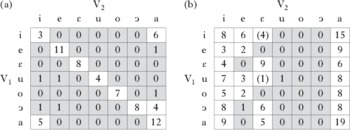
In the preceding section we ended by raising the issue of whether the distributional properties of consonants suggest an initial stress. The question is how to account for the asymmetries between C1 and C2, which are reminiscent of onset–coda asymmetries. First, C1 has a much fuller inventory than C2 (cf. (7b) vs. (7c)). Second, C1 is obligatory, as opposed to C2, which is not. It is not just consonants which show such an asymmetry, but also vowels. Restricting ourselves to lexical entries having the shapes C1V1(ː)C2V2(ː), Tables 1a and b show that the vowels which follow C2 are significantly restricted. In (a) I only counted nouns which meet the shape requirements in (7), i.e. ignoring compounds, borrowings and reduplications which have a C2 consonant other than /B D G/ (cf. (32) below). As seen, 64/74 (86·5%) of these nouns have an identical V1 and V2 or an /i–a/ or /a–i/ sequence. Thus mid vowels and rounded vowels are permitted as V2 only if they are identical to V1. The story is different in verbs, where, as seen in (b), the V2 has one of the suffix shapes /i a E/, the last harmonising as [e] after /i u e o/ and [ε] after /ε ɔ a/. As indicated, only two verbs are exceptional: gjɔ  vè ‘wet’, which has a final [e] instead of [ε], and bunu ‘break’, which has a rounded V2.
Vowel distribution in bisyllabic nouns and verbs: (a) nouns (74 out of a total of 311 noun entries); (b) verbs (159 out of a total of 316 verb entries). Cells with either no entry or one exceptional case are shaded. The V2 vowels in parentheses are the result of nasalisation, which permits [], but not *[ẽ].

Clearly all seven vowels contrast as V1, but not as V2, just as all consonants occur as C1 but not as C2. In recognition of the fuller distribution of C1 and V1, Hyman (Reference Hyman1990) proposed a compromise: perhaps Gokana syllabifies the first CV of the word, while any remaining segments remain unsyllabified. If syllabified, all segments contrast; if not syllabified, there are significant restrictions. However, the above asymmetries are clearly reflexes of stem-initial prominence, which licenses a fuller set of contrasts (Beckman Reference Beckman1998, Hyman Reference Hyman1998, Reference Hyman2008a, Smith Reference Smith2002). In this connection, note that there is compelling evidence that the ‘prosodic stem’ is definable in terms of foot structure in related languages, e.g. in Ibibio, another Cross-River language (Akinlabi & Urua Reference Akinlabi and Urua2003, Harris Reference Harris, Local, Ogden and Temple2004). As Akinlabi & Urua demonstrate, Ibibio verbs show evidence of a heavy–light trochee in the negative.
(19)
In (19a), when the negative suffix /-ké/ is suffixed to a CV verb base, three things happen: (i) the root vowel lengthens; (ii) the /k/ voices and spirantises to [ɣ]; (iii) the vowel of /-ké/ assimilates in rounding and lowness to the preceding vowel. The same vowel assimilations are observed in (19b), where the /k/ assimilates to the preceding consonant, and (19c), where the /k/ is deleted. As a result, the root+negative forms have the shape CVV.CV or CVC.CV in (19a–c), i.e. a heavy–light trochee. The remaining forms, (19d–f), show that when the verb base already has two syllables, whether CV.CV, CVV.CV or CVC.CV, the negative suffix fails to undergo any of the modifications seen in (19a–c), and is instead realised as [-ké]. The explanation is that /-ké/ is modified only when it constitutes the second syllable of the trochaic foot, which determines the realisation of C2 and V2 segments. Can such a foot analysis work for Gokana?
To help address this question, consider the internal structure of the Gokana verb stem in (20).
(20)
As seen, there are three ‘slots’: an obligatory root, a possible derivational suffix and a possible inflectional suffix. Since each of these slots can be filled by only one morpheme, the PrStem has a maximum of one derivational and one inflectional suffix. Thus, when one of the productive suffixes -mà or -a is added to a verb which has an unproductive suffix, e.g. /-Da/, the latter deletes, as in (21).
(21)
Just as one cannot stack derivational suffixes, inflectional logophoricity cannot be marked when the subject is 2nd person plural (cf. (13)).
Having established the above morphological definition, recall from (7a) that the PrStem is restricted to the following shapes: CV, CVV, CVC, CVCV, CVVCV, CVCVV, CVVV, CVVCVV and CVVVV. As indicated, the PrStem must begin with a consonant.Footnote 12 In addition, it has a maximum of two Cs and four Vs. We saw in (7c) that C2 is restricted to /B D G/. The PrStem is also the domain of D-insertion (14a). Recall the verb form with six lengths of [] from (5a), repeated in (22a).
(22)
As indicated in (22b), the PrStem consists of the root plus two suffixes (causative /-È/, logophoric /-ÈÈ/). It is in turn followed by two enclitics: /´EE/ (3sg object), /É/ (focus marker). Given the underlying input to the right in (22b), D-insertion could have applied between the logophoric suffix and the 3rd singular, both of which consist of a long vowel, but does not, because the enclitic falls outside the PrStem. Instead, both the logophoric suffix and the 3rd singular enclitic undergo vowel shortening (14b), which applies both within and outside the PrStem.
Another effect of the PrStem is tonal. The PrStem is restricted to at most a bitonal melody, e.g. HM, ML, MH, calculated on the basis of the root tone+morphological tone. If the M-toned 3rd singular enclitic belonged to the PrStem, this would produce a tritonal melody MLM. This would not only exceed the bitonal melody restriction, but also contain a prohibited output *L-M, which, if present in the input, surfaces as M-M, e.g. /k-D /→[kr] ‘to hang (tr)’ (Hyman Reference Hyman1985: 108).Footnote 13
Given the structure of the verb stem in (20) and the restrictions of at most one derivational and one inflectional suffix, the PrStem will never be longer than CVV(C)VV. Nouns which exceed this length look suspiciously like compounds, reduplications or borrowings.
(23)
Of the 22 such nouns in my lexicon, several suggest frozen noun class prefixes, e.g. págbárà ‘man’ (cf. gbárà ‘man’, pábia ‘woman’), vikoko ‘chimpanzee’ (cf. vígà~  -gà ‘needle’, gà ‘skewer’), where ví- was likely a diminutive prefix cognate with Proto-Bantu class 19 *pi-).
The crucial question is how to capture the fact that the PrStem has the maximum length CVV(C)VV. Among the possibilities are that the PrStem consists of a maximum of (i) four Vs; (ii) four moras; (iii) two moraic trochees; (iv) two heavy syllables. While all four correctly predict that there cannot be a fifth V (or mora), only the last accounts for two additional sets of prohibitions in (24).
(24)
In §3 we saw that the PrStem can have at most two Cs. Since this restriction can rule out the structures in (24a), just as it rules out *CVCVC, there is no need to invoke syllables. Somewhat more surprising (and overlooked in my earlier studies) is the unacceptability of the structures in (24b), where the C2 occurs between one and three Vs. Recall that both CVVCVV and CVVVV are well-formed. All of this can be readily captured if we assume that the PrStem is subject to a maximum size constraint of two heavy syllables, i.e. a [σs-σw] trochee, where each syllable can have one or two Vs (or moras). Under this assumption, the nine CV PrStem shapes in (7a) have the syllable structures in (25).
(25)
An unexpected by-product of this analysis can be seen in its interaction with the conspiracy motivating the two processes in (14): both D-insertion and vowel shortening respond to the constraint in (26a), which prohibits a long vowel following another vowel (whether long or short).
(26)
As seen in (26b), if the first vowel were short, the result could be a long-vowel split between two syllables. Since such a structure is often prohibited in languages, the fact that vowel shortening applies to delink the long vowel, as indicated, is not an unwelcome result.Footnote 14
This completes the case for the syllable in Gokana: the PrStem consists exactly of one foot, which in turn can be mono- or bisyllabic, with either syllable being heavy or light. Note that while this analysis correctly accounts for the ill-formedness of (24), it does not do everything: we still need to explain the restricted distribution of stem-final C2 and the non-occurrence of consonant clusters within the PrStem.
(27)
While several of the starred sequences in (27) can be ruled out by the maximum of two Cs, the bisyllabic trochee does not directly account for this limitation. Nor does it explain why CVCVC and CVVVC are unacceptable, since they could be syllabified as CV.CVC and CVV.VC, the latter on analogy with CVV.V and CVV.VV. One idea could be to assume that a stem-final C is necessarily a syllable, which might include an empty nucleus (Kaye Reference Kaye1990) and function as a word-final onset, as proposed by Piggott (Reference Piggott1999), Harris & Gussmann (Reference Harris and Gussmann2002) and others. One might go further and assume that consonant clusters also have an intervening nucleus (see Scheer Reference Scheer2004 and references cited therein). Under this interpretation, both CV.CV.C and CV.C.CV would necessarily consist of three syllables, hence exceeding the bisyllabic maximum of the PrStem. This approach would be perhaps appropriate if C.CV and C.CVV were well-formed bisyllabic prosodic stems, with initial CC clusters disallowed in longer forms (where the PrStem would exceed two syllables). An empty nucleus or ‘ghost V’ approach will certainly be a bit abstract for many phonologists who, like myself, would be willing simply to impose further constraints on final consonants and consonant clusters.Footnote 15
Except for this last consideration, I have attempted to normalise the discussion and avoid framework-specific positions of the sort considered in the last paragraph. Still, it must be pointed out that there is a potential argument that CVC verbs are not consonant-final at an abstract level of representation. In Gokana, verb roots show a binary tonal contrast, which I refer to here as [±H] (cf. Hyman Reference Hyman1985: 108ff). It turns out that all CVC verbs are [−H], while almost all CVC-i verbs are [+H].Footnote 16
(28)
The tonal complementarity seen in (28) suggests that the CVC verbs can be analysed as /CVC-i/, with a tonally sensitive rule deleting the -i suffix of [−H] roots. It turns out that this -i appears in the aorist (‘zero’) tense, which adds a L-tone suffix when the subject is 1st or 2nd person (Hyman Reference Hyman1985: 109). Compare the various realisations of the future and aorist forms in (29).
(29)
While CV verbs add a mora with L tone in the aorist to which the root vowel can spread, CVC verbs appear to add -ì. In reality this is the underlying /-i/ suffix that accompanies CVC verbs, e.g. /diB-i/ ‘hit’, but which otherwise drops out in the [−H] tone class. The last examples in (29) show that a [+H] CVC-i verb and both tone classes of CVV verbs do not insert an additional mora to take the L tone. A reasonable interpretation, then, is that these aorist forms assign a L suffix which cannot link to the V1. (Gokana does not allow ML or HL contours on a single mora.) As a result, an additional mora is required whenever the verb base is CV.
While there is reason to posit a ‘floating’ -i suffix after CVC verbs, there is no corresponding evidence in the case of CVC nouns, which contrast all three tones.
(30)
In this context consider the genitive construction in Gokana. As seen in (31a, b), when a noun has H or L tone, the genitive consists of a simple juxtaposition of possessed+possessor.
(31)
In (31c–f), however, we observe that there is a L tonal morpheme that marks the genitive after M tone nouns. The example in (31c) shows that this L requires an inserted mora when the noun is CV (Hyman Reference Hyman1985: 24). Crucially, no mora is inserted when the M noun is CVC, as in (31d) or CVV (31e), nor when the noun is bisyllabic M–M (31f). It seems, therefore, that nouns such as in (31) are really /CVC/. Finally, note that while there are no verbs of the shape CVCVC, 11 CVCVC nouns occur in my database (GZ=data from my consultant).
(32)
All but (32d) can be identified as reduplications (32a), diminutive prefix ví-+stem (32b) or compounds (32c). In any case, all of them except the last have a C2 consonant which is not normally allowed in the PrStem. Unfortunately none of them end in a M tone, so we cannot test what would happen in the genitive. However, we can clearly say that CVCVC is marginal in Gokana and that closed syllable stems are almost exclusively CVC.Footnote 17 In the next section we consider some of the implications of these findings.
5 Discussion
In §4 we presented the following potential evidence in support of the syllable in Gokana.
(33)
Among the above arguments, (33b) is stronger than (33a) and (33c–e), as these either have other possible explanations, e.g. positional prominence, or are highly theory-dependent, e.g. requiring a final C to be a syllable. It should be noted here that (33b) is insufficient in the absence of (33a), since it would be possible to characterise the CVV(C)VV structure either as a bisyllabic trochaic foot or as a ‘colon’ consisting of two moraic trochees (cf. Michael (to appear) for such a situation in Iquito, an Zaparoan language of Peru). Finally, it should be noted that the crucial piece of evidence in (33b) pertains only to verbs. In nouns the PrStem is limited to CV, CVV, CVCV and CVVCV.Footnote 18 While nouns can never be CVVV or CVVVV, my lexicon includes 23 noun entries of the shapes CVCVV and CVVCVV. However, of these, only two have an acceptable foot-internal C2: tɔnàà ‘branch’, gɔɔmáá ‘cowrie’. Rather than realisations of /B D G/, the second consonant of the remaining 27 nouns resembles C1. Most of these are likely borrowings, reduplications or frozen compounds: paàsĩĩ ‘tobacco’, gbgbí ‘bamboo’, záázóó ‘bee’, doodoo ‘red flower (sp.)’, bèkéé ‘European’. What this means is that the observation and syllable argument from (31b) pertain only to verbs.
Assuming that the Gokana PrStem does consist of a maximal bisyllabic trochee, if only for verbs, this still leaves open the question of how to syllabify moras which lie outside the one stem foot. The answer is that we still have considerable indeterminacy. For example, should the extra two moras of (22b) be interpreted as one bimoraic or two monomoraic syllables? Up until now we have tacitly proceeded by assigning stem moras to syllables in a left-to-right, two-by-two fashion. This would mean that forms like those in (16) would be syllabified as in (34a, b).
(34)
In (34a) /bua/ has been assigned to one syllable, although it could conceivably have been interpreted as two. In (34b), the first two moras have been assigned to the first syllable, and the third mora to the second syllable, basically because we want to fill up the head syllable of the trochee before moving to the second syllable. The reverse in (34c), however, would not pose any problems and would be needed in any case in forms like da.rà ‘pick up+log’.Footnote 19 Perhaps more serious indeterminacy arises in the case of enclitics. Consider the sentence in (35a), which should be compared with (22a).
(35)
As seen, (35a) differs from (22a) in not having the logophoric suffix /-´ÈÈ/. As a result, ‘who’ and ‘him’ are not coreferential. If we follow the left-to-right syllabification procedure we have applied thus far, the PrStem will syllabify as k .. But how do we syllabify the remaining two moras? If the 3rd singular enclitic joins the causative suffix of the PrStem, this would produce k... If syllabification is not permitted to apply across the PrStem-enclitic boundary, this will instead produce k...
Whichever solution one adopts – and there seems to be no consequence of choosing one vs. the other – there is also the issue of what to do with the excess moras/syllables that would result: do they form their own foot or do they remain unfooted? The problems of how to syllabify and how/whether to foot extra-PrStem moras also arise with proclitics, e.g. the ea sequence in (36a).
(36)
This sequence is obtained by concatenating the relativiser /´e/, the 3rd singular subject pronoun /a/ and the past tense morpheme /È/. (The final /a/ is a determiner which occurs at the end of relative clauses.) As seen from the initial glottal stop, the sequence forms a different phrase from what precedes it. The two questions concern how this sequence should be syllabified and whether it should be considered a foot. Following what has been said thus far, the most likely syllabification would be ʔea. rather than ʔe.a or ʔe.a.. The first syllabification would also be consistent with recognising ʔea. as a [σs-σw] trochaic foot. Consider, however, the corresponding sentence in (36b), which differs only in having a 2nd singular subject. Following the same assumptions, when /ó+È/ fuses as oò, not only would this produce the unusual syllabification ʔeo.ò, with the long vowel split between two syllables, but we would also have to explain why the resulting long vowel does not undergo shortening by (14b). While a number of solutions come to mind (rule ordering, blocking of (14b) when the result would be the loss of a full morpheme, etc.), we have to at least recognise that questions of syllabification and footing are quite irrelevant, and even more underdetermined by the facts once one leaves the PrStem domain. In other words, other than the PrStem-specific argument in (33b), there is little reason to posit syllables in Gokana. We consider the implications of this last point in §6.
6 Conclusion
To sum up the previous discussion, we first saw in §2 that absolute universals in phonology have generally been theory-dependent, and are hence difficult to test, let alone disprove. As Bickel (Reference Bickel and Hogan2010) puts it, ‘absolute universals can never be falsified by individual data. Their validity can only be evaluated by exploring whether they are consistent with other absolute universals that are claimed simultaneously’. The absolute universal of interest in this study is the claim that all languages have syllables. To minimise the problem of theory-dependency as much as possible and make the claim testable, the strategy followed in §§3–5 was to ‘normalise’ the discussion, attempting to the extent possible to convert what might be interpreted as an analytic claim into a descriptive one. Thus, the discussion focused on whether Gokana exhibits the descriptive properties in (6) which are traditionally cited as evidence for the presence of syllables and specific syllabifications. Recall that Hyman (Reference Hyman, Kaye, Koopman, Sportiche and Dugas1983, Reference Hyman1985) found no positive evidence for the syllable in Gokana – and in fact considerable indeterminacy if the syllable were adopted. In this study we have found minor, but ambiguous, evidence for the syllable: if the PrStem four-mora maximum of CVV.CVV and CVV.VV is characterised as a weight-insensitive trochee, each containing two bimoraic syllables, we can also account for the non-occurrence of *CV.CVVV and *CV.CVVV, where one of the syllables would unacceptably have to be trimoraic. All of the remaining properties discussed in §§3–5 can be equally well handled in terms of moras and without syllables. The question is what the significance of this is for the universality of the syllable in particular, and for the study of (phonological) universals in general.
To determine the significance of the Gokana facts, we return to the distinction drawn in §2 between descriptive and analytic universals (cf. Newmeyer's Reference Newmeyer2007 ‘surface’ vs. ‘deep’ universals in syntax). It turns out that each has its problem. First, descriptive phonological universals have been said to be both few and unimpressively general:
The issue of language universals is difficult because there appear to be so few absolute universals. In the domain of phonology, we cannot move much beyond the statement that all languages utilize consonants and vowels. Perhaps the most specific statements we can make would be to say that all languages have plain stop consonants and low vowels … (Bybee Reference Bybee2001: 191)
More specific universals have typically not held up under scrutiny. In Hyman (Reference Hyman2008b) I pointed out the four consonant universals in (37), which were said not to be violated by the 451 sound systems in the UPSID database (Maddieson & Precoda Reference Maddieson and Precoda1990).
(37)
Within almost no time, two of these have already been challenged. First, Mark Donohue (personal communication) points out that the Ontena dialect of Gadsup has the consonant system in (38).Footnote 20
(38)
Let us assume that the glottal stop falls outside the claim in (37a), which refers instead to supralaryngeal stops. The remaining problem concerns allophony: word-medially, /Φ s x/ are realised as [p t k] after a glottal stop, and /ns/ is realised as [nt]. While the phonemic analysis in (38) seems reasonable, the Gadsup dialect does not lack stop allophones.
Although to a lesser extent, a similar allophonic issue arises in Blevins' (Reference Blevins2009) counterexample to (37d) from the northwest dialect of Mekeo, which has the consonant system in (39).
(39)
While other dialects of Mekeo have an /l/, this latter has become [j] alternating with [ε] in Northwest Mekeo. Even if we ignore this [j], the rules in (39b) indicate that the voiced velar consonants produce coronal allophones before the vowel /i/. Unless we modify them to read ‘oral stop allophones’ and ‘coronal allophones’, the descriptive universals in (37a) and (37d) are clearly violated by Ontena Gadsup and Northwest Mekeo. Or, as Blevins puts it, ‘another universal bites the dust’.
What about analytic universals? Since phonemes do not occur on the surface, i.e. they are not phones, one could reanalyse the Ontena Gadsup voiceless obstruents as /p t k/, which are realised as [+continuant] except after glottal stop (and perhaps a homorganic nasal). While this does not seem too far-fetched, reanalysing Northwest Mekeo /g ŋ/ as, say, /d n/ would be highly unmotivated and unaesthetic, especially as /k/ is not modified before /i/. Hopefully, most linguists would find such a move totally ad hoc, designed solely to circumvent the counterexamples in question. Returning to syllables, in Hyman (Reference Hyman2008b: 111) I considered the alleged counterexamples to the universal claims in (2) above and concluded:
In each of the above cases, there is no ‘knock-out argument’. Anyone determined to maintain the universals in [(2)] can continue to do so, the worst consequence being an indeterminate or more awkward analysis. One can establish syllables in Gokana, assign extrasyllabic consonants to syllables in Bella Coola and Piro, and reanalyze [the VC constituents of] Arrernte in terms of CV syllables. Architectural universals have this property: It all depends on your model and on what complications you are willing to live with.
That is, one can repackage the counterexamples and maintain all of the universals in (36), just as one can force all languages to comply with the universal claims in (2). The important question is not how phonologists should analyse Ontena Gadsup, Northwest Mekeo and Gokana, which show such little regard for stops, coronals and syllables, or even whether the claimed universals are actually violated, but rather what such ‘outlier’ systems say about the nature of phonological systems in general.
The possibility of no syllables in Gokana naturally leads us to the controversy initiated by Evans & Levinson. Stating that ‘there are vanishingly few universals of language in the direct sense that all languages exhibit them’ (2009: 429), Evans & Levinson argue that the attention of linguists and cognitive scientists should be redirected away from the quest for an abstract universal grammar (UG) and reoriented towards explaining the enormous diversity found among the world's languages, including some which appear to violate grammatical universals. It is not possible to review the tremendous richness in this article, the open peer commentaries which accompanied it and the others which have subsequently appeared in Rooryck et al. (Reference Rooryck, Smith, Liptak and Blakemore2010). Instead I would like to compare the Gokana syllable facts with a point that Evans & Levinson (Reference Evans and Levinson2009: 476) make in questioning whether syntactic constituency is universal. Remarking that some of the commentaries ‘take up the issue of constituency, and argue that recent research finds it subtly present in languages previously claimed to lack it’, they go on to distinguish two different senses in which syntactic constituency can be claimed to be universal.
(40)
The parallel to the universality of the syllable could not be clearer; cf. (41).
(41)
If it's the first, then Gokana might be consistent with claims of syllable universality, although it depends on whether we think (33b) is clear evidence for the syllable. If it's the second, then Gokana clearly is a counterexample, as it does not organise its phonology with the syllable as the main constituent; rather, it is the mora that is supreme in Gokana.
At this point we must ask: does it matter whether a property, e.g. the syllable, must be at least marginally present in every language, or whether a language can do without it entirely? If the latter, then the syllable may turn out to be similar to the characterisation which Evans & Levinson (Reference Evans and Levinson2009: 443) ascribe to recursion:
The clear conclusion that these languages point to is that recursion is not a necessary or defining feature of every language. It is a well-developed feature of some languages, like English or Japanese, rare but allowed in others (like Bininj Gun-wok), capped at a single level of nesting in other (Kayardild), and in others, like Pirahã, it is completely absent. Recursion, then, is a capacity languages may exhibit, not a universally present feature.
This, then, leads to my subtitle: ‘What's so great about being universal?’ Whether evidence for the syllable can be found in all languages or in all languages in the world except Gokana hardly seems to make a difference. There is no controversy concerning the universal asymmetry between C to V vs. V to C transitions or the overwhelming tendency for languages to phonologise such transitions into constituents with open syllables prevailing over closed. Thus, even if one accepts the VC(C) ‘syllable’ constituents which are uniquely activated at the expense of CV in the phonology and morphology of Western Arrernte (Breen & Pensalfini Reference Breen and Pensalfini1999), it would not be surprising to find Western Arrernte exhibiting the same kind of phonetic C to V transitions that could ultimately give rise to CV syllable effects. Whether the syllable is an absolute universal definitional of language or ‘just’ an almost irrepressible universal tendency would hardly affect the work that phonology has yet to do. Specifically, it would seem that either position on its universality is compatible with grounding the syllable in processing and/or production and with studying its cross-linguistic manifestations, both common and rare. Thus, while Evans & Levinson rightly emphasise the need to study and understand linguistic diversity, I suggest that the central explanandum of phonological theory is not the fact that languages vary in their reference to the syllable, but rather that they overwhelmingly refer to the syllable, typically showing some or all of the phonological activations mentioned in (6).
In §1 I included a quote from Hayward (Reference Hayward1997) which expressed surprise at the lack of response to the earlier claim that Gokana lacked syllables. Ironically, if Gokana has syllables, then perhaps the field was correct to ignore Hyman (Reference Hyman, Kaye, Koopman, Sportiche and Dugas1983, Reference Hyman1985), feeling that further investigations would ultimately reveal them. Independent of the confidence we may or may not have in the evidence presented for syllables in Gokana in this paper, I would like to follow Hayward and argue for a less ‘black and white’ stance: some languages show extensive activation of syllable properties, while others show fewer. The activation is so slight in Gokana that all we have is the ambiguous interpretation of the CVV(C)VV PrStem maximum. In fact, a moment's reflection will reveal that lots of things in phonology are like this: some languages, like English, provide extensive activation of stress-accent properties, such that there can be no question that stress both exists and constitutes a major organisational property of English phonology. In other languages, stress accent is identifiable, but less activated. Thus, in Hungarian, ‘stress does not play a significant role in the word level phonology’ (Kenesei et al. Reference Kenesei, Vago and Fenyvesi1998: 428). Similarly, in Turkish, stress can be identified mostly on the basis of F0 (Levi Reference Levi2005), but not a single phonological constraint or rule refers to stress. In fact, some languages have so little activation that they have been claimed not to have stress at all, e.g. Bella Coola:
[There are] no phonemically significant phenomena of stress or pitch associated with syllables or words. … When two or more syllabics occur in a word or sentence, one can clearly hear different degrees of articulatory force. But these relative stresses in a sequence of acoustic syllables do not remain constant in repetitions of the utterance. (Newman Reference Newman1947: 132)
Similar distinctions in the degree of activation are observed in the different ways in which phonetic features are phonologised: in some languages nasality is highly activated, e.g. as a contrastive feature on consonants and vowels, or as a prosody on morphemes. In others, e.g. several Lakes Plain languages of New Guinea, nasality may have no phonological activation and be phonetically absent as well. As these and many other such examples amply demonstrate, phonological typologists should be concerned with characterising and explaining these interesting variations in how phonetic substance is phonologised in different languages – but we needn't claim that every available phonetic feature or structure will be exploited to the same extent in every language. Finally, linguists on both sides of the Evans & Levinson debate should take special heed, as the Gokana case has two lessons to share. On the one hand, proponents of universality should not rejoice too quickly, as the evidence for the syllable is both marginal and ambiguous. On the other hand, proponents of diversity should also beware: in the 1980s Gokana was claimed to be a language which falsified the universality of the syllable. With the current study we now know that if one looks hard enough an apparent counterexample may ultimately show weak traces of evidence for the universal. Whether or not Gokana has syllables, these are intriguing facts worthy of serious consideration in the pursuit of phonological universals and phonological typology.
 ] intervocalically (Okotie
 báná, a likely frozen compound. Brosnahan (
 l‘select’ and vjób ‘make the hitting sound of a tiny stick’ become pj
 ] when nasalised.
 nεn and biɔ